
Plasma cleaning of Cu surfaces before and after
Plasma cleaning of Cu surfaces before and after conditioning with DC pulses Helsinki Institute of Physics CERN A. Saressalo, A. Kyritsakis, F. Djurabekova I. Profatilova, W. Wuensch anton. saressalo@helsinki. fi Me. VArc 2019, Sep 19 th 2019
Contents 1. Recap on the pulsed DC system in Helsinki a. Including recent development 2. Plasma cleaning 3. How the treatment affects the surfaces 4. Next steps 5. Conclusions Anton Saressalo | anton. saressalo@helsinki. fi | Helsinki Institute of Physics | University of Helsinki 2
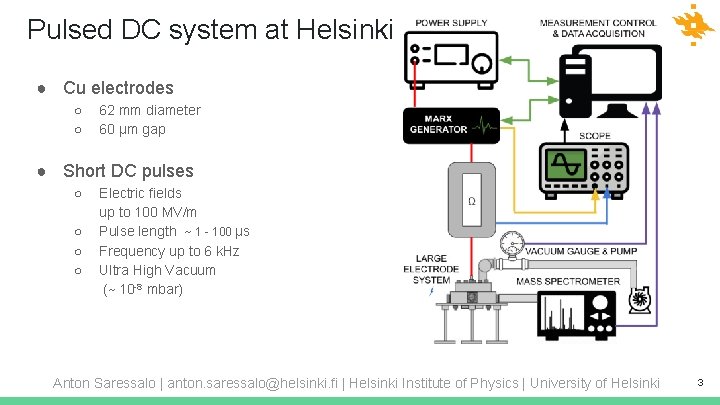
Pulsed DC system at Helsinki ● Cu electrodes ○ ○ 62 mm diameter 60 µm gap ● Short DC pulses ○ ○ Electric fields up to 100 MV/m Pulse length ~ 1 - 100 µs Frequency up to 6 k. Hz Ultra High Vacuum (~ 10 -8 mbar) Anton Saressalo | anton. saressalo@helsinki. fi | Helsinki Institute of Physics | University of Helsinki 3
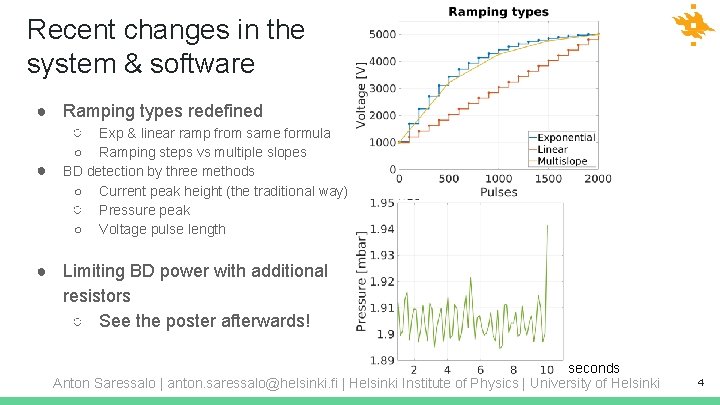
Recent changes in the system & software ● Ramping types redefined ○ Exp & linear ramp from same formula ● ○ Ramping steps vs multiple slopes BD detection by three methods ○ Current peak height (the traditional way) ○ Pressure peak ○ Voltage pulse length ● Limiting BD power with additional resistors ○ See the poster afterwards! seconds Anton Saressalo | anton. saressalo@helsinki. fi | Helsinki Institute of Physics | University of Helsinki 4
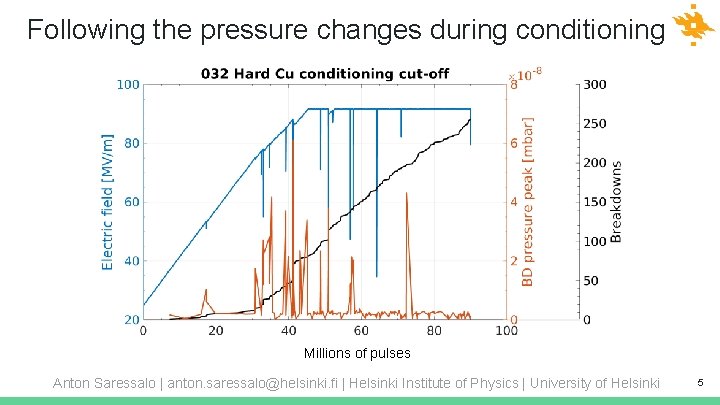
Following the pressure changes during conditioning Millions of pulses Anton Saressalo | anton. saressalo@helsinki. fi | Helsinki Institute of Physics | University of Helsinki 5
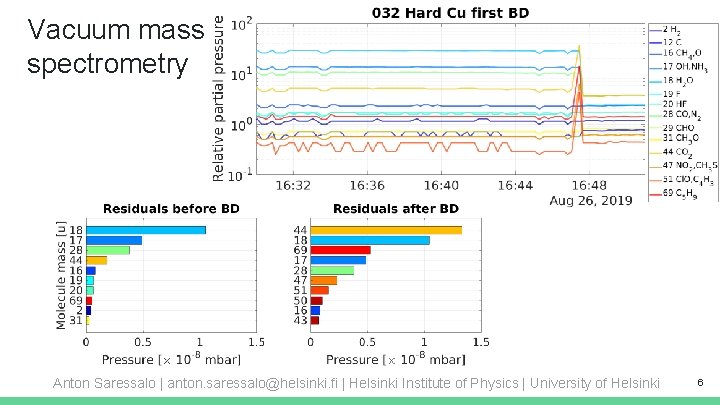
Vacuum mass spectrometry Anton Saressalo | anton. saressalo@helsinki. fi | Helsinki Institute of Physics | University of Helsinki 6

Plasma cleaning the electrode surfaces Aim ● Clean the electrode surface from contamination after exposure to air ● “Micro sandblasting” with Ar+ ions the best way to remove oxygen ○ Also called ion etching ○ Effects mostly on cathode Argon Oxygen UV © 2016 Diener electronic Gmb. H Anton Saressalo | anton. saressalo@helsinki. fi | Helsinki Institute of Physics | University of Helsinki 7

First plasma treatments 1. Let Argon into vacuum (from < 1 e-7 mbar to 5 e-6 mbar) ○ One of LES viewports connected to Argon bottle 2. Put on DC voltage 2500 -3000 V (constant voltage, no pulsing) 3. Cleaning time up to 10 minutes until the sparking fades (also the current diminishes) 4. Pumping back to vacuum after cleaning ○ No exposure to air in between! 5. Start conditioning/flat mode run Anton Saressalo | anton. saressalo@helsinki. fi | Helsinki Institute of Physics | University of Helsinki 8
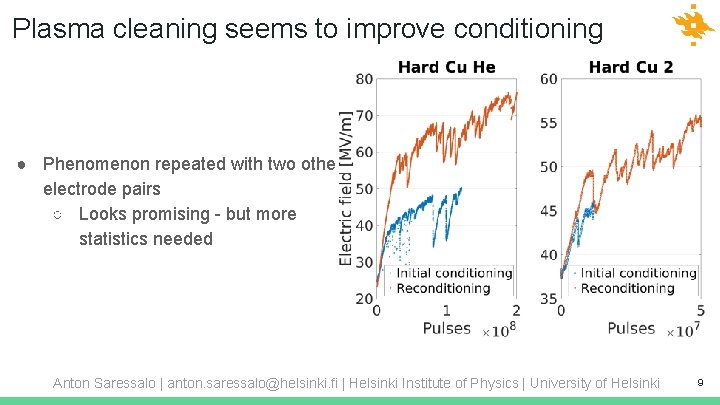
Plasma cleaning seems to improve conditioning ● Phenomenon repeated with two other electrode pairs ○ Looks promising - but more statistics needed Anton Saressalo | anton. saressalo@helsinki. fi | Helsinki Institute of Physics | University of Helsinki 9
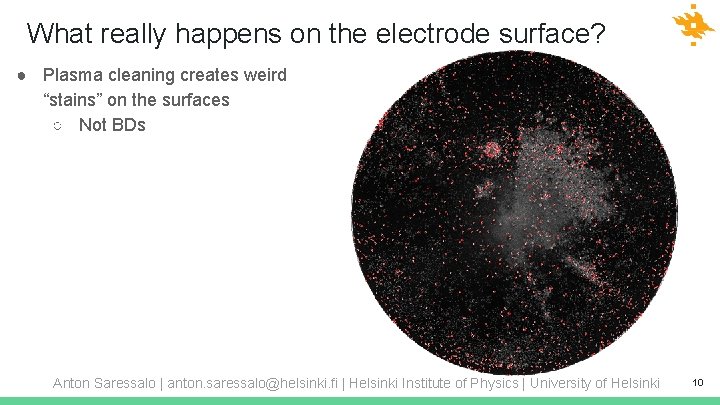
What really happens on the electrode surface? ● Plasma cleaning creates weird “stains” on the surfaces ○ Not BDs Anton Saressalo | anton. saressalo@helsinki. fi | Helsinki Institute of Physics | University of Helsinki 10
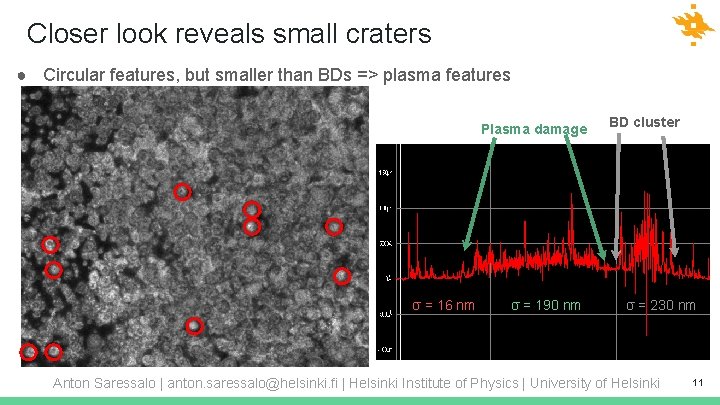
Closer look reveals small craters ● Circular features, but smaller than BDs => plasma features Plasma damage σ = 16 nm σ = 190 nm BD cluster σ = 230 nm Anton Saressalo | anton. saressalo@helsinki. fi | Helsinki Institute of Physics | University of Helsinki 11
Conclusions on the plasma experiments ● Experiment done incorrectly ○ ○ No cleaning effect visible Electrode surface damaged ● Conditions should be changed ○ ○ ○ Vacuum should be close to 1 mbar Enables smaller voltages Leads to smaller ion energies => smaller surface damage ● Question remains: Why did the conditioning curve still improve? Anton Saressalo | anton. saressalo@helsinki. fi | Helsinki Institute of Physics | University of Helsinki 12
Next steps ● Testing with different ramping types ○ Effect on the fraction of secondary BDs? ● Another take on the plasma cleaning ○ Understanding the surface chemistry ● More detailed look on limiting the BD power ○ Looks promising! See the poster. Anton Saressalo | anton. saressalo@helsinki. fi | Helsinki Institute of Physics | University of Helsinki 13
Conclusions ● Pressure & residual molecules now more closely followed with LES Helsinki ○ Pressure spikes in correlation with BD avalanches (ramping BDs) ● Plasma cleaning provides good results even when done incorrectly ○ More experimenting needed Anton Saressalo | anton. saressalo@helsinki. fi | Helsinki Institute of Physics | University of Helsinki 14
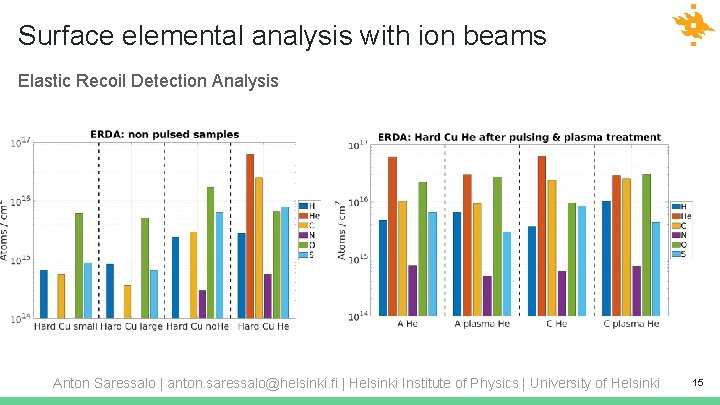
Surface elemental analysis with ion beams Elastic Recoil Detection Analysis Anton Saressalo | anton. saressalo@helsinki. fi | Helsinki Institute of Physics | University of Helsinki 15
- Slides: 15