
PLASMA ATOMIC LAYER ETCHING USING CONVENTIONAL PLASMA EQUIPMENT
- Slides: 24
PLASMA ATOMIC LAYER ETCHING USING CONVENTIONAL PLASMA EQUIPMENT* Ankur Agarwala) and Mark J. Kushnerb) a)Department of Chemical and Biomolecular Engineering University of Illinois, Urbana, IL 61801, USA aagarwl 3@uiuc. edu b)Department of Electrical and Computer Engineering Iowa State University, Ames, IA 50011, USA mjk@iastate. edu http: //uigelz. ece. iastate. edu 53 rd AVS Symposium, November 2006 *Work supported by the SRC and NSF
AGENDA · Atomic Layer Processing · Plasma Atomic Layer Etching (PALE) · Approach and Methodology · Demonstration Systems · Results · PALE of Si using Ar/Cl 2 · PALE of Si. O 2 using Ar/c-C 4 F 8 · PALE of Self-aligned contacts · Concluding Remarks ANKUR_AVS 06 AL_Agenda Iowa State University Optical and Discharge Physics
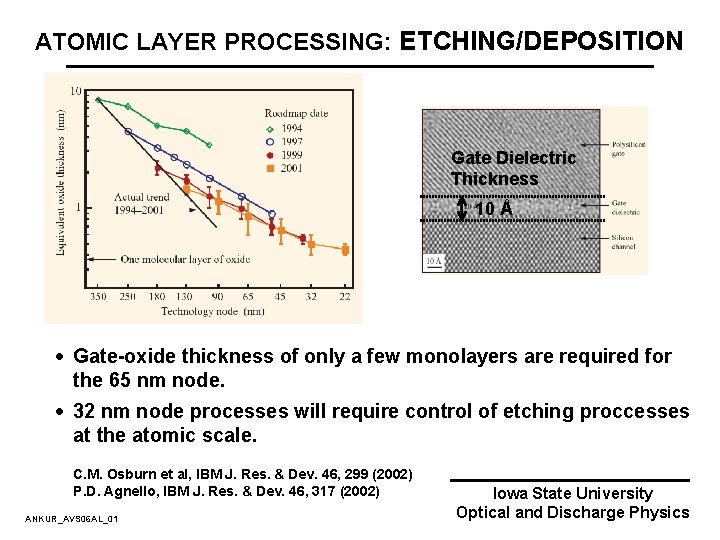
ATOMIC LAYER PROCESSING: ETCHING/DEPOSITION Gate Dielectric Thickness 10 Å · Gate-oxide thickness of only a few monolayers are required for the 65 nm node. · 32 nm node processes will require control of etching proccesses at the atomic scale. C. M. Osburn et al, IBM J. Res. & Dev. 46, 299 (2002) P. D. Agnello, IBM J. Res. & Dev. 46, 317 (2002) ANKUR_AVS 06 AL_01 Iowa State University Optical and Discharge Physics
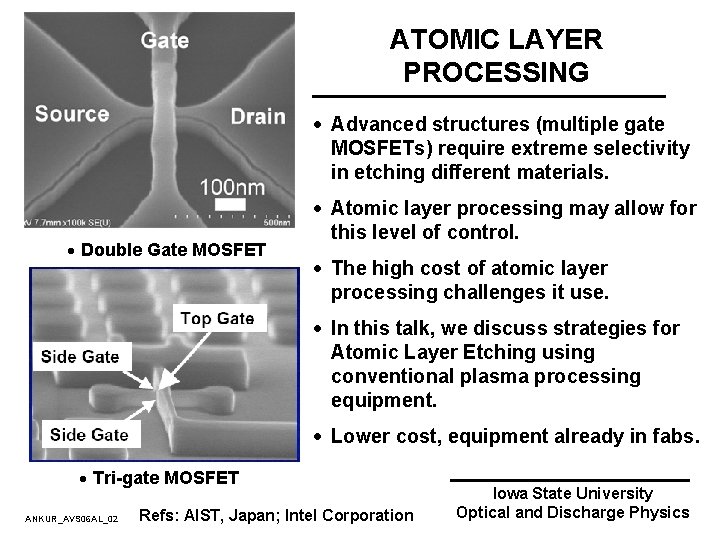
ATOMIC LAYER PROCESSING · Advanced structures (multiple gate MOSFETs) require extreme selectivity in etching different materials. · Double Gate MOSFET · Atomic layer processing may allow for this level of control. · The high cost of atomic layer processing challenges it use. · In this talk, we discuss strategies for Atomic Layer Etching using conventional plasma processing equipment. · Lower cost, equipment already in fabs. · Tri-gate MOSFET ANKUR_AVS 06 AL_02 Refs: AIST, Japan; Intel Corporation Iowa State University Optical and Discharge Physics
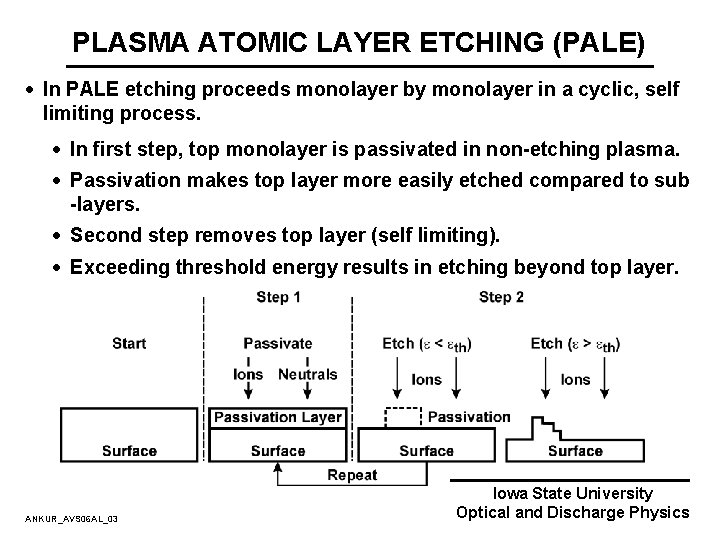
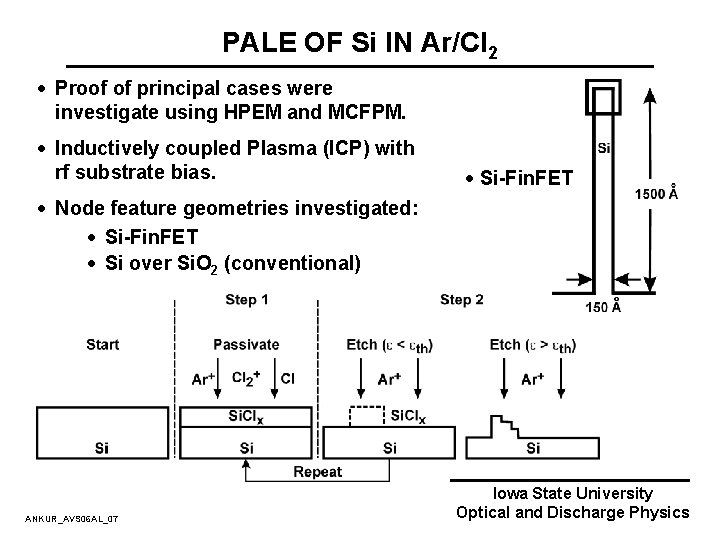
PLASMA ATOMIC LAYER ETCHING (PALE) · In PALE etching proceeds monolayer by monolayer in a cyclic, self limiting process. · In first step, top monolayer is passivated in non-etching plasma. · Passivation makes top layer more easily etched compared to sub -layers. · Second step removes top layer (self limiting). · Exceeding threshold energy results in etching beyond top layer. ANKUR_AVS 06 AL_03 Iowa State University Optical and Discharge Physics
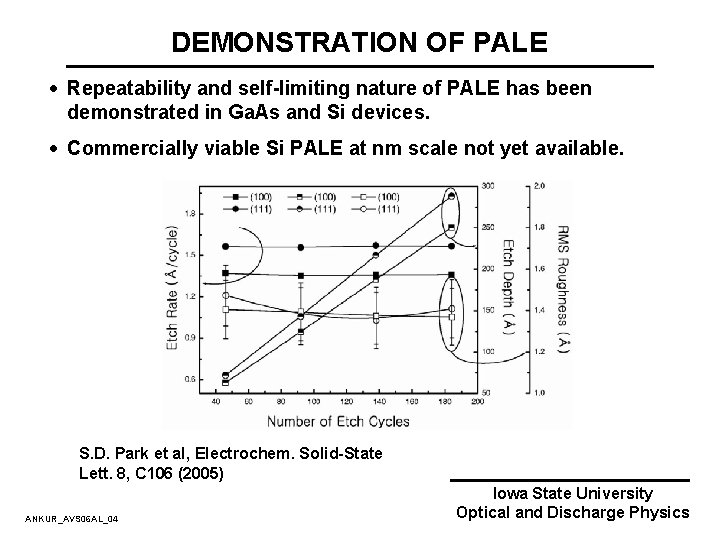
DEMONSTRATION OF PALE · Repeatability and self-limiting nature of PALE has been demonstrated in Ga. As and Si devices. · Commercially viable Si PALE at nm scale not yet available. S. D. Park et al, Electrochem. Solid-State Lett. 8, C 106 (2005) ANKUR_AVS 06 AL_04 Iowa State University Optical and Discharge Physics
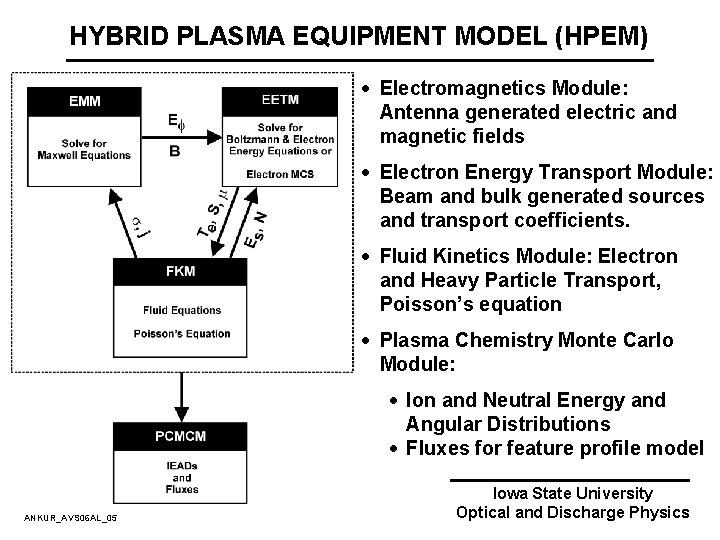
HYBRID PLASMA EQUIPMENT MODEL (HPEM) · Electromagnetics Module: Antenna generated electric and magnetic fields · Electron Energy Transport Module: Beam and bulk generated sources and transport coefficients. · Fluid Kinetics Module: Electron and Heavy Particle Transport, Poisson’s equation · Plasma Chemistry Monte Carlo Module: · Ion and Neutral Energy and Angular Distributions · Fluxes for feature profile model ANKUR_AVS 06 AL_05 Iowa State University Optical and Discharge Physics
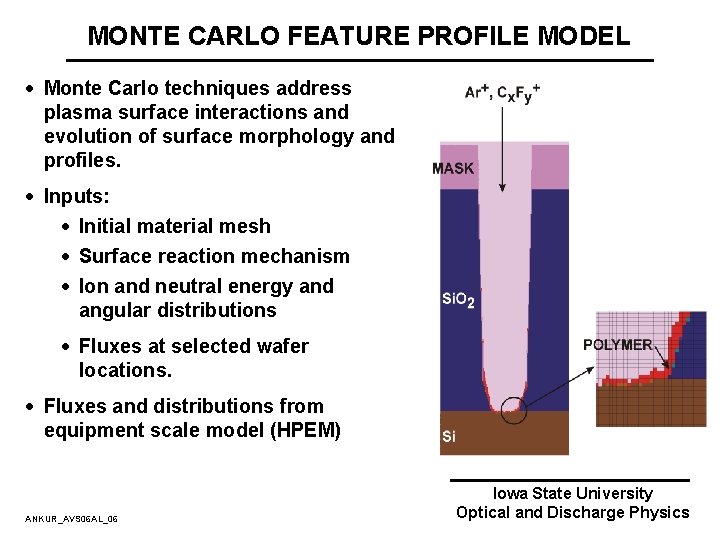
MONTE CARLO FEATURE PROFILE MODEL · Monte Carlo techniques address plasma surface interactions and evolution of surface morphology and profiles. · Inputs: · Initial material mesh · Surface reaction mechanism · Ion and neutral energy and angular distributions · Fluxes at selected wafer locations. · Fluxes and distributions from equipment scale model (HPEM) ANKUR_AVS 06 AL_06 Iowa State University Optical and Discharge Physics
PALE OF Si IN Ar/Cl 2 · Proof of principal cases were investigate using HPEM and MCFPM. · Inductively coupled Plasma (ICP) with rf substrate bias. · Si-Fin. FET · Node feature geometries investigated: · Si-Fin. FET · Si over Si. O 2 (conventional) ANKUR_AVS 06 AL_07 Iowa State University Optical and Discharge Physics
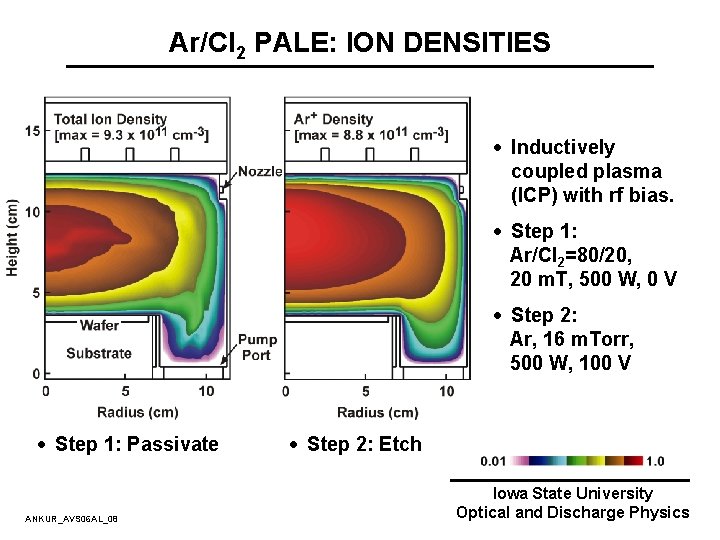
Ar/Cl 2 PALE: ION DENSITIES · Inductively coupled plasma (ICP) with rf bias. · Step 1: Ar/Cl 2=80/20, 20 m. T, 500 W, 0 V · Step 2: Ar, 16 m. Torr, 500 W, 100 V · Step 1: Passivate ANKUR_AVS 06 AL_08 · Step 2: Etch Iowa State University Optical and Discharge Physics
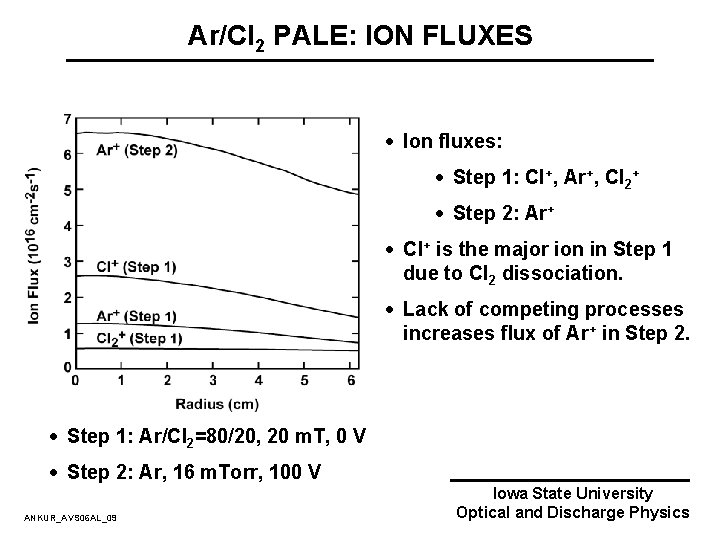
Ar/Cl 2 PALE: ION FLUXES · Ion fluxes: · Step 1: Cl+, Ar+, Cl 2+ · Step 2: Ar+ · Cl+ is the major ion in Step 1 due to Cl 2 dissociation. · Lack of competing processes increases flux of Ar+ in Step 2. · Step 1: Ar/Cl 2=80/20, 20 m. T, 0 V · Step 2: Ar, 16 m. Torr, 100 V ANKUR_AVS 06 AL_09 Iowa State University Optical and Discharge Physics
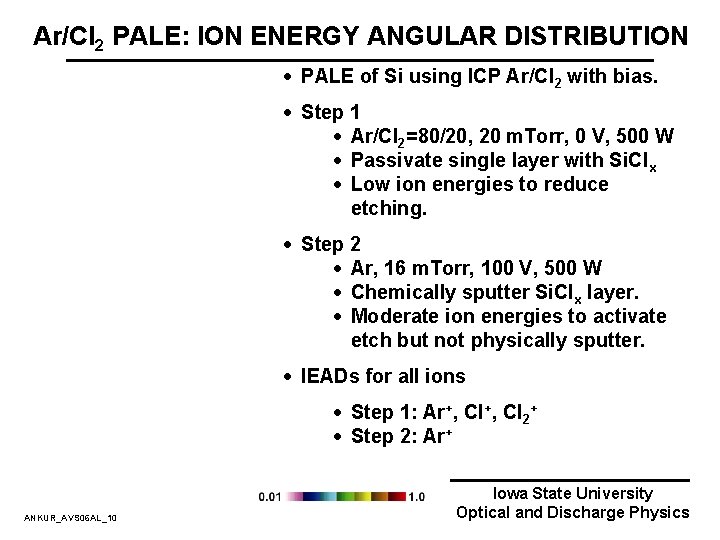
Ar/Cl 2 PALE: ION ENERGY ANGULAR DISTRIBUTION · PALE of Si using ICP Ar/Cl 2 with bias. · Step 1 · Ar/Cl 2=80/20, 20 m. Torr, 0 V, 500 W · Passivate single layer with Si. Clx · Low ion energies to reduce etching. · Step 2 · Ar, 16 m. Torr, 100 V, 500 W · Chemically sputter Si. Clx layer. · Moderate ion energies to activate etch but not physically sputter. · IEADs for all ions · Step 1: Ar+, Cl 2+ · Step 2: Ar+ ANKUR_AVS 06 AL_10 Iowa State University Optical and Discharge Physics
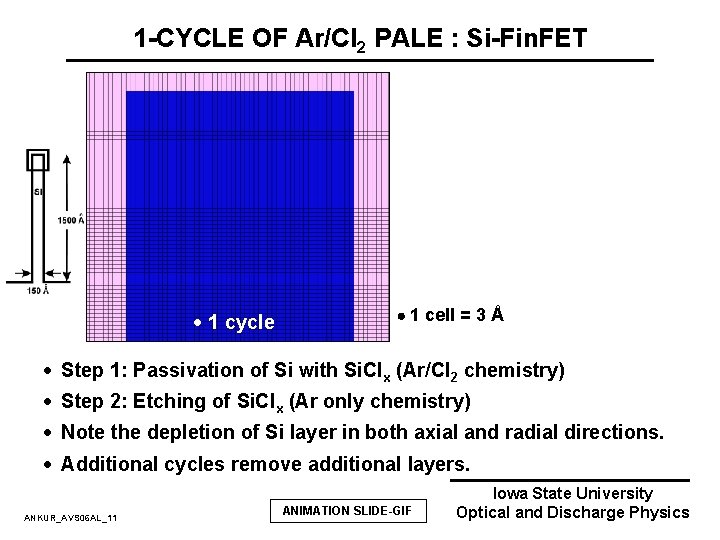
1 -CYCLE OF Ar/Cl 2 PALE : Si-Fin. FET · 1 cycle 1 cell = 3 Å · Step 1: Passivation of Si with Si. Clx (Ar/Cl 2 chemistry) · Step 2: Etching of Si. Clx (Ar only chemistry) · Note the depletion of Si layer in both axial and radial directions. · Additional cycles remove additional layers. ANKUR_AVS 06 AL_11 ANIMATION SLIDE-GIF Iowa State University Optical and Discharge Physics
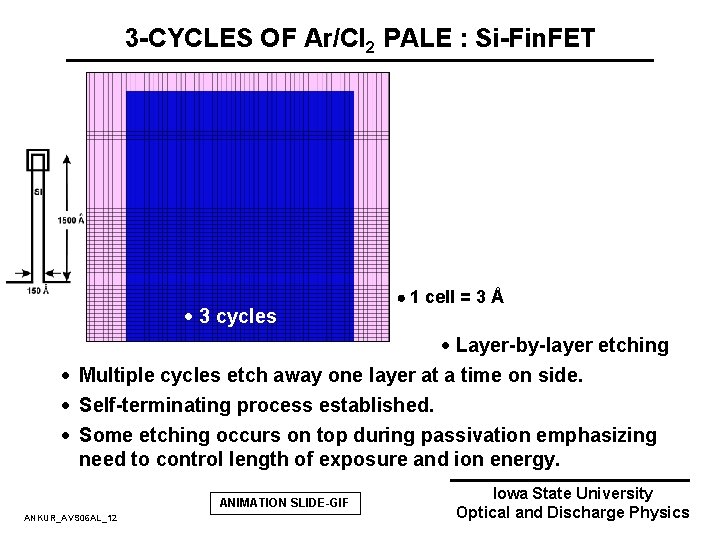
3 -CYCLES OF Ar/Cl 2 PALE : Si-Fin. FET · 3 cycles 1 cell = 3 Å · Layer-by-layer etching · Multiple cycles etch away one layer at a time on side. · Self-terminating process established. · Some etching occurs on top during passivation emphasizing need to control length of exposure and ion energy. ANIMATION SLIDE-GIF ANKUR_AVS 06 AL_12 Iowa State University Optical and Discharge Physics
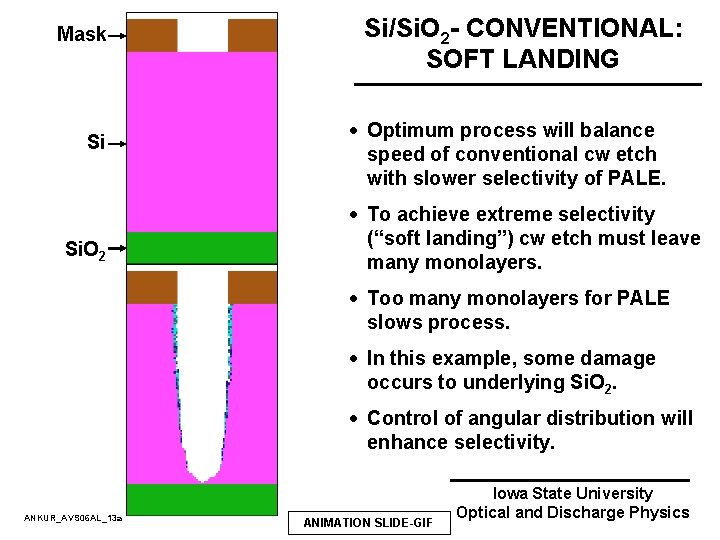
Mask Si Si. O 2 Si/Si. O 2 - CONVENTIONAL: SOFT LANDING · Optimum process will balance speed of conventional cw etch with slower selectivity of PALE. · To achieve extreme selectivity (“soft landing”) cw etch must leave many monolayers. · Too many monolayers for PALE slows process. · In this example, some damage occurs to underlying Si. O 2. · Control of angular distribution will enhance selectivity. ANKUR_AVS 06 AL_13 a ANIMATION SLIDE-GIF Iowa State University Optical and Discharge Physics
Si/Si. O 2 - CONVENTIONAL: SOFT LANDING · Optimum process will balance speed of conventional cw etch with slower selectivity of PALE. · To achieve extreme selectivity (“soft landing”) cw etch must leave many monolayers. · Too many monolayers for PALE slows process. · In this example, some damage occurs to underlying Si. O 2. · Control of angular distribution will enhance selectivity. Aspect Ratio = 1: 5 ANKUR_AVS 06 AL_13 b Iowa State University Optical and Discharge Physics
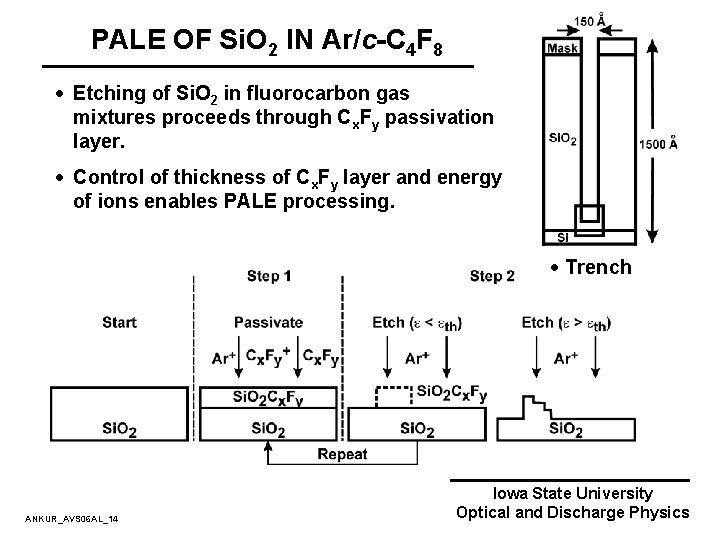
PALE OF Si. O 2 IN Ar/c-C 4 F 8 · Etching of Si. O 2 in fluorocarbon gas mixtures proceeds through Cx. Fy passivation layer. · Control of thickness of Cx. Fy layer and energy of ions enables PALE processing. · Trench ANKUR_AVS 06 AL_14 Iowa State University Optical and Discharge Physics
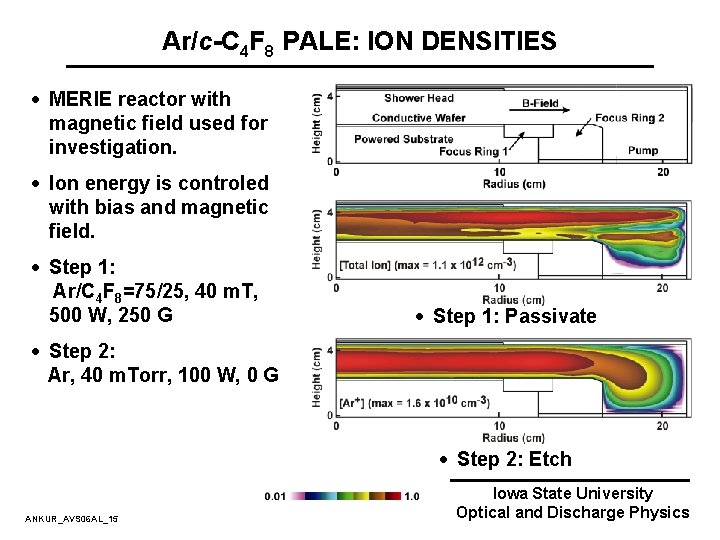
Ar/c-C 4 F 8 PALE: ION DENSITIES · MERIE reactor with magnetic field used for investigation. · Ion energy is controled with bias and magnetic field. · Step 1: Ar/C 4 F 8=75/25, 40 m. T, 500 W, 250 G · Step 1: Passivate · Step 2: Ar, 40 m. Torr, 100 W, 0 G · Step 2: Etch ANKUR_AVS 06 AL_15 Iowa State University Optical and Discharge Physics
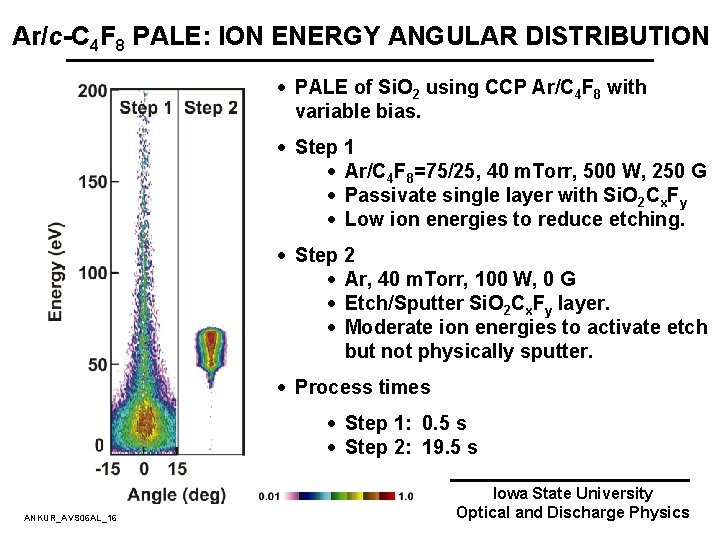
Ar/c-C 4 F 8 PALE: ION ENERGY ANGULAR DISTRIBUTION · PALE of Si. O 2 using CCP Ar/C 4 F 8 with variable bias. · Step 1 · Ar/C 4 F 8=75/25, 40 m. Torr, 500 W, 250 G · Passivate single layer with Si. O 2 Cx. Fy · Low ion energies to reduce etching. · Step 2 · Ar, 40 m. Torr, 100 W, 0 G · Etch/Sputter Si. O 2 Cx. Fy layer. · Moderate ion energies to activate etch but not physically sputter. · Process times · Step 1: 0. 5 s · Step 2: 19. 5 s ANKUR_AVS 06 AL_16 Iowa State University Optical and Discharge Physics
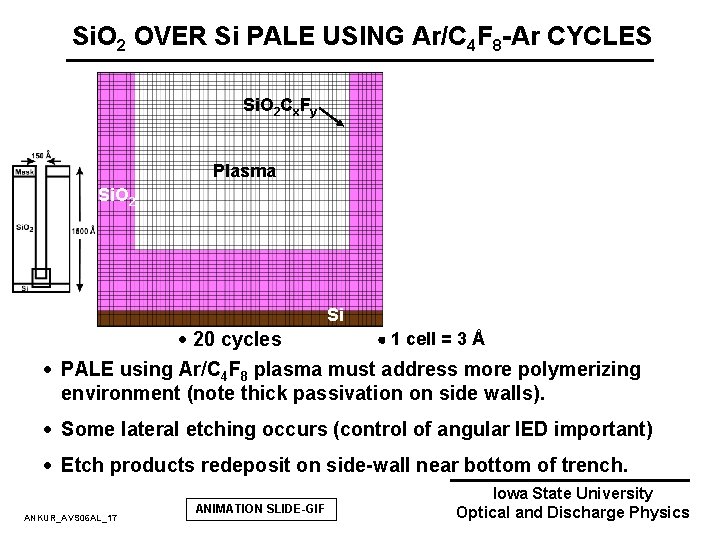
Si. O 2 OVER Si PALE USING Ar/C 4 F 8 -Ar CYCLES Si. O 2 Cx. Fy Plasma Si. O 2 Si 1 cell = 3 Å · 20 cycles · PALE using Ar/C 4 F 8 plasma must address more polymerizing environment (note thick passivation on side walls). · Some lateral etching occurs (control of angular IED important) · Etch products redeposit on side-wall near bottom of trench. ANKUR_AVS 06 AL_17 ANIMATION SLIDE-GIF Iowa State University Optical and Discharge Physics
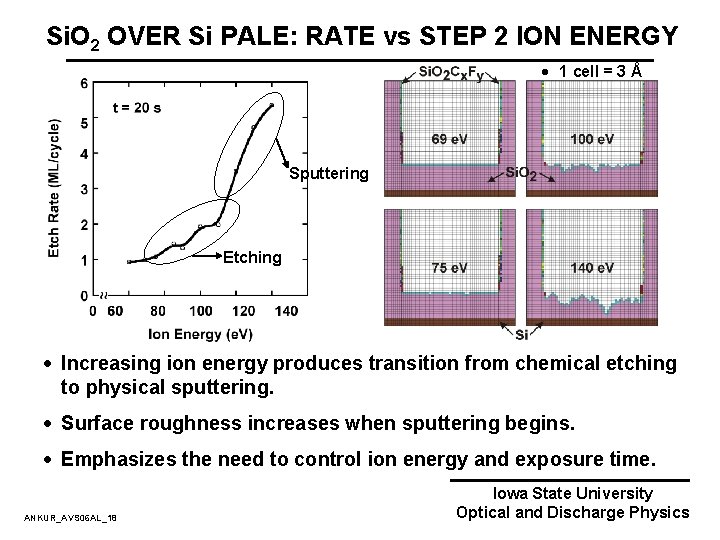
Si. O 2 OVER Si PALE: RATE vs STEP 2 ION ENERGY · 1 cell = 3 Å Sputtering Etching · Increasing ion energy produces transition from chemical etching to physical sputtering. · Surface roughness increases when sputtering begins. · Emphasizes the need to control ion energy and exposure time. ANKUR_AVS 06 AL_18 Iowa State University Optical and Discharge Physics
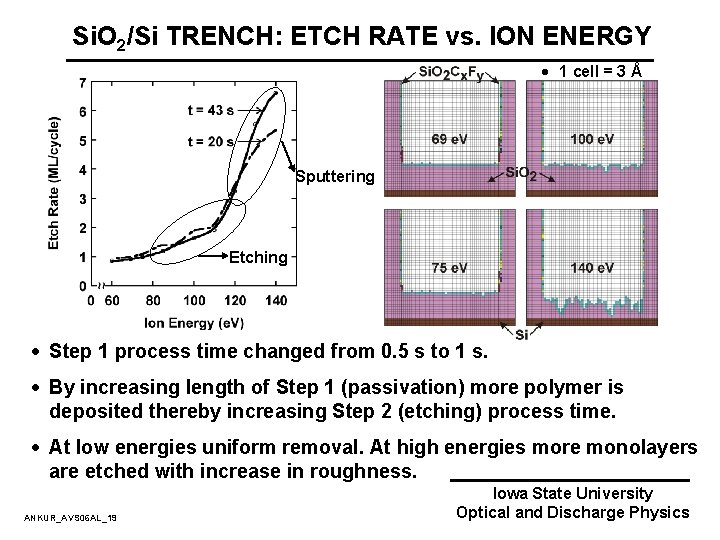
Si. O 2/Si TRENCH: ETCH RATE vs. ION ENERGY · 1 cell = 3 Å Sputtering Etching · Step 1 process time changed from 0. 5 s to 1 s. · By increasing length of Step 1 (passivation) more polymer is deposited thereby increasing Step 2 (etching) process time. · At low energies uniform removal. At high energies more monolayers are etched with increase in roughness. ANKUR_AVS 06 AL_19 Iowa State University Optical and Discharge Physics
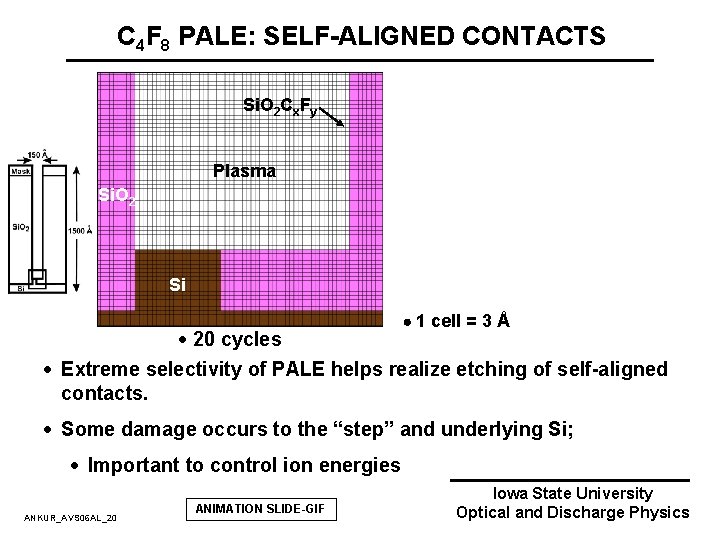
C 4 F 8 PALE: SELF-ALIGNED CONTACTS Si. O 2 Cx. Fy Plasma Si. O 2 Si 1 cell = 3 Å · 20 cycles · Extreme selectivity of PALE helps realize etching of self-aligned contacts. · Some damage occurs to the “step” and underlying Si; · Important to control ion energies ANKUR_AVS 06 AL_20 ANIMATION SLIDE-GIF Iowa State University Optical and Discharge Physics
CONCLUDING REMARKS · Atomic layer control of etch processes will be critical for 32 nm node devices. · PALE using conventional plasma equipment makes for an more economic processes. · Proof of principle calculations demonstrate Si-Fin. FET and Si/Si. O 2 deep trenches can be atomically etched in selfterminating Ar/Cl 2 mixtures. · Si. O 2/Si deep trenches can be atomically etched in selfterminating Ar/C 4 F 8 mixtures. · Control of angular distribution is critical to removing redeposited etch products on sidewalls. · Passivation step may induce unwanted etching: · Control length of exposure · Control ion energy ANKUR_AVS 06 AL_21 Iowa State University Optical and Discharge Physics