
Plasma Astrophysics Chapter 3 Kinetic Theory Yosuke Mizuno



- Slides: 24
Plasma Astrophysics Chapter 3: Kinetic Theory Yosuke Mizuno Institute of Astronomy National Tsing-Hua University
Kinetic Theory • Single particle description: tenuous plasma with strong external fields, important for gaining insight into physical processes involved • For a system with a large number of particles it is neither possible nor desirable to determine the motion of every single particle => statistical approaches, average macroscopic properties • Kinetic theory averages out microscopic information to obtain statistical, kinetic equations. No knowledge of individual particle motion is required to describe observable phenomena.
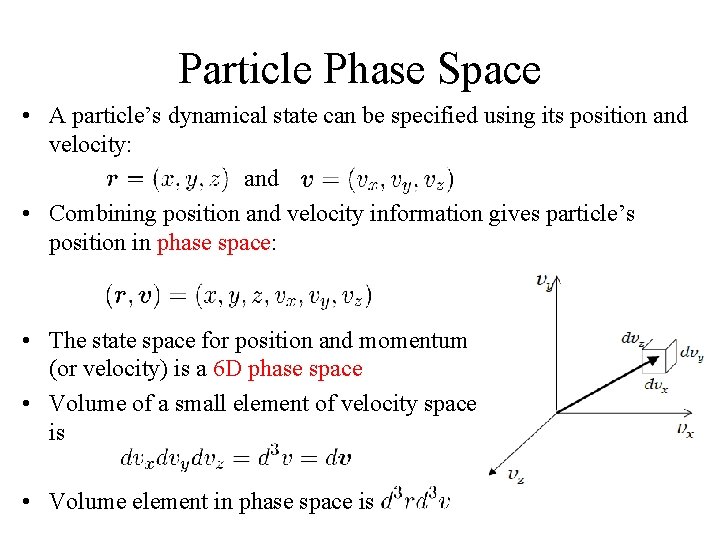
Particle Phase Space • A particle’s dynamical state can be specified using its position and velocity: and • Combining position and velocity information gives particle’s position in phase space: • The state space for position and momentum (or velocity) is a 6 D phase space • Volume of a small element of velocity space is • Volume element in phase space is
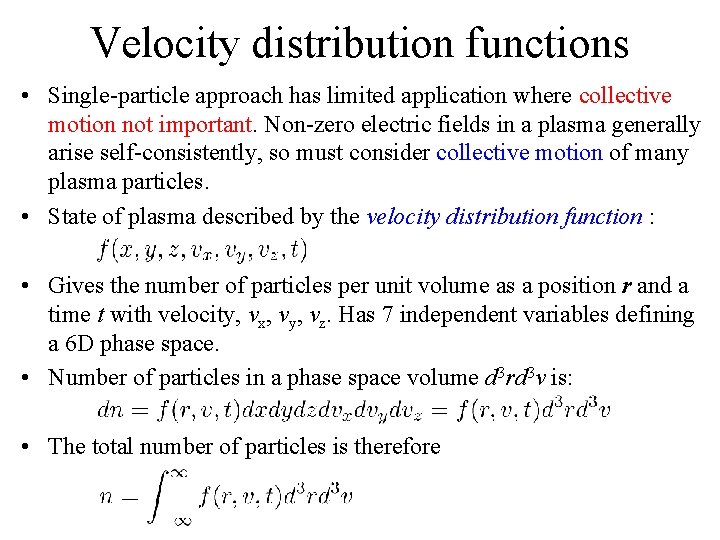
Velocity distribution functions • Single-particle approach has limited application where collective motion not important. Non-zero electric fields in a plasma generally arise self-consistently, so must consider collective motion of many plasma particles. • State of plasma described by the velocity distribution function : • Gives the number of particles per unit volume as a position r and a time t with velocity, vx, vy, vz. Has 7 independent variables defining a 6 D phase space. • Number of particles in a phase space volume d 3 rd 3 v is: • The total number of particles is therefore
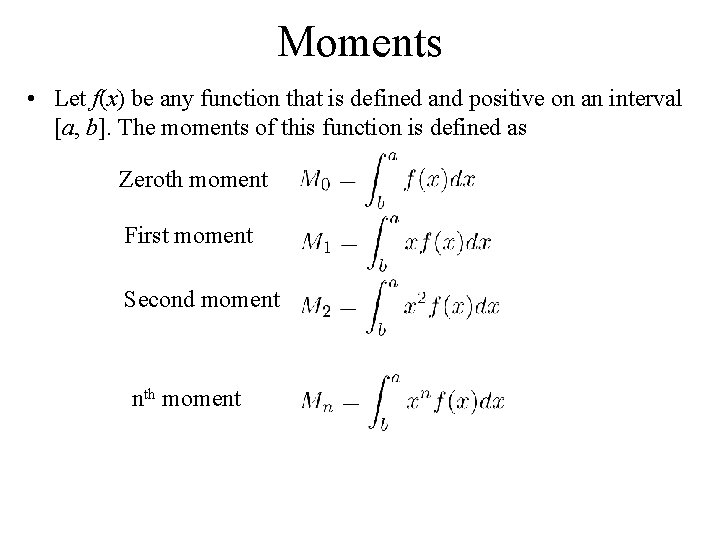
Moments • Let f(x) be any function that is defined and positive on an interval [a, b]. The moments of this function is defined as Zeroth moment First moment Second moment nth moment
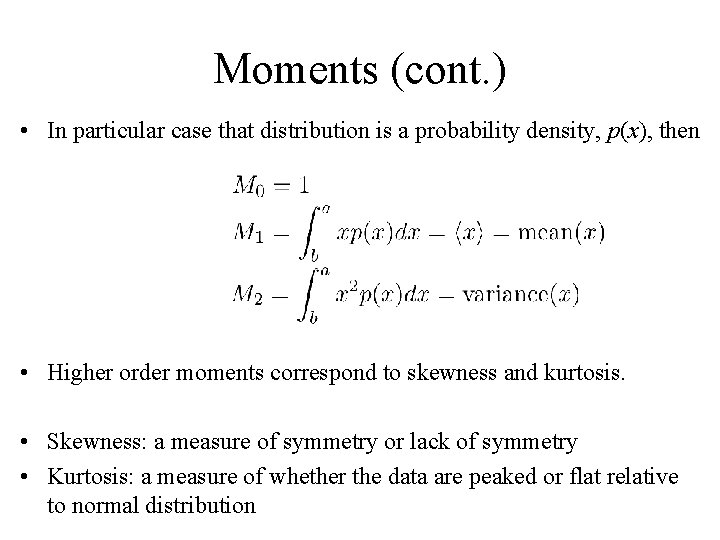
Moments (cont. ) • In particular case that distribution is a probability density, p(x), then • Higher order moments correspond to skewness and kurtosis. • Skewness: a measure of symmetry or lack of symmetry • Kurtosis: a measure of whether the data are peaked or flat relative to normal distribution
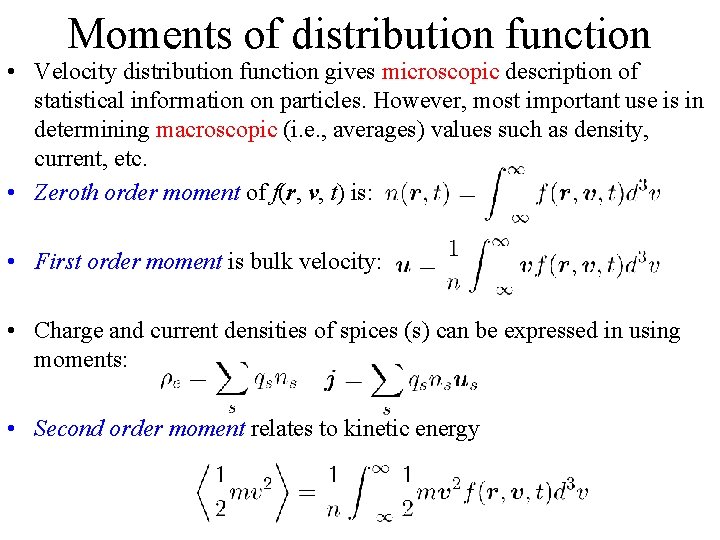
Moments of distribution function • Velocity distribution function gives microscopic description of statistical information on particles. However, most important use is in determining macroscopic (i. e. , averages) values such as density, current, etc. • Zeroth order moment of f(r, v, t) is: • First order moment is bulk velocity: • Charge and current densities of spices (s) can be expressed in using moments: • Second order moment relates to kinetic energy
Derivation of Boltzmann Equation • Evolution of f(r, v, t) is described by the Boltzmann Equation. • Consider particles entering and leaving a small volume of space. Since r and v is independent, can treat separately. • Position: Number of particles leaving d 3 r per second through its surface d. S is • Velocity: Number of particles leaving d 3 v per second through its surface d. Sv is • So the net number of particles leaving the phase space volume d 3 rd 3 v is
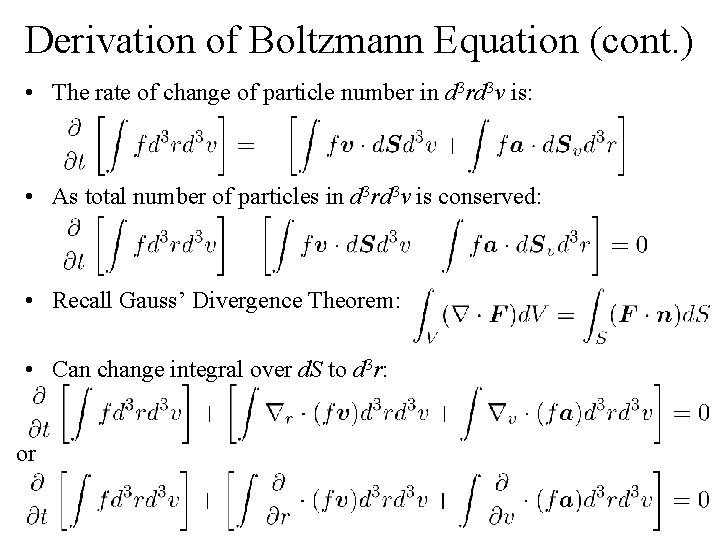
Derivation of Boltzmann Equation (cont. ) • The rate of change of particle number in d 3 rd 3 v is: • As total number of particles in d 3 rd 3 v is conserved: • Recall Gauss’ Divergence Theorem: • Can change integral over d. S to d 3 r: or
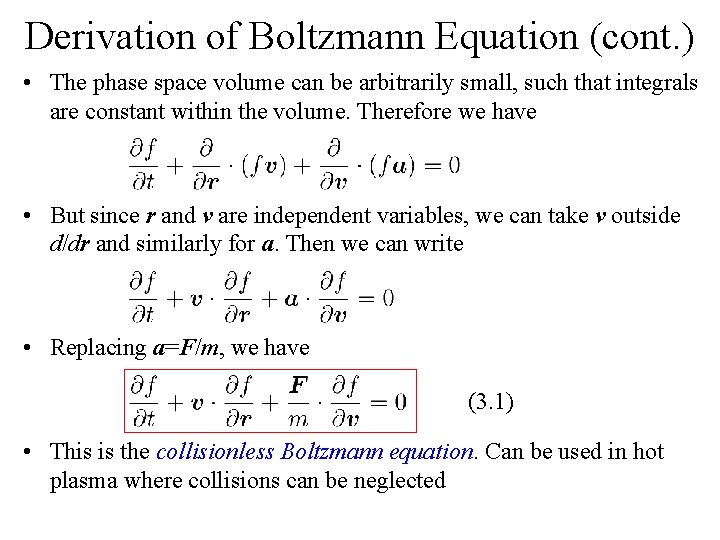
Derivation of Boltzmann Equation (cont. ) • The phase space volume can be arbitrarily small, such that integrals are constant within the volume. Therefore we have • But since r and v are independent variables, we can take v outside d/dr and similarly for a. Then we can write • Replacing a=F/m, we have (3. 1) • This is the collisionless Boltzmann equation. Can be used in hot plasma where collisions can be neglected
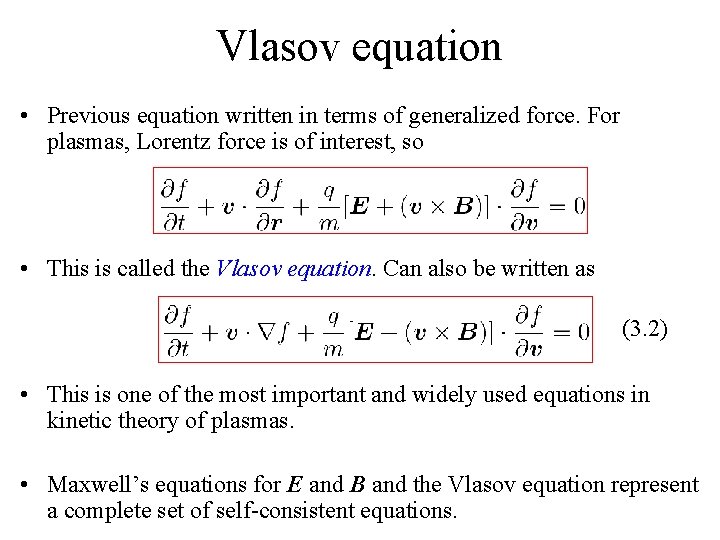
Vlasov equation • Previous equation written in terms of generalized force. For plasmas, Lorentz force is of interest, so • This is called the Vlasov equation. Can also be written as (3. 2) • This is one of the most important and widely used equations in kinetic theory of plasmas. • Maxwell’s equations for E and B and the Vlasov equation represent a complete set of self-consistent equations.
Convective derivative in phase space • Distribution function f(r, v, t) depends on 7 independent variables. Total time derivative of f is: • This can be written as • To appreciate meaning of this equation, consider f=f(r, t): • Called the convective derivative or Lagrangian derivative. Second term gives change in f measured by an observed moving in the fluid frame.
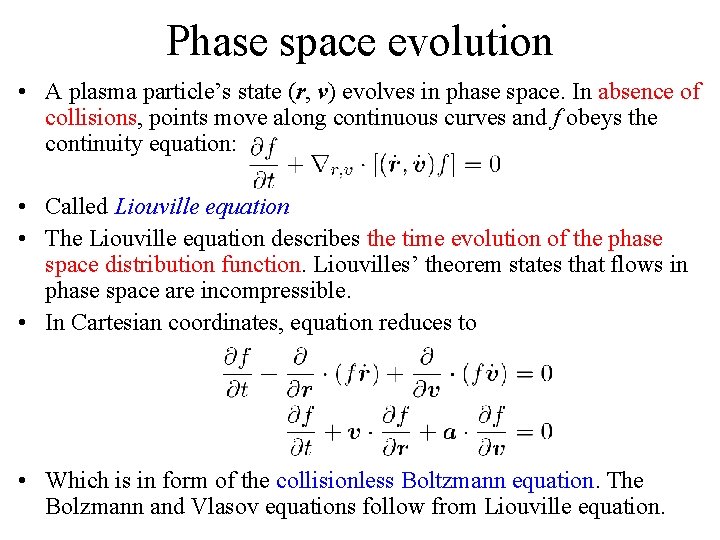
Phase space evolution • A plasma particle’s state (r, v) evolves in phase space. In absence of collisions, points move along continuous curves and f obeys the continuity equation: • Called Liouville equation • The Liouville equation describes the time evolution of the phase space distribution function. Liouvilles’ theorem states that flows in phase space are incompressible. • In Cartesian coordinates, equation reduces to • Which is in form of the collisionless Boltzmann equation. The Bolzmann and Vlasov equations follow from Liouville equation.
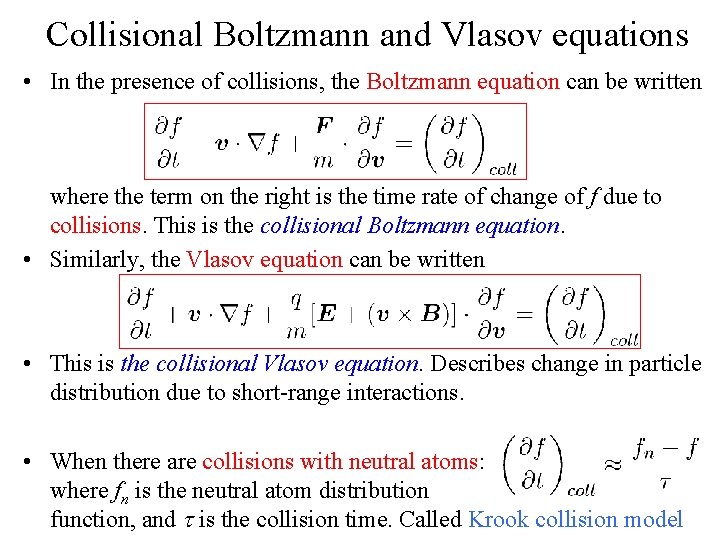
Collisional Boltzmann and Vlasov equations • In the presence of collisions, the Boltzmann equation can be written where the term on the right is the time rate of change of f due to collisions. This is the collisional Boltzmann equation. • Similarly, the Vlasov equation can be written • This is the collisional Vlasov equation. Describes change in particle distribution due to short-range interactions. • When there are collisions with neutral atoms: where fn is the neutral atom distribution function, and t is the collision time. Called Krook collision model
Kinetic description of plasma • Kinetic description of plasma is highly applicable treatment for collisionless plasma (wave-particle interaction, collision-less shock, particle acceleration) • But evaluation of a 6 D distribution function is difficult: analytical solutions of a kinetic equation are rare and numerical are expensive. • Astrophysical application: – – – Dark matter evolution in cosmological simulation Neutrino transport in core-collapse supernova simulation Stellar interior (equation of state) Collisionless shock (supernova blast wave) Particle acceleration (astrophysical shock)
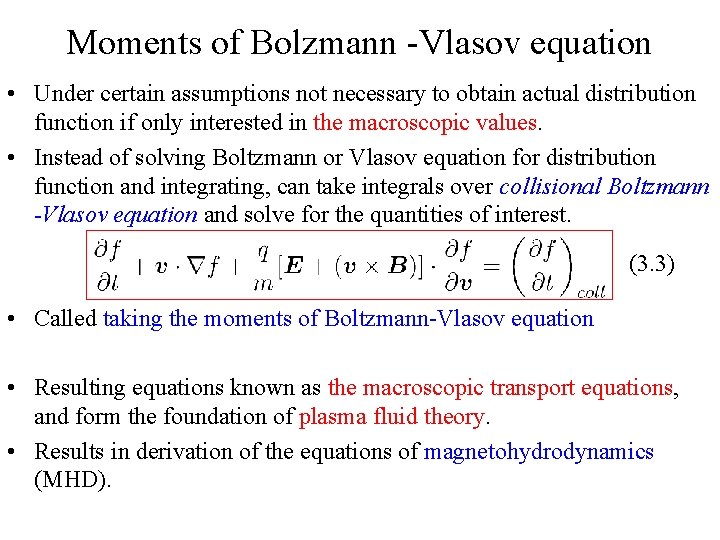
Moments of Bolzmann -Vlasov equation • Under certain assumptions not necessary to obtain actual distribution function if only interested in the macroscopic values. • Instead of solving Boltzmann or Vlasov equation for distribution function and integrating, can take integrals over collisional Boltzmann -Vlasov equation and solve for the quantities of interest. (3. 3) • Called taking the moments of Boltzmann-Vlasov equation • Resulting equations known as the macroscopic transport equations, and form the foundation of plasma fluid theory. • Results in derivation of the equations of magnetohydrodynamics (MHD).
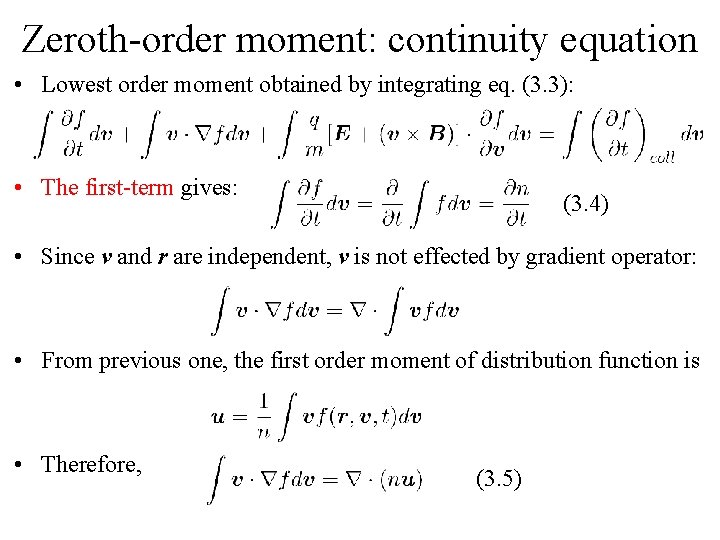
Zeroth-order moment: continuity equation • Lowest order moment obtained by integrating eq. (3. 3): • The first-term gives: (3. 4) • Since v and r are independent, v is not effected by gradient operator: • From previous one, the first order moment of distribution function is • Therefore, (3. 5)
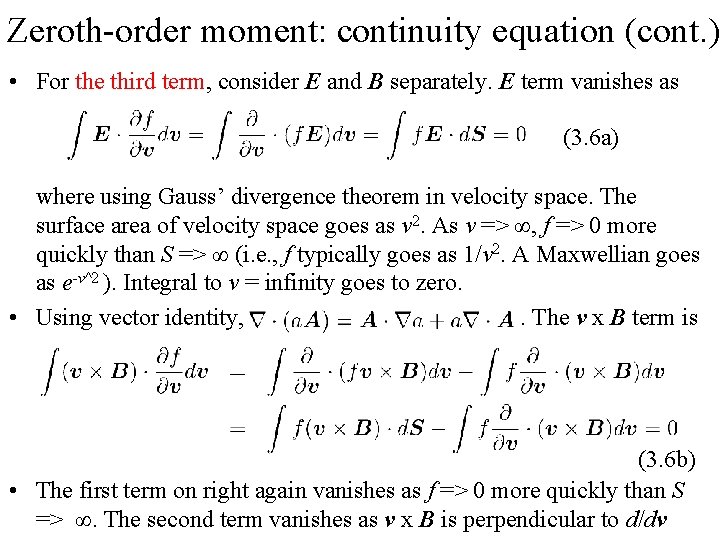
Zeroth-order moment: continuity equation (cont. ) • For the third term, consider E and B separately. E term vanishes as (3. 6 a) where using Gauss’ divergence theorem in velocity space. The surface area of velocity space goes as v 2. As v => ∞, f => 0 more quickly than S => ∞ (i. e. , f typically goes as 1/v 2. A Maxwellian goes as e-v^2 ). Integral to v = infinity goes to zero. • Using vector identity, . The v x B term is (3. 6 b) • The first term on right again vanishes as f => 0 more quickly than S => ∞. The second term vanishes as v x B is perpendicular to d/dv
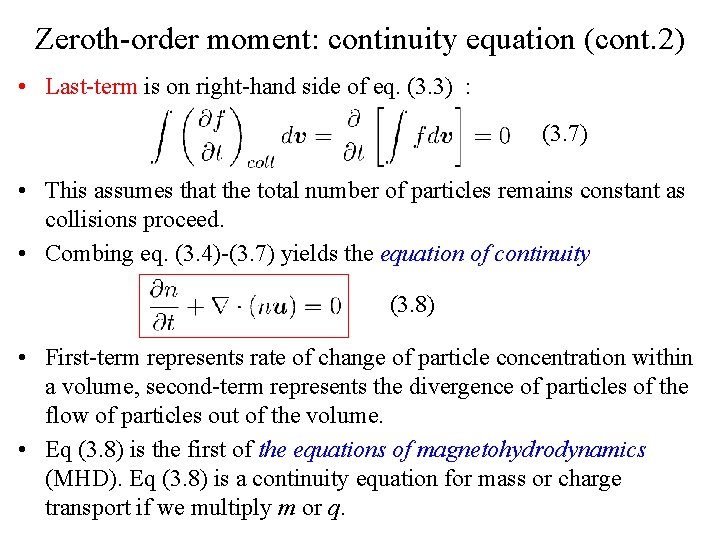
Zeroth-order moment: continuity equation (cont. 2) • Last-term is on right-hand side of eq. (3. 3) : (3. 7) • This assumes that the total number of particles remains constant as collisions proceed. • Combing eq. (3. 4)-(3. 7) yields the equation of continuity (3. 8) • First-term represents rate of change of particle concentration within a volume, second-term represents the divergence of particles of the flow of particles out of the volume. • Eq (3. 8) is the first of the equations of magnetohydrodynamics (MHD). Eq (3. 8) is a continuity equation for mass or charge transport if we multiply m or q.
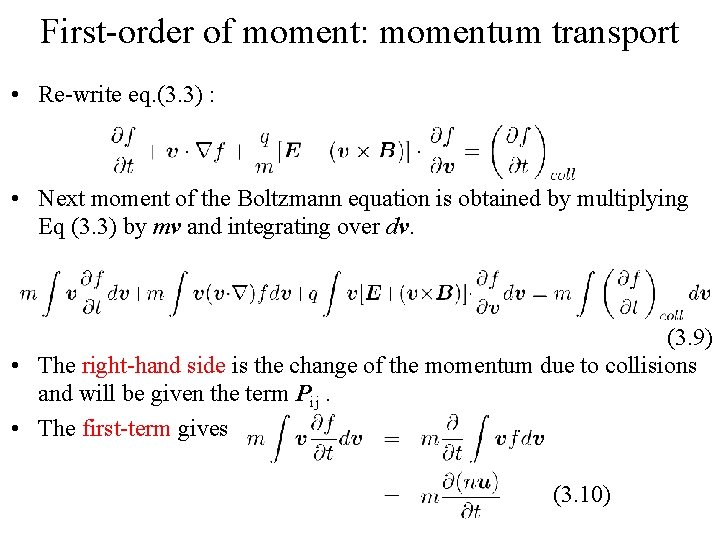
First-order of moment: momentum transport • Re-write eq. (3. 3) : • Next moment of the Boltzmann equation is obtained by multiplying Eq (3. 3) by mv and integrating over dv. (3. 9) • The right-hand side is the change of the momentum due to collisions and will be given the term Pij. • The first-term gives (3. 10)
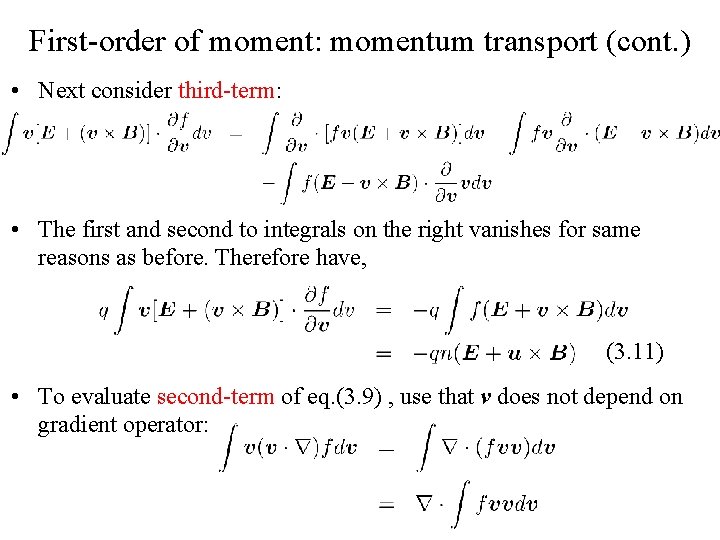
First-order of moment: momentum transport (cont. ) • Next consider third-term: • The first and second to integrals on the right vanishes for same reasons as before. Therefore have, (3. 11) • To evaluate second-term of eq. (3. 9) , use that v does not depend on gradient operator:
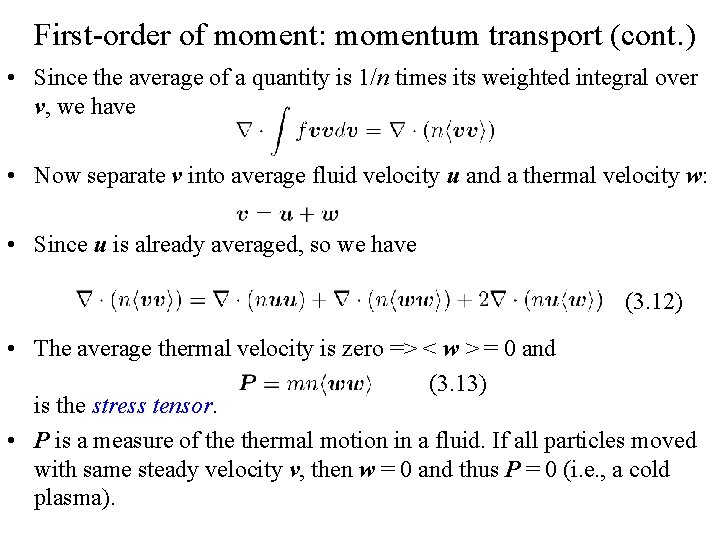
First-order of moment: momentum transport (cont. ) • Since the average of a quantity is 1/n times its weighted integral over v, we have • Now separate v into average fluid velocity u and a thermal velocity w: • Since u is already averaged, so we have (3. 12) • The average thermal velocity is zero => < w > = 0 and (3. 13) is the stress tensor. • P is a measure of thermal motion in a fluid. If all particles moved with same steady velocity v, then w = 0 and thus P = 0 (i. e. , a cold plasma).
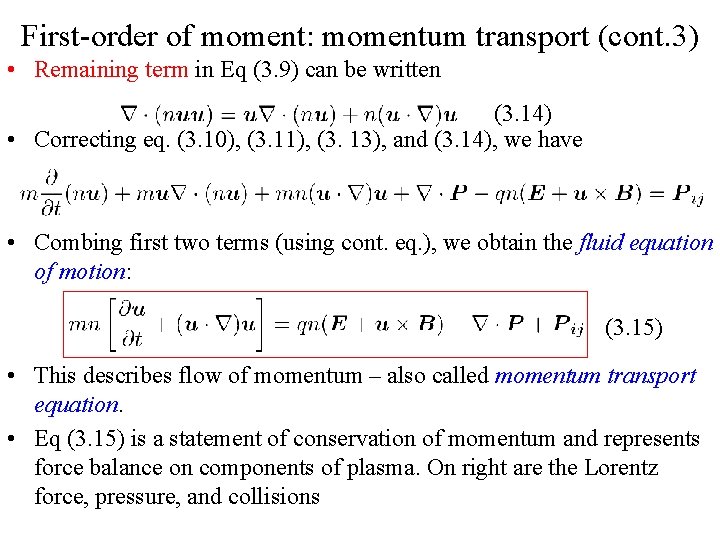
First-order of moment: momentum transport (cont. 3) • Remaining term in Eq (3. 9) can be written (3. 14) • Correcting eq. (3. 10), (3. 11), (3. 13), and (3. 14), we have • Combing first two terms (using cont. eq. ), we obtain the fluid equation of motion: (3. 15) • This describes flow of momentum – also called momentum transport equation. • Eq (3. 15) is a statement of conservation of momentum and represents force balance on components of plasma. On right are the Lorentz force, pressure, and collisions
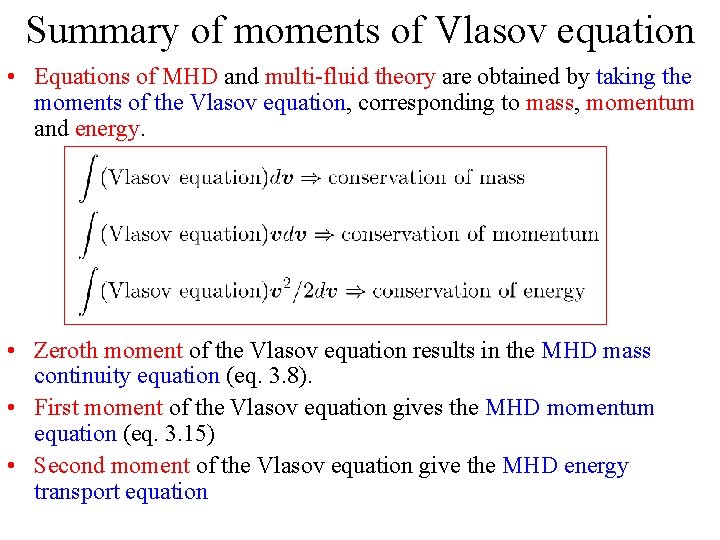
Summary of moments of Vlasov equation • Equations of MHD and multi-fluid theory are obtained by taking the moments of the Vlasov equation, corresponding to mass, momentum and energy. • Zeroth moment of the Vlasov equation results in the MHD mass continuity equation (eq. 3. 8). • First moment of the Vlasov equation gives the MHD momentum equation (eq. 3. 15) • Second moment of the Vlasov equation give the MHD energy transport equation