
Plaque stabilization by Statin From EASYFIT to ESCORT
Plaque stabilization by Statin: From EASY-FIT to ESCORT Trial Takashi Akasaka, MD, Ph. D, FESC, FAPSC Department of Cardiovascular Medicine Wakayama Medical University, Japan

Disclosure Statement of Financial Interest Takashi Akasaka, MD, Ph. D Within the past 12 months, I or my spouse/partner have had a financial interest/arrangement or affiliation with the organization(s) listed below Grant/Research Support : Abbott Vascular Japan Daiichi-Sankyo Pharmaceutical Inc. Goodman Inc. St. Jude Medical Japan Terumo Inc. Consulting Fees/Honoraria : Daiichi-Sankyo Pharmaceutical Inc. Goodman Inc. St. Jude Medical Japan Terumo Inc.
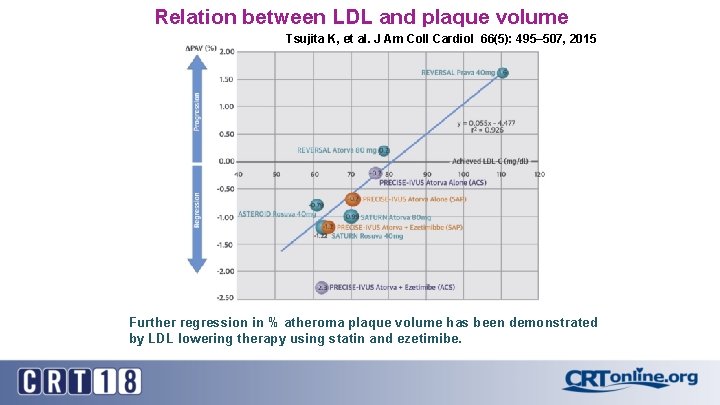
Relation between LDL and plaque volume Tsujita K, et al. J Am Coll Cardiol 66(5): 495– 507, 2015 Further regression in % atheroma plaque volume has been demonstrated by LDL lowering therapy using statin and ezetimibe.

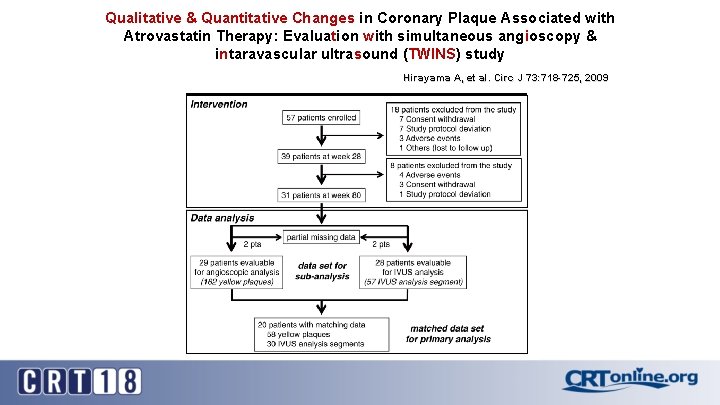
Qualitative & Quantitative Changes in Coronary Plaque Associated with Atrovastatin Therapy: Evaluation with simultaneous angioscopy & intaravascular ultrasound (TWINS) study Hirayama A, et al. Circ J 73: 718 -725, 2009
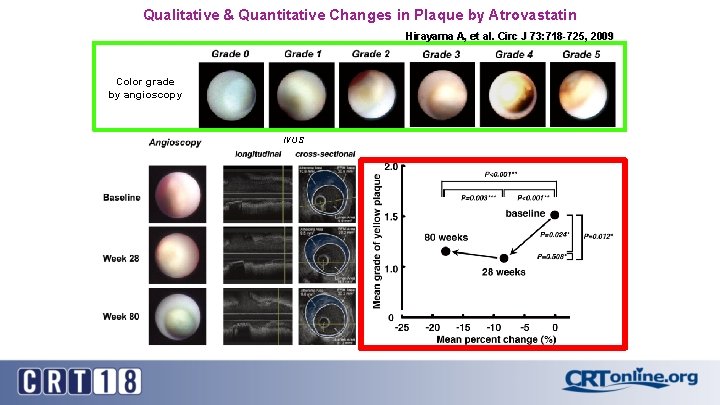
Qualitative & Quantitative Changes in Plaque by Atrovastatin Hirayama A, et al. Circ J 73: 718 -725, 2009 Color grade by angioscopy IVUS
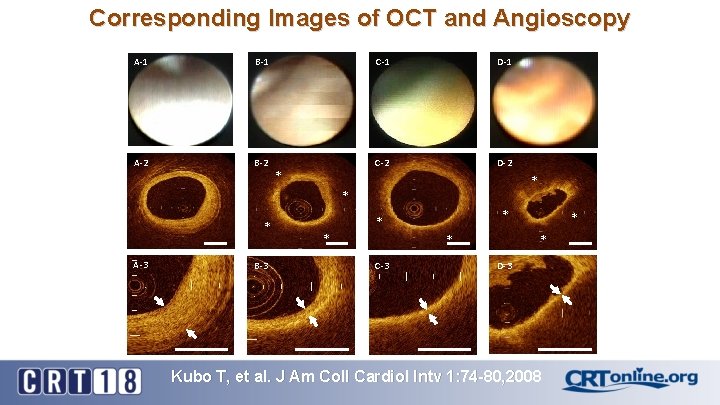
Corresponding Images of OCT and Angioscopy A-1 B-1 C-1 D-1 A-2 B-2 C-2 D-2 * * A-3 B-3 * * C-3 * * D-3 Kubo T, et al. J Am Coll Cardiol Intv 1: 74 -80, 2008
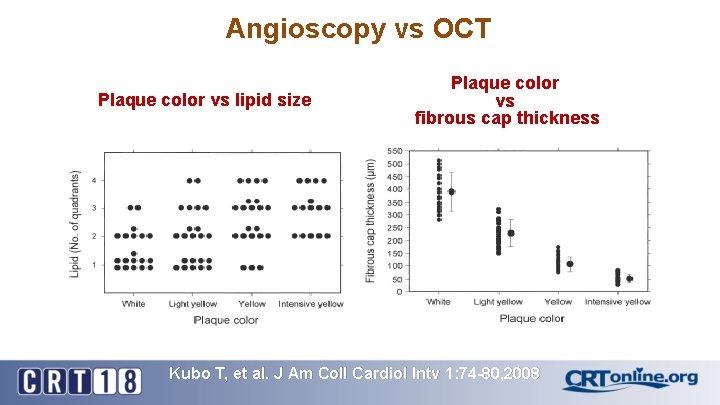
Angioscopy vs OCT Plaque color vs lipid size Plaque color vs fibrous cap thickness Kubo T, et al. J Am Coll Cardiol Intv 1: 74 -80, 2008
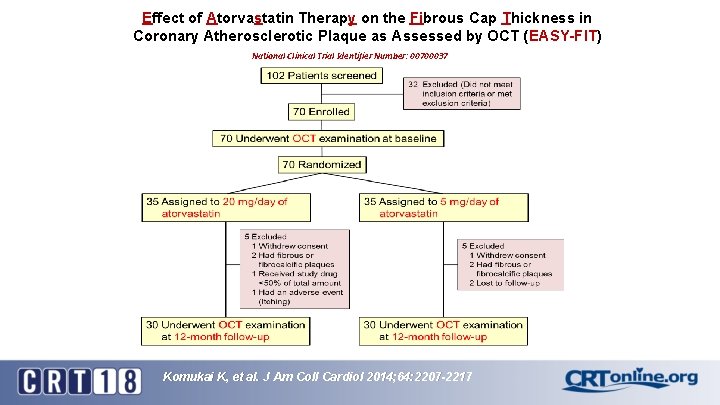
Effect of Atorvastatin Therapy on the Fibrous Cap Thickness in Coronary Atherosclerotic Plaque as Assessed by OCT (EASY-FIT) National Clinical Trial Identifier Number: 00700037 Komukai K, et al. J Am Coll Cardiol 2014; 64: 2207 -2217
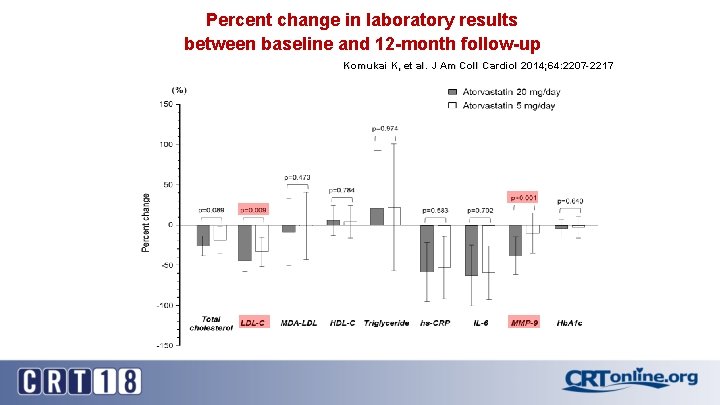
Percent change in laboratory results between baseline and 12 -month follow-up Komukai K, et al. J Am Coll Cardiol 2014; 64: 2207 -2217
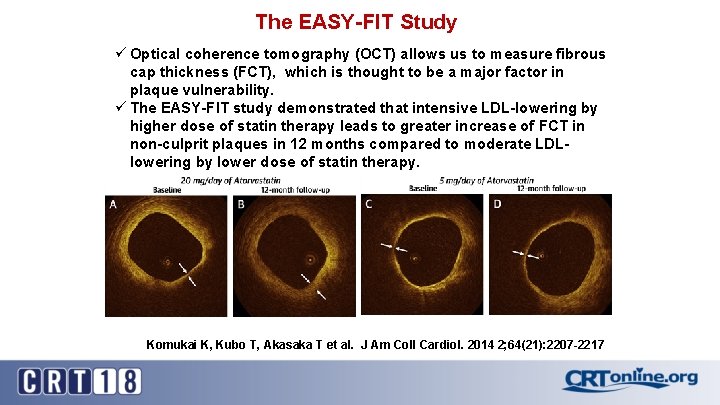
The EASY-FIT Study ü Optical coherence tomography (OCT) allows us to measure fibrous cap thickness (FCT), which is thought to be a major factor in plaque vulnerability. ü The EASY-FIT study demonstrated that intensive LDL-lowering by higher dose of statin therapy leads to greater increase of FCT in non-culprit plaques in 12 months compared to moderate LDLlowering by lower dose of statin therapy. Komukai K, Kubo T, Akasaka T et al. J Am Coll Cardiol. 2014 2; 64(21): 2207 -2217
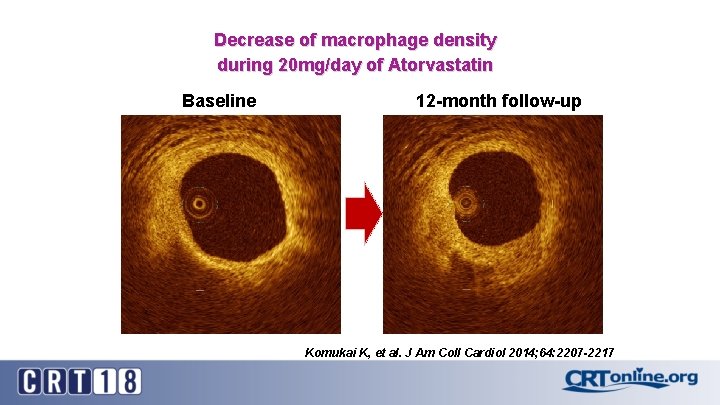
Decrease of macrophage density during 20 mg/day of Atorvastatin Baseline 12 -month follow-up Komukai K, et al. J Am Coll Cardiol 2014; 64: 2207 -2217
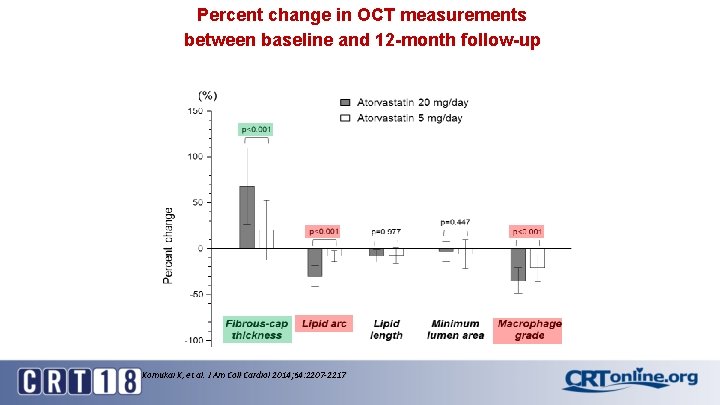
Percent change in OCT measurements between baseline and 12 -month follow-up Komukai K, et al. J Am Coll Cardiol 2014; 64: 2207 -2217
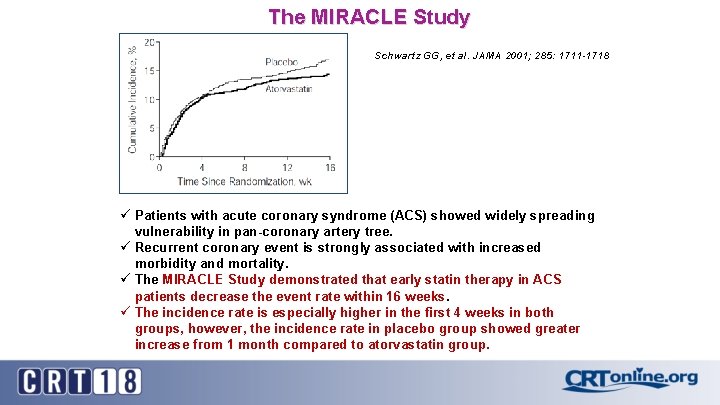
The MIRACLE Study Schwartz GG, et al. JAMA 2001; 285: 1711 -1718 ü Patients with acute coronary syndrome (ACS) showed widely spreading vulnerability in pan-coronary artery tree. ü Recurrent coronary event is strongly associated with increased morbidity and mortality. ü The MIRACLE Study demonstrated that early statin therapy in ACS patients decrease the event rate within 16 weeks. ü The incidence rate is especially higher in the first 4 weeks in both groups, however, the incidence rate in placebo group showed greater increase from 1 month compared to atorvastatin group.
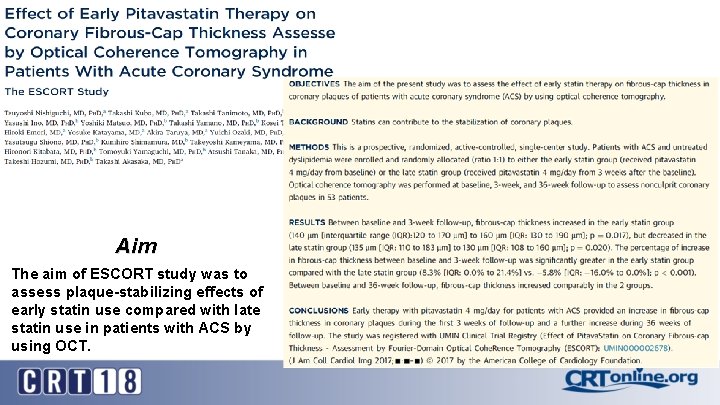
Aim The aim of ESCORT study was to assess plaque-stabilizing effects of early statin use compared with late statin use in patients with ACS by using OCT.
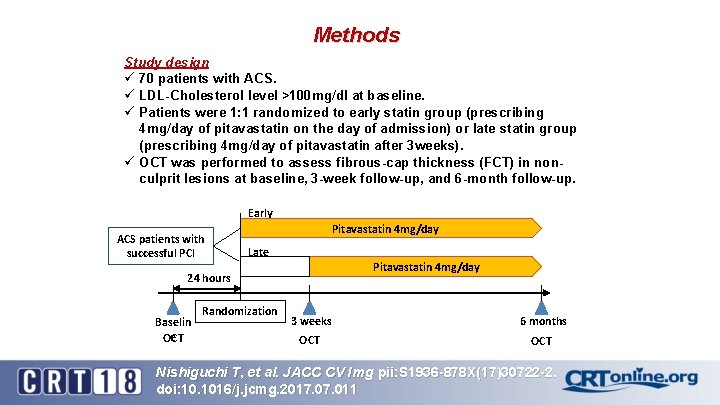
Methods Study design ü 70 patients with ACS. ü LDL-Cholesterol level >100 mg/dl at baseline. ü Patients were 1: 1 randomized to early statin group (prescribing 4 mg/day of pitavastatin on the day of admission) or late statin group (prescribing 4 mg/day of pitavastatin after 3 weeks). ü OCT was performed to assess fibrous-cap thickness (FCT) in nonculprit lesions at baseline, 3 -week follow-up, and 6 -month follow-up. ACS patients with successful PCI 24 hours Baselin e OCT Early group Pitavastatin 4 mg/day Late group Randomization Pitavastatin 4 mg/day 3 weeks 6 months OCT Nishiguchi T, et al. JACC CV Img pii: S 1936 -878 X(17)30722 -2. doi: 10. 1016/j. jcmg. 2017. 011
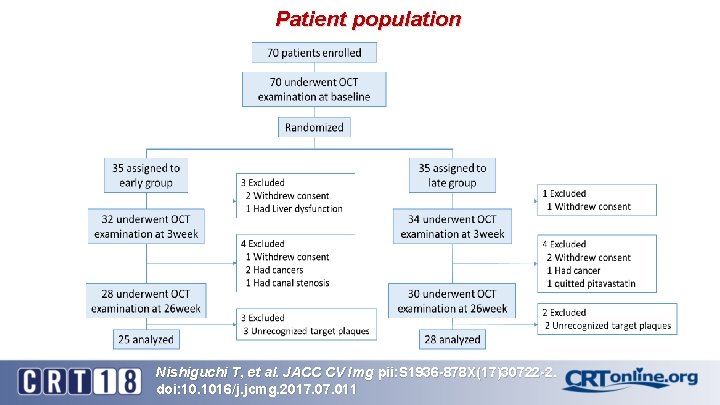
Patient population Nishiguchi T, et al. JACC CV Img pii: S 1936 -878 X(17)30722 -2. doi: 10. 1016/j. jcmg. 2017. 011
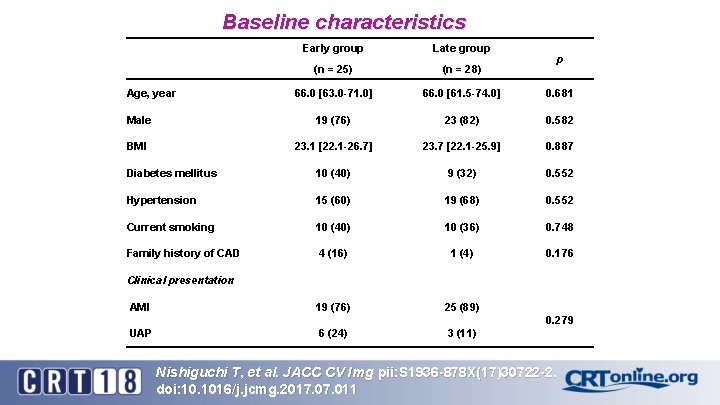
Baseline characteristics Early group Late group (n = 25) (n = 28) 66. 0 [63. 0 -71. 0] 66. 0 [61. 5 -74. 0] 0. 681 Male 19 (76) 23 (82) 0. 582 BMI 23. 1 [22. 1 -26. 7] 23. 7 [22. 1 -25. 9] 0. 887 Diabetes mellitus 10 (40) 9 (32) 0. 552 Hypertension 15 (60) 19 (68) 0. 552 Current smoking 10 (40) 10 (36) 0. 748 Family history of CAD 4 (16) 1 (4) 0. 176 AMI 19 (76) 25 (89) UAP 6 (24) 3 (11) Age, year p Clinical presentation 0. 279 Nishiguchi T, et al. JACC CV Img pii: S 1936 -878 X(17)30722 -2. doi: 10. 1016/j. jcmg. 2017. 011
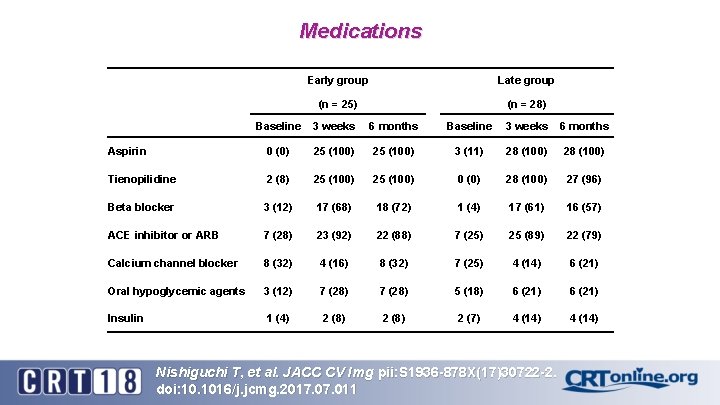
Medications Early group Late group (n = 25) (n = 28) Baseline 3 weeks 6 months Aspirin 0 (0) 25 (100) 3 (11) 28 (100) Tienopilidine 2 (8) 25 (100) 0 (0) 28 (100) 27 (96) Beta blocker 3 (12) 17 (68) 18 (72) 1 (4) 17 (61) 16 (57) ACE inhibitor or ARB 7 (28) 23 (92) 22 (88) 7 (25) 25 (89) 22 (79) Calcium channel blocker 8 (32) 4 (16) 8 (32) 7 (25) 4 (14) 6 (21) Oral hypoglycemic agents 3 (12) 7 (28) 5 (18) 6 (21) Insulin 1 (4) 2 (8) 2 (7) 4 (14) Nishiguchi T, et al. JACC CV Img pii: S 1936 -878 X(17)30722 -2. doi: 10. 1016/j. jcmg. 2017. 011
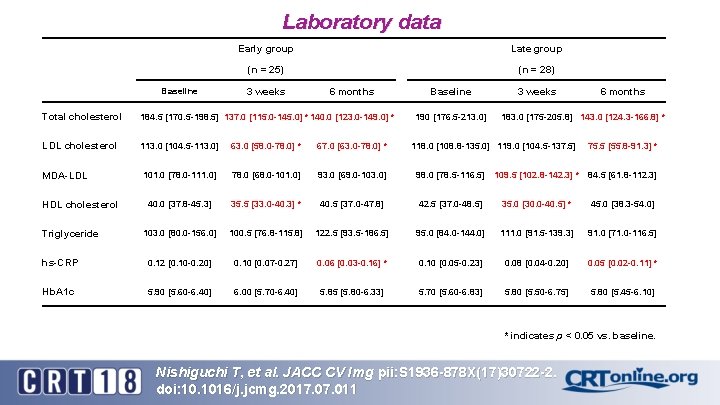
Laboratory data Baseline Early group Late group (n = 25) (n = 28) 3 weeks 6 months Baseline 3 weeks 6 months Total cholesterol 184. 5 [170. 5 -198. 5] 137. 0 [115. 0 -145. 0] * 140. 0 [123. 0 -149. 0] * LDL cholesterol 113. 0 [104. 5 -113. 0] 63. 0 [58. 0 -78. 0] * 67. 0 [63. 0 -78. 0] * MDA-LDL 101. 0 [78. 0 -111. 0] 78. 0 [68. 0 -101. 0] 93. 0 [69. 0 -103. 0] 98. 0 [78. 5 -116. 5] 109. 5 [102. 8 -142. 3] * 84. 5 [61. 8 -112. 3] 40. 0 [37. 8 -45. 3] 35. 5 [33. 0 -40. 3] * 40. 5 [37. 0 -47. 8] 42. 5 [37. 0 -48. 5] 35. 0 [30. 0 -40. 5] * 45. 0 [38. 3 -54. 0] 103. 0 [80. 0 -156. 0] 100. 5 [76. 8 -115. 8] 122. 5 [93. 5 -186. 5] 95. 0 [84. 0 -144. 0] 111. 0 [91. 5 -139. 3] 91. 0 [71. 0 -116. 5] hs-CRP 0. 12 [0. 10 -0. 20] 0. 10 [0. 07 -0. 27] 0. 06 [0. 03 -0. 16] * 0. 10 [0. 05 -0. 23] 0. 08 [0. 04 -0. 20] 0. 05 [0. 02 -0. 11] * Hb. A 1 c 5. 90 [5. 60 -6. 40] 6. 00 [5. 70 -6. 40] 5. 85 [5. 80 -6. 33] 5. 70 [5. 60 -6. 83] 5. 80 [5. 50 -6. 75] 5. 80 [5. 45 -6. 10] HDL cholesterol Triglyceride 190 [176. 5 -213. 0] 183. 0 [175 -205. 8] 143. 0 [124. 3 -166. 8] * 118. 0 [108. 8 -135. 0] 119. 0 [104. 5 -137. 5] 75. 5 [55. 8 -91. 3] * * indicates p < 0. 05 vs. baseline. Nishiguchi T, et al. JACC CV Img pii: S 1936 -878 X(17)30722 -2. doi: 10. 1016/j. jcmg. 2017. 011
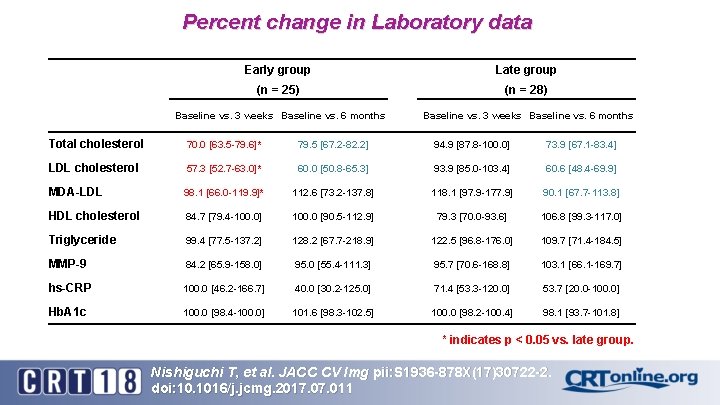
Percent change in Laboratory data Early group Late group (n = 25) (n = 28) Baseline vs. 3 weeks Baseline vs. 6 months Total cholesterol 70. 0 [63. 5 -79. 6]* 79. 5 [67. 2 -82. 2] 94. 9 [87. 8 -100. 0] 73. 9 [67. 1 -83. 4] LDL cholesterol 57. 3 [52. 7 -63. 0]* 60. 0 [50. 8 -65. 3] 93. 9 [85. 0 -103. 4] 60. 6 [48. 4 -69. 9] MDA-LDL 98. 1 [66. 0 -119. 9]* 112. 6 [73. 2 -137. 8] 118. 1 [97. 9 -177. 9] 90. 1 [67. 7 -113. 8] HDL cholesterol 84. 7 [79. 4 -100. 0] 100. 0 [90. 5 -112. 9] 79. 3 [70. 0 -93. 6] 106. 8 [99. 3 -117. 0] Triglyceride 99. 4 [77. 5 -137. 2] 128. 2 [67. 7 -218. 9] 122. 5 [96. 8 -176. 0] 109. 7 [71. 4 -184. 5] MMP-9 84. 2 [65. 9 -158. 0] 95. 0 [55. 4 -111. 3] 95. 7 [70. 6 -168. 8] 103. 1 [66. 1 -169. 7] hs-CRP 100. 0 [46. 2 -166. 7] 40. 0 [30. 2 -125. 0] 71. 4 [53. 3 -120. 0] 53. 7 [20. 0 -100. 0] Hb. A 1 c 100. 0 [98. 4 -100. 0] 101. 6 [98. 3 -102. 5] 100. 0 [98. 2 -100. 4] 98. 1 [93. 7 -101. 8] * indicates p < 0. 05 vs. late group. Nishiguchi T, et al. JACC CV Img pii: S 1936 -878 X(17)30722 -2. doi: 10. 1016/j. jcmg. 2017. 011
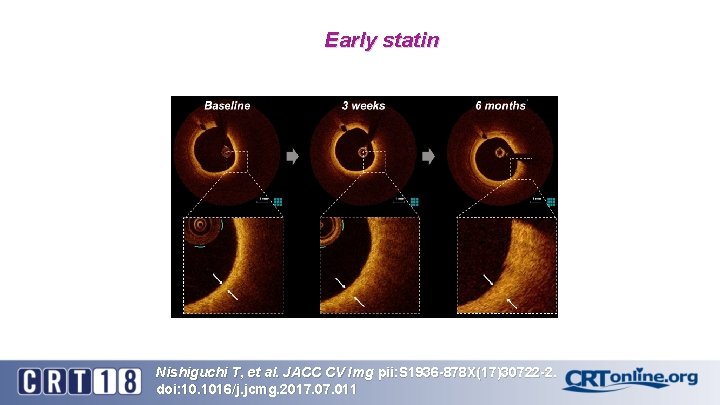
Early statin Nishiguchi T, et al. JACC CV Img pii: S 1936 -878 X(17)30722 -2. doi: 10. 1016/j. jcmg. 2017. 011
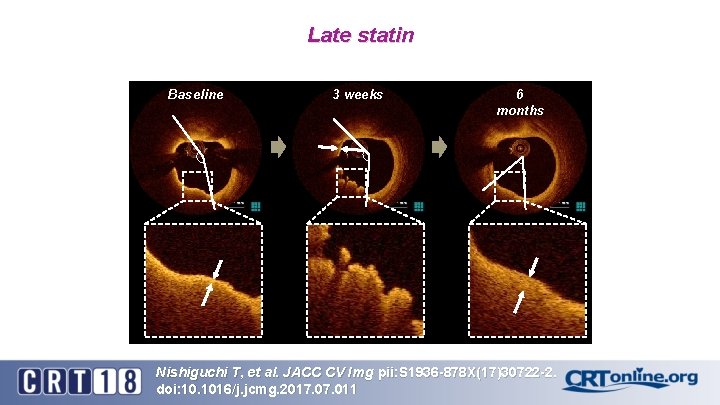
Late statin Baseline 3 weeks 6 months Nishiguchi T, et al. JACC CV Img pii: S 1936 -878 X(17)30722 -2. doi: 10. 1016/j. jcmg. 2017. 011
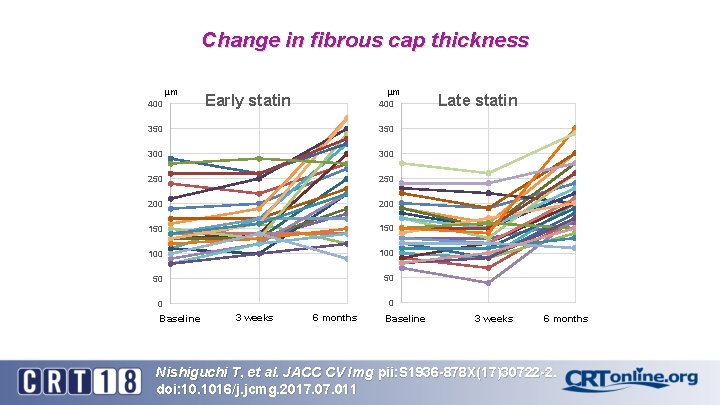
Change in fibrous cap thickness μm 400 Early statin 350 300 250 200 150 100 50 50 0 0 Baseline 3 weeks 6 months Baseline Late statin 3 weeks 6 months Nishiguchi T, et al. JACC CV Img pii: S 1936 -878 X(17)30722 -2. doi: 10. 1016/j. jcmg. 2017. 011
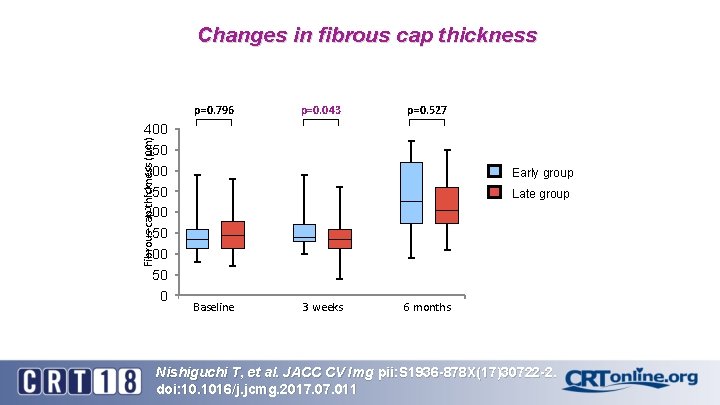
Changes in fibrous cap thickness p=0. 796 p=0. 527 Fibrous cap thickness (μm) 400 350 300 250 200 150 100 50 0 p=0. 043 Early group Late group 変数 1 変数 2 Baseline 変数 3 変数 4 変数 5 3 weeks 変数 6 変数 7 変数 8 6 months Nishiguchi T, et al. JACC CV Img pii: S 1936 -878 X(17)30722 -2. doi: 10. 1016/j. jcmg. 2017. 011
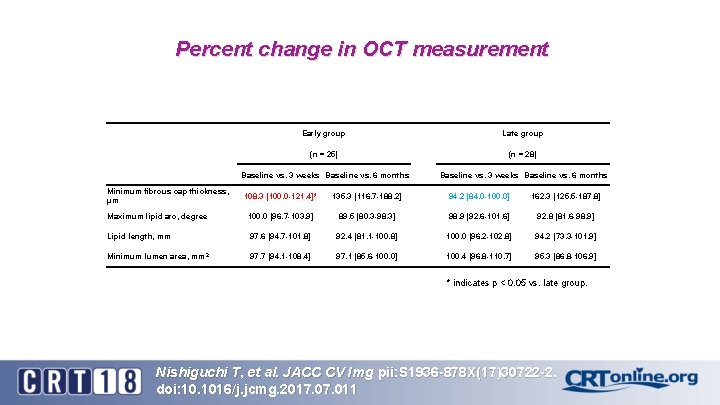
Percent change in OCT measurement Minimum fibrous cap thickness, µm Early group Late group (n = 25) (n = 28) Baseline vs. 3 weeks Baseline vs. 6 months 108. 3 [100. 0 -121. 4]* 135. 3 [116. 7 -188. 2] 94. 2 [84. 0 -100. 0] 162. 3 [125. 5 -187. 8] Maximum lipid arc, degree 100. 0 [96. 7 -103. 9] 89. 5 [80. 3 -98. 3] 98. 9 [92. 6 -101. 6] 92. 8 [81. 6 -98. 9] Lipid length, mm 97. 6 [94. 7 -101. 8] 92. 4 [81. 1 -100. 8] 100. 0 [96. 2 -102. 8] 94. 2 [73. 3 -101. 9] Minimum lumen area, mm 2 97. 7 [94. 1 -108. 4] 97. 1 [85. 6 -100. 0] 100. 4 [96. 8 -110. 7] 95. 3 [86. 8 -106. 9] * indicates p < 0. 05 vs. late group. Nishiguchi T, et al. JACC CV Img pii: S 1936 -878 X(17)30722 -2. doi: 10. 1016/j. jcmg. 2017. 011
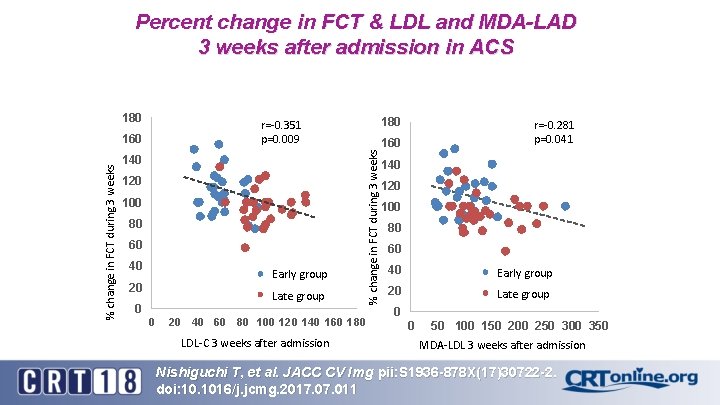
Percent change in FCT & LDL and MDA-LAD 3 weeks after admission in ACS 180 140 120 100 80 60 40 Early group 20 Late group 0 0 % change in FCT during 3 weeks 160 % change in FCT during 3 weeks 180 r=-0. 351 p=0. 009 20 40 60 80 100 120 140 160 180 LDL-C 3 weeks after admission r=-0. 281 p=0. 041 160 140 120 100 80 60 40 Early group 20 Late group 0 0 50 100 150 200 250 300 350 MDA-LDL 3 weeks after admission Nishiguchi T, et al. JACC CV Img pii: S 1936 -878 X(17)30722 -2. doi: 10. 1016/j. jcmg. 2017. 011
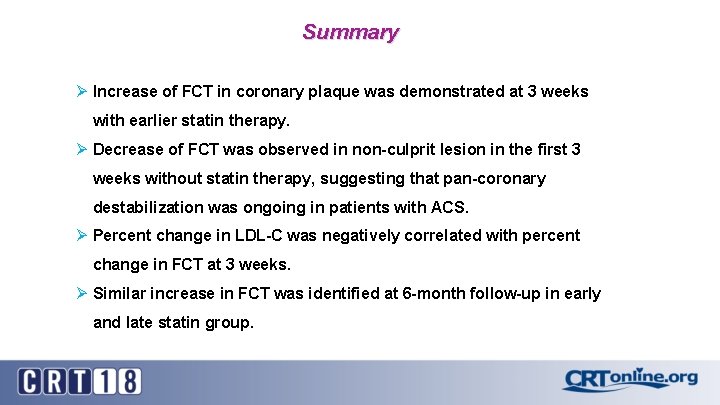
Summary Ø Increase of FCT in coronary plaque was demonstrated at 3 weeks with earlier statin therapy. Ø Decrease of FCT was observed in non-culprit lesion in the first 3 weeks without statin therapy, suggesting that pan-coronary destabilization was ongoing in patients with ACS. Ø Percent change in LDL-C was negatively correlated with percent change in FCT at 3 weeks. Ø Similar increase in FCT was identified at 6 -month follow-up in early and late statin group.
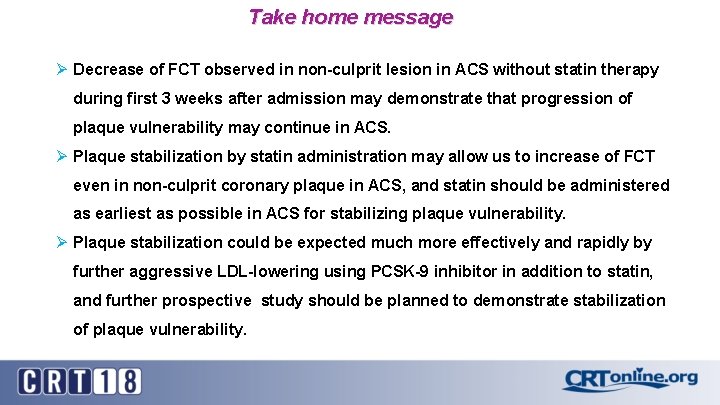
Take home message Ø Decrease of FCT observed in non-culprit lesion in ACS without statin therapy during first 3 weeks after admission may demonstrate that progression of plaque vulnerability may continue in ACS. Ø Plaque stabilization by statin administration may allow us to increase of FCT even in non-culprit coronary plaque in ACS, and statin should be administered as earliest as possible in ACS for stabilizing plaque vulnerability. Ø Plaque stabilization could be expected much more effectively and rapidly by further aggressive LDL-lowering using PCSK-9 inhibitor in addition to statin, and further prospective study should be planned to demonstrate stabilization of plaque vulnerability.

Thank you very much for your kind attention !
Effect of Pitava. Statin on Coronary Fibrous-cap Thickness Assessed by Optical Cohe. Rence Tomography: ESCORT Study (Effect of Early Statin Therapy on Fibrous-cap Thickness in ACS) Tsuyoshi Nishiguchi, Takashi Kubo, Yasushi Ino, Takashi Tanimoto, Hiroki Emori, Yosuke Katayama, Akira Taruya, Hiroshi Aoki, Shingo Ota, Makoto Orii, Keishi Okochi, Akio Kuroi, Takeyoshi Kameyama, Takashi Yamano, Tomoyuki Yamaguchi, Yoshiki Matsuo, Atsushi Tanaka, Takeshi Hozumi, and Takashi Akasaka (submitting) Aim The aim of ESCORT study was to assess plaque-stabilizing effects of early statin use compared with late statin use in patients with ACS by using OCT.
- Slides: 31