
PLANTS STRUCTURE DIVERSITY AND REPRODUCTION Basic Characteristics Cell
PLANTS STRUCTURE, DIVERSITY AND REPRODUCTION
Basic Characteristics Cell Type: Eukaryotic Cell Organization: Multicellular (with specialization for tissues and organs) Nutrition: Autotrophs (through photosynthesis) Structure: cells are surrounded by a cell wall made of cellulose
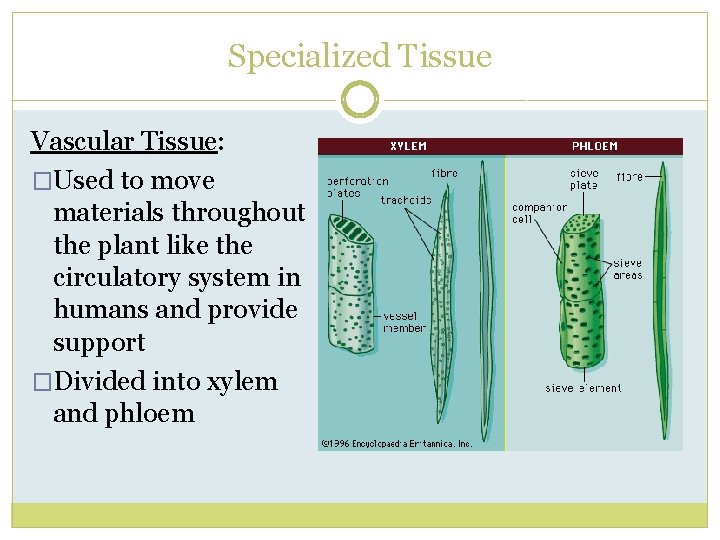
Specialized Tissue Vascular Tissue: �Used to move materials throughout the plant like the circulatory system in humans and provide support �Divided into xylem and phloem
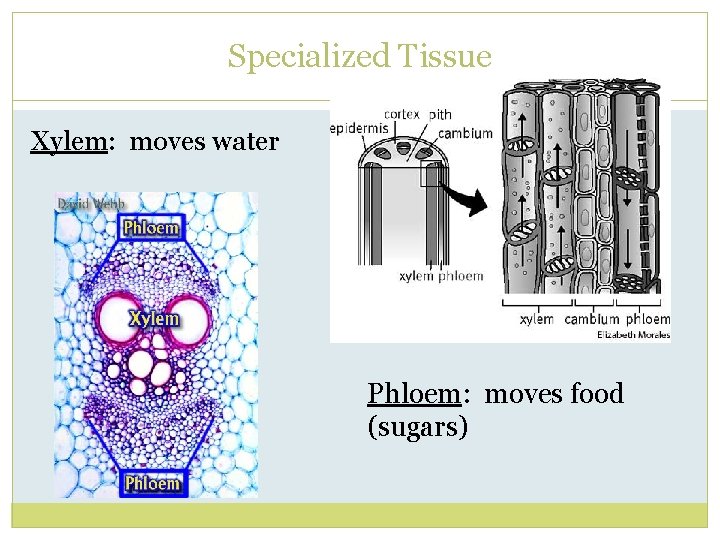
Specialized Tissue Xylem: moves water Phloem: moves food (sugars)
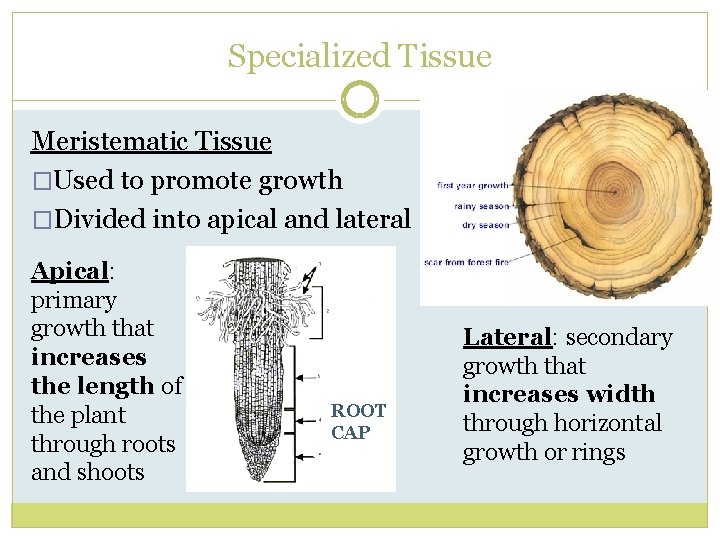
Specialized Tissue Meristematic Tissue �Used to promote growth �Divided into apical and lateral Apical: primary growth that increases the length of the plant through roots and shoots ROOT CAP Lateral: secondary growth that increases width through horizontal growth or rings
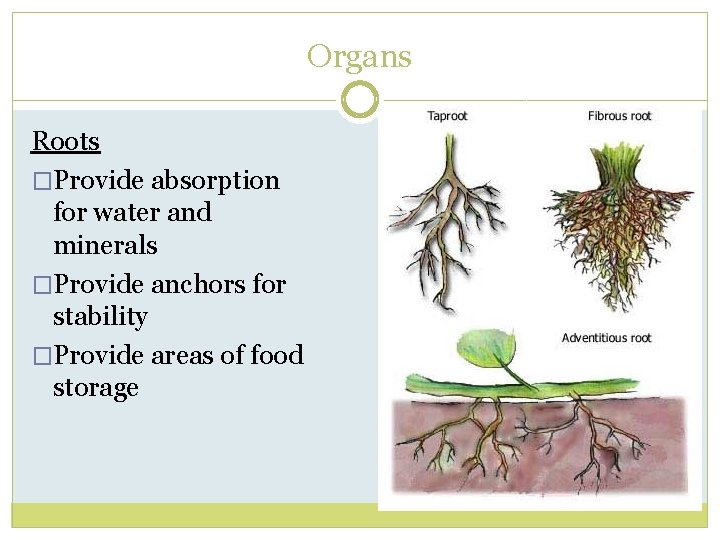
Organs Roots �Provide absorption for water and minerals �Provide anchors for stability �Provide areas of food storage
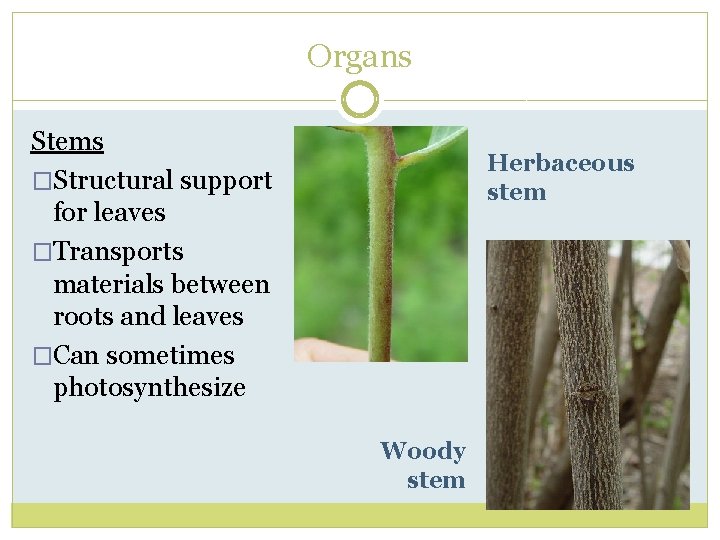
Organs Stems �Structural support for leaves �Transports materials between roots and leaves �Can sometimes photosynthesize Herbaceous stem Woody stem
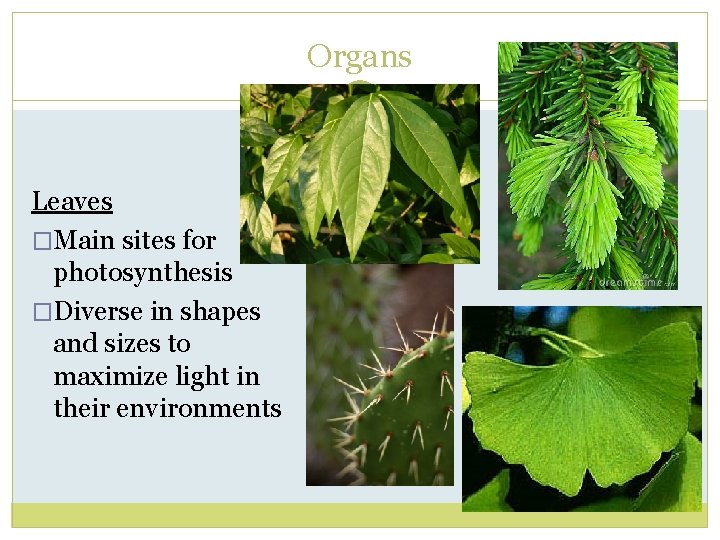
Organs Leaves �Main sites for photosynthesis �Diverse in shapes and sizes to maximize light in their environments
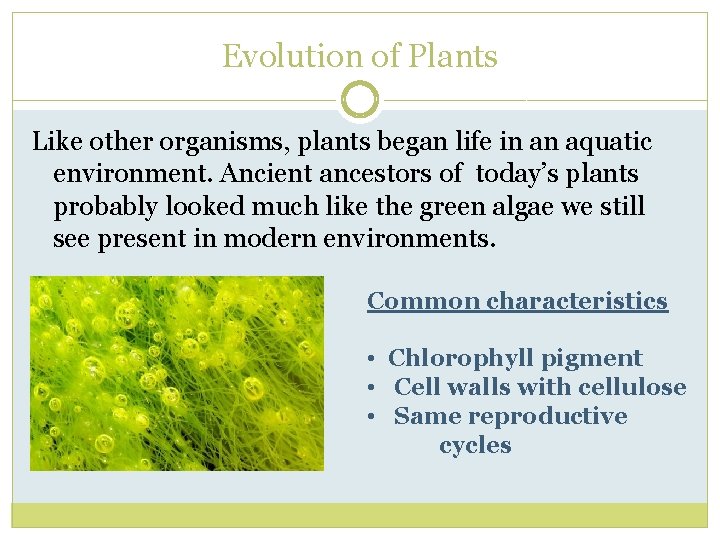
Evolution of Plants Like other organisms, plants began life in an aquatic environment. Ancient ancestors of today’s plants probably looked much like the green algae we still see present in modern environments. Common characteristics • Chlorophyll pigment • Cell walls with cellulose • Same reproductive cycles
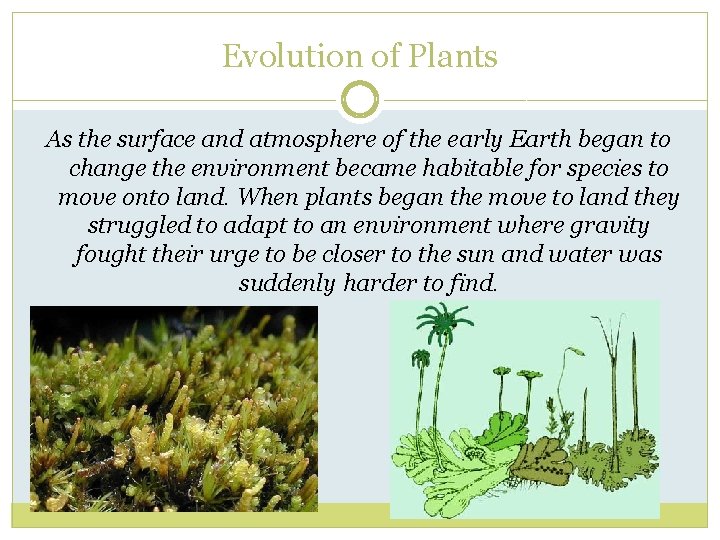
Evolution of Plants As the surface and atmosphere of the early Earth began to change the environment became habitable for species to move onto land. When plants began the move to land they struggled to adapt to an environment where gravity fought their urge to be closer to the sun and water was suddenly harder to find.
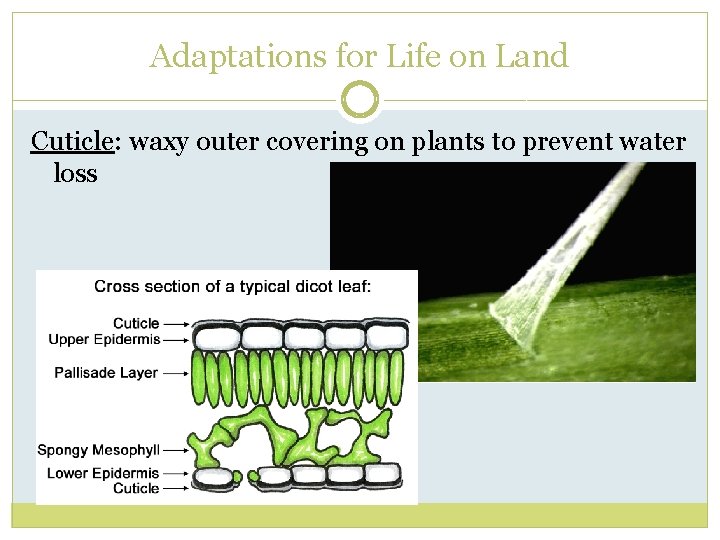
Adaptations for Life on Land Cuticle: waxy outer covering on plants to prevent water loss

Adaptations for Life on Land Pollen: male reproductive cells (sperm) �Carries sperm without the need for water �Small enough to be transferred by wind or animals
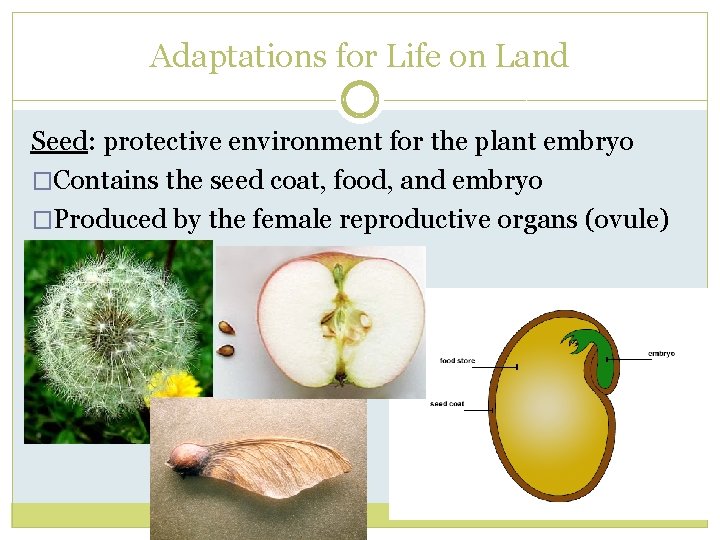
Adaptations for Life on Land Seed: protective environment for the plant embryo �Contains the seed coat, food, and embryo �Produced by the female reproductive organs (ovule)
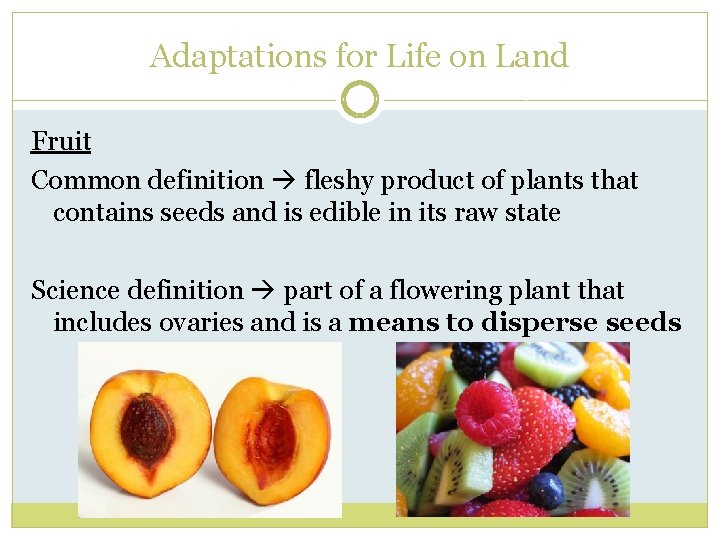
Adaptations for Life on Land Fruit Common definition fleshy product of plants that contains seeds and is edible in its raw state Science definition part of a flowering plant that includes ovaries and is a means to disperse seeds

Adaptations for Life on Land Common Fruits Botanical Fruits
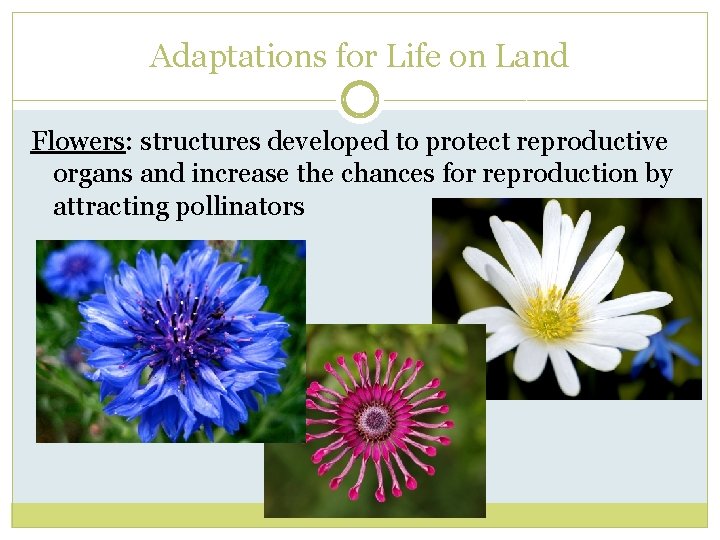
Adaptations for Life on Land Flowers: structures developed to protect reproductive organs and increase the chances for reproduction by attracting pollinators
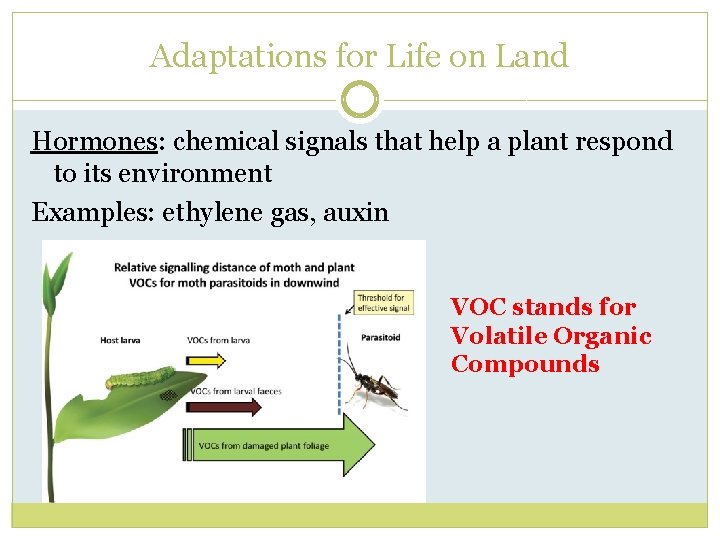
Adaptations for Life on Land Hormones: chemical signals that help a plant respond to its environment Examples: ethylene gas, auxin VOC stands for Volatile Organic Compounds
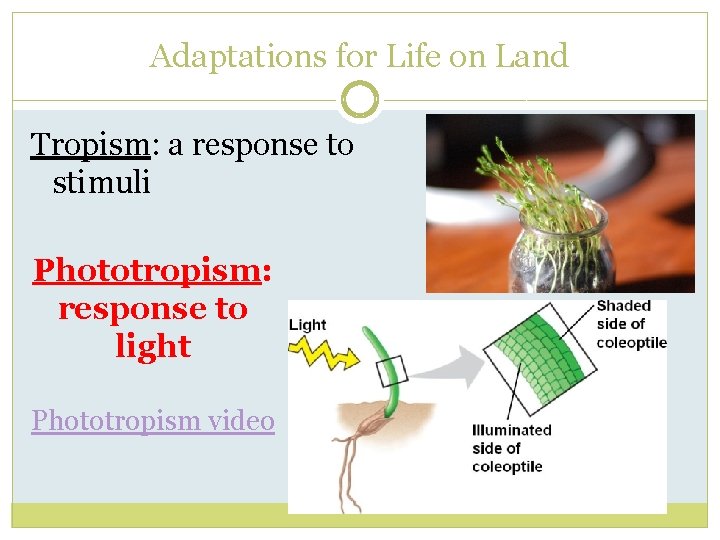
Adaptations for Life on Land Tropism: a response to stimuli Phototropism: response to light Phototropism video
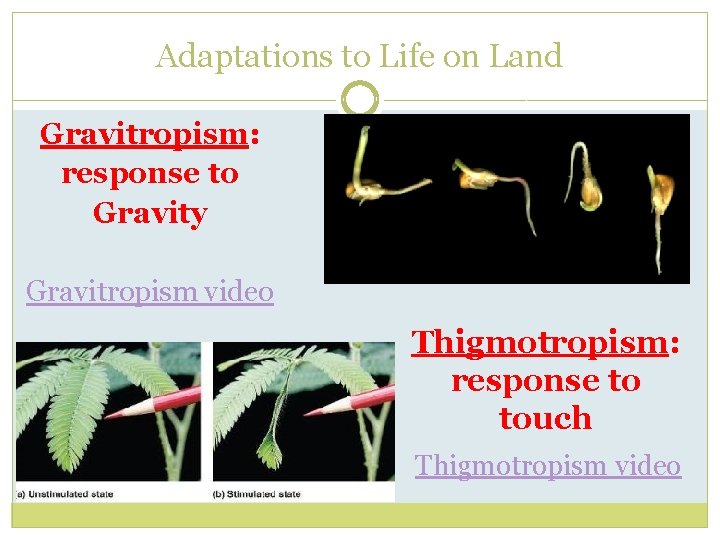
Adaptations to Life on Land Gravitropism: response to Gravity Gravitropism video Thigmotropism: response to touch Thigmotropism video
Plant Diversity After moving onto land, groups of plants diverged based on adaptations to their environments. Non-Vascular Short plants with no need for roots or stems to move nutrients to the leaves Tall plants that rely on roots and stems to move nutrients to the leaves
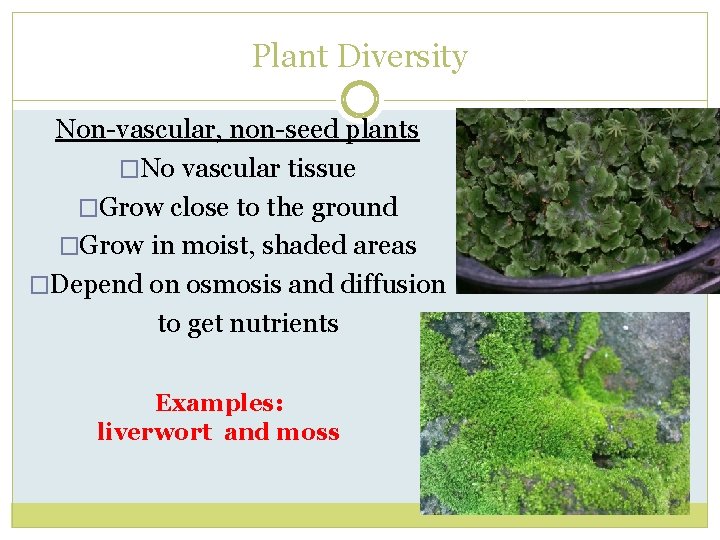
Plant Diversity Non-vascular, non-seed plants �No vascular tissue �Grow close to the ground �Grow in moist, shaded areas �Depend on osmosis and diffusion to get nutrients Examples: liverwort and moss
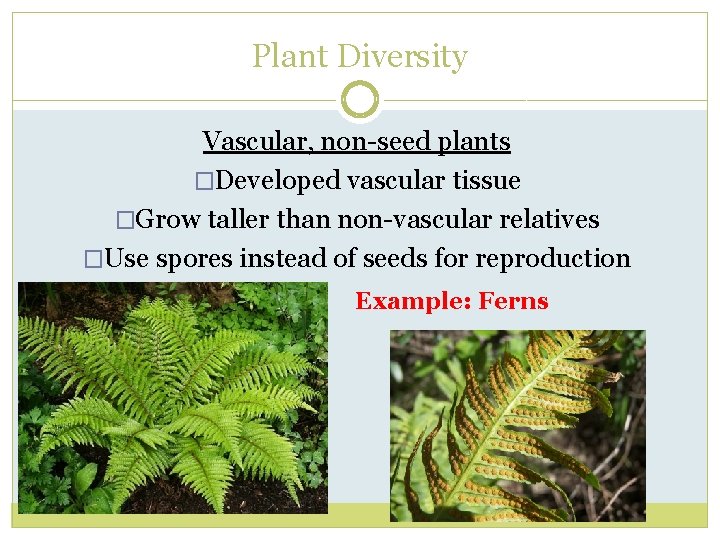
Plant Diversity Vascular, non-seed plants �Developed vascular tissue �Grow taller than non-vascular relatives �Use spores instead of seeds for reproduction Example: Ferns
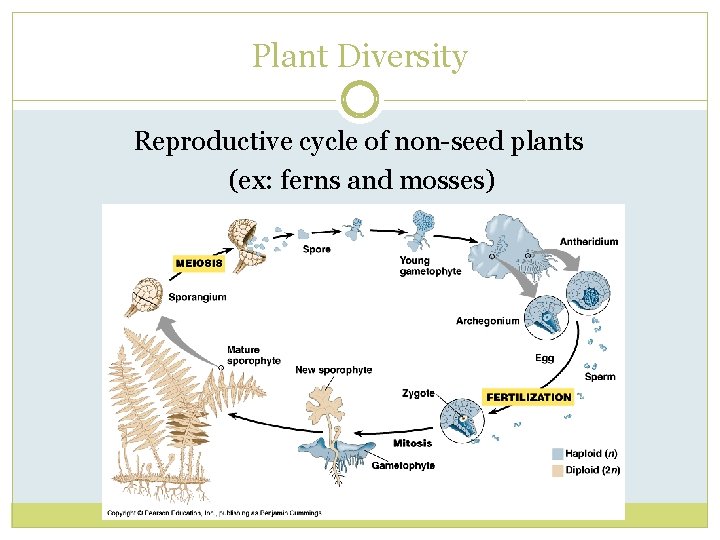
Plant Diversity Reproductive cycle of non-seed plants (ex: ferns and mosses)
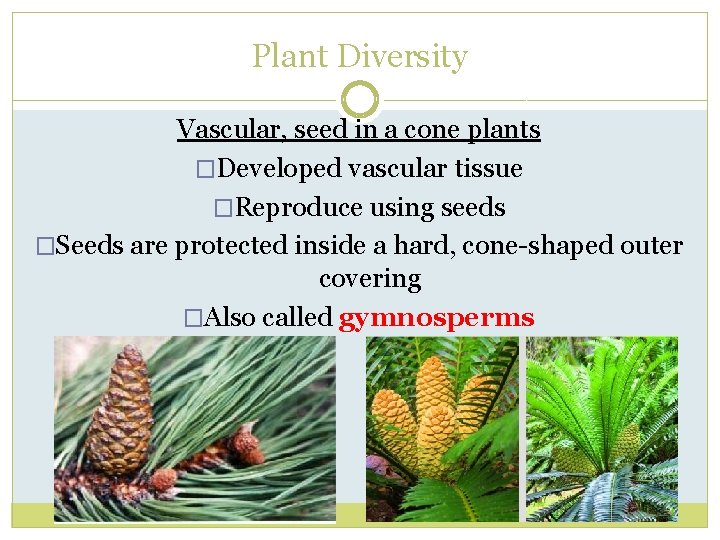
Plant Diversity Vascular, seed in a cone plants �Developed vascular tissue �Reproduce using seeds �Seeds are protected inside a hard, cone-shaped outer covering �Also called gymnosperms
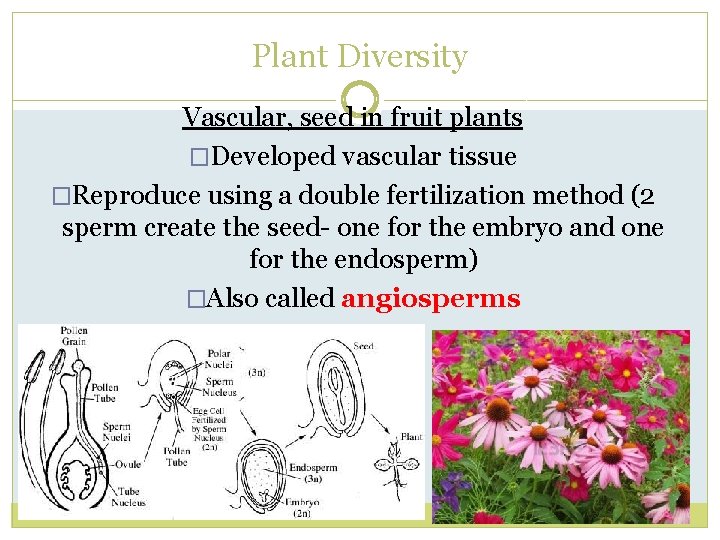
Plant Diversity Vascular, seed in fruit plants �Developed vascular tissue �Reproduce using a double fertilization method (2 sperm create the seed- one for the embryo and one for the endosperm) �Also called angiosperms
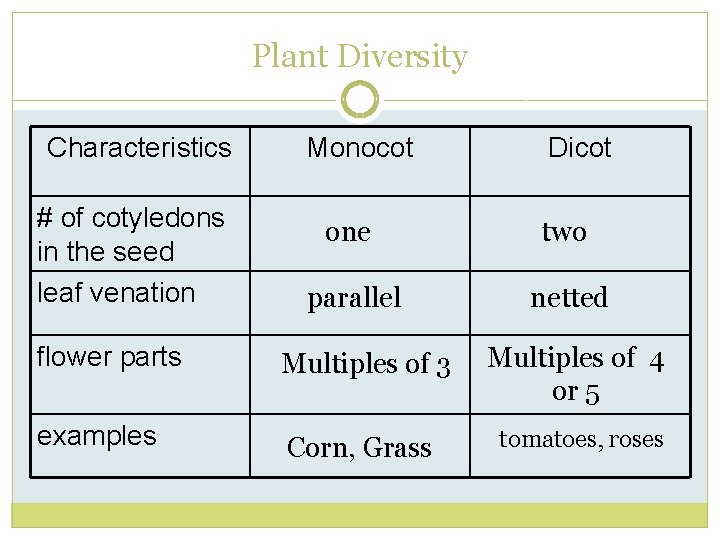
Plant Diversity Characteristics # of cotyledons in the seed leaf venation Monocot Dicot one two parallel netted flower parts Multiples of 3 Multiples of 4 or 5 examples Corn, Grass tomatoes, roses
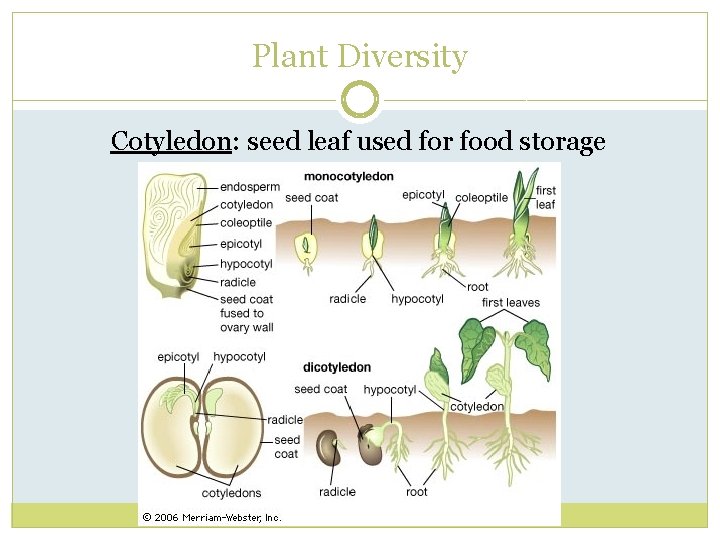
Plant Diversity Cotyledon: seed leaf used for food storage
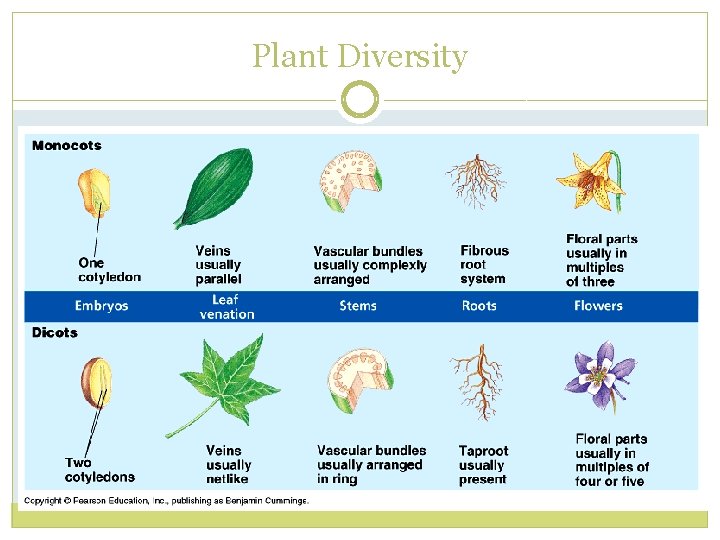
Plant Diversity
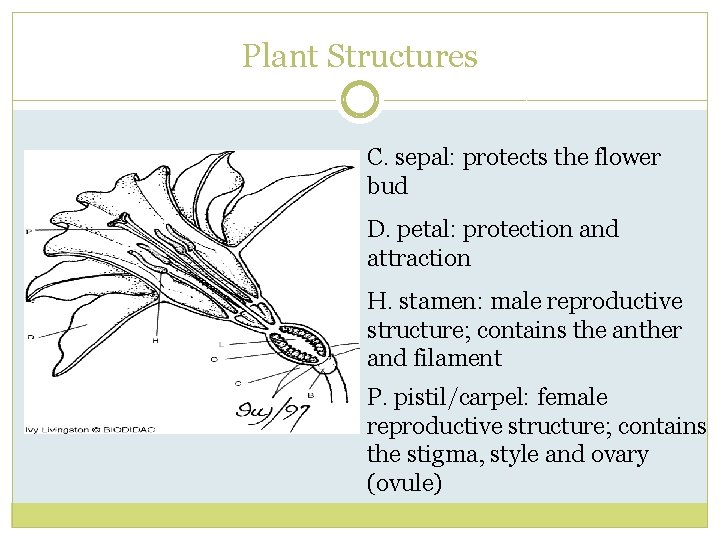
Plant Structures C. sepal: protects the flower bud D. petal: protection and attraction H. stamen: male reproductive structure; contains the anther and filament P. pistil/carpel: female reproductive structure; contains the stigma, style and ovary (ovule)
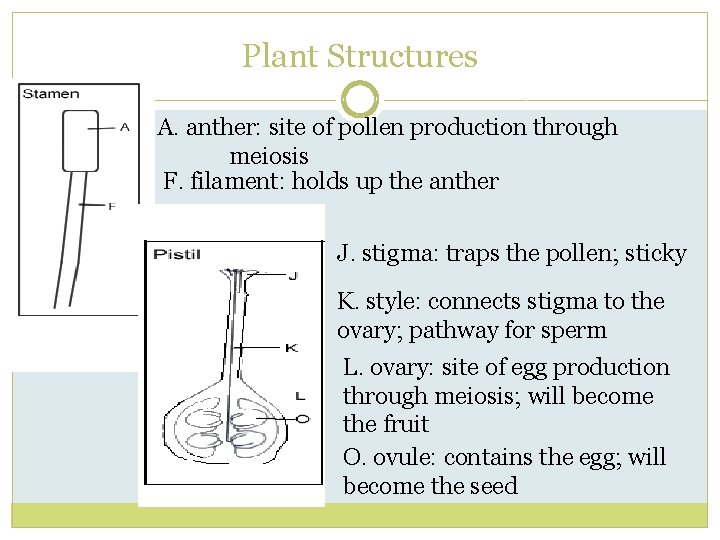
Plant Structures A. anther: site of pollen production through meiosis F. filament: holds up the anther J. stigma: traps the pollen; sticky K. style: connects stigma to the ovary; pathway for sperm L. ovary: site of egg production through meiosis; will become the fruit O. ovule: contains the egg; will become the seed
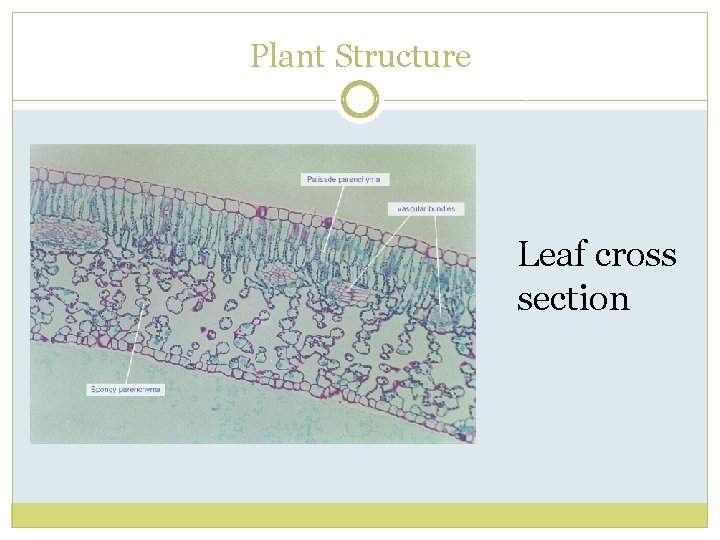
Plant Structure Leaf cross section
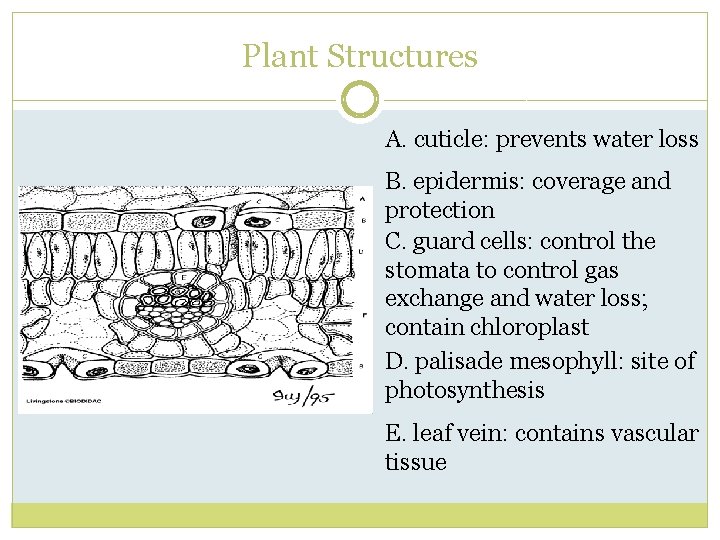
Plant Structures A. cuticle: prevents water loss B. epidermis: coverage and protection C. guard cells: control the stomata to control gas exchange and water loss; contain chloroplast D. palisade mesophyll: site of photosynthesis E. leaf vein: contains vascular tissue
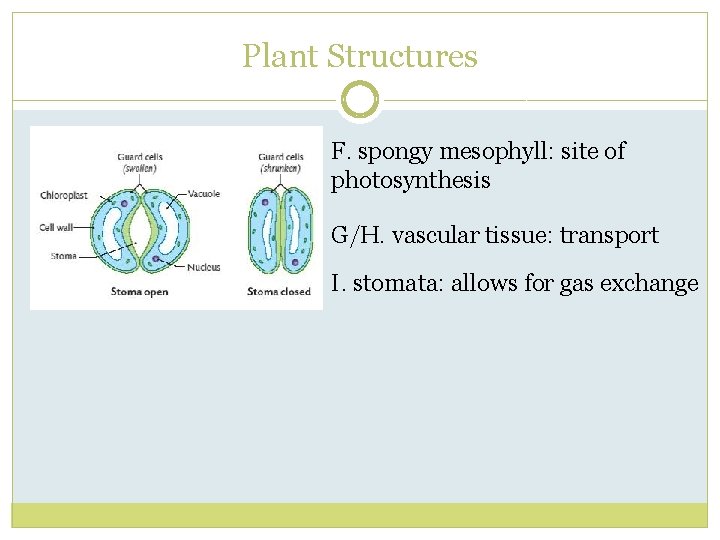
Plant Structures F. spongy mesophyll: site of photosynthesis G/H. vascular tissue: transport I. stomata: allows for gas exchange
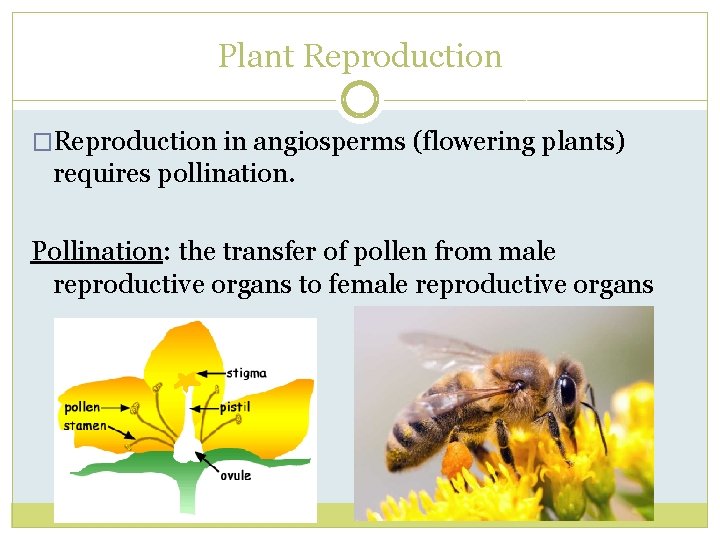
Plant Reproduction �Reproduction in angiosperms (flowering plants) requires pollination. Pollination: the transfer of pollen from male reproductive organs to female reproductive organs
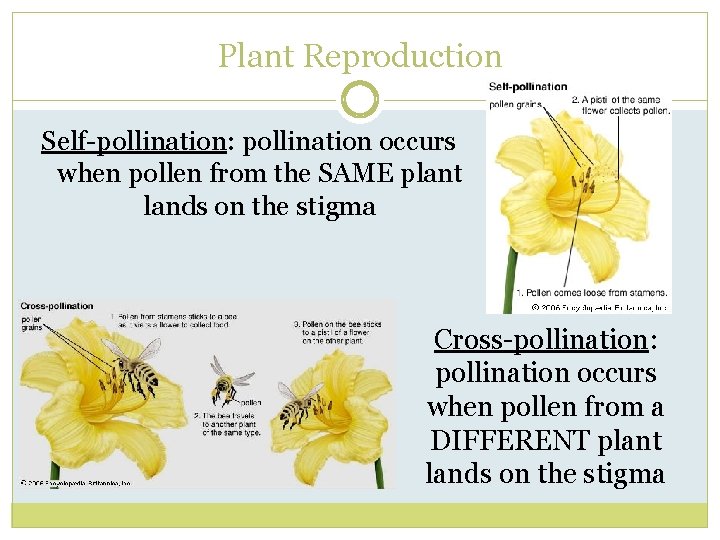
Plant Reproduction Self-pollination: pollination occurs when pollen from the SAME plant lands on the stigma Cross-pollination: pollination occurs when pollen from a DIFFERENT plant lands on the stigma
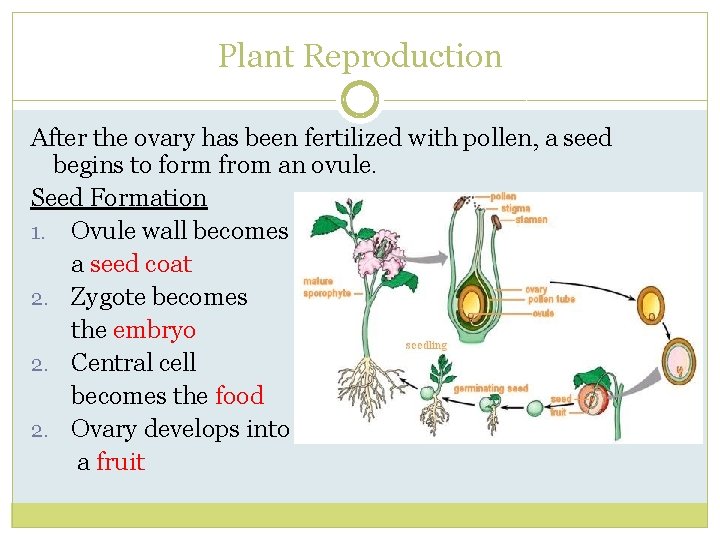
Plant Reproduction After the ovary has been fertilized with pollen, a seed begins to form from an ovule. Seed Formation 1. Ovule wall becomes a seed coat 2. Zygote becomes the embryo 2. Central cell becomes the food 2. Ovary develops into a fruit
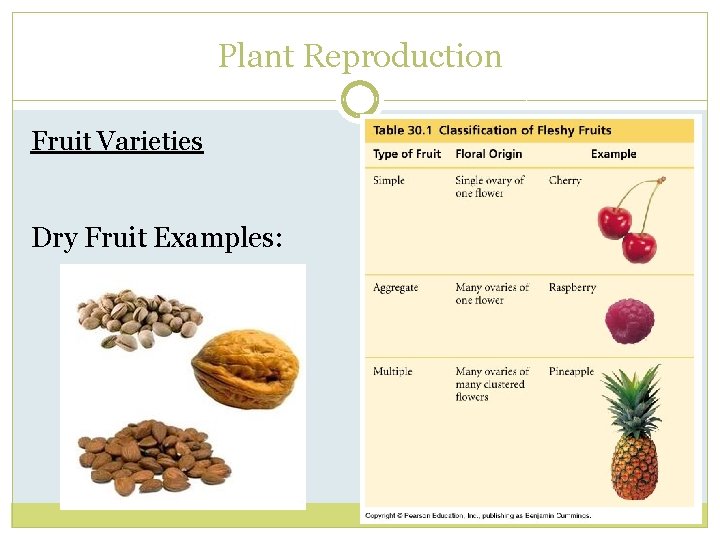
Plant Reproduction Fruit Varieties Dry Fruit Examples:
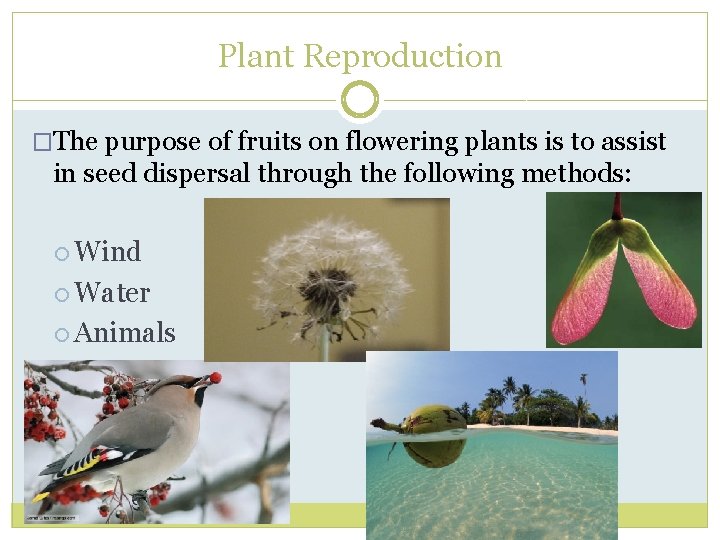
Plant Reproduction �The purpose of fruits on flowering plants is to assist in seed dispersal through the following methods: Wind Water Animals
Plant Reproduction �Once seeds are dispersed they then begin the process of germination Seed Germination 1. All seeds have a period of inactivity called dormancy 2. Germination occurs when dormancy is broken under favorable conditions
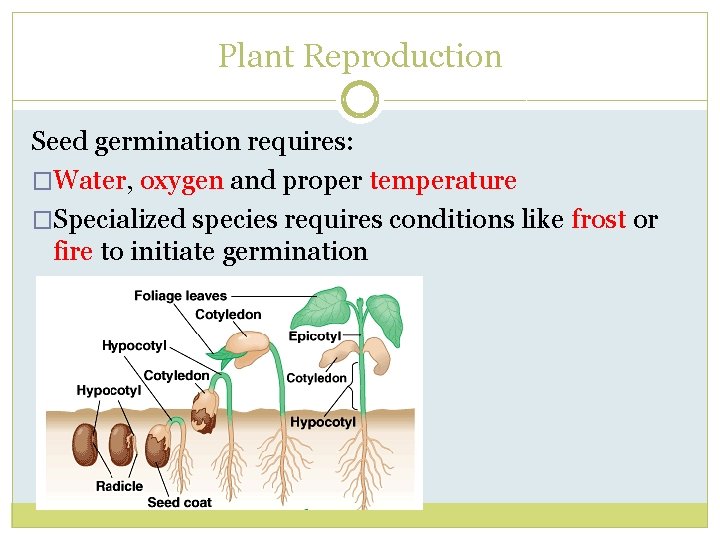
Plant Reproduction Seed germination requires: �Water, oxygen and proper temperature �Specialized species requires conditions like frost or fire to initiate germination
- Slides: 40