
PLANTS POWERPOINT SLIDESHOW Grade 7 Science PLANTS FOR
- Slides: 50
PLANTS POWERPOINT SLIDESHOW Grade 7 Science PLANTS FOR FOOD & FIBER Supporting Science Textbook Content while enriching the Learning Process in Junior High/Middle School
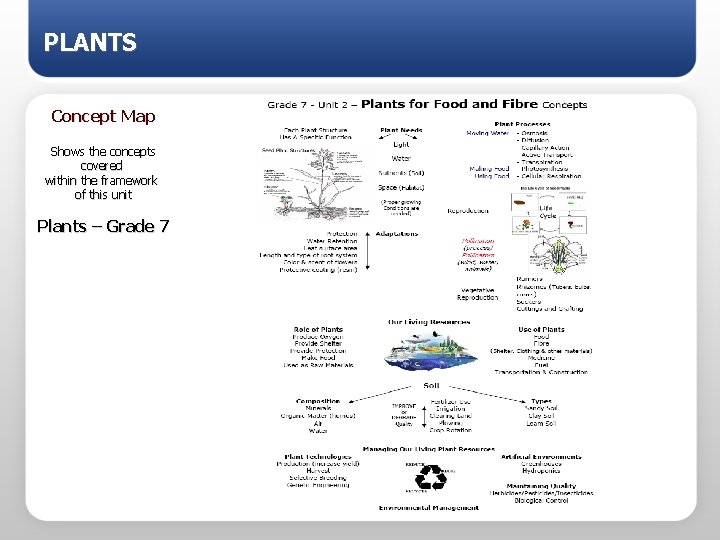
PLANTS Concept Map Shows the concepts covered within the framework of this unit Plants – Grade 7
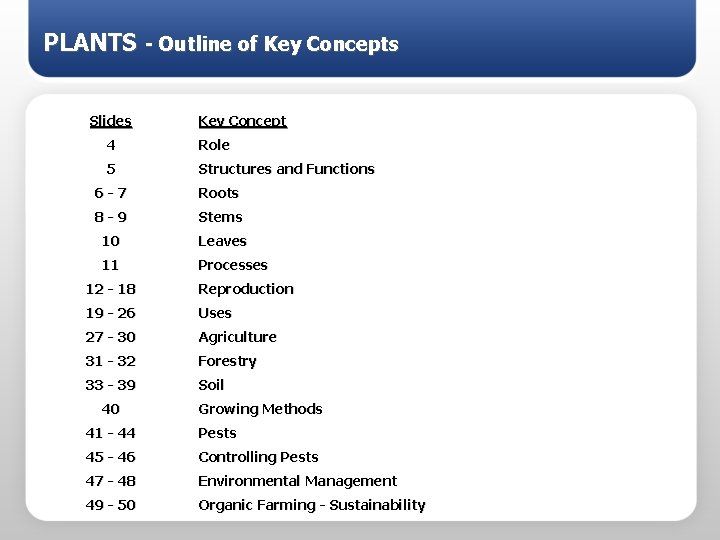
PLANTS - Outline of Key Concepts Slides Key Concept 4 Role 5 Structures and Functions 6 -7 Roots 8 -9 Stems 10 Leaves 11 Processes 12 - 18 Reproduction 19 - 26 Uses 27 - 30 Agriculture 31 - 32 Forestry 33 - 39 Soil 40 Growing Methods 41 - 44 Pests 45 - 46 Controlling Pests 47 - 48 Environmental Management 49 - 50 Organic Farming - Sustainability
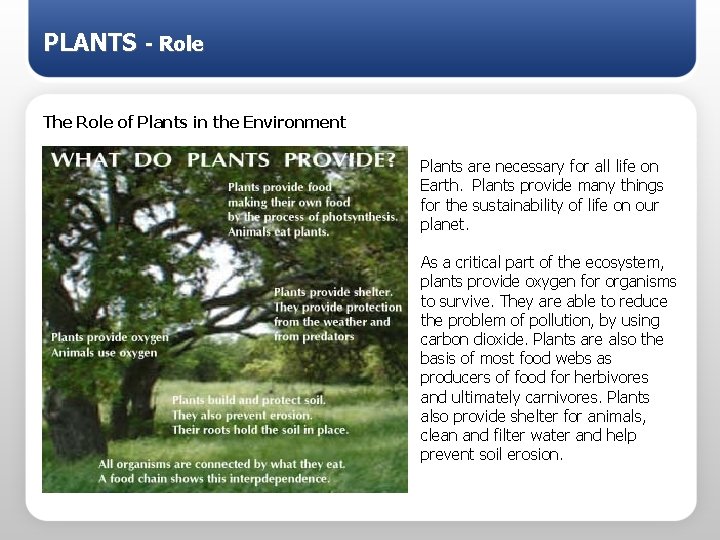
PLANTS - Role The Role of Plants in the Environment Plants are necessary for all life on Earth. Plants provide many things for the sustainability of life on our planet. As a critical part of the ecosystem, plants provide oxygen for organisms to survive. They are able to reduce the problem of pollution, by using carbon dioxide. Plants are also the basis of most food webs as producers of food for herbivores and ultimately carnivores. Plants also provide shelter for animals, clean and filter water and help prevent soil erosion.
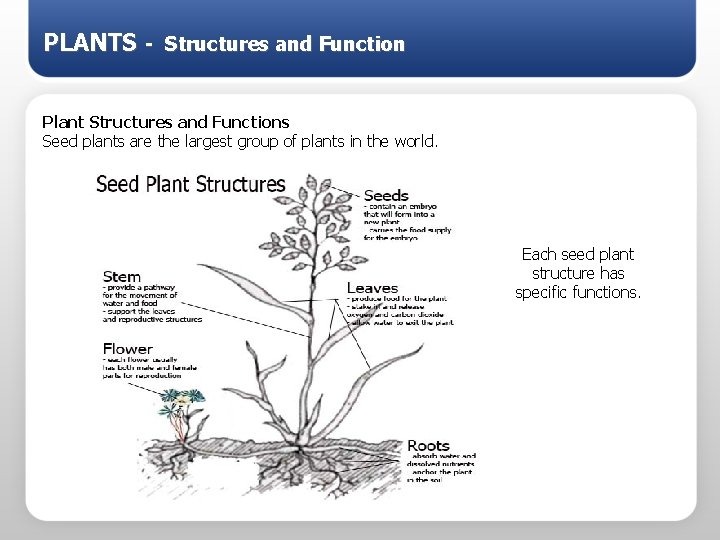
PLANTS - Structures and Function Plant Structures and Functions Seed plants are the largest group of plants in the world. Each seed plant structure has specific functions.
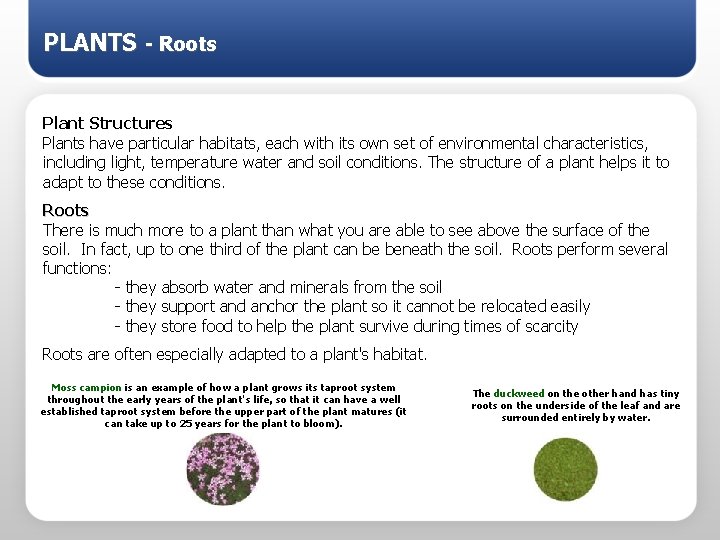
PLANTS - Roots Plant Structures Plants have particular habitats, each with its own set of environmental characteristics, including light, temperature water and soil conditions. The structure of a plant helps it to adapt to these conditions. Roots There is much more to a plant than what you are able to see above the surface of the soil. In fact, up to one third of the plant can be beneath the soil. Roots perform several functions: - they absorb water and minerals from the soil - they support and anchor the plant so it cannot be relocated easily - they store food to help the plant survive during times of scarcity Roots are often especially adapted to a plant's habitat. Moss campion is an example of how a plant grows its taproot system throughout the early years of the plant's life, so that it can have a well established taproot system before the upper part of the plant matures (it can take up to 25 years for the plant to bloom). The duckweed on the other hand has tiny roots on the underside of the leaf and are surrounded entirely by water.
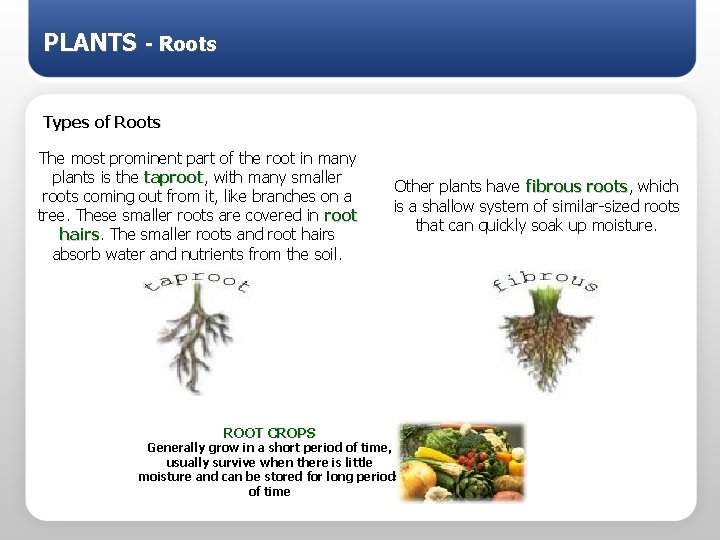
PLANTS - Roots Types of Roots The most prominent part of the root in many plants is the taproot, taproot with many smaller roots coming out from it, like branches on a tree. These smaller roots are covered in root hairs The smaller roots and root hairs absorb water and nutrients from the soil. ROOT CROPS Other plants have fibrous roots, roots which is a shallow system of similar-sized roots that can quickly soak up moisture. Generally grow in a short period of time, usually survive when there is little moisture and can be stored for long periods of time
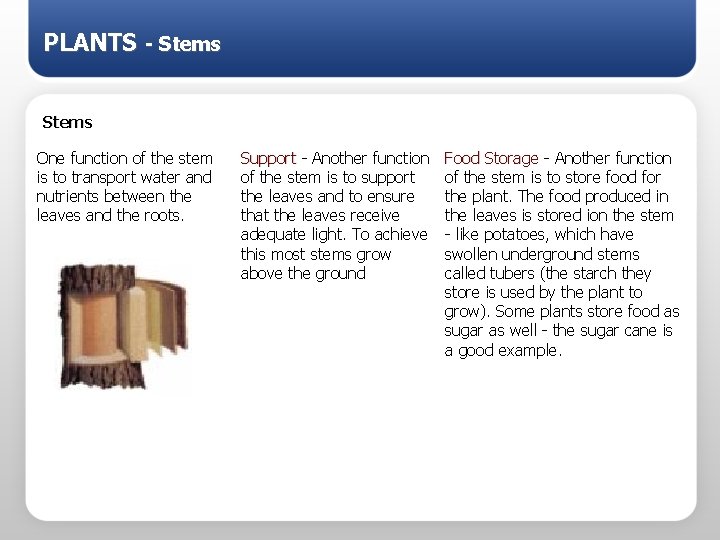
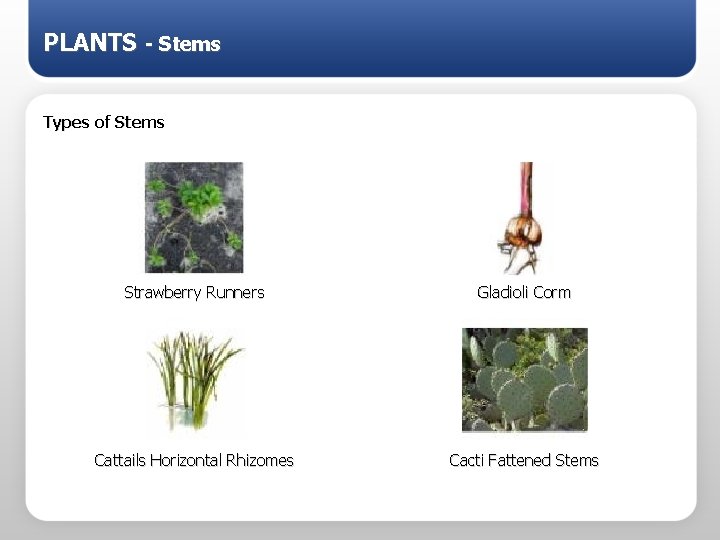
PLANTS - Stems One function of the stem is to transport water and nutrients between the leaves and the roots. Support - Another function of the stem is to support the leaves and to ensure that the leaves receive adequate light. To achieve this most stems grow above the ground Food Storage - Another function of the stem is to store food for the plant. The food produced in the leaves is stored ion the stem - like potatoes, which have swollen underground stems called tubers (the starch they store is used by the plant to grow). Some plants store food as sugar as well - the sugar cane is a good example.
PLANTS - Stems Types of Stems Strawberry Runners Gladioli Corm Cattails Horizontal Rhizomes Cacti Fattened Stems
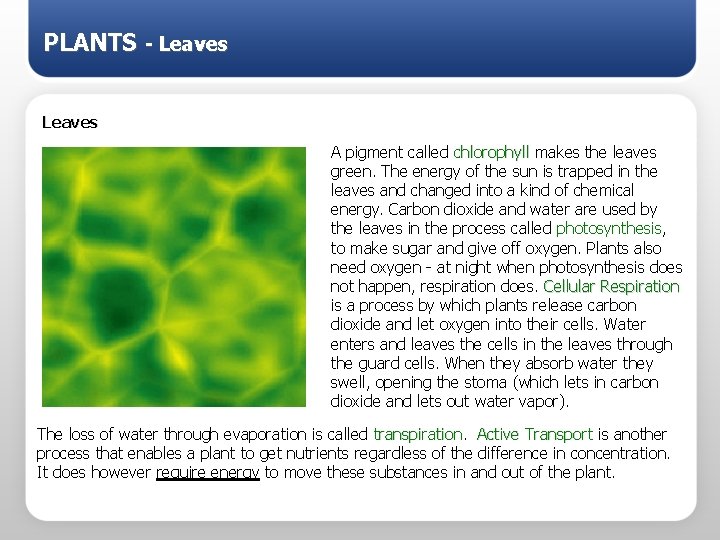
PLANTS - Leaves A pigment called chlorophyll makes the leaves green. The energy of the sun is trapped in the leaves and changed into a kind of chemical energy. Carbon dioxide and water are used by the leaves in the process called photosynthesis, to make sugar and give off oxygen. Plants also need oxygen - at night when photosynthesis does not happen, respiration does. Cellular Respiration is a process by which plants release carbon dioxide and let oxygen into their cells. Water enters and leaves the cells in the leaves through the guard cells. When they absorb water they swell, opening the stoma (which lets in carbon dioxide and lets out water vapor). The loss of water through evaporation is called transpiration Active Transport is another process that enables a plant to get nutrients regardless of the difference in concentration. It does however require energy to move these substances in and out of the plant.
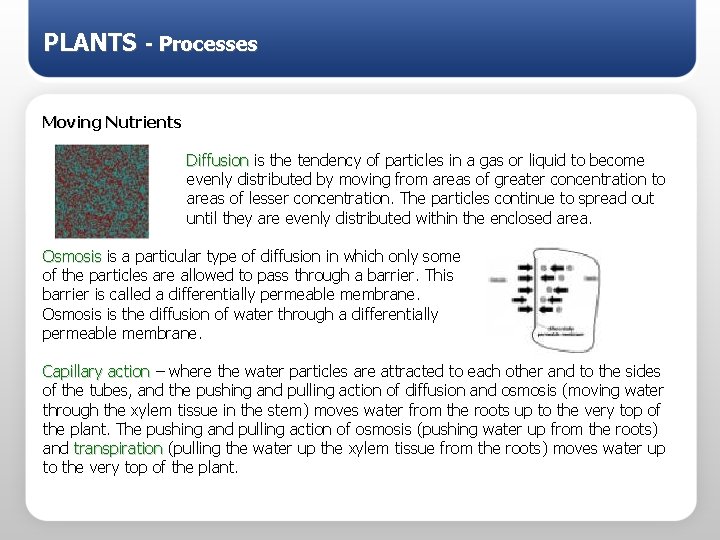
PLANTS - Processes Moving Nutrients Diffusion is the tendency of particles in a gas or liquid to become evenly distributed by moving from areas of greater concentration to areas of lesser concentration. The particles continue to spread out until they are evenly distributed within the enclosed area. Osmosis is a particular type of diffusion in which only some of the particles are allowed to pass through a barrier. This barrier is called a differentially permeable membrane. Osmosis is the diffusion of water through a differentially permeable membrane. Capillary action – where the water particles are attracted to each other and to the sides of the tubes, and the pushing and pulling action of diffusion and osmosis (moving water through the xylem tissue in the stem) moves water from the roots up to the very top of the plant. The pushing and pulling action of osmosis (pushing water up from the roots) and transpiration (pulling the water up the xylem tissue from the roots) moves water up to the very top of the plant.
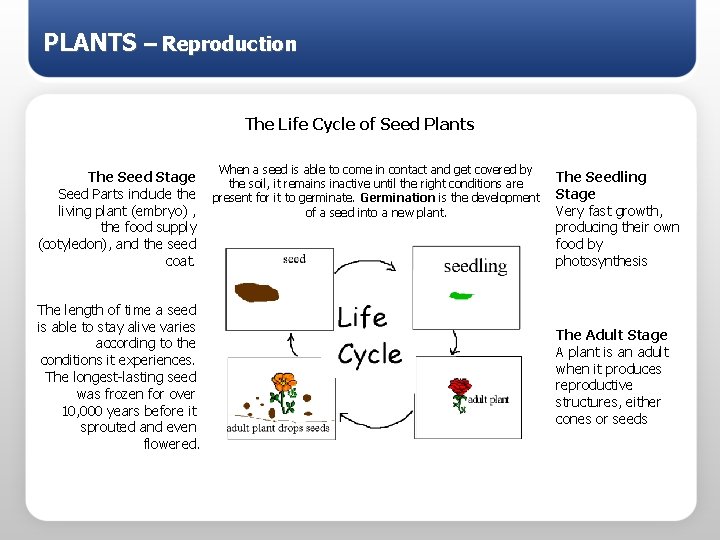
PLANTS – Reproduction The Life Cycle of Seed Plants The Seed Stage Seed Parts include the living plant (embryo) , the food supply (cotyledon), and the seed coat. The length of time a seed is able to stay alive varies according to the conditions it experiences. The longest-lasting seed was frozen for over 10, 000 years before it sprouted and even flowered. When a seed is able to come in contact and get covered by the soil, it remains inactive until the right conditions are present for it to germinate. Germination is the development of a seed into a new plant. The Seedling Stage Very fast growth, producing their own food by photosynthesis The Adult Stage A plant is an adult when it produces reproductive structures, either cones or seeds
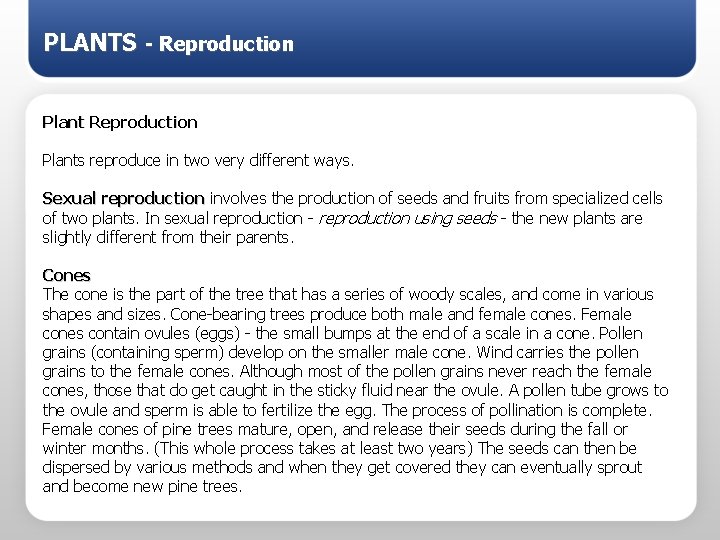
PLANTS - Reproduction Plants reproduce in two very different ways. Sexual reproduction involves the production of seeds and fruits from specialized cells of two plants. In sexual reproduction - reproduction using seeds - the new plants are slightly different from their parents. Cones The cone is the part of the tree that has a series of woody scales, and come in various shapes and sizes. Cone-bearing trees produce both male and female cones. Female cones contain ovules (eggs) - the small bumps at the end of a scale in a cone. Pollen grains (containing sperm) develop on the smaller male cone. Wind carries the pollen grains to the female cones. Although most of the pollen grains never reach the female cones, those that do get caught in the sticky fluid near the ovule. A pollen tube grows to the ovule and sperm is able to fertilize the egg. The process of pollination is complete. Female cones of pine trees mature, open, and release their seeds during the fall or winter months. (This whole process takes at least two years) The seeds can then be dispersed by various methods and when they get covered they can eventually sprout and become new pine trees.
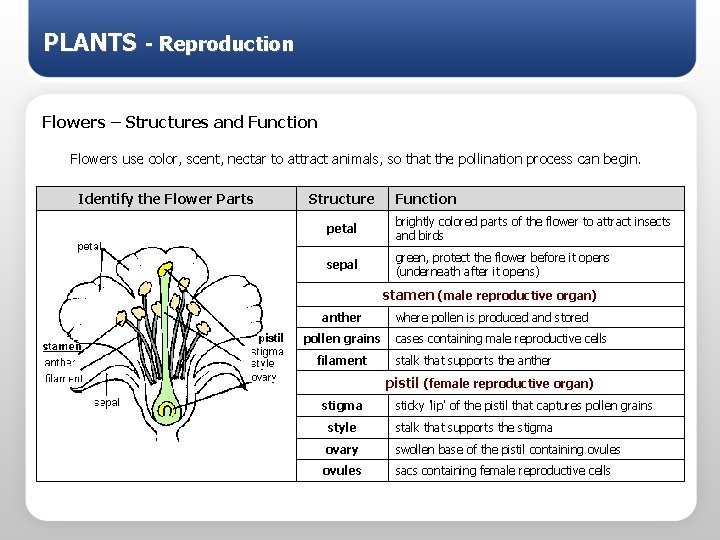
PLANTS - Reproduction Flowers – Structures and Function Flowers use color, scent, nectar to attract animals, so that the pollination process can begin. Identify the Flower Parts Structure Function petal brightly colored parts of the flower to attract insects and birds sepal green, protect the flower before it opens (underneath after it opens) stamen (male reproductive organ) anther pollen grains filament where pollen is produced and stored cases containing male reproductive cells stalk that supports the anther pistil (female reproductive organ) stigma sticky 'lip' of the pistil that captures pollen grains style stalk that supports the stigma ovary swollen base of the pistil containing ovules sacs containing female reproductive cells
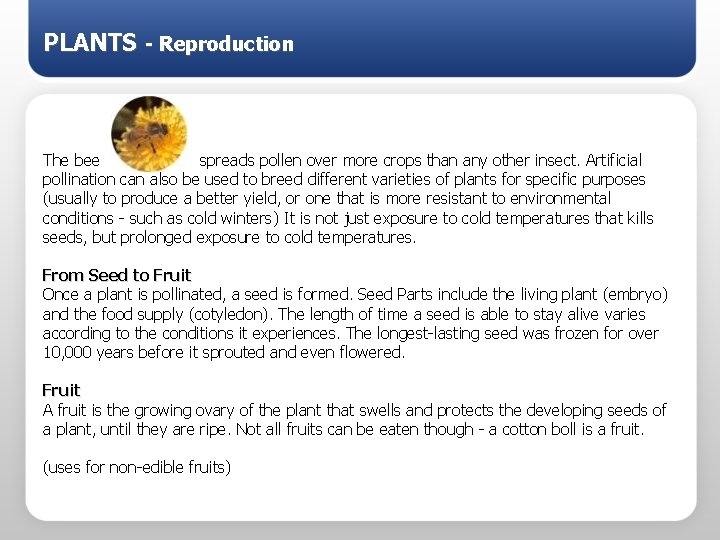
PLANTS - Reproduction The bee spreads pollen over more crops than any other insect. Artificial pollination can also be used to breed different varieties of plants for specific purposes (usually to produce a better yield, or one that is more resistant to environmental conditions - such as cold winters) It is not just exposure to cold temperatures that kills seeds, but prolonged exposure to cold temperatures. From Seed to Fruit Once a plant is pollinated, a seed is formed. Seed Parts include the living plant (embryo) and the food supply (cotyledon). The length of time a seed is able to stay alive varies according to the conditions it experiences. The longest-lasting seed was frozen for over 10, 000 years before it sprouted and even flowered. Fruit A fruit is the growing ovary of the plant that swells and protects the developing seeds of a plant, until they are ripe. Not all fruits can be eaten though - a cotton boll is a fruit. (uses for non-edible fruits)
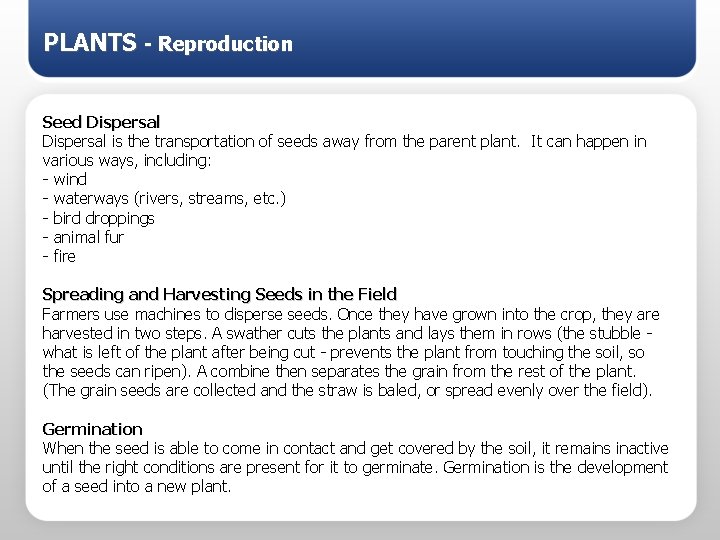
PLANTS - Reproduction Seed Dispersal is the transportation of seeds away from the parent plant. It can happen in various ways, including: - wind - waterways (rivers, streams, etc. ) - bird droppings - animal fur - fire Spreading and Harvesting Seeds in the Field Farmers use machines to disperse seeds. Once they have grown into the crop, they are harvested in two steps. A swather cuts the plants and lays them in rows (the stubble what is left of the plant after being cut - prevents the plant from touching the soil, so the seeds can ripen). A combine then separates the grain from the rest of the plant. (The grain seeds are collected and the straw is baled, or spread evenly over the field). Germination When the seed is able to come in contact and get covered by the soil, it remains inactive until the right conditions are present for it to germinate. Germination is the development of a seed into a new plant.
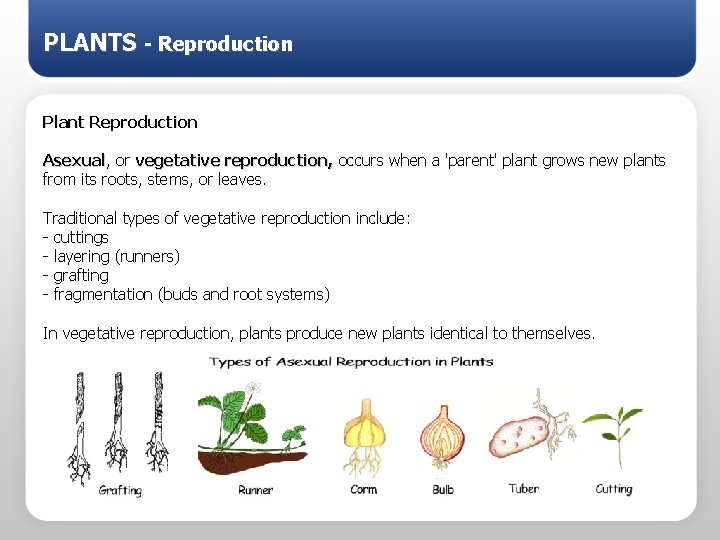
PLANTS - Reproduction Plant Reproduction Asexual, Asexual or vegetative reproduction, occurs when a 'parent' plant grows new plants from its roots, stems, or leaves. Traditional types of vegetative reproduction include: - cuttings - layering (runners) - grafting - fragmentation (buds and root systems) In vegetative reproduction, plants produce new plants identical to themselves.
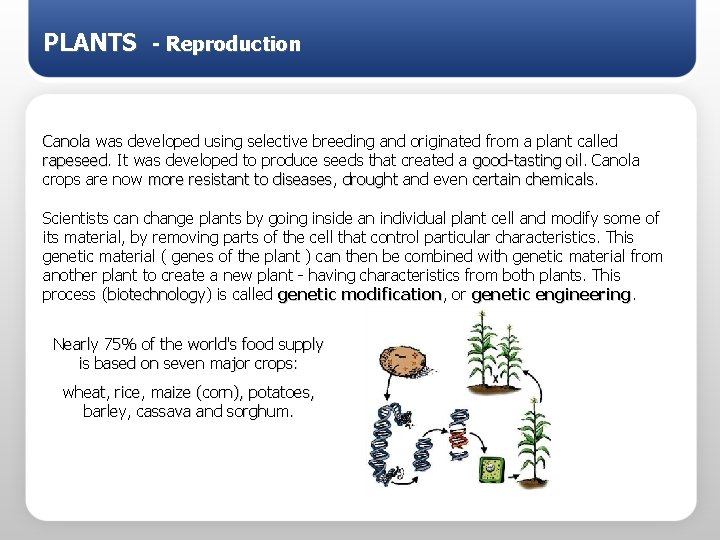
PLANTS - Reproduction Canola was developed using selective breeding and originated from a plant called rapeseed It was developed to produce seeds that created a good-tasting oil Canola crops are now more resistant to diseases, diseases drought and even certain chemicals Scientists can change plants by going inside an individual plant cell and modify some of its material, by removing parts of the cell that control particular characteristics. This genetic material ( genes of the plant ) can then be combined with genetic material from another plant to create a new plant - having characteristics from both plants. This process (biotechnology) biotechnology is called genetic modification, modification or genetic engineering Nearly 75% of the world's food supply is based on seven major crops: wheat, rice, maize (corn), potatoes, barley, cassava and sorghum.
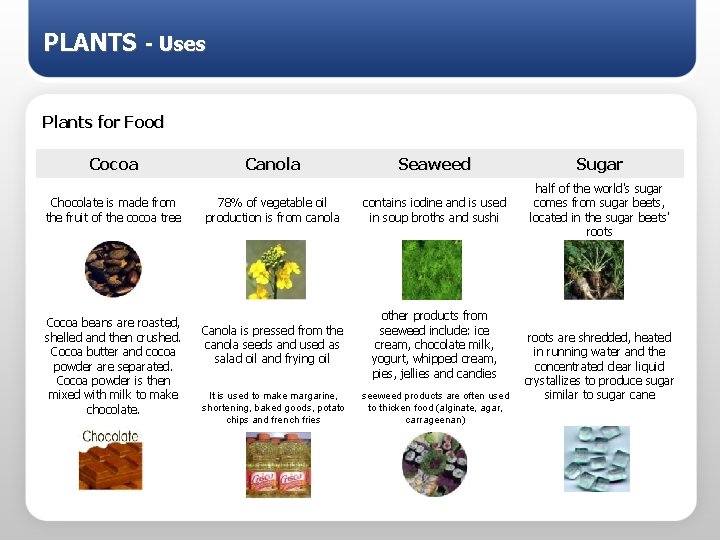
PLANTS - Uses Plants for Food Cocoa Canola Seaweed Sugar Chocolate is made from the fruit of the cocoa tree 78% of vegetable oil production is from canola contains iodine and is used in soup broths and sushi half of the world's sugar comes from sugar beets, located in the sugar beets' roots Canola is pressed from the canola seeds and used as salad oil and frying oil other products from seeweed include: ice cream, chocolate milk, yogurt, whipped cream, pies, jellies and candies It is used to make margarine, shortening, baked goods, potato chips and french fries seeweed products are often used to thicken food (alginate, agar, carrageenan) Cocoa beans are roasted, shelled and then crushed. Cocoa butter and cocoa powder are separated. Cocoa powder is then mixed with milk to make chocolate. roots are shredded, heated in running water and the concentrated clear liquid crystallizes to produce sugar similar to sugar cane
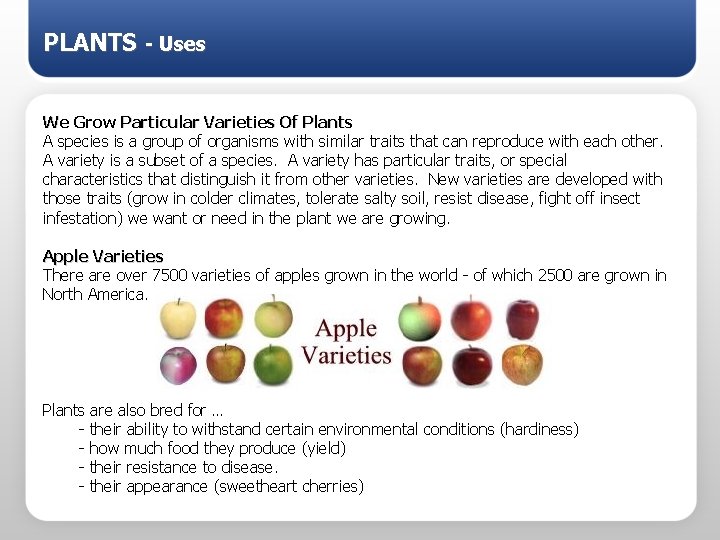
PLANTS - Uses We Grow Particular Varieties Of Plants A species is a group of organisms with similar traits that can reproduce with each other. A variety is a subset of a species. A variety has particular traits, or special characteristics that distinguish it from other varieties. New varieties are developed with those traits (grow in colder climates, tolerate salty soil, resist disease, fight off insect infestation) we want or need in the plant we are growing. Apple Varieties There are over 7500 varieties of apples grown in the world - of which 2500 are grown in North America. Plants are also bred for … - their ability to withstand certain environmental conditions (hardiness) - how much food they produce (yield) - their resistance to disease. - their appearance (sweetheart cherries)
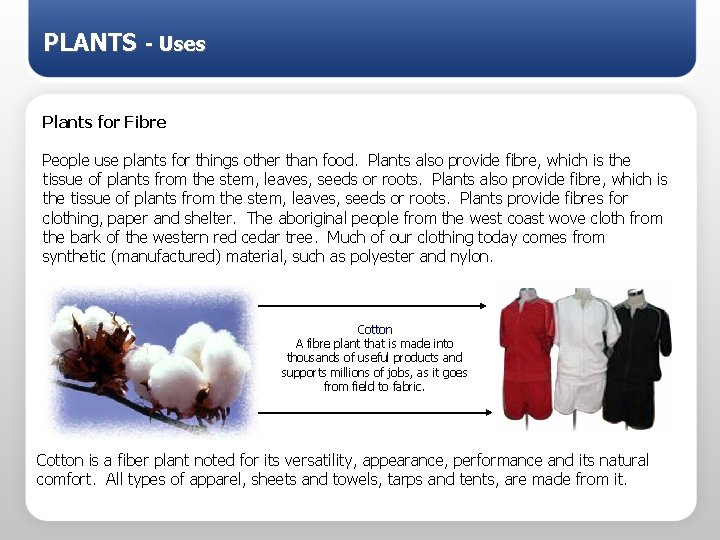
PLANTS - Uses Plants for Fibre People use plants for things other than food. Plants also provide fibre, which is the tissue of plants from the stem, leaves, seeds or roots. Plants provide fibres for clothing, paper and shelter. The aboriginal people from the west coast wove cloth from the bark of the western red cedar tree. Much of our clothing today comes from synthetic (manufactured) material, such as polyester and nylon. Cotton A fibre plant that is made into thousands of useful products and supports millions of jobs, as it goes from field to fabric. Cotton is a fiber plant noted for its versatility, appearance, performance and its natural comfort. All types of apparel, sheets and towels, tarps and tents, are made from it.
PLANTS - Uses Natural fibres provide resources for cloth: Cotton - is a natural fibre that absorbs moisture and then allows it to evaporate easily, making it the world's most important non-edible plant. The cotton fibres come from the plant's seeds. The silky fibres are strong, flexible and have a gradual spiral that causes the strands to interlock when twisted, making them ideal for spinning into thread. The second layer of fibers are shorter and are 'fuzzy' - they are used to make cotton batting, rayon and various types of plastic and paper. Hemp - Early makers of jeans used hemp, which is the oldest cultivated fibre plant in the world. Other products included the Bible, sails and ropes. Hemp has a less negative effect on the environment, because it uses less land area than trees, can be harvested in a year, lasts longer than paper, can be recycled up to seven times, chokes out weeds naturally and is not prone to insect pests. Flax - is a food and fibre crop. The flax fibres, which are smooth and straight, are taken from the stem of the plant are two to three times stronger than cotton fibres. Flax fibre is used for making linen paper, linseed oil - which is used as a drying oil in paints and varnish - and in products such as linoleum and printing inks.
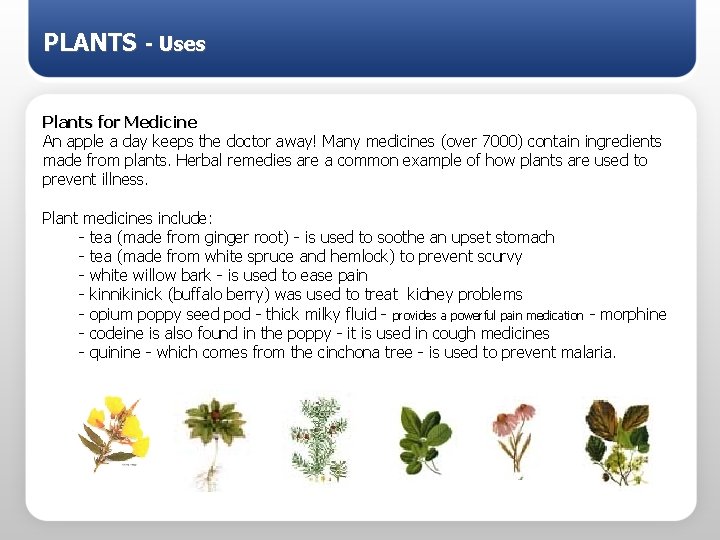
PLANTS - Uses Plants for Medicine An apple a day keeps the doctor away! Many medicines (over 7000) contain ingredients made from plants. Herbal remedies are a common example of how plants are used to prevent illness. Plant medicines include: - tea (made from ginger root) - is used to soothe an upset stomach - tea (made from white spruce and hemlock) to prevent scurvy - white willow bark - is used to ease pain - kinnikinick (buffalo berry) was used to treat kidney problems - opium poppy seed pod - thick milky fluid - provides a powerful pain medication - morphine - codeine is also found in the poppy - it is used in cough medicines - quinine - which comes from the cinchona tree - is used to prevent malaria.
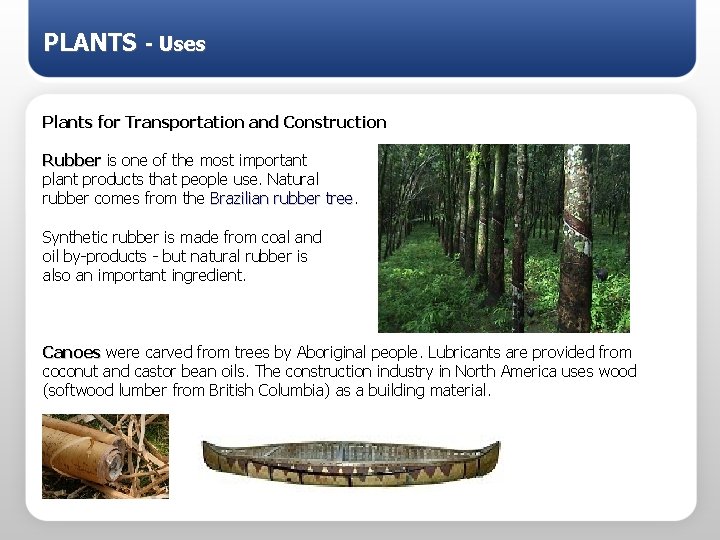
PLANTS - Uses Plants for Transportation and Construction Rubber is one of the most important plant products that people use. Natural rubber comes from the Brazilian rubber tree Synthetic rubber is made from coal and oil by-products - but natural rubber is also an important ingredient. Canoes were carved from trees by Aboriginal people. Lubricants are provided from coconut and castor bean oils. The construction industry in North America uses wood (softwood lumber from British Columbia) as a building material.
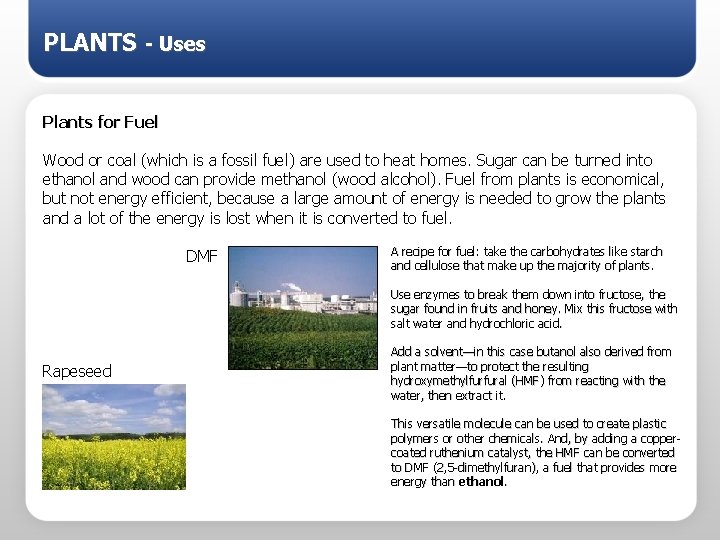
PLANTS - Uses Plants for Fuel Wood or coal (which is a fossil fuel) are used to heat homes. Sugar can be turned into ethanol and wood can provide methanol (wood alcohol). Fuel from plants is economical, but not energy efficient, because a large amount of energy is needed to grow the plants and a lot of the energy is lost when it is converted to fuel. DMF A recipe for fuel: take the carbohydrates like starch and cellulose that make up the majority of plants. Use enzymes to break them down into fructose, the sugar found in fruits and honey. Mix this fructose with salt water and hydrochloric acid. Rapeseed Add a solvent—in this case butanol also derived from plant matter—to protect the resulting hydroxymethylfurfural (HMF) from reacting with the water, then extract it. This versatile molecule can be used to create plastic polymers or other chemicals. And, by adding a coppercoated ruthenium catalyst, the HMF can be converted to DMF (2, 5 -dimethylfuran), a fuel that provides more energy than ethanol.
PLANTS - Uses Living resources are living things that can be used for human needs. Managing living resources involves maintaining healthy populations of all living things that make up those resources. Because we grow more than we consume, Canada exports the excess to other countries around the world. Canada is also a leader in forestry and agricultural research science. Changing practices in using the living resources the land provides has resulted in certain stresses on these resources. This has led to the need to become better mangers of the resources we have and need. Scientists, farmers and foresters are working together, developing practices that will reduce the negative effects that sometimes occur when we harvest plants for food and fibre. Sustainability (an ecological balance) is essential, if we are to keep our living resources healthy in the long term.
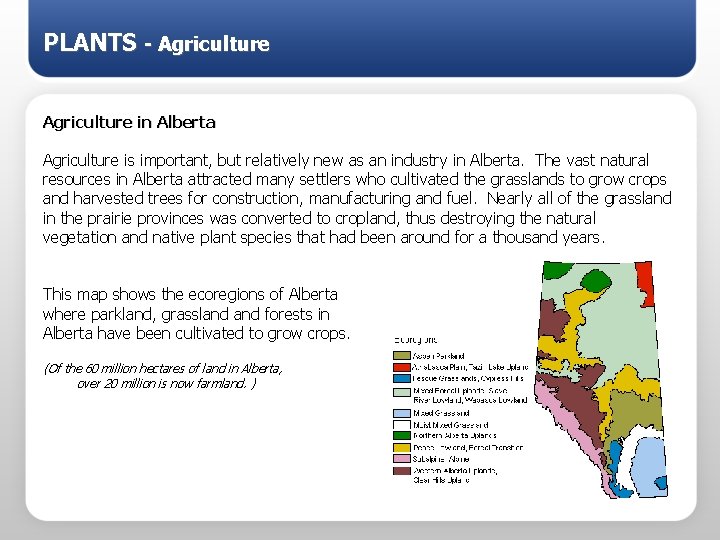
PLANTS - Agriculture in Alberta Agriculture is important, but relatively new as an industry in Alberta. The vast natural resources in Alberta attracted many settlers who cultivated the grasslands to grow crops and harvested trees for construction, manufacturing and fuel. Nearly all of the grassland in the prairie provinces was converted to cropland, thus destroying the natural vegetation and native plant species that had been around for a thousand years. This map shows the ecoregions of Alberta where parkland, grassland forests in Alberta have been cultivated to grow crops. (Of the 60 million hectares of land in Alberta, over 20 million is now farmland. )
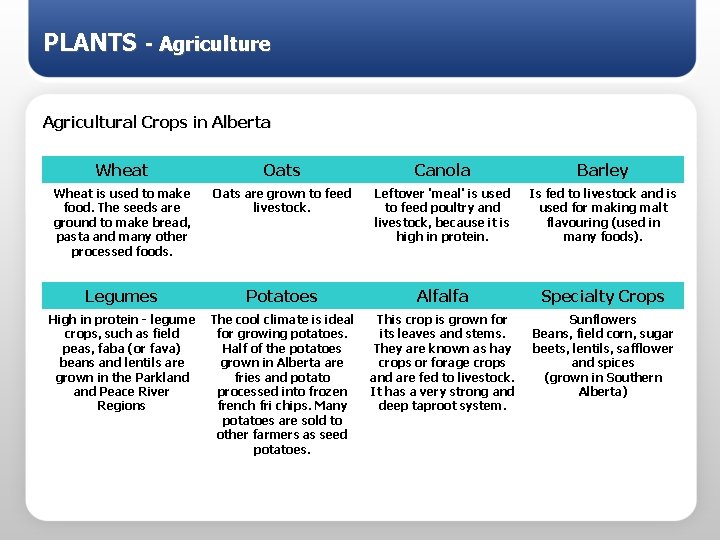
PLANTS - Agriculture Agricultural Crops in Alberta Wheat Oats Canola Barley Wheat is used to make food. The seeds are ground to make bread, pasta and many other processed foods. Oats are grown to feed livestock. Leftover 'meal' is used to feed poultry and livestock, because it is high in protein. Is fed to livestock and is used for making malt flavouring (used in many foods). Legumes Potatoes Alfalfa Specialty Crops High in protein - legume crops, such as field peas, faba (or fava) beans and lentils are grown in the Parkland Peace River Regions The cool climate is ideal for growing potatoes. Half of the potatoes grown in Alberta are fries and potato processed into frozen french fri chips. Many potatoes are sold to other farmers as seed potatoes. This crop is grown for its leaves and stems. They are known as hay crops or forage crops and are fed to livestock. It has a very strong and deep taproot system. Sunflowers Beans, field corn, sugar beets, lentils, safflower and spices (grown in Southern Alberta)
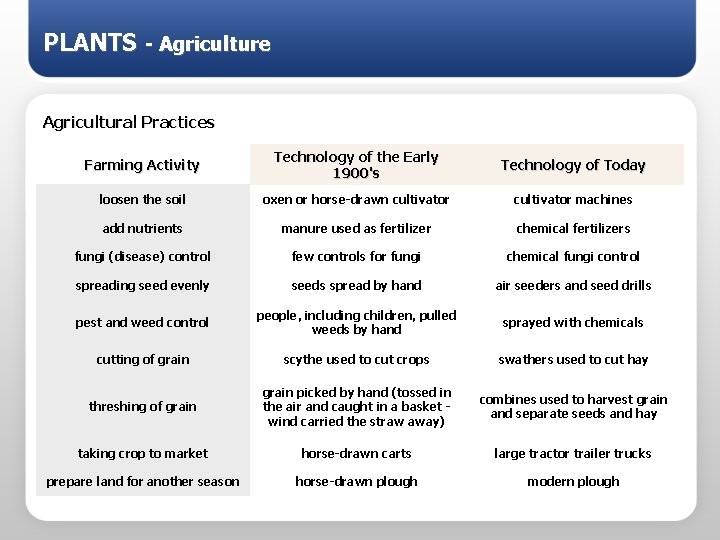
PLANTS - Agriculture Agricultural Practices Growing Under Glass The yield from crops that are grown outdoors is highly dependent on the environmental conditions, climate and soil types. In a greenhouse all of the growing conditions can be controlled. There are obvious advantages, but there also disadvantages. A great advantage is a higher yield, yield while the disadvantage is the cost of growing A wide range of warm-season crops, including seedless cucumbers, tomatoes, lettuce, peppers, house plants, and cut flowers grown in greenhouses To be economically sustainable, farmers need to make more money with their crops than they spend to grow their crops. They are able to do this by using very large machinery that can cover large parcels of land as they seed and harvest their crops. They also need to add fertilizer to the soil to increase the yield and irrigate to provide the need moisture for growth of the crop. As you can see in the next slide, farming practices changed from using human and animal power in the early 1900's, to total mechanization by the 1950's, to modern computerized controls in the present.
PLANTS - Agriculture Agricultural Practices Farming Activity Technology of the Early 1900's Technology of Today loosen the soil oxen or horse-drawn cultivator machines add nutrients manure used as fertilizer chemical fertilizers fungi (disease) control few controls for fungi chemical fungi control spreading seed evenly seeds spread by hand air seeders and seed drills pest and weed control people, including children, pulled weeds by hand sprayed with chemicals cutting of grain scythe used to cut crops swathers used to cut hay threshing of grain picked by hand (tossed in the air and caught in a basket wind carried the straw away) combines used to harvest grain and separate seeds and hay taking crop to market horse-drawn carts large tractor trailer trucks prepare land for another season horse-drawn plough modern plough
PLANTS - Forestry Global Problems Erosion is a worldwide problem. Frequent and long-lasting droughts have resulted in desertification - a process in which desert has taken over much of the agricultural land. Forestry in Alberta Canada has about 10% of the world's forests. Alberta tree species most valued for lumber and paper include: Lodgepole Pine, White Spruce, Black Spruce, Aspen, Tamarack (Larch) and White Birch. From these forests come lumber and pulp and paper products. Natural forests have many different kinds of trees, shrubs, and smaller plants. There are many animals that make their homes in, around and under these plants. A natural ecosystem has a higher diversity, or variety, of plants and animals than a field of wheat or a stand of trees. The species within this ecosystem are all interdependent. Forestry practices can increase the diversity of forest species by careful cutting to let in more light and air.
PLANTS - Forestry Harvesting the Forest Agencies that mange forests resources establish methods and regulations that foresters must follow when a forest is to be harvested. These regulations provide the rules for harvesting. Forest fires are a natural development of forests, but foresters try to ensure that they burn in a controlled fashion (as much as possible). Foresters explore a potential tree cutting area thoroughly before any work begins. They map the area indicating which species of trees are to be cut and what special features should be noted. They also decide how to cut the trees, either clear cut (removing all the trees) or, selective harvesting (removing only selected trees). Reforestation Foresters attempt to improve the conditions (light, temperature, water and nutrients) within the forest. Leftover branches (from the logging operations) must be disposed of. They are chopped (shredded) spread out over the forest floor and some smaller piles are burned. Replanting is always done by hand. When the trees begin to grow again, if too many of a particular kind compete, they must be removed by thinning or pruning. Fertilizer is dropped from a helicopter to improve the level of nutrients for the young trees.
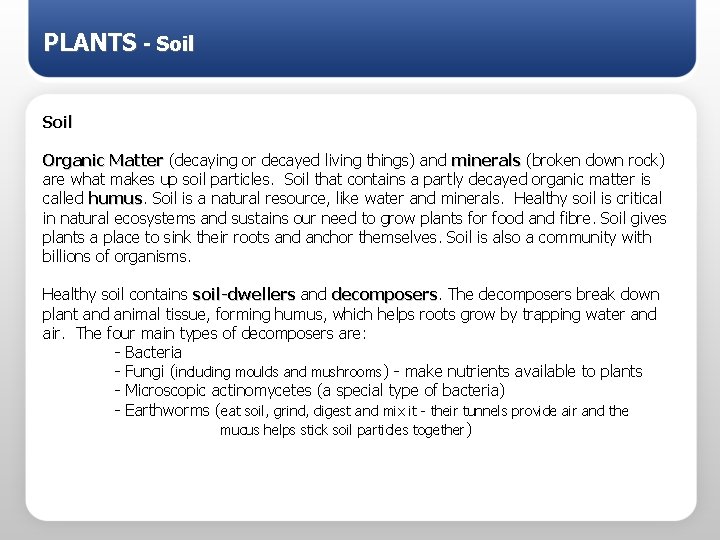
PLANTS - Soil Organic Matter (decaying or decayed living things) and minerals (broken down rock) are what makes up soil particles. Soil that contains a partly decayed organic matter is called humus Soil is a natural resource, like water and minerals. Healthy soil is critical in natural ecosystems and sustains our need to grow plants for food and fibre. Soil gives plants a place to sink their roots and anchor themselves. Soil is also a community with billions of organisms. Healthy soil contains soil-dwellers and decomposers The decomposers break down plant and animal tissue, forming humus, which helps roots grow by trapping water and air. The four main types of decomposers are: - Bacteria - Fungi (including moulds and mushrooms) - make nutrients available to plants - Microscopic actinomycetes (a special type of bacteria) - Earthworms (eat soil, grind, digest and mix it - their tunnels provide air and the mucus helps stick soil particles together )
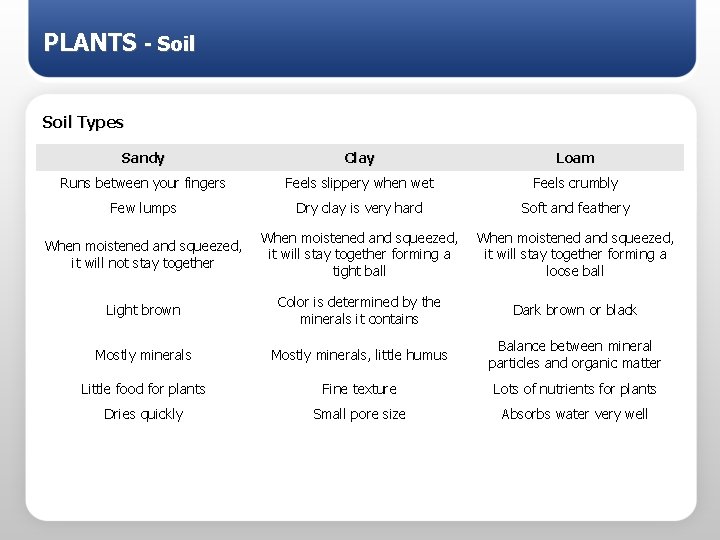
PLANTS - Soil Types Sandy Clay Loam Runs between your fingers Feels slippery when wet Feels crumbly Few lumps Dry clay is very hard Soft and feathery When moistened and squeezed, it will not stay together When moistened and squeezed, it will stay together forming a tight ball When moistened and squeezed, it will stay together forming a loose ball Light brown Color is determined by the minerals it contains Dark brown or black Mostly minerals, little humus Balance between mineral particles and organic matter Little food for plants Fine texture Lots of nutrients for plants Dries quickly Small pore size Absorbs water very well
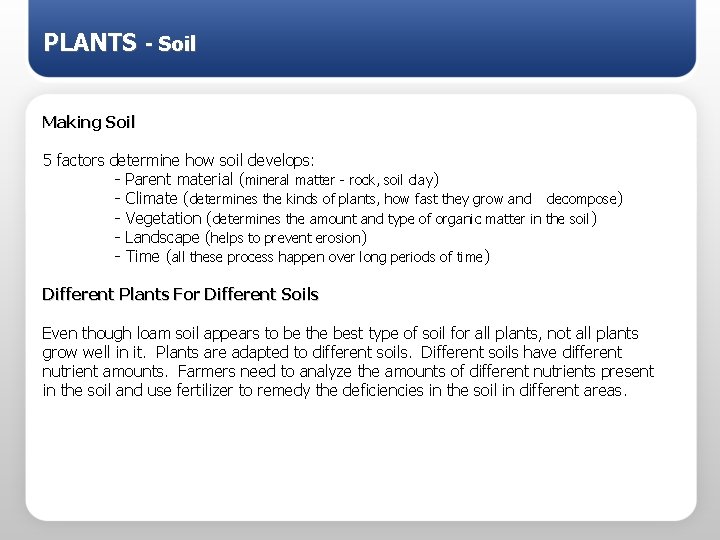
PLANTS - Soil Making Soil 5 factors determine how soil develops: - Parent material (mineral matter - rock, soil clay) - Climate (determines the kinds of plants, how fast they grow and decompose) - Vegetation (determines the amount and type of organic matter in the soil) - Landscape (helps to prevent erosion) - Time (all these process happen over long periods of time) Different Plants For Different Soils Even though loam soil appears to be the best type of soil for all plants, not all plants grow well in it. Plants are adapted to different soils. Different soils have different nutrient amounts. Farmers need to analyze the amounts of different nutrients present in the soil and use fertilizer to remedy the deficiencies in the soil in different areas.
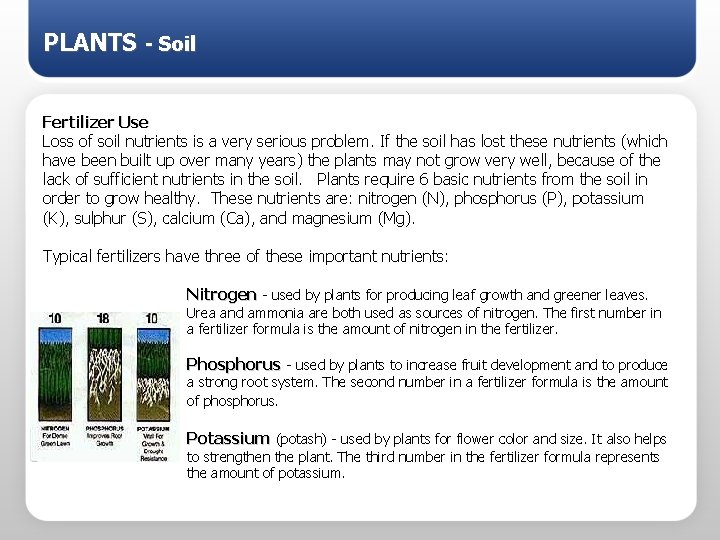
PLANTS - Soil Fertilizer Use Loss of soil nutrients is a very serious problem. If the soil has lost these nutrients (which have been built up over many years) the plants may not grow very well, because of the lack of sufficient nutrients in the soil. Plants require 6 basic nutrients from the soil in order to grow healthy. These nutrients are: nitrogen (N), phosphorus (P), potassium (K), sulphur (S), calcium (Ca), and magnesium (Mg). Typical fertilizers have three of these important nutrients: Nitrogen - used by plants for producing leaf growth and greener leaves. Urea and ammonia are both used as sources of nitrogen. The first number in a fertilizer formula is the amount of nitrogen in the fertilizer. Phosphorus - used by plants to increase fruit development and to produce a strong root system. The second number in a fertilizer formula is the amount of phosphorus. Potassium (potash) - used by plants for flower color and size. It also helps to strengthen the plant. The third number in the fertilizer formula represents the amount of potassium.
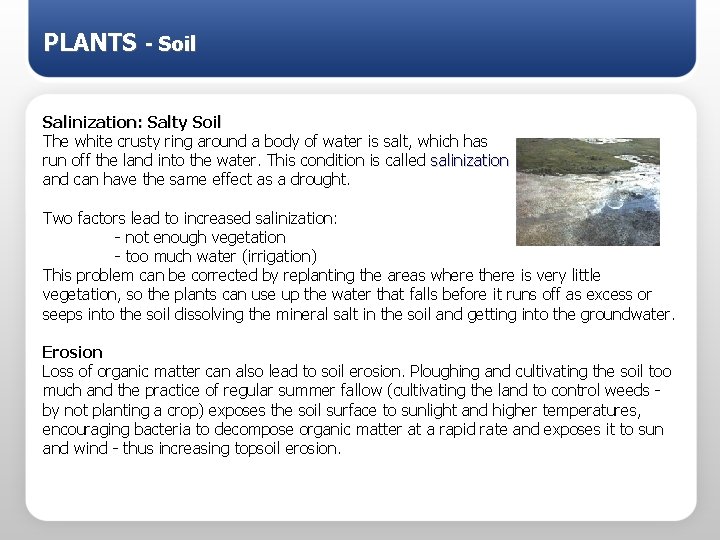
PLANTS - Soil Salinization: Salty Soil The white crusty ring around a body of water is salt, which has run off the land into the water. This condition is called salinization and can have the same effect as a drought. Two factors lead to increased salinization: - not enough vegetation - too much water (irrigation) This problem can be corrected by replanting the areas where there is very little vegetation, so the plants can use up the water that falls before it runs off as excess or seeps into the soil dissolving the mineral salt in the soil and getting into the groundwater. Erosion Loss of organic matter can also lead to soil erosion. Ploughing and cultivating the soil too much and the practice of regular summer fallow (cultivating the land to control weeds by not planting a crop) exposes the soil surface to sunlight and higher temperatures, encouraging bacteria to decompose organic matter at a rapid rate and exposes it to sun and wind - thus increasing topsoil erosion.
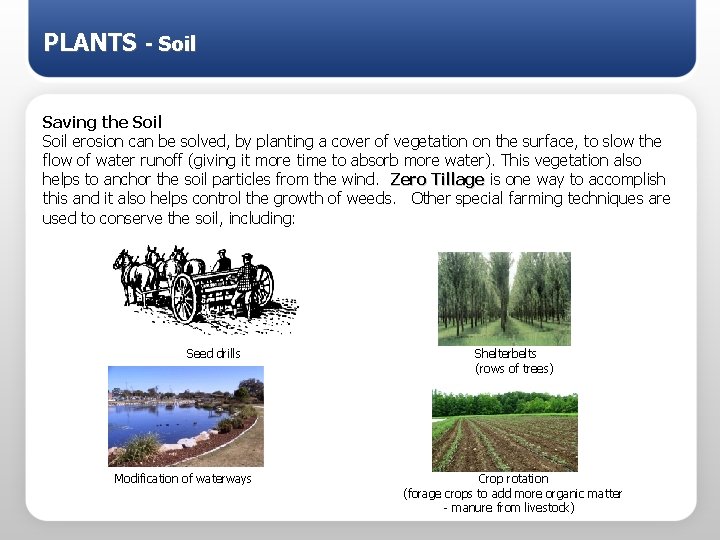
PLANTS - Soil Saving the Soil erosion can be solved, by planting a cover of vegetation on the surface, to slow the flow of water runoff (giving it more time to absorb more water). This vegetation also helps to anchor the soil particles from the wind. Zero Tillage is one way to accomplish this and it also helps control the growth of weeds. Other special farming techniques are used to conserve the soil, including: Seed drills Modification of waterways Shelterbelts (rows of trees) Crop rotation (forage crops to add more organic matter - manure from livestock)
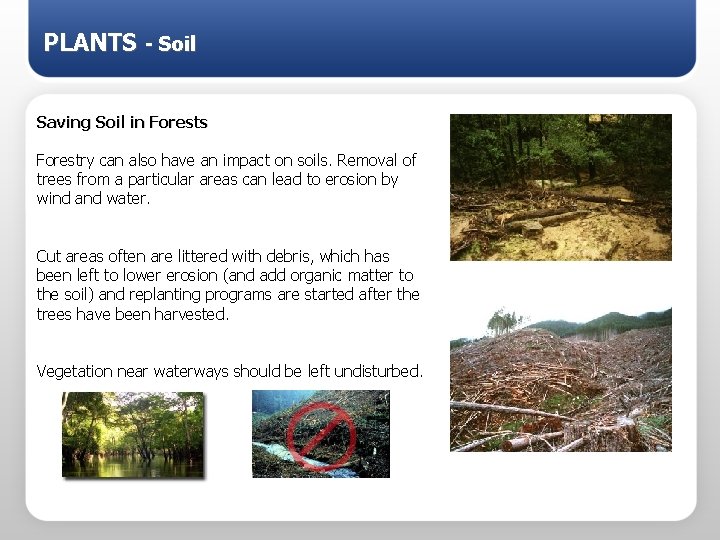
PLANTS - Soil Saving Soil in Forests Forestry can also have an impact on soils. Removal of trees from a particular areas can lead to erosion by wind and water. Cut areas often are littered with debris, which has been left to lower erosion (and add organic matter to the soil) and replanting programs are started after the trees have been harvested. Vegetation near waterways should be left undisturbed.
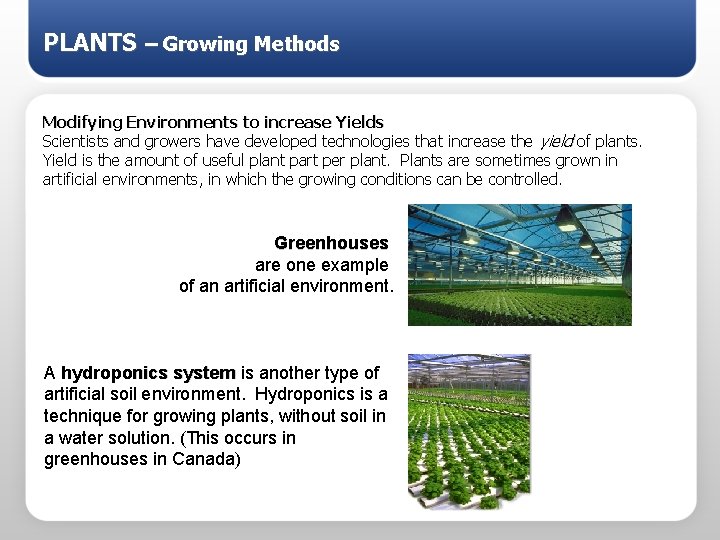
PLANTS – Growing Methods Modifying Environments to increase Yields Scientists and growers have developed technologies that increase the yield of plants. Yield is the amount of useful plant part per plant. Plants are sometimes grown in artificial environments, in which the growing conditions can be controlled. Greenhouses are one example of an artificial environment. A hydroponics system is another type of artificial soil environment. Hydroponics is a technique for growing plants, without soil in a water solution. (This occurs in greenhouses in Canada)
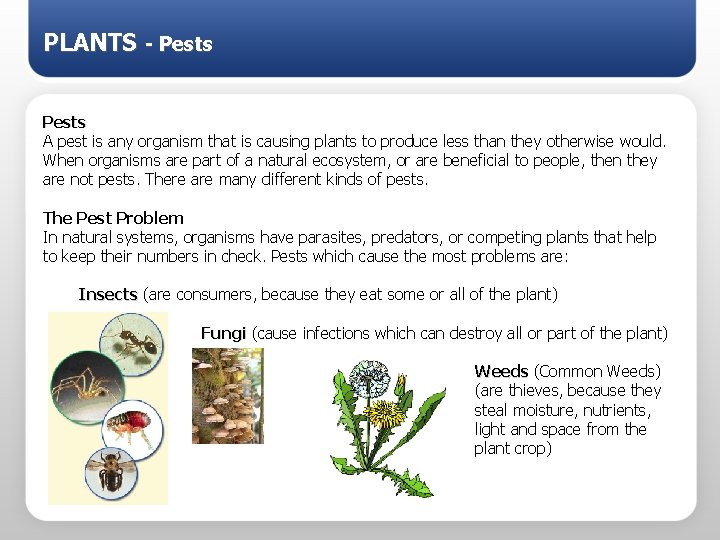
PLANTS - Pests A pest is any organism that is causing plants to produce less than they otherwise would. When organisms are part of a natural ecosystem, or are beneficial to people, then they are not pests. There are many different kinds of pests. The Pest Problem In natural systems, organisms have parasites, predators, or competing plants that help to keep their numbers in check. Pests which cause the most problems are: Insects (are consumers, because they eat some or all of the plant) Fungi (cause infections which can destroy all or part of the plant) Weeds (Common Weeds) (are thieves, because they steal moisture, nutrients, light and space from the plant crop)
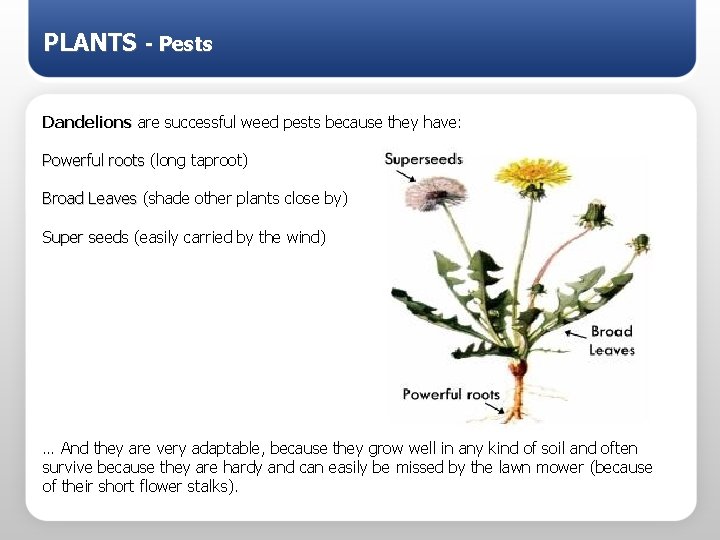
PLANTS - Pests Dandelions are successful weed pests because they have: Powerful roots (long taproot) Broad Leaves (shade other plants close by) Super seeds (easily carried by the wind) … And they are very adaptable, because they grow well in any kind of soil and often survive because they are hardy and can easily be missed by the lawn mower (because of their short flower stalks).
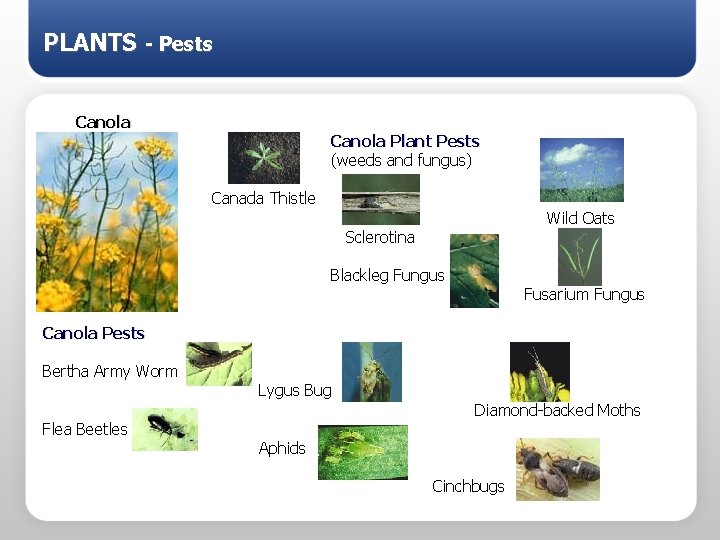
PLANTS - Pests Canola Plant Pests (weeds and fungus) Canada Thistle Wild Oats Sclerotina Blackleg Fungus Fusarium Fungus Canola Pests Bertha Army Worm Flea Beetles Lygus Bug Diamond-backed Moths Aphids Cinchbugs
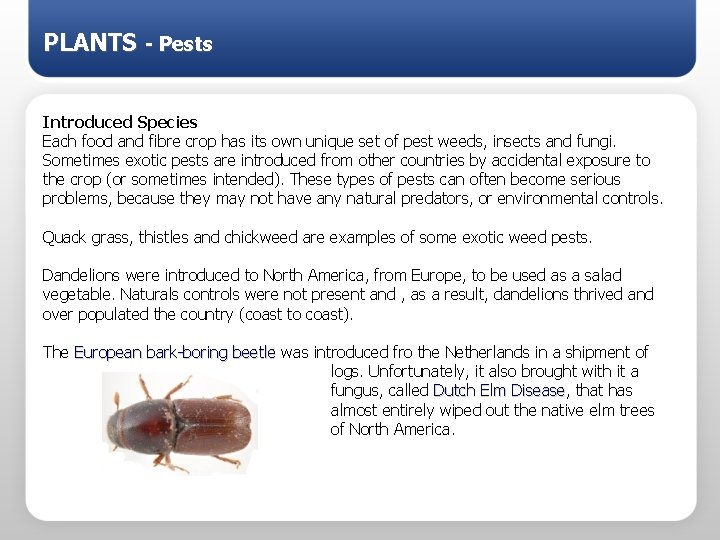
PLANTS - Pests Introduced Species Each food and fibre crop has its own unique set of pest weeds, insects and fungi. Sometimes exotic pests are introduced from other countries by accidental exposure to the crop (or sometimes intended). These types of pests can often become serious problems, because they may not have any natural predators, or environmental controls. Quack grass, thistles and chickweed are examples of some exotic weed pests. Dandelions were introduced to North America, from Europe, to be used as a salad vegetable. Naturals controls were not present and , as a result, dandelions thrived and over populated the country (coast to coast). The European bark-boring beetle was introduced fro the Netherlands in a shipment of logs. Unfortunately, it also brought with it a fungus, called Dutch Elm Disease, Disease that has almost entirely wiped out the native elm trees of North America.
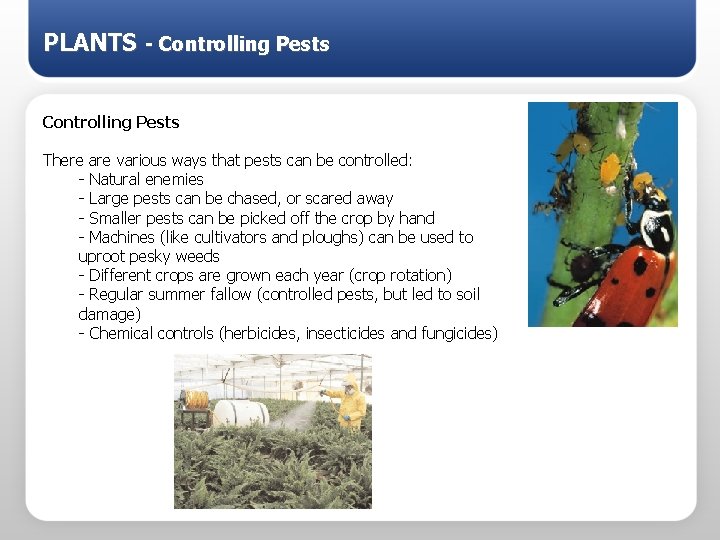
PLANTS - Controlling Pests There are various ways that pests can be controlled: - Natural enemies - Large pests can be chased, or scared away - Smaller pests can be picked off the crop by hand - Machines (like cultivators and ploughs) can be used to uproot pesky weeds - Different crops are grown each year (crop rotation) - Regular summer fallow (controlled pests, but led to soil damage) - Chemical controls (herbicides, insecticides and fungicides)
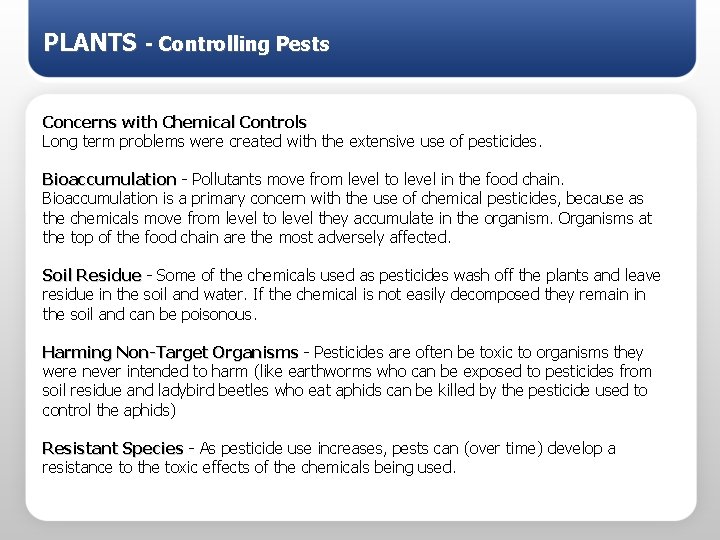
PLANTS - Controlling Pests Concerns with Chemical Controls Long term problems were created with the extensive use of pesticides. Bioaccumulation - Pollutants move from level to level in the food chain. Bioaccumulation is a primary concern with the use of chemical pesticides, because as the chemicals move from level to level they accumulate in the organism. Organisms at the top of the food chain are the most adversely affected. Soil Residue - Some of the chemicals used as pesticides wash off the plants and leave residue in the soil and water. If the chemical is not easily decomposed they remain in the soil and can be poisonous. Harming Non-Target Organisms - Pesticides are often be toxic to organisms they were never intended to harm (like earthworms who can be exposed to pesticides from soil residue and ladybird beetles who eat aphids can be killed by the pesticide used to control the aphids) Resistant Species - As pesticide use increases, pests can (over time) develop a resistance to the toxic effects of the chemicals being used.
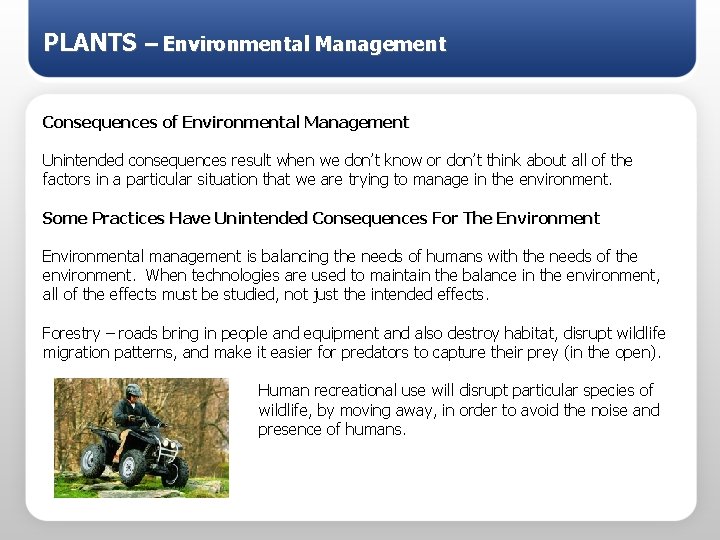
PLANTS – Environmental Management Consequences of Environmental Management Unintended consequences result when we don’t know or don’t think about all of the factors in a particular situation that we are trying to manage in the environment. Some Practices Have Unintended Consequences For The Environmental management is balancing the needs of humans with the needs of the environment. When technologies are used to maintain the balance in the environment, all of the effects must be studied, not just the intended effects. Forestry – roads bring in people and equipment and also destroy habitat, disrupt wildlife migration patterns, and make it easier for predators to capture their prey (in the open). Human recreational use will disrupt particular species of wildlife, by moving away, in order to avoid the noise and presence of humans.
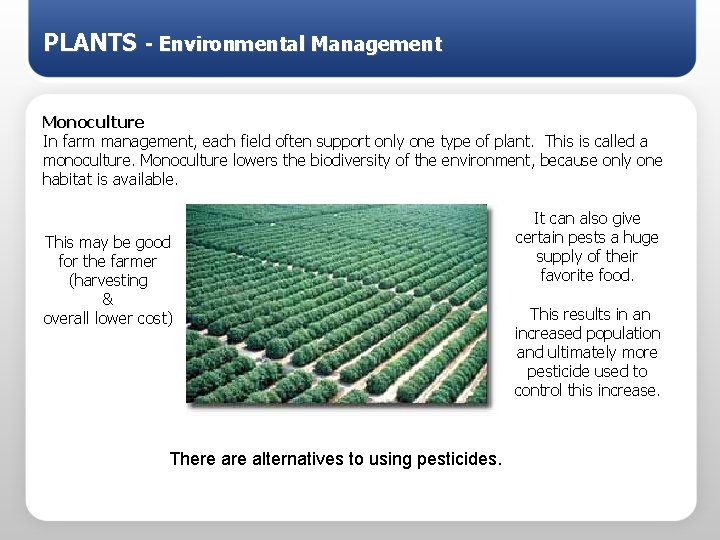
PLANTS - Environmental Management Monoculture In farm management, each field often support only one type of plant. This is called a monoculture. Monoculture lowers the biodiversity of the environment, because only one habitat is available. This may be good for the farmer (harvesting & overall lower cost) There alternatives to using pesticides. It can also give certain pests a huge supply of their favorite food. This results in an increased population and ultimately more pesticide used to control this increase.
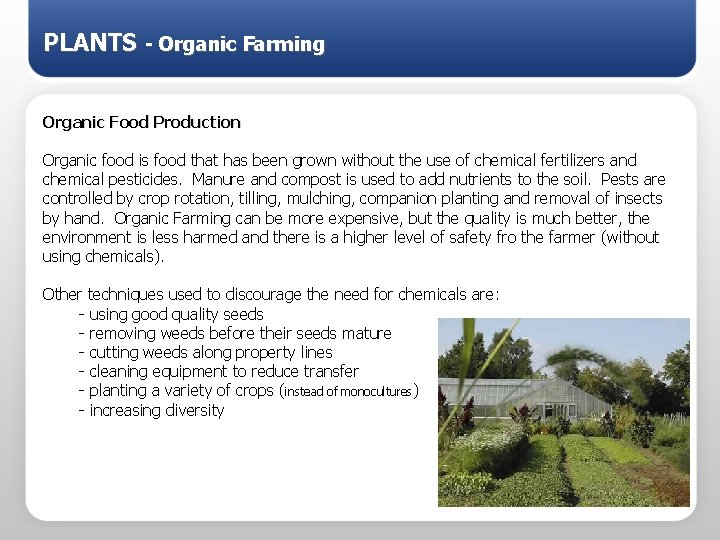
PLANTS - Organic Farming Organic Food Production Organic food is food that has been grown without the use of chemical fertilizers and chemical pesticides. Manure and compost is used to add nutrients to the soil. Pests are controlled by crop rotation, tilling, mulching, companion planting and removal of insects by hand. Organic Farming can be more expensive, but the quality is much better, the environment is less harmed and there is a higher level of safety fro the farmer (without using chemicals). Other techniques used to discourage the need for chemicals are: - using good quality seeds - removing weeds before their seeds mature - cutting weeds along property lines - cleaning equipment to reduce transfer - planting a variety of crops (instead of monocultures ) - increasing diversity
PLANTS - Sustainability Sustainable Management of Plants for Food and Fibre Producers, Producers such as farmers and foresters must make very careful economically feasible decisions about what to produce and the practices they use to produce it. Consumers must be more conscious of interdependence, and environmental impact factors, which must be taken into account, besides the cost, to ensure that the food and fibre industry is sustainable (so it will continue for a long time). Sustainable ways of producing plants (like crop rotation) rotation can also have some consequences other than just helping the environment: Breaks insect and disease cycle Improves soil structure Controls problem weeds Improves yield by as much as 15% Prevents the continued depletion of nutrients in the soil Makes economic sense Maintains a secure work environment for the grower and the workers