
Plants of the day Hawaiian Silversword alliance Madiinae
- Slides: 39
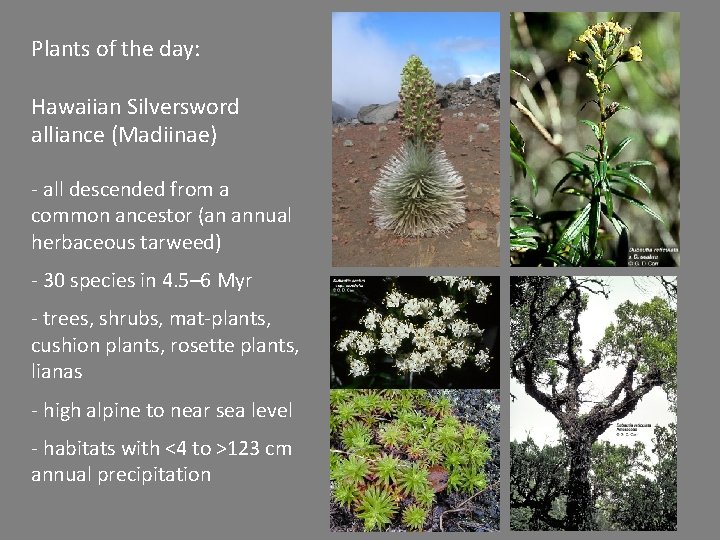
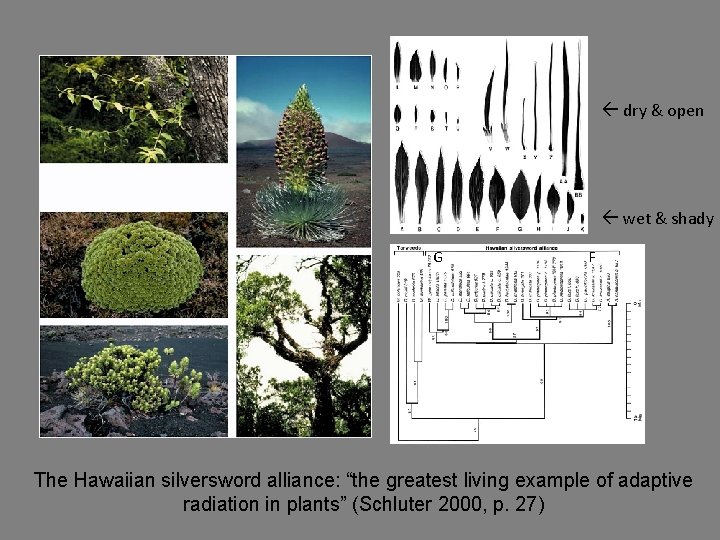
Plants of the day: Hawaiian Silversword alliance (Madiinae) - all descended from a common ancestor (an annual herbaceous tarweed) - 30 species in 4. 5– 6 Myr - trees, shrubs, mat-plants, cushion plants, rosette plants, lianas - high alpine to near sea level - habitats with <4 to >123 cm annual precipitation
Macroevolution Definition: evolution at or above the level of the species Also, long-term trends, biases, or patterns in the evolution of higher taxonomic levels.
big questions in macroevolution • Is evolution gradual or punctuated (characterized by periods of stasis and large “jumps”)? • What are the main drivers of macroevolutionary change? – intrinsic or extrinsic? – biotic or abiotic? • Why are some clades more diverse than others? • How do novel features evolve?
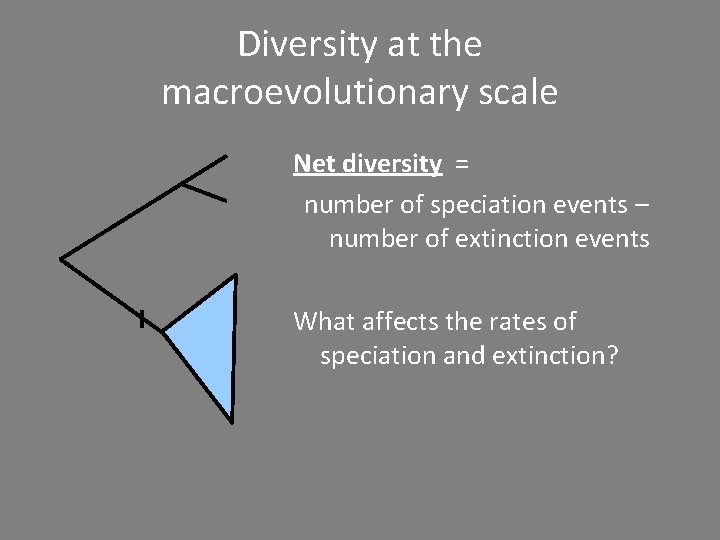
Diversity at the macroevolutionary scale Net diversity = number of speciation events – number of extinction events What affects the rates of speciation and extinction?
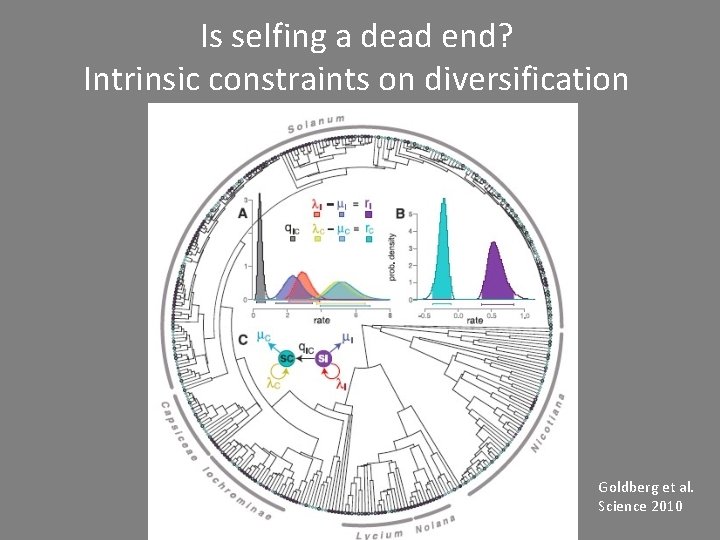
Is selfing a dead end? Intrinsic constraints on diversification Goldberg et al. Science 2010
What are the main extrinsic drivers of macroevolutionary change? • Physical environment (abotic) • Interaction with other species (biotic) • e. g. Darwin put a lot of emphasis on competition and predation Van Valen’s Red Queen hypothesis
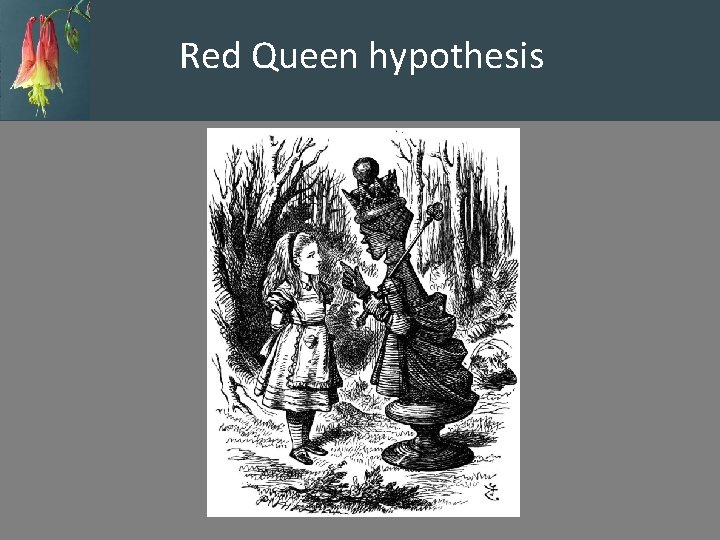
Red Queen hypothesis
Red Queen hypothesis The continual evolutionary change by a species that is necessary to retain its place in an ecosystem because of ongoing interactions with other species. Food supplies, predators, competitors, pathogens, parasites, and intraspecific dynamics are constantly in flux. the targets of selection keep changing, and so the organism is never perfectly adapted. Evidence for the Red Queen includes (from Benton 2009): – interspecific competition – character displacement – evolutionary arms races – incumbency advantage
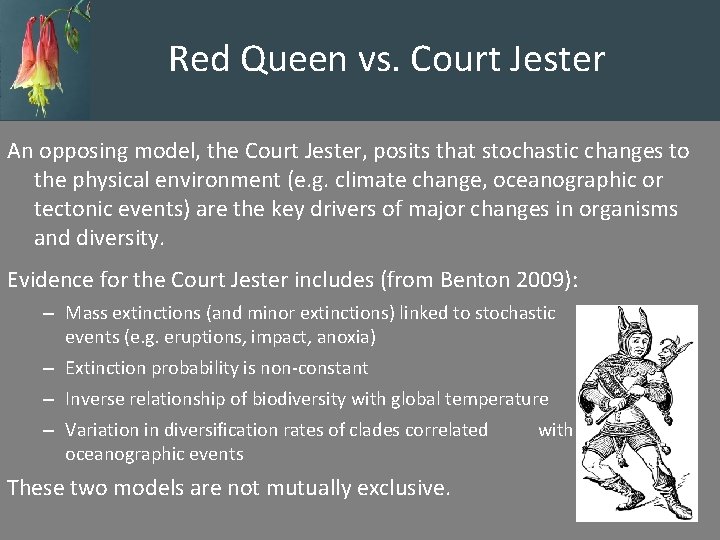
Red Queen vs. Court Jester An opposing model, the Court Jester, posits that stochastic changes to the physical environment (e. g. climate change, oceanographic or tectonic events) are the key drivers of major changes in organisms and diversity. Evidence for the Court Jester includes (from Benton 2009): – Mass extinctions (and minor extinctions) linked to stochastic events (e. g. eruptions, impact, anoxia) abiotic – Extinction probability is non-constant – Inverse relationship of biodiversity with global temperature – Variation in diversification rates of clades correlated oceanographic events These two models are not mutually exclusive. with tectonic and
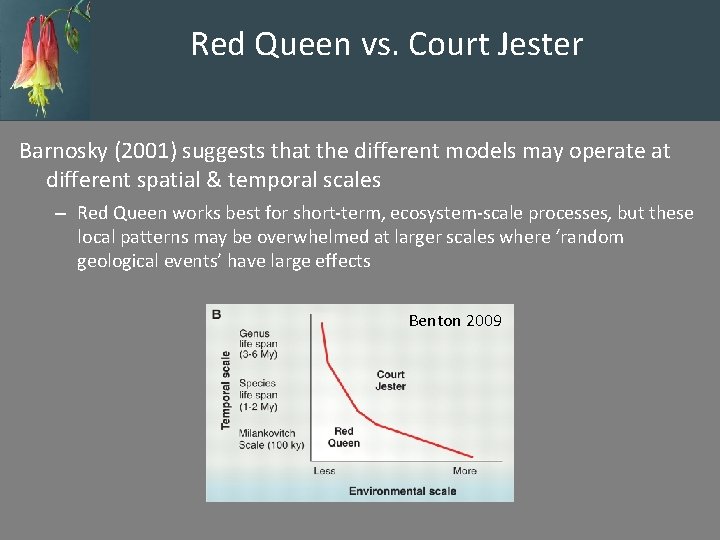
Red Queen vs. Court Jester Barnosky (2001) suggests that the different models may operate at different spatial & temporal scales – Red Queen works best for short-term, ecosystem-scale processes, but these local patterns may be overwhelmed at larger scales where ‘random geological events’ have large effects Benton 2009
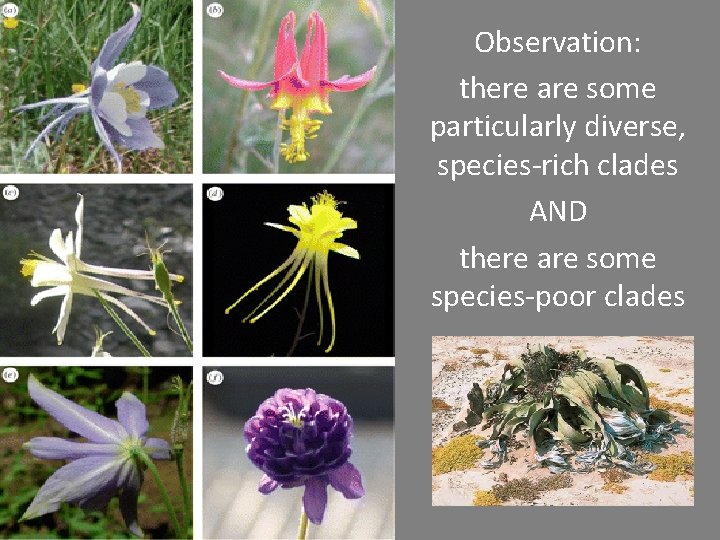
Observation: there are some particularly diverse, species-rich clades AND there are some species-poor clades
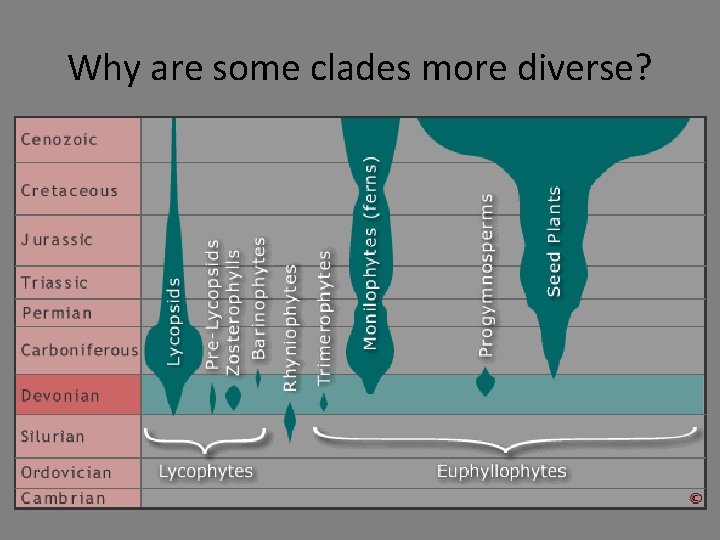
Why are some clades more diverse?
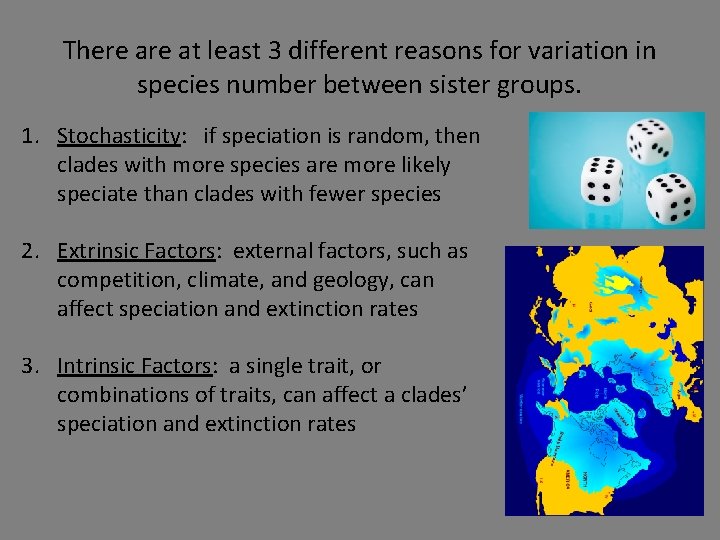
There at least 3 different reasons for variation in species number between sister groups. 1. Stochasticity: if speciation is random, then clades with more species are more likely speciate than clades with fewer species 2. Extrinsic Factors: external factors, such as competition, climate, and geology, can affect speciation and extinction rates 3. Intrinsic Factors: a single trait, or combinations of traits, can affect a clades’ speciation and extinction rates
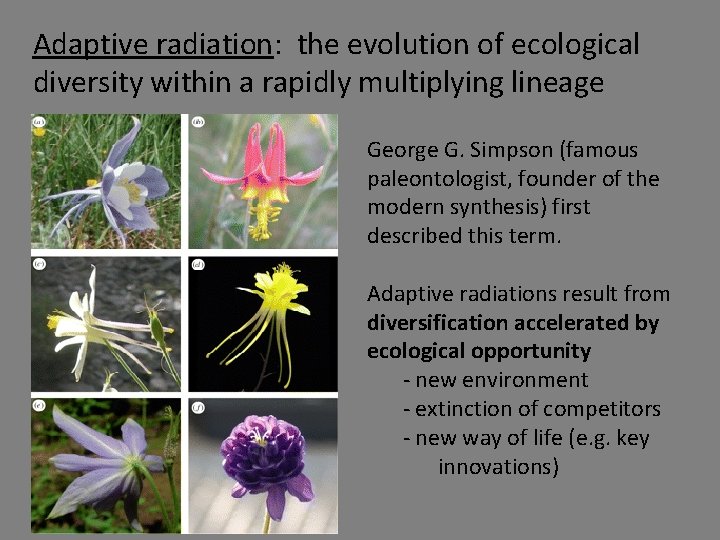
Adaptive radiation: the evolution of ecological diversity within a rapidly multiplying lineage George G. Simpson (famous paleontologist, founder of the modern synthesis) first described this term. Adaptive radiations result from diversification accelerated by ecological opportunity - new environment - extinction of competitors - new way of life (e. g. key innovations)
This view is echoed by Verne Grant… “When a species succeeds in establishing itself in a […] new habitat, it gains an ecological opportunity for expansion and diversification. [It] may respond to this opportunity by giving rise to […] daughter species adapted to different niches within the territory or habitat. These daughter species become the ancestors of […] new daughter species. The group enters its second phase of development, the phase of proliferation. ” “Adaptive radiation is the pattern of evolution in this phase of proliferation. And speciation is the dominant mode of evolution in adaptive radiation. ” (1977: p. 309)
Identifying adaptive radiations Criteria from Schluter 2000: 1) single common ancestor of component species 2) increase in speciation rate 3) associated increase in ecological and phenotypic diversity • phenotypes must be correlated with environments and increase fitness in “home” environment
dry & open wet & shady G F The Hawaiian silversword alliance: “the greatest living example of adaptive radiation in plants” (Schluter 2000, p. 27)
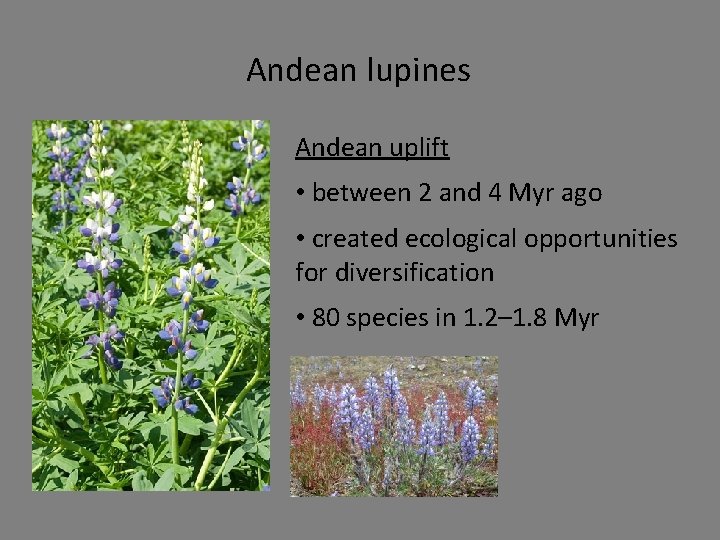
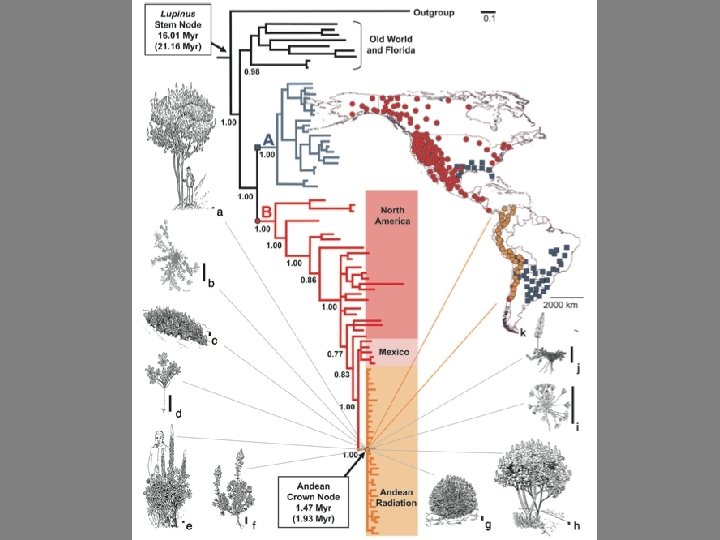
Andean lupines Andean uplift • between 2 and 4 Myr ago • created ecological opportunities for diversification • 80 species in 1. 2– 1. 8 Myr
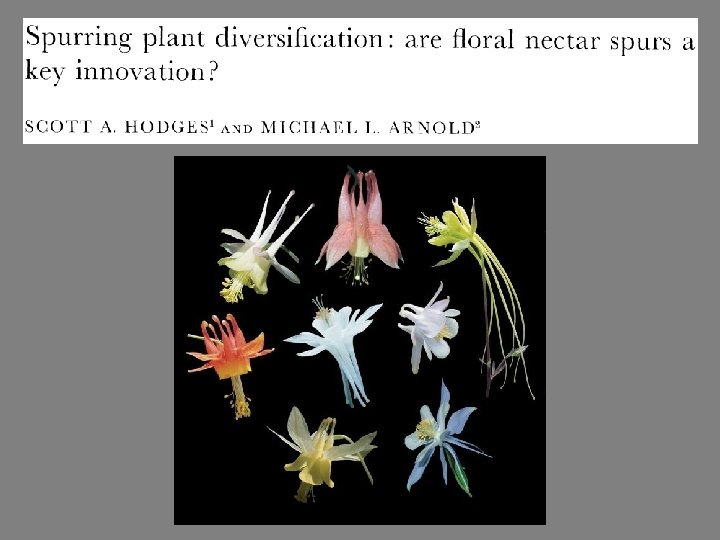
Adaptive radiation Caveats: 1) Few examples of strong causal relationships between rapid levels of adaptive diversification and speciation • genes underlying adaptive differences must be linked to/the same as those responsible for isolation • at minimum, ecological speciation has been documented in plants (e. g. sago palms, pollinator isolation in Aquilegia ) 2) The environment is not divided into predetermined niches in the absence of the organisms that inhabit them
(Non-)adaptive radiations Criteria from Schluter 2000: 1) common ancestor of component species 2) increase in speciation rate 3) associated increase in ecological and phenotypic diversity • phenotypes must be correlated with environment and also increase fitness
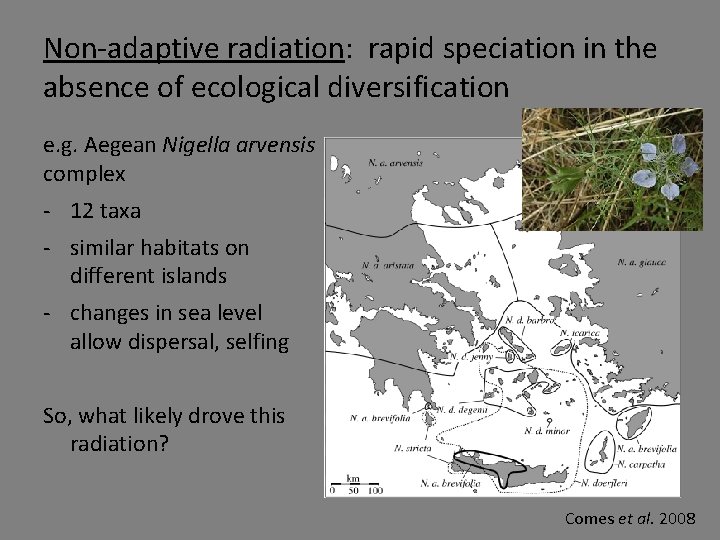
Non-adaptive radiation: rapid speciation in the absence of ecological diversification e. g. Aegean Nigella arvensis complex - 12 taxa - similar habitats on different islands - changes in sea level allow dispersal, selfing So, what likely drove this radiation? Comes et al. 2008
Intrinsic Factors: Key innovations are novel phenotypic traits thought to open new ‘adaptive zones’ (the ability to exploit new niches) or to increase diversification rates by decreasing extinction and/or increasing speciation rates.
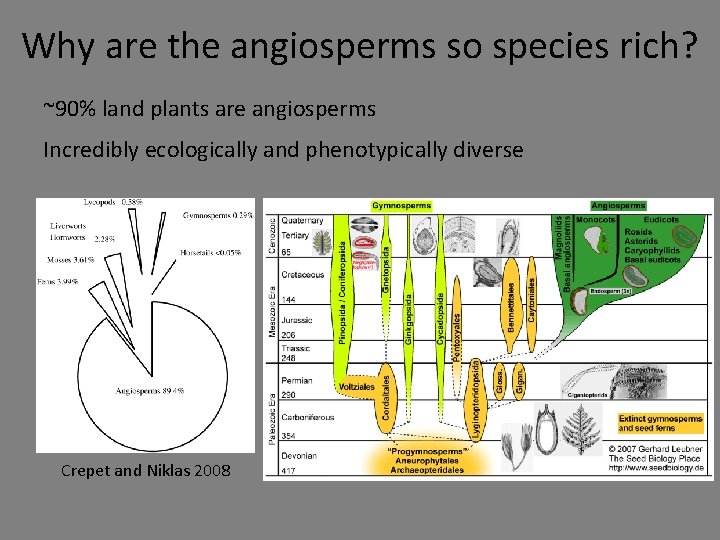
Why are the angiosperms so species rich? ~90% land plants are angiosperms Incredibly ecologically and phenotypically diverse Crepet and Niklas 2008
“The rapid development as far as we can judge of all the higher plants within recent geological times is an abominable mystery[. . . ] I should like to see this whole problem solved. I have fancied that perhaps there was during long ages a small isolated continent in the S. hemisphere which served as the birthplace of the higher plants—but this is a wretchedly poor conjecture. ” —Excerpt of a letter written by Charles Darwin on 22 July 1879 to Joseph Hooker
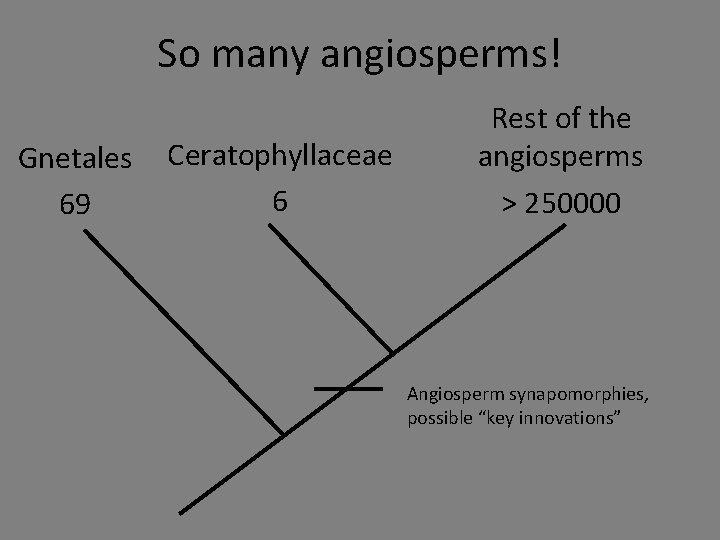
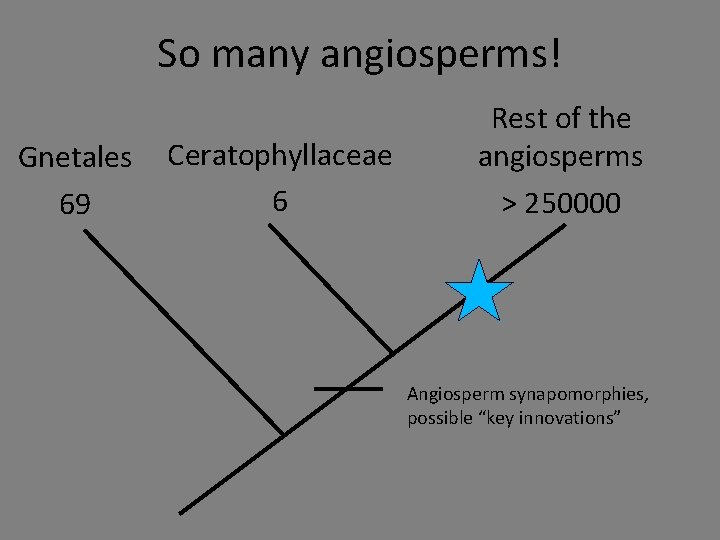
Solving Darwin’s Abominable Mystery Exercise: Could the angiosperms represent an adaptive radiation driven by one or a complex of key innovations? If so, can we identify the key innovations (angiosperm synapomorphies)?
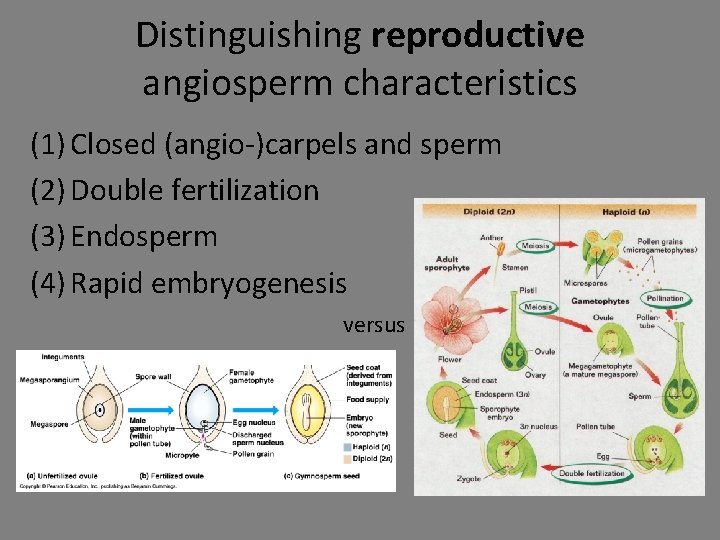
Distinguishing reproductive angiosperm characteristics (1) Closed (angio-)carpels and sperm (2) Double fertilization (3) Endosperm (4) Rapid embryogenesis versus
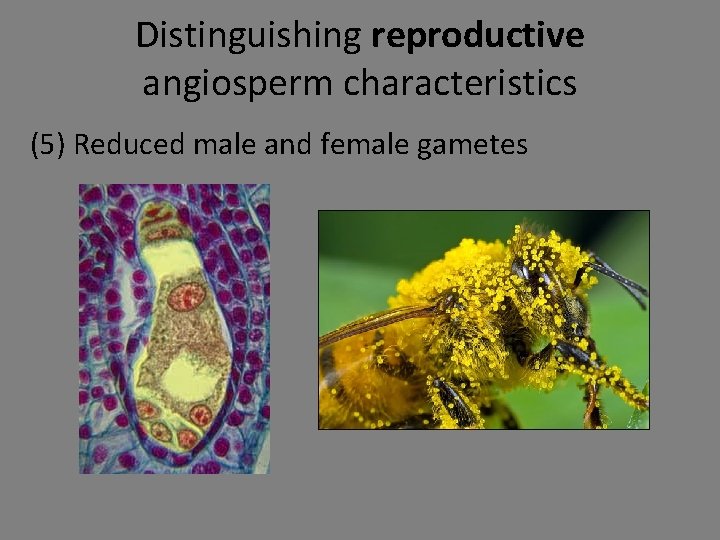
Distinguishing reproductive angiosperm characteristics (5) Reduced male and female gametes
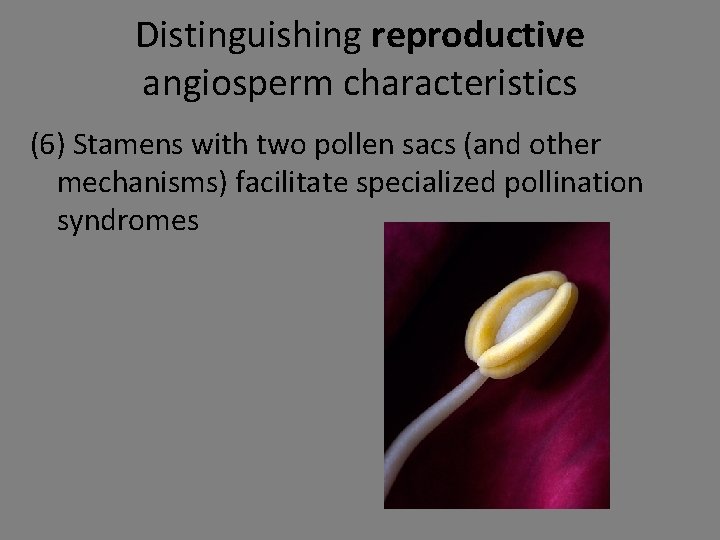
Distinguishing reproductive angiosperm characteristics (6) Stamens with two pollen sacs (and other mechanisms) facilitate specialized pollination syndromes
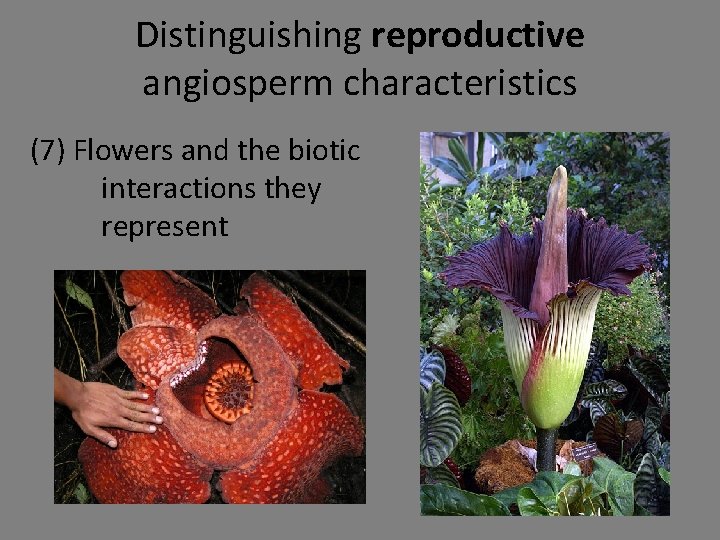
Distinguishing reproductive angiosperm characteristics (7) Flowers and the biotic interactions they represent
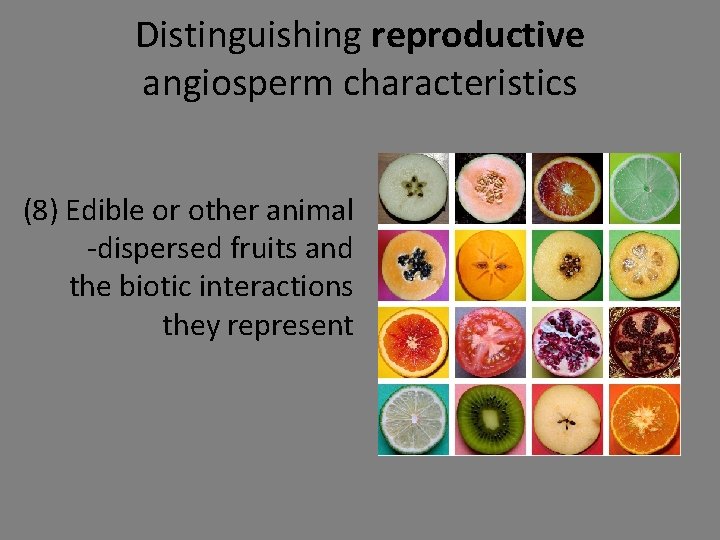
Distinguishing reproductive angiosperm characteristics (8) Edible or other animal -dispersed fruits and the biotic interactions they represent
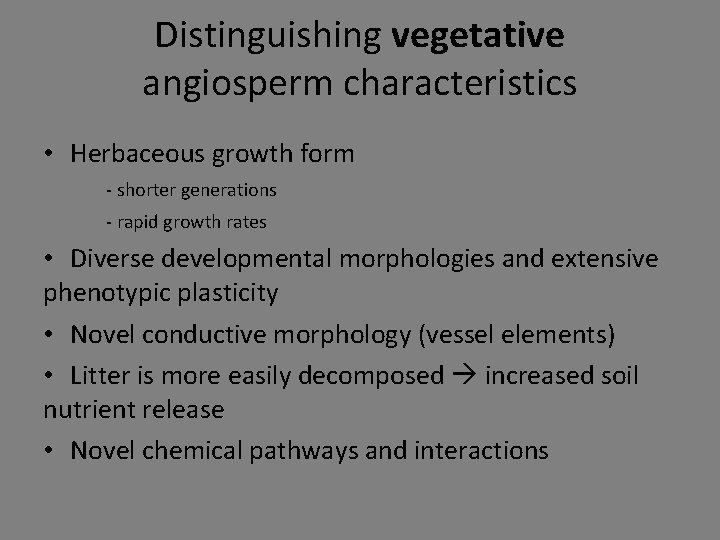
Distinguishing vegetative angiosperm characteristics • Herbaceous growth form - shorter generations - rapid growth rates • Diverse developmental morphologies and extensive phenotypic plasticity • Novel conductive morphology (vessel elements) • Litter is more easily decomposed increased soil nutrient release • Novel chemical pathways and interactions
So many angiosperms! Gnetales 69 Ceratophyllaceae 6 Rest of the angiosperms > 250000 Angiosperm synapomorphies, possible “key innovations”
So many angiosperms! Gnetales 69 Ceratophyllaceae 6 Rest of the angiosperms > 250000 Angiosperm synapomorphies, possible “key innovations”
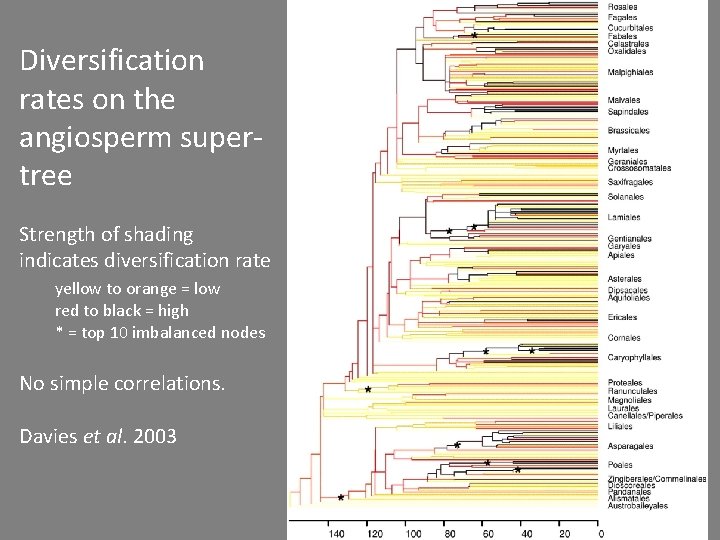
Diversification rates on the angiosperm supertree Strength of shading indicates diversification rate yellow to orange = low red to black = high * = top 10 imbalanced nodes No simple correlations. Davies et al. 2003
Difficulties in identifying key innovations • multiple innovations may work together to affect diversification, a key “complex” • the effects of innovations may be obscured over time by the evolution of other characters or the loss in some lineages • timing of evolution of trait and diversification “burst” may involve a lag or delay • requires accurate timing of character evolution and well-resolved phylogenies
Conclusions There is no simple key innovation involved in the angiosperm radiation, but many possible with varying levels of support. The picture is more dynamic than a single origin of one key innovation & subsequent diversification. Innovations have likely been gained and lost within the Angiosperma.
unanswered questions • Is evolution gradual or punctuated? • Is evolution primarily driven by biotic or abiotic factors? • Is evolution repeatable? – “replaying the tape of life”