
Plants Herbivores and Parasitoids A Model System for
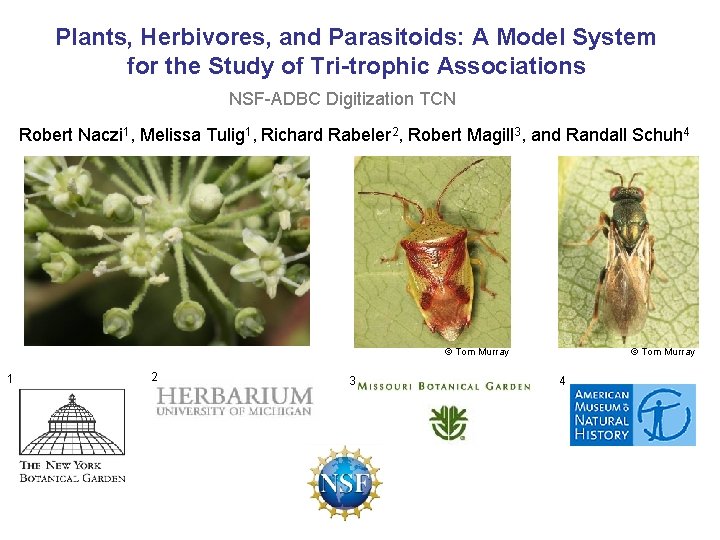
Plants, Herbivores, and Parasitoids: A Model System for the Study of Tri-trophic Associations NSF-ADBC Digitization TCN Robert Naczi 1, Melissa Tulig 1, Richard Rabeler 2, Robert Magill 3, and Randall Schuh 4 © Tom Murray 1 2 3 © Tom Murray 4
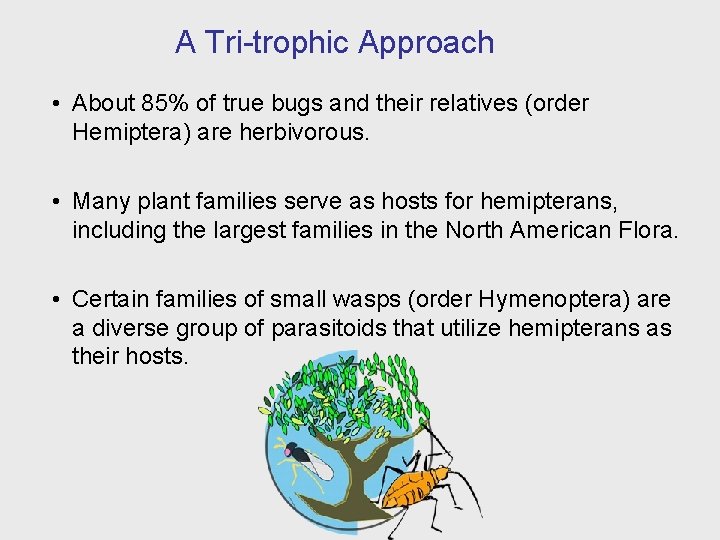
A Tri-trophic Approach • About 85% of true bugs and their relatives (order Hemiptera) are herbivorous. • Many plant families serve as hosts for hemipterans, including the largest families in the North American Flora. • Certain families of small wasps (order Hymenoptera) are a diverse group of parasitoids that utilize hemipterans as their hosts.
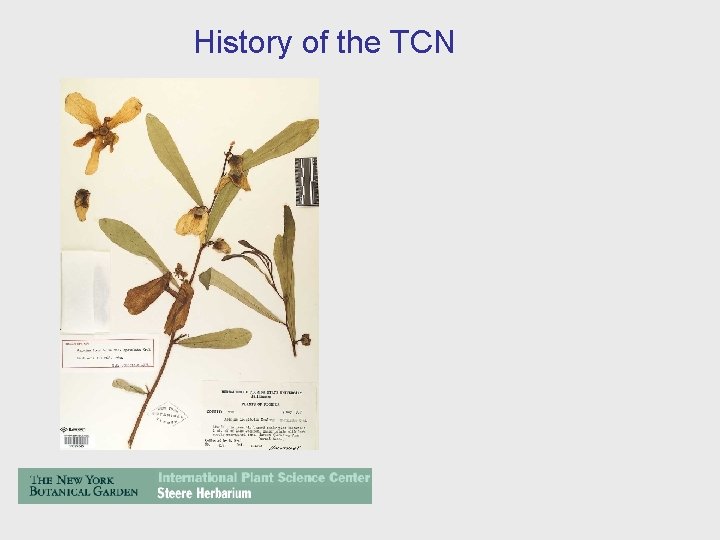
History of the TCN
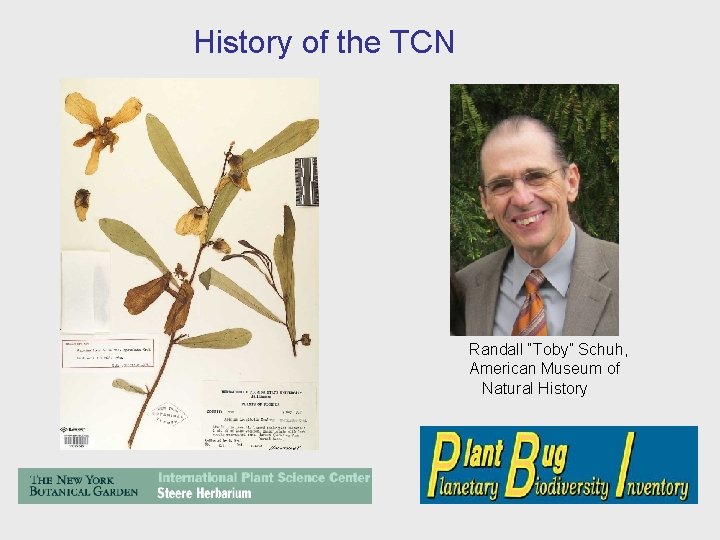
History of the TCN Randall “Toby” Schuh, American Museum of Natural History
Significance • As a result of feeding on crop plants, many species of Hempitera are serious agricultural pests (e. g. , armored scales, mealy bugs, potato leafhoppers). • As well, Hemiptera are vectors of viral and bacterial diseases (e. g. , Green Peach Aphid is a vector of over 100 plant viruses). • Parasitoid Hymenoptera and predatory Hemiptera are beneficial as biological control agents. • The relationships among plants, Hemiptera, and parasitoid Hymenoptera are of significant ecological and economic importance. • This TCN is cross-collection, as well as cross-disciplinary.
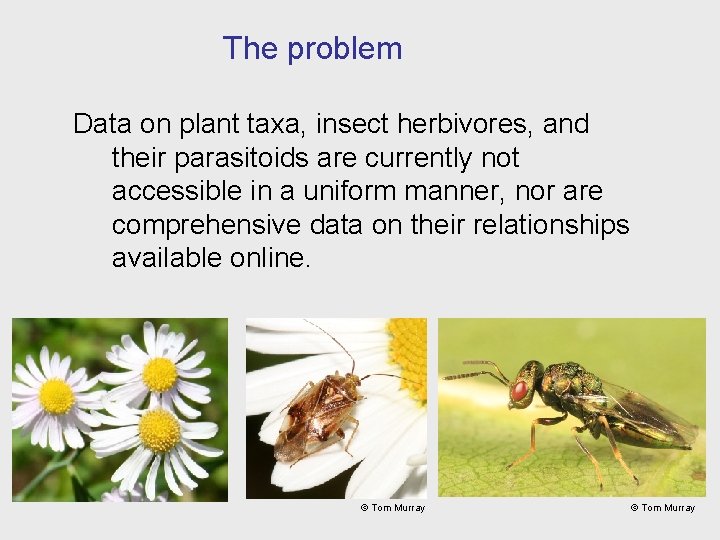
The problem Data on plant taxa, insect herbivores, and their parasitoids are currently not accessible in a uniform manner, nor are comprehensive data on their relationships available online. © Tom Murray
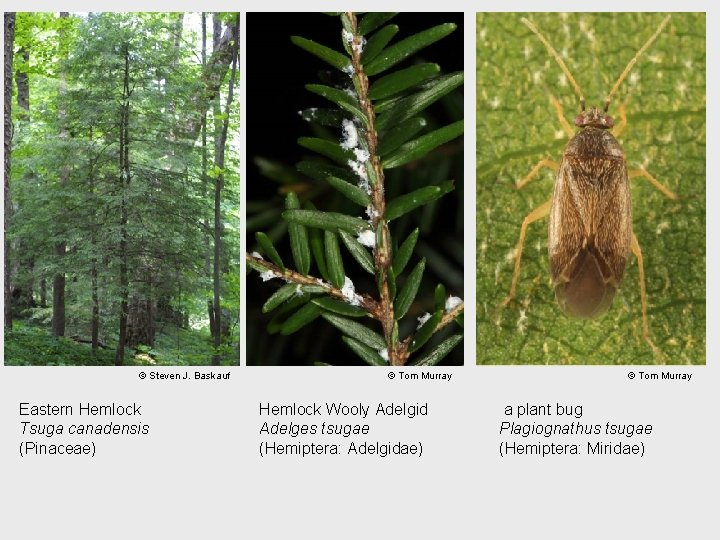
© Steven J. Baskauf Eastern Hemlock Tsuga canadensis (Pinaceae) © Tom Murray Hemlock Wooly Adelgid Adelges tsugae (Hemiptera: Adelgidae) © Tom Murray a plant bug Plagiognathus tsugae (Hemiptera: Miridae)
Enabling Research Systematics: facilitate assembly of specimen data Biogeography: large data set for analyses of patterns of distribution Ecology: host-herbivore-parasitoid relationships Conservation biology: information-based decision-making Agricultural sciences: invasive/pest species data, facilitate identifications at ports Climate change studies: ecological niche modeling; phenological changes; distributional changes
Goals 1. Digitize and integrate online the collections data from ca. 4 million specimens (including ca. 2. 6 million plants). 2. Build and sustain a network that collects and integrates data from a network of 32 museums (14 herbaria, 18 insect collections). 3. Facilitate research on tri-trophic associations. Scope: North American specimens in non-federal institutions.
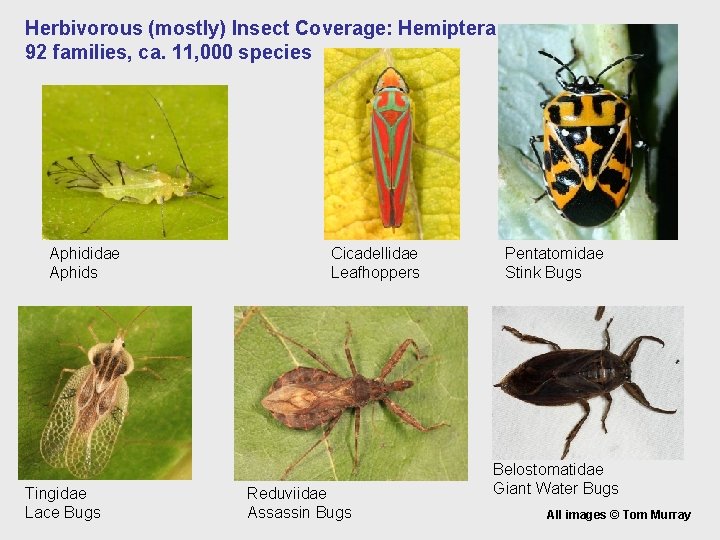
Herbivorous (mostly) Insect Coverage: Hemiptera 92 families, ca. 11, 000 species Aphididae Aphids Tingidae Lace Bugs Cicadellidae Leafhoppers Reduviidae Assassin Bugs Pentatomidae Stink Bugs Belostomatidae Giant Water Bugs All images © Tom Murray
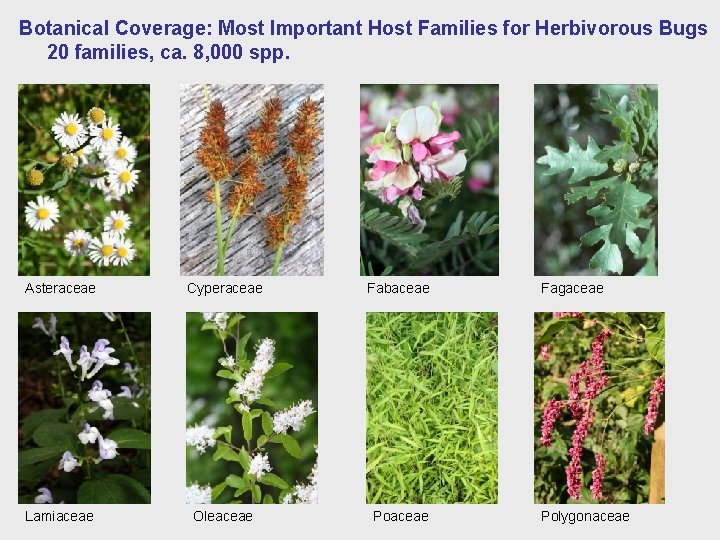
Botanical Coverage: Most Important Host Families for Herbivorous Bugs 20 families, ca. 8, 000 spp. Asteraceae Cyperaceae Fabaceae Lamiaceae Oleaceae Poaceae Fagaceae Polygonaceae
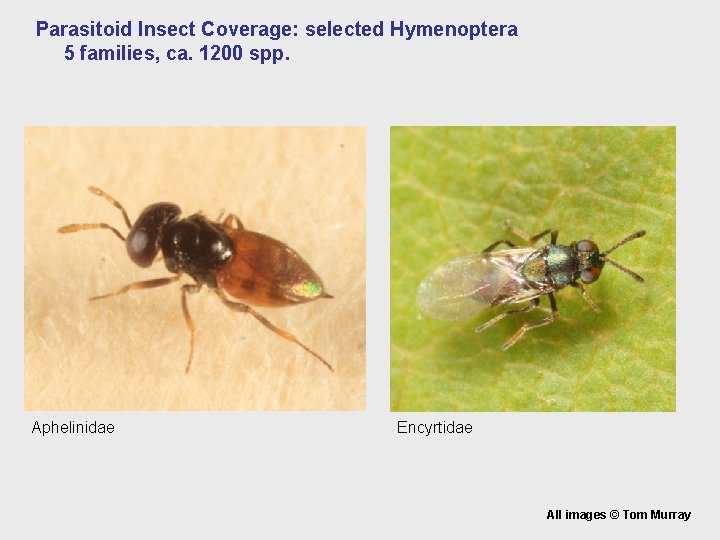
Parasitoid Insect Coverage: selected Hymenoptera 5 families, ca. 1200 spp. Aphelinidae Encyrtidae All images © Tom Murray
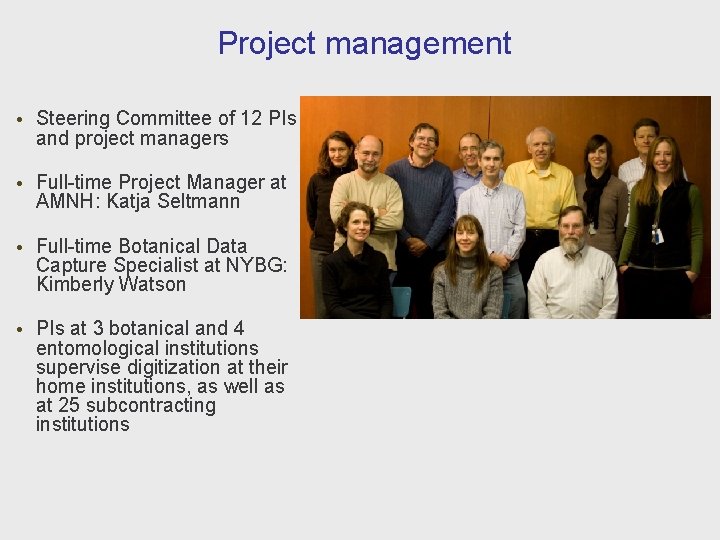
Project management • Steering Committee of 12 PIs and project managers • Full-time Project Manager at AMNH: Katja Seltmann • Full-time Botanical Data Capture Specialist at NYBG: Kimberly Watson • PIs at 3 botanical and 4 entomological institutions supervise digitization at their home institutions, as well as at 25 subcontracting institutions
Partners The work of this project is possible only with an accomplished team of people. Botany – Robert Magill, Missouri Botanical Garden – Robert Naczi, New York Botanical Garden – Richard Rabeler, University of Michigan – Melissa Tulig, New York Botanical Garden – Margaret Hanes, Eastern Michigan University – Rick Phillippe, Illinois Natural History Survey – Deborah Lewis, Iowa State University – Michael Vincent, Miami University – Timothy Hogan, University of Colorado – Mary Ann Feist, University of Illinois – Craig Freeman, University of Kansas – Christopher Campbell, University of Maine – Anita Cholewa, University of Minnesota – Beryl Simpson, University of Texas – Kenneth Cameron, University of Wisconsin Data Contributors – Consortium of Pacific Northwest Herbaria – Consortium of California Herbaria – Southwest Biodiversity Consortium Entomology – Toby Schuh, American Museum of Natural History – Christine Johnson, American Museum of Natural History – Christiane Weirauch, University of California, Riverside – John Heraty, University of California, Riverside – Charles Bartlett, University of Delaware – Benjamin Normark, University of Massachusetts, Amherst – Neal Evenhuis, BP Bishop Museum, Honolulu – David Kavanaugh, California Academy of Sciences – Stephen D. Gaimari, California Dept. Food and Agriculture – Chen Young, Carnegie Museum, Pittsburgh – Boris C. Kondratieff, Colorado State University – James K. Liebherr, Cornell University – Dmitry Dmitriev, Illinois Natural History Survey – Richard Brown, Mississippi State University – Andy Deans, North Carolina State University – David Maddison, Oregon State University – John Oswald, Texas A&M University – Kipling Will, University of California, Berkeley – Caroline Chaboo, University of Kansas – Michael Sharkey, University of Kentucky Data Contributors – Canadian National Collection, Ottawa – University of California, Davis – Kansas State University
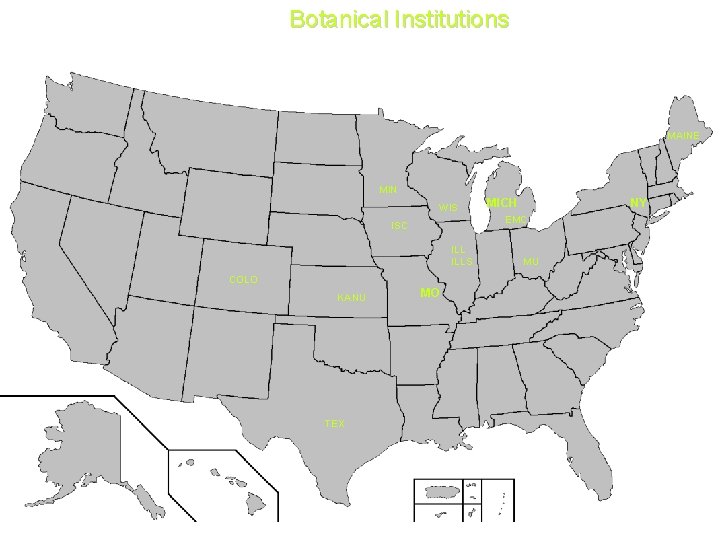
Botanical Institutions MAINE MIN WIS ILLS COLO TEX NY EMC ISC KANU MICH MO MU
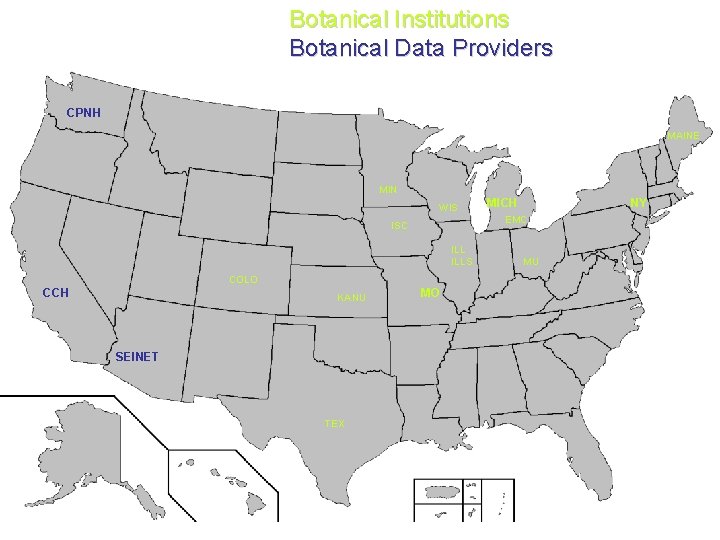
Botanical Institutions Botanical Data Providers CPNH MAINE MIN WIS ILLS COLO KANU SEINET TEX NY EMC ISC CCH MICH MO MU
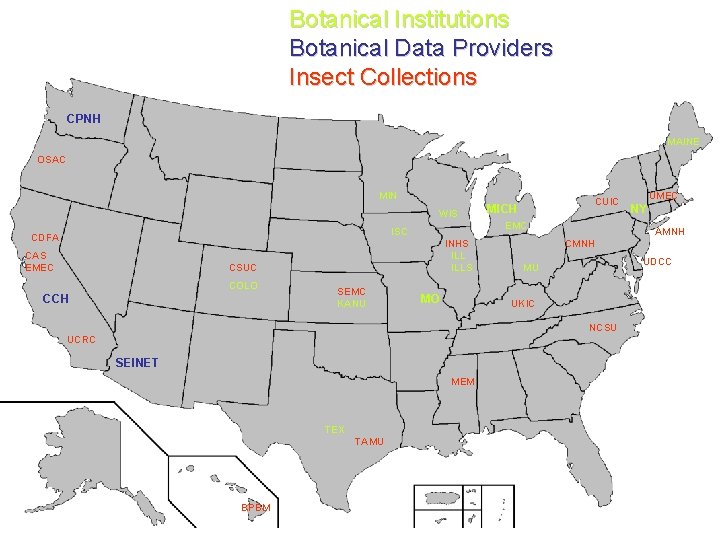
Botanical Institutions Botanical Data Providers Insect Collections CPNH MAINE OSAC MIN WIS CAS EMEC INHS ILLS CSUC COLO CCH SEMC KANU MICH EMC ISC CDFA CUIC MO AMNH UDCC MU NCSU SEINET MEM TEX TAMU BPBM NY CMNH UKIC UCRC UMEC
Infrastructure • Use existing infrastructure for hardware and software at each institution • Each entomology collection will use existing databases and imaging stations or share with partner institutions • Use existing Storage Area Networks at NYBG & AMNH • Use existing web portal for data integration (Discover Life) as modeled by AMNH’s NSF PBI Plants & Bugs project, plus send copies to i. Dig. Bio, GBIF, & other networks • Looking forward to working with tools and solutions developed by i. Dig. Bio & others
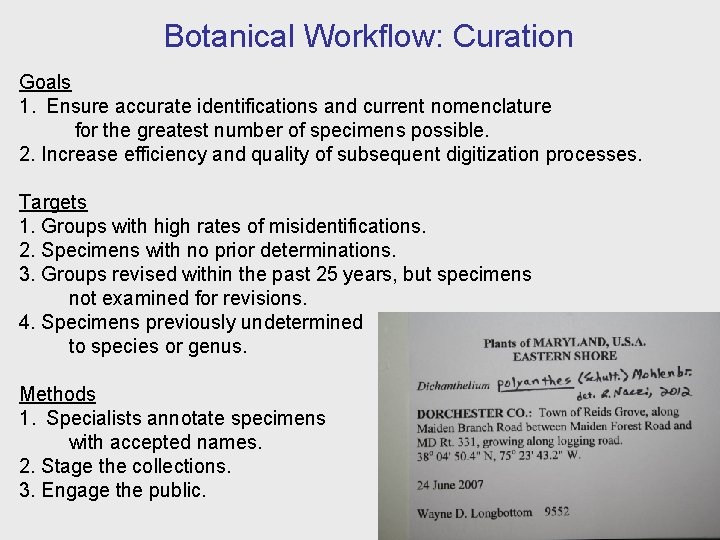
Botanical Workflow: Curation Goals 1. Ensure accurate identifications and current nomenclature for the greatest number of specimens possible. 2. Increase efficiency and quality of subsequent digitization processes. Targets 1. Groups with high rates of misidentifications. 2. Specimens with no prior determinations. 3. Groups revised within the past 25 years, but specimens not examined for revisions. 4. Specimens previously undetermined to species or genus. Methods 1. Specialists annotate specimens with accepted names. 2. Stage the collections. 3. Engage the public.
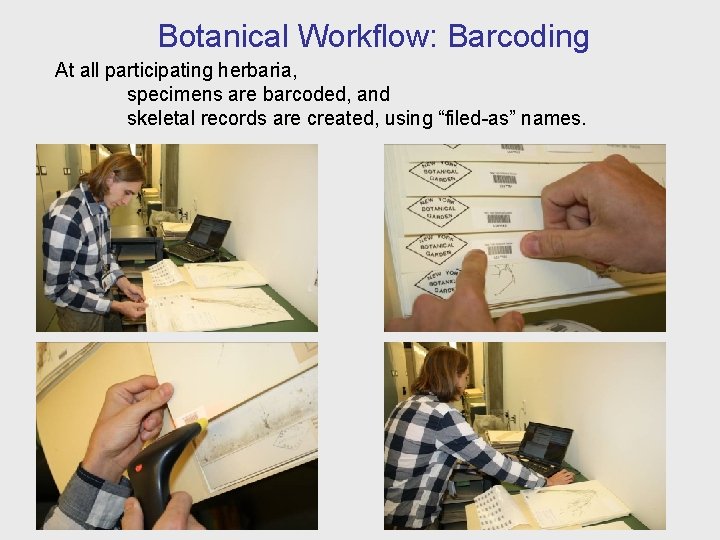
Botanical Workflow: Barcoding At all participating herbaria, specimens are barcoded, and skeletal records are created, using “filed-as” names.
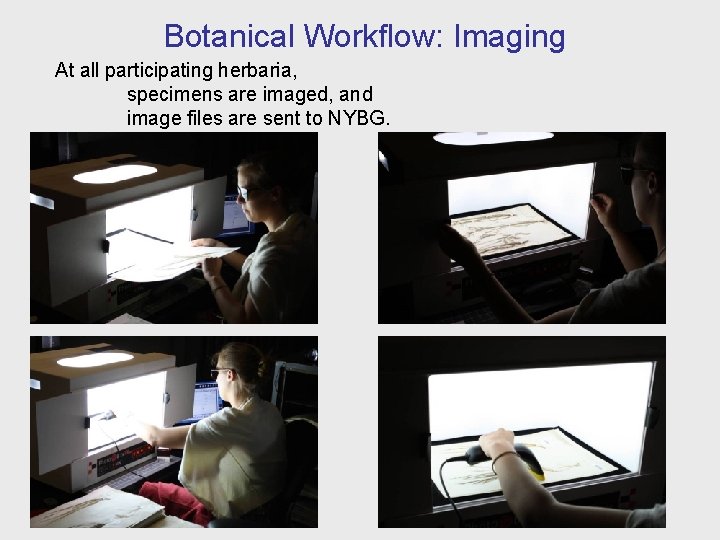
Botanical Workflow: Imaging At all participating herbaria, specimens are imaged, and image files are sent to NYBG.
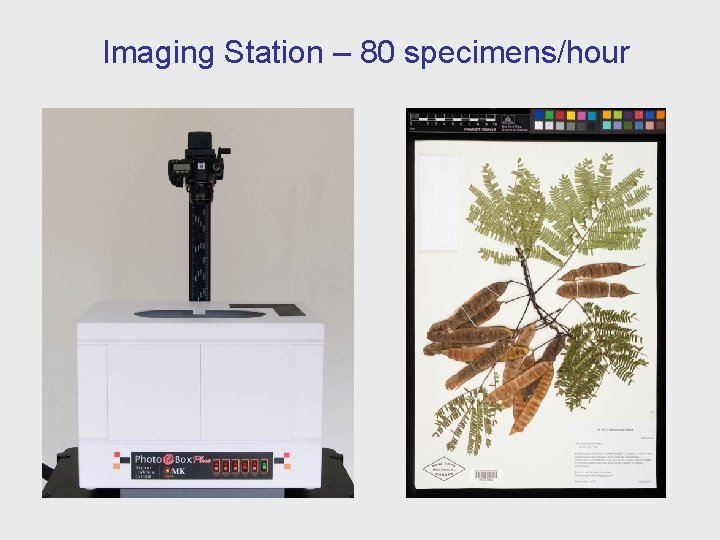
Imaging Station – 80 specimens/hour
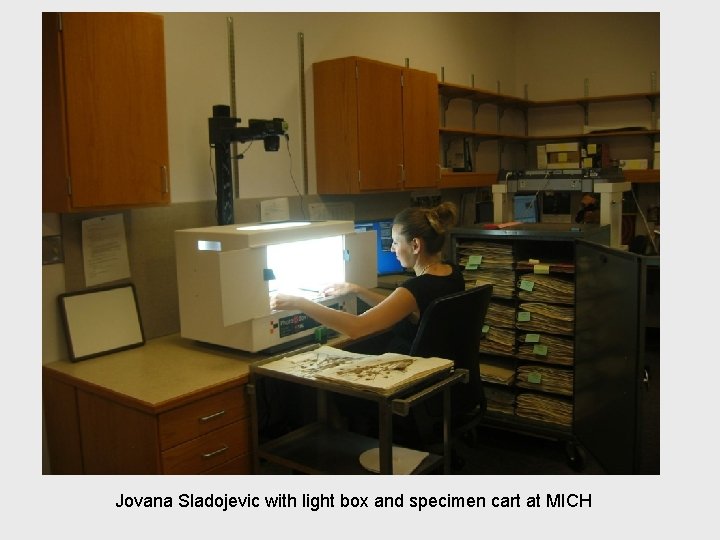
Jovana Sladojevic with light box and specimen cart at MICH
Botanical Workflow: Post-imaging Data Capture • Each image file gets a database record with the institution, barcode number, filed-as determination, and preliminary OCR of the label – Using Tropicos from Missouri Botanical Garden as our names authority file • Duplicates reconciled. • NYBG Data Capture Specialist completes the partial records • Darwin. Core-formatted data sent to Discover. Life and to each participating herbarium
How do we complete & georeference 1, 200, 000+ partial records? • Send image files through OCR, Symbiota, etc. • Merge existing partner datasets and expected duplicates. • Scatter, Gather, Reconcile; Filtered. Push. • Crowd sourcing & citizen scientists. • Georeferencing tools: GEOLocate, Bio. Geomancer & others.
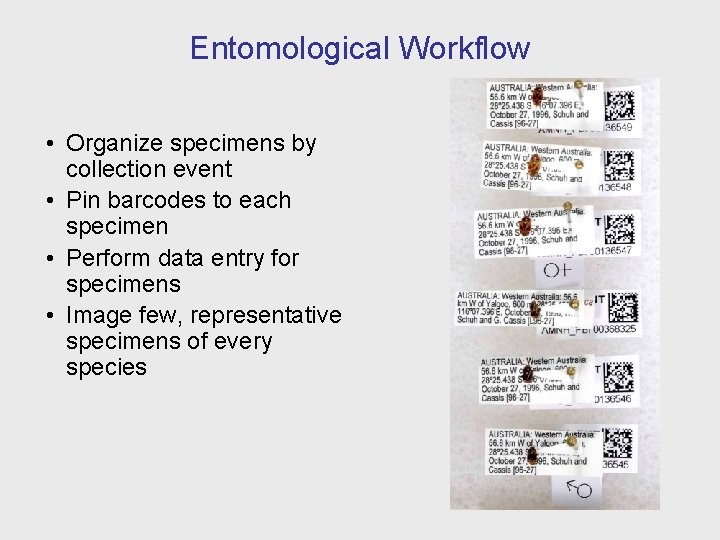
Entomological Workflow • Organize specimens by collection event • Pin barcodes to each specimen • Perform data entry for specimens • Image few, representative specimens of every species
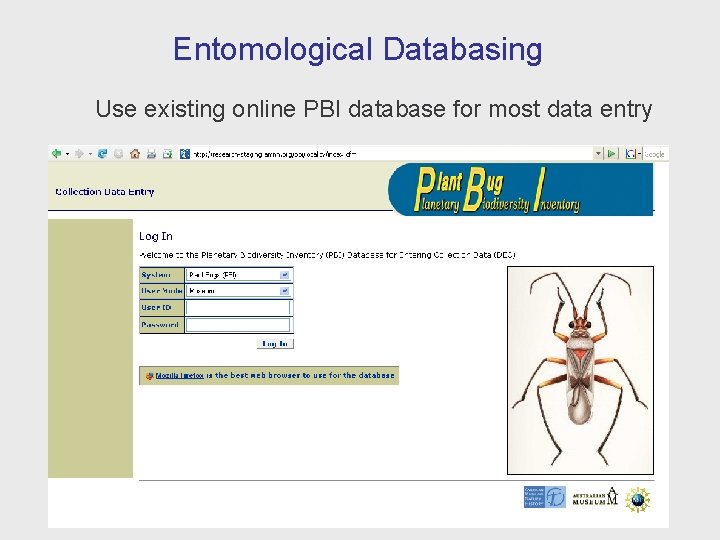
Entomological Databasing Use existing online PBI database for most data entry
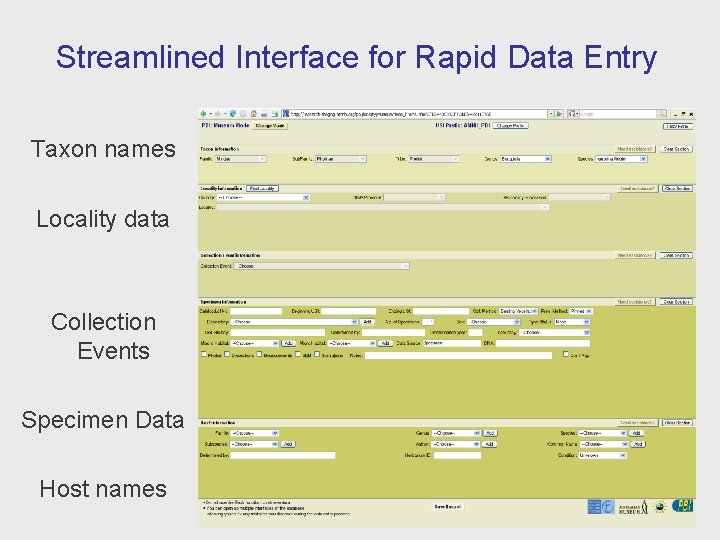
Streamlined Interface for Rapid Data Entry Taxon names Locality data Collection Events Specimen Data Host names
Biggest Challenges Combining data across institutions: Duplicates and differing names – how to know which is correct, how to report discrepancies to home institutions? File transfer: What’s the best way to move 1, 200, 000 images to NYBG, Discover Life, and/or the HUB? Long-term archival image storage for all institutions? Potentially 36+ TB of raw files. Integrating Host, Herbivore, and Parasitoid Data.
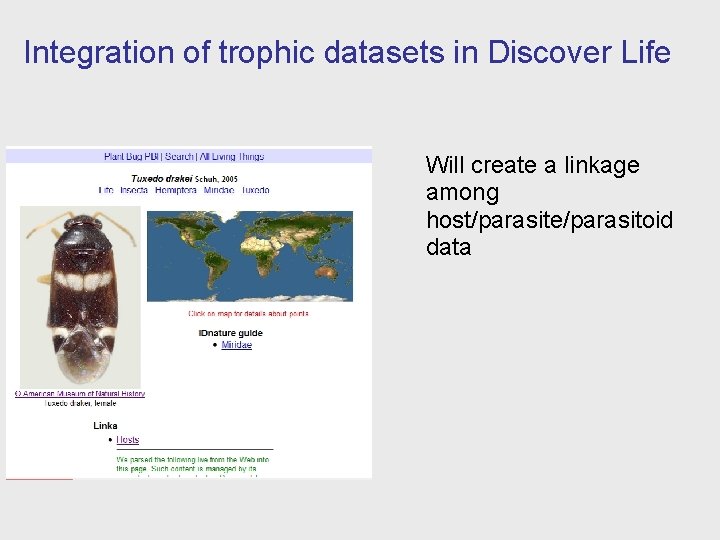
Integration of trophic datasets in Discover Life Will create a linkage among host/parasite/parasitoid data
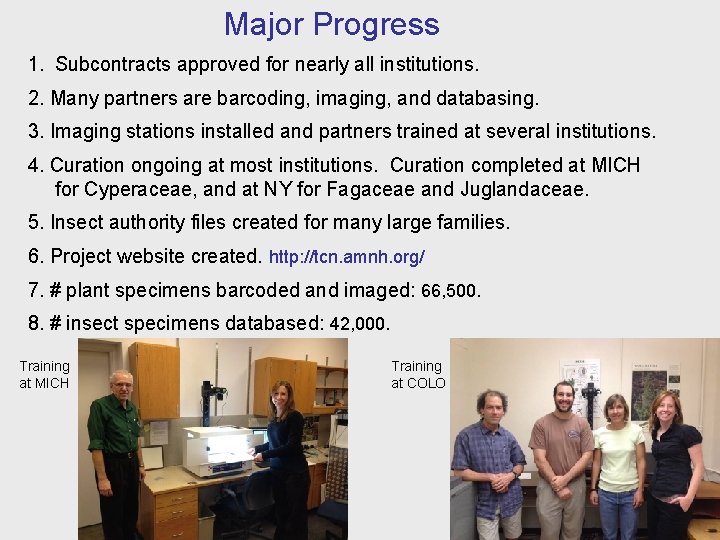
Major Progress 1. Subcontracts approved for nearly all institutions. 2. Many partners are barcoding, imaging, and databasing. 3. Imaging stations installed and partners trained at several institutions. 4. Curation ongoing at most institutions. Curation completed at MICH for Cyperaceae, and at NY for Fagaceae and Juglandaceae. 5. Insect authority files created for many large families. 6. Project website created. http: //tcn. amnh. org/ 7. # plant specimens barcoded and imaged: 66, 500. 8. # insect specimens databased: 42, 000. Training at MICH Training at COLO
Lessons Learned Provide sufficient time for essential tasks. administration coordination of network, subcontracts quality control image processing (e. g. , ca. 3 hr/week for MICH), curation --- largely volunteer effort Ally yourselves with helpful and competent personnel in offices of Grants & Contracts/Sponsored Programs. Get to know the NSF program officers. Celebrate milestones.
Acknowledgments Judith Skog NSF-ADBC i. Dig. Bio, especially Austin Mast and Pam Soltis All partners, particularly Barbara Thiers, Katja Seltmann, Kimberly Watson, Charles Zimmerman, Michael Bevans, Nicole Tarnowsky, Tony Kirchgessner, Christine Johnson, Christiane Weirauch, John Heraty, Charles Bartlett, Benjamin Normark Our dedicated digitizers Tom Murray and Steven Baskauf
- Slides: 33