
Plants Common characteristics of plants 1 Multicellular 2
- Slides: 28
Plants
Common characteristics of plants 1. Multicellular 2. Eukaryote-organelles surrounded by a membrane 3. Cell walls made of cellulose 4. Cuticle-waterproof coating 5. Make own food (Photosynthesis) -First plants are thought to look like moss but it is unknown because plant’s don’t leave fossils
Plant Adaptations • Plants have structures based on whether they live on water or land – Ex. Plants on water dissolves their nutrients directly into cells – Land plants absorb their nutrients by roots
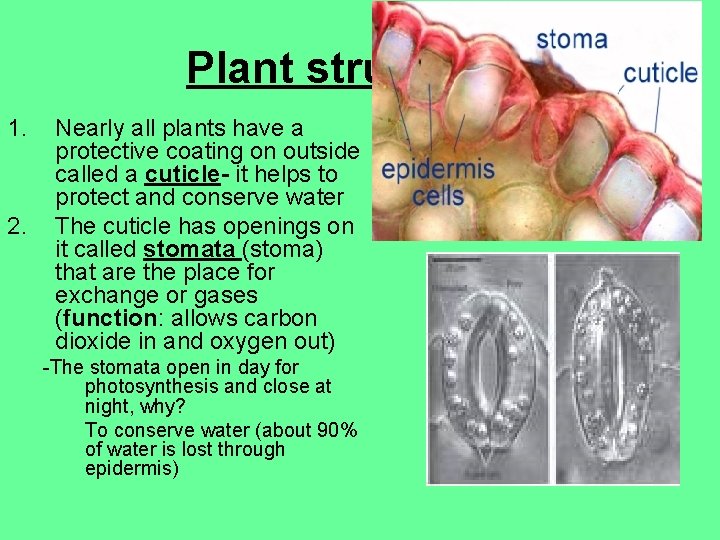
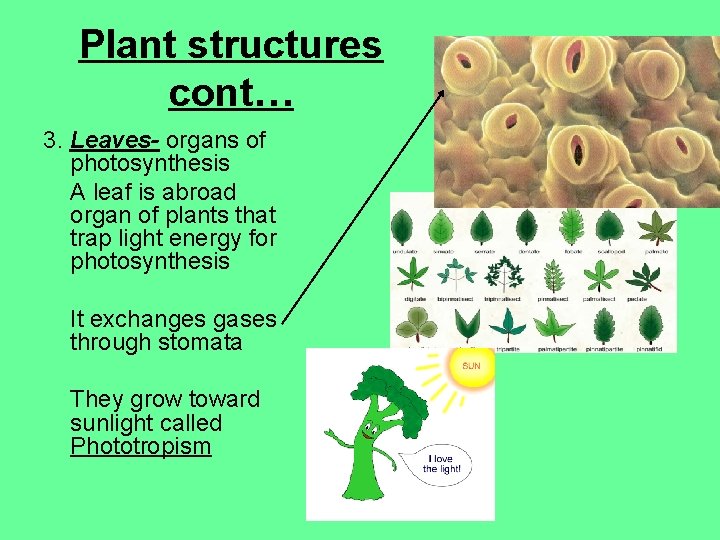
Plant structures: 1. 2. Nearly all plants have a protective coating on outside called a cuticle- it helps to protect and conserve water The cuticle has openings on it called stomata (stoma) that are the place for exchange or gases (function: allows carbon dioxide in and oxygen out) -The stomata open in day for photosynthesis and close at night, why? To conserve water (about 90% of water is lost through epidermis)
Plant structures cont… 3. Leaves- organs of photosynthesis A leaf is abroad organ of plants that trap light energy for photosynthesis It exchanges gases through stomata They grow toward sunlight called Phototropism
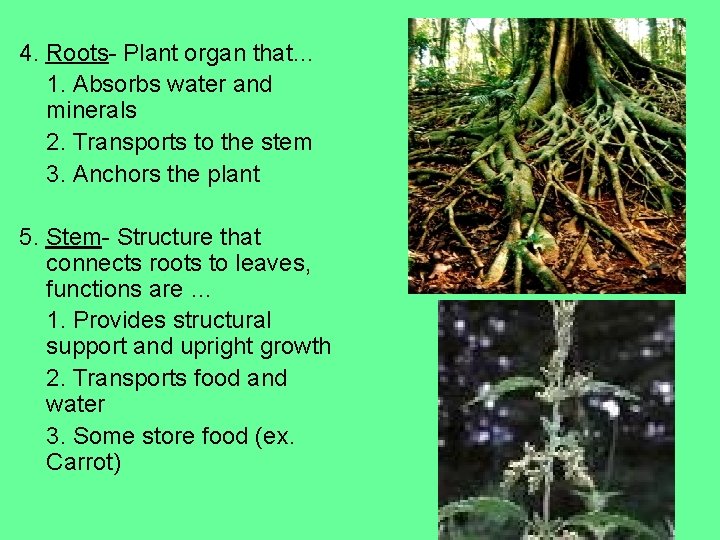
4. Roots- Plant organ that… 1. Absorbs water and minerals 2. Transports to the stem 3. Anchors the plant 5. Stem- Structure that connects roots to leaves, functions are … 1. Provides structural support and upright growth 2. Transports food and water 3. Some store food (ex. Carrot)
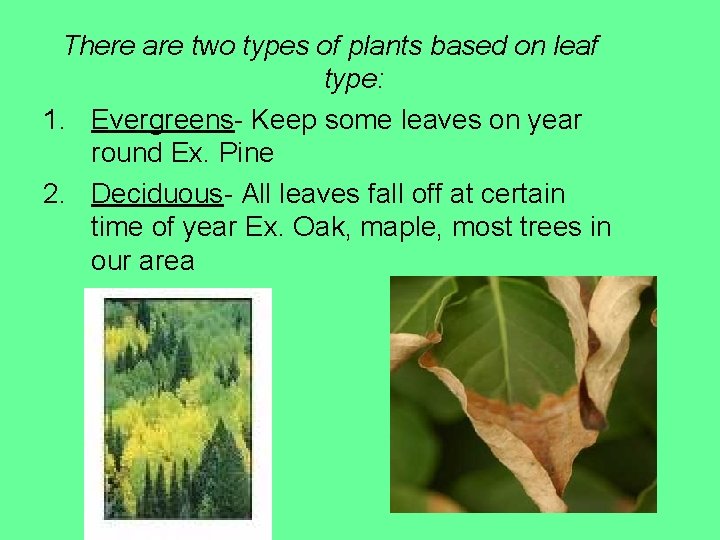
There are two types of plants based on leaf type: 1. Evergreens- Keep some leaves on year round Ex. Pine 2. Deciduous- All leaves fall off at certain time of year Ex. Oak, maple, most trees in our area
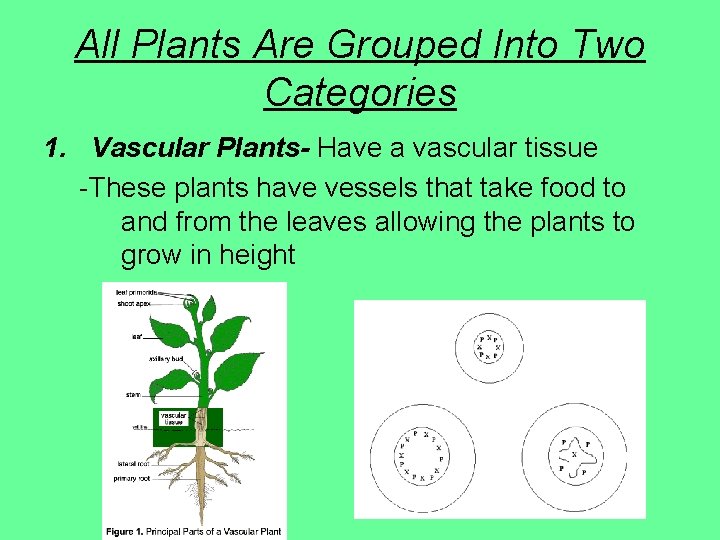
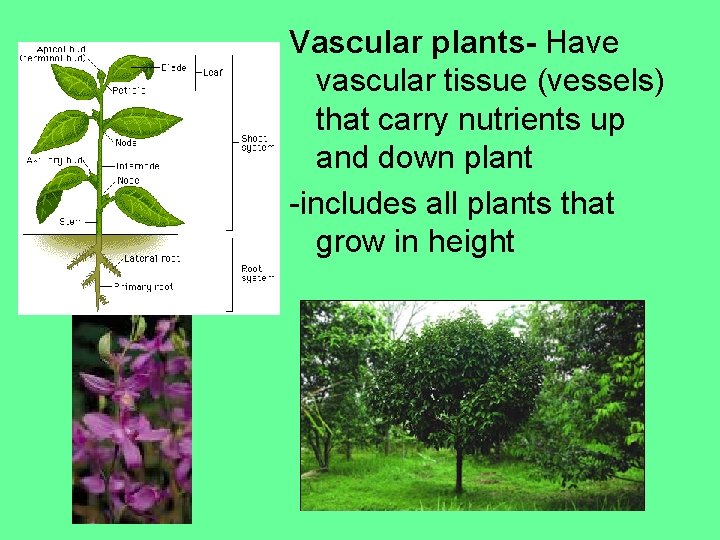
All Plants Are Grouped Into Two Categories 1. Vascular Plants- Have a vascular tissue -These plants have vessels that take food to and from the leaves allowing the plants to grow in height
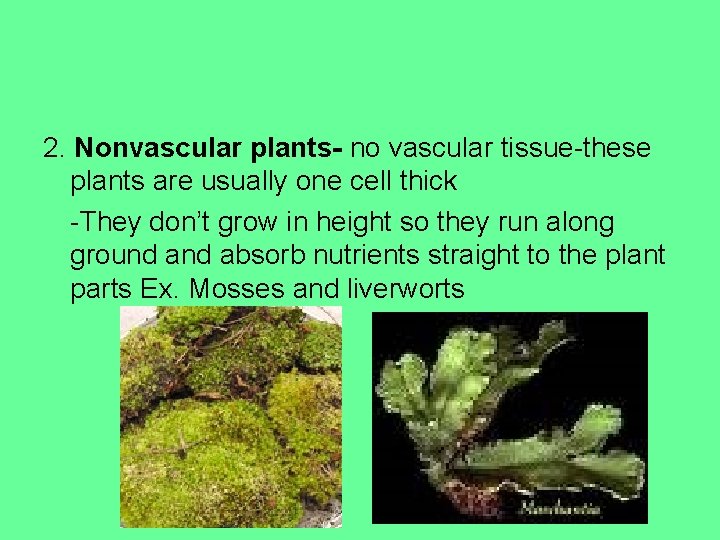
2. Nonvascular plants- no vascular tissue-these plants are usually one cell thick -They don’t grow in height so they run along ground absorb nutrients straight to the plant parts Ex. Mosses and liverworts
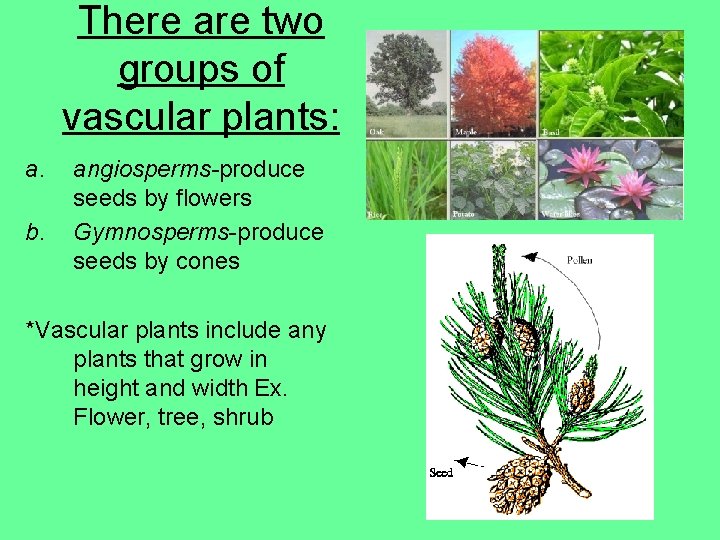
There are two groups of vascular plants: a. b. angiosperms-produce seeds by flowers Gymnosperms-produce seeds by cones *Vascular plants include any plants that grow in height and width Ex. Flower, tree, shrub
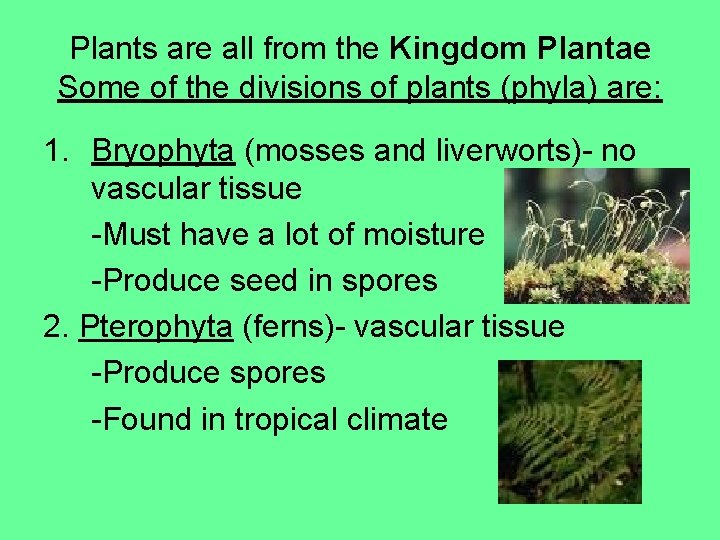
Plants are all from the Kingdom Plantae Some of the divisions of plants (phyla) are: 1. Bryophyta (mosses and liverworts)- no vascular tissue -Must have a lot of moisture -Produce seed in spores 2. Pterophyta (ferns)- vascular tissue -Produce spores -Found in tropical climate
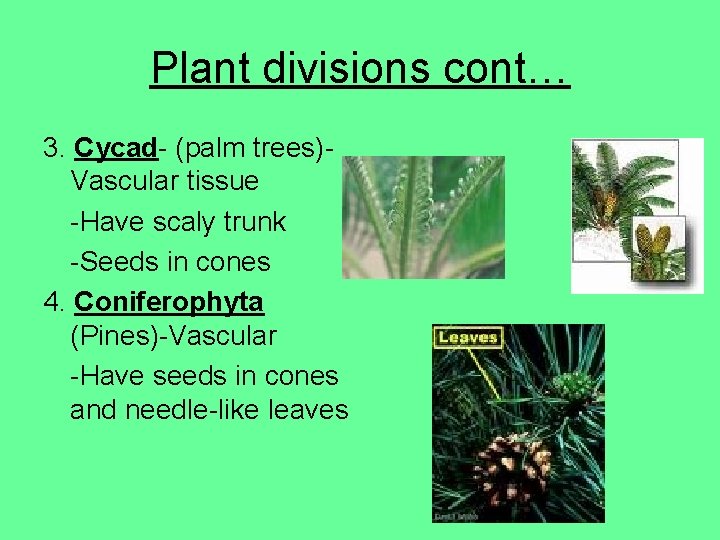
Plant divisions cont… 3. Cycad- (palm trees)Vascular tissue -Have scaly trunk -Seeds in cones 4. Coniferophyta (Pines)-Vascular -Have seeds in cones and needle-like leaves
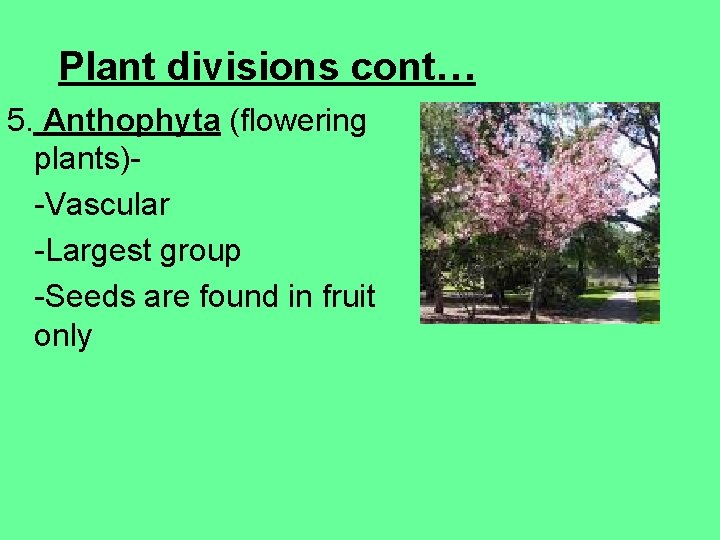
Plant divisions cont… 5. Anthophyta (flowering plants)-Vascular -Largest group -Seeds are found in fruit only
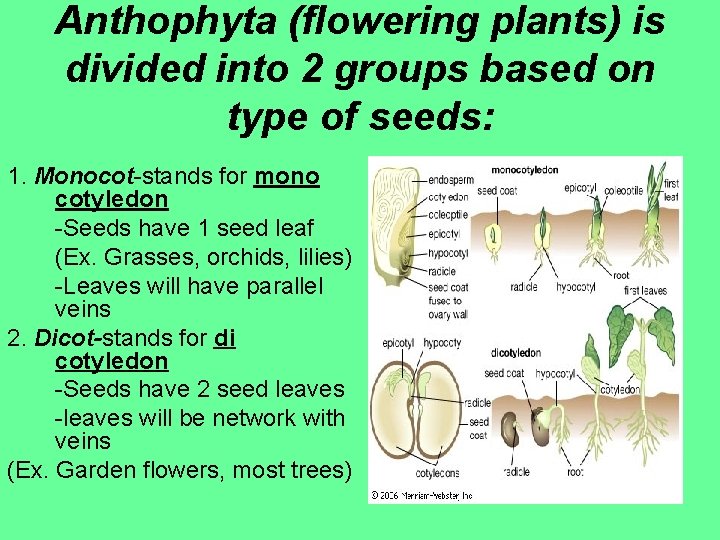
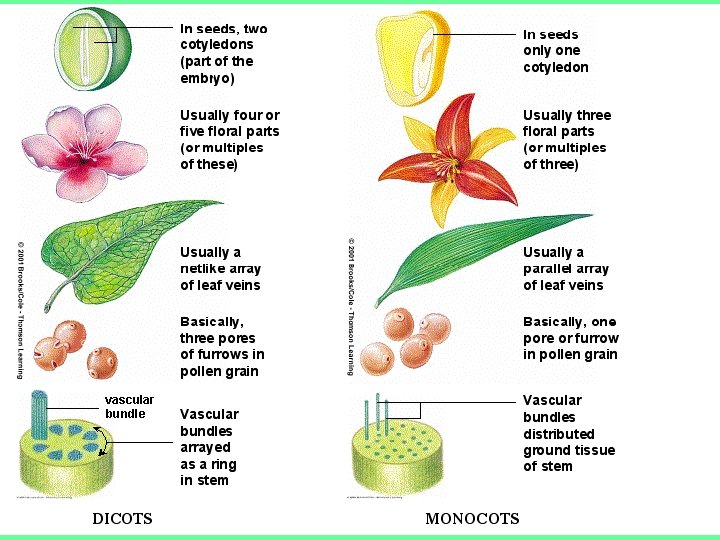
Anthophyta (flowering plants) is divided into 2 groups based on type of seeds: 1. Monocot-stands for mono cotyledon -Seeds have 1 seed leaf (Ex. Grasses, orchids, lilies) -Leaves will have parallel veins 2. Dicot-stands for di cotyledon -Seeds have 2 seed leaves -leaves will be network with veins (Ex. Garden flowers, most trees)
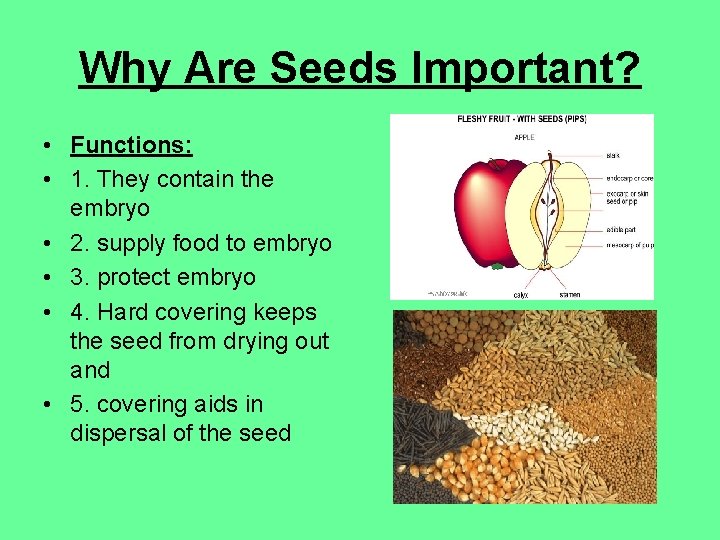
Why Are Seeds Important? • Functions: • 1. They contain the embryo • 2. supply food to embryo • 3. protect embryo • 4. Hard covering keeps the seed from drying out and • 5. covering aids in dispersal of the seed
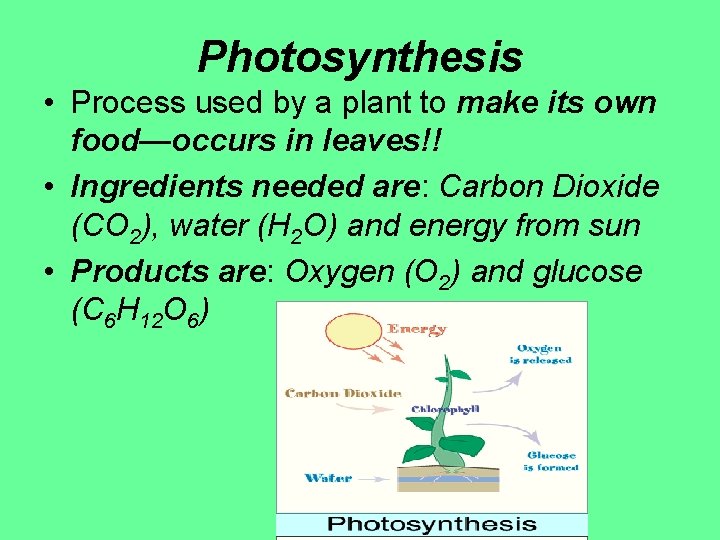
Photosynthesis • Process used by a plant to make its own food—occurs in leaves!! • Ingredients needed are: Carbon Dioxide (CO 2), water (H 2 O) and energy from sun • Products are: Oxygen (O 2) and glucose (C 6 H 12 O 6)
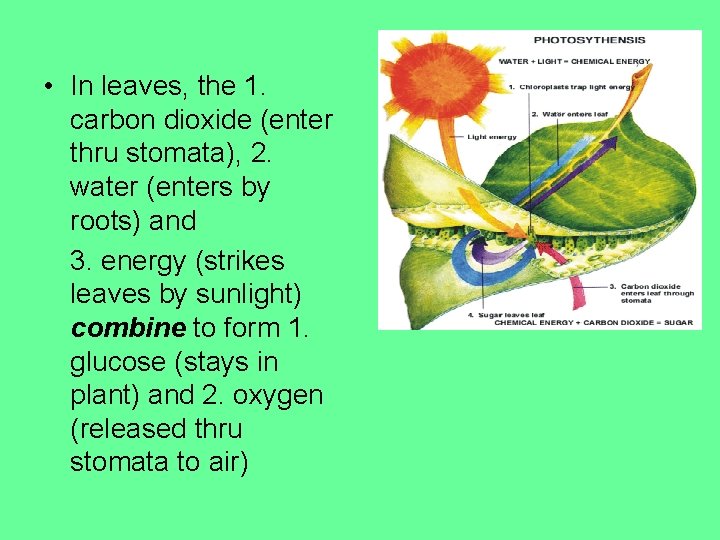
• In leaves, the 1. carbon dioxide (enter thru stomata), 2. water (enters by roots) and 3. energy (strikes leaves by sunlight) combine to form 1. glucose (stays in plant) and 2. oxygen (released thru stomata to air)
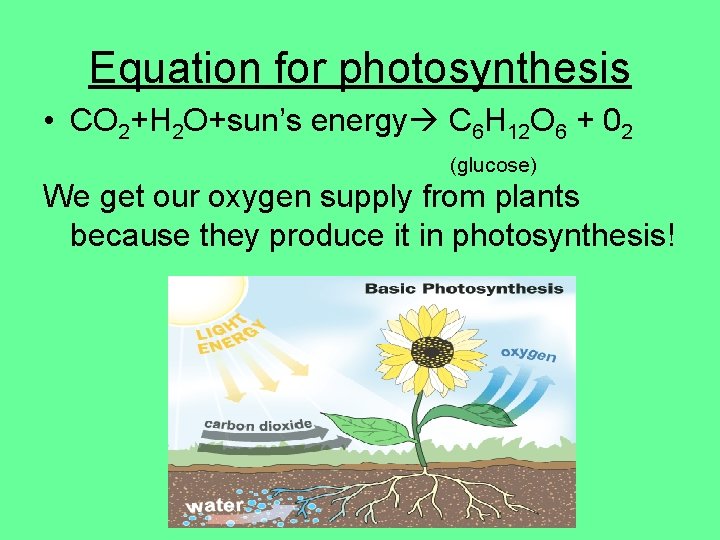
Equation for photosynthesis • CO 2+H 2 O+sun’s energy C 6 H 12 O 6 + 02 (glucose) We get our oxygen supply from plants because they produce it in photosynthesis!
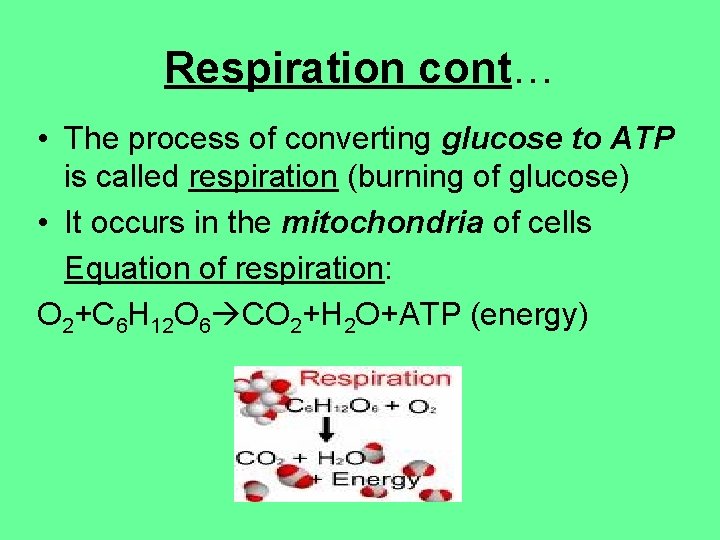
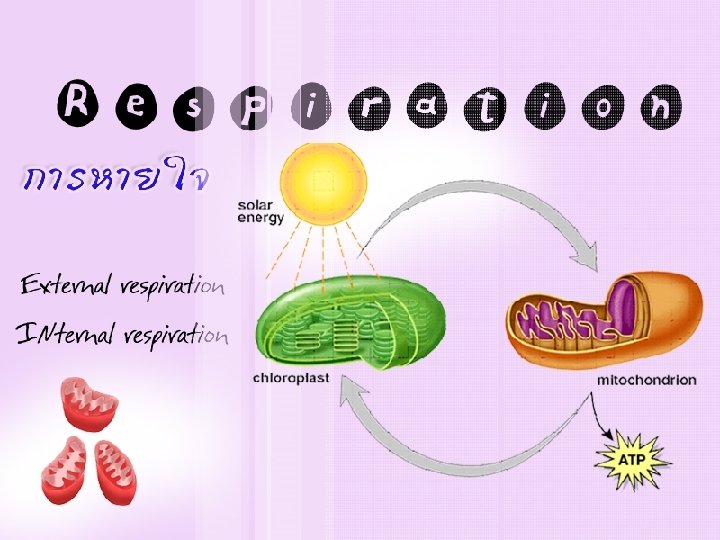
Respiration • In order for organisms (like animals) to have energy for their cells to function, they must: – 1. ingest glucose from plants – 2. convert it to a form of energy that their cells can use. • The energy form that animal cells use is called ATP (Adenosine Triphosphate)
Respiration cont… • The process of converting glucose to ATP is called respiration (burning of glucose) • It occurs in the mitochondria of cells Equation of respiration: O 2+C 6 H 12 O 6 CO 2+H 2 O+ATP (energy)
Vascular plants- Have vascular tissue (vessels) that carry nutrients up and down plant -includes all plants that grow in height
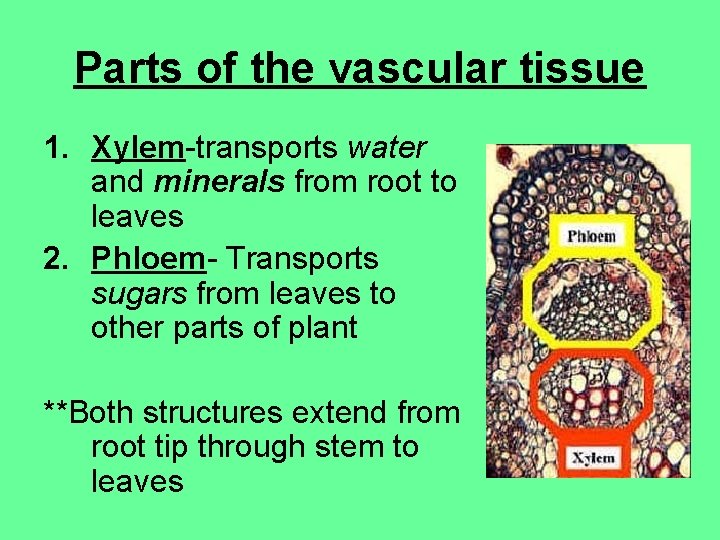
Parts of the vascular tissue 1. Xylem-transports water and minerals from root to leaves 2. Phloem- Transports sugars from leaves to other parts of plant **Both structures extend from root tip through stem to leaves
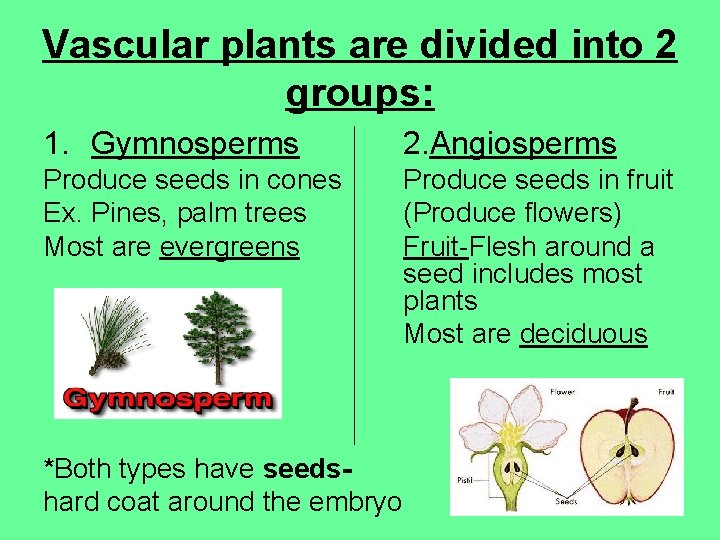
Vascular plants are divided into 2 groups: 1. Gymnosperms 2. Angiosperms Produce seeds in cones Ex. Pines, palm trees Most are evergreens Produce seeds in fruit (Produce flowers) Fruit-Flesh around a seed includes most plants Most are deciduous *Both types have seedshard coat around the embryo
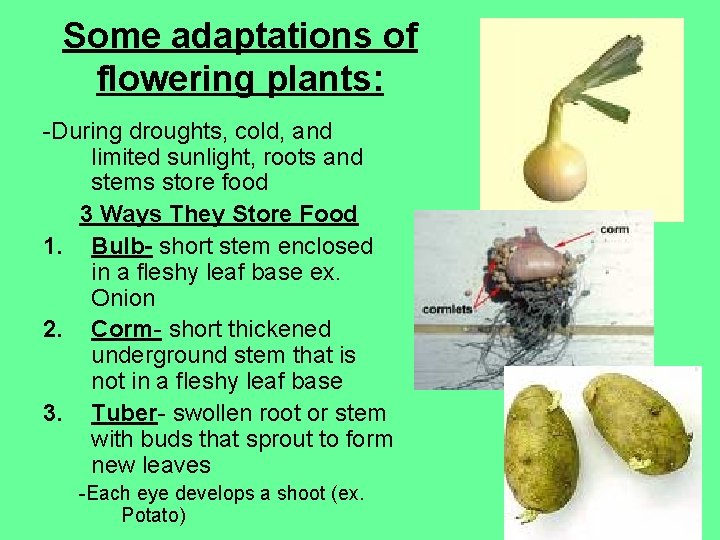
Some adaptations of flowering plants: -During droughts, cold, and limited sunlight, roots and stems store food 3 Ways They Store Food 1. Bulb- short stem enclosed in a fleshy leaf base ex. Onion 2. Corm- short thickened underground stem that is not in a fleshy leaf base 3. Tuber- swollen root or stem with buds that sprout to form new leaves -Each eye develops a shoot (ex. Potato)
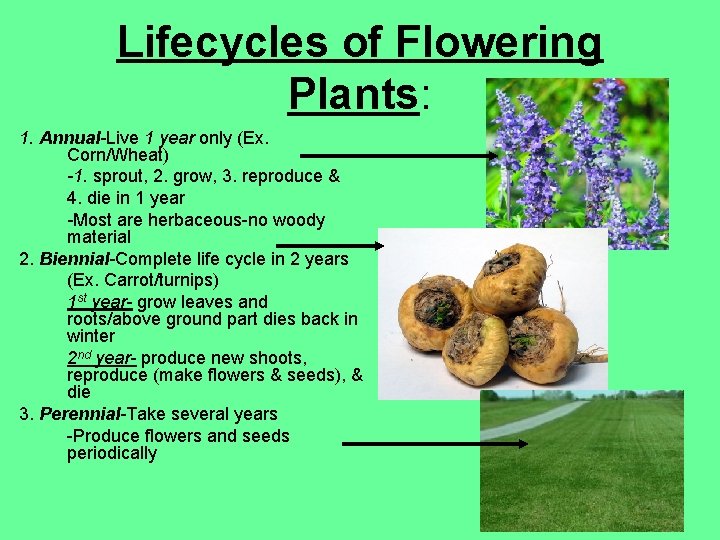
Lifecycles of Flowering Plants: 1. Annual-Live 1 year only (Ex. Corn/Wheat) -1. sprout, 2. grow, 3. reproduce & 4. die in 1 year -Most are herbaceous-no woody material 2. Biennial-Complete life cycle in 2 years (Ex. Carrot/turnips) 1 st year- grow leaves and roots/above ground part dies back in winter 2 nd year- produce new shoots, reproduce (make flowers & seeds), & die 3. Perennial-Take several years -Produce flowers and seeds periodically
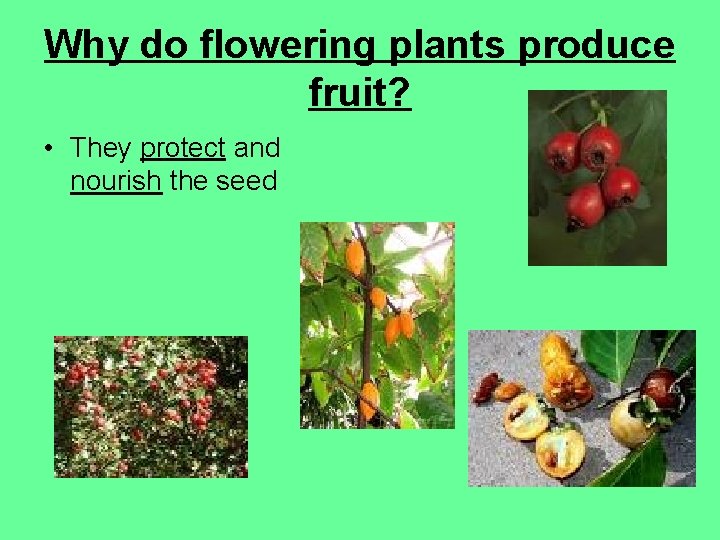
Why do flowering plants produce fruit? • They protect and nourish the seed