
PLANTS An overview All plants have a cuticle
- Slides: 46
PLANTS
An overview: • All plants have a cuticle -- a waxy protective coating • All plants are made of one or more cells • Eukaryotic cells (contain a nucleus and membrane bound organelles) • All autotrophic: meaning they contain chlorophyll and make their own food through photosynthesis • Cell walls made of cellulose • Called divisions instead of a phylum when classifying • Twelve divisions have been identified • Botanists: people who study plants
II. Plant Roles and Uses A. Crucial Ecological Roles 1. Through photosynthesis 2. Provide food for ALL land organisms 3. Produce O 2 gas continually replenishing oxygen in the atmosphere B. Plants help create and maintain soil 1. Provide nutrients when decomposed 2. Prevent _EROSION_ C. Human Necessities and Luxuries 1. Houses built of wood 2. Wood and coal provide fuel 3. Plants provide MEDICINES e. g. aspirin, Taxol, morphine D. Plants provide pleasure 1. Flowers, gardens, and lawns 2. Coffee, tea, and wine
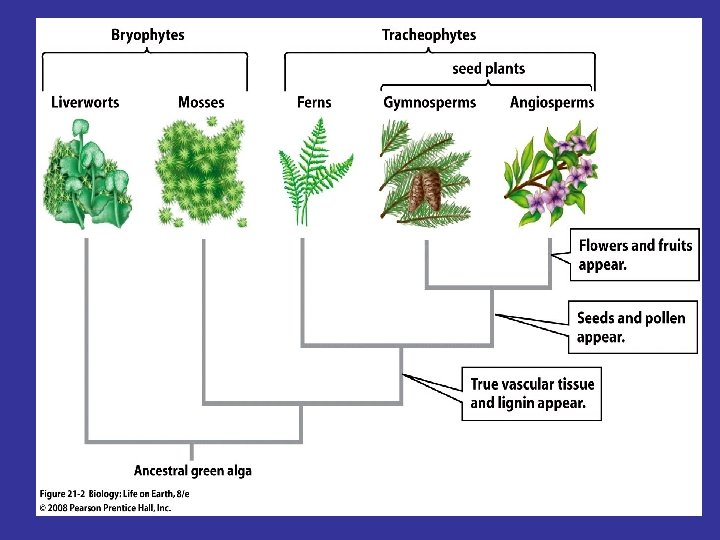
III. The Plant Evolutionary Tree A. Certain anatomical features represent milestones in the evolution of plants 1. Appearance of CHLOROPLASTS and lignin 2. Appearance of pollen and seeds 3. Appearance of VASCULAR TISSUE B. Green Algae 1. DNA comparisons show that green ALGAE are plants’ closest living relatives 2. Both have same type of chlorophyll and accessory pigments in photosynthesis 3. Both store food as GLUCOSE 4. Both have cell walls made of CELLULOSE
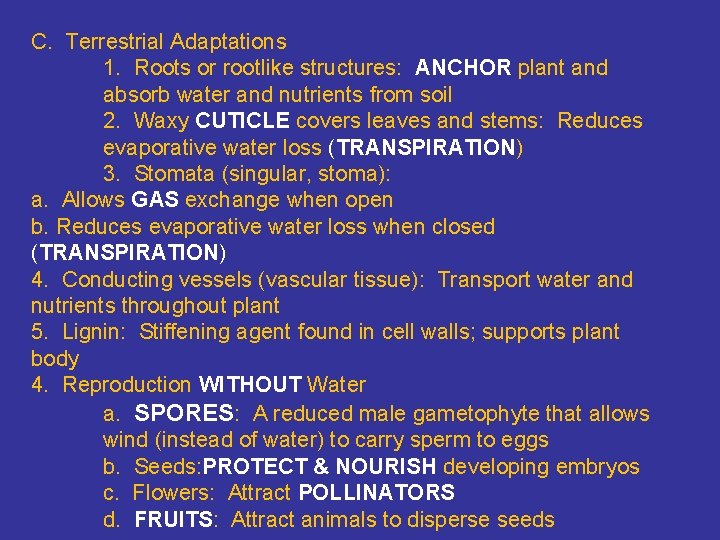
C. Terrestrial Adaptations 1. Roots or rootlike structures: ANCHOR plant and absorb water and nutrients from soil 2. Waxy CUTICLE covers leaves and stems: Reduces evaporative water loss (TRANSPIRATION) 3. Stomata (singular, stoma): a. Allows GAS exchange when open b. Reduces evaporative water loss when closed (TRANSPIRATION) 4. Conducting vessels (vascular tissue): Transport water and nutrients throughout plant 5. Lignin: Stiffening agent found in cell walls; supports plant body 4. Reproduction WITHOUT Water a. SPORES: A reduced male gametophyte that allows wind (instead of water) to carry sperm to eggs b. Seeds: PROTECT & NOURISH developing embryos c. Flowers: Attract POLLINATORS d. FRUITS: Attract animals to disperse seeds
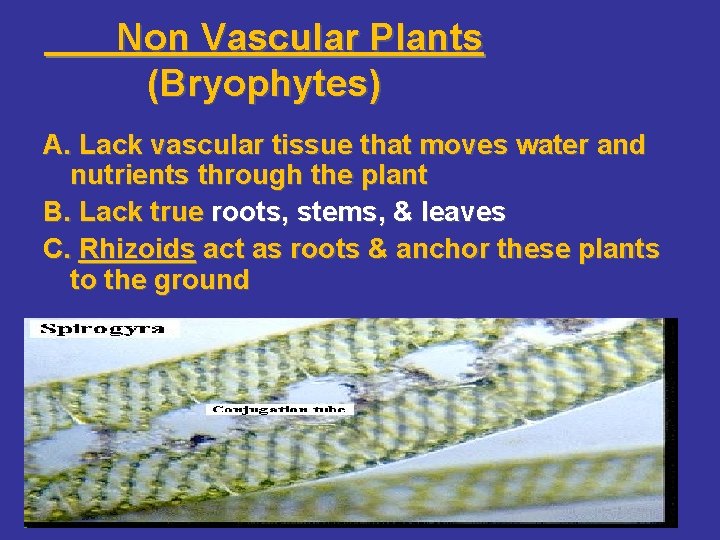
Non Vascular Plants (Bryophytes) A. Lack vascular tissue that moves water and nutrients through the plant B. Lack true roots, stems, & leaves C. Rhizoids act as roots & anchor these plants to the ground
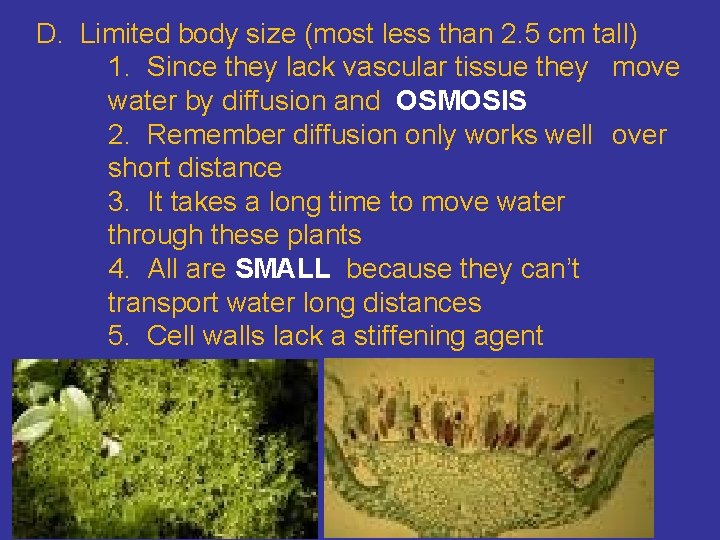
D. Limited body size (most less than 2. 5 cm tall) 1. Since they lack vascular tissue they move water by diffusion and OSMOSIS 2. Remember diffusion only works well over short distance 3. It takes a long time to move water through these plants 4. All are SMALL because they can’t transport water long distances 5. Cell walls lack a stiffening agent
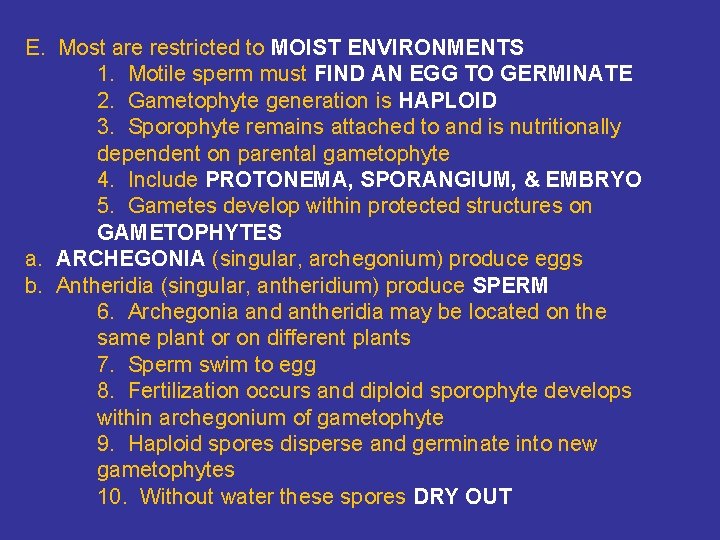
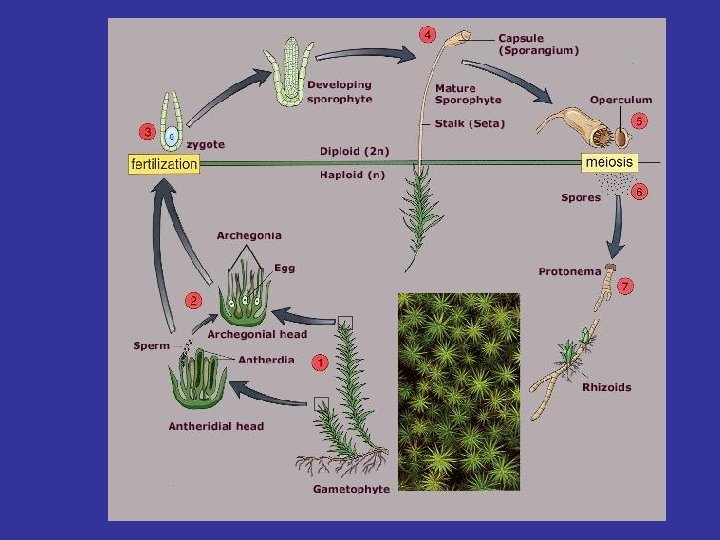
E. Most are restricted to MOIST ENVIRONMENTS 1. Motile sperm must FIND AN EGG TO GERMINATE 2. Gametophyte generation is HAPLOID 3. Sporophyte remains attached to and is nutritionally dependent on parental gametophyte 4. Include PROTONEMA, SPORANGIUM, & EMBRYO 5. Gametes develop within protected structures on GAMETOPHYTES a. ARCHEGONIA (singular, archegonium) produce eggs b. Antheridia (singular, antheridium) produce SPERM 6. Archegonia and antheridia may be located on the same plant or on different plants 7. Sperm swim to egg 8. Fertilization occurs and diploid sporophyte develops within archegonium of gametophyte 9. Haploid spores disperse and germinate into new gametophytes 10. Without water these spores DRY OUT
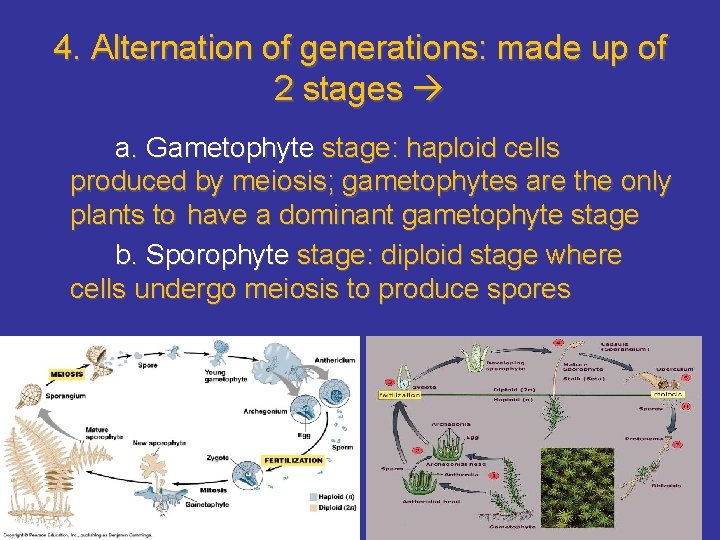
4. Alternation of generations: made up of 2 stages a. Gametophyte stage: haploid cells produced by meiosis; gametophytes are the only plants to have a dominant gametophyte stage b. Sporophyte stage: diploid stage where cells undergo meiosis to produce spores
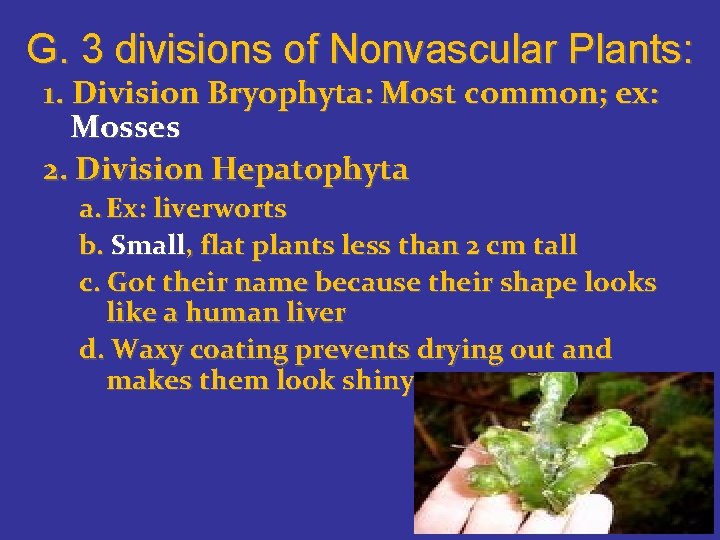
G. 3 divisions of Nonvascular Plants: 1. Division Bryophyta: Most common; ex: Mosses 2. Division Hepatophyta a. Ex: liverworts b. Small, flat plants less than 2 cm tall c. Got their name because their shape looks like a human liver d. Waxy coating prevents drying out and makes them look shiny
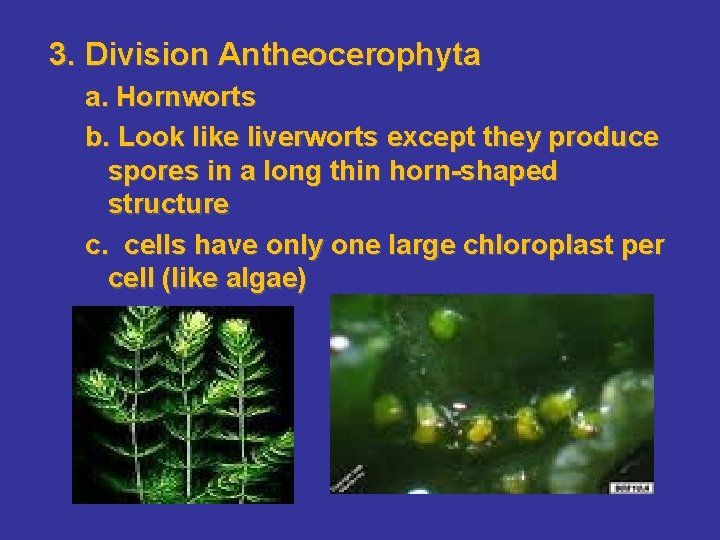
3. Division Antheocerophyta a. Hornworts b. Look like liverworts except they produce spores in a long thin horn-shaped structure c. cells have only one large chloroplast per cell (like algae)
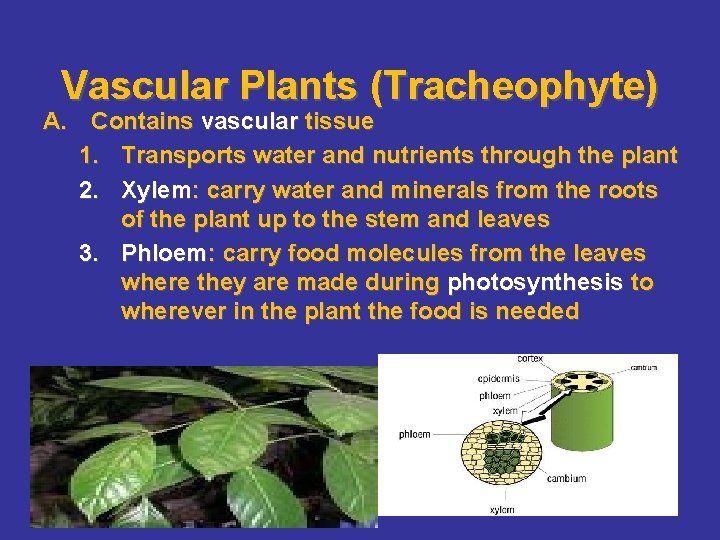
Vascular Plants (Tracheophyte) A. Contains vascular tissue 1. Transports water and nutrients through the plant 2. Xylem: carry water and minerals from the roots of the plant up to the stem and leaves 3. Phloem: carry food molecules from the leaves where they are made during photosynthesis to wherever in the plant the food is needed
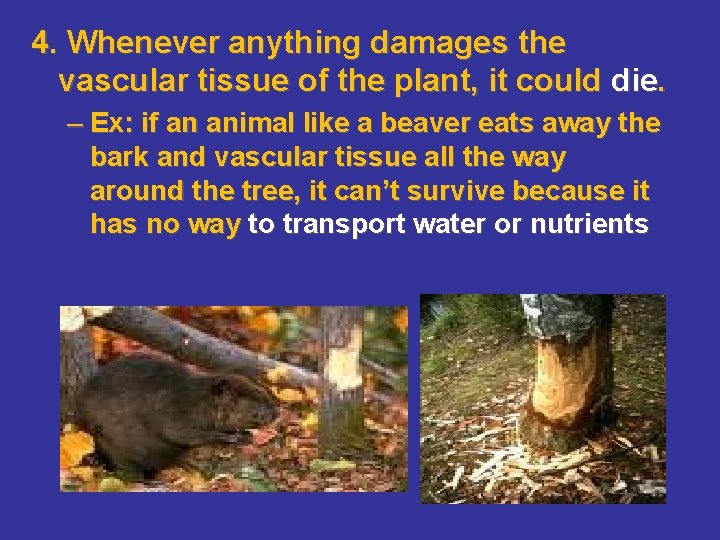
4. Whenever anything damages the vascular tissue of the plant, it could die. – Ex: if an animal like a beaver eats away the bark and vascular tissue all the way around the tree, it can’t survive because it has no way to transport water or nutrients
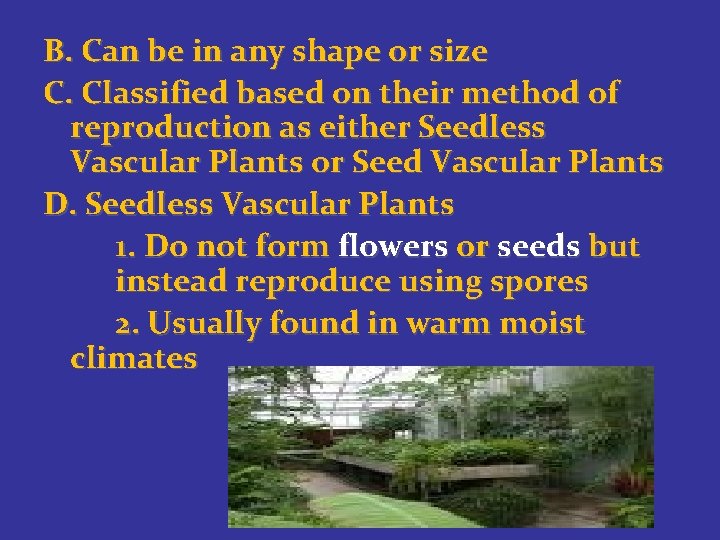
B. Can be in any shape or size C. Classified based on their method of reproduction as either Seedless Vascular Plants or Seed Vascular Plants D. Seedless Vascular Plants 1. Do not form flowers or seeds but instead reproduce using spores 2. Usually found in warm moist climates
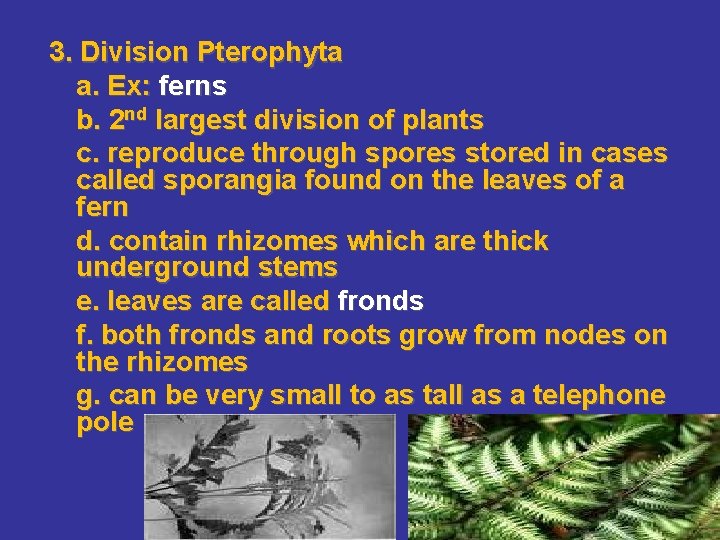
3. Division Pterophyta a. Ex: ferns b. 2 nd largest division of plants c. reproduce through spores stored in cases called sporangia found on the leaves of a fern d. contain rhizomes which are thick underground stems e. leaves are called fronds f. both fronds and roots grow from nodes on the rhizomes g. can be very small to as tall as a telephone pole
4. Seedless Vascular Plant Reproduction a. Sporophyte produces haploid spores within SPORANGIA (singular, sporangium) b. Spores disperse and germinate into tiny, independent gametophytes i. Archegonium produces EGG ii. ANTHRIDIA produces sperm c. Sperm swim to egg d. Fertilization occurs and zygote develops into a OVULE OR NEW SEED
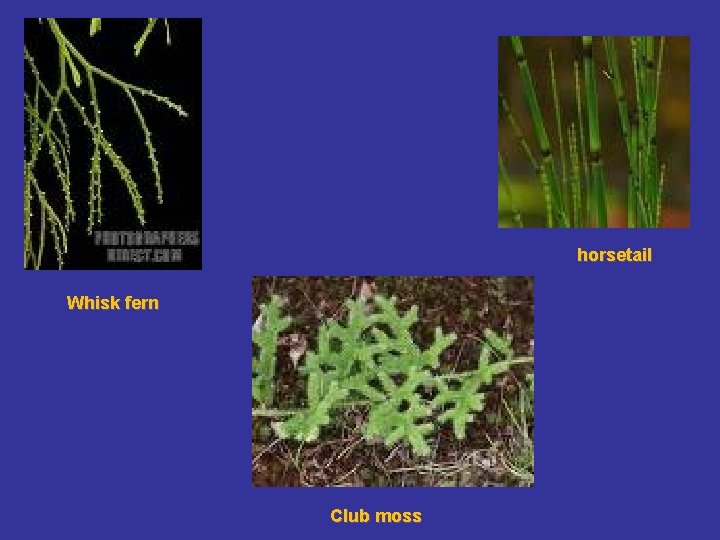
4. Division Psilotophyta a. whisk ferns b. simple plants lacking roots and leaves 5. Division Lycophyta a. club mosses b. have leaves that look like moss but have roots, stems, and leaves c. spores used to be used to make the “flash” for cameras before their were lightbulbs 6. Division Sphenophyta a. Ex: horsetails b. used to be used to scrub pots and pans b/c they contain silica in their stems c. Genus Equisetum are the only genus left and are considered to be living fossils
horsetail Whisk fern Club moss
**Seed Vascular Plants are then divided into Gymnosperms and Angiosperm** E. Seed Producing gymnosperms 1. Produce seeds in cones or some in “naked” form. 2. Do not produce flowers 3. Produce pollen and seeds a. Pollen grains contain spermproducing cells b. Dispersed by WIND OR ANIMALS c. Eliminate need for sperm to swim to egg
4. Seeds consist of: a. Embryonic plant b. Seed coat (protects EMBRYO) c. Food supply (nourishes emerging plant) d. May remain DORMANT for days, months, or years e. May possess adaptations for dispersal by wind, water, and animals F. Gametophytes greatly reduced in size and dependent on sporophyte for nutrition g. Female gametophyte is a small group of haploid cells h. Male gametophyte is A MICROSPORE CONSISTING OF 2 CELLS
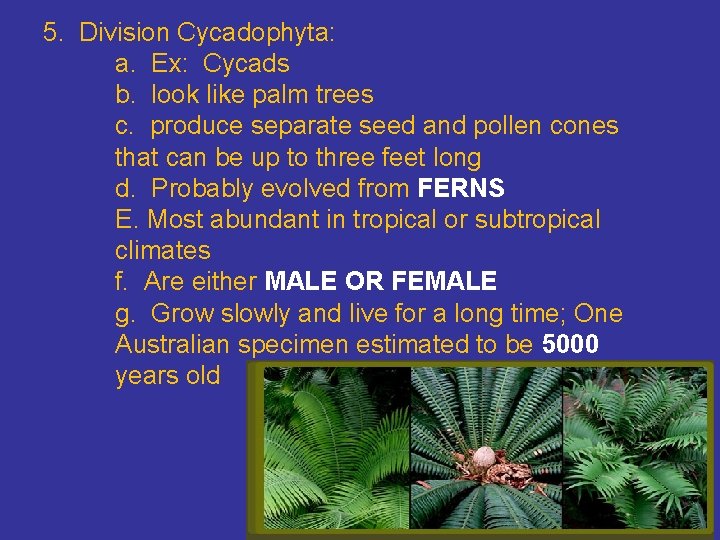
5. Division Cycadophyta: a. Ex: Cycads b. look like palm trees c. produce separate seed and pollen cones that can be up to three feet long d. Probably evolved from FERNS E. Most abundant in tropical or subtropical climates f. Are either MALE OR FEMALE g. Grow slowly and live for a long time; One Australian specimen estimated to be 5000 years old
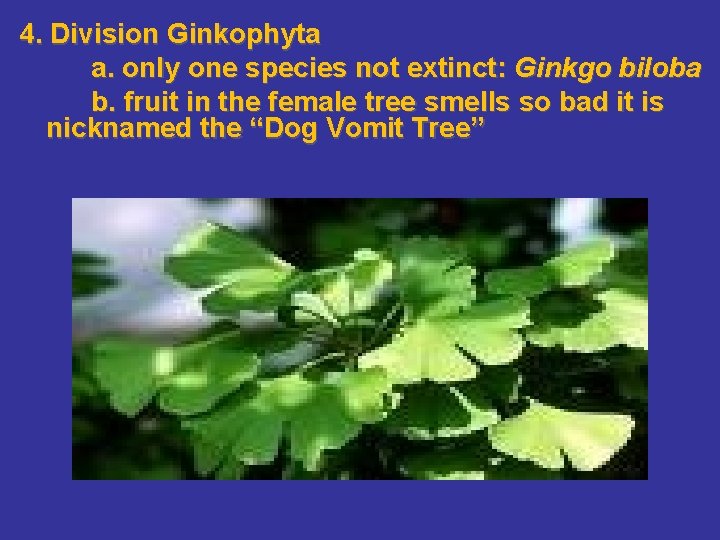
4. Division Ginkophyta a. only one species not extinct: Ginkgo biloba b. fruit in the female tree smells so bad it is nicknamed the “Dog Vomit Tree”
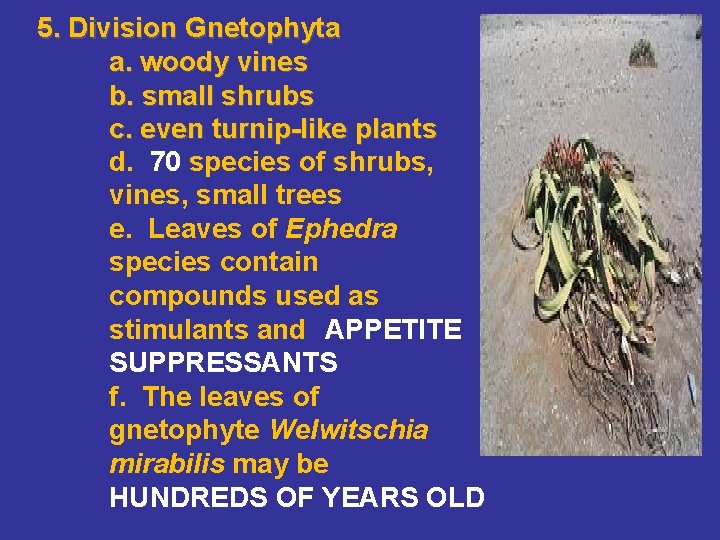
5. Division Gnetophyta a. woody vines b. small shrubs c. even turnip-like plants d. 70 species of shrubs, vines, small trees e. Leaves of Ephedra species contain compounds used as stimulants and APPETITE SUPPRESSANTS f. The leaves of gnetophyte Welwitschia mirabilis may be HUNDREDS OF YEARS OLD
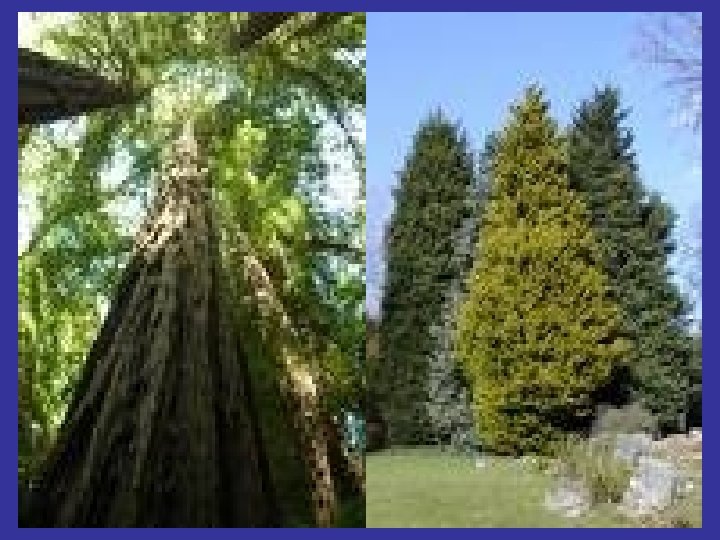
6. Division Coniferophyta a. conifers b. produce seeds in cones c. classified by their (needle-like or scaly) d. used to make paper and building supplies, provide habitat, medicines are made from the Yew – cancer medications e. Includes the redwoods (the tallest trees), pines f. Most abundant in COLD latitudes and at high elevations g. Adapted to dry, cold conditions: i. Retain green leaves throughout the year (EVERGREEN) ii. Thin, needle-like leaves covered with waterproofing material to reduce evaporation iii. Produces an “ANTIFREEZE” in sap
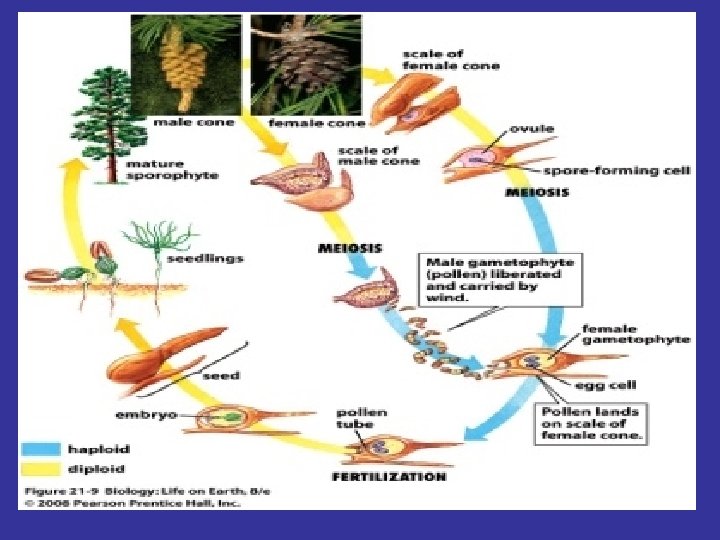
_ h. Conifer Seeds Develop in Cones i. Female cones consist of numerous woody scales arranged spirally around a CENTRAL axis ii. Two ovules (immature seeds) located at base of each scale iii. Cells within each ovule undergo MEIOSIS to produce haploid female gametophytes iv. Female gametophytes produce EGG CELLS v. Male cones are relatively SMALL vi. Produce pollen (MALE gametophytes) by meiosis vii. Pollen dispersed by WIND viii. Pollen grain germinates and forms a pollen tube if it lands near female gametophyte ix. Pollen tube slowly burrows into FEMALE gametophyte (may take 14 MONTHS) x. POLLEN TUBE releases sperm when it comes into contact with egg xi. FERTILIZATION occurs and seed develops xii. Seeds released when cone is MATURE xiii. Seeds dispersed by WIND xiv. Seeds germinate to form SPOROPHYTE TREES
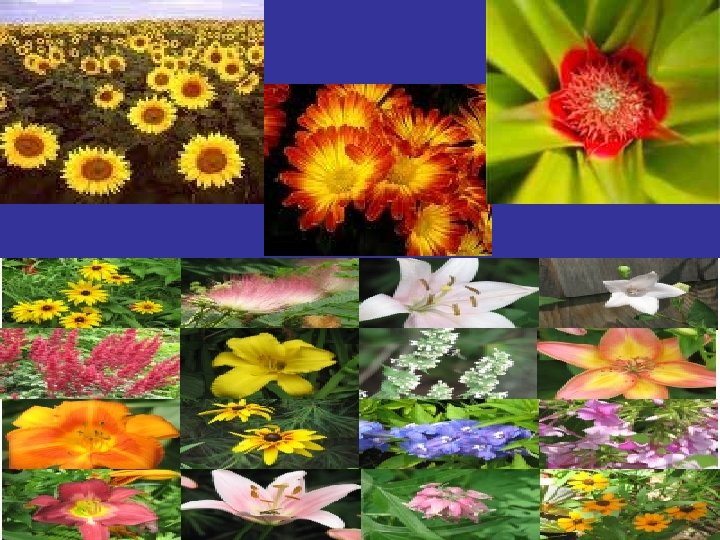
F. Seed Producing Angiosperms The 12 th Division in plants is Anthophyta. 1. flowering plants *not always big and colorful, sometimes you don’t even notice them* 2. Have covered seeds 3. contain roots stems and leaves 4. Produce seeds *Seeds develop in fruits which are a matured flower part* 5. Have broad range in size: Smallest is duckweed ( 3 mm in diameter), Largest is eucalyptus tree (100 meters in height)
6. Life Cycle of an Angiosperm. a. Flowers develop on dominant sporophyte plant b. Male gametophytes (pollen) develop inside anthers. c. Female gametophyte develops from an ovule inside the ovary d. Pollination occurs when pollen grain lands on the stigma of a flower e. Fertilization occurs when growing pollen tube releases sperm into the ovule F. Fertilized ovule develops into a seed. g. Seed is dispersed and germinates to form a sporophyte plant.
7. Three major adaptations have contributed to dominance of angiosperms. a. Flowers i. Flowers are reproductive structures in which both male and female gametophytes are formed. ii. Believed to have evolved when gymnosperm ancestors formed an association with animals. iii. Animals benefited by eating some of the protein-rich pollen iv. Plants benefited by using animals as pollinators v. Most flowers are showy and attract animal pollinators (e. g. insects) vi. Some flowers are inconspicuous and rely on wind for pollination
b. Fruits i. Fruits are mature ovaries that contain developing seeds ii. Various fruit adaptations help disperse seeds iii. Edible fruits entice animals to eat them (seeds pass through digestive tract unharmed) iv. Burrs cling to animal fur. v. Winged fruits are carried through the air. c. Leaves i. collect more sunlight for photosynthesis than narrow leaves of gymnosperms.
8. Temperate angiosperms drop leaves to conserve water when it is in short supply (fall, winter): deciduous – ex. oak 9. Tropical/Subtropical angiosperms are evergreen (May shed leaves during dry season) 10. Photosynthetic advantage is offset by fact that broad, tender leaves are more appealing than tough, waxy needles of conifers 11. Angiosperm defenses include a. Physical defenses (thorns, spines, resins) b. Chemical defenses (make plant tissue poisonous or distasteful) c. Many defensive compounds have been exploited by humans for medicinal uses i. Medicines (aspirin, codeine) ii. Stimulants (nicotine, coffee) iii. Spicy flavors (mustard, peppermint)
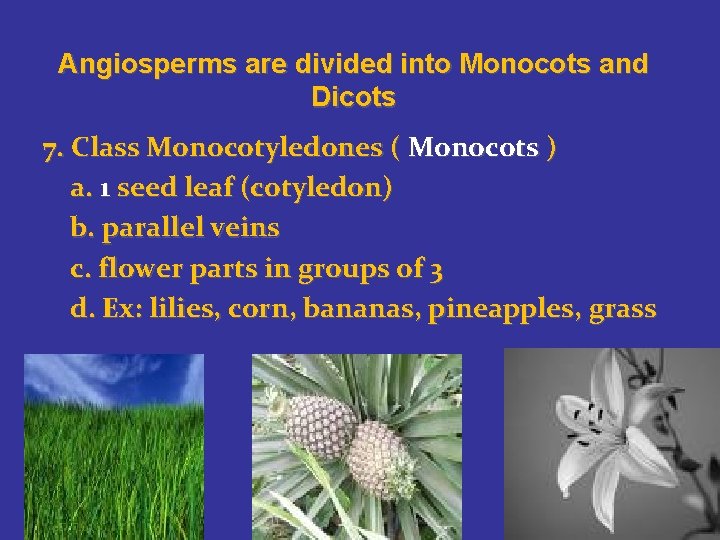
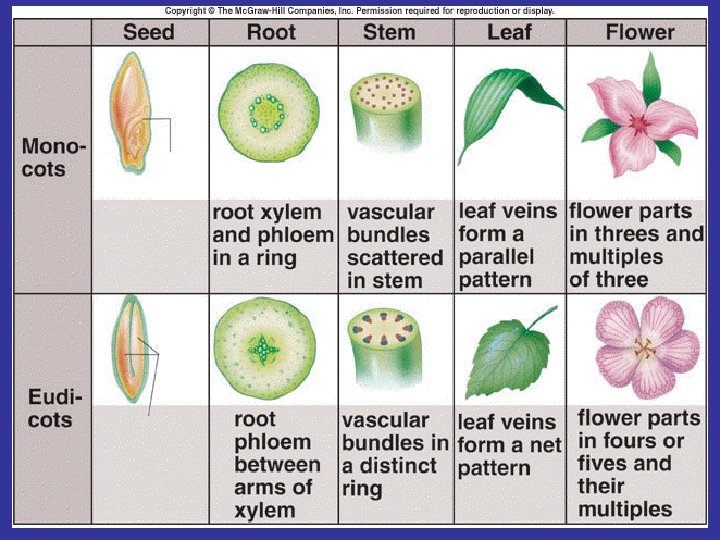
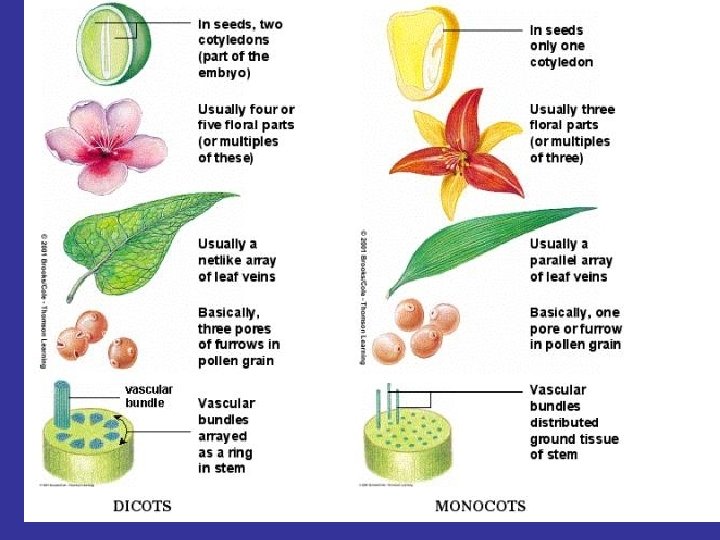
Angiosperms are divided into Monocots and Dicots 7. Class Monocotyledones ( Monocots ) a. 1 seed leaf (cotyledon) b. parallel veins c. flower parts in groups of 3 d. Ex: lilies, corn, bananas, pineapples, grass
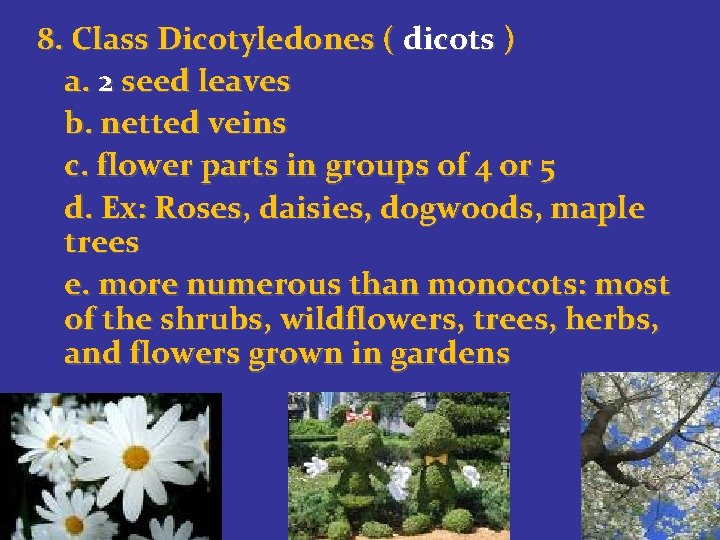
8. Class Dicotyledones ( dicots ) a. 2 seed leaves b. netted veins c. flower parts in groups of 4 or 5 d. Ex: Roses, daisies, dogwoods, maple trees e. more numerous than monocots: most of the shrubs, wildflowers, trees, herbs, and flowers grown in gardens
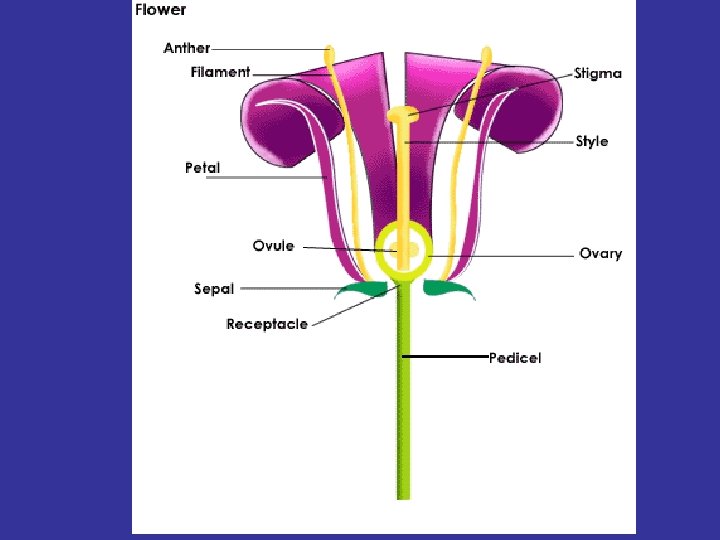
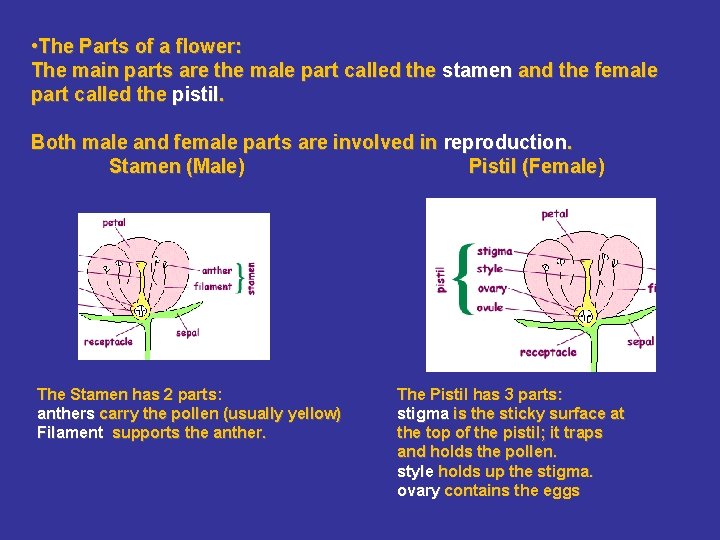
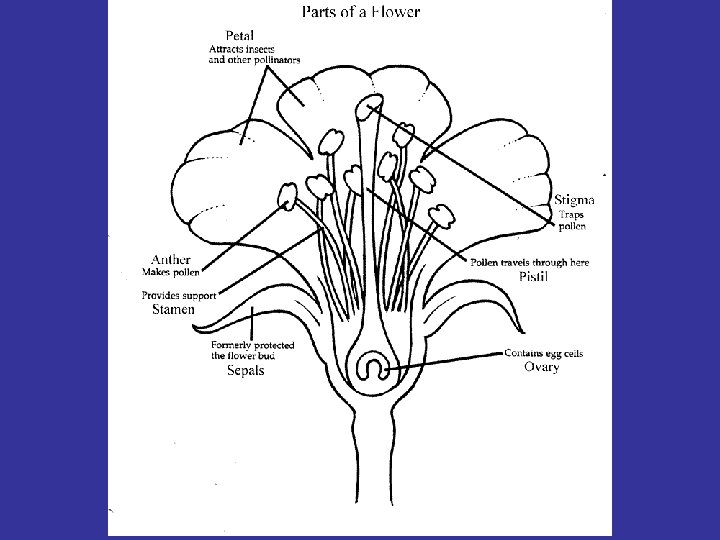
14. Review: Organs in Sexually Reproducing Plants: a. b. c. d. e. f. g. h. Stigma – sticky, pollen receptive surface of a carpel Anther - pollen-bearing structure in the stamen of the flower Filament – stalk of the stamen; supports the anther Pollen grain – male gamete of plants Ovary – organ responsible for producing the female gamete Ovule – structure that contains the materials that develop into a seed after fertilization Pistil – unit of female reproduction in a flower made of one or more carpels Stamen – male organ of the flower made of a stalk (filament) and the pollen bearing portion (anther)
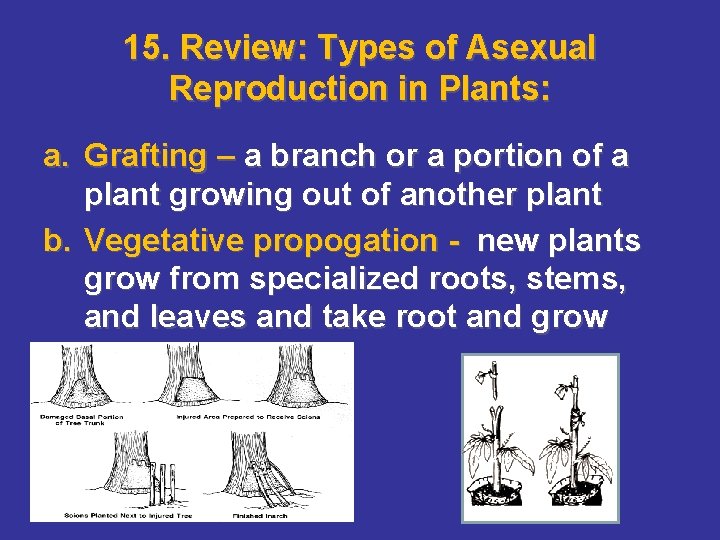
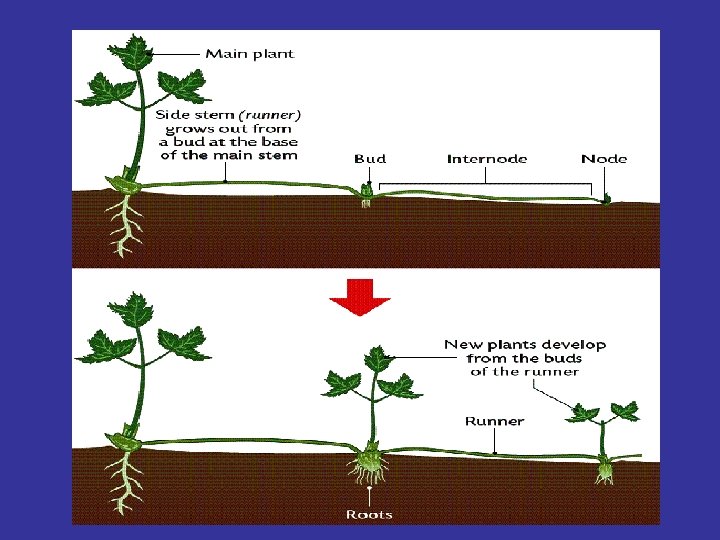
15. Review: Types of Asexual Reproduction in Plants: a. Grafting – a branch or a portion of a plant growing out of another plant b. Vegetative propogation - new plants grow from specialized roots, stems, and leaves and take root and grow individually
• The Parts of a flower: The main parts are the male part called the stamen and the female part called the pistil. Both male and female parts are involved in reproduction. Stamen (Male) Pistil (Female) The Stamen has 2 parts: anthers carry the pollen (usually yellow) Filament supports the anther. The Pistil has 3 parts: stigma is the sticky surface at the top of the pistil; it traps and holds the pollen. style holds up the stigma. ovary contains the eggs
• Other parts of the flower that are important are the petals and the sepals. Petals attract pollinators. Sepals are the green petal-like parts at the base of the flower. They protect a flower from damage while it is a bud. • The leaves have a watertight covering, which reduces water loss, makes it possible for plants to live in drier habitats. The cuticle is the waxy, watertight outer covering. The cuticle does not let oxygen or carbon dioxide (gases) pass through it. Beneath the waxy cuticle layer of a leaf is a layer of cells called the epidermis. The epidermis is the out layer of cells of a plant. The epidermis is like a skin and is usually one cell thick. Pores called stomata permit plants to exchange oxygen and carbon dioxide (gases). A pair of specialized cells called guard cells border each stomata. Stomata open and close as the guard cells change shape. The primary function of plant leaves is to trap sunlight.