
PlantEnvironment Relationship HO Puising Contents Development of Plants



- Slides: 59
Plant-Environment Relationship HO Pui-sing
Contents Development of Plants Equatorial / Tropical Rain Forest Tropical Desert Vegetation Local Plant-Environment Relationship The Relationship of Biomes to Ecolines
Development of Plants Classification of Plants Factors affecting plants development
Classification of Plants Life form of plants Trees Shrubs Lianas Herbs Vegetation structure Forest Woodland Lichens
Factors affecting development Plant habitats Water availability Temperature Time Human
Plant habitats Plants affect landform and soil (Env. ) Different conditions of slopes, drainage and soil type will create different plant environment = plant habitats
Water availability Types of plants Xerophytes Hygrophytes Mesophytes Tropophytes Deciduous plants Evergreen plants
Temperature Plant growth: photosynthesis, flowering, fruiting and seed germination Water availability: rate of transpiration and evaporation Damage: damage the cell tissues for too cold Frontier: a boundary which a plant species cannot survive.
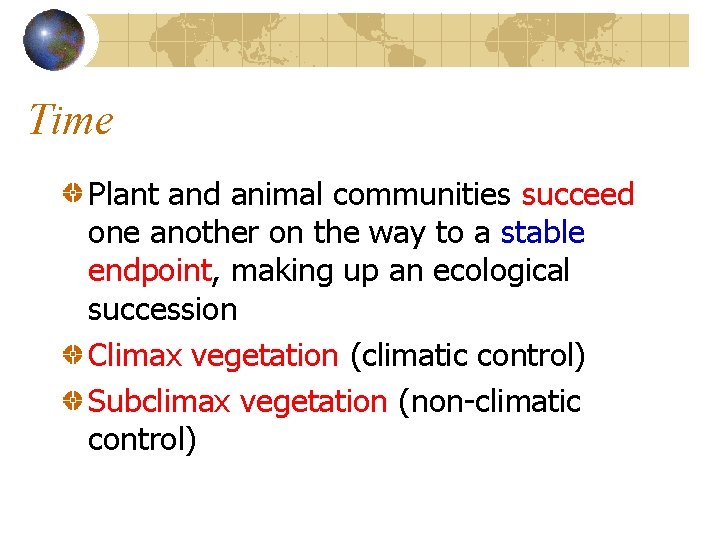
Time Plant and animal communities succeed one another on the way to a stable endpoint, making up an ecological succession Climax vegetation (climatic control) Subclimax vegetation (non-climatic control)
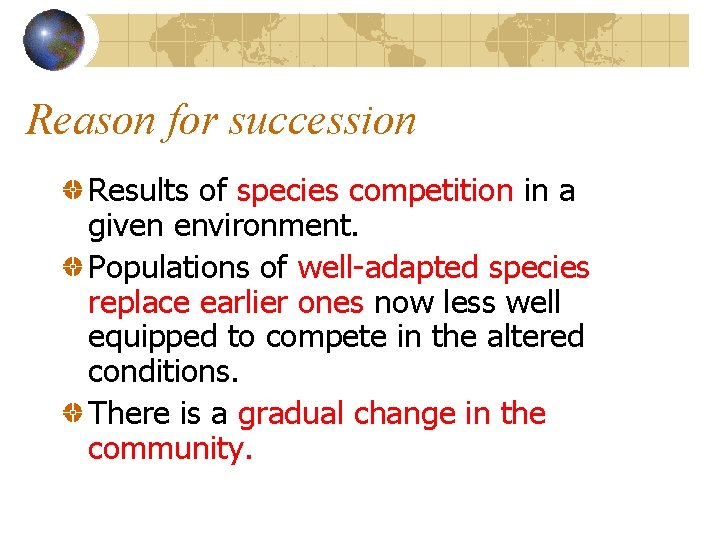
Reason for succession Results of species competition in a given environment. Populations of well-adapted species replace earlier ones now less well equipped to compete in the altered conditions. There is a gradual change in the community.
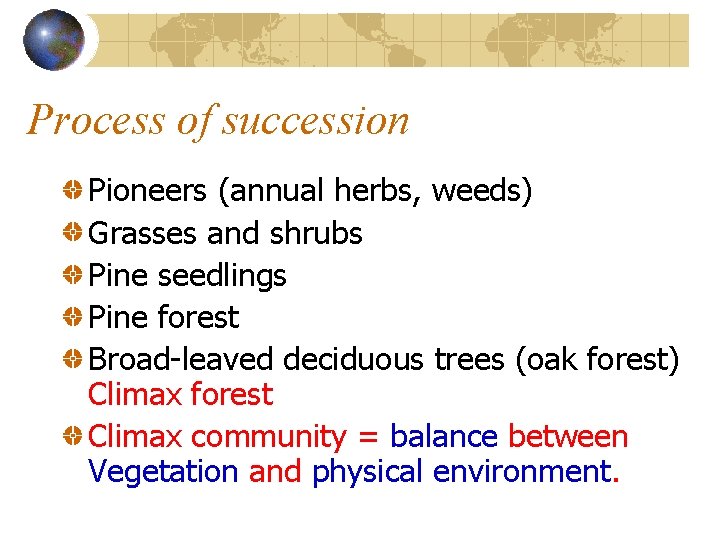
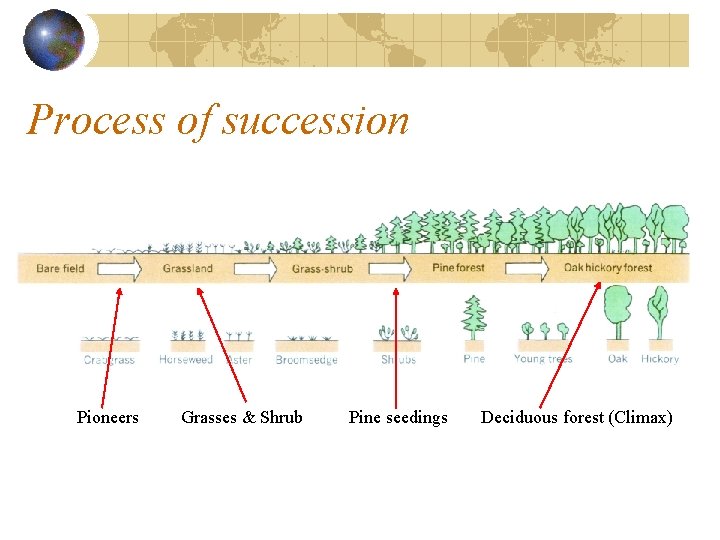
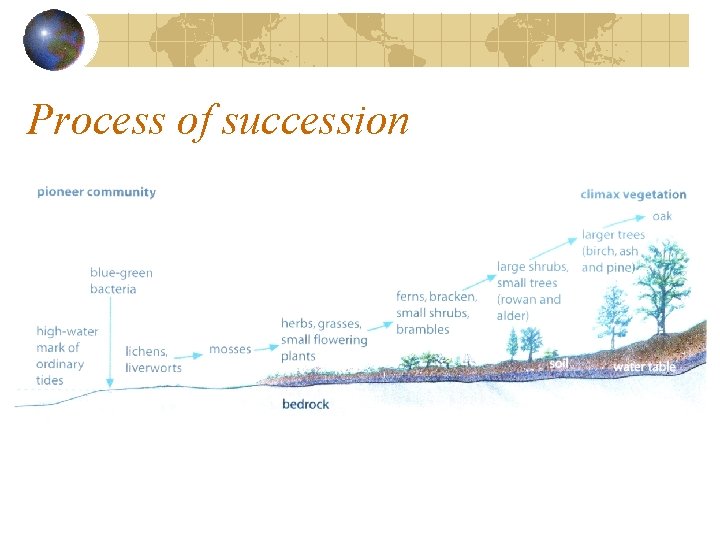
Process of succession Pioneers (annual herbs, weeds) Grasses and shrubs Pine seedlings Pine forest Broad-leaved deciduous trees (oak forest) Climax forest Climax community = balance between Vegetation and physical environment.
Process of succession Pioneers Grasses & Shrub Pine seedings Deciduous forest (Climax)
Process of succession
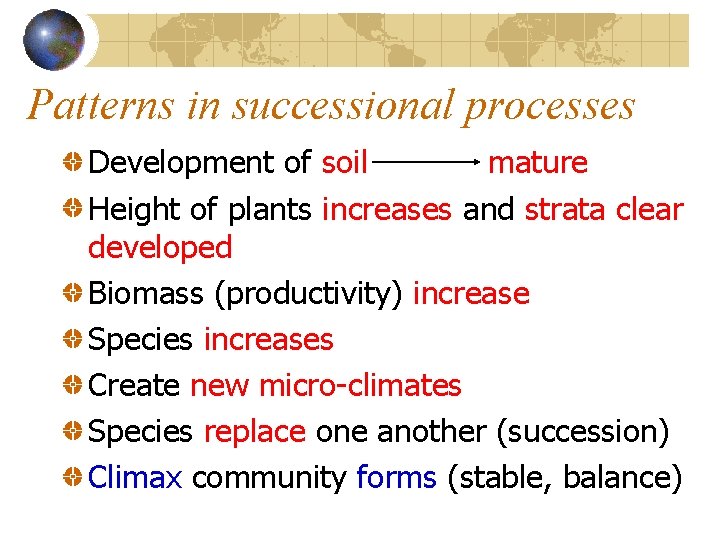
Patterns in successional processes Development of soil mature Height of plants increases and strata clear developed Biomass (productivity) increase Species increases Create new micro-climates Species replace one another (succession) Climax community forms (stable, balance)
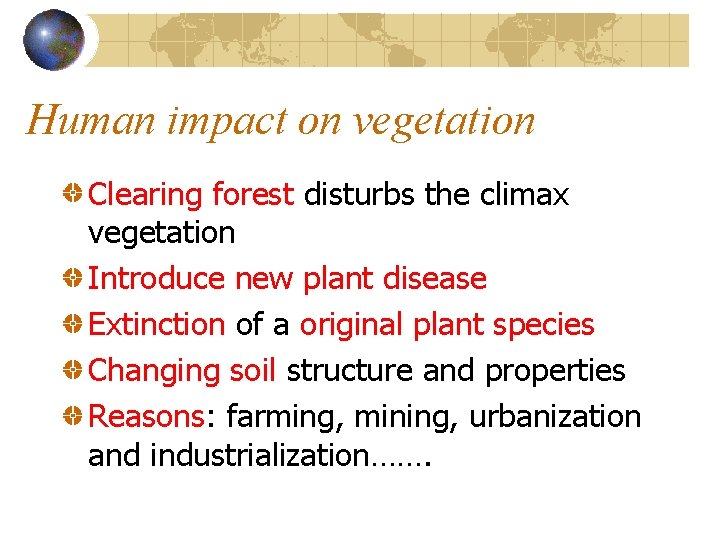
Human impact on vegetation Clearing forest disturbs the climax vegetation Introduce new plant disease Extinction of a original plant species Changing soil structure and properties Reasons: farming, mining, urbanization and industrialization…….
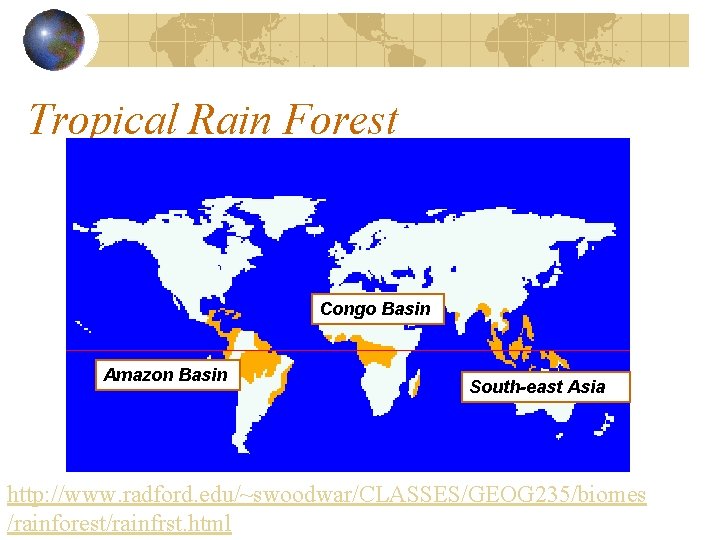
Tropical Rain Forest Congo Basin Amazon Basin South-east Asia http: //www. radford. edu/~swoodwar/CLASSES/GEOG 235/biomes /rainforest/rainfrst. html
Natural Environment High insolation Monthly temperature between 26 o. C and 27 o. C Annual rainfall usually more than 2000 mm Convection Rain is common Hot and wet throughout the year
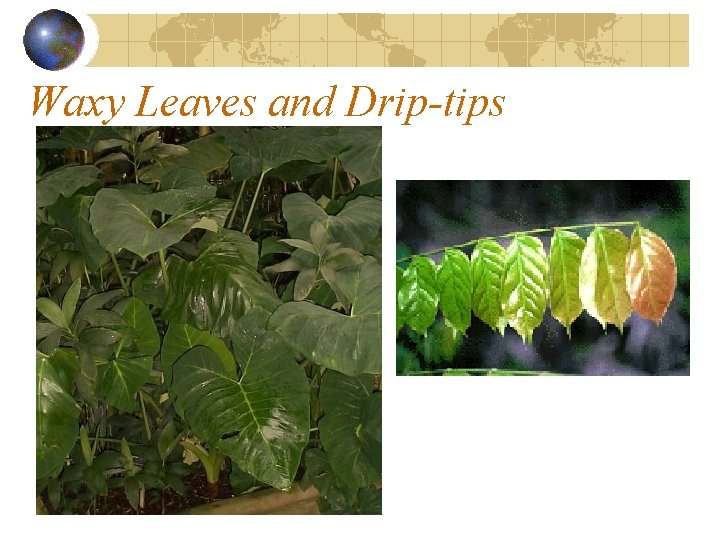
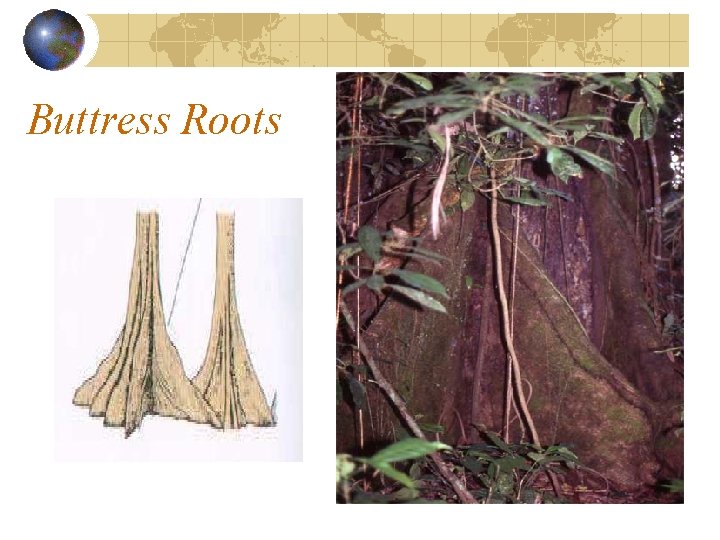
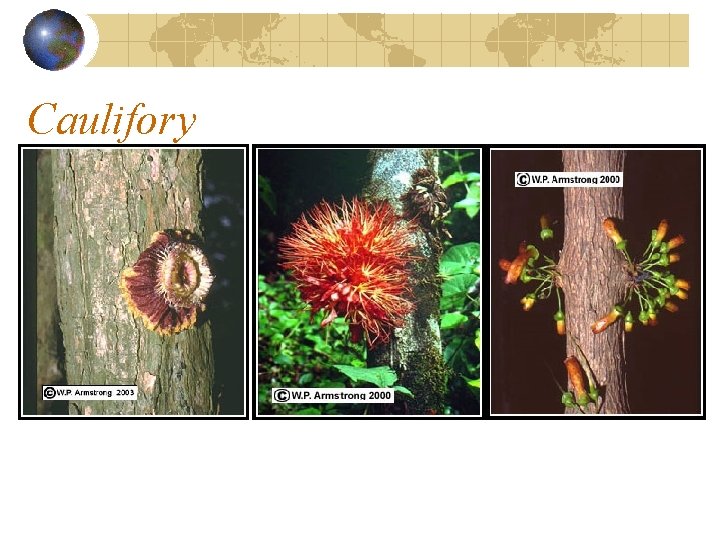
Characteristics of TRF Vegetation Evergreen forest Vegetation Layers Leaves Drip-tips Roots Cauliflory
Evergreen No Seasonal variation Leaf-growth, flowering, fruiting, leaffall……. go on continuously Trees can live to a great age
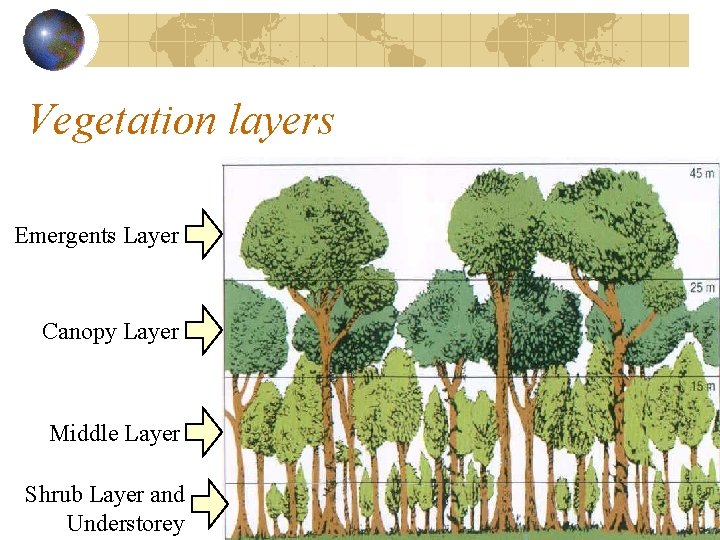
Vegetation layers Emergents Layer Canopy Layer Middle Layer Shrub Layer and Understorey
Vegetation Layers Emergent layer very tall tree with broad crown (30 -40 m) few in number Canopy layer a continuous cover (20 m) Middle layer younger trees (5 -15 m) Shrub layer and undergrowth little growth because of shade
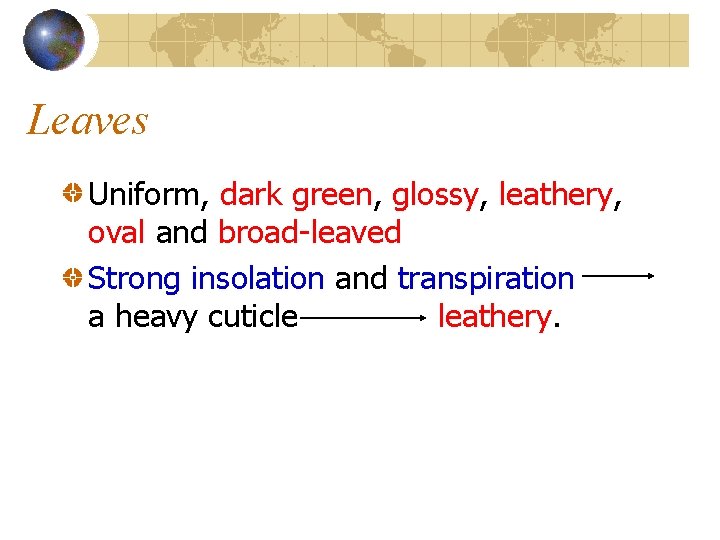
Leaves Uniform, dark green, glossy, leathery, oval and broad-leaved Strong insolation and transpiration a heavy cuticle leathery.
Waxy Leaves and Drip-tips
Buttress Roots
Caulifory
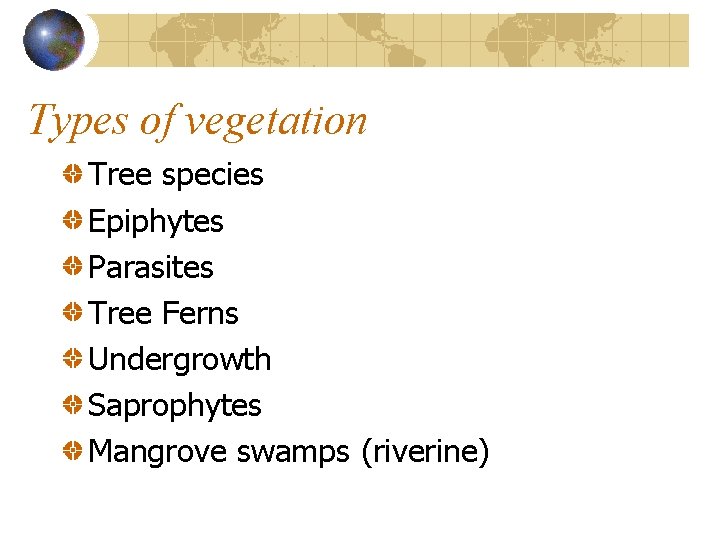
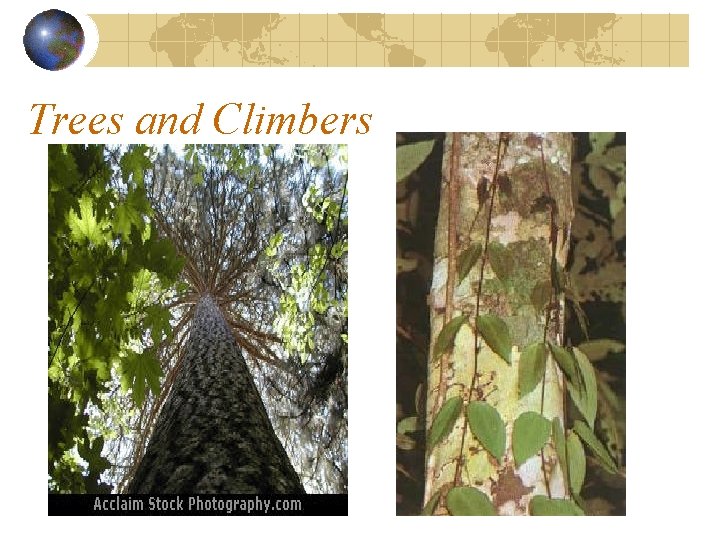
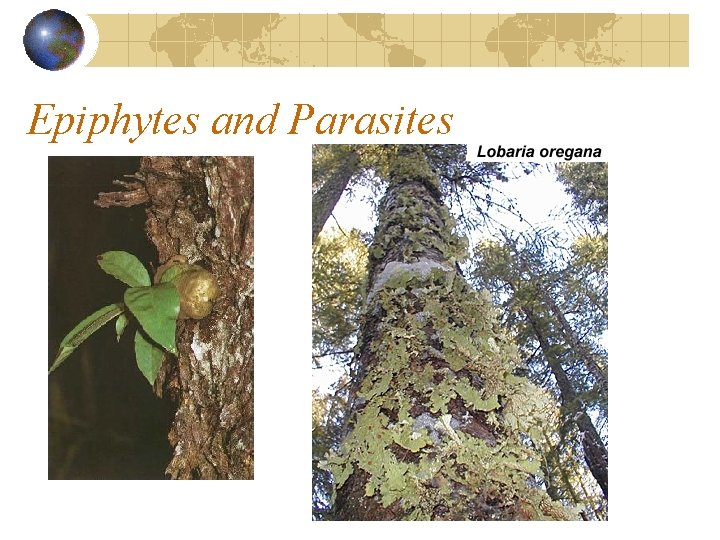
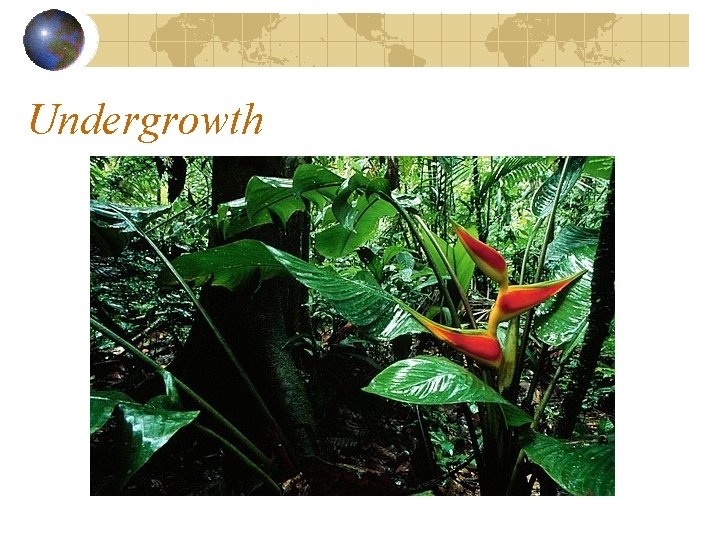
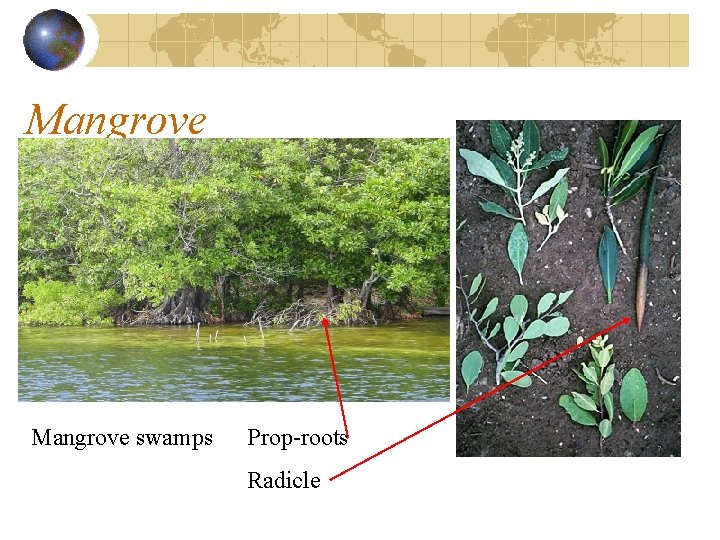
Types of vegetation Tree species Epiphytes Parasites Tree Ferns Undergrowth Saprophytes Mangrove swamps (riverine)
Trees and Climbers
Epiphytes and Parasites
Undergrowth
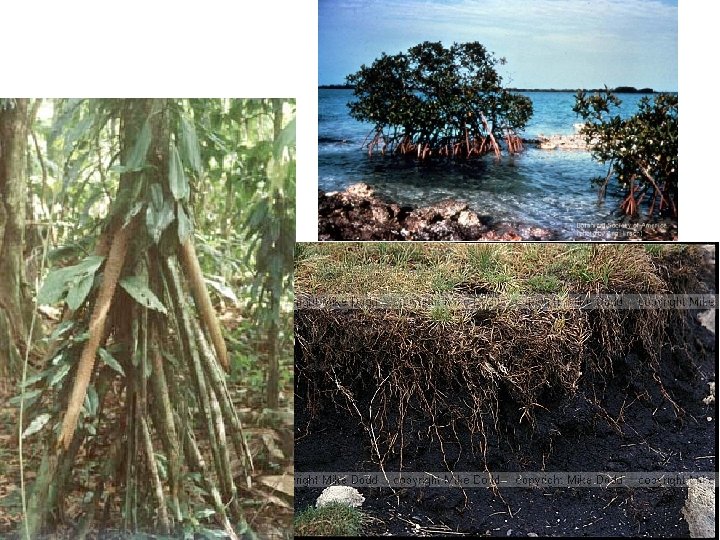
Mangrove swamps Prop-roots Radicle
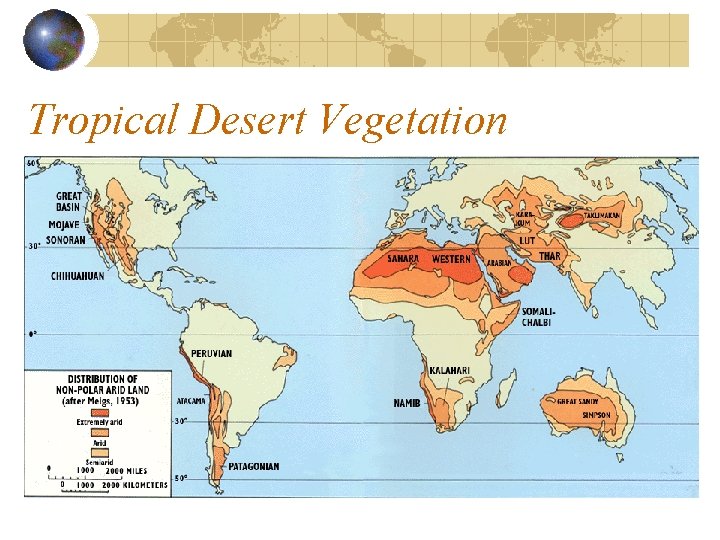
Tropical Desert Vegetation
Natural Environment Among the driest places on earth (<250 mm) Mean annual temperature above 18 o. C Low relative humidity Irregular and unreliable rainfall Highest percentage of sunshine of any climate Large diurnal temperature range Highest daytime temperature of any climate Annual precipitation < half the annual potential evapotranspiration
Tropical Desert Vegetation Characteristics of the vegetation Types of vegetation
Characteristics - Morphological Extensive root systems (vertical or horizontal) Deeply penetrating roots reach permanently wet soil or ground water store Horizontal roots may extend for 5 -20 m Low shoot-to-root ratio (1: 3. 5 to 1: 6) Special leaves (small, roll, spiny and shed foliage) for reduce transpiration and preserve water.
Characteristics - Anatomical Cuticularisation produces a watertight and waxy-like surface Lignification provides mechanical support Low, rounded shapes can reduce damage by strong wind Many hairs
Characteristics - others Sparsely distribution for not enough water supply Low biomass, few species, lack of competition
Types of vegetation Ephemeral annuals Succulent perennials Non-succulent perennials
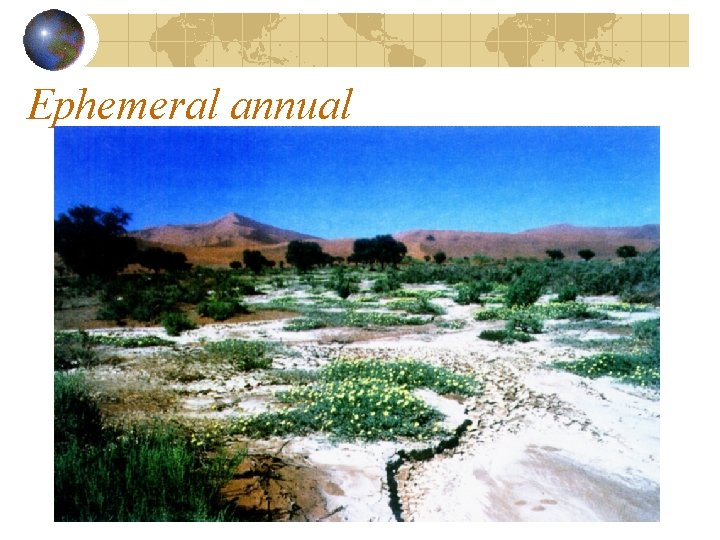
Ephemeral annual 50 -60% of desert plants Complete its full life cycle within 6 -8 weeks (short life cycle) Small size, shallow roots Fast germinating, growing, flowering and seeding Extensive germination immediately after precipitation Eg. Desert plantains, desert fescue
Ephemeral annual
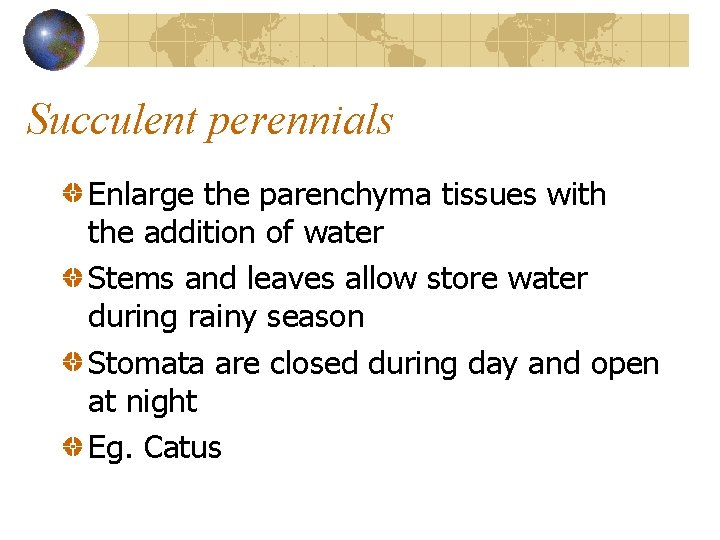
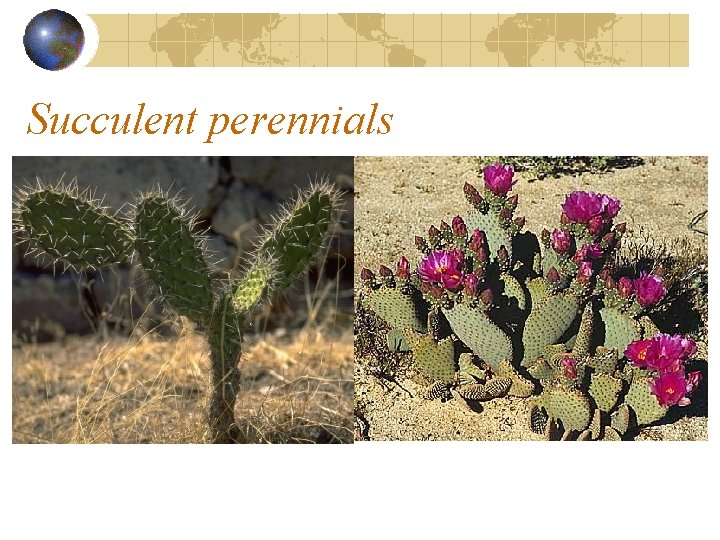
Succulent perennials Enlarge the parenchyma tissues with the addition of water Stems and leaves allow store water during rainy season Stomata are closed during day and open at night Eg. Catus
Succulent perennials
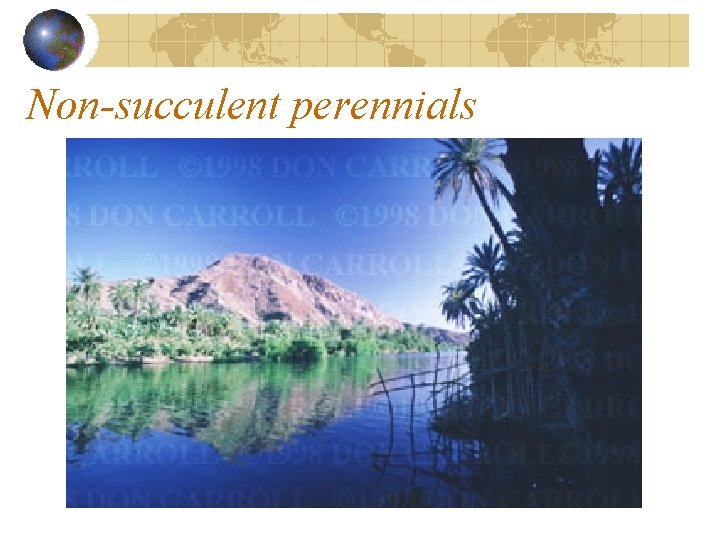
Non-succulent perennials Can be divided into three types Evergreens Drought-deciduous Cold-deciduous Commonly found where a little water is available. (wadis, oases, perennial rivers) Eg. Tamarisks, acacias, grasses, palms
Non-succulent perennials
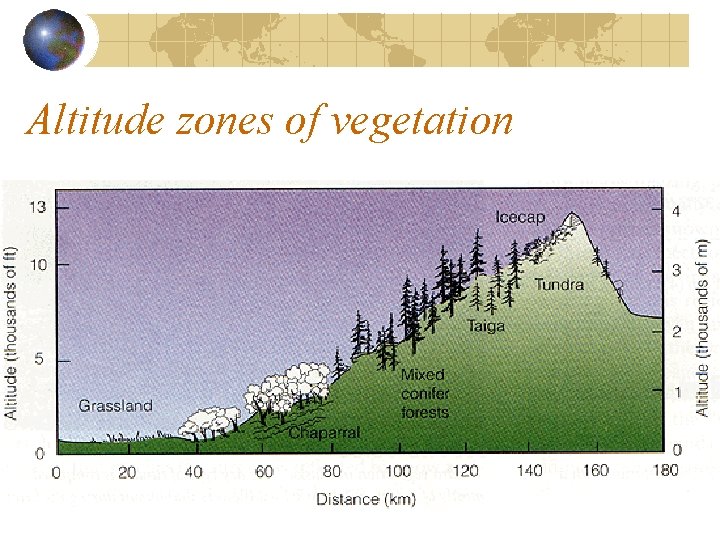
Local Plant-Environment Relationship Altitude zones of vegetation The local variation of vegetation in TRF The local variation of vegetation in desert
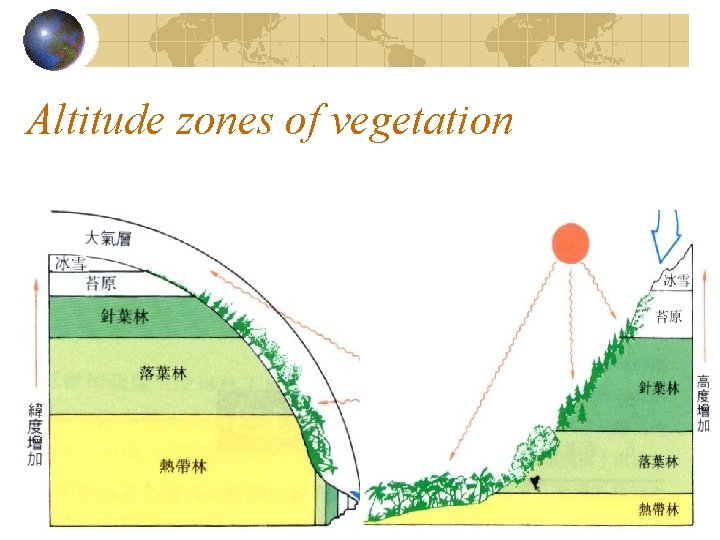
Altitude zones of vegetation Vegetation changes with an increase in elevation because the following reasons Temperature drops Relative Humidity increase Precipitation increase Orographic rain in windward slope Rain shadow in leeward slope
continues Light intensive and day time increase Outgoing radiation at night increase Large diurnal range of temperature Permanent snowcaps exist on very high Mts. Faster wind speed Aspects – South facing slope vs. North facing slope
Altitude zones of vegetation
Altitude zones of vegetation
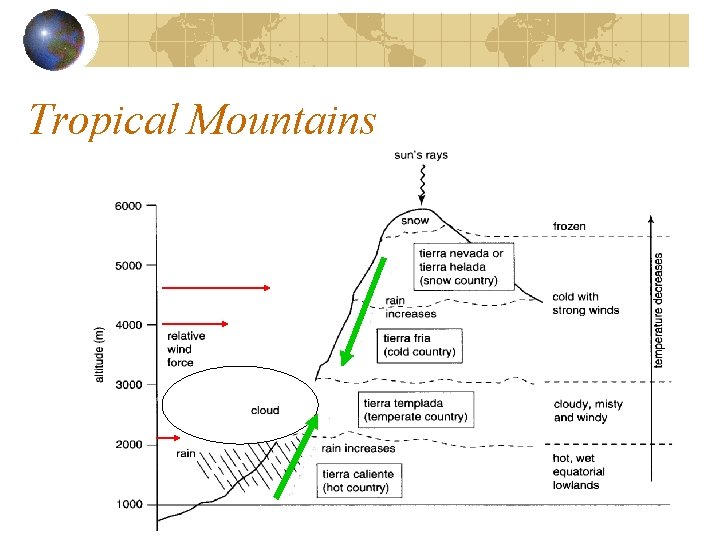
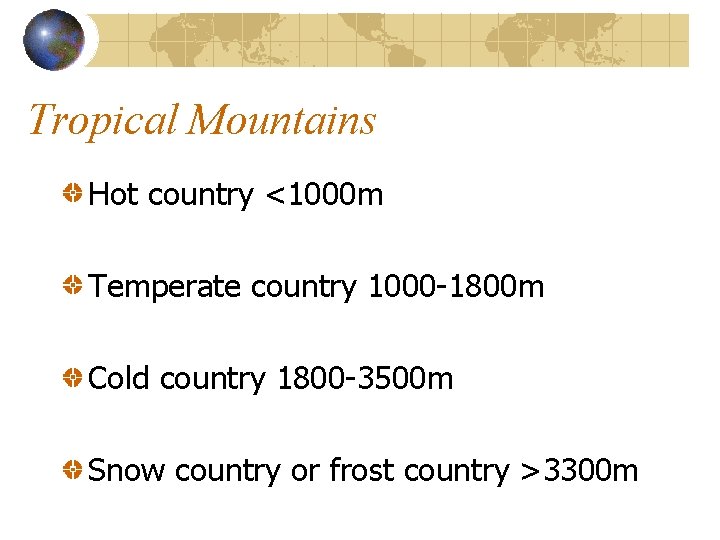
Tropical Mountains
Tropical Mountains Hot country <1000 m Temperate country 1000 -1800 m Cold country 1800 -3500 m Snow country or frost country >3300 m
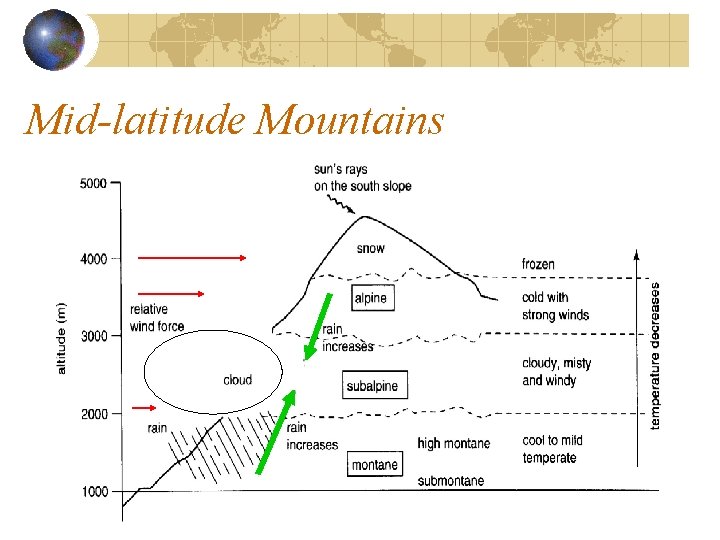
Mid-latitude Mountains
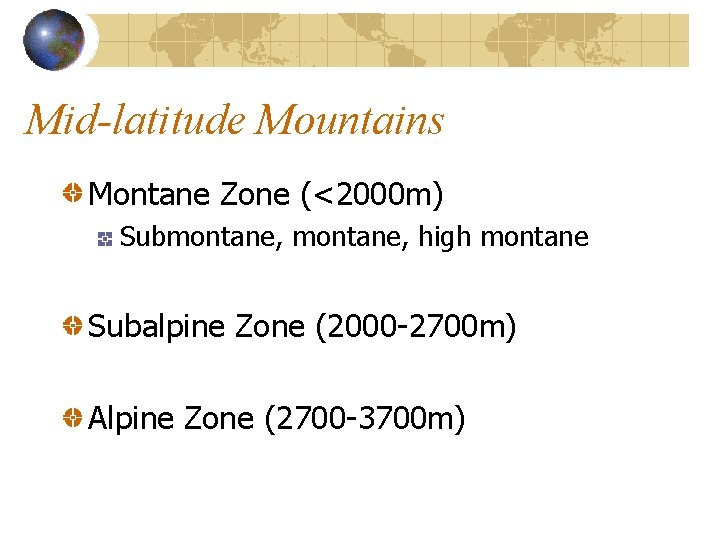
Mid-latitude Mountains Montane Zone (<2000 m) Submontane, high montane Subalpine Zone (2000 -2700 m) Alpine Zone (2700 -3700 m)
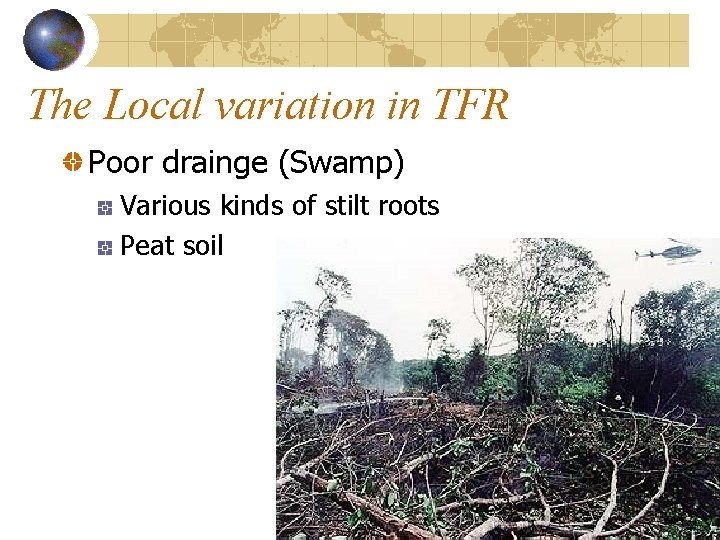
The Local variation in TFR Poor drainge (Swamp) Various kinds of stilt roots Peat soil
The local variation in Desert Near Water courses more vegetation Plant can be established in stable sand dunes Ephemerals grow in thin soil Succulent and non-succulent need a thick soil
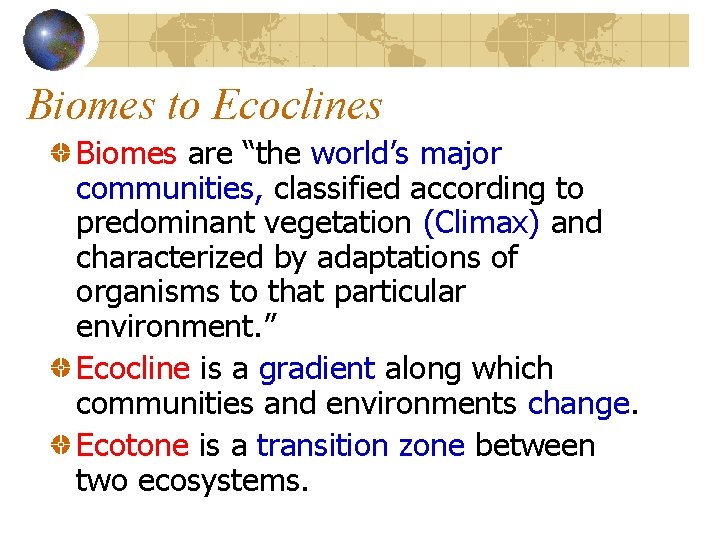
Biomes to Ecoclines Biomes are “the world’s major communities, classified according to predominant vegetation (Climax) and characterized by adaptations of organisms to that particular environment. ” Ecocline is a gradient along which communities and environments change. Ecotone is a transition zone between two ecosystems.
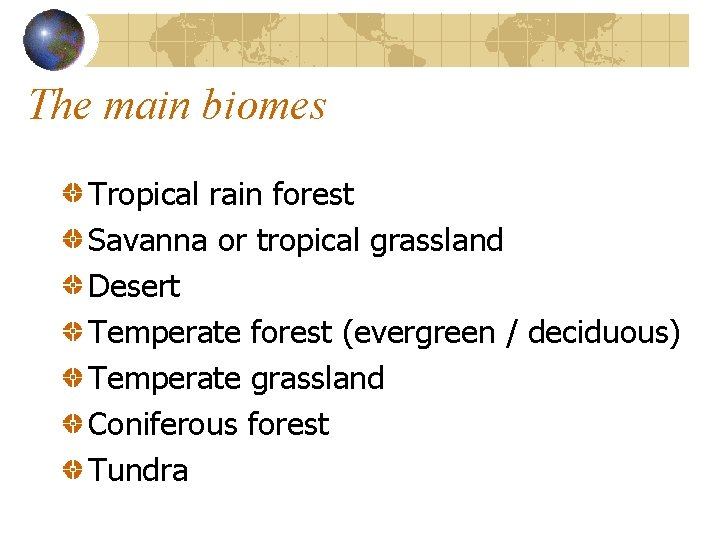
The main biomes Tropical rain forest Savanna or tropical grassland Desert Temperate forest (evergreen / deciduous) Temperate grassland Coniferous forest Tundra
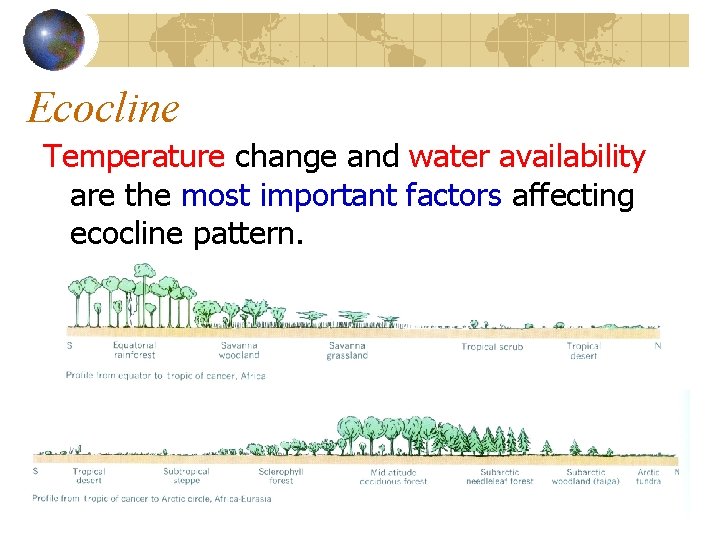
Ecocline Temperature change and water availability are the most important factors affecting ecocline pattern.
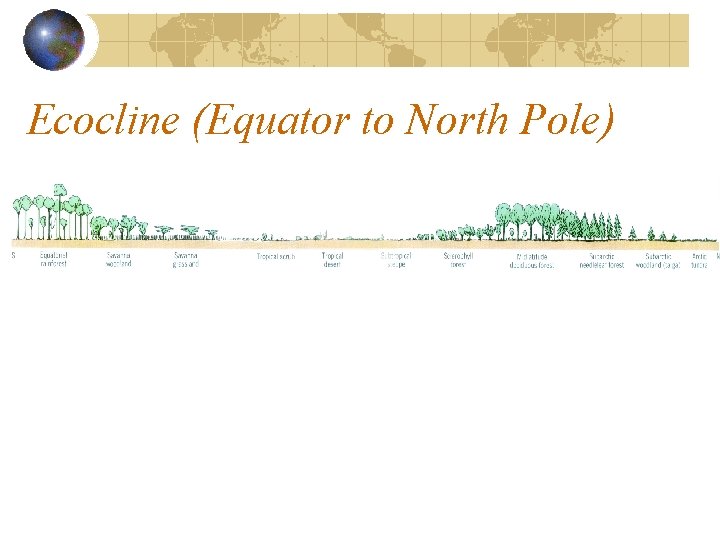
Ecocline (Equator to North Pole)