
PLANT TISSUES AND ANATOMY OF DICOTYLEDONOUS PLANTS SUBJECT
PLANT TISSUES AND ANATOMY OF DICOTYLEDONOUS PLANTS SUBJECT: LIFE SCIENCES PRESENTER: MR YALEZO ORTI DISTRICT
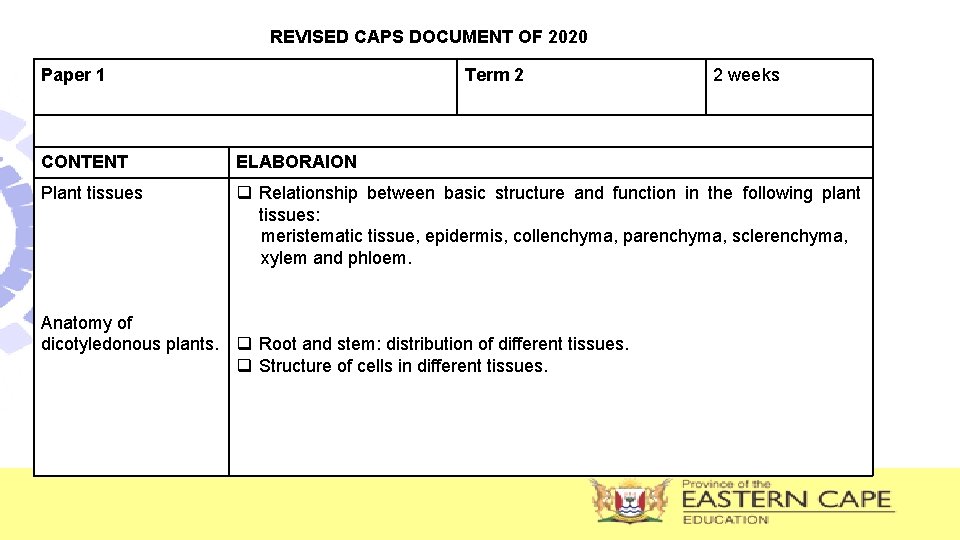
REVISED CAPS DOCUMENT OF 2020 Paper 1 Term 2 2 weeks CONTENT ELABORAION Plant tissues q Relationship between basic structure and function in the following plant tissues: meristematic tissue, epidermis, collenchyma, parenchyma, sclerenchyma, xylem and phloem. Anatomy of dicotyledonous plants. q Root and stem: distribution of different tissues. q Structure of cells in different tissues.
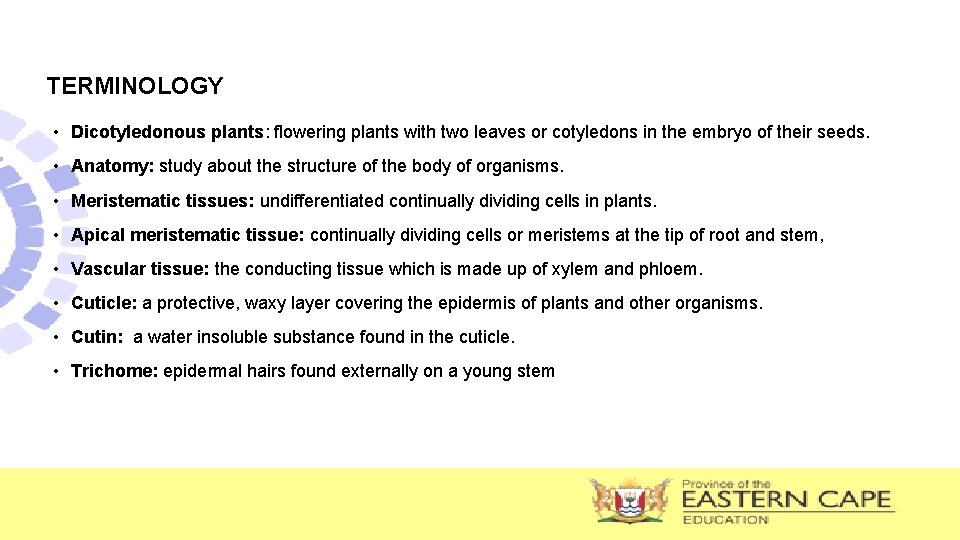
TERMINOLOGY • Dicotyledonous plants: flowering plants with two leaves or cotyledons in the embryo of their seeds. • Anatomy: study about the structure of the body of organisms. • Meristematic tissues: undifferentiated continually dividing cells in plants. • Apical meristematic tissue: continually dividing cells or meristems at the tip of root and stem, • Vascular tissue: the conducting tissue which is made up of xylem and phloem. • Cuticle: a protective, waxy layer covering the epidermis of plants and other organisms. • Cutin: a water insoluble substance found in the cuticle. • Trichome: epidermal hairs found externally on a young stem
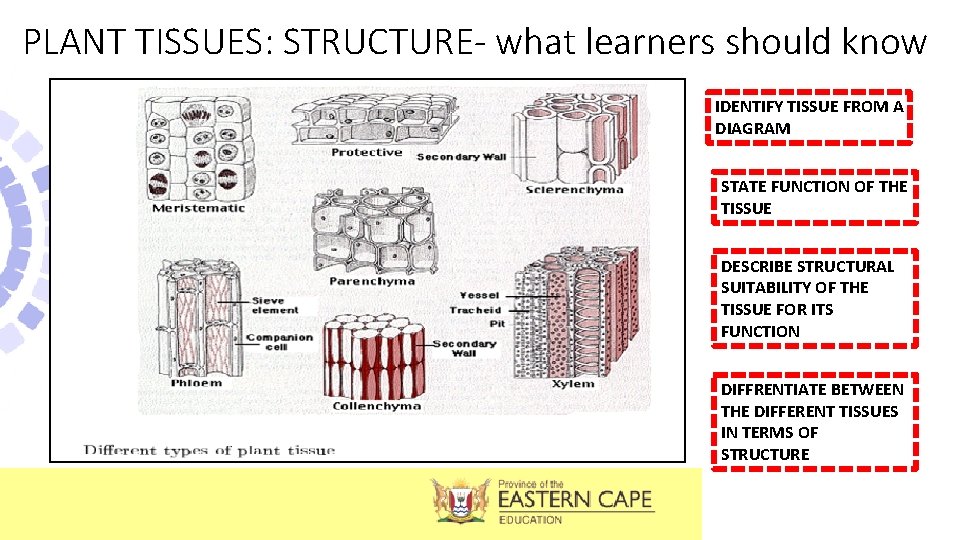
PLANT TISSUES: STRUCTURE- what learners should know IDENTIFY TISSUE FROM A DIAGRAM STATE FUNCTION OF THE TISSUE DESCRIBE STRUCTURAL SUITABILITY OF THE TISSUE FOR ITS FUNCTION DIFFRENTIATE BETWEEN THE DIFFERENT TISSUES IN TERMS OF STRUCTURE
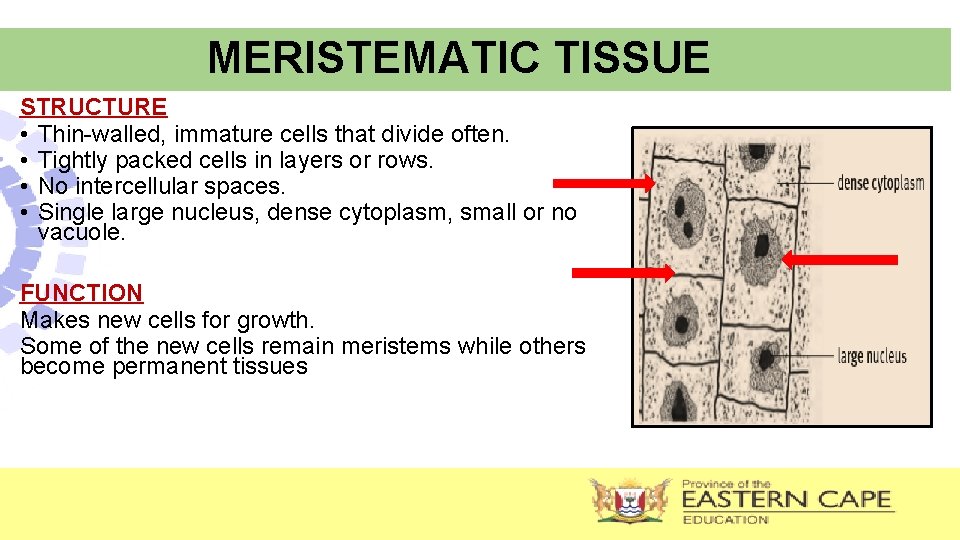
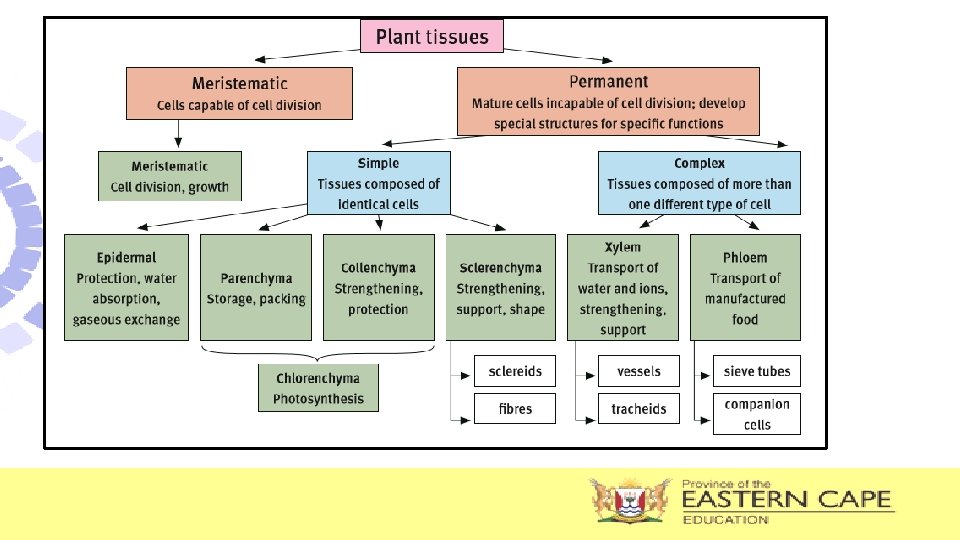
MERISTEMATIC TISSUE STRUCTURE • Thin-walled, immature cells that divide often. • Tightly packed cells in layers or rows. • No intercellular spaces. • Single large nucleus, dense cytoplasm, small or no vacuole. FUNCTION Makes new cells for growth. Some of the new cells remain meristems while others become permanent tissues
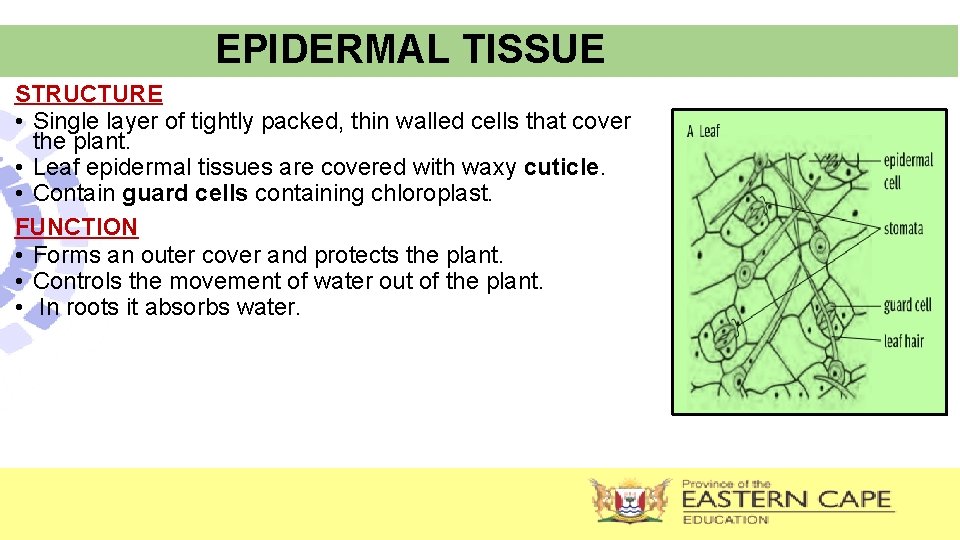
EPIDERMAL TISSUE STRUCTURE • Single layer of tightly packed, thin walled cells that cover the plant. • Leaf epidermal tissues are covered with waxy cuticle. • Contain guard cells containing chloroplast. FUNCTION • Forms an outer cover and protects the plant. • Controls the movement of water out of the plant. • In roots it absorbs water.
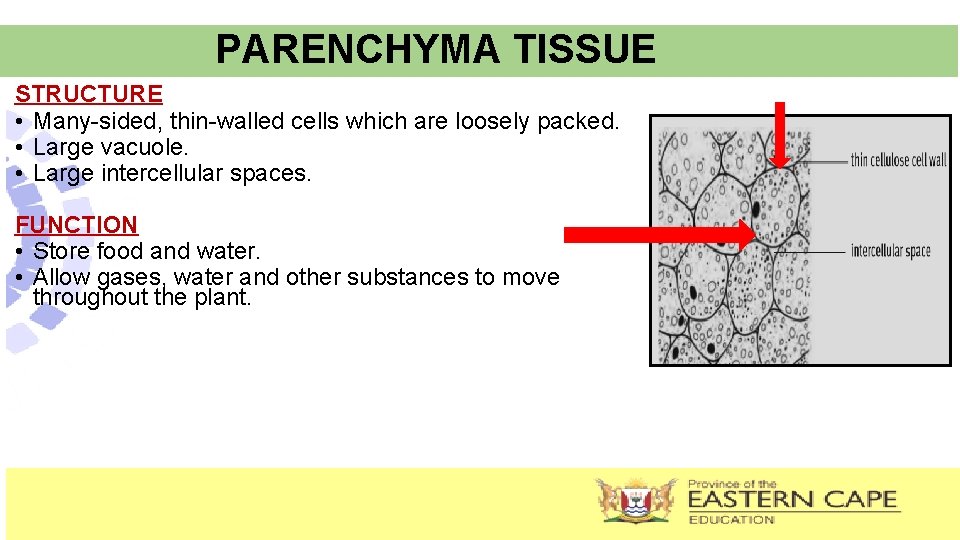
PARENCHYMA TISSUE STRUCTURE • Many-sided, thin-walled cells which are loosely packed. • Large vacuole. • Large intercellular spaces. FUNCTION • Store food and water. • Allow gases, water and other substances to move throughout the plant.
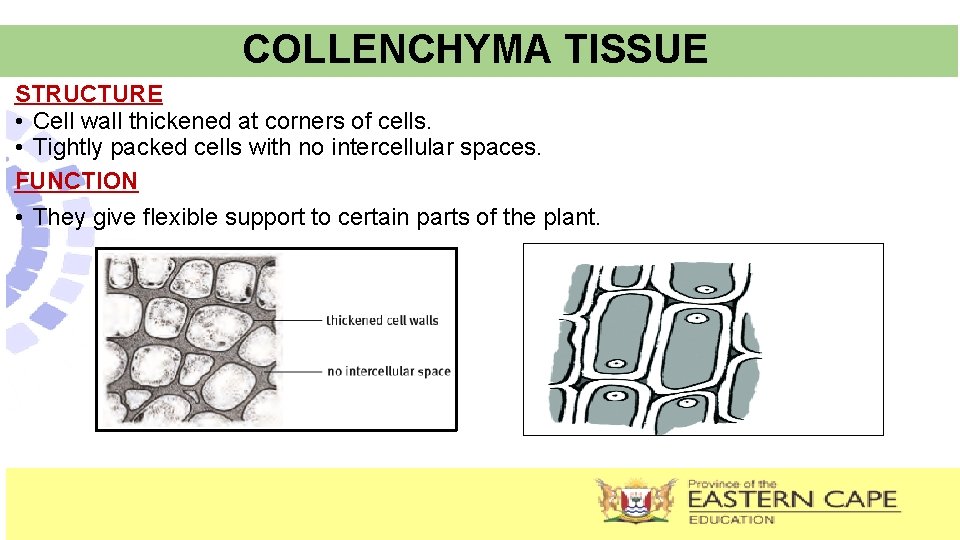
COLLENCHYMA TISSUE STRUCTURE • Cell wall thickened at corners of cells. • Tightly packed cells with no intercellular spaces. FUNCTION • They give flexible support to certain parts of the plant.
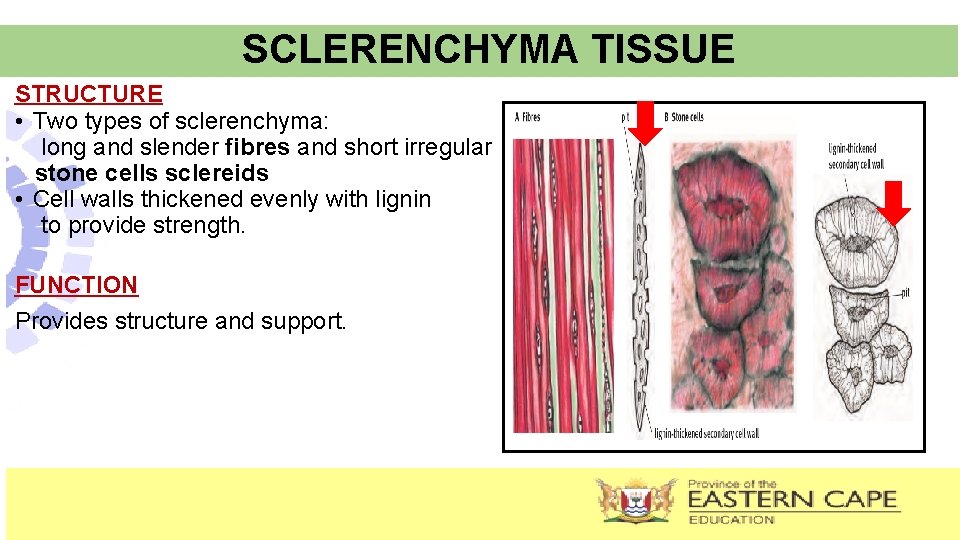
SCLERENCHYMA TISSUE STRUCTURE • Two types of sclerenchyma: long and slender fibres and short irregular stone cells sclereids • Cell walls thickened evenly with lignin to provide strength. FUNCTION Provides structure and support.
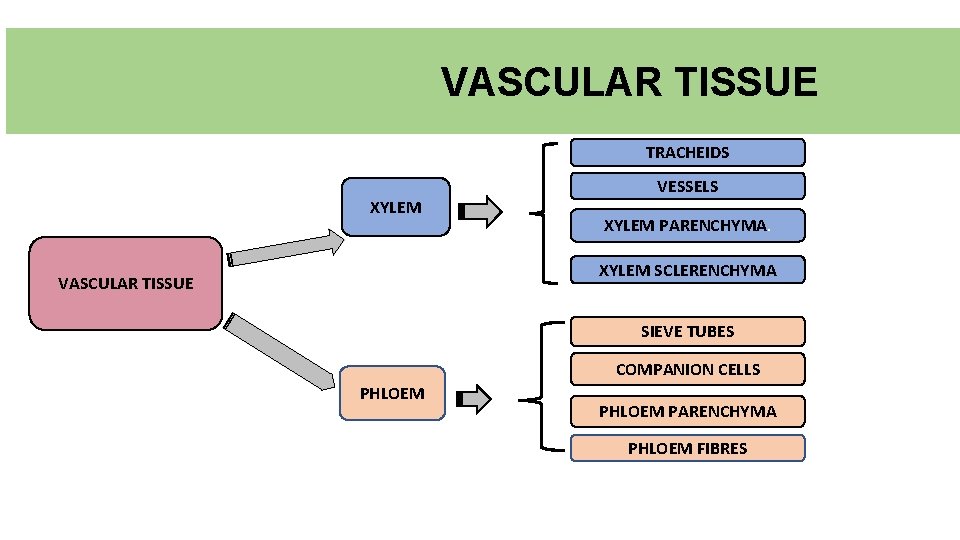
VASCULAR TISSUE TRACHEIDS XYLEM VESSELS XYLEM PARENCHYMA. XYLEM SCLERENCHYMA VASCULAR TISSUE SIEVE TUBES COMPANION CELLS PHLOEM PARENCHYMA PHLOEM FIBRES
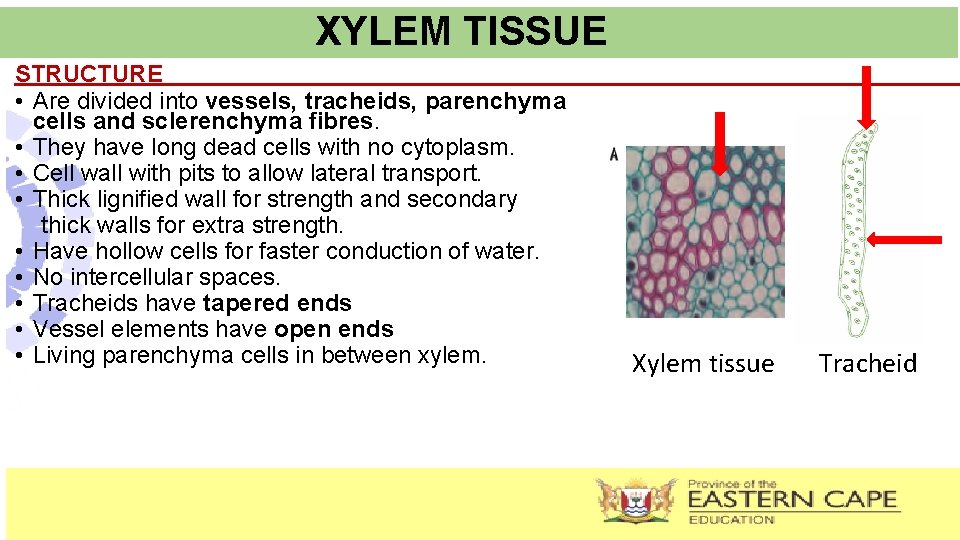
XYLEM TISSUE STRUCTURE • Are divided into vessels, tracheids, parenchyma cells and sclerenchyma fibres. • They have long dead cells with no cytoplasm. • Cell wall with pits to allow lateral transport. • Thick lignified wall for strength and secondary thick walls for extra strength. • Have hollow cells for faster conduction of water. • No intercellular spaces. • Tracheids have tapered ends • Vessel elements have open ends • Living parenchyma cells in between xylem. Xylem tissue Tracheid
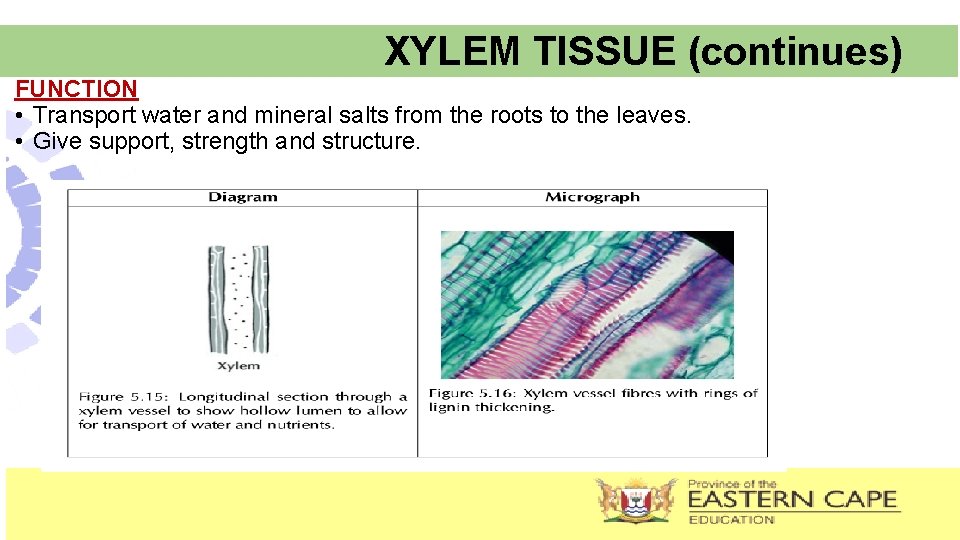
XYLEM TISSUE (continues) FUNCTION • Transport water and mineral salts from the roots to the leaves. • Give support, strength and structure.
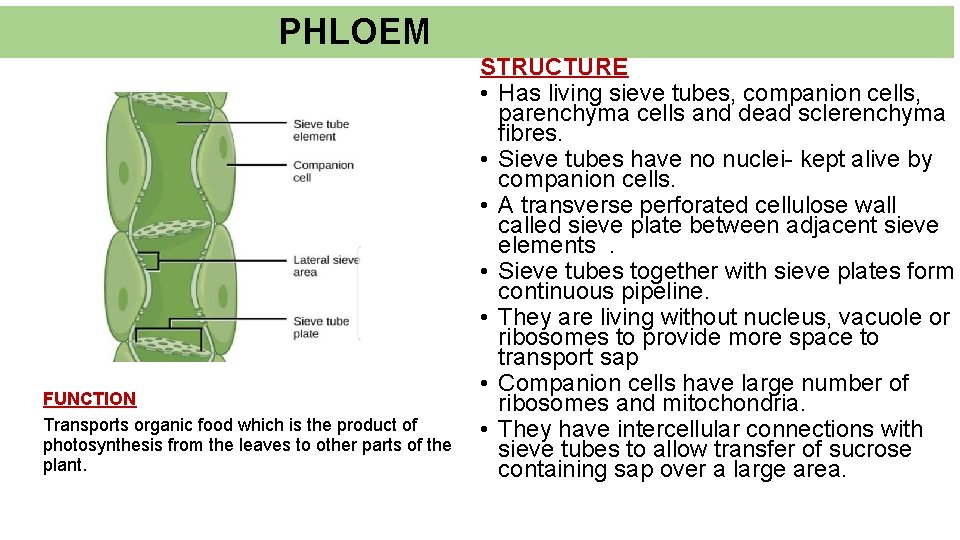
PHLOEM FUNCTION Transports organic food which is the product of photosynthesis from the leaves to other parts of the plant. STRUCTURE • Has living sieve tubes, companion cells, parenchyma cells and dead sclerenchyma fibres. • Sieve tubes have no nuclei- kept alive by companion cells. • A transverse perforated cellulose wall called sieve plate between adjacent sieve elements. • Sieve tubes together with sieve plates form continuous pipeline. • They are living without nucleus, vacuole or ribosomes to provide more space to transport sap • Companion cells have large number of ribosomes and mitochondria. • They have intercellular connections with sieve tubes to allow transfer of sucrose containing sap over a large area.
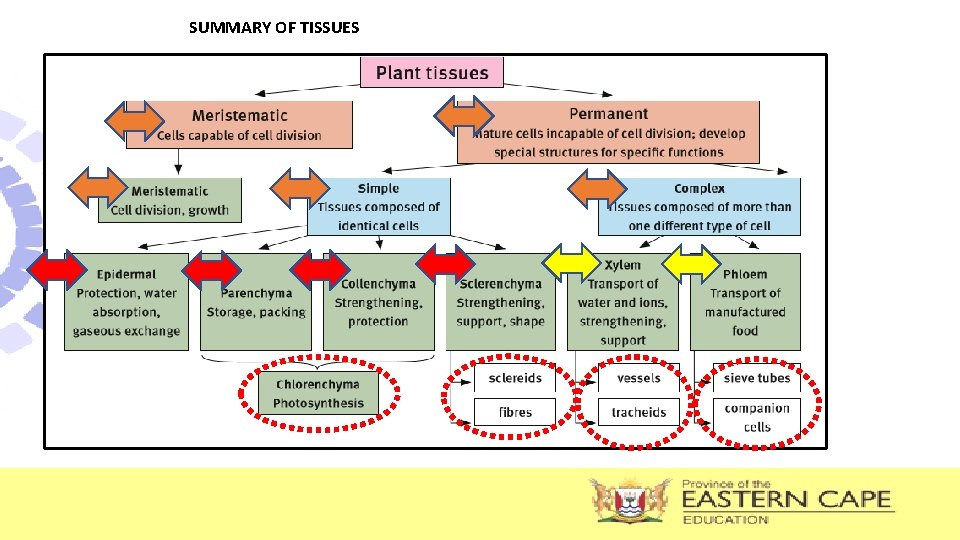
SUMMARY OF TISSUES
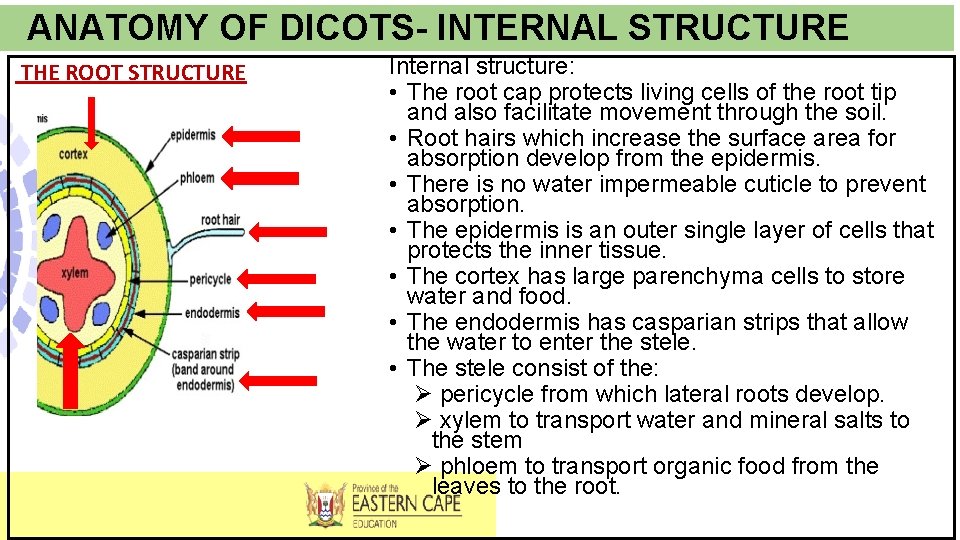
ANATOMY OF DICOTS- INTERNAL STRUCTURE THE ROOT STRUCTURE Internal structure: • The root cap protects living cells of the root tip and also facilitate movement through the soil. • Root hairs which increase the surface area for absorption develop from the epidermis. • There is no water impermeable cuticle to prevent absorption. • The epidermis is an outer single layer of cells that protects the inner tissue. • The cortex has large parenchyma cells to store water and food. • The endodermis has casparian strips that allow the water to enter the stele. • The stele consist of the: Ø pericycle from which lateral roots develop. Ø xylem to transport water and mineral salts to the stem Ø phloem to transport organic food from the leaves to the root.
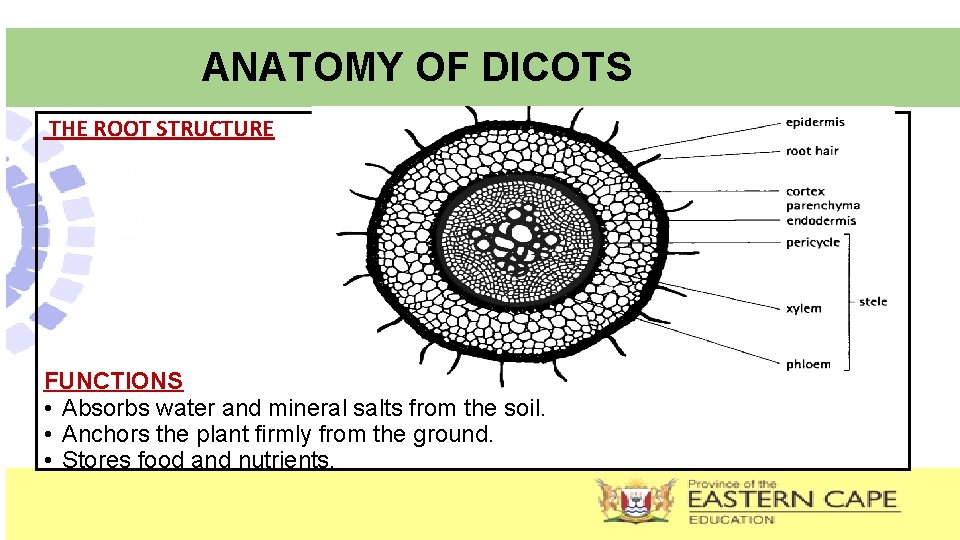
ANATOMY OF DICOTS THE ROOT STRUCTURE FUNCTIONS • Absorbs water and mineral salts from the soil. • Anchors the plant firmly from the ground. • Stores food and nutrients.
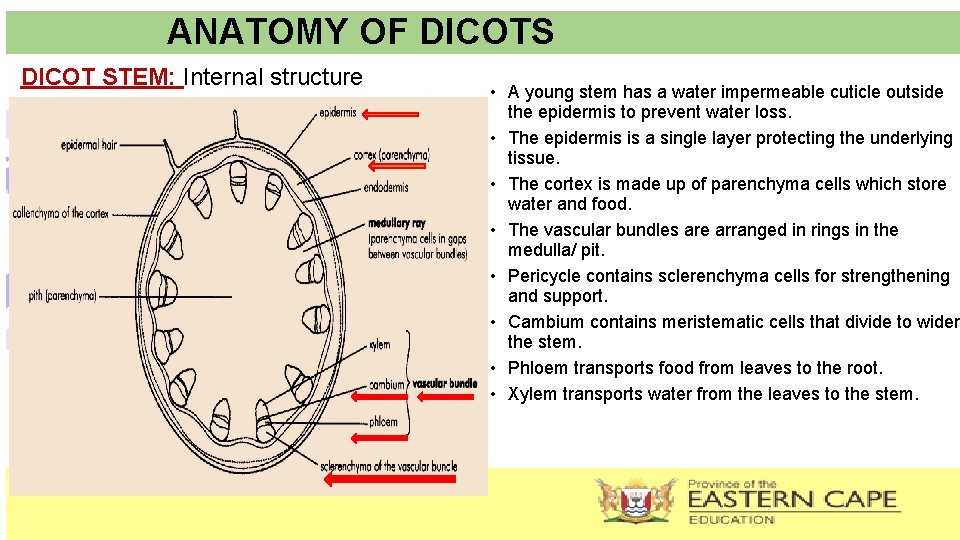
ANATOMY OF DICOTS DICOT STEM: Internal structure • A young stem has a water impermeable cuticle outside the epidermis to prevent water loss. • The epidermis is a single layer protecting the underlying tissue. • The cortex is made up of parenchyma cells which store water and food. • The vascular bundles are arranged in rings in the medulla/ pit. • Pericycle contains sclerenchyma cells for strengthening and support. • Cambium contains meristematic cells that divide to widen the stem. • Phloem transports food from leaves to the root. • Xylem transports water from the leaves to the stem.
ANATOMY OF DICOTS DICOT STEM Functions: • Supports the plant as it holds leaves, flowers and fruit upright above the ground. • Transports water, mineral salts/ inorganic food, sugars/ organic food between roots and leaves in the xylem and phloem. • Stores nutrients. • Production of new living tissue.
EXERCISE 1. Give the biological term for each of the following statements. 1. 1 Continually dividing cells in plants. Meristematic cells 1. 2. It is found in the endodermis and it allows water with dissolved nutrients to enter the root. Casparian strip 1. 3 They conduct water and organic food in plants. Phloem 1. 4 The part of the root which stores water and food in its cells. Cortex 1. 5 The main tissues used for strengthening and support in plants. Sclerenchyma tissue 5 x 1 (5)
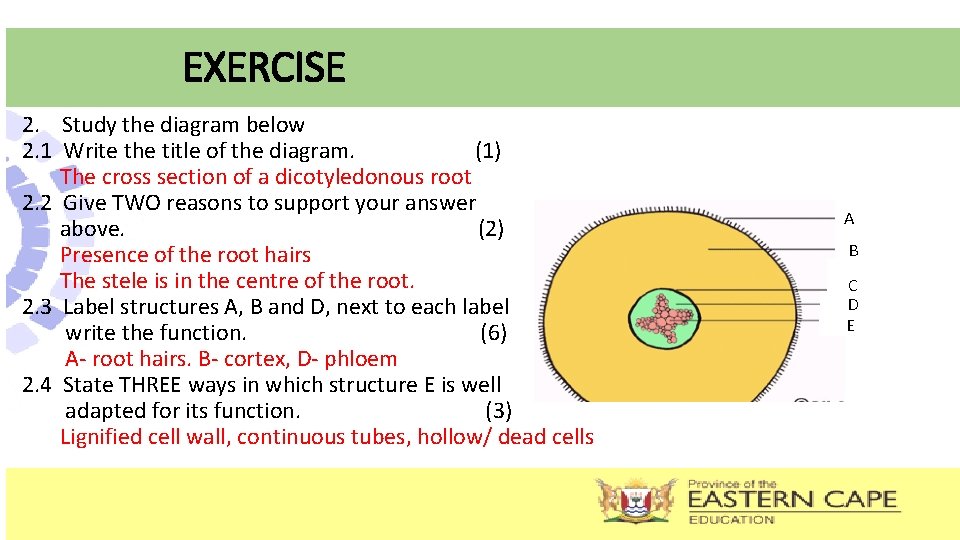
EXERCISE 2. Study the diagram below 2. 1 Write the title of the diagram. (1) The cross section of a dicotyledonous root 2. 2 Give TWO reasons to support your answer above. (2) Presence of the root hairs The stele is in the centre of the root. 2. 3 Label structures A, B and D, next to each label write the function. (6) A- root hairs. B- cortex, D- phloem 2. 4 State THREE ways in which structure E is well adapted for its function. (3) Lignified cell wall, continuous tubes, hollow/ dead cells A B C D E
- Slides: 21