
Plant Tissue Differentiated by its location and function
Plant Tissue Differentiated by its location and function. 1. Dermal (outermost layer) 2. Ground (bulk of the cell – between dermal and vascular) 3. Vascular (venous system)
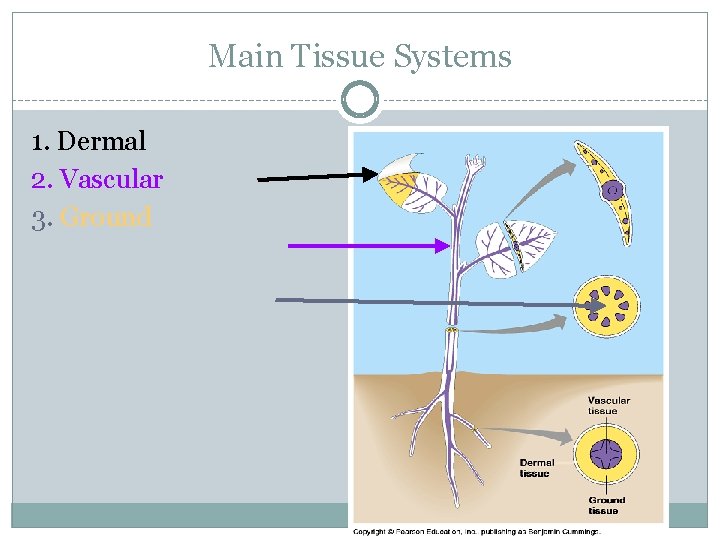
Main Tissue Systems 1. Dermal 2. Vascular 3. Ground
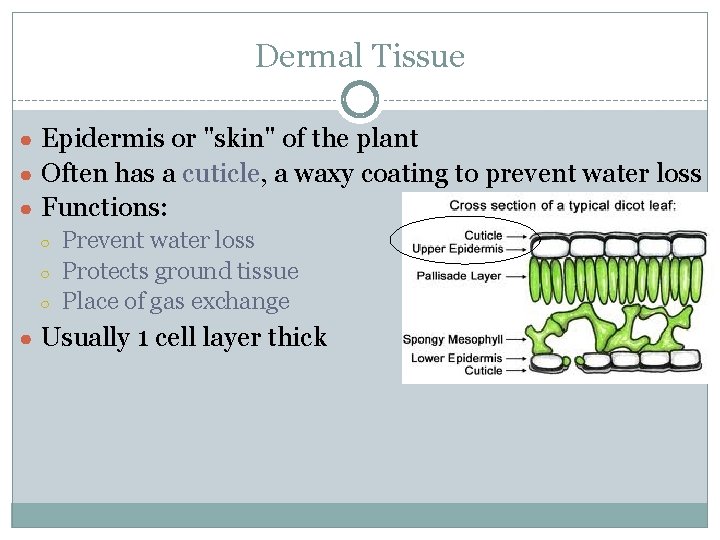
Dermal Tissue ● Epidermis or "skin" of the plant ● Often has a cuticle, a waxy coating to prevent water loss ● Functions: ○ Prevent water loss ○ Protects ground tissue ○ Place of gas exchange ● Usually 1 cell layer thick
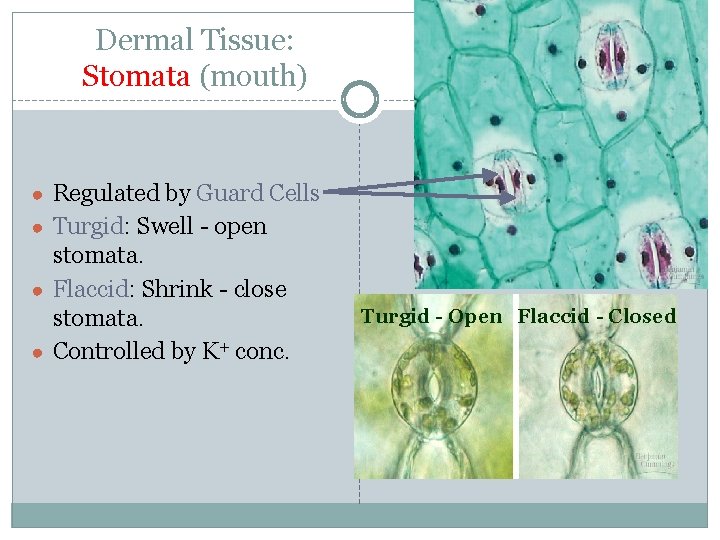
Dermal Tissue: Stomata (mouth) ● Regulated by Guard Cells ● Turgid: Swell - open stomata. ● Flaccid: Shrink - close stomata. ● Controlled by K+ conc. Turgid - Open Flaccid - Closed
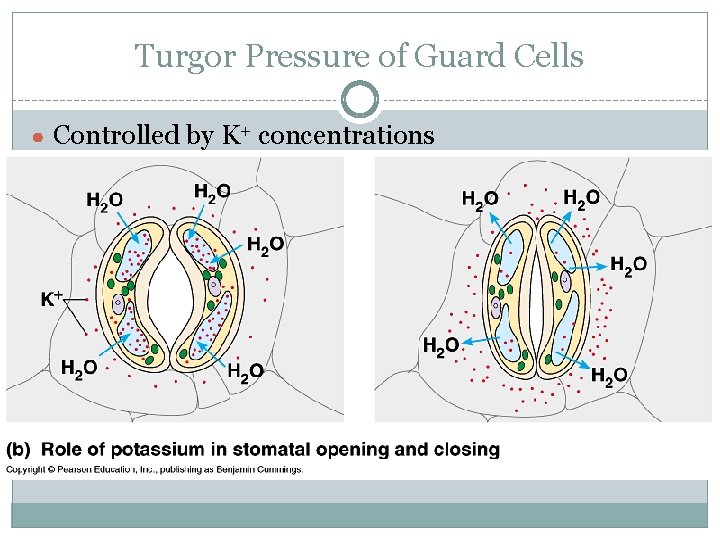
Turgor Pressure of Guard Cells ● Controlled by K+ concentrations
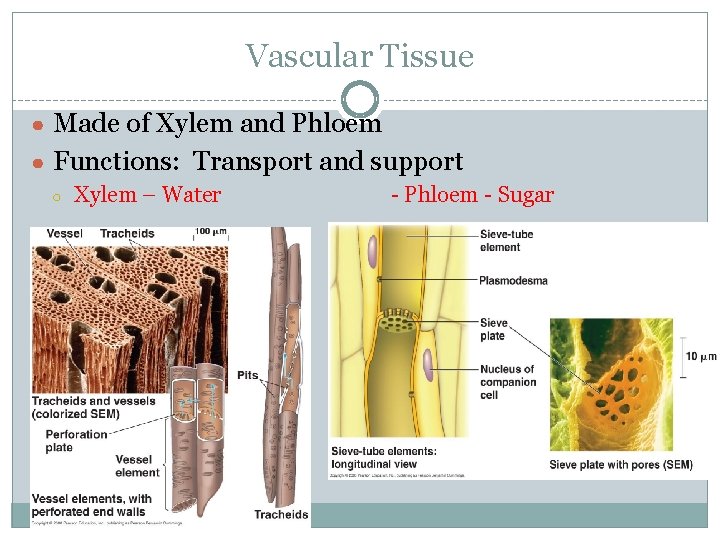
Vascular Tissue ● Made of Xylem and Phloem ● Functions: Transport and support ○ Xylem – Water - Phloem - Sugar
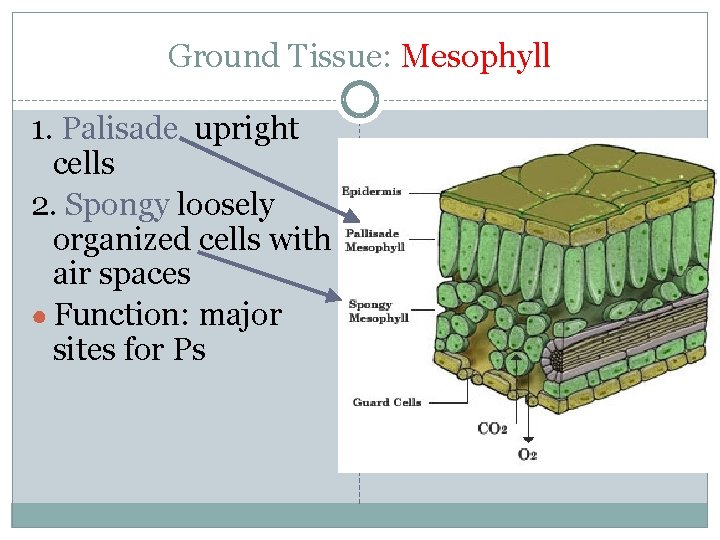
Ground Tissue: Mesophyll 1. Palisade upright cells 2. Spongy loosely organized cells with air spaces ● Function: major sites for Ps
Fundamental Tissues Differentiated by structure. 1. Parenchyma (soft tissue) 2. Collenchyma (glue tissue) 3. Sclerenchyma (hard tissue)
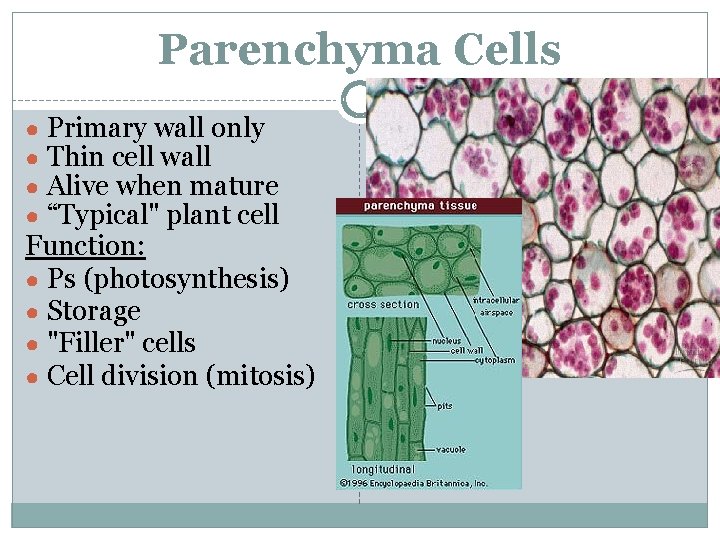
Parenchyma Cells ● Primary wall only ● Thin cell wall ● Alive when mature ● “Typical" plant cell Function: ● Ps (photosynthesis) ● Storage ● "Filler" cells ● Cell division (mitosis)
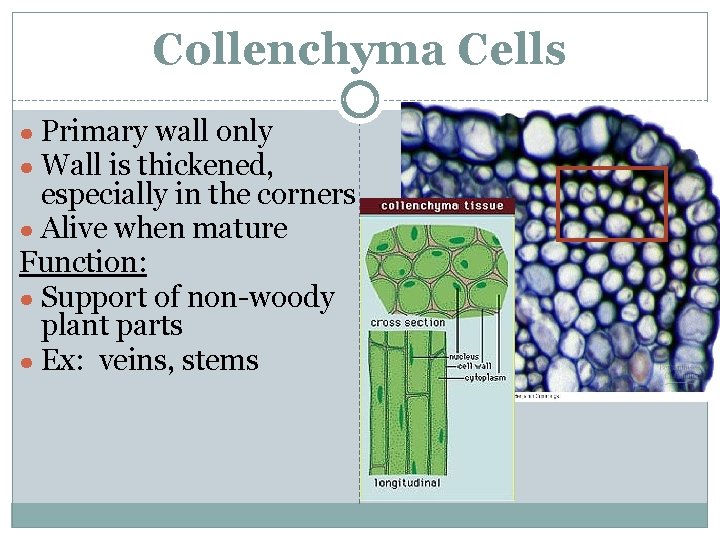
Collenchyma Cells ● Primary wall only ● Wall is thickened, especially in the corners ● Alive when mature Function: ● Support of non-woody plant parts ● Ex: veins, stems
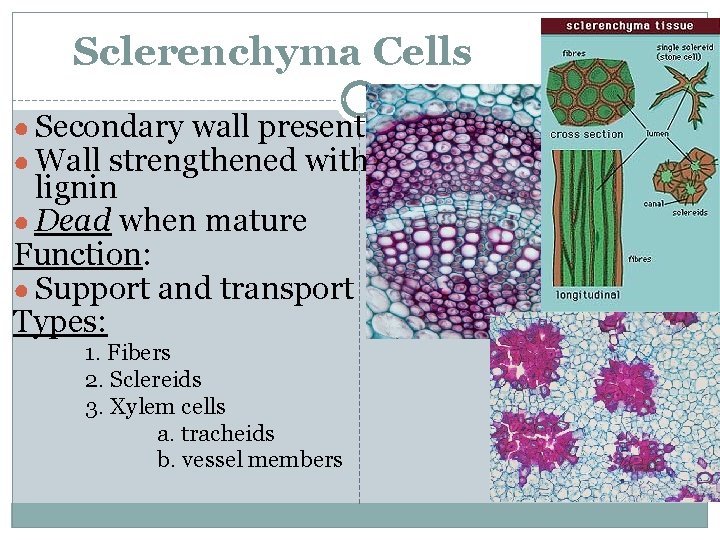
Sclerenchyma Cells ● Secondary wall present ● Wall strengthened with lignin ● Dead when mature Function: ● Support and transport Types: 1. Fibers 2. Sclereids 3. Xylem cells a. tracheids b. vessel members
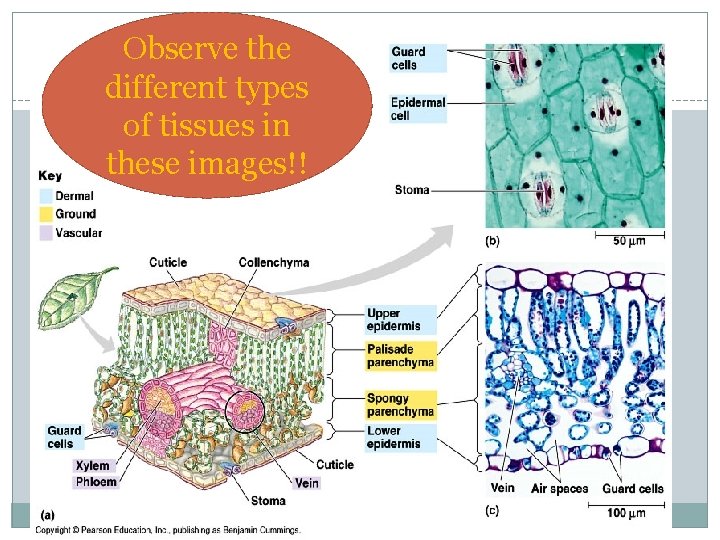
Observe the different types of tissues in these images!!
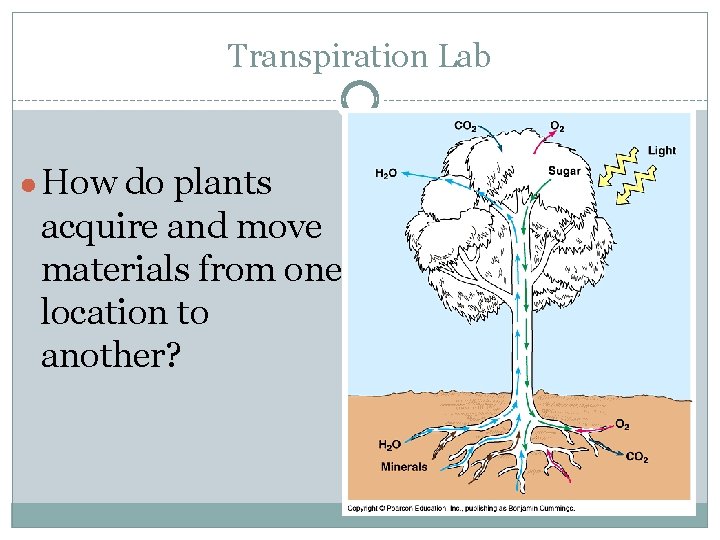
Transpiration Lab ● How do plants acquire and move materials from one location to another?
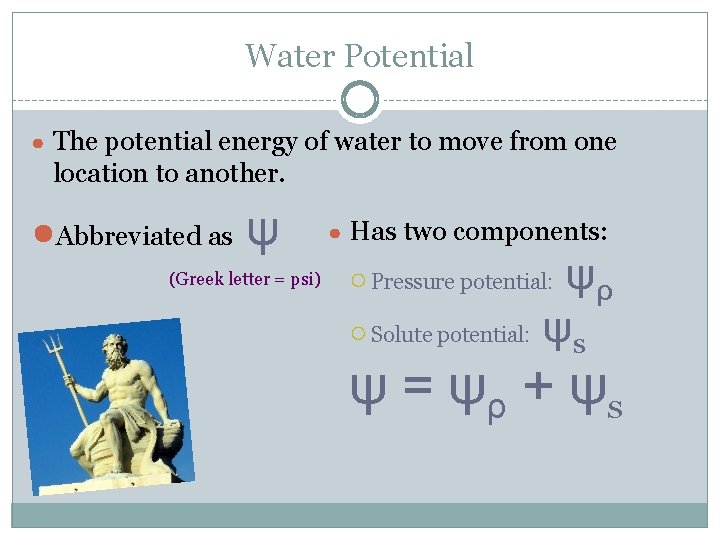
Water Potential ● The potential energy of water to move from one location to another. ●Abbreviated as ψ (Greek letter = psi) ● Has two components: ψρ ○ Solute potential: ψs ○ Pressure potential: ψ = ψρ + ψs
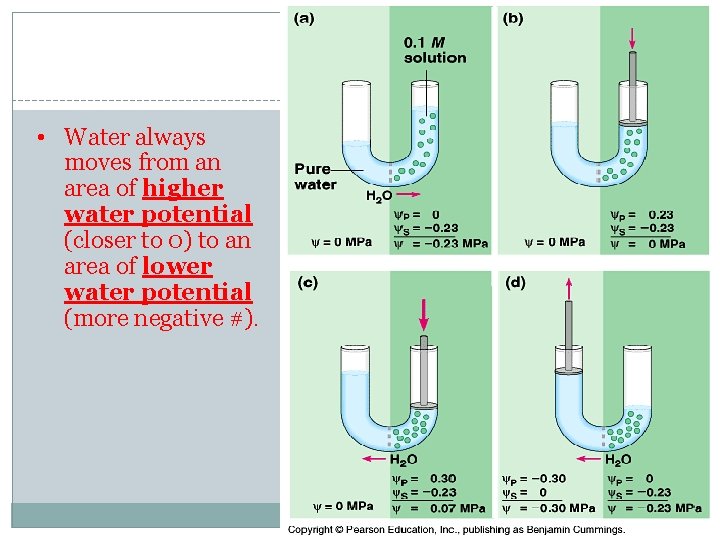
• Water always moves from an area of higher water potential (closer to 0) to an area of lower water potential (more negative #).
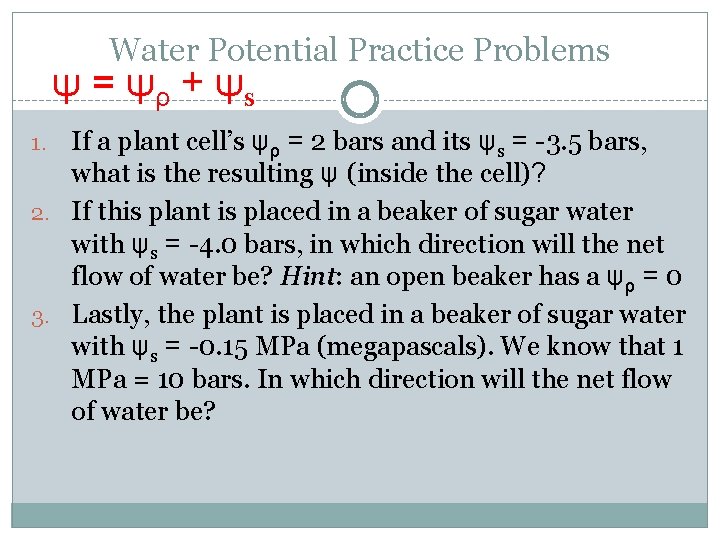
Water Potential Practice Problems ψ = ψρ + ψs If a plant cell’s ψρ = 2 bars and its ψs = -3. 5 bars, what is the resulting ψ (inside the cell)? 2. If this plant is placed in a beaker of sugar water with ψs = -4. 0 bars, in which direction will the net flow of water be? Hint: an open beaker has a ψρ = 0 3. Lastly, the plant is placed in a beaker of sugar water with ψs = -0. 15 MPa (megapascals). We know that 1 MPa = 10 bars. In which direction will the net flow of water be? 1.
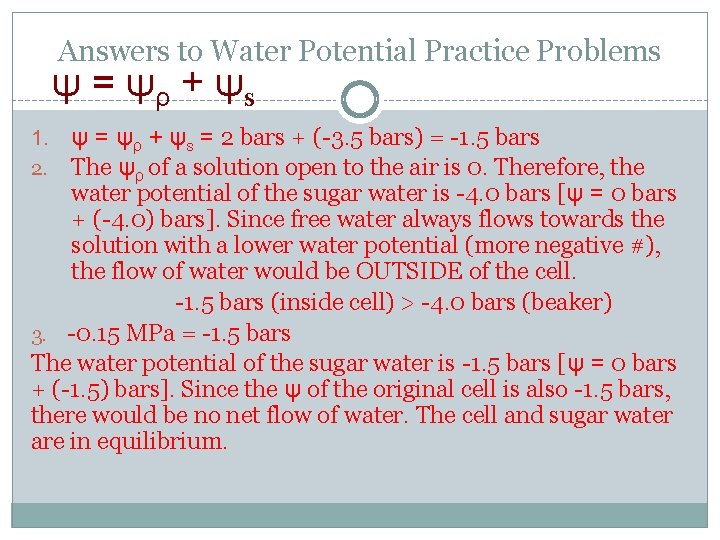
Answers to Water Potential Practice Problems ψ = ψρ + ψs = 2 bars + (-3. 5 bars) = -1. 5 bars The ψρ of a solution open to the air is 0. Therefore, the water potential of the sugar water is -4. 0 bars [ψ = 0 bars + (-4. 0) bars]. Since free water always flows towards the solution with a lower water potential (more negative #), the flow of water would be OUTSIDE of the cell. -1. 5 bars (inside cell) > -4. 0 bars (beaker) 3. -0. 15 MPa = -1. 5 bars The water potential of the sugar water is -1. 5 bars [ψ = 0 bars + (-1. 5) bars]. Since the ψ of the original cell is also -1. 5 bars, there would be no net flow of water. The cell and sugar water are in equilibrium. 1. 2.
Bulk Flow ● The movement of water between two locations due to fluid pressure or tension. ● Bulk flow is a mechanism for long distance transport in plants. ● Important in both xylem and phloem sap transport.
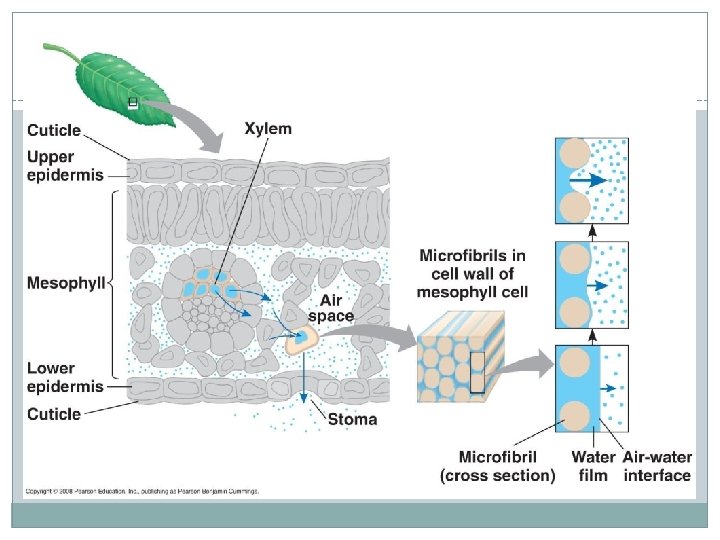
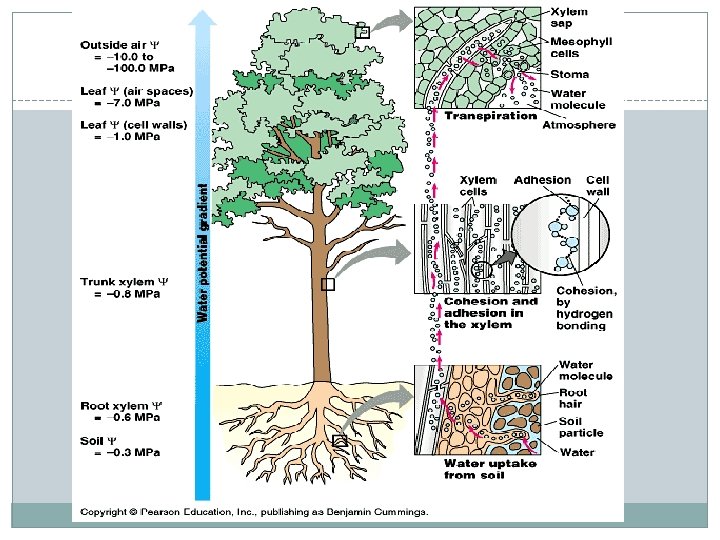
TCTM Theory How do plants get water to the tops of trees? ? Transpiration Tension Cohesion Mechanism ● Water evaporates from leaves because water potential of the air is usually much less than that of the cells. ○ Water always moves from an area of higher water potential (closer to 0) to an area of lower water potential (more negative #).
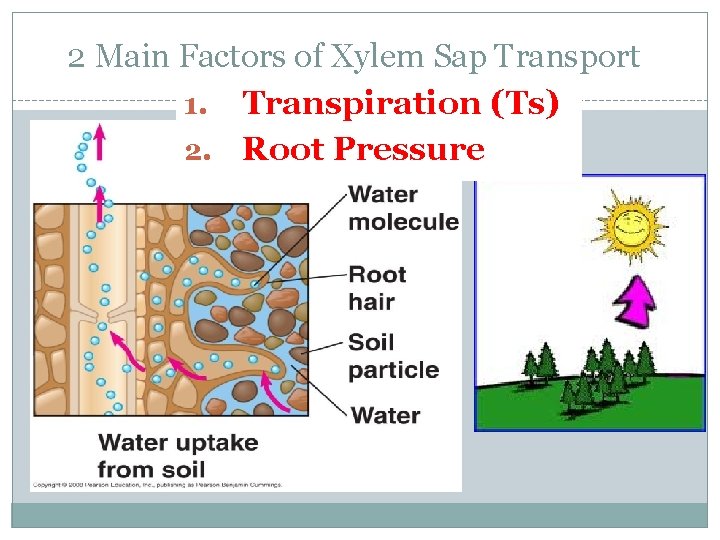
2 Main Factors of Xylem Sap Transport 1. Transpiration (Ts) 2. Root Pressure
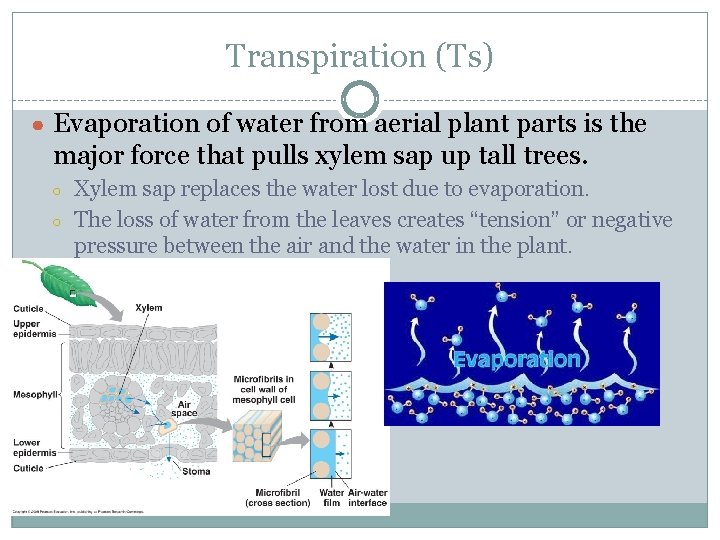
Transpiration (Ts) ● Evaporation of water from aerial plant parts is the major force that pulls xylem sap up tall trees. ○ ○ Xylem sap replaces the water lost due to evaporation. The loss of water from the leaves creates “tension” or negative pressure between the air and the water in the plant.
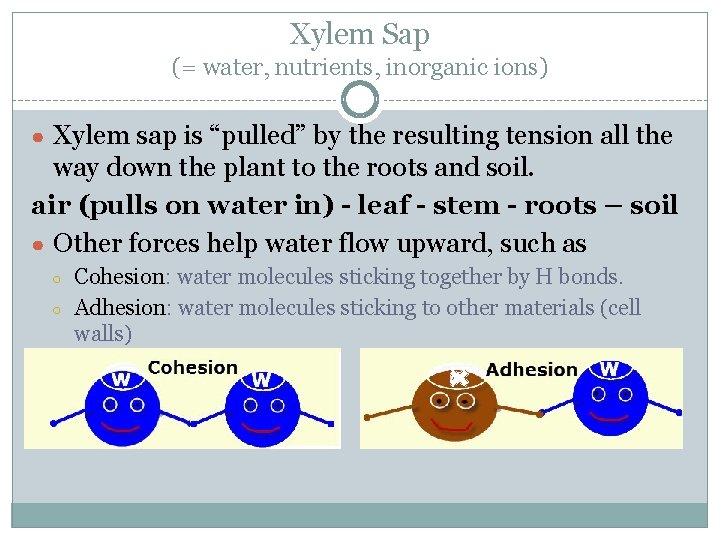
Xylem Sap (= water, nutrients, inorganic ions) ● Xylem sap is “pulled” by the resulting tension all the way down the plant to the roots and soil. air (pulls on water in) - leaf - stem - roots – soil ● Other forces help water flow upward, such as ○ ○ Cohesion: water molecules sticking together by H bonds. Adhesion: water molecules sticking to other materials (cell walls)
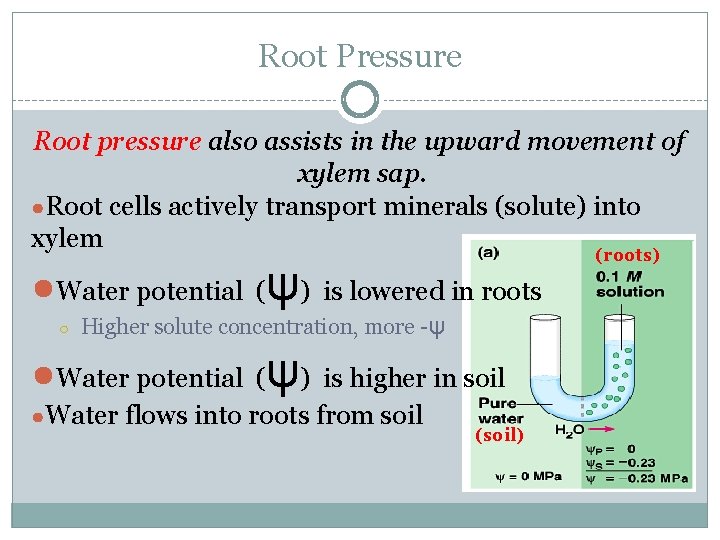
Root Pressure Root pressure also assists in the upward movement of xylem sap. ●Root cells actively transport minerals (solute) into xylem ●Water potential (ψ) ○ (roots) is lowered in roots Higher solute concentration, more -ψ ●Water potential (ψ) is higher in soil ●Water flows into roots from soil (soil)
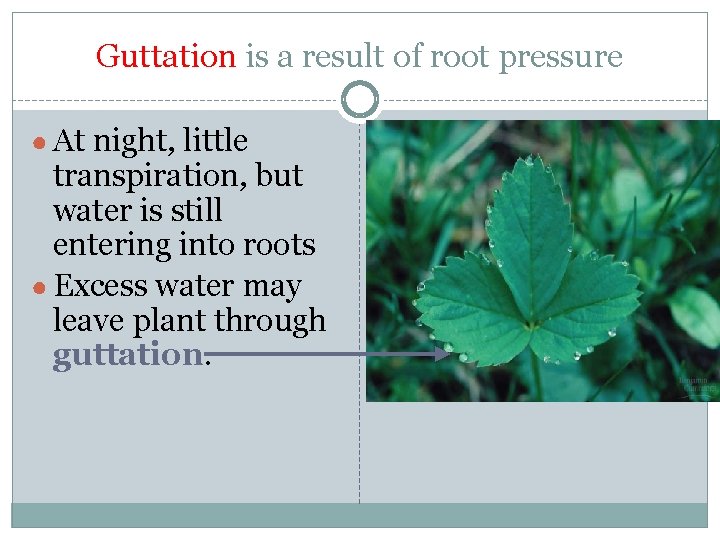
Guttation is a result of root pressure ● At night, little transpiration, but water is still entering into roots ● Excess water may leave plant through guttation.
Environmental Factors In our lab, we learned about some of the environmental factors that affect movement of water through a plant. What are these factors? 1. Humidity 2. Temperature 3. Light 4. Soil Water Content 5. Wind
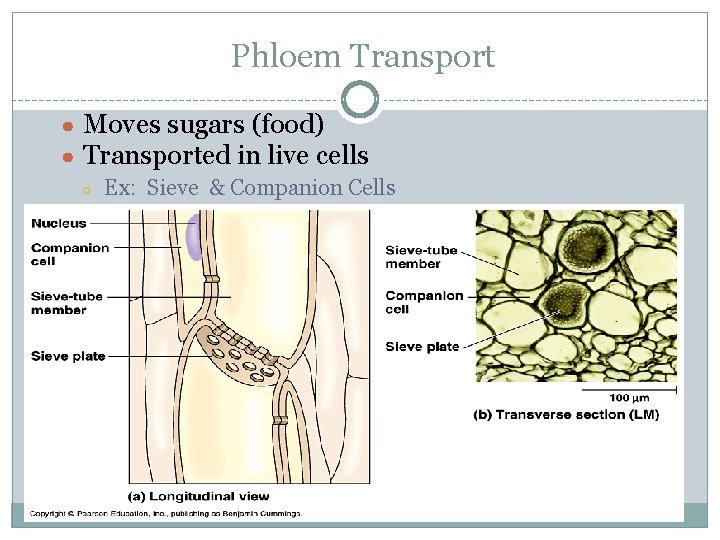
Phloem Transport ● Moves sugars (food) ● Transported in live cells ○ Ex: Sieve & Companion Cells
Source - Sink Transport Model for movement of phloem sap from a Source to a Sink. ● Source: Sugar production site ● Sink: Sugar usage site - growth, reproduction, storage ● Transport around the plant happens in multiple directions
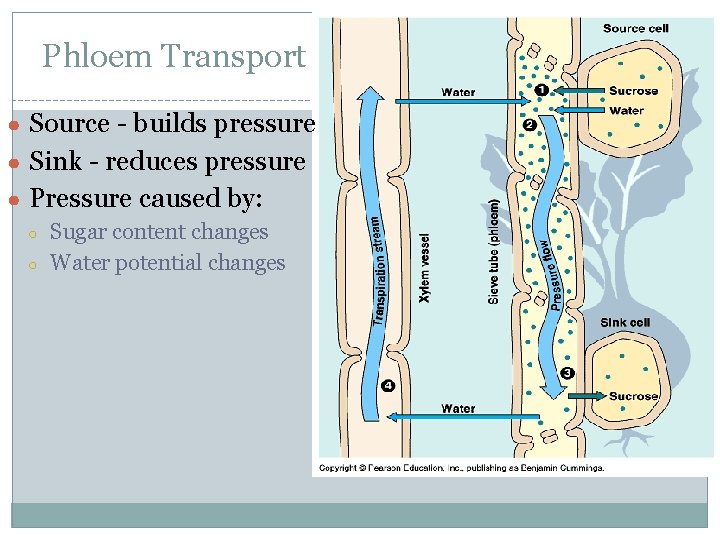
Phloem Transport ● Source - builds pressure ● Sink - reduces pressure ● Pressure caused by: ○ ○ Sugar content changes Water potential changes
- Slides: 30