
Plant Taxonomy Taxonomy is a science that deals



- Slides: 128
Plant Taxonomy • Taxonomy is a science that deals with the identification, • Nomencla ture and • Classification of plants: is the grouping together of plants whose similarities are greater than their differences.
Historical • The great Swedish naturalist and physician Carolus Linnaeus (1707 -1778) was the dominant figure in systematic botany during his time a dominate that persisted for much of the half century after his death. At the age of 32 he was the author of 14 botanical books. It represented the first time that a binomial nomenclature (i. e. the Latin name of a plant, composed of two words: the generic name e. g. Zygophyllum and the specific term, e. g. album was assigned to partially every species of plant known to the author.
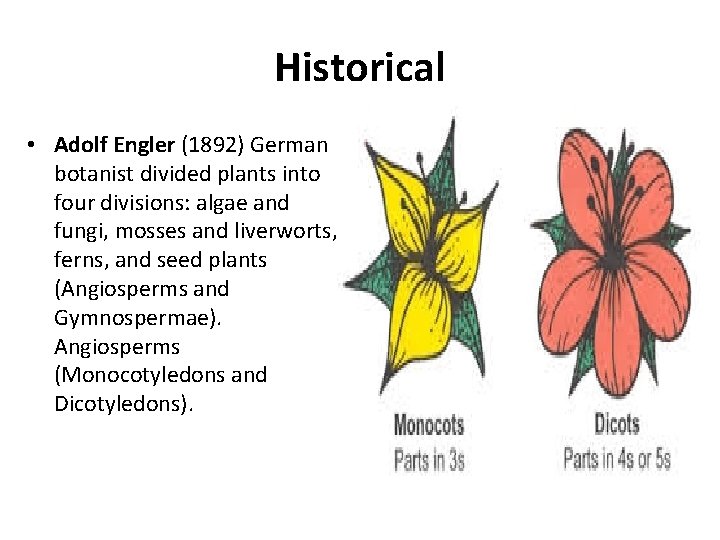
Historical • Adolf Engler (1892) German botanist divided plants into four divisions: algae and fungi, mosses and liverworts, ferns, and seed plants (Angiosperms and Gymnospermae). Angiosperms (Monocotyledons and Dicotyledons).
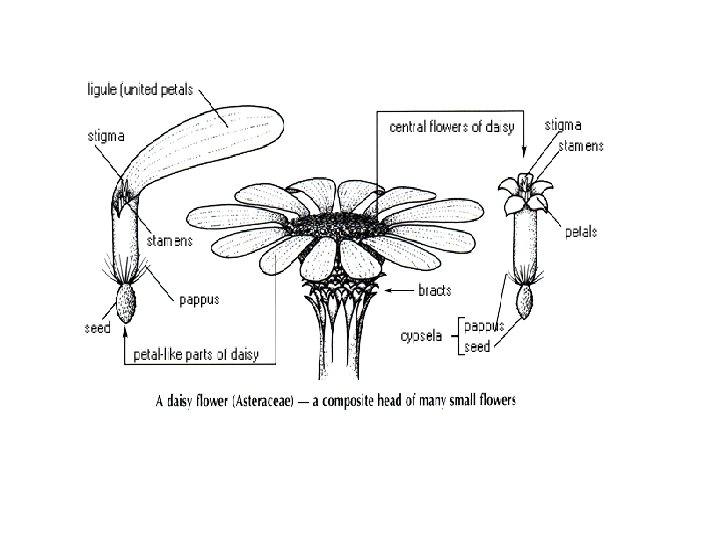
The Flower • The angiospermae are easily distinguished from the gymnosperm by the possession of flower, which are really highly specialized fertile shoots. The angiospermae are more markedly characterized by the enclosure of their ovules in a protective ovary.
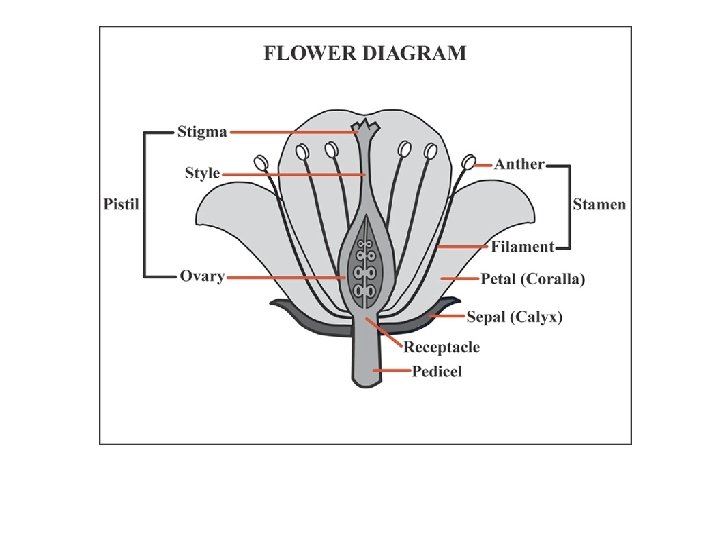
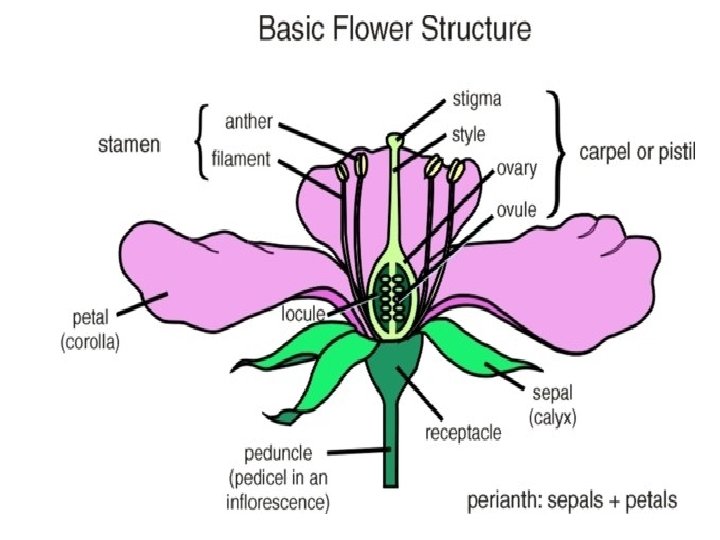
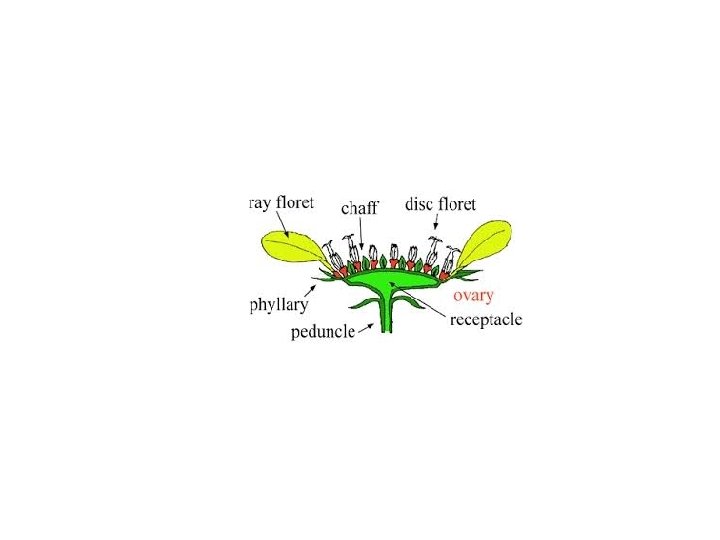
Morphology of the flower • The flower is a modified (compressed) shoot, serving for the purposes of reproduction. It arises in the axial of a leaf known as bract, and it usually has a short stalk or pedicel, sometimes the pedicel is absent and the flower is then sessile. In addition to the bract, the flower may have one or more accessory bracteoles, which are similar to and usually smaller than the bract. The floral organs are inserted on the expanded end of the pedicel, which is disc like called receptacle.
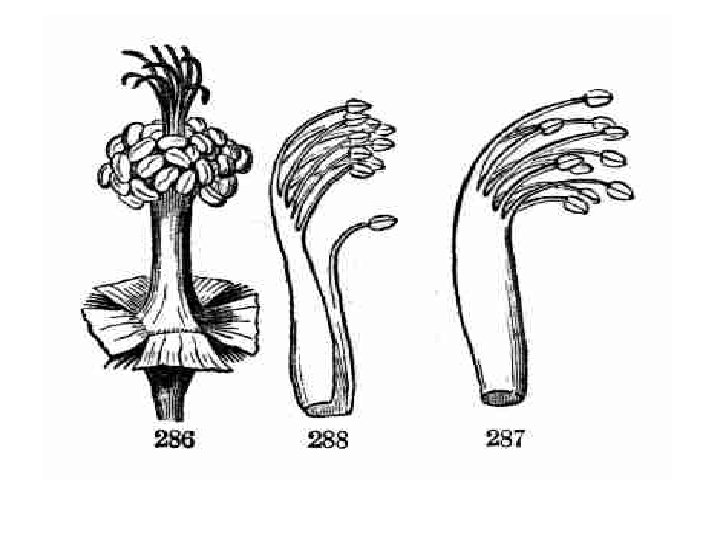
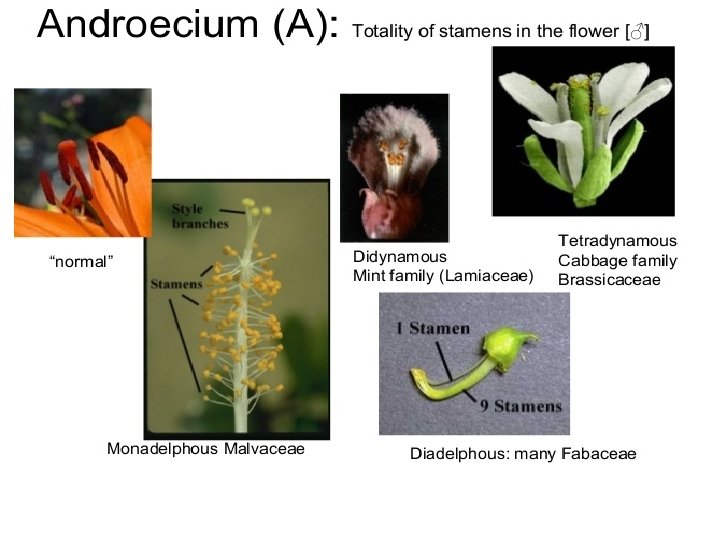
The parts of the flower • a) Essential (spore or fertile) leaves (sporophylls) which are either male (microsporophylls) or stamens and female (megasporophylls) or carpels. • b) Subsidiary or sterile leaf (perianth or floral envelope). Its leaves envelop and protect the fertile leaves; these are the calyx and corolla.
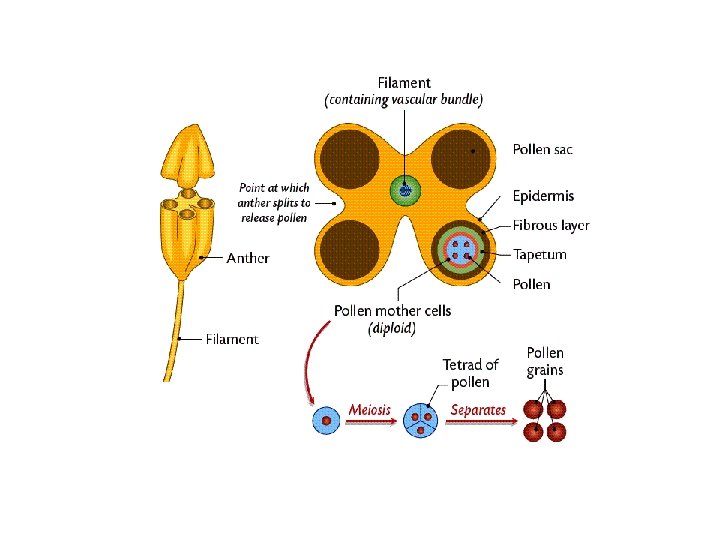
Structure of the Anther • The anther consists of two lobes each lobe contains 2 pollen sacs The two lobes of the anther are joined by a continuation of the filament known as the connective. A single vascular bundle traverses the filament and the connective. The wall of the pollen sac is composed of an outer epidermis followed by a fibrous layer in which the walls of the cells assume fibrous thickenings in the form of bands on all sides. Inside the fibrous layers there is a number of intermediate (middle) layers. The inner most layer is known as the tapetum which is composed of a densely filled cells and acts as a nutritive tissue for the developing pollen grains inside
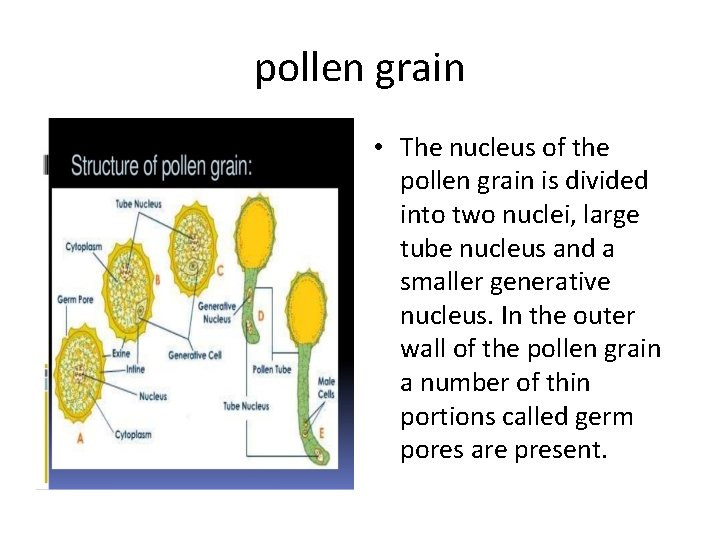
pollen grain • The nucleus of the pollen grain is divided into two nuclei, large tube nucleus and a smaller generative nucleus. In the outer wall of the pollen grain a number of thin portions called germ pores are present.
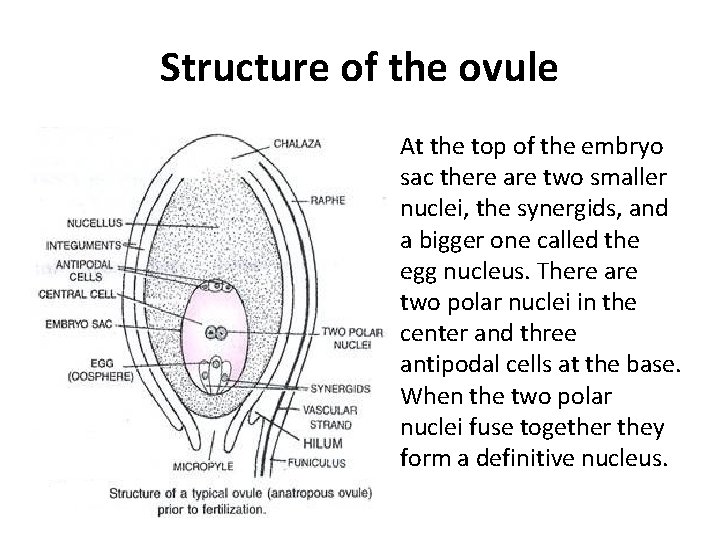
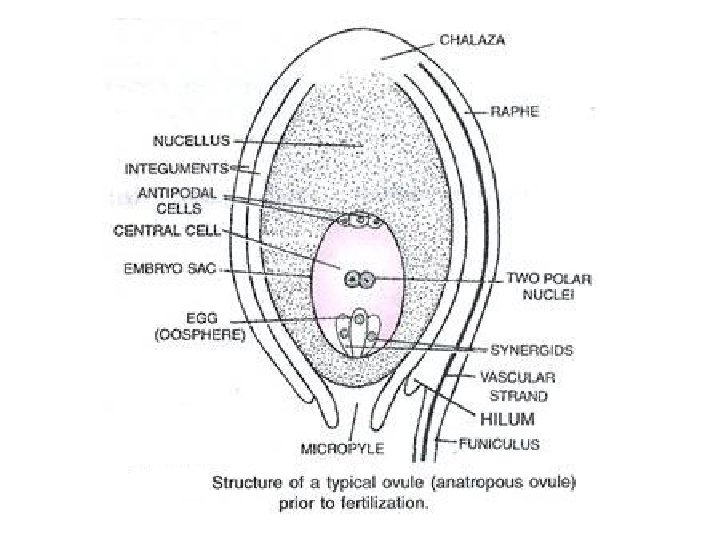
Structure of the ovule • The ovules are attached to the inner wall of the ovary in places known as placentae (single = placenta). Each ovule has a short stalk or funicle, which attach the basal part of the ovule, the chlaza, to the placenta. The central part of the ovule is known as the embryo sac. A tissue called the nucellus, which is covered externally by one or two investments known as the inner and outer integument, surrounds the embryo sac. A gap left by integument at the top of the ovule is called micropyle.
Structure of the ovule • At the top of the embryo sac there are two smaller nuclei, the synergids, and a bigger one called the egg nucleus. There are two polar nuclei in the center and three antipodal cells at the base. When the two polar nuclei fuse together they form a definitive nucleus.
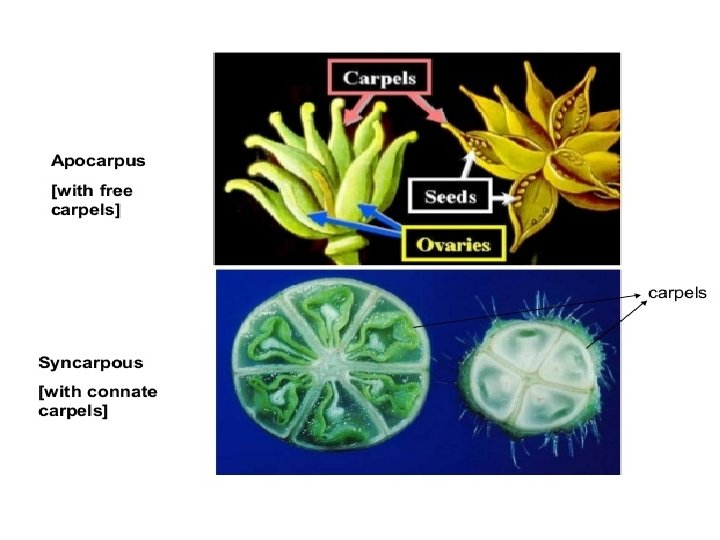
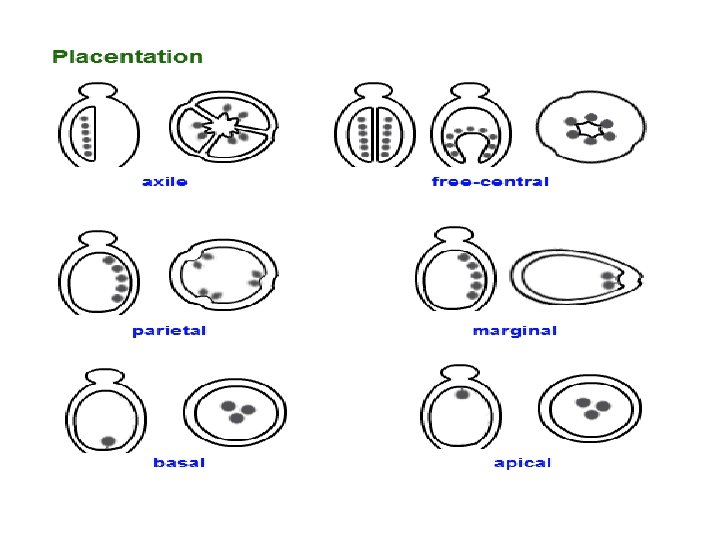
Placentation: • It is the arrangement of ovules on the inner wall of the ovary. When the edges of the carpels of the syncarpous ovary meet at the center, the ovules naturally arise on the central column, the placenta, produced by the united swollen margins of the carpels. Such arrangement or placentation of the • ovules is called axile placentation.
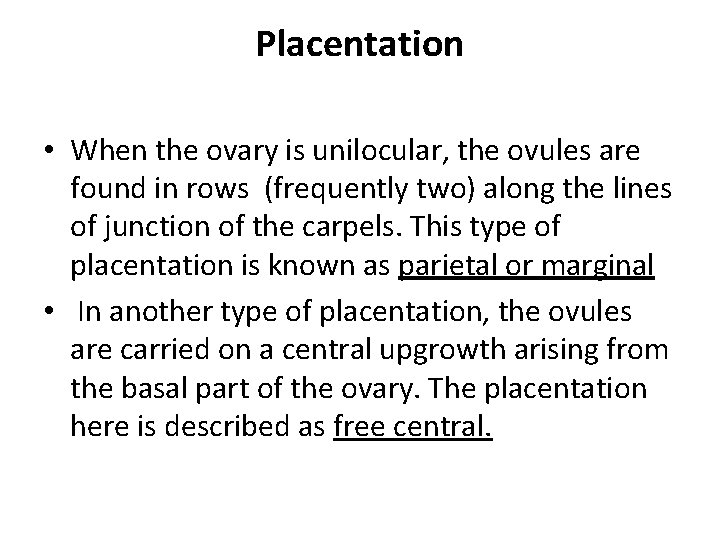
Placentation • When the ovary is unilocular, the ovules are found in rows (frequently two) along the lines of junction of the carpels. This type of placentation is known as parietal or marginal • In another type of placentation, the ovules are carried on a central upgrowth arising from the basal part of the ovary. The placentation here is described as free central.
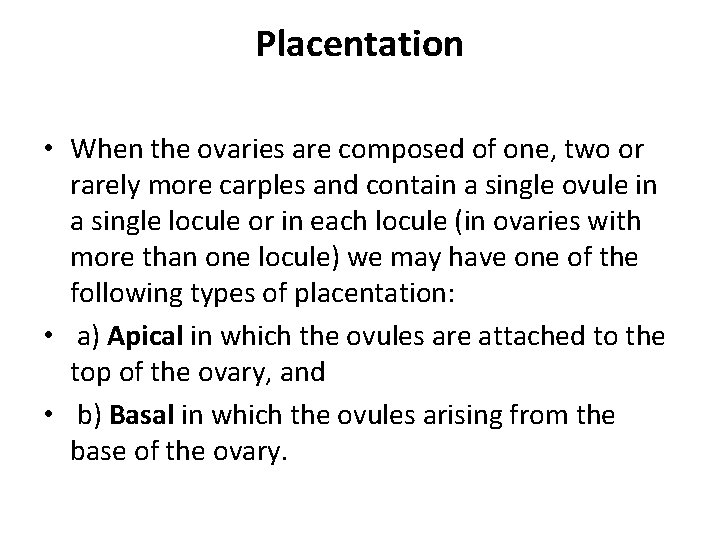
Placentation • When the ovaries are composed of one, two or rarely more carples and contain a single ovule in a single locule or in each locule (in ovaries with more than one locule) we may have one of the following types of placentation: • a) Apical in which the ovules are attached to the top of the ovary, and • b) Basal in which the ovules arising from the base of the ovary.
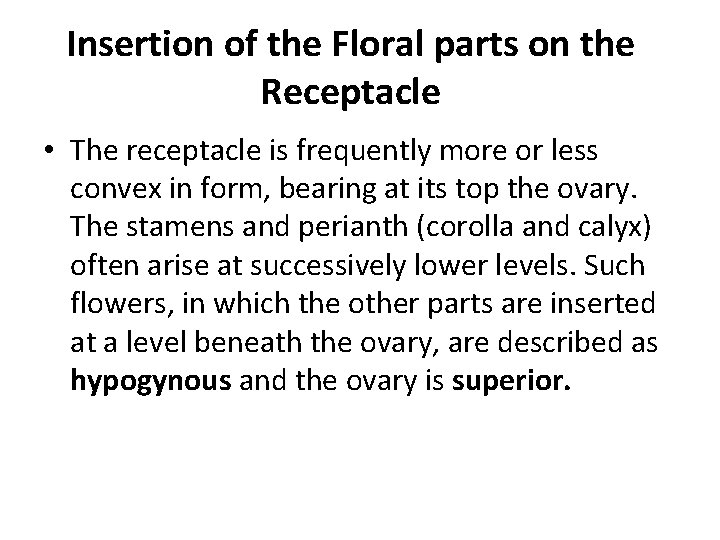
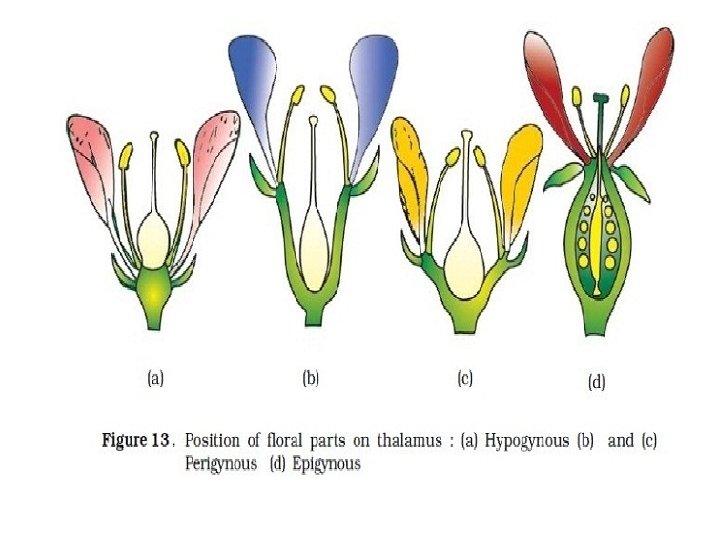
Insertion of the Floral parts on the Receptacle • The receptacle is frequently more or less convex in form, bearing at its top the ovary. The stamens and perianth (corolla and calyx) often arise at successively lower levels. Such flowers, in which the other parts are inserted at a level beneath the ovary, are described as hypogynous and the ovary is superior.
Insertion of the Floral parts on the Receptacle • When the receptacle is flattened, or more or less concave enclosing the ovary, the flower is known as perigynous. If the ovary becomes completely surrounded and altogether united with the receptacle whilst the other floral organs arise above, the flower is known as epigynous and the ovary is inferior.
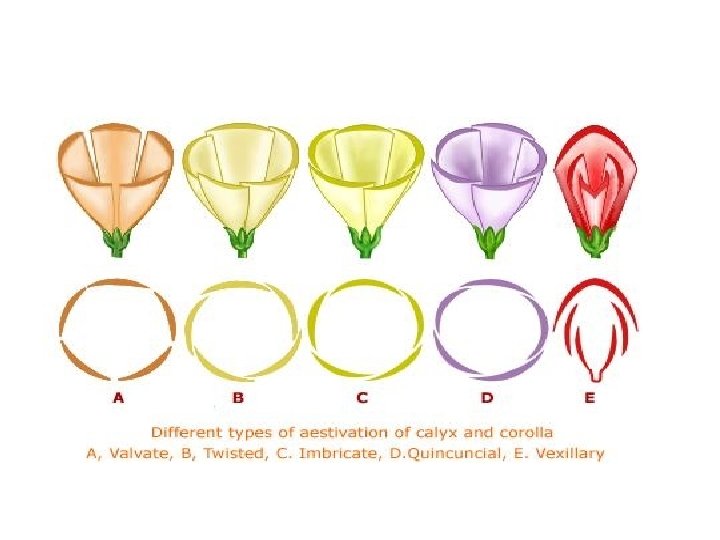
Aestivation of the perianth Leaves • The arrangement of the sepals and petals in relation to each other varies in flowers of different species. The following types of aestivation are recognized: • A) Valvate: in which the sepals or petals are arranged edge to edge. • B) Open: Like valvate but the sepals or petals are far from each other. • C) Imbricate: in which the sepals or petals are overlapping by their edges.
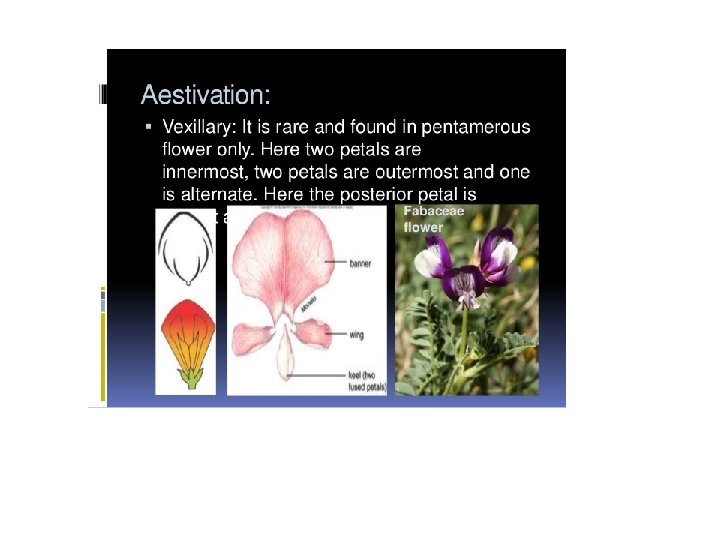
Aestivation of the perianth Leaves • The way of overlapping varies and accordingly the following types are known: • 1 -Contorted in which every petals or sepal is overlapping by one side and overlapped by the other. The twisting of sepals and petals may be clockwise or anticlockwise. • 2 -Descending in which the overlapping proceeds from the posterior to the anterior side of the flower. In this case the posterior petal or sepal is the outermost. • 3 - Ascending in which the overlapping proceeds in a direction opposite to that of the previous type • 4 - Quincuncial in which we have two outermost perianth leaves, two innermost and one overlapping by one side and overlapped by the other.
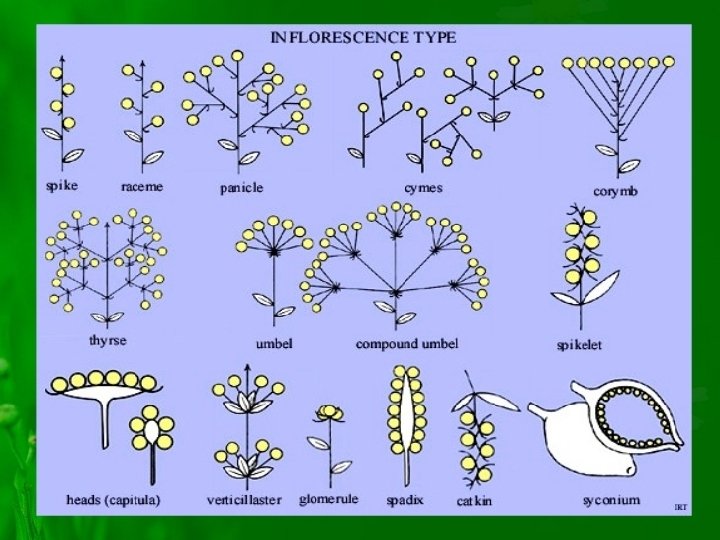
The cymose Inflorescence: • 1 - Cyme monochasium: In a simple cyme monochasium, the number of flowers does not exceed two. The two flowers arise from the terminal buds of two branches of a sympodial inflorescence
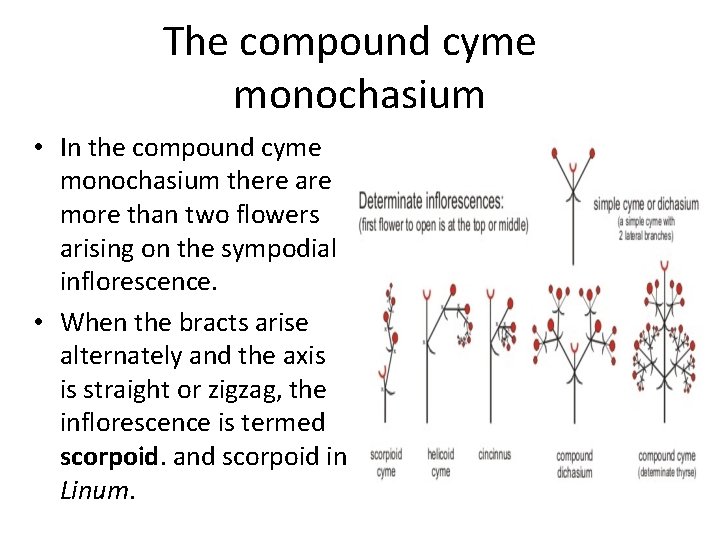
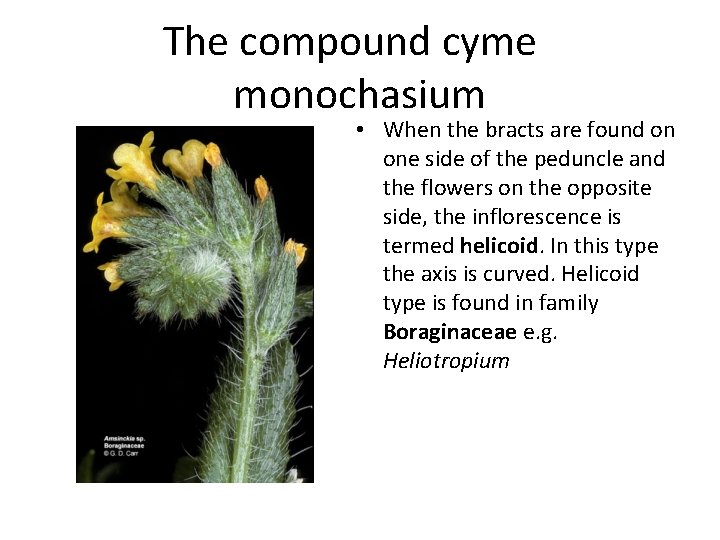
The compound cyme monochasium • In the compound cyme monochasium there are more than two flowers arising on the sympodial inflorescence. • When the bracts arise alternately and the axis is straight or zigzag, the inflorescence is termed scorpoid. and scorpoid in Linum.
The compound cyme monochasium • When the bracts are found on one side of the peduncle and the flowers on the opposite side, the inflorescence is termed helicoid. In this type the axis is curved. Helicoid type is found in family Boraginaceae e. g. Heliotropium
2 - Cyme dichasium • In the simple type the inflorescence is composed of three flowers. The terminal bud of the axis ends in a flower, and from the axial of two opposite leaves arise two lateral branches, which terminate also in two flowers younger than the middle one.
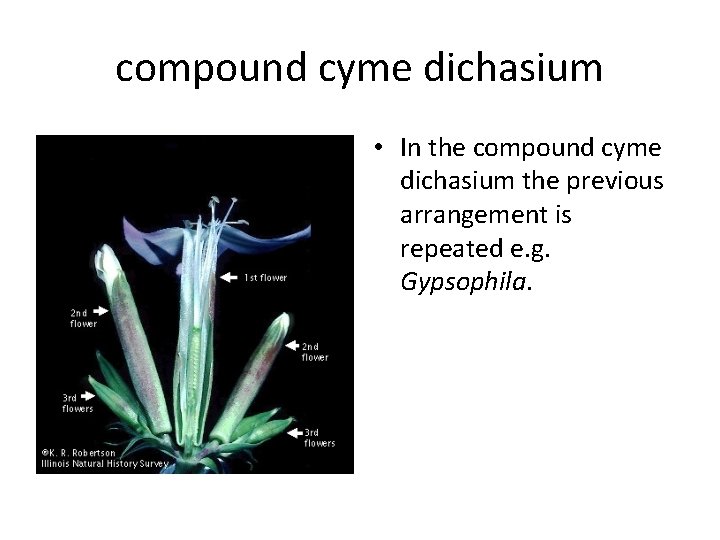
compound cyme dichasium • In the compound cyme dichasium the previous arrangement is repeated e. g. Gypsophila.
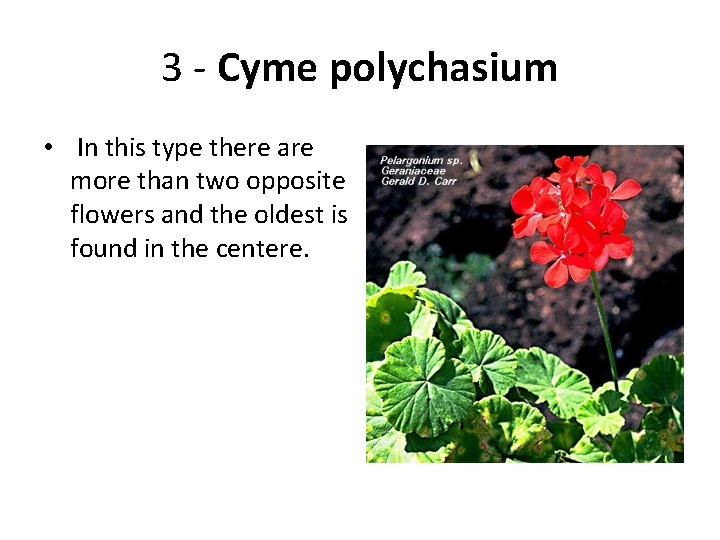
3 - Cyme polychasium • In this type there are more than two opposite flowers and the oldest is found in the centere.
Pollination This is a process through which pollen grains are transferred from the anthers to the stigma. If fertilization is happened by pollen from the flower of a different individual of the same species, the term of cross-pollination is applied. The term self-pollination is used when the pollen comes either from another flower of the same individual or from the stamens of the same flower.
A very large number of flowers exhibit a structure, which tends to favour cross-pollination. Most flowers contain both stamens and ovaries. In other words, are hermaphrodite, but the two kinds of organs rarely ripened at exactly the same time. When the stamens mature before the stigma, the flower is described as protandrous, but when the stigma mature first the flower is called protogynous. The stage in which the stamens mature is known as male stage. While that in which the stigma mature is called the female stage.
Greater certainty of cross-pollination is ensured, when stamens and ovaries occur in distinct unisexual flowers. The two sexes are either found on the same individual (monoecious) or on different individuals (dioecious). In the latter self-pollination is out of question. Pollination can be affected by various agencies, the commonest being wind, insects and water.
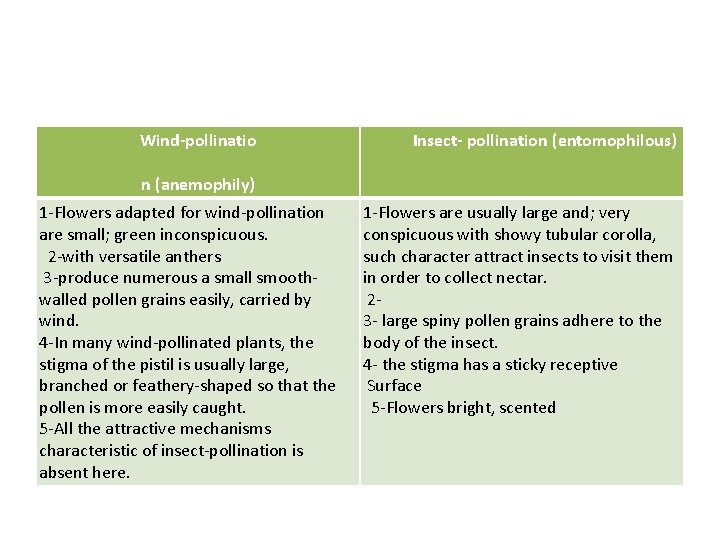
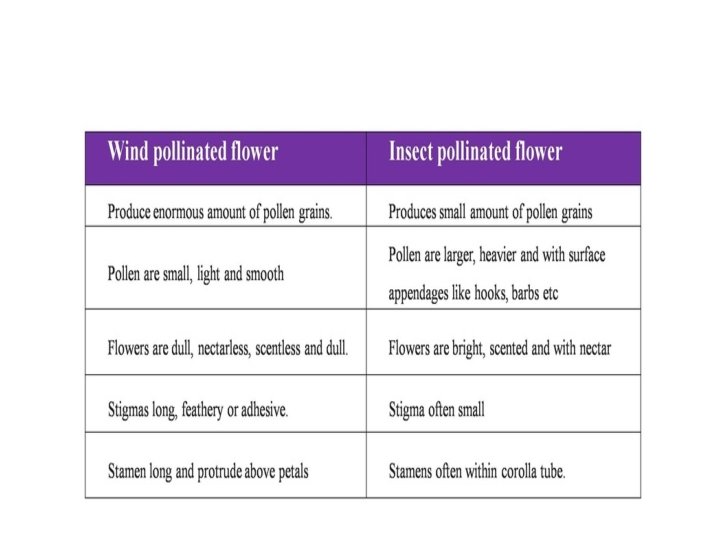
Wind-pollinatio Insect- pollination (entomophilous) n (anemophily) 1 -Flowers adapted for wind-pollination are small; green inconspicuous. 2 -with versatile anthers 3 -produce numerous a small smoothwalled pollen grains easily, carried by wind. 4 -In many wind-pollinated plants, the stigma of the pistil is usually large, branched or feathery-shaped so that the pollen is more easily caught. 5 -All the attractive mechanisms characteristic of insect-pollination is absent here. 1 -Flowers are usually large and; very conspicuous with showy tubular corolla, such character attract insects to visit them in order to collect nectar. 23 - large spiny pollen grains adhere to the body of the insect. 4 - the stigma has a sticky receptive Surface 5 -Flowers bright, scented
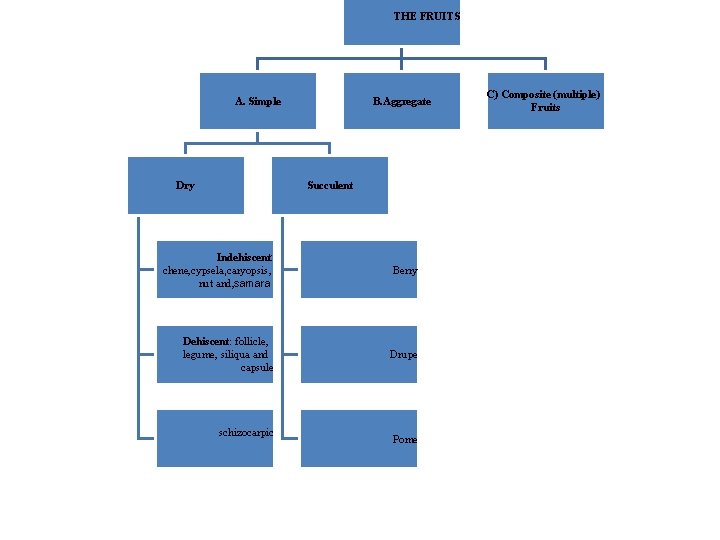
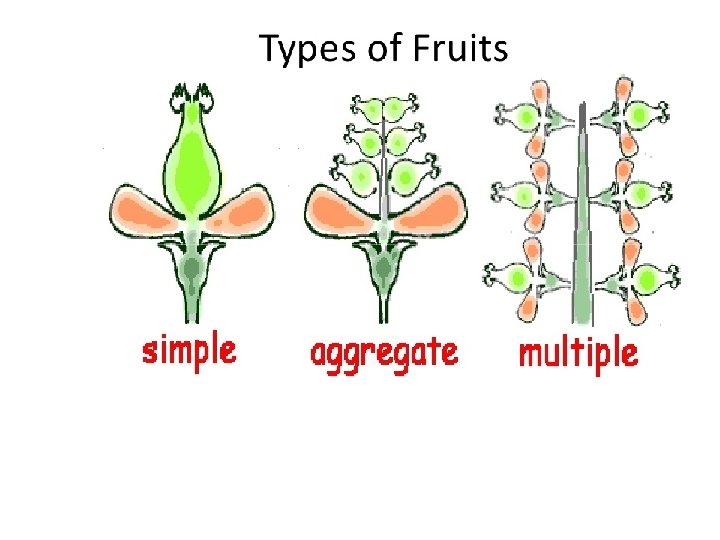
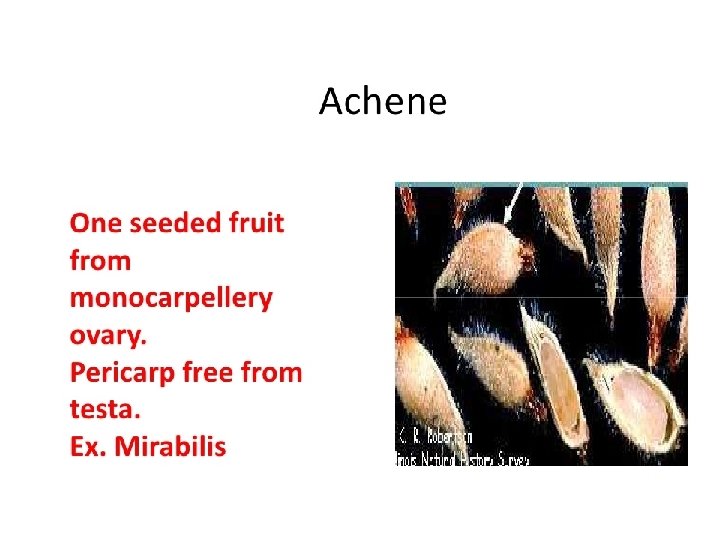
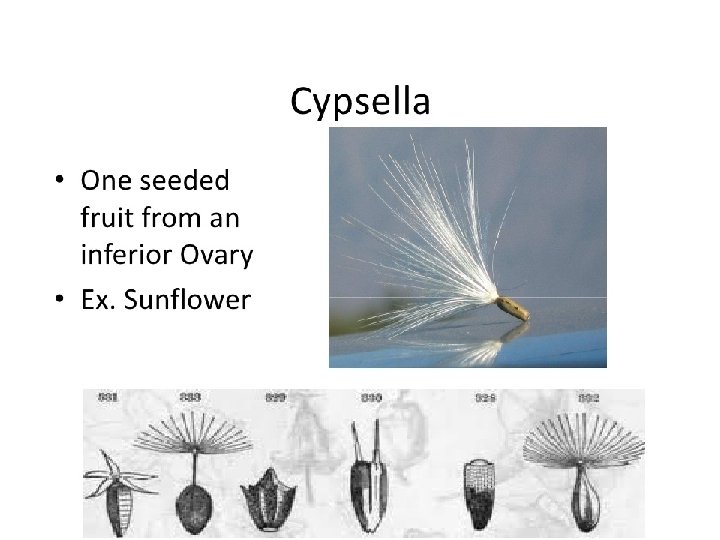
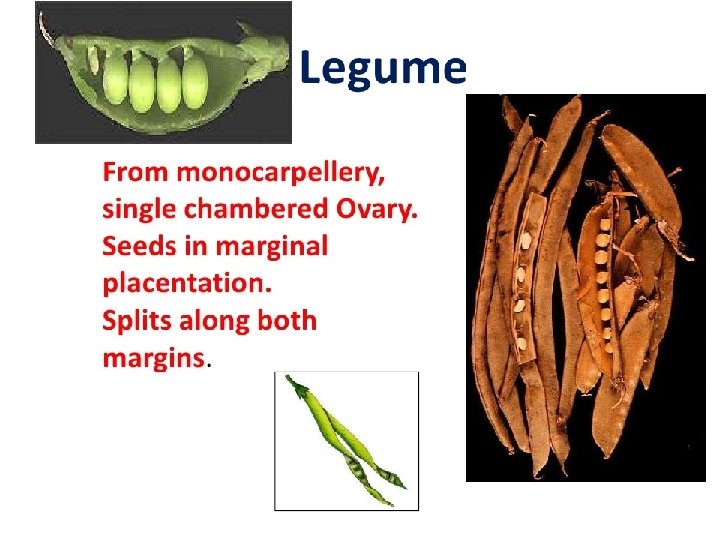
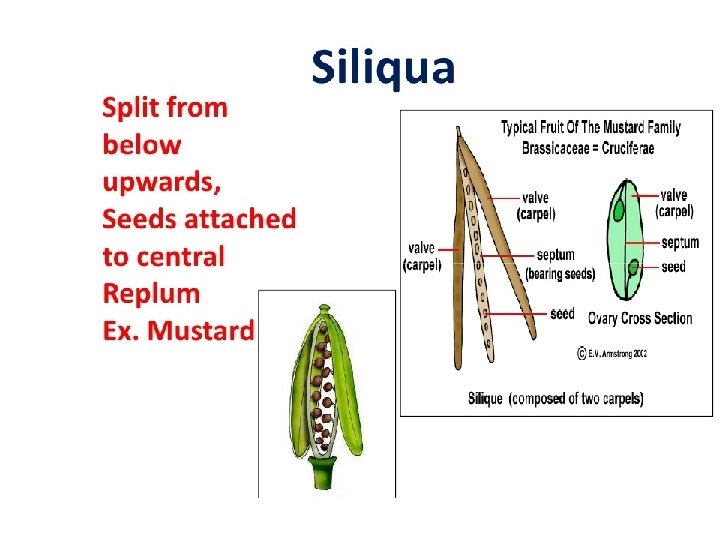
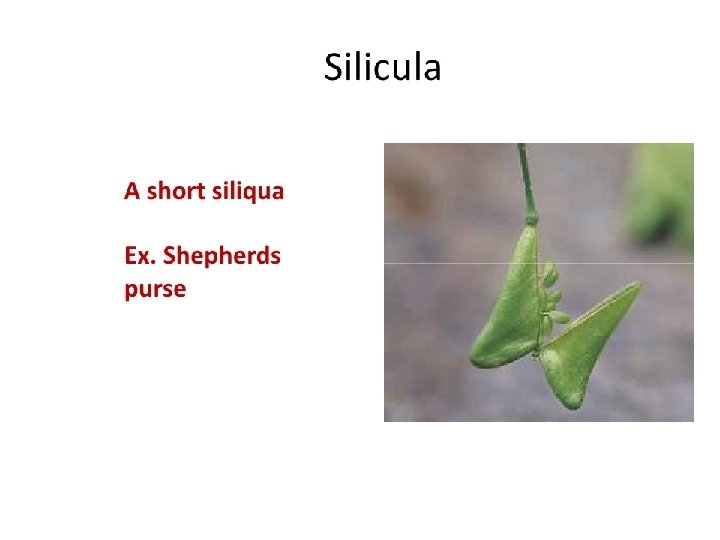
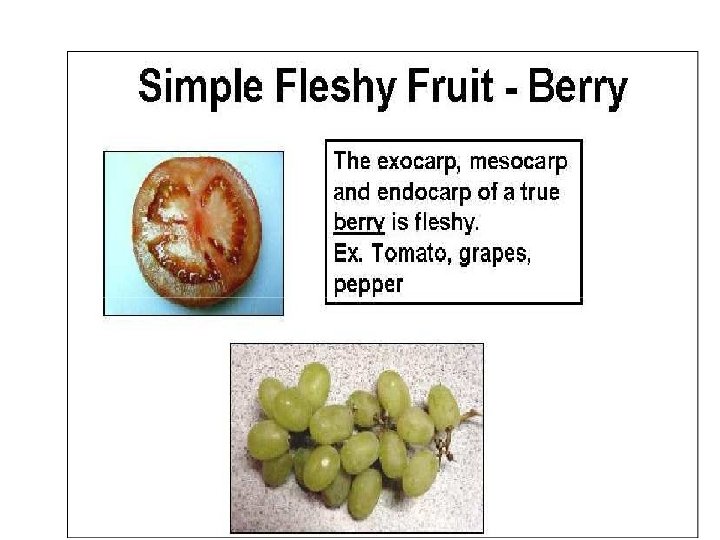
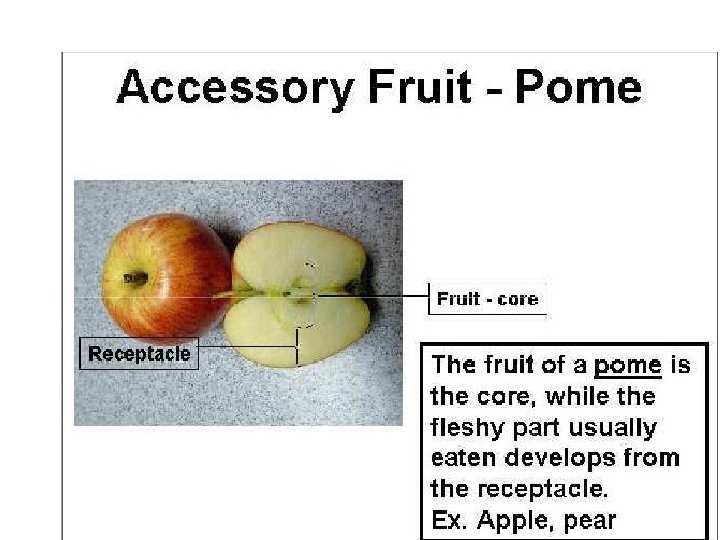
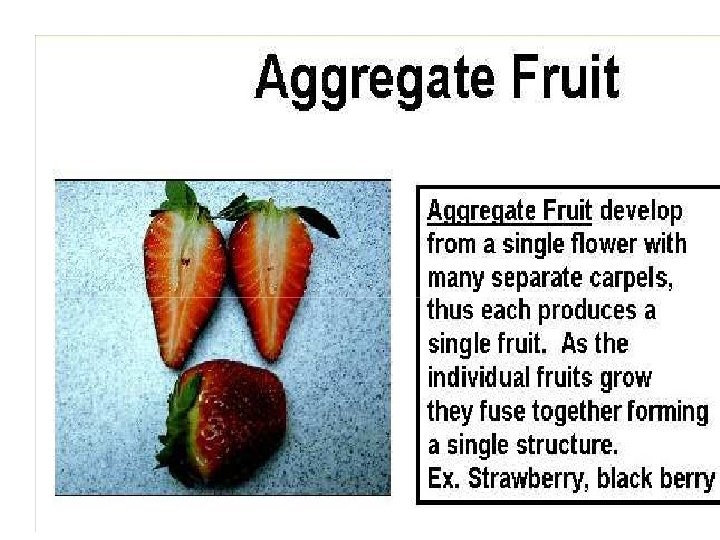
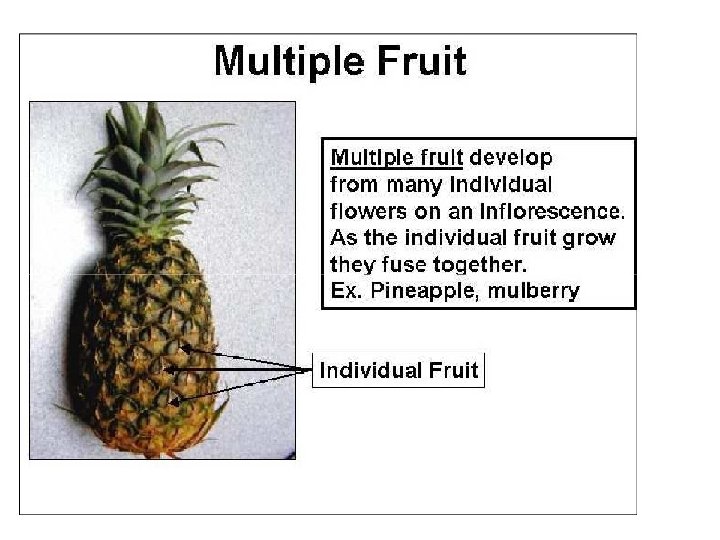
THE FRUITS A. Simple Dry B. Aggregate Succulent Indehiscent: chene, cypsela, caryopsis, nut and, samara Berry Dehiscent: follicle, legume, siliqua and capsule Drupe schizocarpic Pome C) Composite (multiple) Fruits
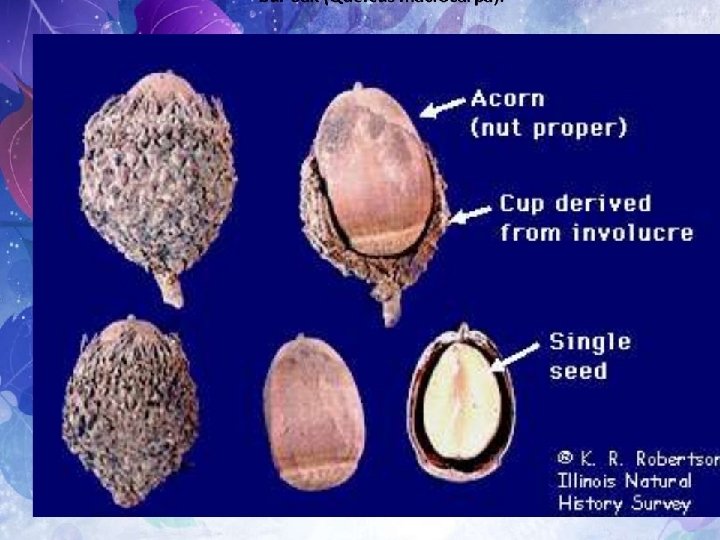
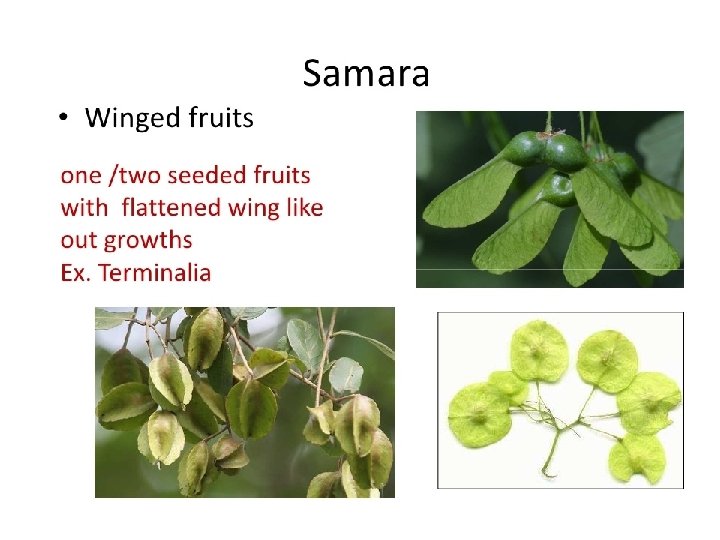
A) Simple Fruits • I - Dry Fruits • The dry fruits can be distinguished into: • a) Indehiscent fruits: in which the wall may remain closed and the seeds liberated after the disintegration of the pericarp.
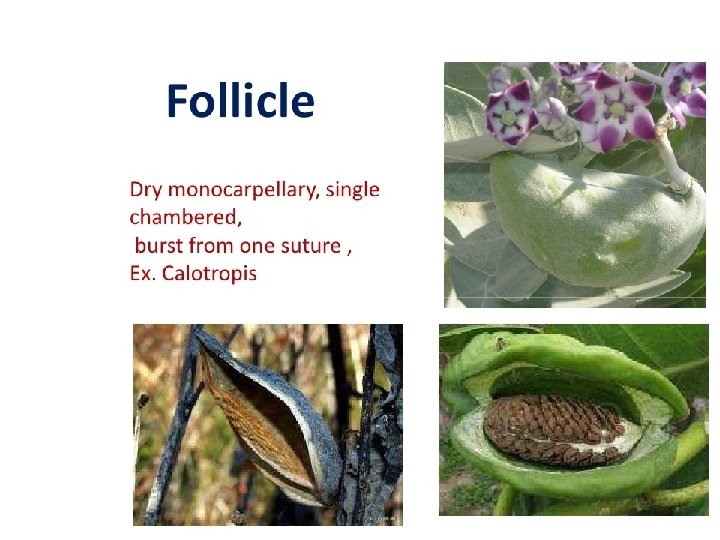
b) Dry Dehiscent fruits
5 - Capsules • The fruit is generally composed of more than one carpel. According to the way of dehiscence, the following types of capsule can be distinguished.
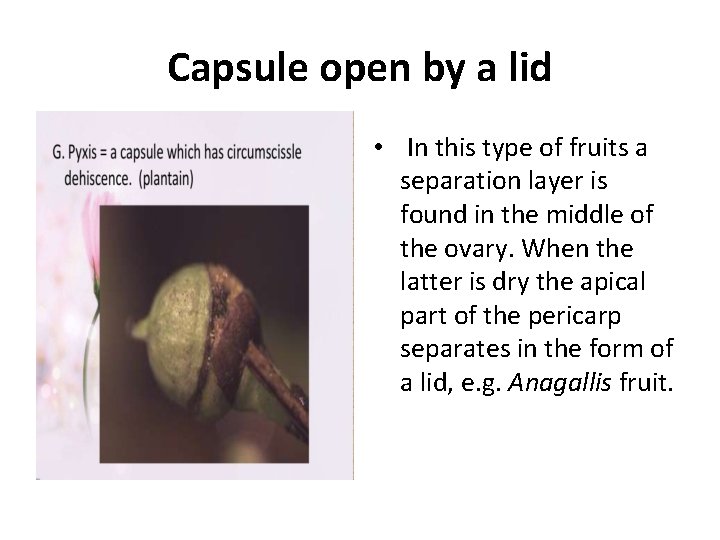
Capsule open by a lid • In this type of fruits a separation layer is found in the middle of the ovary. When the latter is dry the apical part of the pericarp separates in the form of a lid, e. g. Anagallis fruit.
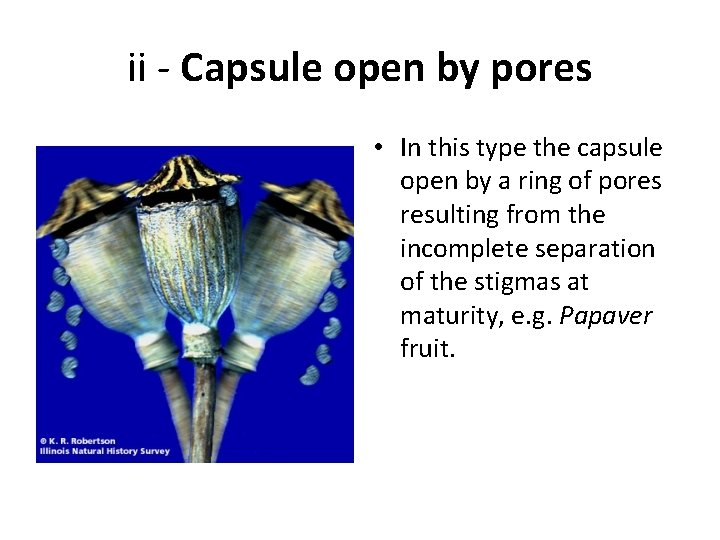
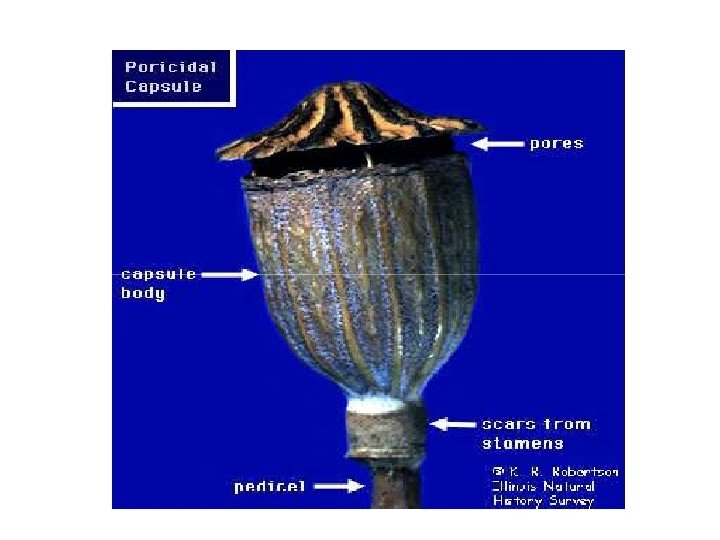
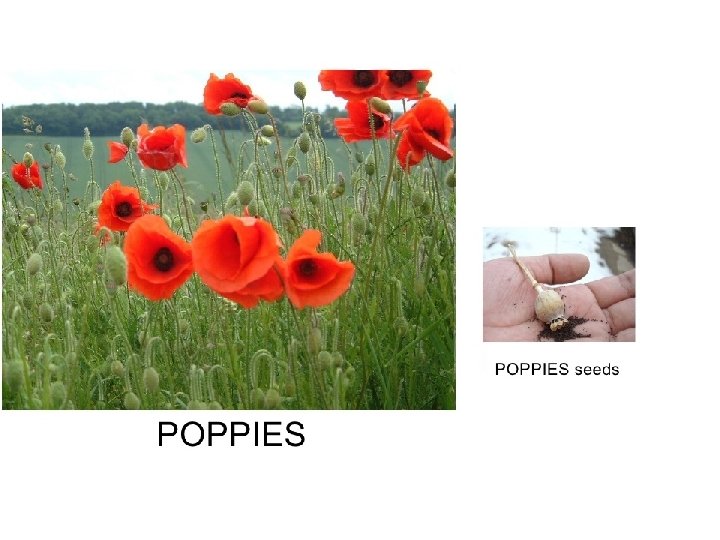
ii - Capsule open by pores • In this type the capsule open by a ring of pores resulting from the incomplete separation of the stigmas at maturity, e. g. Papaver fruit.
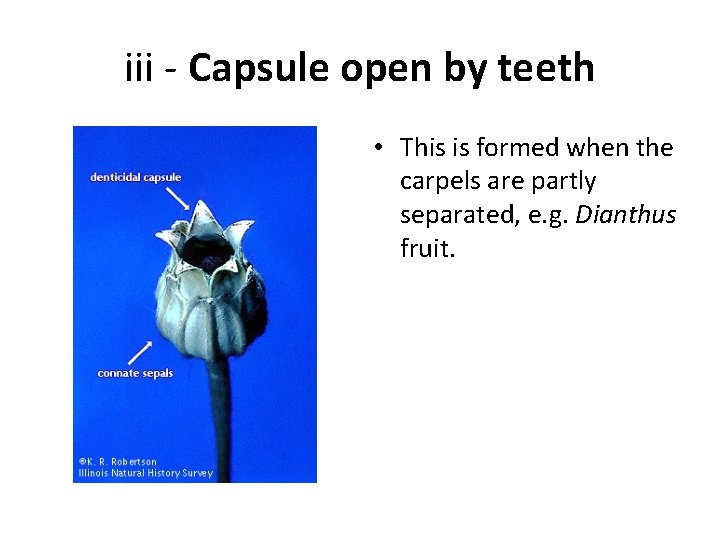
iii - Capsule open by teeth • This is formed when the carpels are partly separated, e. g. Dianthus fruit.
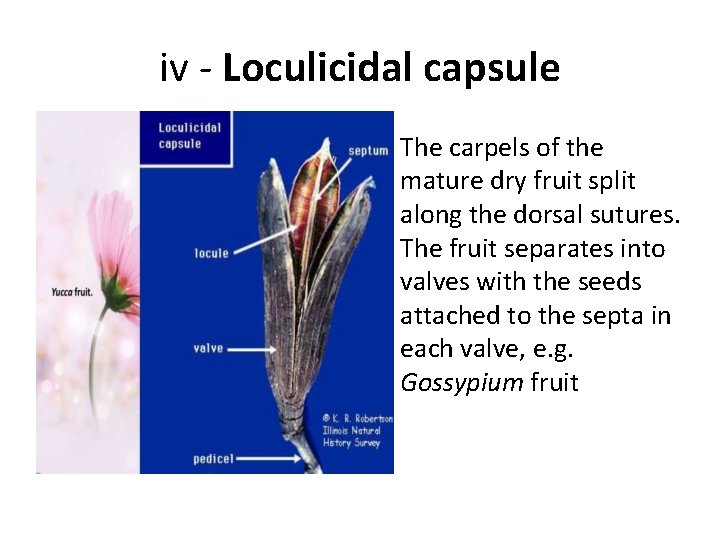
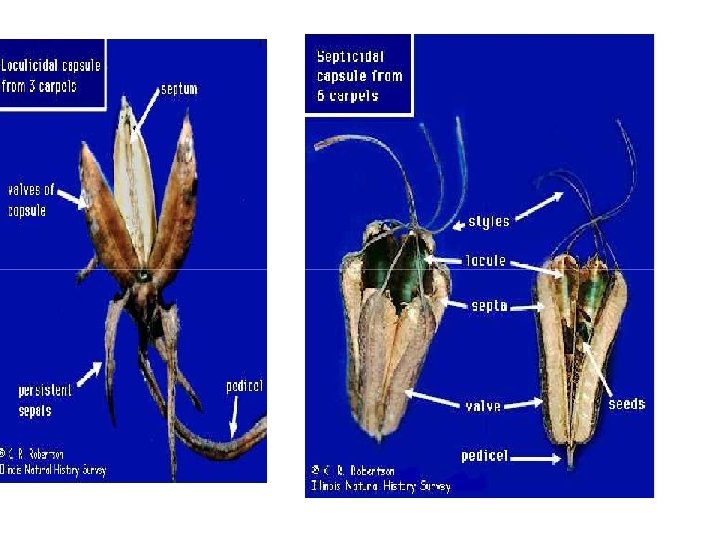
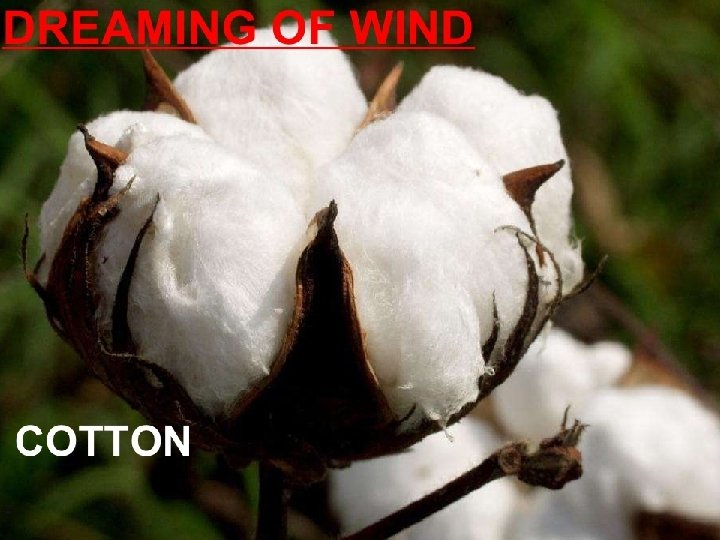
iv - Loculicidal capsule • The carpels of the mature dry fruit split along the dorsal sutures. The fruit separates into valves with the seeds attached to the septa in each valve, e. g. Gossypium fruit
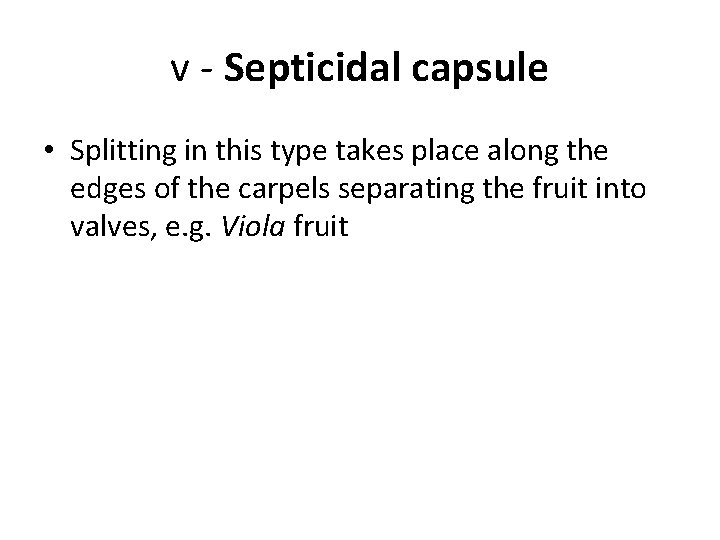
v - Septicidal capsule • Splitting in this type takes place along the edges of the carpels separating the fruit into valves, e. g. Viola fruit
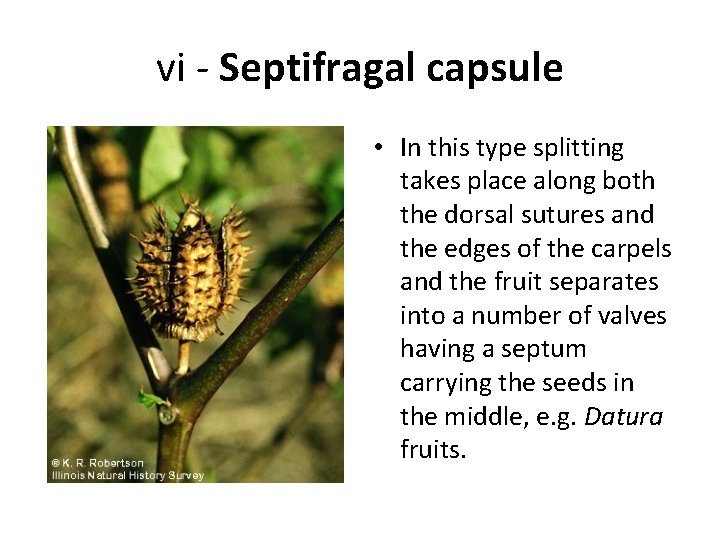
vi - Septifragal capsule • In this type splitting takes place along both the dorsal sutures and the edges of the carpels and the fruit separates into a number of valves having a septum carrying the seeds in the middle, e. g. Datura fruits.
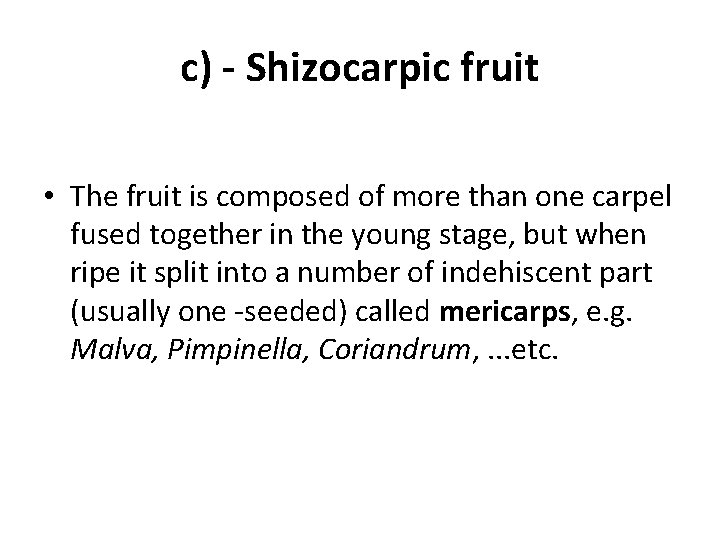
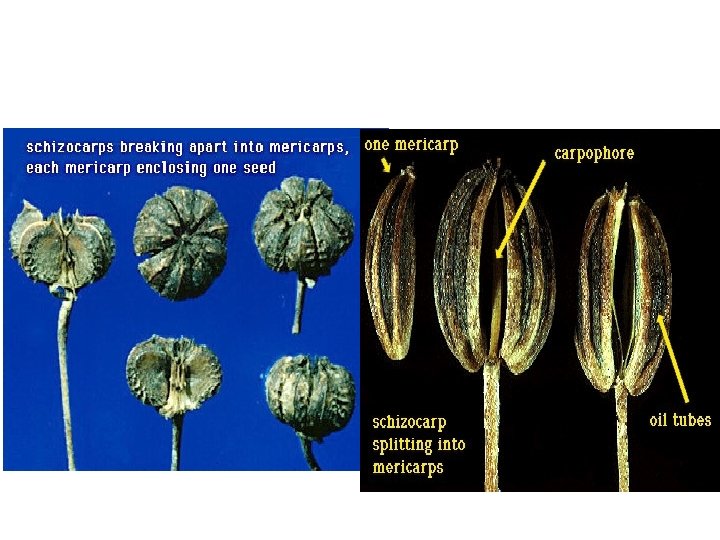
c) - Shizocarpic fruit • The fruit is composed of more than one carpel fused together in the young stage, but when ripe it split into a number of indehiscent part (usually one -seeded) called mericarps, e. g. Malva, Pimpinella, Coriandrum, . . . etc.
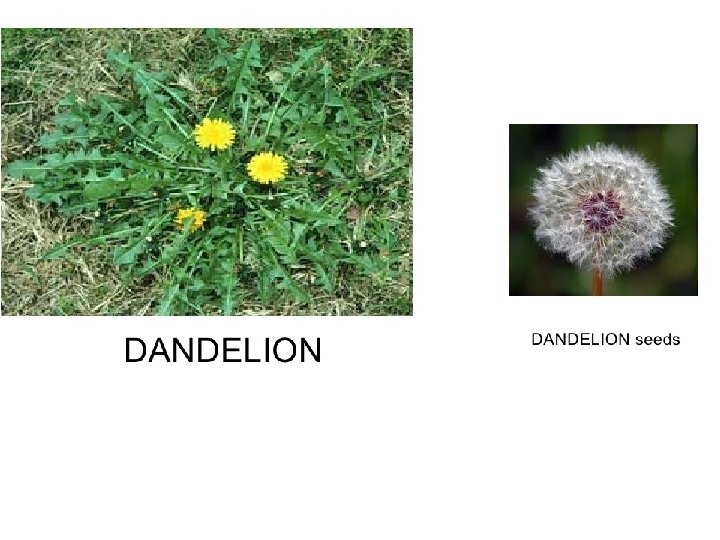
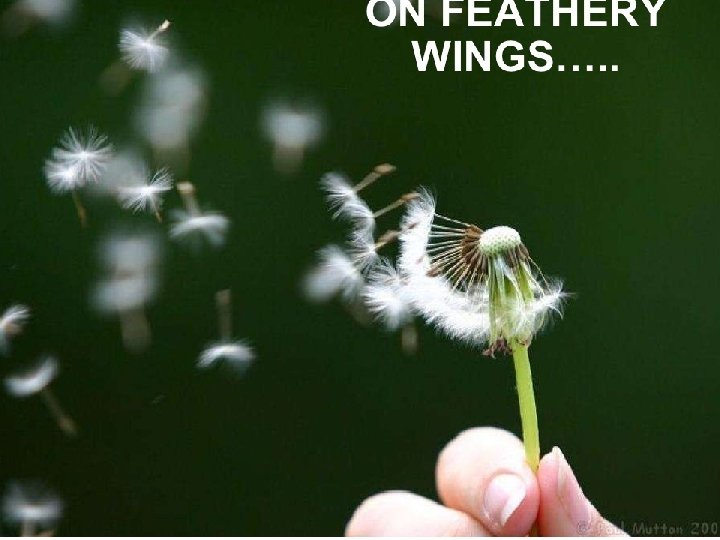
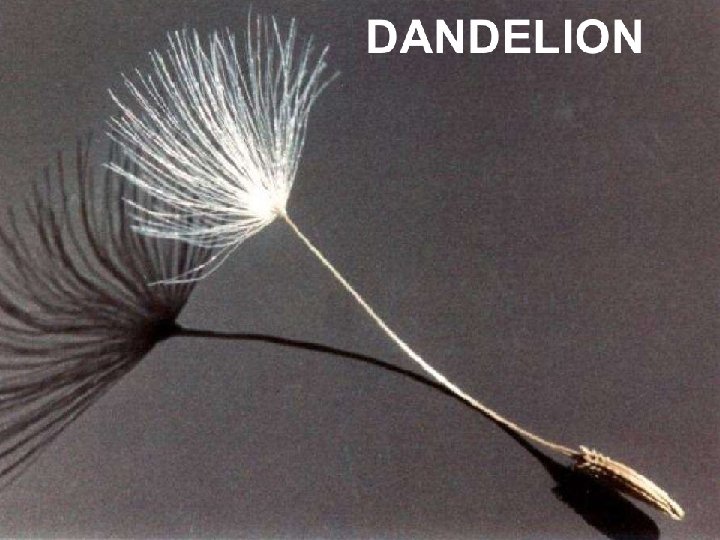
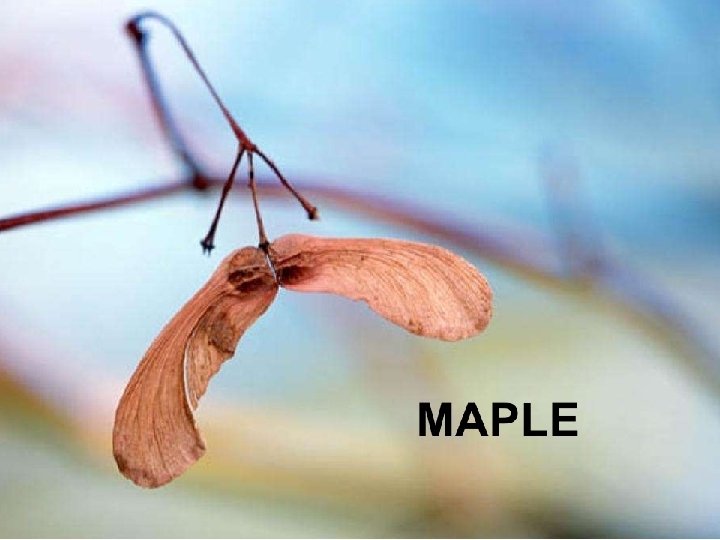
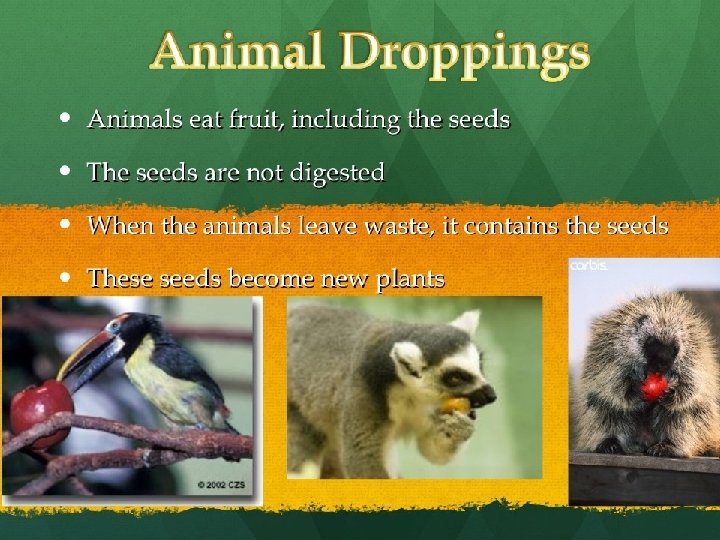
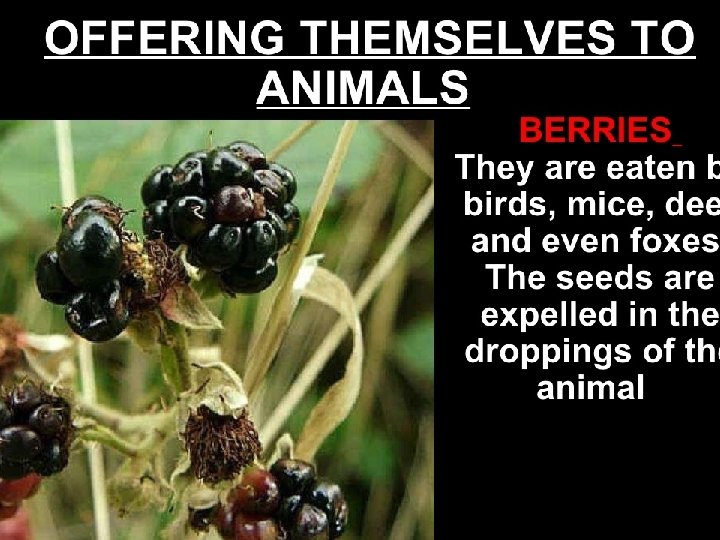
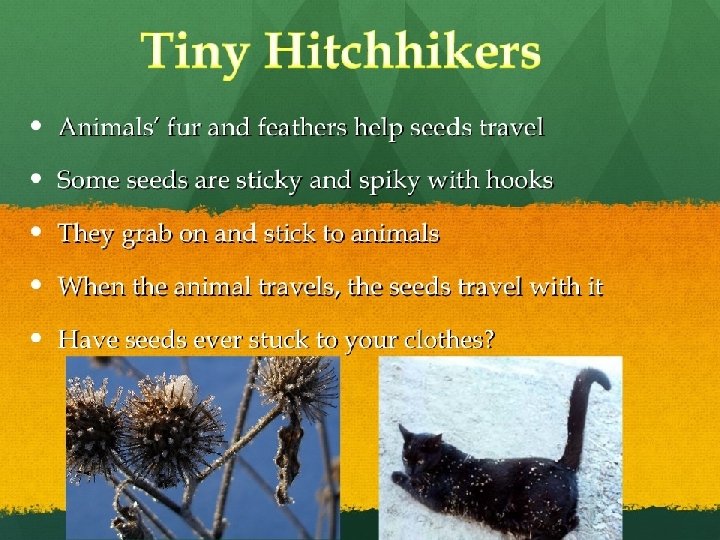
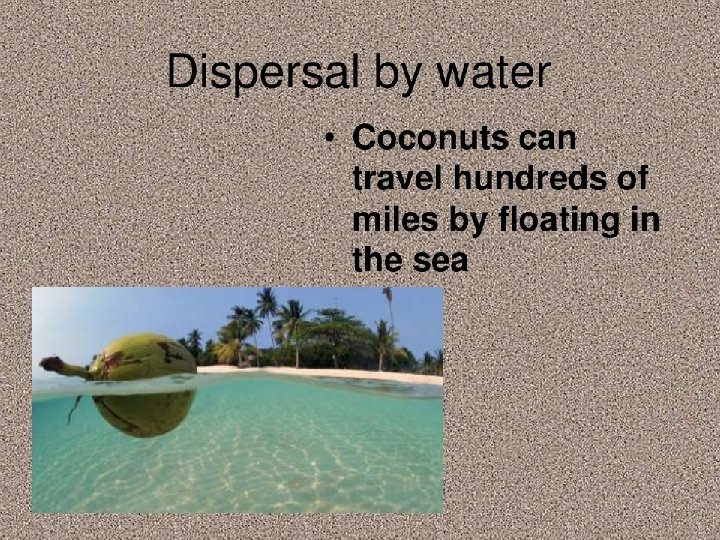
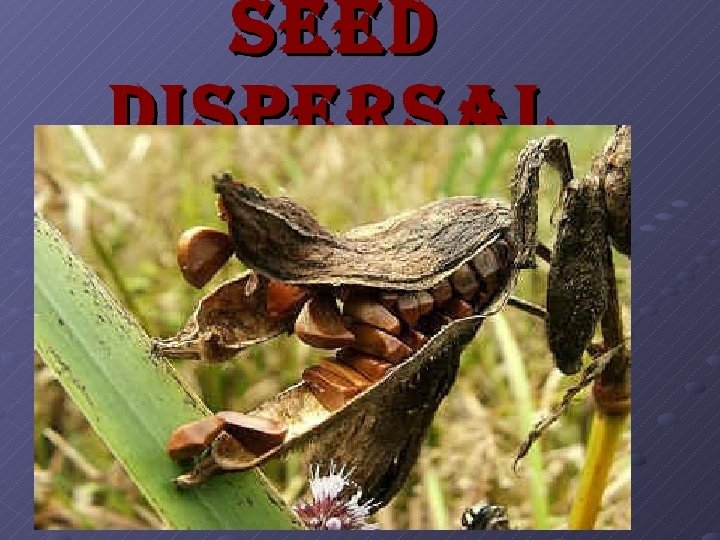
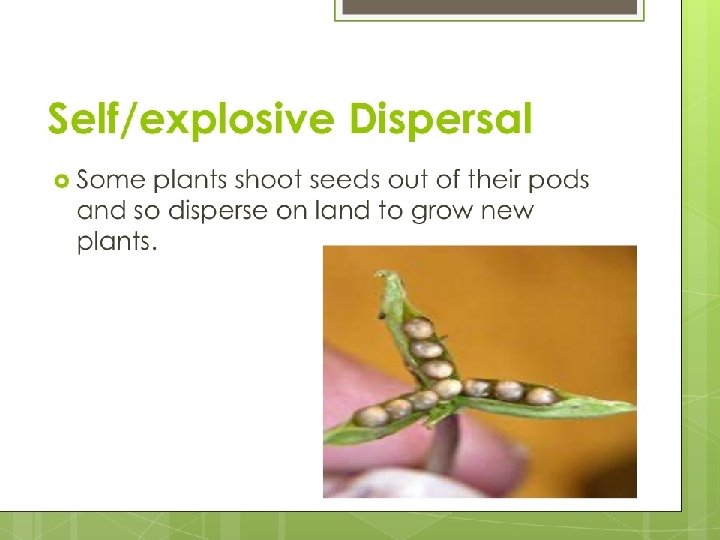
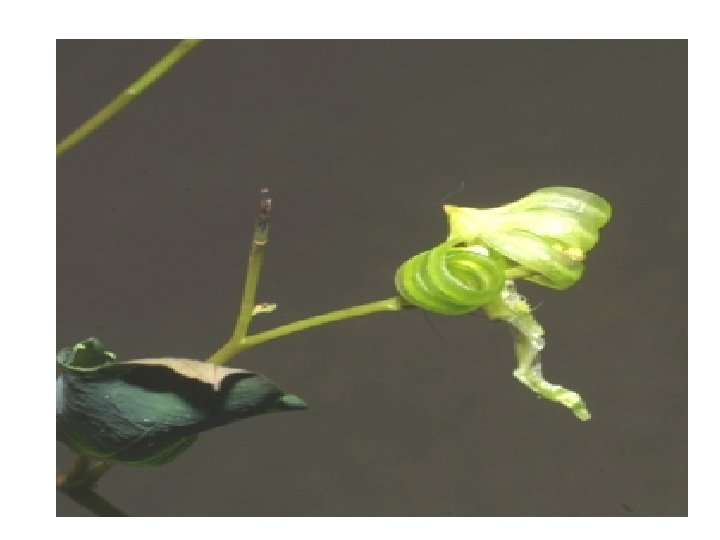
Dispersal of seeds and fruits • The dispersal of seeds and fruits is of great importance in plant life. By the widely scattering of the seeds away from the parent plant, the risk of competition of the developing plants with the parent or with one another is diminished. • The agents that act in the dispersal of seeds and fruits are wind, animals and water. Some plants possess certain mechanism in their fruits, which help in seed dispersal.
1) Dispersal by wind
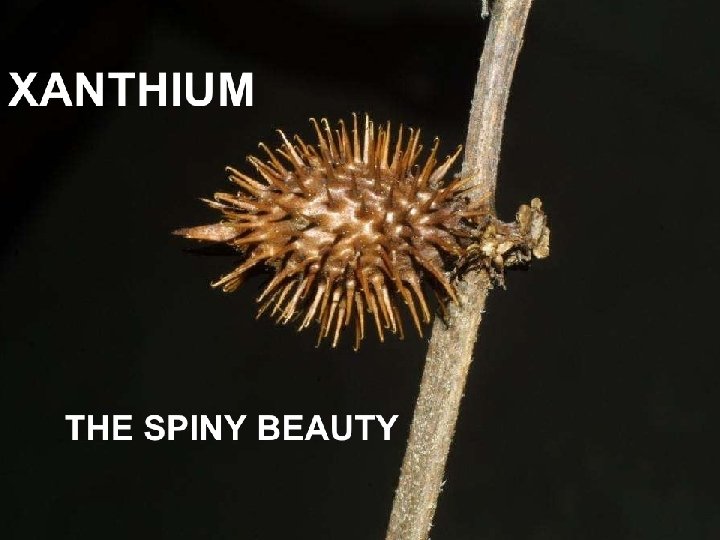
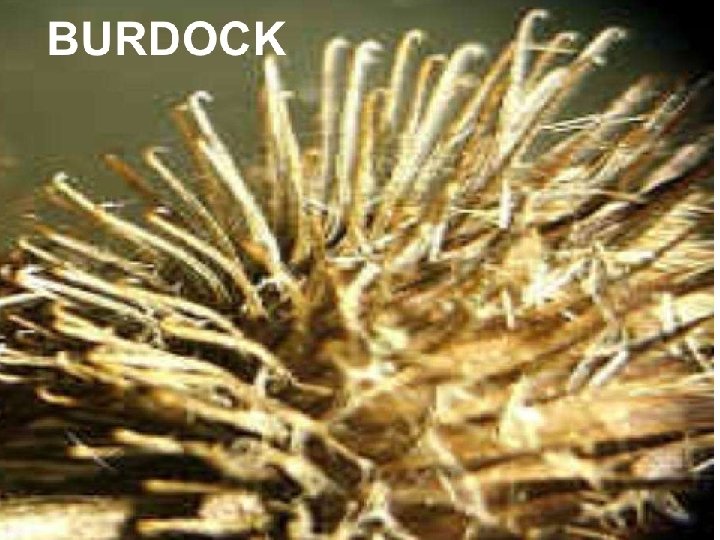
2) Dispersal by animals
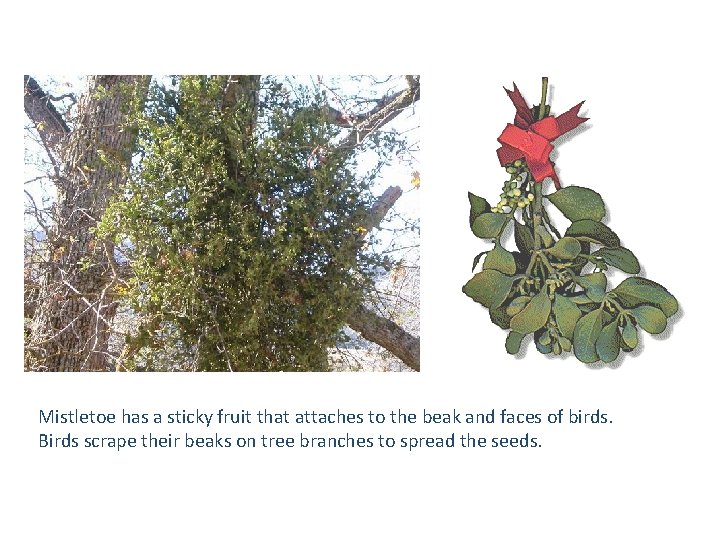
Mistletoe has a sticky fruit that attaches to the beak and faces of birds. Birds scrape their beaks on tree branches to spread the seeds.
3) Dispersal by water
4) Mechanical dispersal
Class " 1 ": Monocotyledonae Order Glumiflorae
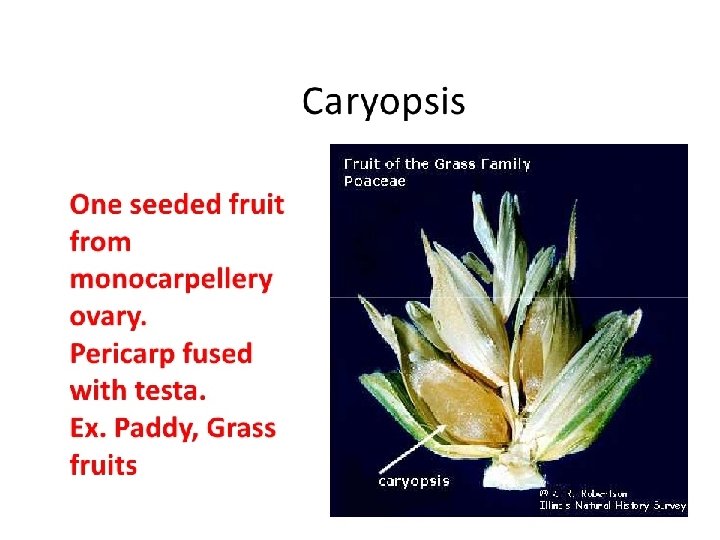
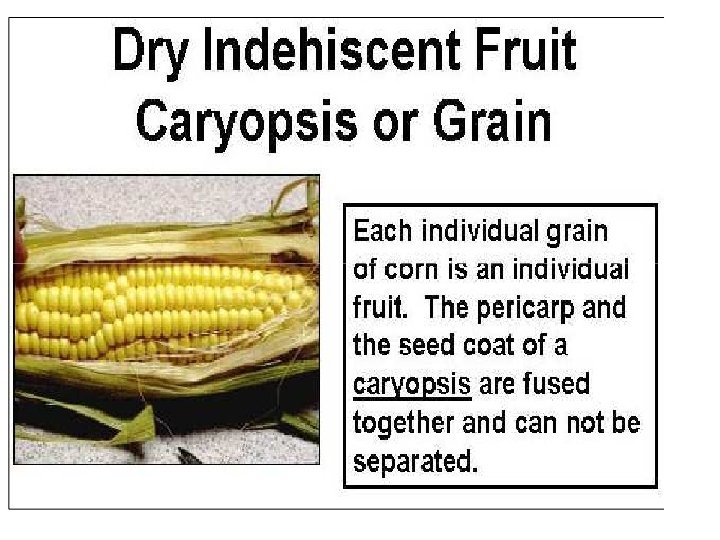
Order Glumiflorae • The order is characterized by the presence of very small flowers arranged in spikelets. The flower has no real perianth and composed usually of three or six stamens and a superior ovary consisting of one or two carpels. It arises in the axile of a dry bract. The fruit may be caryopsis or achene with rich endosperm. The family Gramineae is described as an example of this order.
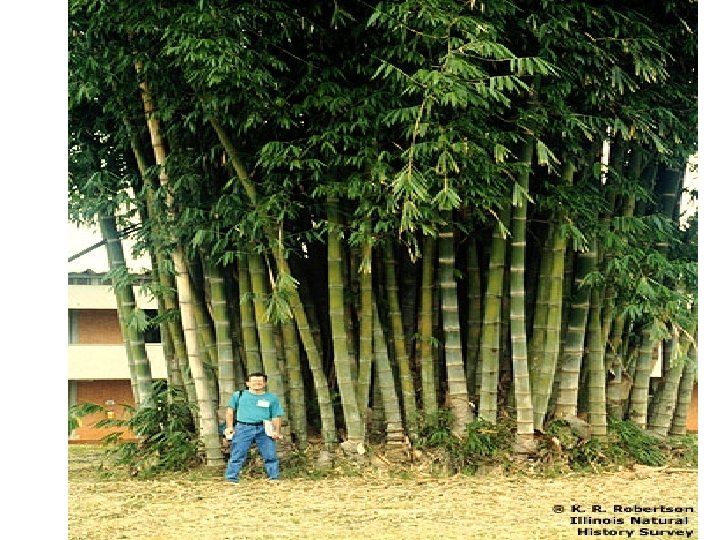
Family Gramineae (grass family). 1 -Annual or perennial herbs, rarely woody (Bambusa spp. ). 2 -The stems (culms) are with hollow internodes and swollen nodes. In few species, e. g. Saccharum officinarum the clum is solid.
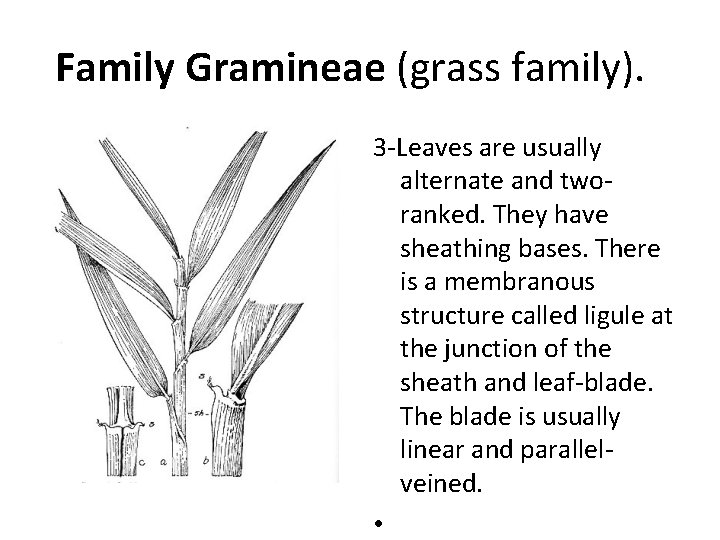
Family Gramineae (grass family). 3 -Leaves are usually alternate and tworanked. They have sheathing bases. There is a membranous structure called ligule at the junction of the sheath and leaf-blade. The blade is usually linear and parallelveined. •
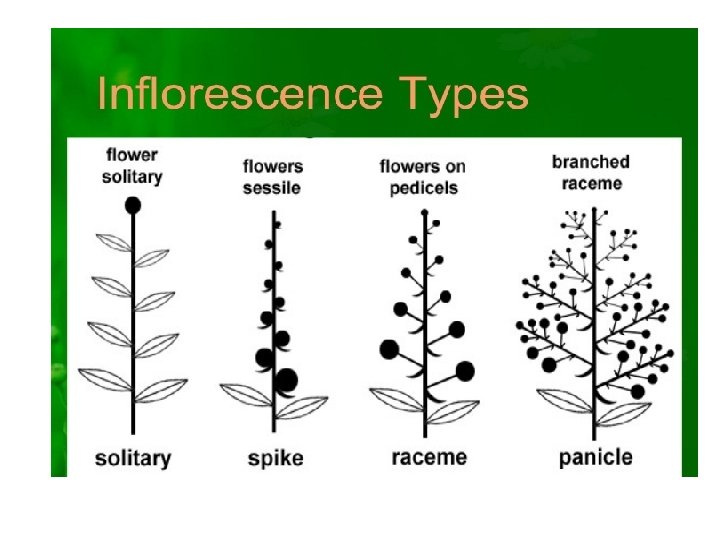
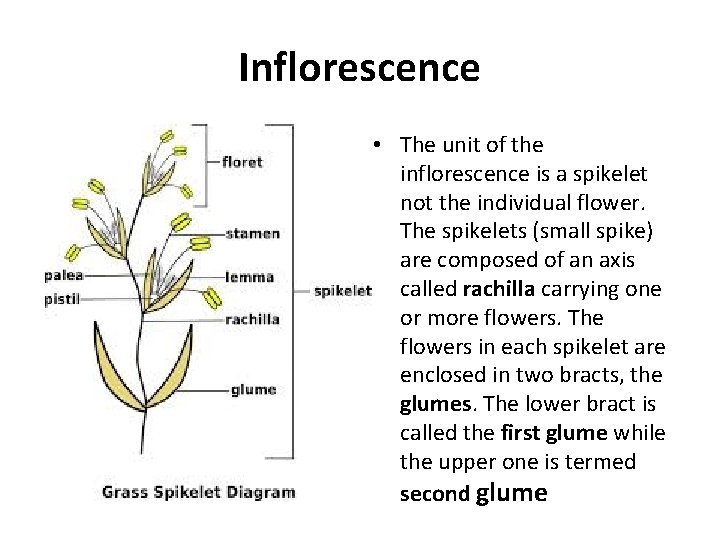
Inflorescence • The unit of the inflorescence is a spikelet not the individual flower. The spikelets (small spike) are composed of an axis called rachilla carrying one or more flowers. The flowers in each spikelet are enclosed in two bracts, the glumes. The lower bract is called the first glume while the upper one is termed second glume
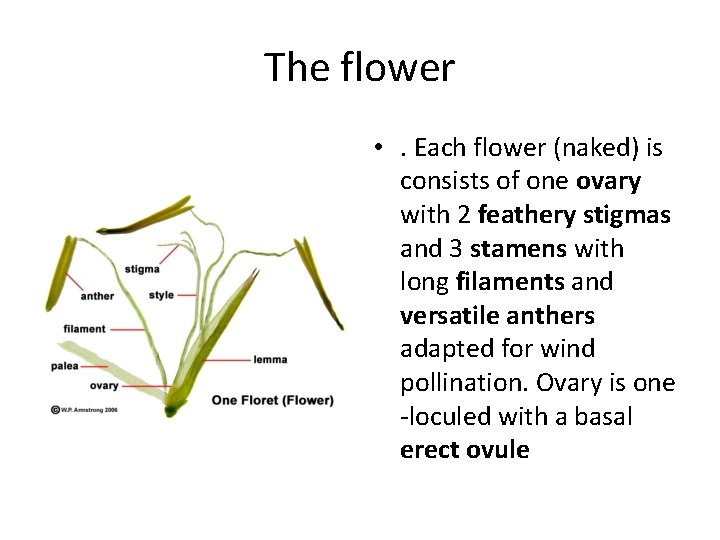
The flower • . Each flower (naked) is consists of one ovary with 2 feathery stigmas and 3 stamens with long filaments and versatile anthers adapted for wind pollination. Ovary is one -loculed with a basal erect ovule
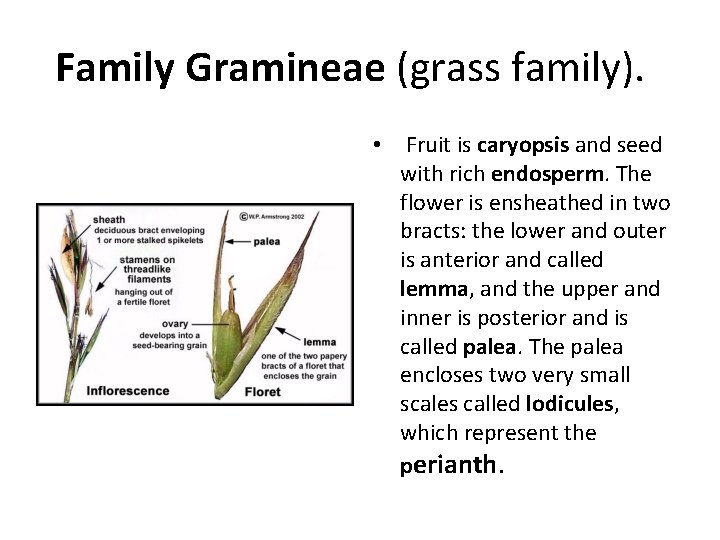
Family Gramineae (grass family). • Fruit is caryopsis and seed with rich endosperm. The flower is ensheathed in two bracts: the lower and outer is anterior and called lemma, and the upper and inner is posterior and is called palea. The palea encloses two very small scales called lodicules, which represent the perianth.
Family Gramineae (grass family) • A) Crop plants Triticum vulgar, Zea mays, Saccharum officinarum, Oryza sativa, Hordeum vulgar, Sorghum durra. B) Wild plants Bambusa (bamboo, woody tall clum), Arundo donax, phraginites communis, Imperata cylindrica, Desmostachya bipinnata, Panicum turgium and Polypogon monsepliensis. . . etc.
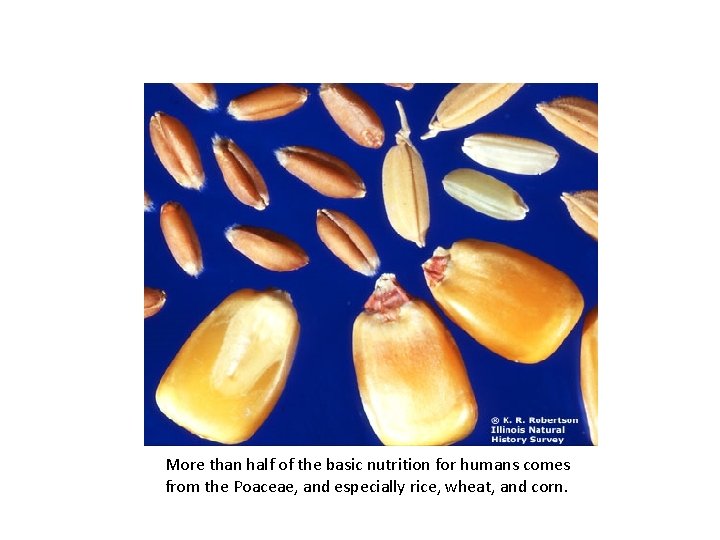
More than half of the basic nutrition for humans comes from the Poaceae, and especially rice, wheat, and corn.
Order Liliflorae • . It is recognized by 3 -merous flowers with the perianth not differentiated into calyx and corolla. The androecium consists of three or six stamens. The ovary is composed of three united carpels. The seed is endospermic.
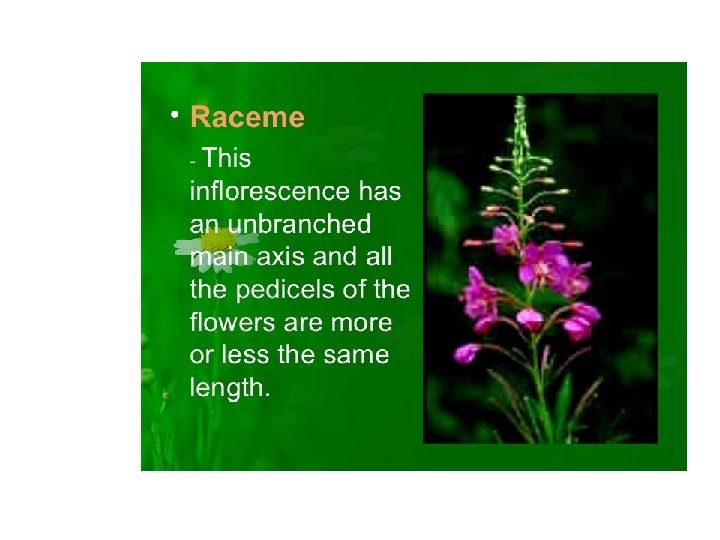
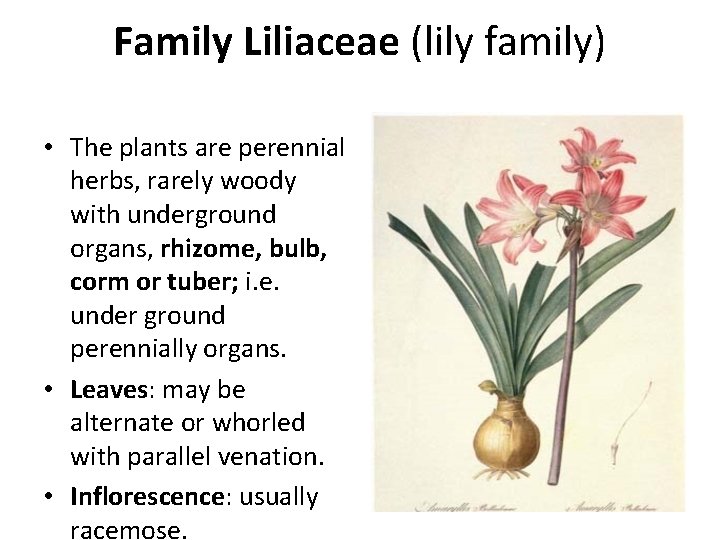
Family Liliaceae (lily family) • The plants are perennial herbs, rarely woody with underground organs, rhizome, bulb, corm or tuber; i. e. under ground perennially organs. • Leaves: may be alternate or whorled with parallel venation. • Inflorescence: usually racemose.
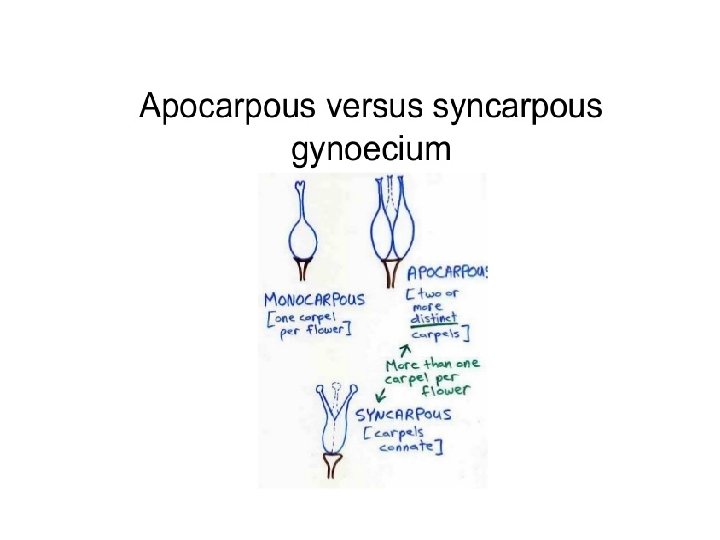
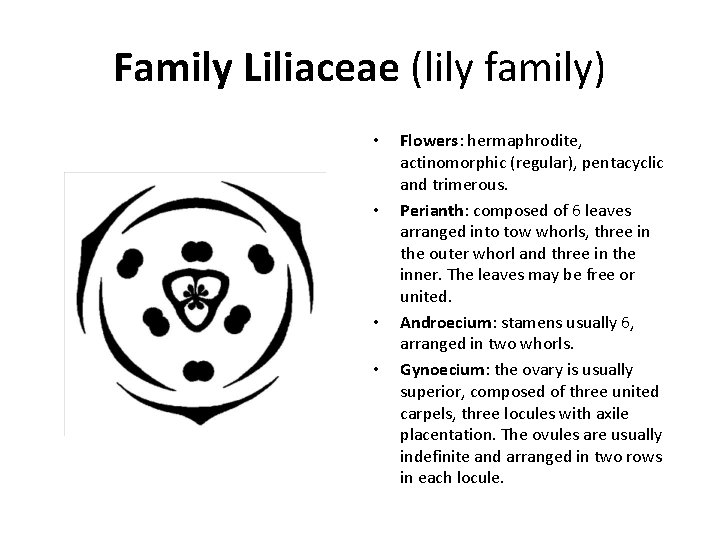
Family Liliaceae (lily family) • • Flowers: hermaphrodite, actinomorphic (regular), pentacyclic and trimerous. Perianth: composed of 6 leaves arranged into tow whorls, three in the outer whorl and three in the inner. The leaves may be free or united. Androecium: stamens usually 6, arranged in two whorls. Gynoecium: the ovary is usually superior, composed of three united carpels, three locules with axile placentation. The ovules are usually indefinite and arranged in two rows in each locule.
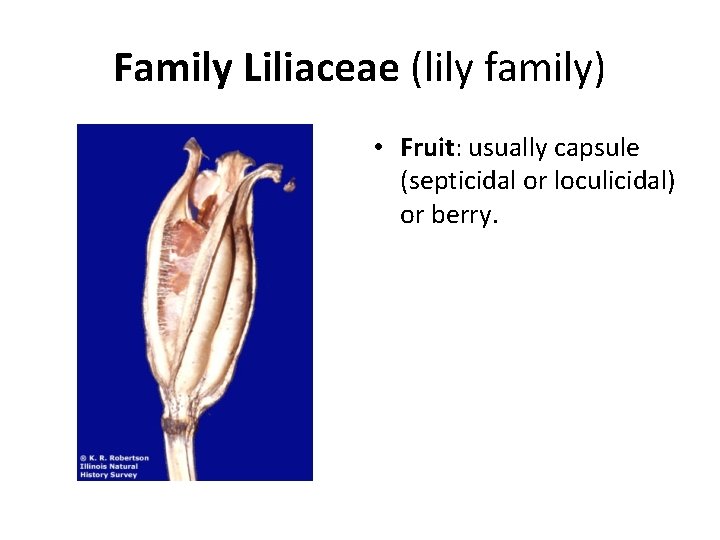
Family Liliaceae (lily family) • Fruit: usually capsule (septicidal or loculicidal) or berry.
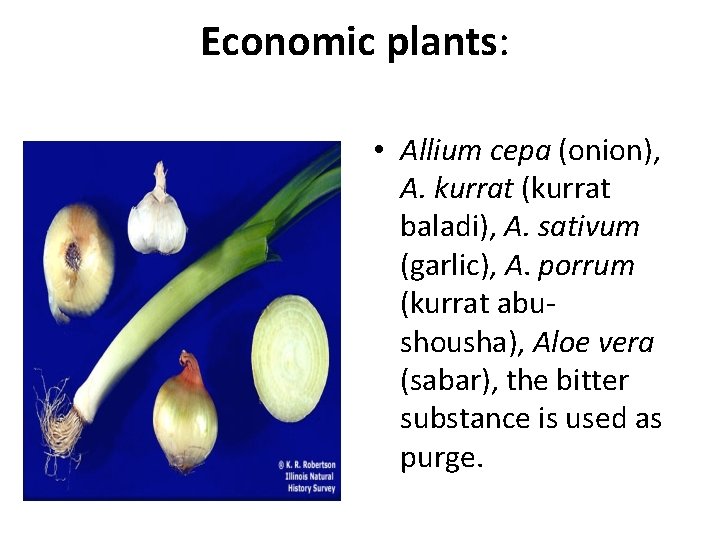
Economic plants: • Allium cepa (onion), A. kurrat (kurrat baladi), A. sativum (garlic), A. porrum (kurrat abu- shousha), Aloe vera (sabar), the bitter substance is used as purge.
Class " 2 ": Dicotyledoneae subclass: Choripetalae
Order centrospermae Family Chenopodiaceae
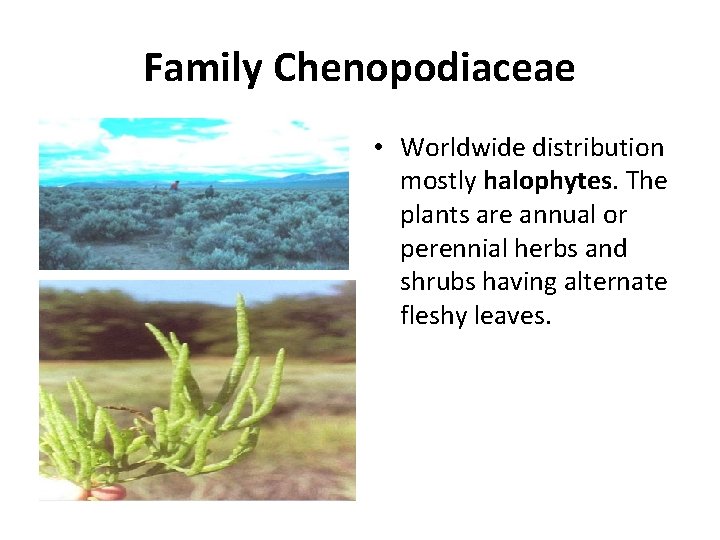
Family Chenopodiaceae • Worldwide distribution mostly halophytes. The plants are annual or perennial herbs and shrubs having alternate fleshy leaves.
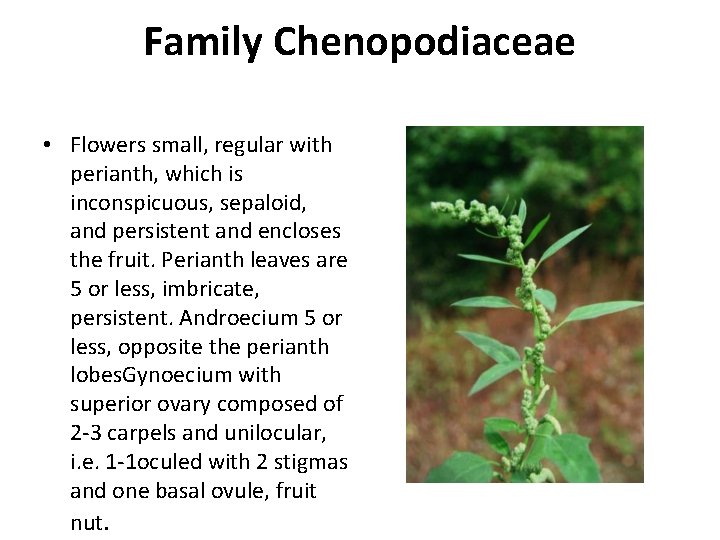
Family Chenopodiaceae • Flowers small, regular with perianth, which is inconspicuous, sepaloid, and persistent and encloses the fruit. Perianth leaves are 5 or less, imbricate, persistent. Androecium 5 or less, opposite the perianth lobes. Gynoecium with superior ovary composed of 2 -3 carpels and unilocular, i. e. 1 -1 oculed with 2 stigmas and one basal ovule, fruit nut.
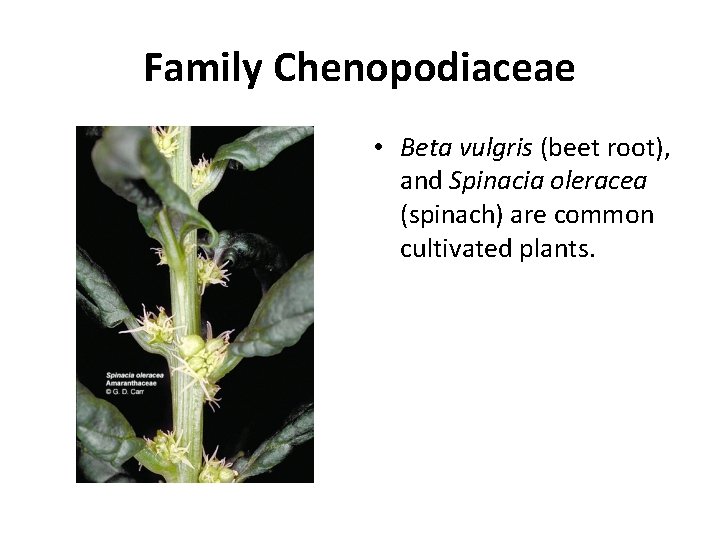
Family Chenopodiaceae • Beta vulgris (beet root), and Spinacia oleracea (spinach) are common cultivated plants.
Family Chenopodiaceae • In Egypt: Chenopodium murale: leaves greenish, triangular, and sharply dentate. Chenopodium album: leaves whitish mealy, almost entire. • Chenopodium ambrosioides: with a characteristic foetid smell, oil extracted from it is used in the treatment of anclystoma. Salsola fruitcosa, suaeda spp. , Halocnemon strobilacaeum, Arthrocnemon glaucum. . . etc. are common salt marsh plants. Haloxylon salicornicum, Haloxylon articulatum, Anabasis articulata. . . etc. are common desert plants.