
Plant Systems Knowledge Organiser Active transport Diffusion Organ
- Slides: 1
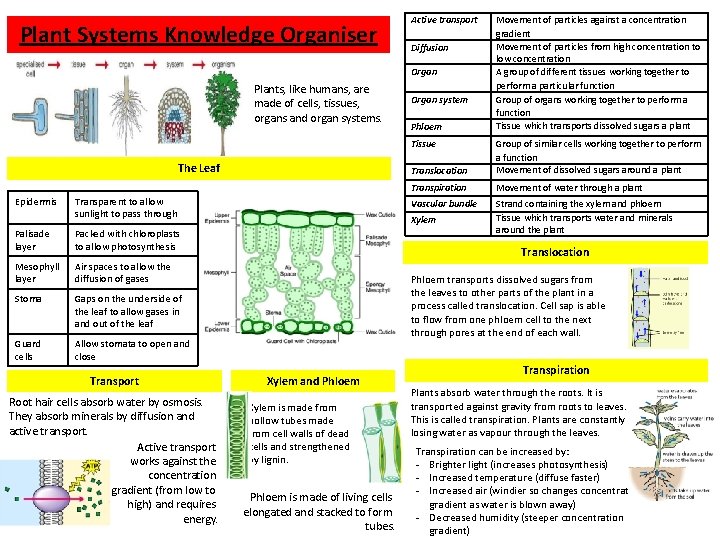
Plant Systems Knowledge Organiser Active transport Diffusion Organ Plants, like humans, are made of cells, tissues, organs and organ systems. Organ system Phloem Tissue The Leaf Epidermis Transparent to allow sunlight to pass through Palisade layer Packed with chloroplasts to allow photosynthesis Mesophyll layer Air spaces to allow the diffusion of gases Stoma Gaps on the underside of the leaf to allow gases in and out of the leaf Guard cells Allow stomata to open and close Transport Root hair cells absorb water by osmosis. They absorb minerals by diffusion and active transport. Active transport works against the concentration gradient (from low to high) and requires energy. Movement of particles against a concentration gradient Movement of particles from high concentration to low concentration A group of different tissues working together to perform a particular function Group of organs working together to perform a function Tissue which transports dissolved sugars a plant Translocation Group of similar cells working together to perform a function Movement of dissolved sugars around a plant Transpiration Movement of water through a plant Vascular bundle Strand containing the xylem and phloem Tissue which transports water and minerals around the plant Xylem Translocation Phloem transports dissolved sugars from the leaves to other parts of the plant in a process called translocation. Cell sap is able to flow from one phloem cell to the next through pores at the end of each wall. Xylem and Phloem Xylem is made from hollow tubes made from cell walls of dead cells and strengthened by lignin. Phloem is made of living cells elongated and stacked to form tubes. Transpiration Plants absorb water through the roots. It is transported against gravity from roots to leaves. This is called transpiration. Plants are constantly losing water as vapour through the leaves. Transpiration can be increased by: - Brighter light (increases photosynthesis) - Increased temperature (diffuse faster) - Increased air (windier so changes concentration gradient as water is blown away) - Decreased humidity (steeper concentration gradient)