
Plant Structure Reproduction and Development Angiosperms Cotyledons embryonic
Plant Structure, Reproduction, and Development
Angiosperms • • Cotyledons – embryonic leaves Monocot – one embryonic leaf Dicot – two embryonic leaves Differences between Monocots & Dicots – – Veins are parallel /branched Vascular bundles complex /ring Leaves arranged in multiples of 3 /multiples of 4 or 5 Fibrous roots /taproot

SEED LEAVES LEAF VEINS STEMS FLOWERS ROOTS MONOCOTS One cotyledon Main veins usually parallel Vascular bundles in complex arrangement Floral parts usually in multiples of three Fibrous root system DICOTS Two cotyledons Main veins usually branched Vascular bundles arranged in ring Floral parts usually in Taproot multiples of four or five usually present Figure 31. 2
Angiosperms • Most angiosperms are dicots • This group includes shrubs, trees (except conifers), and many of our food crops • Monocots include orchids, bamboos, palms, lilies, and grains and grasses.
Plant Body • Root system – anchors the plant into the soil – Roots have root hairs – outgrowth of epidermal cells – Shoot system – part of plant above ground stems – support leaves and grounded nodes – points where leaved are attached leaves – main site of photosynthesis terminal bud – node at tip of plant; responsible for growth lengthwise; apical dominance (inhibits growth of axillary buds) axillary buds – located in angles formed by the leaf; usually dormant; causes the plant to

Terminal bud Leaf Blade Flower Petiole Axillary bud SHOOT SYSTEM Stem Node Internode Taproot ROOT SYSTEM Root hairs Figure 31. 3
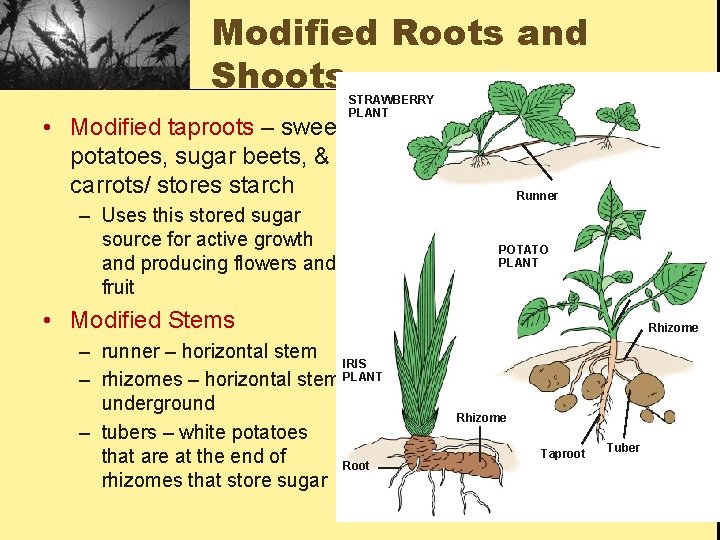
Modified Roots and Shoots • Modified taproots – sweet potatoes, sugar beets, & carrots/ stores starch STRAWBERRY PLANT – Uses this stored sugar source for active growth and producing flowers and fruit Runner POTATO PLANT • Modified Stems – runner – horizontal stem IRIS – rhizomes – horizontal stem PLANT underground – tubers – white potatoes that are at the end of Root rhizomes that store sugar Rhizome Taproot Tuber

Modified Roots and Shoots • Modified leaves – – Grasses have no petioles Celery have enormous petioles that we eat Tendrils have coiled tips which aid in climbing Cactus have spines
Plant Tissue Systems • Epidermis – Covers and protects – First line of defense – Cuticle is the waxy substance that helps plants to retain water • Vascular System – xylem/phloem – transports water and nutrients – support
Plant Tissue System • Ground Tissue System – Filling spaces, bulk – Parenchyma, collenchyma, sclerenchyma – Photosynthesis, storage, support
Plant Tissue System • Roots – Epidermis • • Covers roots Entrance for water and nutrients May form root hairs No cuticle – Ground tissue • Cortex – parenchyma, store food • Endodermis – selective barrier, thin layer of cells decides what passes between vascular tissue and cortex – Vascular Bundles • xylem – spokes of wheel • phloem – fills in wedges between spokes
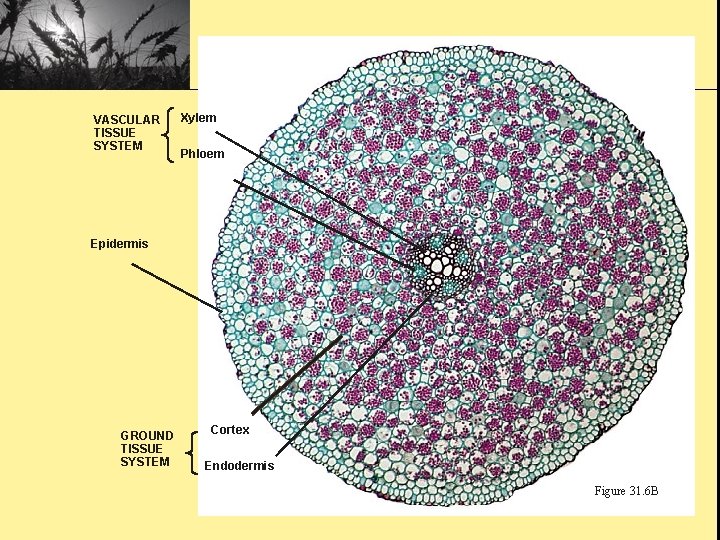
VASCULAR TISSUE SYSTEM Xylem Phloem Epidermis GROUND TISSUE SYSTEM Cortex Endodermis Figure 31. 6 B
Plant Tissue System • Leaf – Epidermis • Covered by cuticle • Small pores called stomata • Surrounded by guard cells – Ground Tissue • Mesophyll composed of parenchyma cells and chloroplast • Air located in spaces between cells – Vascular System • Vein – composed of xylem and phloem surrounded by parenchyma cells
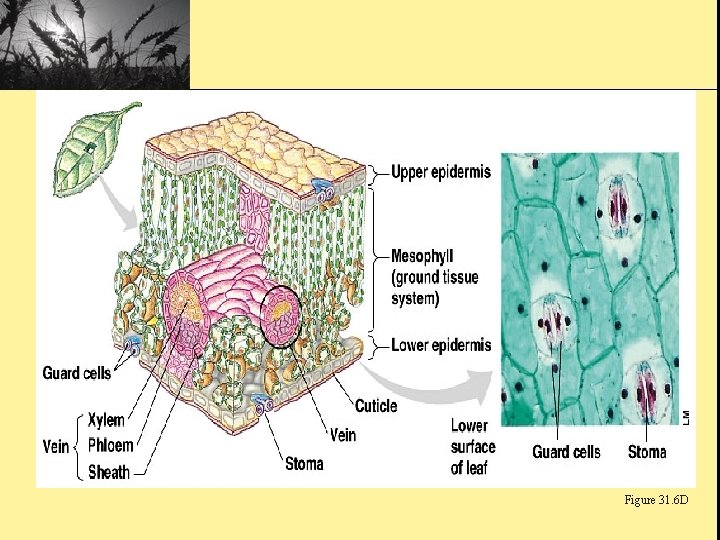
Figure 31. 6 D
Plant Tissue System • Stem – Epidermis • Thin layer of cells • Covered by cuticle – Ground Tissue • Dicot - 2 parts / Monocot – 1 part (ground tissue) – Pith – food storage – Cortex – fills spaces – Vascular Tissue • Occurs in vascular bundles – Dicot – ring – Monocot - random
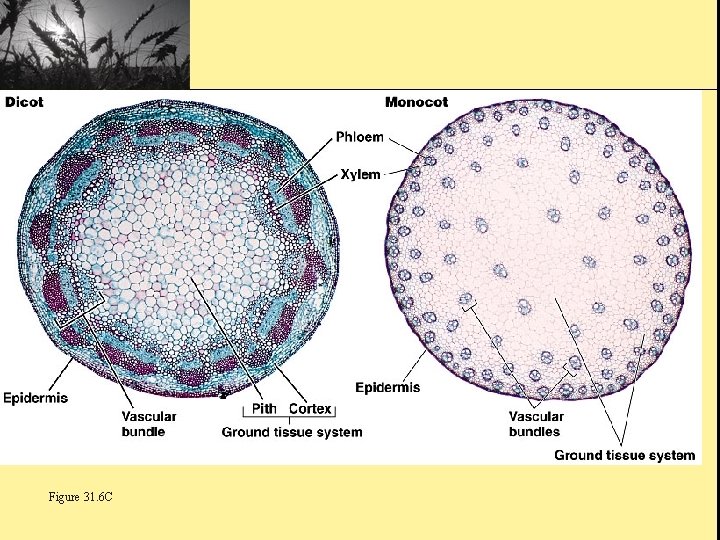
Figure 31. 6 C
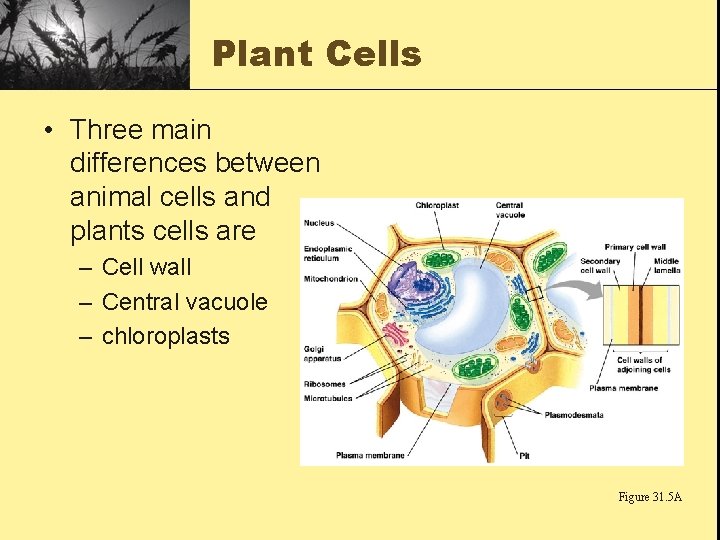
Plant Cells • Three main differences between animal cells and plants cells are – Cell wall – Central vacuole – chloroplasts Figure 31. 5 A
Plant Cells Five Major Types of Plant Cells 1. Parenchyma cells – most abundant type • • 2. Remain alive at maturity Primary cell wall (thin) Function in food storage and photosynthesis Multisided Collenchyma cells primary cell wall (thick) alive at maturity provide support in plants that are still growing
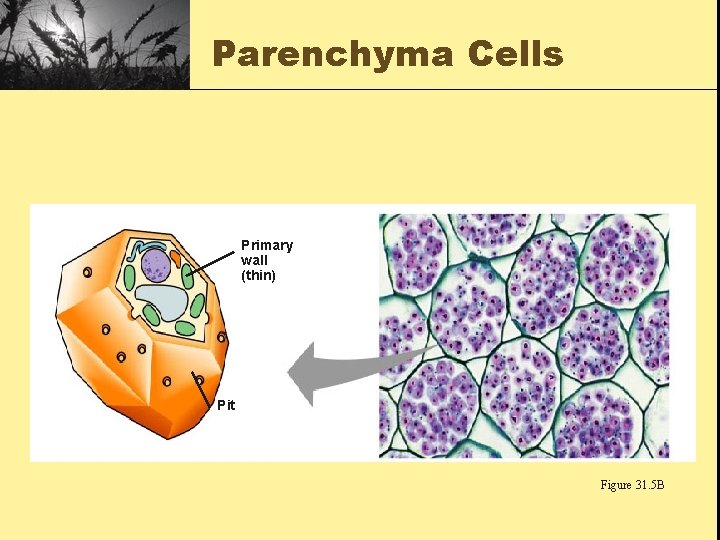
Parenchyma Cells Primary wall (thin) Pit Figure 31. 5 B
Plant Cells 3. Sclerenchyma cells – – – Rigid secondary walls Hardened with lignin Found in regions that is not growing Dead at maturity Two types of sclerenchyma cells • Fiber – long and slender and occurs in bundles; hemp fibers make rope • Sclereid – stone cell; short, irregular shaped secondary wall; found in nutshells and sead-coats
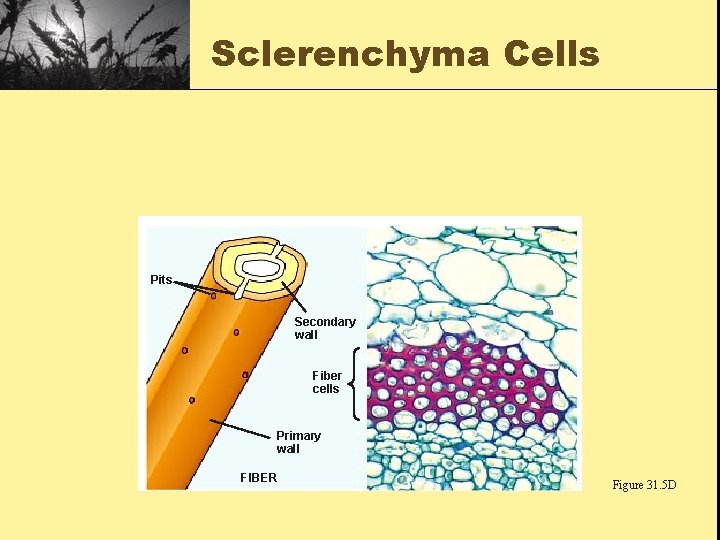
Sclerenchyma Cells Pits Secondary wall Fiber cells Primary wall FIBER Figure 31. 5 D
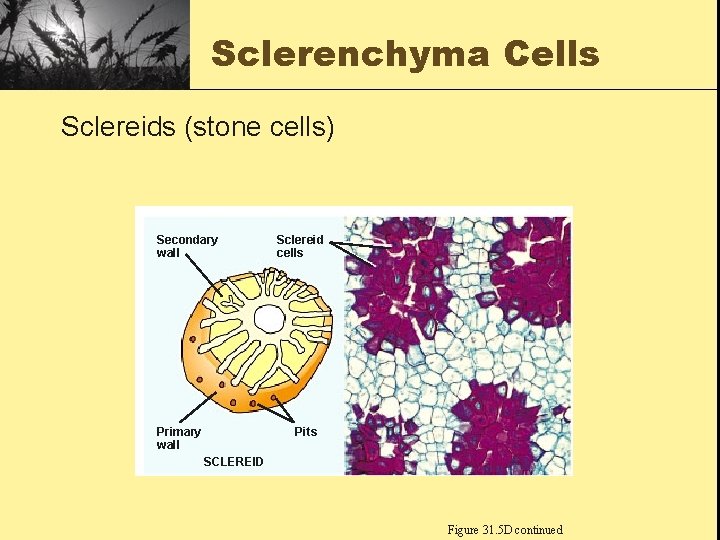
Sclerenchyma Cells Sclereids (stone cells) Secondary wall Primary wall Sclereid cells Pits SCLEREID Figure 31. 5 D continued
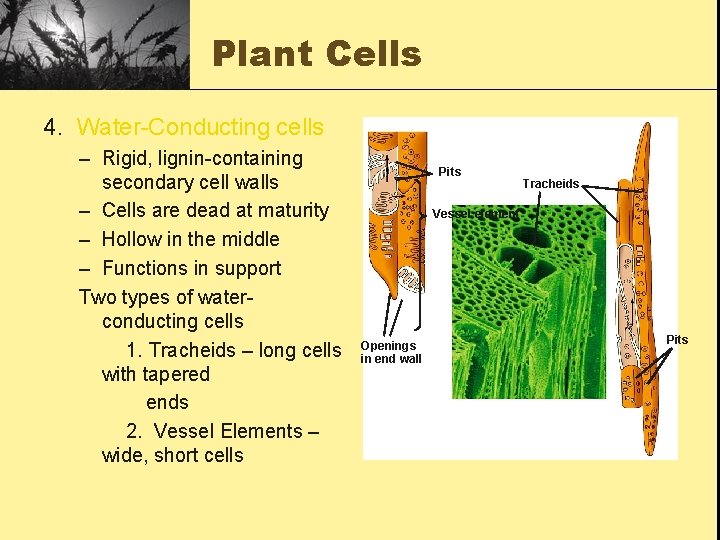
Plant Cells 4. Water-Conducting cells – Rigid, lignin-containing secondary cell walls – Cells are dead at maturity – Hollow in the middle – Functions in support Two types of waterconducting cells 1. Tracheids – long cells with tapered ends 2. Vessel Elements – wide, short cells Pits Tracheids Vessel element Openings in end wall Pits
Plant Cells 5. Food – Conducting cells (sieve tube members) -arranged end to end - thin primary walls with no secondary wall -alive at maturity -transports sugars and minerals -sieve plates – located at the ends of the sieve tube members

Sieve Tube Members Sieve plate Companion cell Cytoplasm Primary wall
Primary Growth • Indeterminate growth – continue to grow as long as they live – Annuals – wheat, corn, rice – Biennials – beets, carrots – Perennials – trees, shrubs, grasses
Primary Growth • Apical meristem – lengthwise growth • Root cap – protects apical meristem in roots • Two functions of root apical meristem – Replaces cells of root cap – Produces cells for primary growth
Primary Growth • Three regions of roots – Epidermis (outermost) – Cortex (bulk) – Vascular tissue • Elongation – uptake of water – cellulose fibers extend (accordion) – forces roots into soil • Differentiation – caused by master gene; causes unspecialized cells to specialize
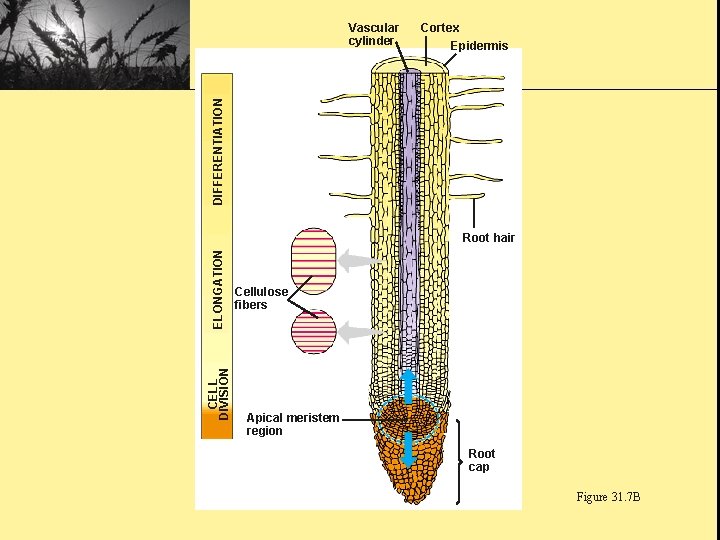
Cortex Epidermis DIFFERENTIATION Vascular cylinder CELL DIVISION ELONGATION Root hair Cellulose fibers Apical meristem region Root cap Figure 31. 7 B
Primary Growth • Three Zones – Cell division – Elongation – Differentiation
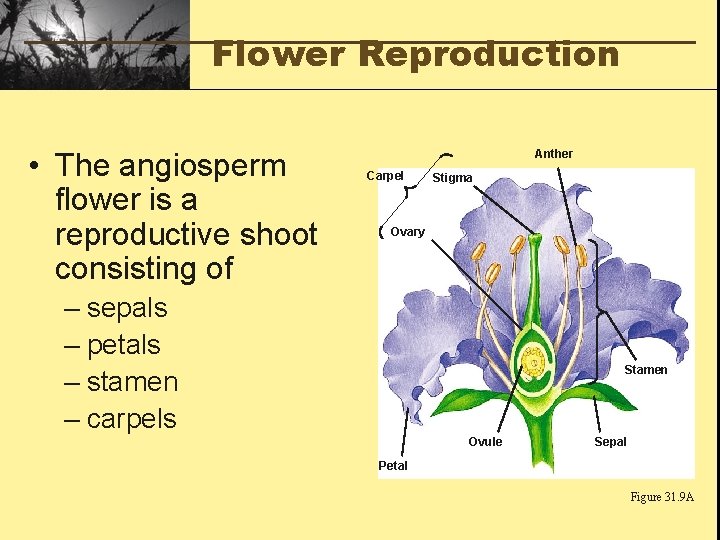
Flower Reproduction • The angiosperm flower is a reproductive shoot consisting of Anther Carpel Stigma Ovary – sepals – petals – stamen – carpels Stamen Ovule Sepal Petal Figure 31. 9 A
Fertilization of an Angiosperm • Formation of a pollen grain – Cells that make pollen grains are located in the anther – Meiosis- four haploid spores that eventually form two haploid cells called a tube cell and a generative cell – Wall forms around the two cells known as a pollen grain – Animals, wind, and water transport pollen grain (male gametophyte)
Fertilization of an Angiosperm • Formation of an Egg Cell – Megaspore mother cell – forms 4 haploid megaspores and three degenerate – Surviving megaspore enlarges/ mitotic division – End Result – One large cell with two haploid nuclei and six smaller cells. – One of the six smaller cells is the haploid egg.
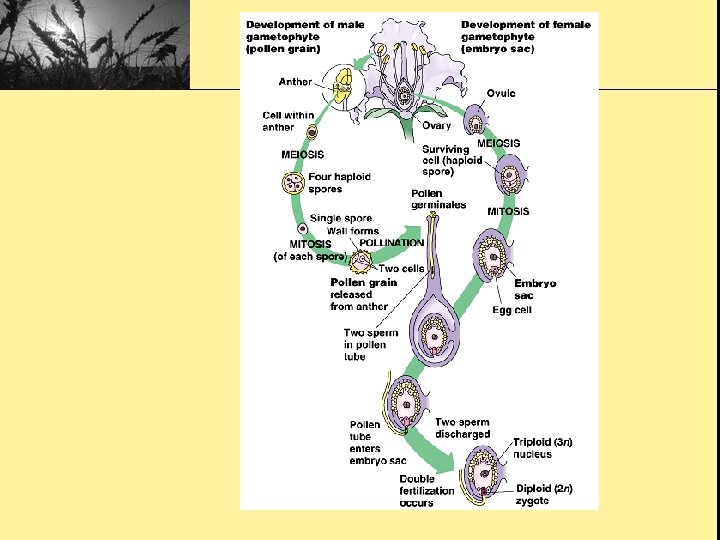
Pollination Sugar/enzymes on stigma causes tube cell to grow and form pollen tube • Both cells (generative cell and tube cell) travel to embryo sac • Generative cell forms two sperm cells • One sperm cell fertilizes the nucleus with the polar nuclei (triploid nucleus/3 n)
Pollination • One sperm cell fertilizes egg cell (diploid nucleus/2 n) • Triploid forms endosperm/functions to nourish embryo (popcorn) • Flowering plants (double fertilization) • Alternation of generations – Haploid – female gametophytes (ovules/egg), male gametophytes (generative cell/sperm) – Diploid – sporophyte (plant/flower); produces haploid spores by meiosis
- Slides: 36