
Plant Structure plant organs 1 Roots 2 Stems

- Slides: 62
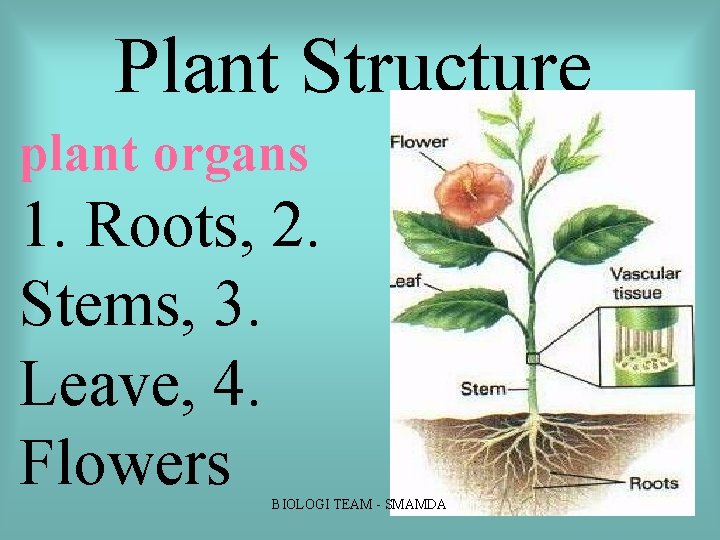
Plant Structure plant organs 1. Roots, 2. Stems, 3. Leave, 4. Flowers BIOLOGI TEAM SMAMDA
Roots: A root is an organ that attaches a plant to the ground and collects water and minerals from the soil. Most roots are important food storage organs too. BIOLOGI TEAM SMAMDA
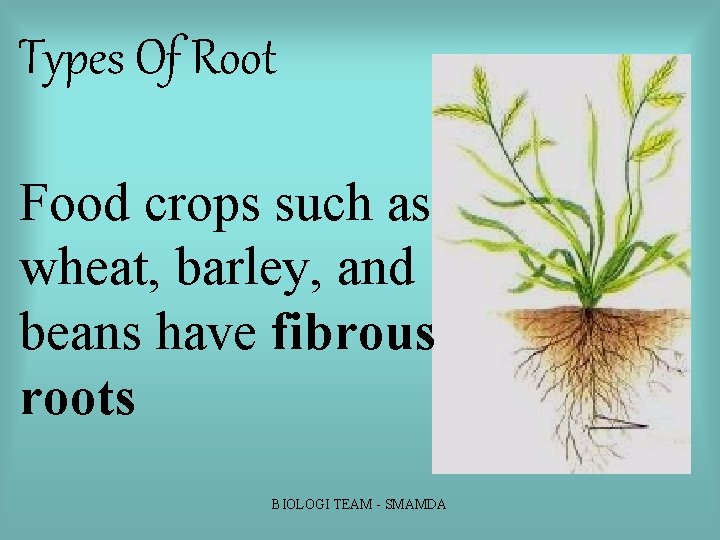
Types Of Root Food crops such as wheat, barley, and beans have fibrous roots BIOLOGI TEAM SMAMDA
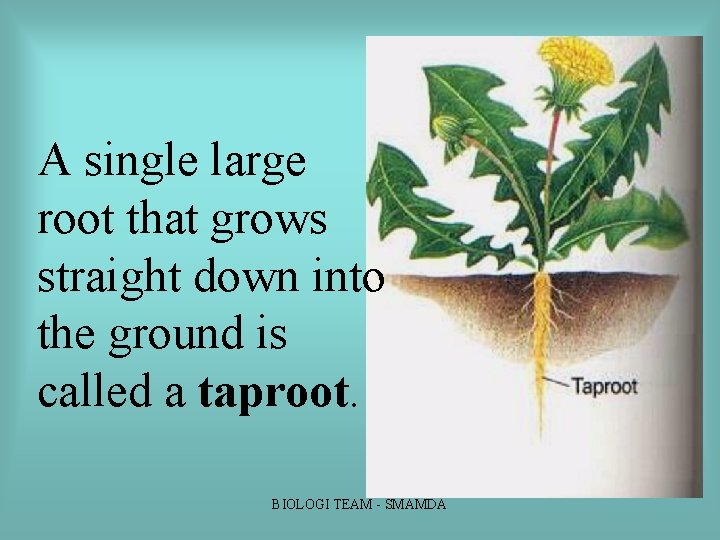
A single large root that grows straight down into the ground is called a taproot. BIOLOGI TEAM SMAMDA
The taproots of many plants store large quantities of food. Beets and turnips are two examples. Can you think of others? BIOLOGI TEAM SMAMDA
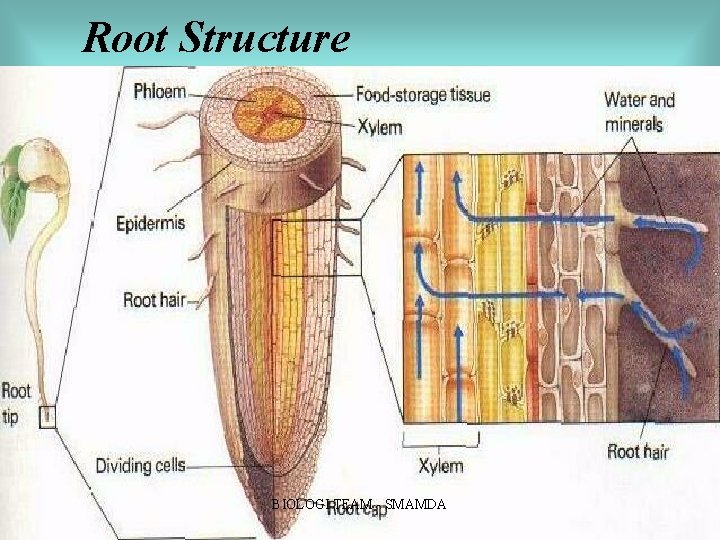
Root Structure BIOLOGI TEAM SMAMDA
BIOLOGI TEAM SMAMDA
BIOLOGI TEAM SMAMDA
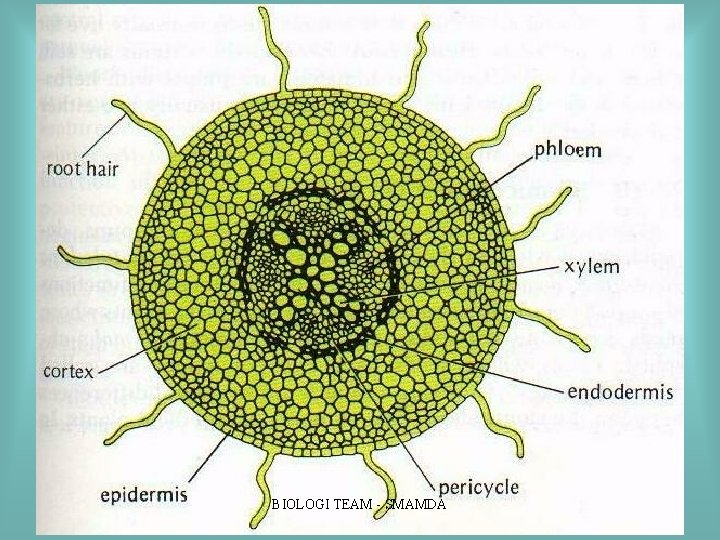
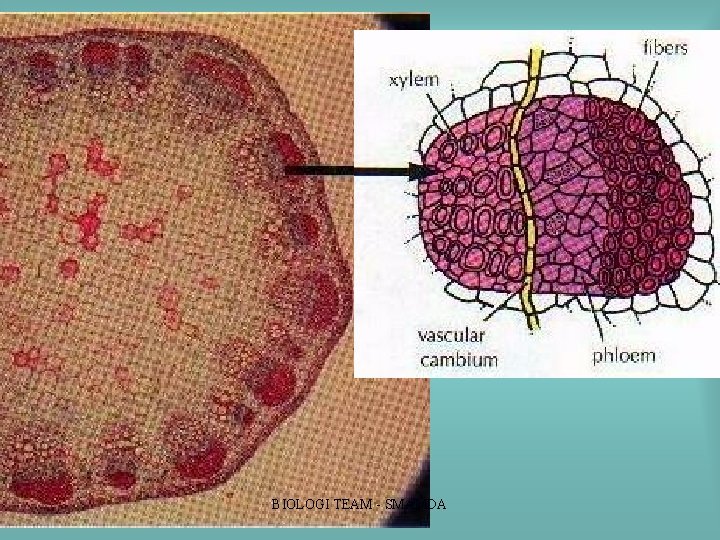
Vascular tissue is made of two kinds of cells. One kind of cell, called phloem, carries food from one part of a plant to another. . BIOLOGI TEAM SMAMDA
Food produced in the leaves of the plant travels down to the root through phloem BIOLOGI TEAM SMAMDA
Xylem carries water and dissolved minerals upward from the roots to the stem and leaves. BIOLOGI TEAM SMAMDA
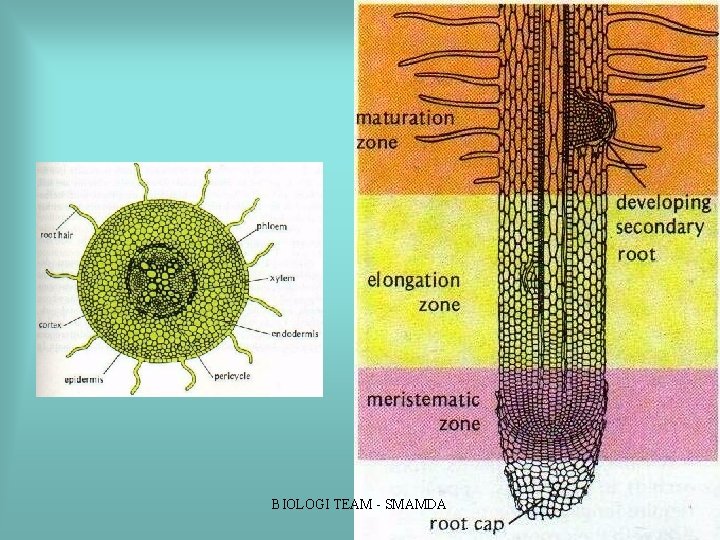
Root Growth A root grows longer at its tip. The root cap protects the growing tip as it pushes through the soil. Dividing cells behind the root cap produce new cells BIOLOGI TEAM SMAMDA
Stems The tree trunk is actually a stem, an organ that transports food, water, and minerals between the roots and leaves of a plant. A stem also supports the leaves and holds them up to the light. BIOLOGI TEAM SMAMDA
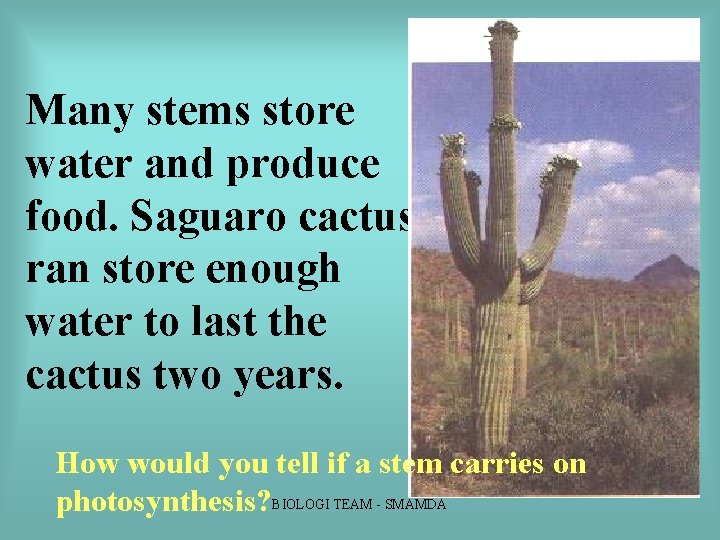
Many stems store water and produce food. Saguaro cactus ran store enough water to last the cactus two years. How would you tell if a stem carries on photosynthesis? BIOLOGI TEAM SMAMDA
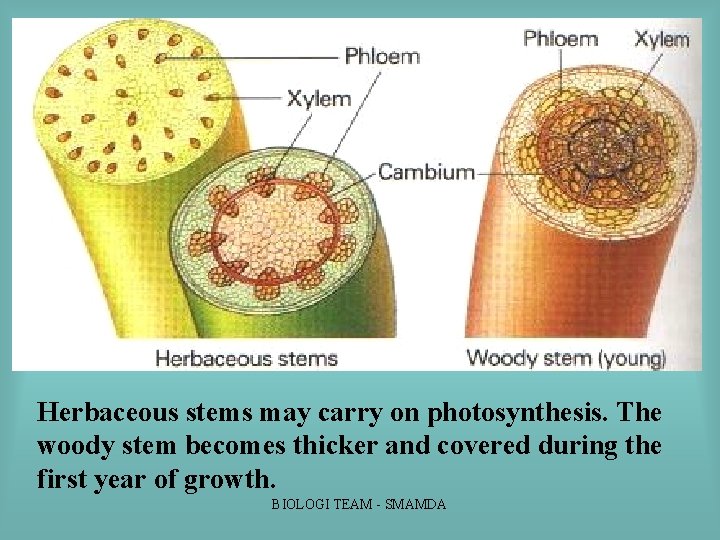
Stem Structure Two are types Stem herbaceous stem is soft, green, and flexible. Plants with herbaceous stems usually live one or two years. BIOLOGI TEAM SMAMDA
Grasses, bean plants, and many wildflowers have herbaceous stems. BIOLOGI TEAM SMAMDA
A woody stem is hard, strong, and rigid Plants. They live for many years. Each year their stems grow wider. Most trees and shrubs have woody stems. BIOLOGI TEAM SMAMDA
Herbaceous stems may carry on photosynthesis. The woody stem becomes thicker and covered during the first year of growth. BIOLOGI TEAM SMAMDA
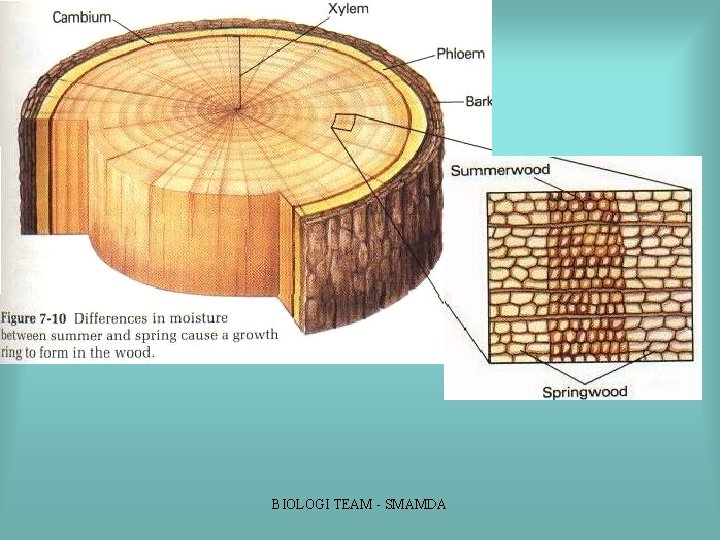
Stem Growth The cambium of woody stems causes the stem to grow wider. Each year the cambium produces a new layer of phloem cells. The new phloem cells push older phloem cells toward the outside surface of the stem. BIOLOGI TEAM SMAMDA
The cambium also produces a new layer of xylem cells each year. The new xylem cells are produced toward the inside of the stem. BIOLOGI TEAM SMAMDA
Together the growth rings form a tree's wood. The wood strengthens and supports the tree. What can you tell by counting a tree's growth rings? BIOLOGI TEAM SMAMDA
BIOLOGI TEAM SMAMDA
BIOLOGI TEAM SMAMDA
As the stem grows wider, cells of the epidermis become filled with a fatty material. These cells are soon changed into a new tissue called bark. Bark is the tough protective covering of a woody stem. BIOLOGI TEAM SMAMDA
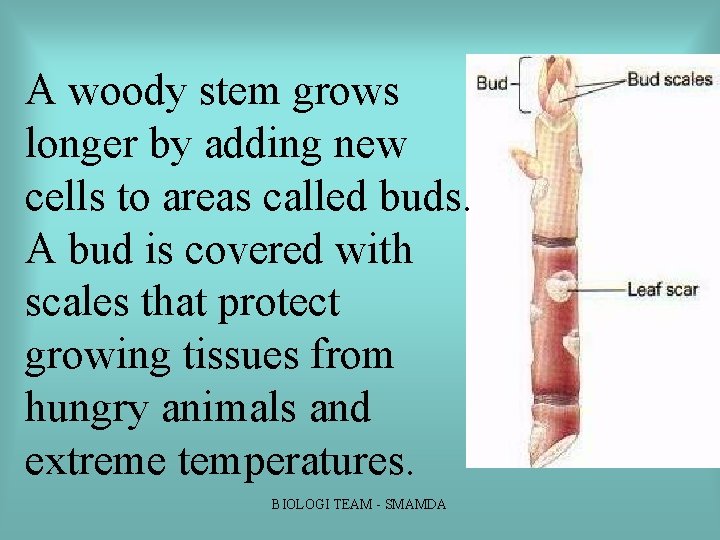
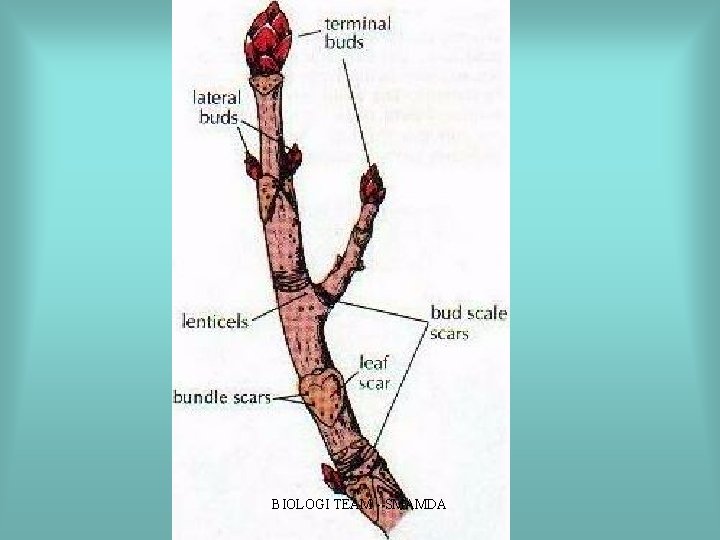
A woody stem grows longer by adding new cells to areas called buds. A bud is covered with scales that protect growing tissues from hungry animals and extreme temperatures. BIOLOGI TEAM SMAMDA
BIOLOGI TEAM SMAMDA
The tip of the stem and several young leaves are underneath the scales. In early spring, cells in the tip of the stem divide and grow longer. As the stem lengthens, the bud scales fall off, leaving a scar on the stem. Each year new buds form. BIOLOGI TEAM SMAMDA
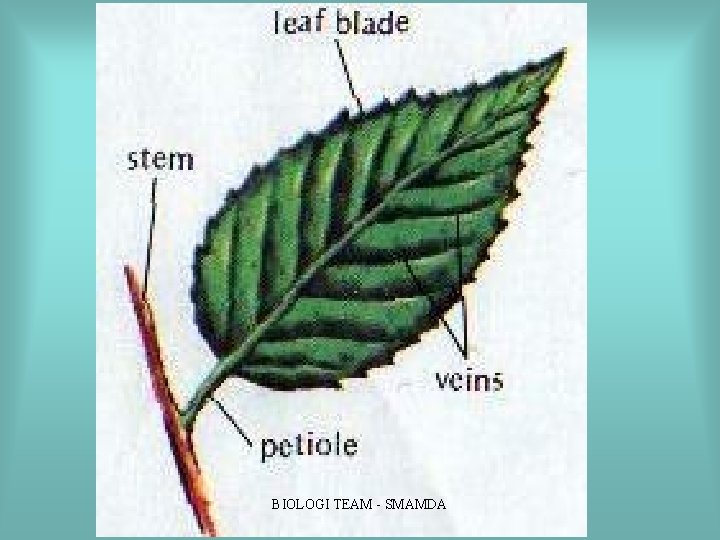
Leaves A leaf is an organ that produces food for a plant. It takes many leaves to make enough food for a large tree to live. BIOLOGI TEAM SMAMDA
BIOLOGI TEAM SMAMDA
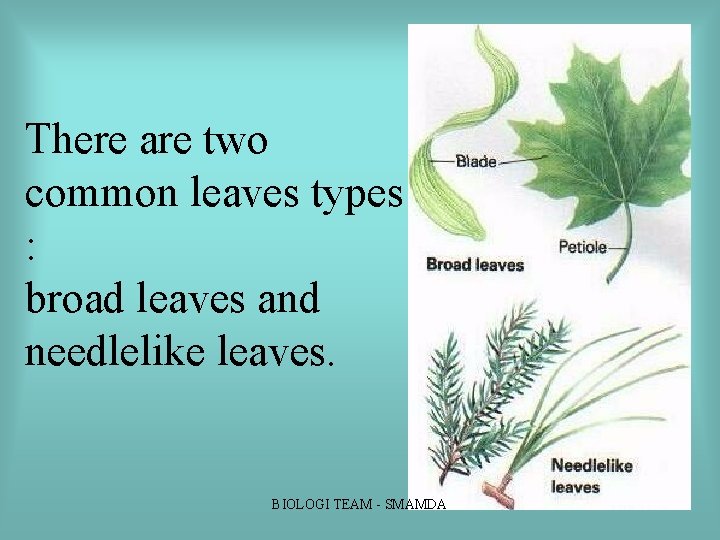
There are two common leaves types : broad leaves and needlelike leaves. BIOLOGI TEAM SMAMDA
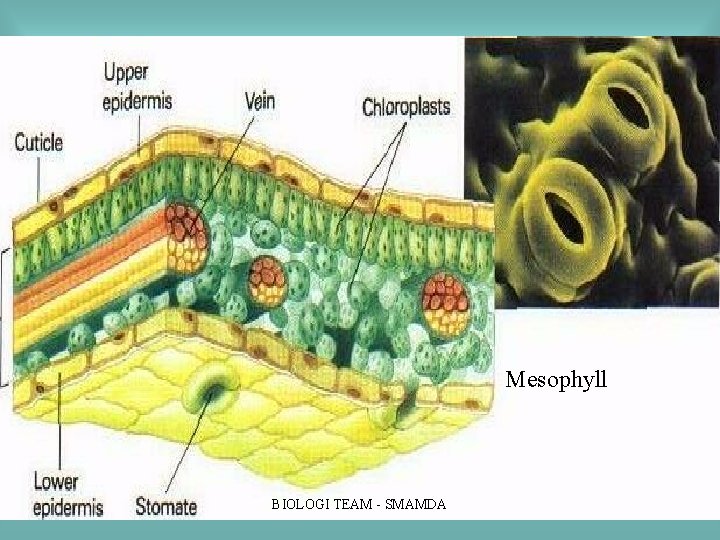
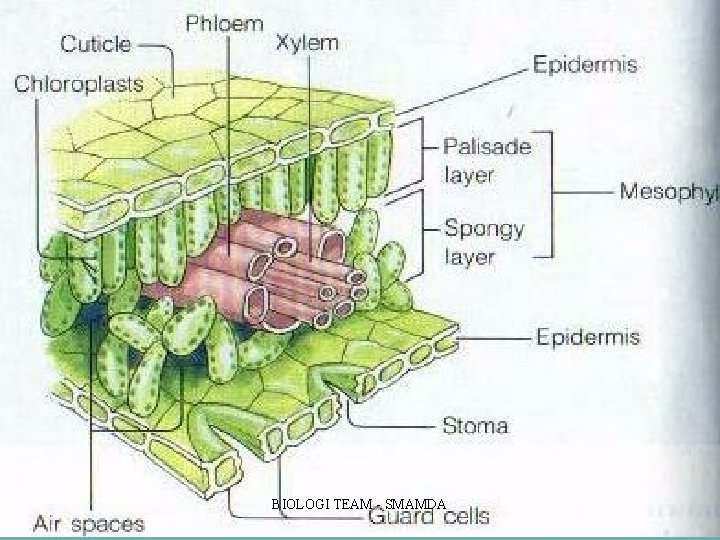
Leaf Structure Look closely at the leaf in Figure The upper and lower epidermises enclose the green part of the leaf. A leaf's epidermis is covered by a waxy cuticle that keeps the leaf from drying out. BIOLOGI TEAM SMAMDA
Mesophyll BIOLOGI TEAM SMAMDA
BIOLOGI TEAM SMAMDA
Notice that the leaf has many openings, or stomates, on its lower surface. Gases such as carbon dioxide, oxygen, and water vapor pass in and out of the leaf through these openings. Two bean shaped cells open and close each stomate. BIOLOGI TEAM SMAMDA
Between the two layers of epidermis is the middle part of the leaf called the mesophyll. The mesophyll of many leaves is arranged in two layers. The top layer contains long, narrow cells, while the bottom layer contains irregularly shaped cells and many air spaces. BIOLOGI TEAM SMAMDA
Cells in both layers are green because they contain chloroplasts contain chlorophyll, the green pigment needed for photosynthesis. BIOLOGI TEAM SMAMDA
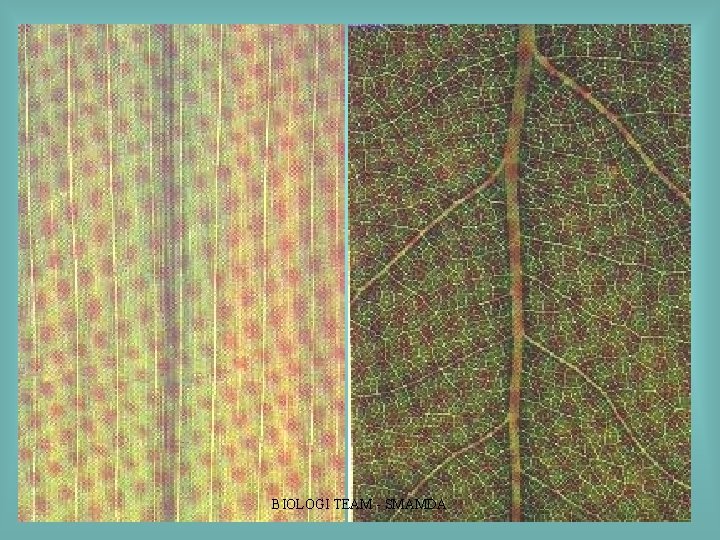
Look at the leaf blade in Figure. Notice the larger veins branch into smaller and smaller veins. A vein is actually a bundle of phloem and xylem in a leaf BIOLOGI TEAM SMAMDA
BIOLOGI TEAM SMAMDA
Lesson Review 1. What are the main functions of roots, stems, and leaves? 2. What path does water follow when it travels from the soil into the xylem of a root? BIOLOGI TEAM SMAMDA
3. Explain how growth rings are formed in a woody stem. 4. Give the function of the mesophyll, epidermis, and stomates of a leaf. 5. Explain how a Venus's flytrap catches an insect. BIOLOGI TEAM SMAMDA
Interpret and Apply 12. How could you tell the difference between herbaceous and woody stems by looking at their vascular tissue? BIOLOGI TEAM SMAMDA
Flower BIOLOGI TEAM SMAMDA
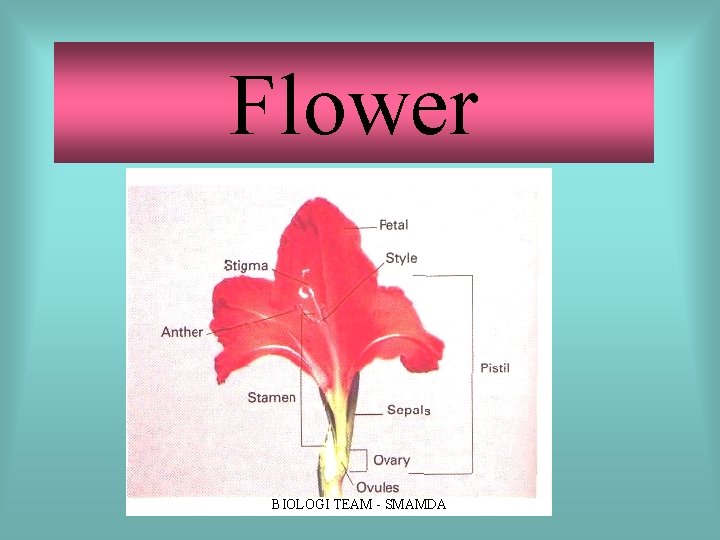
Flower Structure and Function The leaflike structures at the base of a flower are sepals. Sepals are usually green but can be other bright colors. The sepals enclose a flower before it opens. BIOLOGI TEAM SMAMDA
Inside the sepals, leaflike structure are called petals. The petals, often white or brightly colored, surround and protect the reproductive parts of a flower. They also attract insects to the flower. BIOLOGI TEAM SMAMDA
Stamen is the male reproductive part of a flower. Each stamen has a long thin stalk called a filament. The filament supports the anther. The anther is a sac at the end of a stamen that produces pollen, BIOLOGI TEAM SMAMDA
Pistil is the female reproductive part of a flower. The enlarged base of a pistil, called an ovary, contains ovules. Ovules produce eggs. The slender stalk of the pistil is called a style. The style supports the stigma, the sticky end of a pistil that collects pollen. BIOLOGI TEAM SMAMDA
Not all flowers have sepals, petals, stamens, and pistils. Grass flowers, for example, do not have sepals or petals. Corn plants produce flowers that contain only male or female reproductive parts. BIOLOGI TEAM SMAMDA
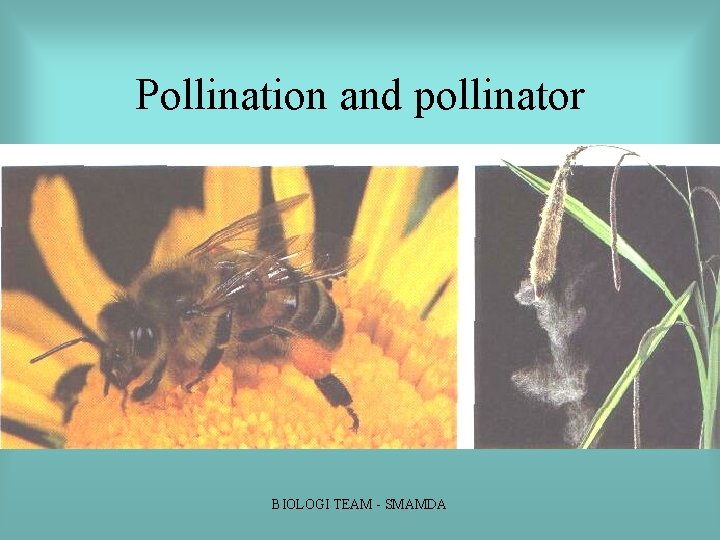
Pollination Before an angiosperm can sexually reproduce, pollination must occur. Pollination in angiosperms occurs when pollen from the male structure, or anther, is transferred to the female structure, or stigma. BIOLOGI TEAM SMAMDA
The transfer of pollen within the same plant is called selfpollination. In garden peas, pollen is transferred from an anther to a stigma in the same flower. BIOLOGI TEAM SMAMDA
The transfer of pollen from one plant to another is called crosspollination. In willows, pollen from an anther on one tree is carried to a stigma on a different tree. BIOLOGI TEAM SMAMDA
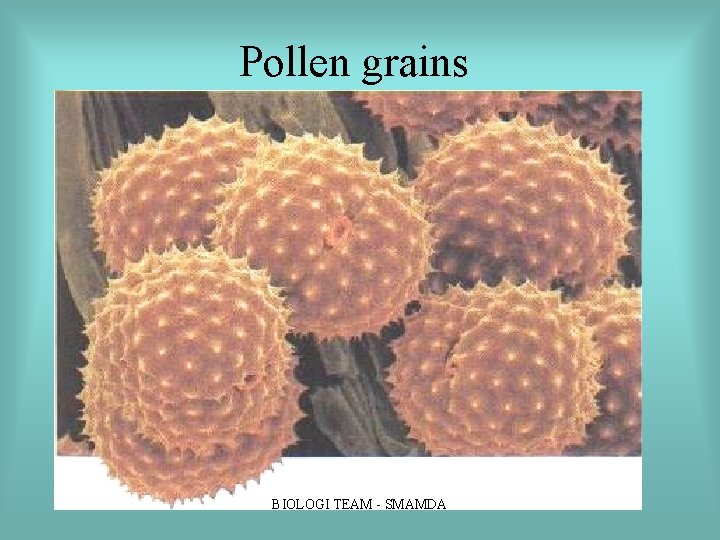
Pollen grains BIOLOGI TEAM SMAMDA
Pollination and pollinator BIOLOGI TEAM SMAMDA
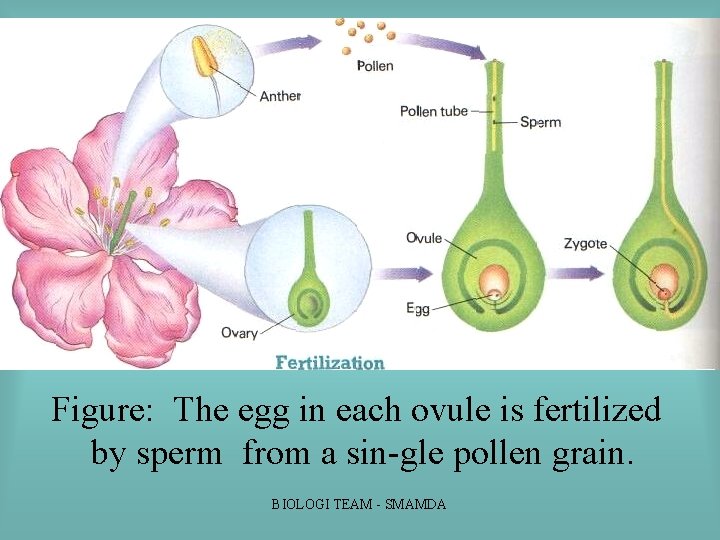
Fertilization Pollination is an important step in angiosperm reproduction. But it is not the final step. Sperm cells in the pollen must get to the egg in the ovule for fertilization to occur. BIOLOGI TEAM SMAMDA
Figure: The egg in each ovule is fertilized by sperm from a sin gle pollen grain. BIOLOGI TEAM SMAMDA
After a pollen grain reaches the stigma of a flower, chemicals on the stigma cause the pollen grain to form a tube As seen in Figure, the pollen tube grows down through the style and ovary to an ovule. BIOLOGI TEAM SMAMDA
Sperm produced by the pollen grain then travel through the pollen tube into the ovule. A sperm fertilizes an egg inside the ovule. The fertilized egg, or zygote, is the beginning of a new angiosperm. BIOLOGI TEAM SMAMDA
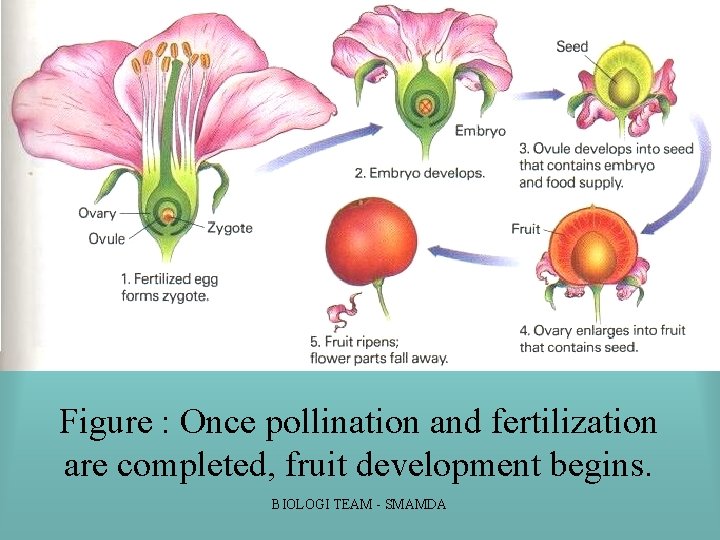
Fruits and Seeds As you know, fertilization occurs inside an ovule in the ovary of a flower. After fertilization, three changes take place in the flower. These changes are shown in BIOLOGI TEAM SMAMDA
Figure : Once pollination and fertilization are completed, fruit development begins. BIOLOGI TEAM SMAMDA
First, by the process of mitosis, the zygote grows into an embryo. Second, the ovule develops into a seed. Third, the ovary may enlarge or change color. As the ovary changes, it becomes a fruit. BIOLOGI TEAM SMAMDA
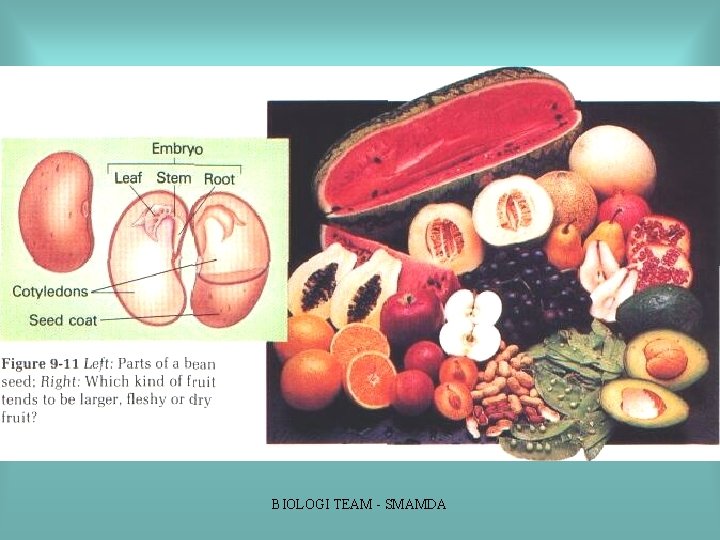
BIOLOGI TEAM SMAMDA
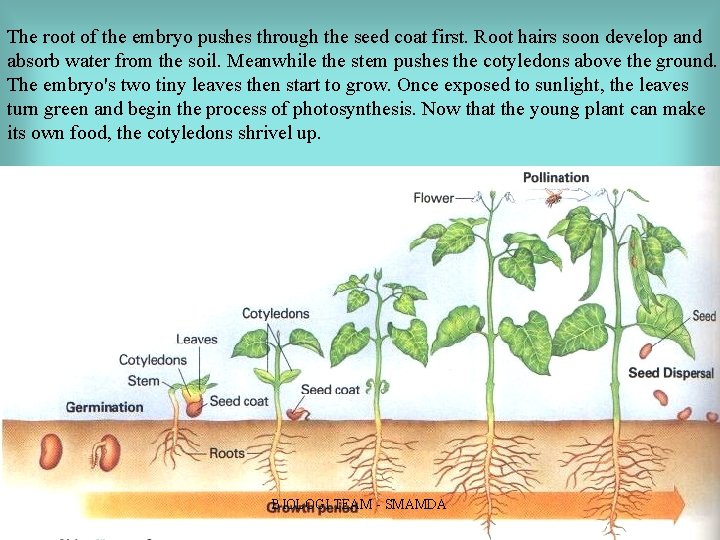
Seed Germination After a seed goes through dormancy, favorable conditions may cause it to germinate. Germination begins when water enters the seed. BIOLOGI TEAM SMAMDA
The root of the embryo pushes through the seed coat first. Root hairs soon develop and absorb water from the soil. Meanwhile the stem pushes the cotyledons above the ground. The embryo's two tiny leaves then start to grow. Once exposed to sunlight, the leaves turn green and begin the process of photosynthesis. Now that the young plant can make its own food, the cotyledons shrivel up. BIOLOGI TEAM SMAMDA