
Plant Science Draw and label plan diagrams to
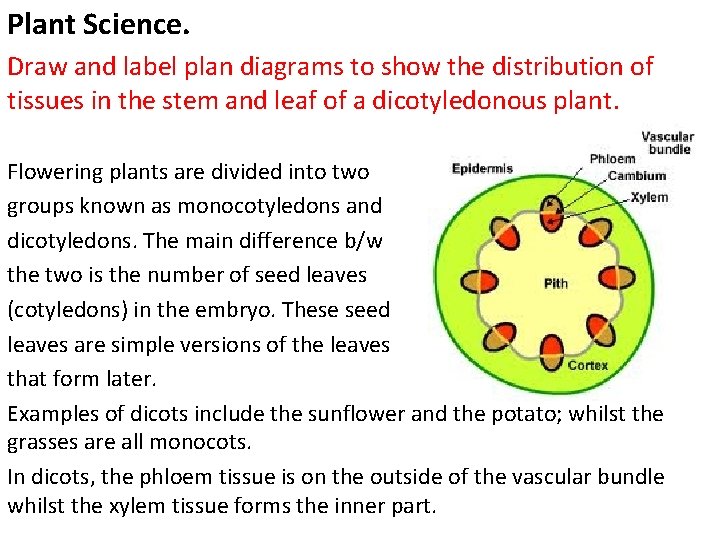
Plant Science. Draw and label plan diagrams to show the distribution of tissues in the stem and leaf of a dicotyledonous plant. Flowering plants are divided into two groups known as monocotyledons and dicotyledons. The main difference b/w the two is the number of seed leaves (cotyledons) in the embryo. These seed leaves are simple versions of the leaves that form later. Examples of dicots include the sunflower and the potato; whilst the grasses are all monocots. In dicots, the phloem tissue is on the outside of the vascular bundle whilst the xylem tissue forms the inner part.
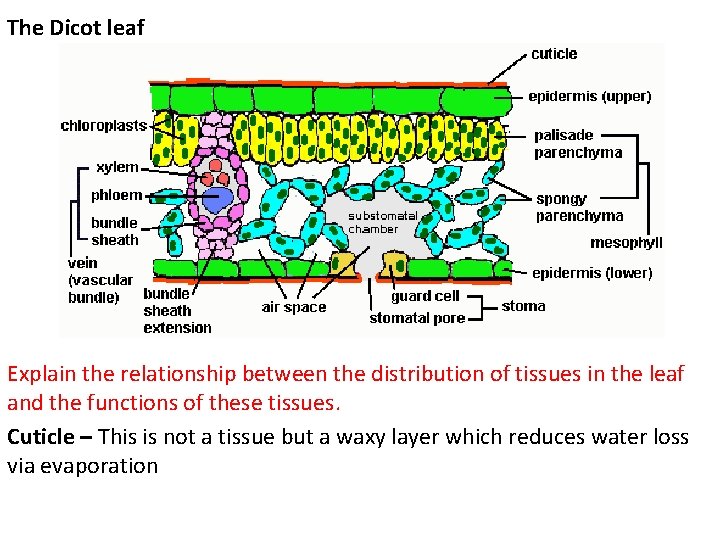
The Dicot leaf Explain the relationship between the distribution of tissues in the leaf and the functions of these tissues. Cuticle – This is not a tissue but a waxy layer which reduces water loss via evaporation
Upper epidermis – single layer of transparent cells which secretes the cuticle. Provides a barrier against infection. No gas exchange occurs here. Palisade mesophyll – Cells contain a large no. of chloroplasts to maximise photosynthesis. Spongy mesophyll – fewer chloroplasts (receives less light) and lots of air spaces. Both photosynthesis and gas exchange occur here. Lower epidermis – single layer of cells which contain stomata for gas exchange. Vascular bundle – contains xylem and phloem tissue for the transport of water, mineral ions (xylem) and sugars (phloem). Water vapour also leaves the leaf via the stomatal pores.

Outline three differences between the structures of dicotyledonous and monocotyledonous plants. Structure: Monocots: Dicots: Veins in leaf Parallel Reticulate (net like) Distribution of vascular tissue Scattered In a ring Number of cotyledons One Two Floral organs Multiples of 3 Multiples of 4 or 5 Roots Unbranched Branched Examples Grass, onion, lily, tulip Daisy, rose, trees
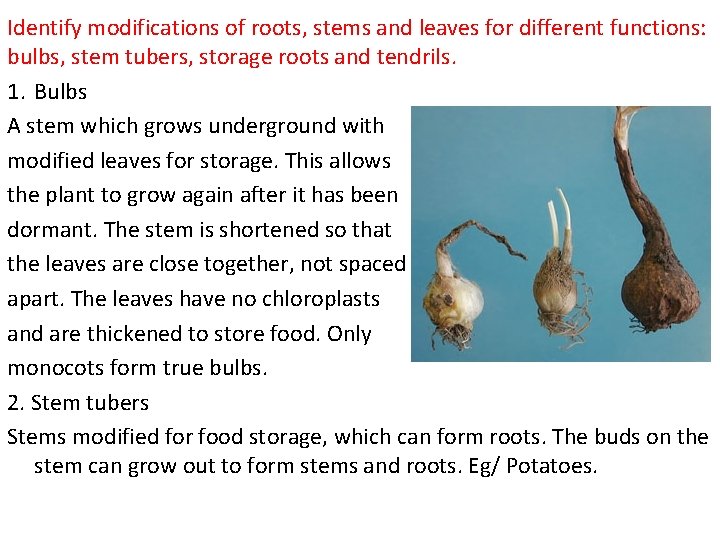
Identify modifications of roots, stems and leaves for different functions: bulbs, stem tubers, storage roots and tendrils. 1. Bulbs A stem which grows underground with modified leaves for storage. This allows the plant to grow again after it has been dormant. The stem is shortened so that the leaves are close together, not spaced apart. The leaves have no chloroplasts and are thickened to store food. Only monocots form true bulbs. 2. Stem tubers Stems modified for food storage, which can form roots. The buds on the stem can grow out to form stems and roots. Eg/ Potatoes.

3. Storage roots Roots are modified to store food or water. Eg/ Carrots. 4. Tendril A specialised leaf or stem which will attach the plant to something. When the tendril touches an object, the other side will grow faster, making it wrap around the object. Eg/ Sweet pea

State that dicotyledonous plants have apical and lateral meristems. Compare growth due to apical and lateral meristems in dicotyledonous plants. Meristem is undifferentiated tissue which generates new cells for growth. Apical meristem is found in the buds and tips of shoots and is responsible for primary growth. Primary growth produces new organs and is responsible for the basic shape of the plant. Lateral meristem is responsible for secondary growth, which makes a stem grow thicker. This includes the growth of new vascular bundles.
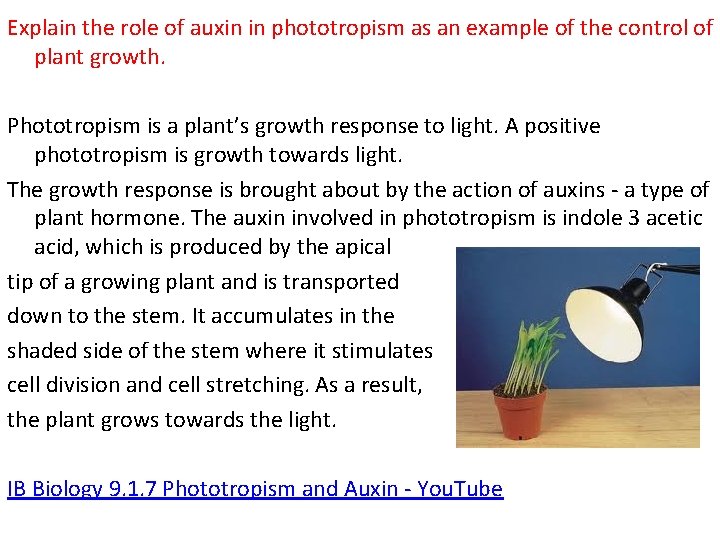
Explain the role of auxin in phototropism as an example of the control of plant growth. Phototropism is a plant’s growth response to light. A positive phototropism is growth towards light. The growth response is brought about by the action of auxins - a type of plant hormone. The auxin involved in phototropism is indole 3 acetic acid, which is produced by the apical tip of a growing plant and is transported down to the stem. It accumulates in the shaded side of the stem where it stimulates cell division and cell stretching. As a result, the plant grows towards the light. IB Biology 9. 1. 7 Phototropism and Auxin - You. Tube
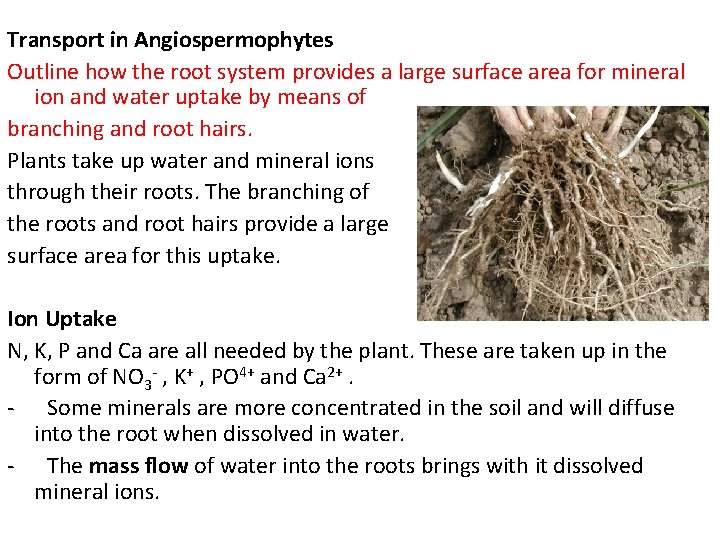
Transport in Angiospermophytes Outline how the root system provides a large surface area for mineral ion and water uptake by means of branching and root hairs. Plants take up water and mineral ions through their roots. The branching of the roots and root hairs provide a large surface area for this uptake. Ion Uptake N, K, P and Ca are all needed by the plant. These are taken up in the form of NO 3 - , K+ , PO 4+ and Ca 2+. - Some minerals are more concentrated in the soil and will diffuse into the root when dissolved in water. - The mass flow of water into the roots brings with it dissolved mineral ions.
Many plant species work symbiotically with a fungus to help absorb minerals. The hyphae of the fungus grow through the soil and absorb minerals. They also grow into the roots of the plant and pass on the ions. The fungus receives sugars from the plant. Most minerals are taken up by active transport. The concentration of most ions in the roots exceeds that of ions in the soil. Roots are able to actively pump H+ out of their own tissue and into the soil, creating an electrochemical gradient. This makes the inside of the root cells more negative and favours the movement of positively charged ions into the root. It also allows negative ions to accompany the H+ ions when they diffuse back into the root.
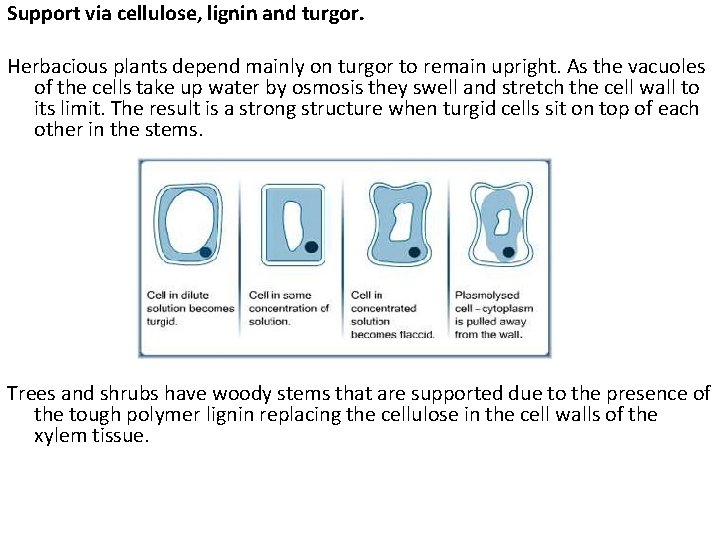
Support via cellulose, lignin and turgor. Herbacious plants depend mainly on turgor to remain upright. As the vacuoles of the cells take up water by osmosis they swell and stretch the cell wall to its limit. The result is a strong structure when turgid cells sit on top of each other in the stems. Trees and shrubs have woody stems that are supported due to the presence of the tough polymer lignin replacing the cellulose in the cell walls of the xylem tissue.
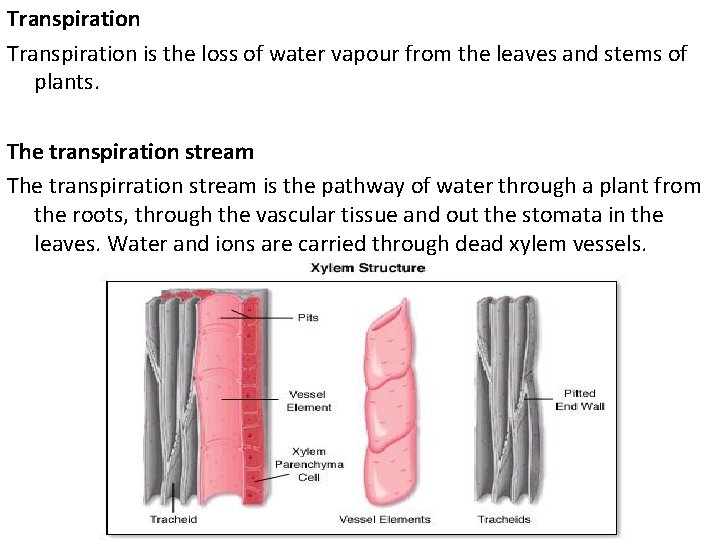
Transpiration is the loss of water vapour from the leaves and stems of plants. The transpiration stream The transpirration stream is the pathway of water through a plant from the roots, through the vascular tissue and out the stomata in the leaves. Water and ions are carried through dead xylem vessels.
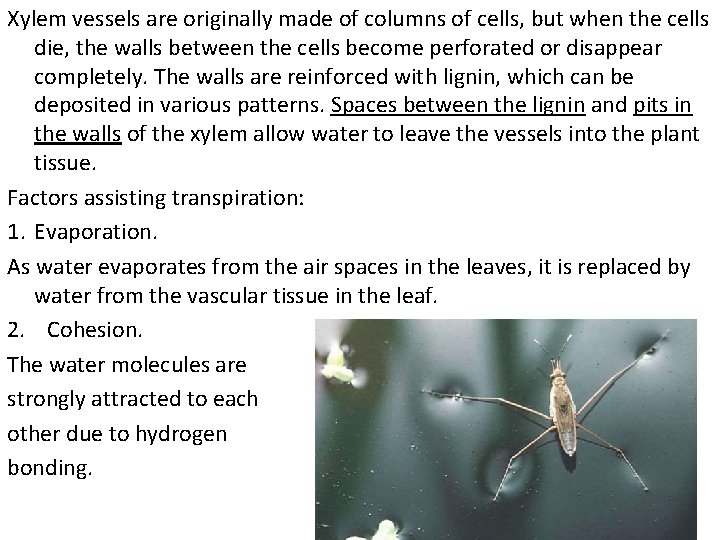
Xylem vessels are originally made of columns of cells, but when the cells die, the walls between the cells become perforated or disappear completely. The walls are reinforced with lignin, which can be deposited in various patterns. Spaces between the lignin and pits in the walls of the xylem allow water to leave the vessels into the plant tissue. Factors assisting transpiration: 1. Evaporation. As water evaporates from the air spaces in the leaves, it is replaced by water from the vascular tissue in the leaf. 2. Cohesion. The water molecules are strongly attracted to each other due to hydrogen bonding.
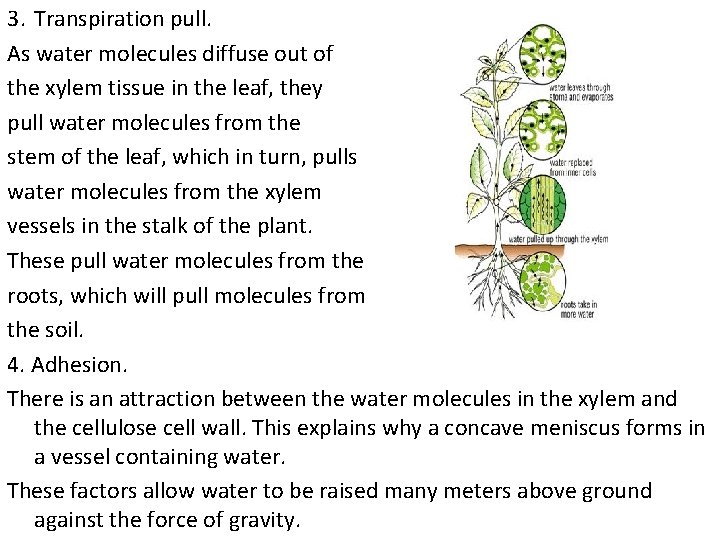
3. Transpiration pull. As water molecules diffuse out of the xylem tissue in the leaf, they pull water molecules from the stem of the leaf, which in turn, pulls water molecules from the xylem vessels in the stalk of the plant. These pull water molecules from the roots, which will pull molecules from the soil. 4. Adhesion. There is an attraction between the water molecules in the xylem and the cellulose cell wall. This explains why a concave meniscus forms in a vessel containing water. These factors allow water to be raised many meters above ground against the force of gravity.
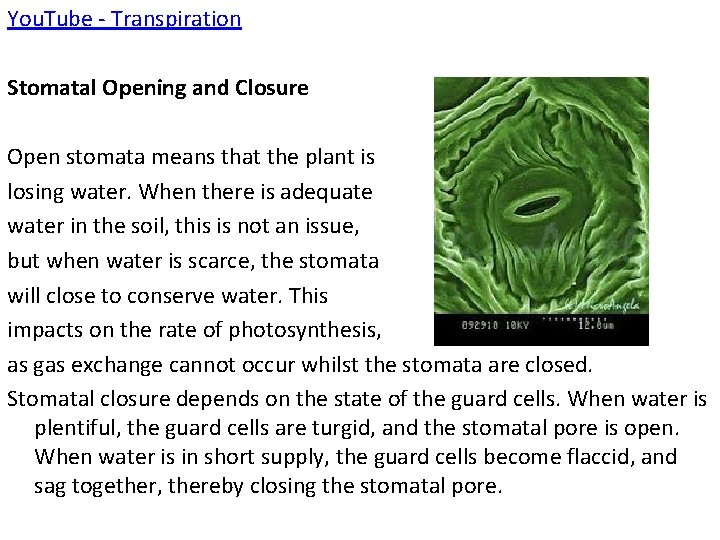
You. Tube - Transpiration Stomatal Opening and Closure Open stomata means that the plant is losing water. When there is adequate water in the soil, this is not an issue, but when water is scarce, the stomata will close to conserve water. This impacts on the rate of photosynthesis, as gas exchange cannot occur whilst the stomata are closed. Stomatal closure depends on the state of the guard cells. When water is plentiful, the guard cells are turgid, and the stomatal pore is open. When water is in short supply, the guard cells become flaccid, and sag together, thereby closing the stomatal pore.
The Role of Abscisic acid When the roots find a lack of water in the soil, they produce the hormone abscisic acid, which is transported to the leaves in the phloem. Abscisic acid changes the concentration of dissolved particles in the guard cells. As a result, these cells lose water via osmosis and become flaccid. They sag together and prevent water loss through the stomata. Stomata Closure – You. Tube Abiotic Factors Affecting Transpiration. 1. Light In light, plants open stomata to allow diffusion of CO 2 into the leaves for photosynthesis. This increases the rate of transpiration.
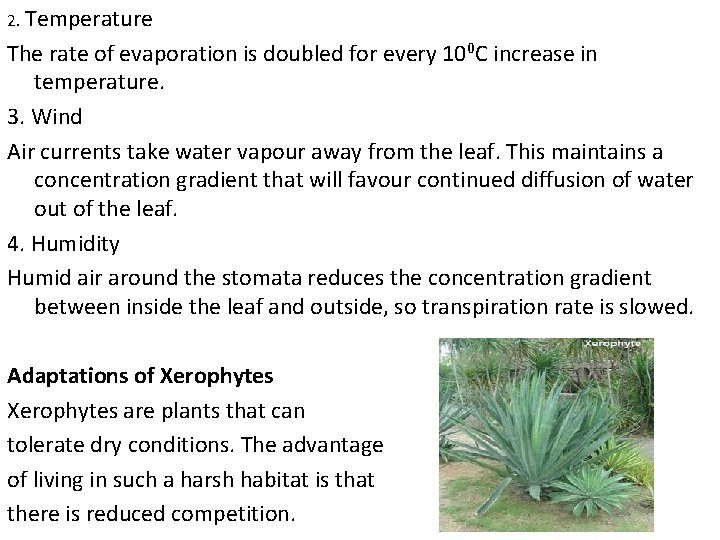
2. Temperature The rate of evaporation is doubled for every 100 C increase in temperature. 3. Wind Air currents take water vapour away from the leaf. This maintains a concentration gradient that will favour continued diffusion of water out of the leaf. 4. Humidity Humid air around the stomata reduces the concentration gradient between inside the leaf and outside, so transpiration rate is slowed. Adaptations of Xerophytes are plants that can tolerate dry conditions. The advantage of living in such a harsh habitat is that there is reduced competition.
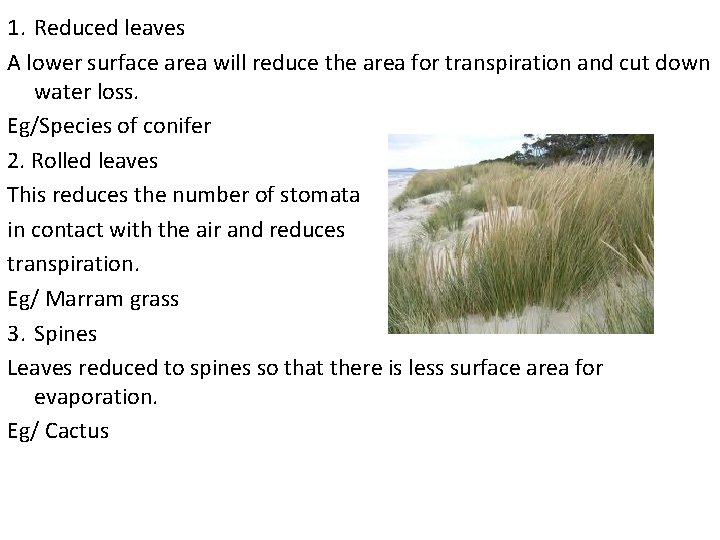
1. Reduced leaves A lower surface area will reduce the area for transpiration and cut down water loss. Eg/Species of conifer 2. Rolled leaves This reduces the number of stomata in contact with the air and reduces transpiration. Eg/ Marram grass 3. Spines Leaves reduced to spines so that there is less surface area for evaporation. Eg/ Cactus
4. Thickened cuticle The thicker the cuticle, the less water loss. Eg/ Rhododendron 5. Low growth form Plants low to the ground will be less exposed to the wind, so they lose less water through evaporation. Eg/ Coastal dune species such as tea tree. 6. Stomata in pits surrounded by hairs Water vapor will stay in the pits, trapped by the hair, creating a humid micro habitat. This reduces evaporation. 7. Less stomata.
Translocation refers to the movement of sugars and amino acids from the leaves and storage organs of the plant to all other areas. Sugars are transported in the form of sucrose. It travels through the phloem vessels by the pressure flow hypothesis. Phloem is made of living cells. Cells at the source of the sucrose (leaves and storage organs) actively transport sugar in. This causes water to follow by osmosis, causing a high pressure in that part of the phloem. The result is that sucrose will flow away from that area. When storing sucrose, phloem cells actively transport sucrose out. Again water follows and an area of low pressure is created. New sugar will flow in. Sugar Transport: Pressure Flow Hypothesis - You. Tube
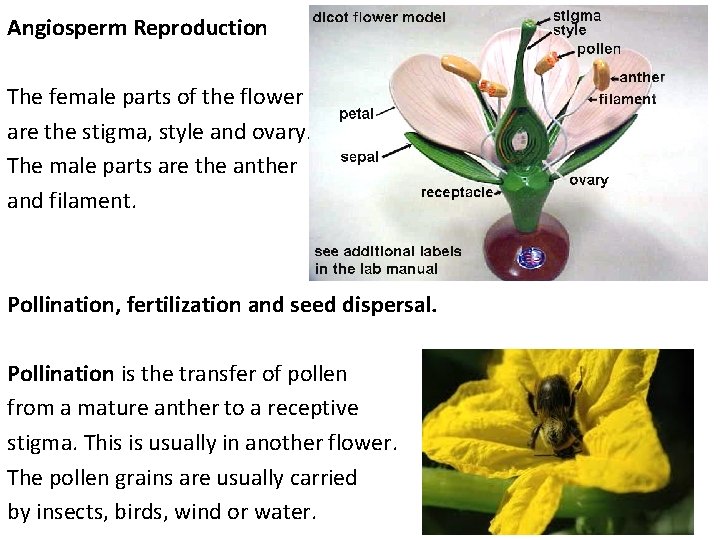
Angiosperm Reproduction The female parts of the flower are the stigma, style and ovary. The male parts are the anther and filament. Pollination, fertilization and seed dispersal. Pollination is the transfer of pollen from a mature anther to a receptive stigma. This is usually in another flower. The pollen grains are usually carried by insects, birds, wind or water.
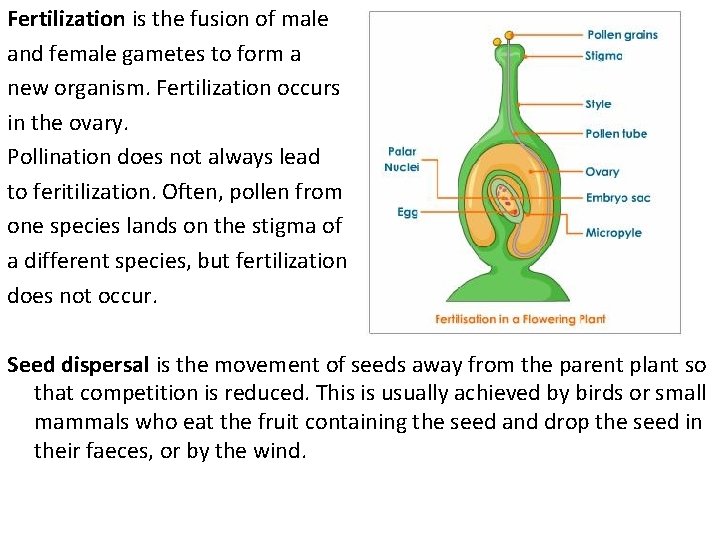
Fertilization is the fusion of male and female gametes to form a new organism. Fertilization occurs in the ovary. Pollination does not always lead to feritilization. Often, pollen from one species lands on the stigma of a different species, but fertilization does not occur. Seed dispersal is the movement of seeds away from the parent plant so that competition is reduced. This is usually achieved by birds or small mammals who eat the fruit containing the seed and drop the seed in their faeces, or by the wind.
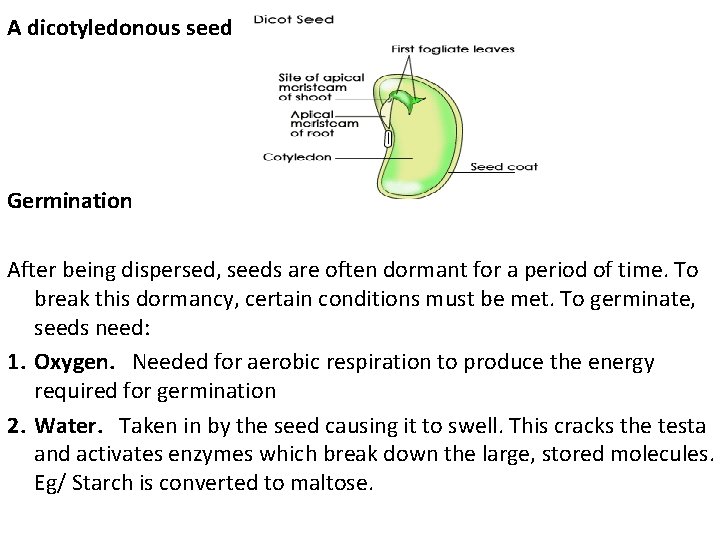
A dicotyledonous seed Germination After being dispersed, seeds are often dormant for a period of time. To break this dormancy, certain conditions must be met. To germinate, seeds need: 1. Oxygen. Needed for aerobic respiration to produce the energy required for germination 2. Water. Taken in by the seed causing it to swell. This cracks the testa and activates enzymes which break down the large, stored molecules. Eg/ Starch is converted to maltose.
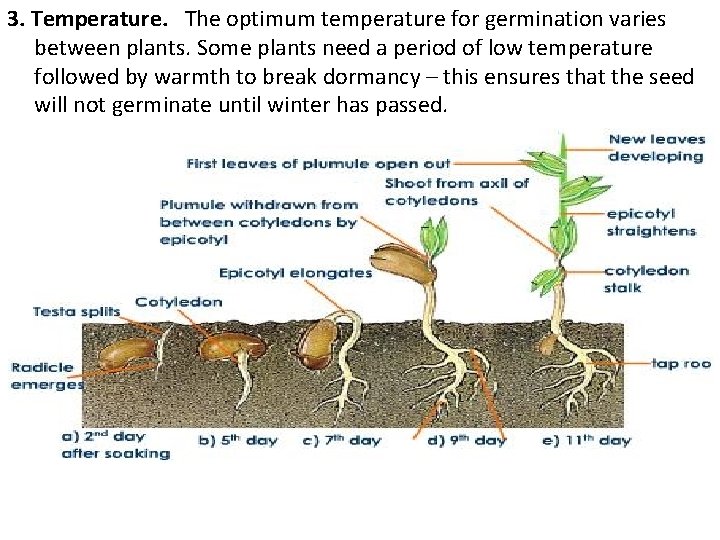
3. Temperature. The optimum temperature for germination varies between plants. Some plants need a period of low temperature followed by warmth to break dormancy – this ensures that the seed will not germinate until winter has passed.
The first step in germination is the absorption of water. A large volume of water is taken in (often as much as the seed itself) and this activates gibberellin, which in turn activates hydrolytic enzymes such as amylase. This converts starch to maltose, which is then moved to the embryo to be used in cellular respiration and to make cellulose for new cell walls. Stored proteins and lipids are also broken down. The resulting amino acids, fatty acids and glycerol are used to make new proteins and cell membranes. Germination uses the stored energy in the cotyledons to grow until it reaches light, where it will start to photosynthesise. Epigeal germination climbing bean time lapse - You. Tube
The Control of Flowering Some plants need a minimum number of hours of darkness before they can flower (too much daylight will prevent flowering). These plants often flower during Spring and Autumn when the days are shorter, and are called “short day” plants. Eg/ Coffee and strawberry. Other plants have a maximum number of hours of darkness that they can have if they are to produce flowers (too much darkness will prevent flowering). They flower in the Summer when the days are long and are called “long day” plants. Eg/ Carnations and clover. Some plants are not affected by the number of hours of darkness and are called day neutral. Photoperiodicity is the name for the plants’ response to the length of darkness. A pigment called phytochrome is present in green plants in low concentrations and is involved in photoperiodicity. There are two forms of phytochrome:
1. PR absorbs red light of wavelength 660 nm. 2. PFR absorbs far-red light of wavelength 730 nm. When PR is exposed to light (or just red light on its own) it is converted to PFR. However, in the dark (or when exposed to just far-red light) it is converted back to PR. PFR is the active form of phytochrome and controls the onset of flowering. In short day plants, PFR inhibits flowering. The long nights required for flowering allow the concentration of PFR to fall to a low level, which removes the inhibition. If, however, there is a flash of light during the night, the PFR levels return to an inhibiting level. In long day plants, PFR promotes flowering. The long period of daylight allows the accumulation of PFR to the levels required as PR is converted to PFR. Tutorial 39. 2 The Effect of Interrupted Days and Nights
- Slides: 27