
Plant Responses to Internal External Signals For the

- Slides: 30
Plant Responses to Internal & External Signals For the readings, pay special attention to the diagrams!!!
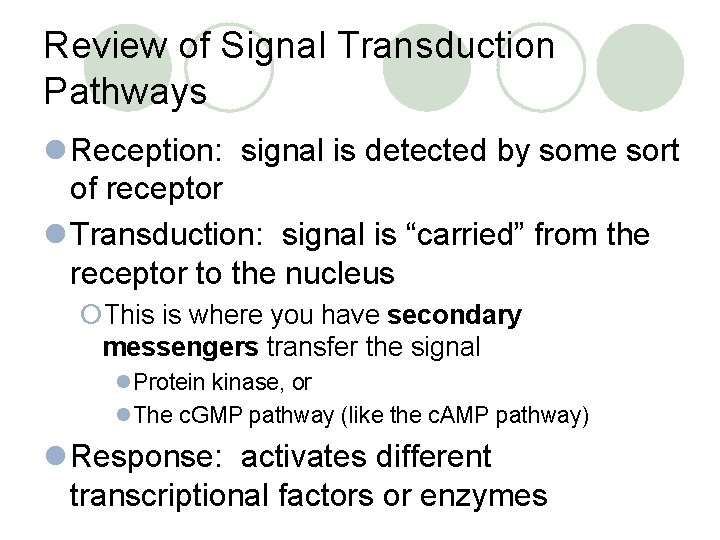
Review of Signal Transduction Pathways l Reception: signal is detected by some sort of receptor l Transduction: signal is “carried” from the receptor to the nucleus ¡This is where you have secondary messengers transfer the signal l. Protein kinase, or l. The c. GMP pathway (like the c. AMP pathway) l Response: activates different transcriptional factors or enzymes
Example: Potatoes l Potatoes grow beneath the soil in a dark environment (they produce many short stems that lack leaves in the hope that the stem will break through the soil surface) ¡The adaptations to grow in the dark is known as etiolation l When a stem breaks through the surface, leaves expand, roots elongate, and the plant produces chlorphyll ¡This process is called de-etiolation
Reception l A photoreceptor, phytochrome, detects that light after the shoot breaks through the soil ¡Phytochromes are not located on the cell surface, but are instead located in the cytoplasm ¡When light strikes the phytochrome, it causes a conformational change that causes a transduction pathway to begin
Transduction l Reception can be from a VERY weak light source, therefore you need to “amplify” the signal through transduction ¡The phytochrome, when activated, causes an increase in the concentration of c. GMP (like c. AMP) and calcium ion. ¡c. GMP activates protein kinases (through phosphorylation) ¡The increased calcium concentration with the activation of kinases leads to a response
Response l Many transcriptional factors are activated in deetiolation ¡Some are activated by phosphorylation ¡Some are activated by c. GMP ¡Some are activated by calcium l In addition to transcriptional factors, posttranslational enzymes are also activated to modify the created proteins l Most of the proteins created are associated with photosynthesis and chlorophyll production
PLANT HORMONES How hormones coordinate growth, development and response to environment
Plant Hormones l Hormones are chemical signals that coordinate the various parts of an organism ¡A hormone is a compound produced in one part of the organism which is then transported to other parts of the organism, where it triggers responses in target cells and tissues ¡Many hormones are effective in VERY small concentrations ¡Many times, hormone concentrations are dependent on environmental stimuli
Example with Light l Example of the action of hormones l Auxin is a hormone that induces a plant to move towards or away from a stimuli, tropism ¡Stimulus: Light ¡Response: the plants growth pattern will cause the growth shoot to move towards or away from the light l. Phototropism: growth towards the light l. Negative phototropism: growth away from the light
Plant Hormones l There are 5 major classes of plant hormones, each with specific functions: ¡Auxin ¡Cytokinins ¡Gibberellins ¡Ethylene ¡Abscisic acid l NOTE: Many hormones interact with each other to enhance or inhibit their activities
Auxin l Found: ¡In the embryo of seeds, meristems of apical buds and young leaves l Function: ¡Stimulates stem elongation and root growth (causes the root cells to elongate) ¡Stimulates development of fruit ¡Involved in phototropism and gravitropism, response of a plant to the effects of gravity
Cytokinins l Found: ¡Made in the roots and transported to other organs of the plant l Function: ¡Affect the growth and differentiation of roots ¡Stimulates cell division and growth (in conjunction with auxins) ¡Stimulates germination, growth from a seed ¡Delay senescence, or the aging of the plant
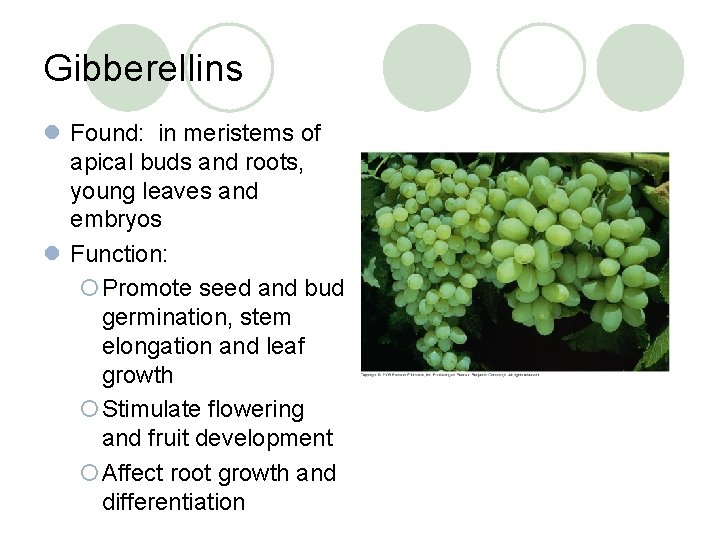
Gibberellins l Found: in meristems of apical buds and roots, young leaves and embryos l Function: ¡Promote seed and bud germination, stem elongation and leaf growth ¡Stimulate flowering and fruit development ¡Affect root growth and differentiation
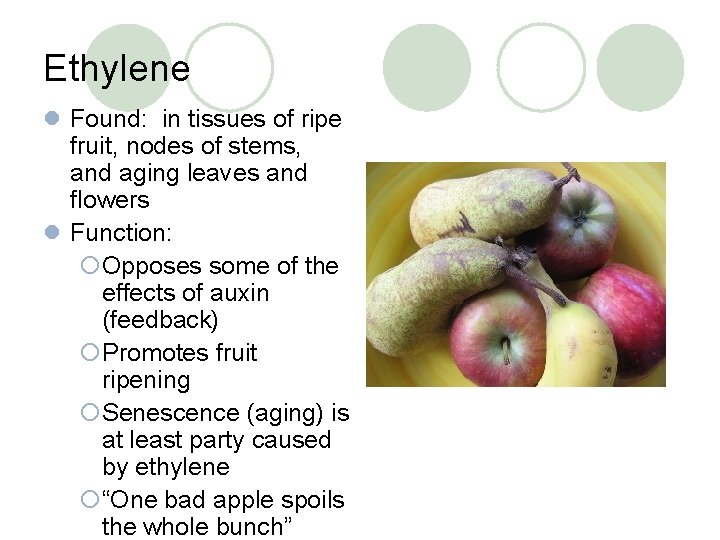
Ethylene l Found: in tissues of ripe fruit, nodes of stems, and aging leaves and flowers l Function: ¡Opposes some of the effects of auxin (feedback) ¡Promotes fruit ripening ¡Senescence (aging) is at least party caused by ethylene ¡“One bad apple spoils the whole bunch”
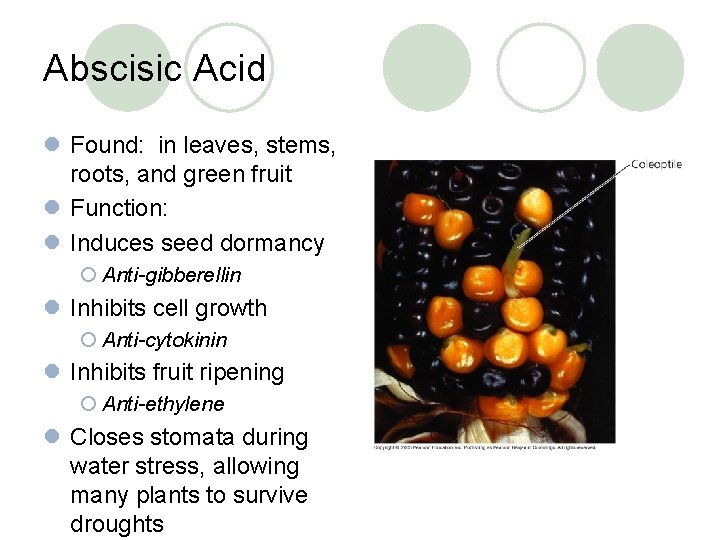
Abscisic Acid l Found: in leaves, stems, roots, and green fruit l Function: l Induces seed dormancy ¡ Anti-gibberellin l Inhibits cell growth ¡ Anti-cytokinin l Inhibits fruit ripening ¡ Anti-ethylene l Closes stomata during water stress, allowing many plants to survive droughts
PLANT RESPONSES How plants respond to various factors
Tropisms l Tropisms are growth responses that result in curvatures of whole plant organs toward or away from a stimuli l There are three major stimuli that induce tropisms ¡Light (Phototropism) ¡Gravity (Gravitropism) ¡Touch (Thigmotropism)
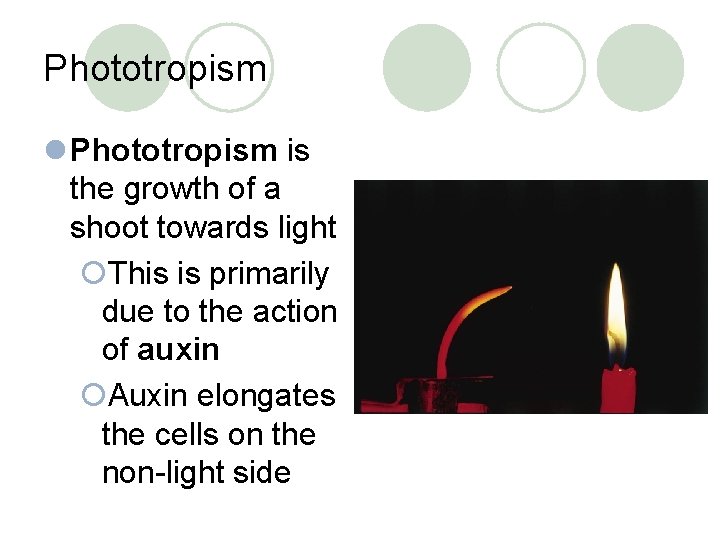
Phototropism l Phototropism is the growth of a shoot towards light ¡This is primarily due to the action of auxin ¡Auxin elongates the cells on the non-light side
Light Receptors: (START HERE) There are 2 main types of photoreceptors l Blue-light l Phytochromes: photoreceptor: These receptors absorb mostly red absorb mostly blue light l Responsible for del May be responsible for etiolation, seed opening stomata, and germination, and inhibit hypocotyl “avoid” shade elongation in seedlings breaking ground
Circadian Rhythms l The production of enzymes, hormones and other processes oscillate during the day ¡This is due to many environmental factors l. Light levels, temperature, humidity l There are other processes that occur with a frequency of every 24 hours that are not dependent on environment: circadian rhythms l These need to be reset daily or else the organism will eventually be “out of whack”
Biological Clocks/Circadian Rhythms l A physiological cycle with a frequency of about 24 hours is called a circadian rhythm l Even without external, environmental cues, circadian rhythms persist in humans and in all eukaryotes l Example: jet lag in humans, leaf position in bean plants l It is believed these are due to some internal biological clock that regulate these processes (these work independent of the day/night cycle for a limited time)
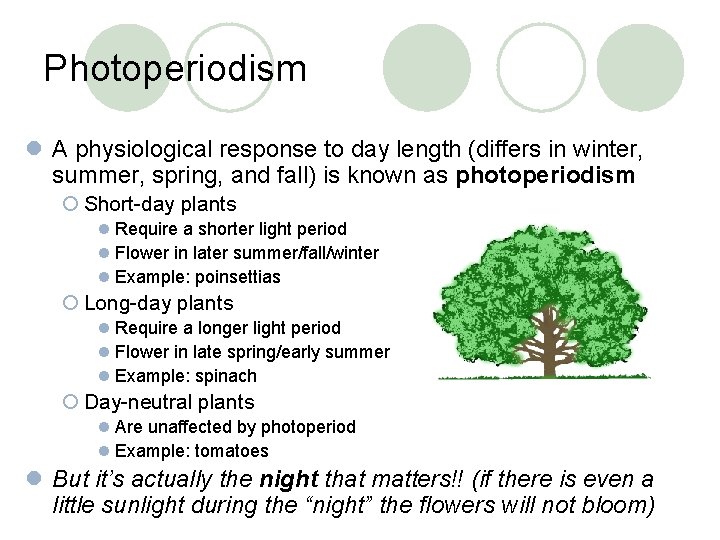
Photoperiodism l A physiological response to day length (differs in winter, summer, spring, and fall) is known as photoperiodism ¡ Short-day plants l Require a shorter light period l Flower in later summer/fall/winter l Example: poinsettias ¡ Long-day plants l Require a longer light period l Flower in late spring/early summer l Example: spinach ¡ Day-neutral plants l Are unaffected by photoperiod l Example: tomatoes l But it’s actually the night that matters!! (if there is even a little sunlight during the “night” the flowers will not bloom)
Other Factors that Affect Flowering l In addition to photoperiod, some plants need additional environmental cues to induce flowering ¡Example: Some plants need to be exposed to critical temperature ranges ¡Vernalization: the need to be exposed to long periods of “cold” temperatures to induce flowering (this occurs in winter wheat)
Missing Flower Hormone l It is believed that the photoperiod is detected by some chemical signal located in the leaves, florigen (actually an m. RNA molecule) ¡Discovered in 2005, but still looking at how it acts in different plants ¡If all of the leaves are removed from the plant, it is no longer affected by photoperiod
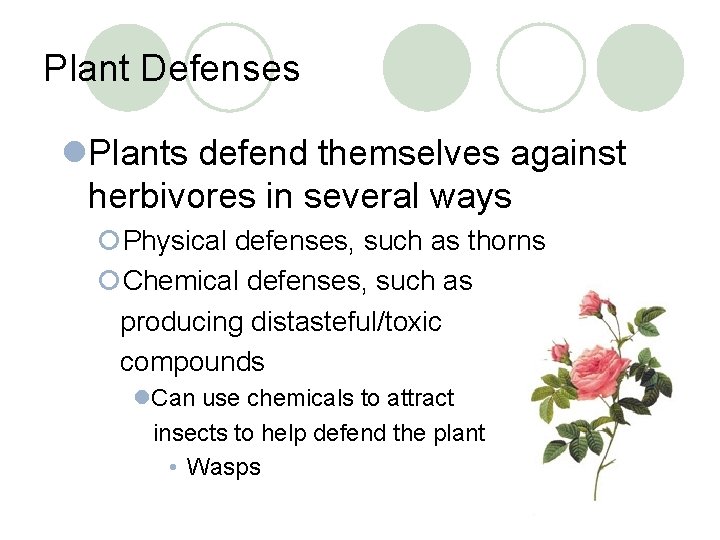
Plant Defenses l. Plants defend themselves against herbivores in several ways ¡Physical defenses, such as thorns ¡Chemical defenses, such as producing distasteful/toxic compounds l. Can use chemicals to attract insects to help defend the plant • Wasps
Plant Defenses l. Chemical warning systems: ¡When there is an infestation by insects, plants can release a chemical signal that causes other plants to activate “defense” genes to counteract the infesting organisms
Plant Defenses l Defense against pathogens is also important for plant survival ¡First line of defense is the plant’s “skin” l. Plant dermis, cuticle, bark ¡If a plant becomes infected, they release a series of chemicals that destroy the pathogen (much like our immune system) l. If a pathogen is able to “avoid” or “suppress” a plants defenses, the pathogen is said to be virulent l. Many times the pathogen weakens, but does not kill, the plant so that the pathogen may survive • This condition is called avirulent
Pathogen Detection l At the genetic level, plant disease resistance can begin with gene-for-gene recognition ¡The plant is able to “recognize” the protein products of the pathogen and able to mount a defense against the disease l Another “detection” method are molecules called elicitors ¡Example: oligosaccharins are molecules that derive from damage cell walls ¡They can also mount a defense against disease
Plant Response to Pathogen l Once warned, plants can release chemicals that can fight an invader ¡Phytoalexins are a group of compounds that are antimicrobial (the equivalent of our B and Tcells) ¡There also a general group of proteins (PR, or pathogenesis-related, proteins) that are antimicrobial or act as messengers to activate further defense ¡If the pathogen is avirulent, then there may be a more aggressive, localized, response called hypersensitive response
General Defense l A hypersensitive response may produce a chemical signal that alerts the rest of the plant ¡ As a result, more phytoalexins and PR proteins can be released to produce a nonspecific defense, system acquired resistance (SAR) ¡A hormone that is thought to produce this resistance is salicylic acid