
Plant Reproduction Integrated Science Grades 7172 B Mrs
Plant Reproduction Integrated Science Grades: 71&72 B Mrs Smith-Morgan
What is plant reproduction? • Plant reproduction can be defined as the production of a new offspring in plants, which can be accomplished by sexual or asexual reproduction.
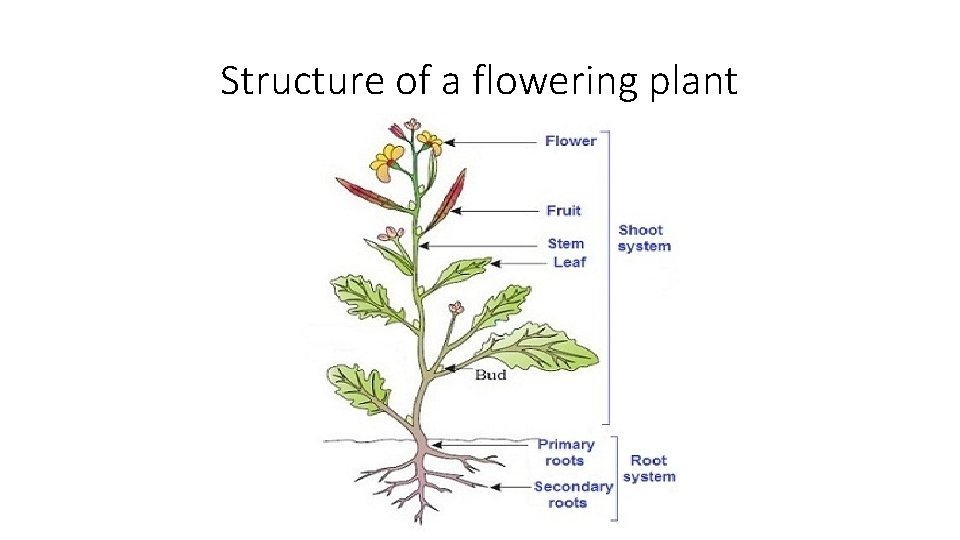
Structure of a flowering plant
Structure and function of a flowering plant All flower plants have the same basic structure. They consist of four main parts: stem, leaves, roots and flowers. v. The stem- is usually upright. It supports the leaves and the flowers in the air. The stem transports manufactured food from the leaves to growing points and storage areas in plant. It also transports water and minerals from the roots to the leaves. v. The roots are in the soil. They branch into small and smaller parts which spread out into the soil. They help to hold the plant in the soil and they take up water and minerals for the plant from the soil.
Cont’d v. The flowers contain the male and female reproductive structures of the plant. They produce fruits that contain seeds which grow into new plants v. The leaves are thin and flat. They have veins I them which helps to support them. Most leaves are green. They contain a green pigment called chlorophyll , which absorbs sunlight. The plants uses the energy from the sunlight , along with carbon dioxide from the air and water from the soil, to make food. This process is called photosynthesis. The production of food is the main function of leaves.
Photosynthesis is the process by which green plants make their own food. Three important things to remember about photosynthesis are: v. The raw materials are water and carbon dioxide. v. The reaction conditions are sunlight and chlorophyll. Chlorophyll traps the energy from the sunlight. v. The products are glucose (plant’s food) and oxygen gas, which is released into the atmosphere.
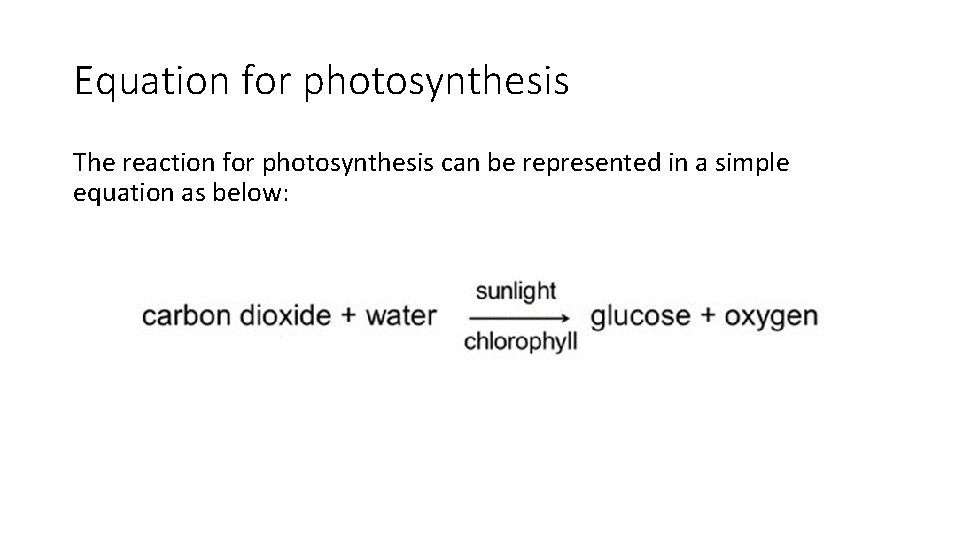
Equation for photosynthesis The reaction for photosynthesis can be represented in a simple equation as below:
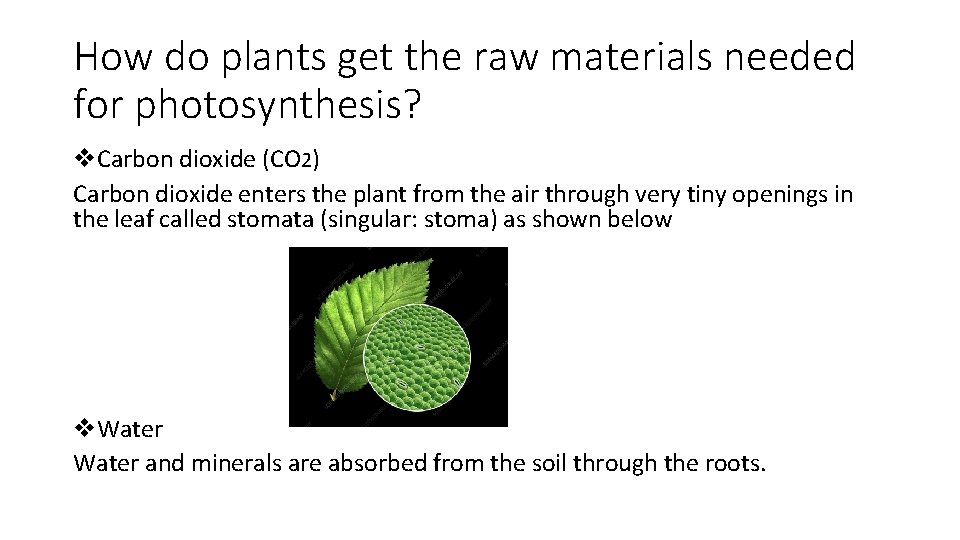
How do plants get the raw materials needed for photosynthesis? v. Carbon dioxide (CO 2) Carbon dioxide enters the plant from the air through very tiny openings in the leaf called stomata (singular: stoma) as shown below v. Water and minerals are absorbed from the soil through the roots.
What happen to the products of Photosynthesis? The food made by plants in glucose, which may be used up immediately to give the plant energy. Any glucose not used immediately by the plant is stored as starch in different parts of the plant, such as the leaves, stems, roots, seeds and fruits.
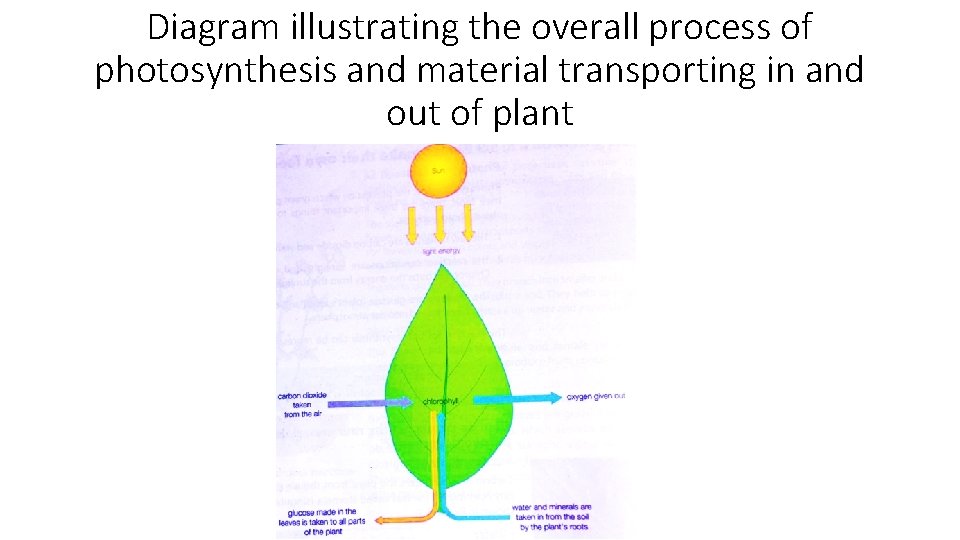
Diagram illustrating the overall process of photosynthesis and material transporting in and out of plant
The link below is a video about photosynthesis and how plants make their own food. Click the link below and have a little fun with Dr Binocs. https: //www. youtube. com/watch? v=D 1 Ymc 311 XS 8
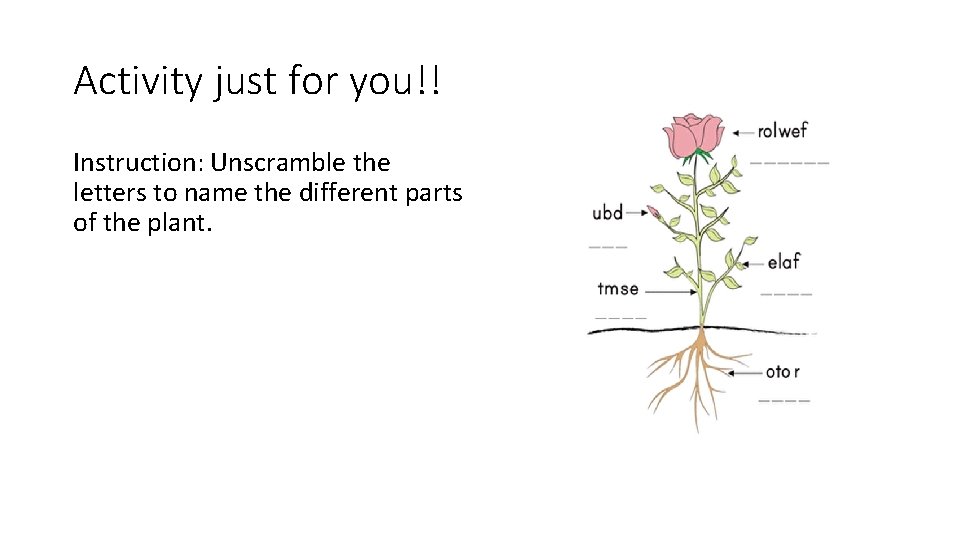
Activity just for you!! Instruction: Unscramble the letters to name the different parts of the plant.
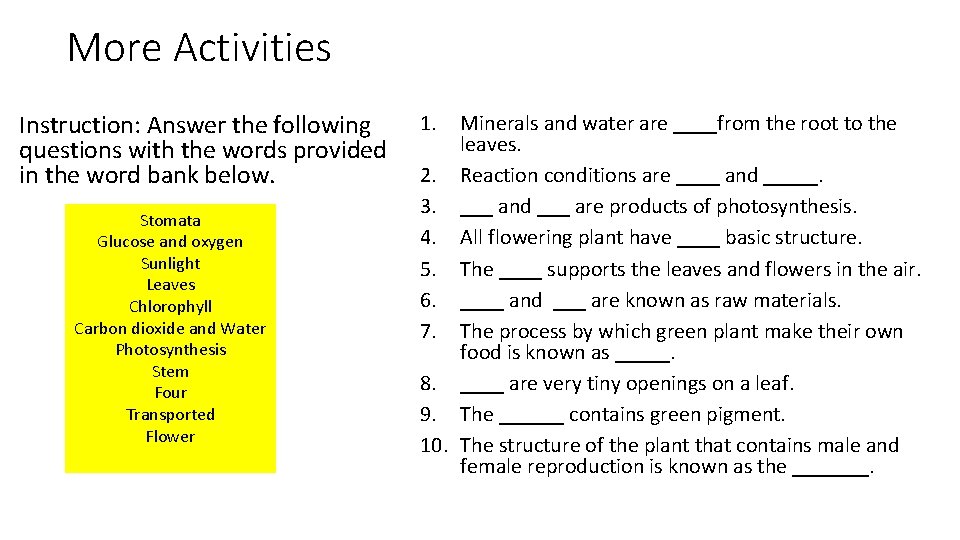
More Activities Instruction: Answer the following questions with the words provided in the word bank below. Stomata Glucose and oxygen Sunlight Leaves Chlorophyll Carbon dioxide and Water Photosynthesis Stem Four Transported Flower 1. Minerals and water are ____from the root to the leaves. 2. Reaction conditions are ____ and _____. 3. ___ and ___ are products of photosynthesis. 4. All flowering plant have ____ basic structure. 5. The ____ supports the leaves and flowers in the air. 6. ____ and ___ are known as raw materials. 7. The process by which green plant make their own food is known as _____. 8. ____ are very tiny openings on a leaf. 9. The ______ contains green pigment. 10. The structure of the plant that contains male and female reproduction is known as the _______.
- Slides: 13