
Plant Propagation Objective 4 02 Use sexual and
Plant Propagation Objective 4. 02: Use sexual and asexual methods of propagation
Do Not Write this Slide • First Title for your notes “Sexual Propagation” • The next 6 slides will go under this section.
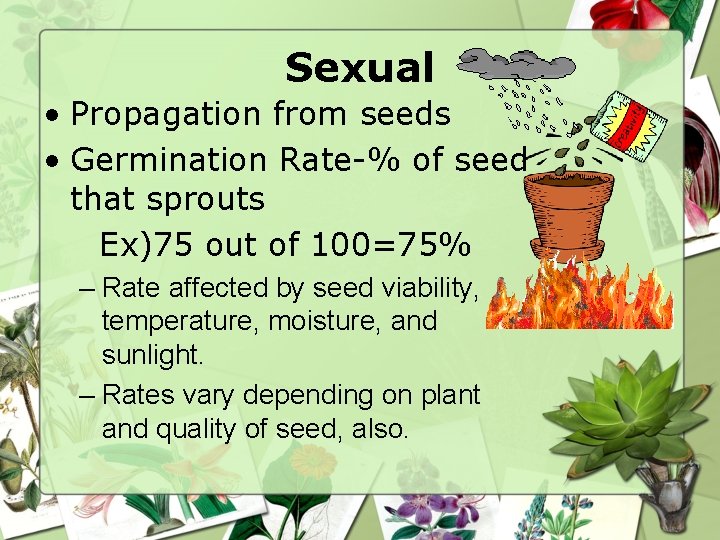
Sexual • Propagation from seeds • Germination Rate-% of seed that sprouts Ex)75 out of 100=75% – Rate affected by seed viability, temperature, moisture, and sunlight. – Rates vary depending on plant and quality of seed, also.
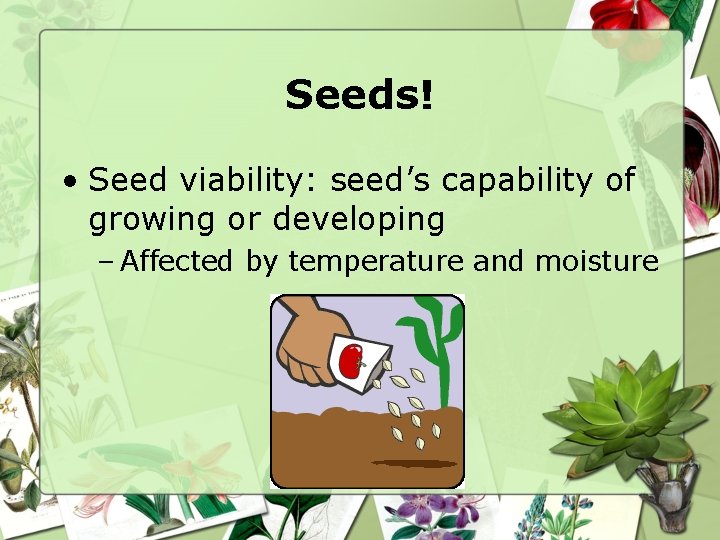
Seeds! • Seed viability: seed’s capability of growing or developing – Affected by temperature and moisture
Seeds & Seedlings • Seed plant depth depends on size of seeds • Plant seeds no more than 1 ½ times the diameter of the seed • Larger seeds planted deeper • Smaller seeds are planted shallow – Ex)Petunia seeds are TINY • Water small seeds from bottom by soaking to prevent burying them
Seeds and Seedlings • Seedlings (small plants) – First set of leaves called cotyledons • Monocots produce _______ seed leaf • Dicots produce ____ seed leaves – True leaves are the second set of leaves – Transplant when first true leaves appear. – Reduce humidity and water and make environment more like outside to “harden off” plants
Sexual Propagation Advantages Disadvantages • Fast way to get many • Some plants, plants especially hybrids, do not reproduce • Easy to do true to parents. • Economical • Some plants are difficult to propagate from seeds.
Materials to Sexually Propagate • Germinating Mat: This is used to warm up the soil to create the exact growing conditions a plant needs to germinate. • Dibbit: tool used to help put an indention in soil where seed is to be planted
Seeds • Some examples of plants started by seed include: – Marigold – Impatiens – Begonia – Coleus – Shasta daisy – Pansy
Key Terms • Stratification: Process where seeds are exposed to water, or certain temp. to increase germination • Scarification: Process where seeds are scratched or notched to rough up seed coat to make easier to germinate • Cotyledons: first leaves that emerge from soil to start process of photosynthesis in seedling
Germination Rate Problems • If you have 1000 seeds and there is a germination rate of 60%…how many seedlings actually emerged from the soil?
NEW SECTION! • DO NOT WRITE THIS SLIDE. • MAKE A NEW SECTION ON YOUR PAPER TITLED “ASEXUAL PROPAGATION”
Asexual Propagation • Asexual—uses growing plant parts other than seeds • There are several different methods – Cutting – Layering – Division or separation – Budding – Grafting – Tissue Culture
Cuttings • Rooting from cuttings—rooting media should be about four inches deep. • Best time of day is early morning because plants have more moisture. 1. Stem 2. Leaf 3. Root
Stem Cuttings • Start with sterile flats, soil, and tools • Must include a node – Node: A point along a plant where leaves or other stems are attached – Internode: Area between two nodes • Cutting: Taking a 4 -6 inch piece of a plant and forcing roots to grow • Using hormones and dipping the cutting in fungicides help speed up rooting
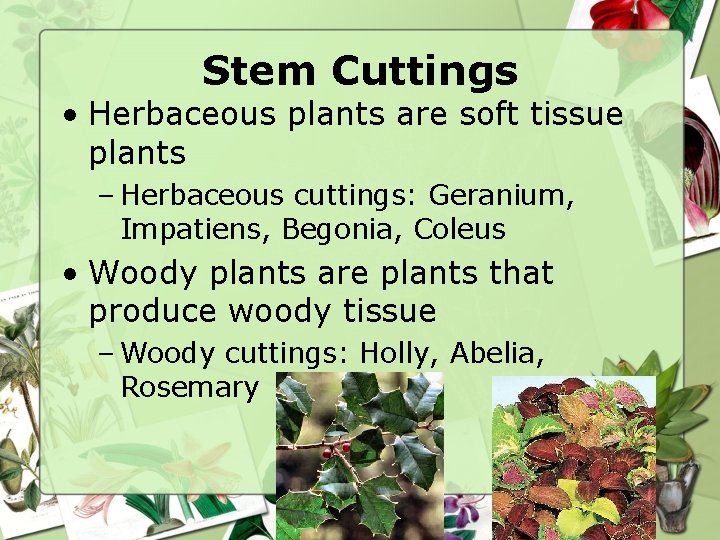
Stem Cuttings • Herbaceous plants are soft tissue plants – Herbaceous cuttings: Geranium, Impatiens, Begonia, Coleus • Woody plants are plants that produce woody tissue – Woody cuttings: Holly, Abelia, Rosemary
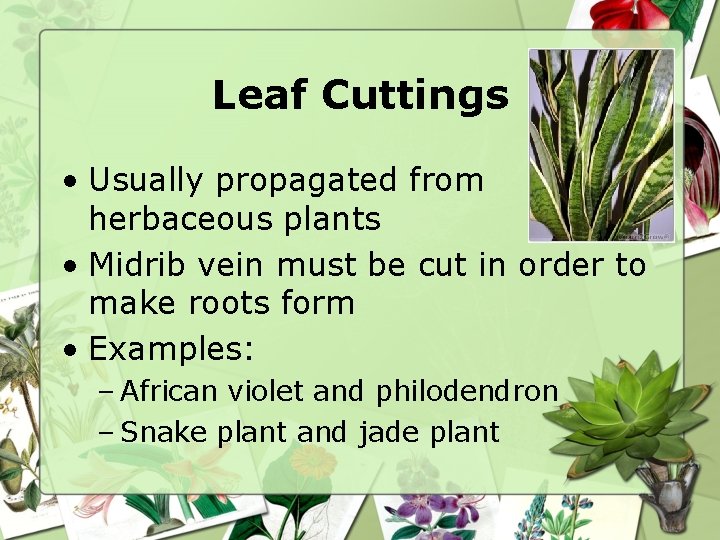
Leaf Cuttings • Usually propagated from herbaceous plants • Midrib vein must be cut in order to make roots form • Examples: – African violet and philodendron – Snake plant and jade plant
Root Cuttings • Should be spaced three inches apart in rooting area • A sand, vermiculite or perlite mixture is a good medium for root cuttings • The best time of day to take a stem, leaf or root cutting is early morning because plants have more moisture • Examples: Hosta and Daylily
Division • Cutting or pulling apart rhizomes, tubers, runners, stolons, etc. to get new plants • Rhizome: Creeping underground stem Ex)Cannas & Bearded Iris • Stolon: Creeping above ground stem – Ex)Strawberry • Tuber: Swollen, modified stem that grows underground – Ex)Potato
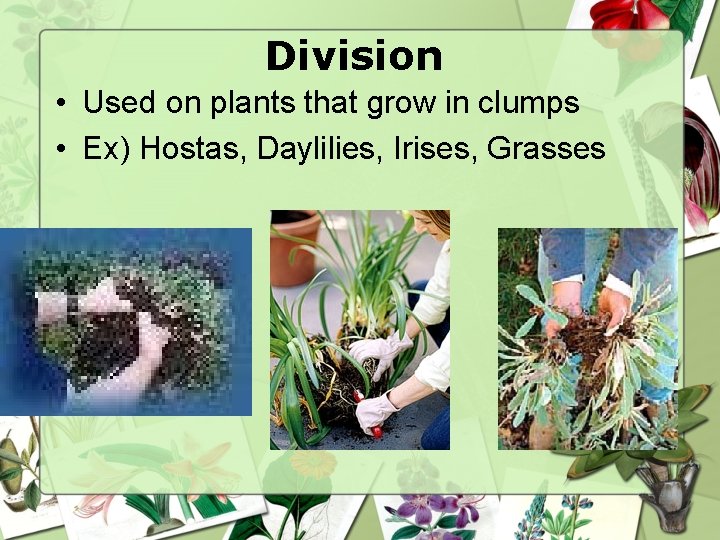
Division • Used on plants that grow in clumps • Ex) Hostas, Daylilies, Irises, Grasses
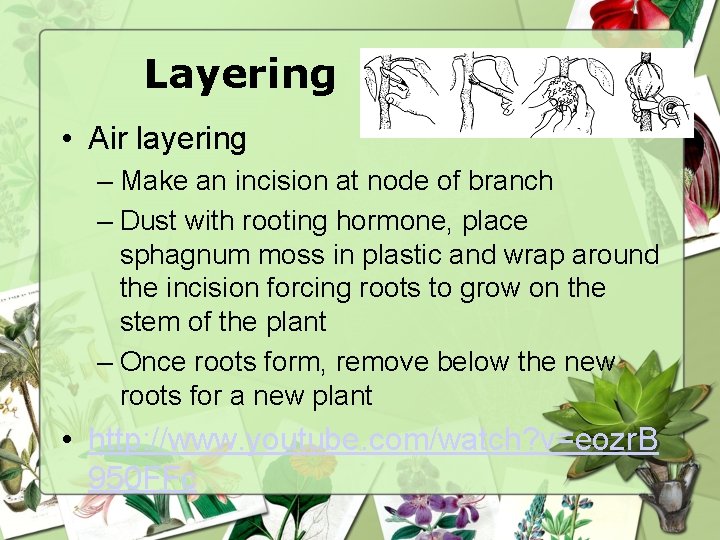
Layering • Air layering – Make an incision at node of branch – Dust with rooting hormone, place sphagnum moss in plastic and wrap around the incision forcing roots to grow on the stem of the plant – Once roots form, remove below the new roots for a new plant • http: //www. youtube. com/watch? v=eozr. B 950 FFc
Layering • Trench Layering – Cutting a trench and laying a branch in the trench – Types include: simple, tip, and serpentine • http: //www. youtube. com/watch? v =z. Cy. T 3 mv 5 Wvs
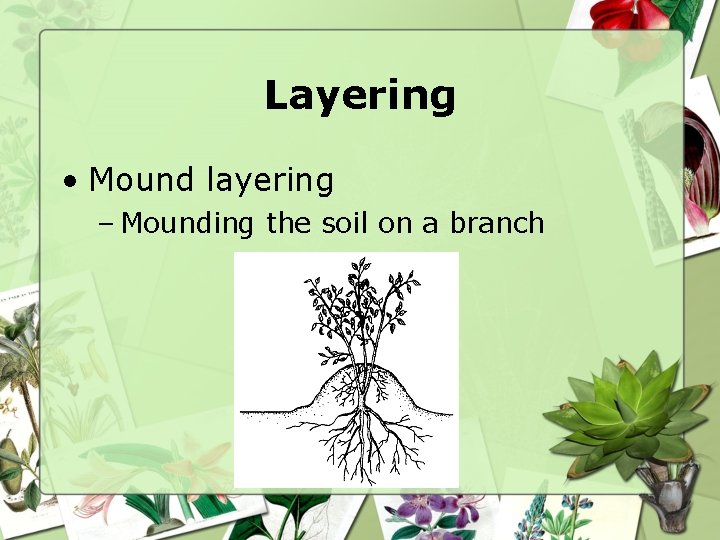
Layering • Mound layering – Mounding the soil on a branch
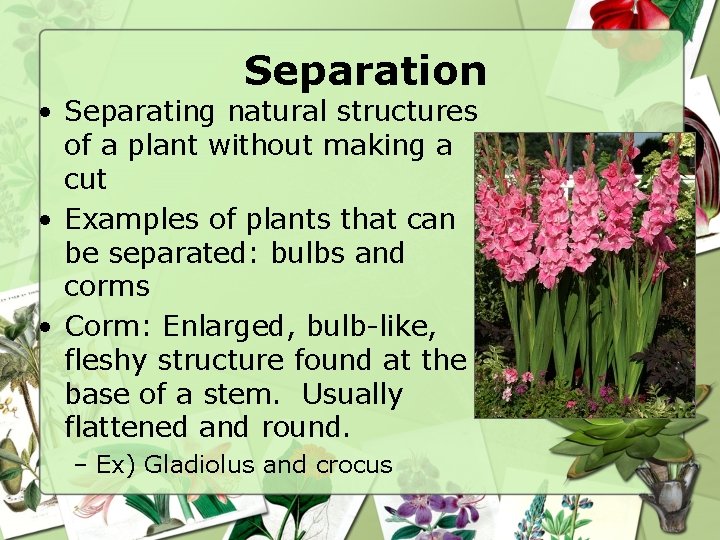
Separation • Separating natural structures of a plant without making a cut • Examples of plants that can be separated: bulbs and corms • Corm: Enlarged, bulb-like, fleshy structure found at the base of a stem. Usually flattened and round. – Ex) Gladiolus and crocus
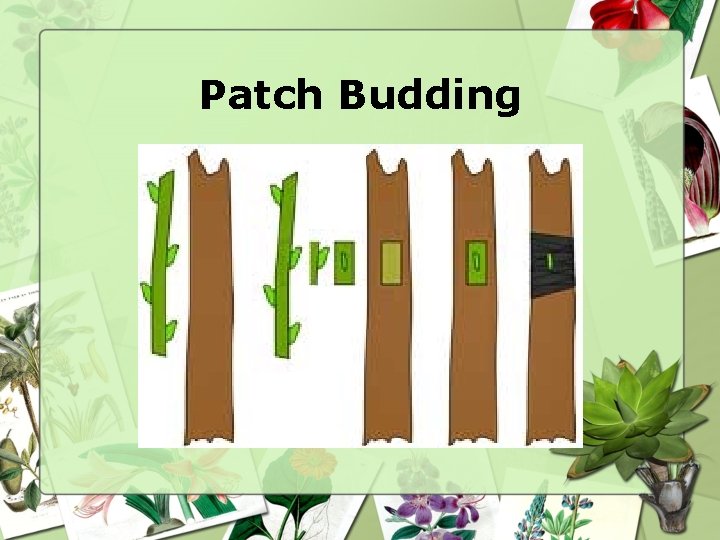
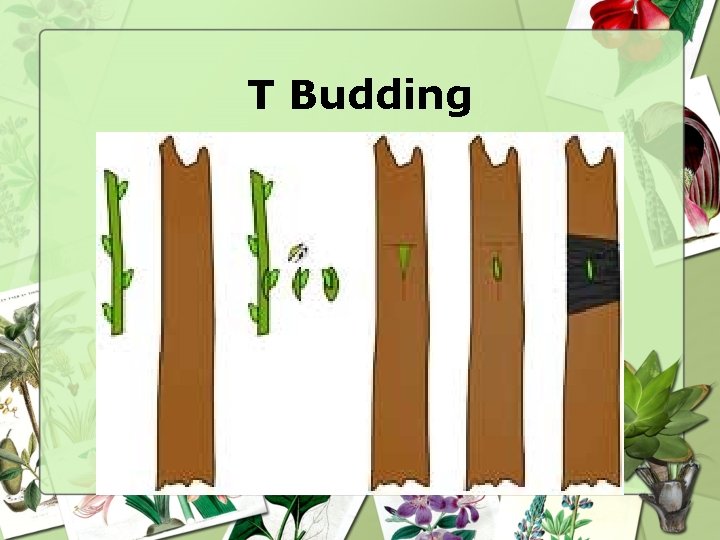
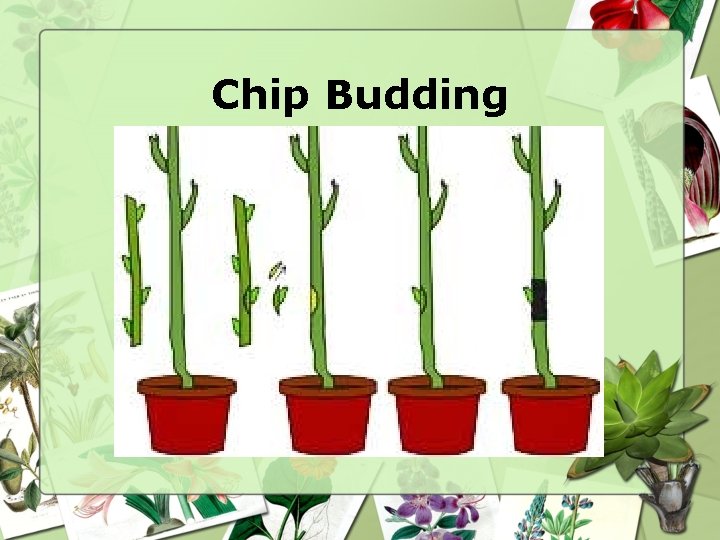
Budding • Budding—a form of grafting when a bud is used • Methods of budding: 1. Patch budding. 2. T-budding. 3. Chip budding. • Ex) Rose
Patch Budding
T Budding
Chip Budding
Grafting • Grafting—joining separate plant parts together so that they form a union and grow together to make one plant • Tools needed: – Knife – Tape – Wax • Plants must be related to each other and normally in the same genus or family
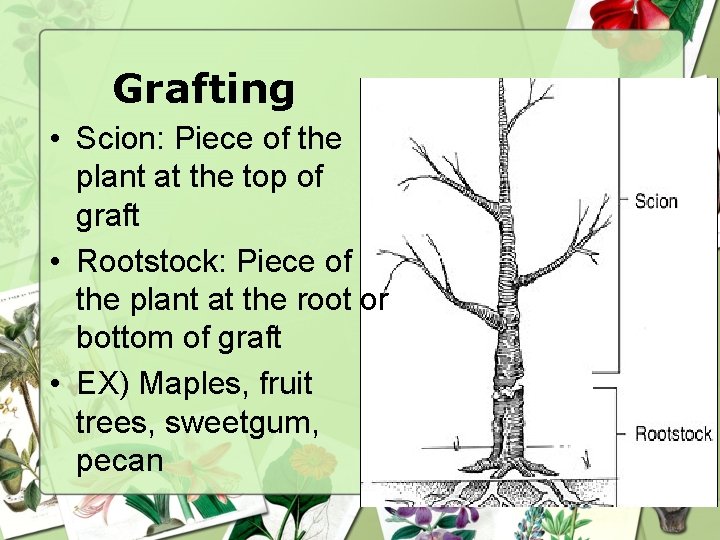
Grafting • Scion: Piece of the plant at the top of graft • Rootstock: Piece of the plant at the root or bottom of graft • EX) Maples, fruit trees, sweetgum, pecan
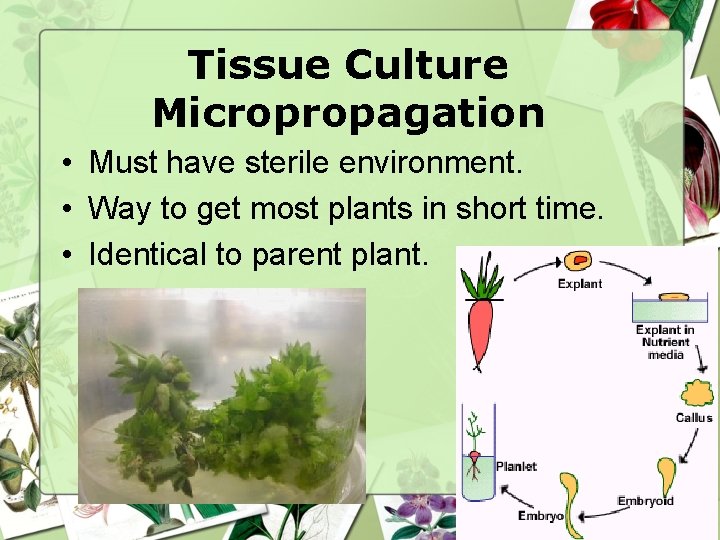
Tissue Culture Micropropagation • Must have sterile environment. • Way to get most plants in short time. • Identical to parent plant.
Advantages • Asexual reproduction or propagation— plants mature in shorter time. • Budding is faster or quicker than grafting. • In trench layering, plant forms at each node on covered stem. • Some plants do not produce viable seeds. • New plants are same as parent plant.
Disadvantages • Some require special equipment and skills, such as grafting. • Cuttings detach plant parts from water and nutrient source. • Some plants are patented making propagation illegal.
- Slides: 33