
Plant Phosphoproteomics to Study Sn RK 2 Kinase
- Slides: 1
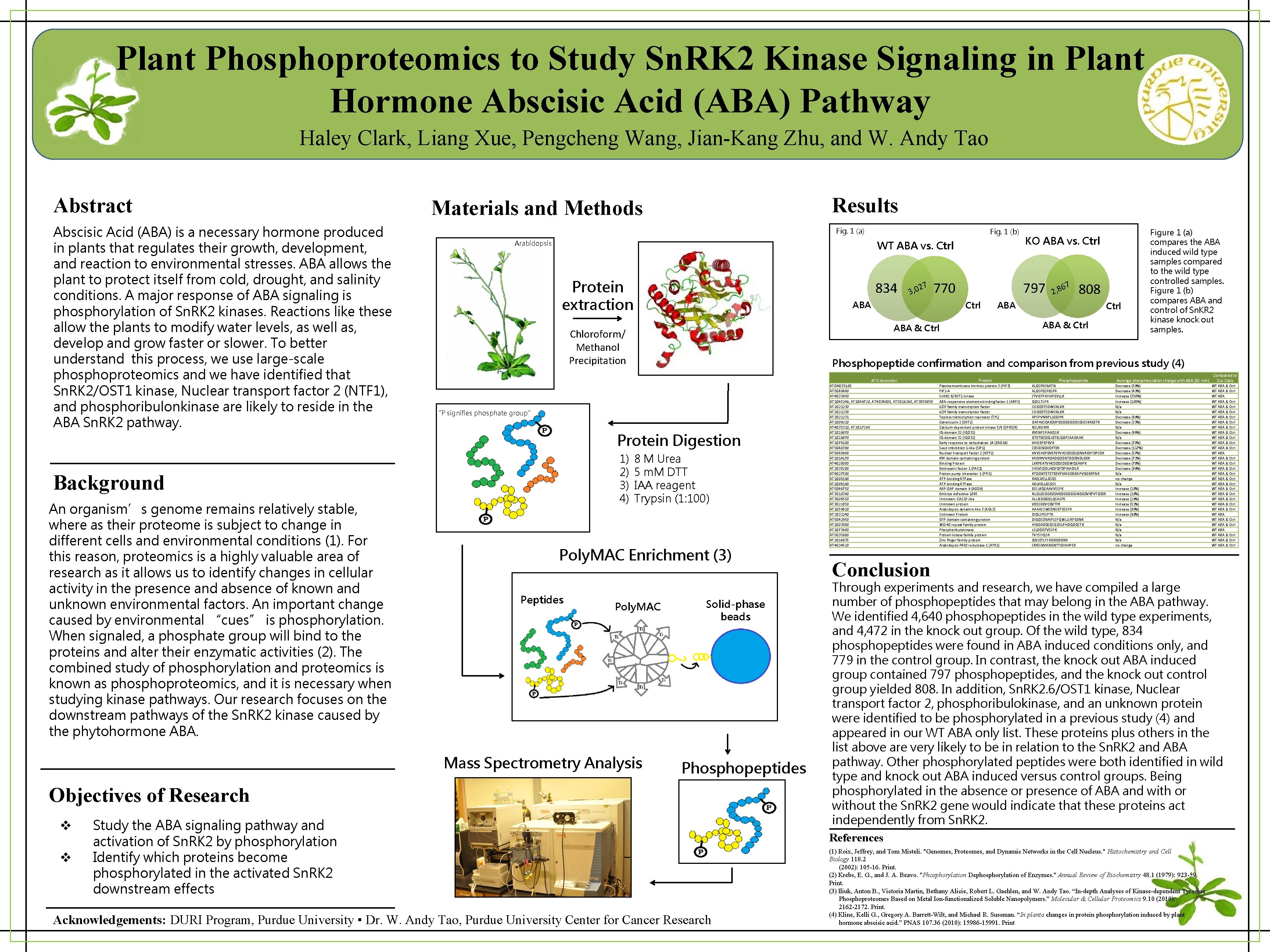
Plant Phosphoproteomics to Study Sn. RK 2 Kinase Signaling in Plant Hormone Abscisic Acid (ABA) Pathway Haley Clark, Liang Xue, Pengcheng Wang, Jian-Kang Zhu, and W. Andy Tao Abstract Abscisic Acid (ABA) is a necessary hormone produced in plants that regulates their growth, development, and reaction to environmental stresses. ABA allows the plant to protect itself from cold, drought, and salinity conditions. A major response of ABA signaling is phosphorylation of Sn. RK 2 kinases. Reactions like these allow the plants to modify water levels, as well as, develop and grow faster or slower. To better understand this process, we use large-scale phosphoproteomics and we have identified that Sn. RK 2/OST 1 kinase, Nuclear transport factor 2 (NTF 1), and phosphoribulonkinase are likely to reside in the ABA Sn. RK 2 pathway. Fig. 1 (a) Arabidopsis Protein extraction KO ABA vs. Ctrl 834 797 7 2 3, 0 Ctrl ATG accession “P signifies phosphate group” Protein Digestion 1) 2) 3) 4) 8 M Urea 5 m. M DTT IAA reagent Trypsin (1: 100) Poly. MAC Enrichment (3) Peptides 770 67 8 , 2 808 ABA Ctrl ABA & Ctrl Figure 1 (a) compares the ABA induced wild type samples compared to the wild type controlled samples. Figure 1 (b) compares ABA and control of Sn. KR 2 kinase knock out samples. Phosphopeptide confirmation and comparison from previous study (4) Poly. MAC Solid-phase beads Phosphopeptides Objectives of Research v WT ABA vs. Ctrl ABA & Ctrl Mass Spectrometry Analysis v Fig. 1 (b) ABA Chloroform/ Methanol Precipitation Background An organism’s genome remains relatively stable, where as their proteome is subject to change in different cells and environmental conditions (1). For this reason, proteomics is a highly valuable area of research as it allows us to identify changes in cellular activity in the presence and absence of known and unknown environmental factors. An important change caused by environmental “cues” is phosphorylation. When signaled, a phosphate group will bind to the proteins and alter their enzymatic activities (2). The combined study of phosphorylation and proteomics is known as phosphoproteomics, and it is necessary when studying kinase pathways. Our research focuses on the downstream pathways of the Sn. RK 2 kinase caused by the phytohormone ABA. Results Materials and Methods Study the ABA signaling pathway and activation of Sn. RK 2 by phosphorylation Identify which proteins become phosphorylated in the activated Sn. RK 2 downstream effects Acknowledgements: DURI Program, Purdue University ▪ Dr. W. Andy Tao, Purdue University Center for Cancer Research ATG 4 G 35100 AT 5 G 60660 AT 4 G 33950 AT 1 G 45249, AT 1 G 49720, AT 4 G 34000, AT 3 G 19290, AT 3 G 56850 AT 2 G 21230 AT 2 G 21231 AT 1 G 09210 AT 4 G 35310, AT 2 G 17290 AT 1 G 19870 AT 1 G 76180 AT 5 G 40390 AT 5 G 60980 AT 1 G 14170 AT 4 G 28080 AT 2 G 38280 AT 4 G 27500 AT 1 G 06190 AT 5 G 46750 AT 3 G 18390 AT 3 G 06550 AT 3 G 22850 AT 1 G 59610 AT 2 G 32240 AT 5 G 42950 AT 1 G 03060 AT 1 G 73980 AT 5 G 35980 AT 2 G 14835 AT 4 G 24520 Protein Plasma membrane intrinsic protein 3 (PIP 3) PIP 2 -4 Sn. RK 2. 6/OST 1 kinase ABA-responsive elements-binding factor 2 (ABF 2) b. ZIP family transcription factor Topless transcription repressor (TPL) Calreticulin-2 (CRT 2) Calcium-dependent protein kinase 5/6 (CPK 5/6) IQ-domain 32 (IQD 32) Early response to dehydration 14 (ERD 14) Seed imbibition 1 -like (SIP 1) Nuclear transport factor 2 (NTF 2) KM domain-containing protein Binding Protein Embryonic factor 1 (FAC 1) Proton pump interactor 1 (PPI 1) ATP-binding ATPase ARF-GAP domain 9 (AGD 9) Embryo defective-1865 Unknown: CAS 1 P-like Unknown protein Arabidopsis dynamin-like 3 (ADL 3) Unknown Protein GYF domain-containing protein WD-40 repeat family protein Phosphoribulokinase Protein kinase family protein Zinc finger family protein Arabidopsis P 450 reductase 1 (ATR 1) Phosphopeptide ALGSFRSNATN ALGSFGSFGSFR STVGTPAYIAPEVLLK QGSLTLPR SISGEDTSDWSNLVK APSPVNNPLLGGIPK DAPAESDAEDEPEDDEGGDDSDSESKAEETK NSLNISMR KVSNPSFIAAQSK GTETEEDDLIGTELQGPSAADAAK VHISEPEPEVK SDSGINGVDFTEK VVVSHEPEVEPEPVASIEEEDLDNVAEVYDPSDK VHDMVVADADQDDGTDDDNDLGEK LVKPEATVHEDDDSDEGWQEAVPK SHSVSGDLHGVQPDPIAADILR KTGGNTETETEEVPEASEEEIEAPVQEEKPQK KAELVELLGSDSS ESSLKQEAAVVSSPK NLGLGSDDEDDVEDDEGGGINGGDVKPVTGEER ALLIEDGGGLQSASPR VDSSGEVCGVTFK AAAASSWSDNSGTESSPR DIDLSFSSPTK DIQGSDNAIPLSPQWLLSKPGENK HINDADDSGSQGSLPHDQDQSTK LSLDDDTVSSPK TVYSYIQSR QNSETLYYADDEDGNR SMESNVANGNTTIDIHHPCR Compared to Average phosphorylation change with ABA (30 min) Our Data Decrease (59%) Decrease (43%) Increase (358%) Increase (106%) N/a Decrease (69%) Decrease (33%) N/a Decrease (66%) N/a Decrease (78%) Decrease (117%) Decrease (57%) Decrease (72%) Decrease (78%) Decrease (99%) N/a no change N/a Increase (28%) Increase (29%) Increase (52%) Increase (80%) Increase (98%) N/a N/a N/a no change Conclusion WT ABA & Ctrl WT ABA & Ctrl WT ABA & Ctrl WT ABA & Ctrl WT ABA & Ctrl WT ABA & Ctrl WT ABA WT ABA & Ctrl Through experiments and research, we have compiled a large number of phosphopeptides that may belong in the ABA pathway. We identified 4, 640 phosphopeptides in the wild type experiments, and 4, 472 in the knock out group. Of the wild type, 834 phosphopeptides were found in ABA induced conditions only, and 779 in the control group. In contrast, the knock out ABA induced group contained 797 phosphopeptides, and the knock out control group yielded 808. In addition, Sn. RK 2. 6/OST 1 kinase, Nuclear transport factor 2, phosphoribulokinase, and an unknown protein were identified to be phosphorylated in a previous study (4) and appeared in our WT ABA only list. These proteins plus others in the list above are very likely to be in relation to the Sn. RK 2 and ABA pathway. Other phosphorylated peptides were both identified in wild type and knock out ABA induced versus control groups. Being phosphorylated in the absence or presence of ABA and with or without the Sn. RK 2 gene would indicate that these proteins act independently from Sn. RK 2. References (1) Roix, Jeffrey, and Tom Misteli. "Genomes, Proteomes, and Dynamic Networks in the Cell Nucleus. " Histochemistry and Cell Biology 118. 2 (2002): 105 -16. Print. (2) Krebs, E. G. , and J. A. Beavo. "Phosphorylation Dephosphorylation of Enzymes. " Annual Review of Biochemistry 48. 1 (1979): 923 -59. Print. (3) Iliuk, Anton B. , Victoria Martin, Bethany Alicie, Robert L. Gaehlen, and W. Andy Tao. “In-depth Analyses of Kinase-dependent Tyrosine Phosphoproteomes Based on Metal Ion-functionalized Soluble Nanopolymers. ” Molecular & Cellular Proteomics 9. 10 (2010): 2162 -2172. Print. (4) Kline, Kelli G. , Gregory A. Barrett-Wilt, and Michael R. Sussman. “In planta changes in protein phosphorylation induced by plant hormone abscisic acid. ” PNAS 107. 36 (2010): 15986 -15991. Print