
Plant Pest Pathways into Canada North American Invasive

- Slides: 23
Plant Pest Pathways into Canada North American Invasive Species Forum May 9, 2017 Wendy Asbil and Kristina Pauk Invasive Alien Species and Domestic Plant Health Programs Section Plant Health and Biosecurity Directorate, CFIA © 2017 Her Majesty the Queen in Right of Canada (Canadian Food Inspection Agency), all rights reserved. Use without permission is prohibited.
Outline • Pathways into Canada • Mitigating plant health risk pathways • Examples of programs related to specific pathways • • • Asian gypsy moth Sea Container Initiative In-transit shipments E-commerce Potentially Injurious Organisms Invasive Plants Program
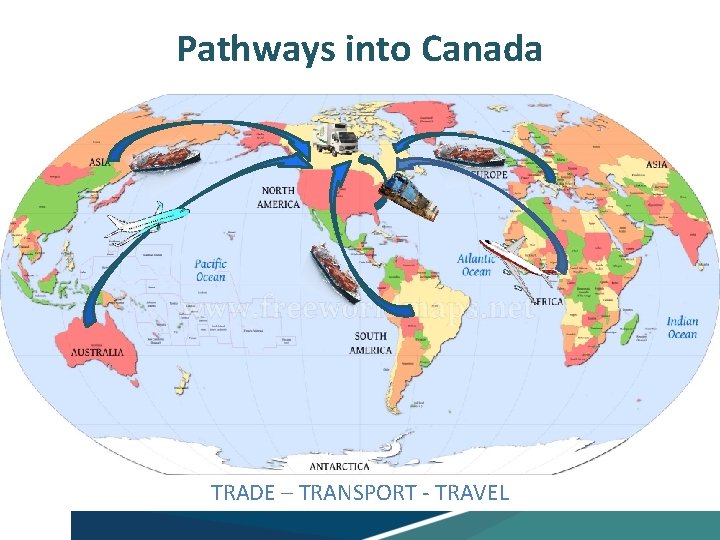
Pathways into Canada TRADE – TRANSPORT - TRAVEL
Focus on Pathways • Managing pathways has the potential to address many pests and • • risks at the same time Traditional pathways are commodity-based (e. g. plants for planting, soil, forest products, wood packaging, grain and fresh produce) Pathways that also pose pest risks include • • Conveyances (e. g. marine vessels) Sea containers Commodities that are not plants/plant products (e. g. steel slabs, tiles, car parts) Transiting shipments Live organisms (e. g. bait, pet food, exhibition) Invasive plants (e. g. birdfeed, biofuels, ornamentals) E-commerce
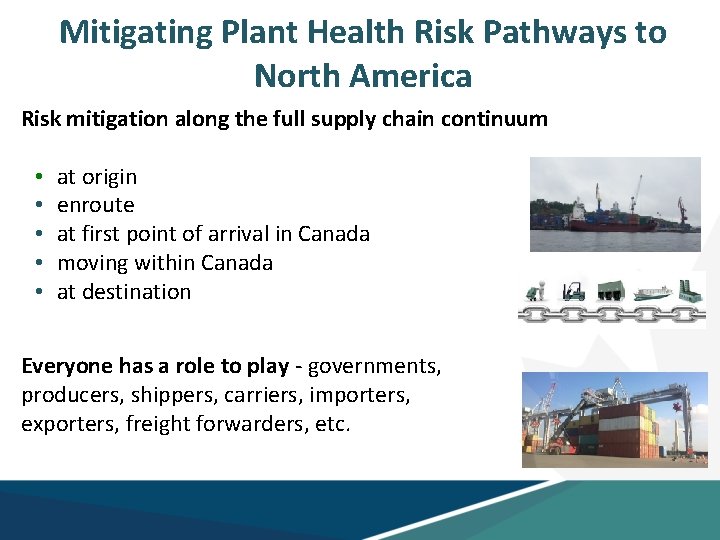
Mitigating Plant Health Risk Pathways to North America Risk mitigation along the full supply chain continuum • • • at origin enroute at first point of arrival in Canada moving within Canada at destination Everyone has a role to play - governments, producers, shippers, carriers, importers, exporters, freight forwarders, etc.
Mitigating Plant Health Risk Pathways to North America Mitigation measures such as • • • policies and programs outreach and awareness (e. g. compliance promotion) international standard setting compliance verification systems approaches and treatments early detection and response Exploring Tools and Technologies • detector dogs and drones for surveys and inspections (e. g. invasive plants, Asian gypsy moth) • new treatments (e. g. cargo, in-field) • data systems (facilitate information collection, sharing and reporting) • remote sensing (identification and diagnostics)
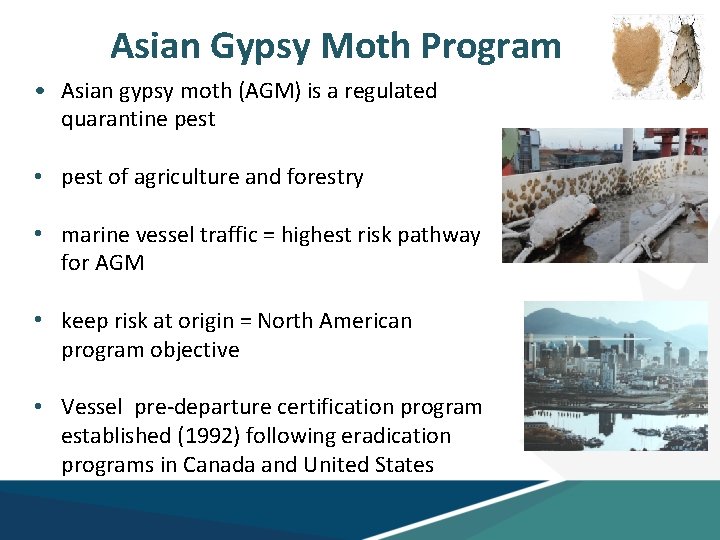
Asian Gypsy Moth Program • Asian gypsy moth (AGM) is a regulated quarantine pest • pest of agriculture and forestry • marine vessel traffic = highest risk pathway for AGM • keep risk at origin = North American program objective • Vessel pre-departure certification program established (1992) following eradication programs in Canada and United States
Asian Gypsy Moth Program • vessels inspected and certified free from AGM in regulated areas (Korea, Japan, China, Russia) • CFIA monitors and inspects to verify compliance • national surveillance trapping for AGM (e. g. Gypsy moth surveillance • Regular engagement with regulated and regulating countries • communication and outreach (e. g. trading partners and the marine transportation industry). is a joint effort between the CFIA and the provincial government of British Columbia)
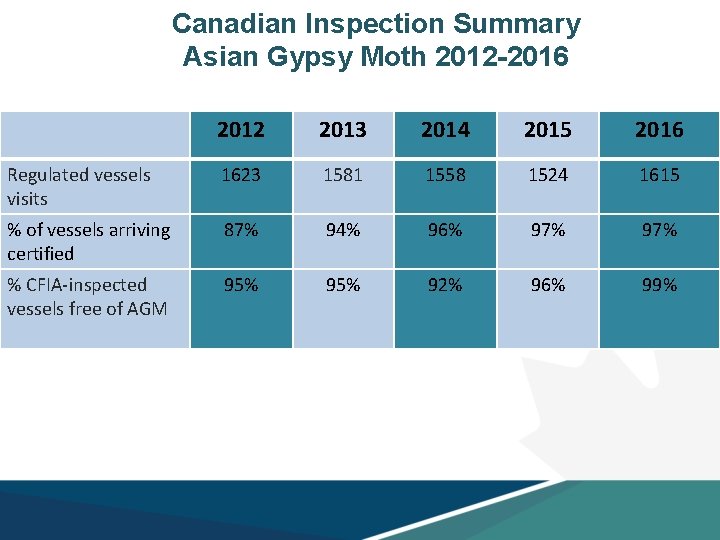
Canadian Inspection Summary Asian Gypsy Moth 2012 -2016 2012 2013 2014 2015 2016 Regulated vessels visits 1623 1581 1558 1524 1615 % of vessels arriving certified 87% 94% 96% 97% % CFIA-inspected vessels free of AGM 95% 92% 96% 99%
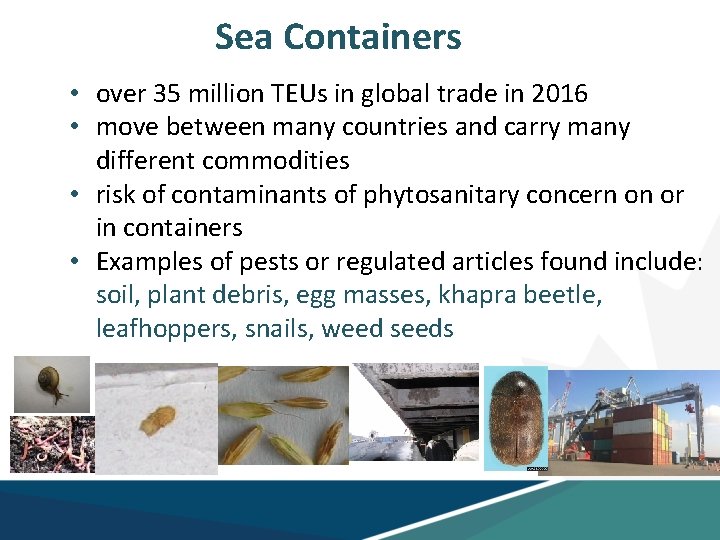
Sea Containers • over 35 million TEUs in global trade in 2016 • move between many countries and carry many different commodities • risk of contaminants of phytosanitary concern on or in containers • Examples of pests or regulated articles found include: soil, plant debris, egg masses, khapra beetle, leafhoppers, snails, weed seeds
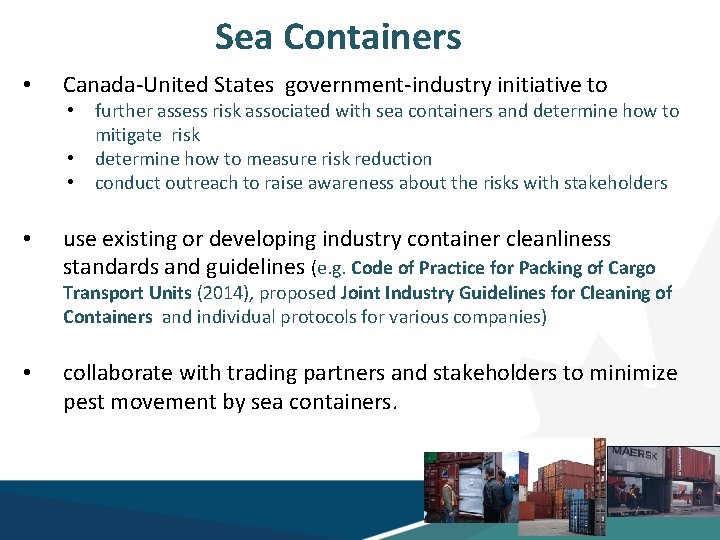
Sea Containers • Canada-United States government-industry initiative to • • further assess risk associated with sea containers and determine how to mitigate risk determine how to measure risk reduction conduct outreach to raise awareness about the risks with stakeholders use existing or developing industry container cleanliness standards and guidelines (e. g. Code of Practice for Packing of Cargo Transport Units (2014), proposed Joint Industry Guidelines for Cleaning of Containers and individual protocols for various companies) • collaborate with trading partners and stakeholders to minimize pest movement by sea containers.
In-transit Shipments • in-transit is the movement from a foreign country, through Canada, to a foreign country • Canada is exposed to the risk of pest introduction from shipments moving in-transit • most non-compliances due to invasive alien species (e. g. snails, weed seeds and live insects) found on articles not regulated by the CFIA (e. g. car parts, tiles, steel slabs)
In-transit Shipments • interim in-transit protocol implemented for U. S. goods transiting Canada back to the U. S. or to a foreign country and for in-transit shipments that were refused entry to the U. S. and are moving through Canada for removal • developing a comprehensive in-transit program for plant health that will include all in-transit movements and modes of transportation. • on-going work with the stakeholders and trading partners to raise awareness and promote compliance
E-Commerce • internet and mail order catalogue sales of regulated pests and potential invasive alien species including plants, molluscs and insects • education and awareness campaign for the import and distribution of invasive species through the e-commerce pathway is key. • inform Canadian importers and exporters of invasive pests, import regulations and requirements in Canada and other countries. • work internationally (e. g. United States, Australia, New Zealand)
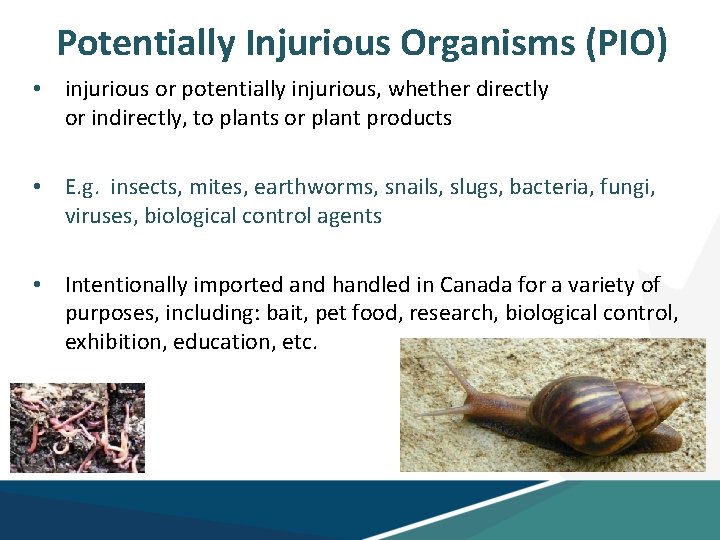
Potentially Injurious Organisms (PIO) • injurious or potentially injurious, whether directly or indirectly, to plants or plant products • E. g. insects, mites, earthworms, snails, slugs, bacteria, fungi, viruses, biological control agents • Intentionally imported and handled in Canada for a variety of purposes, including: bait, pet food, research, biological control, exhibition, education, etc.
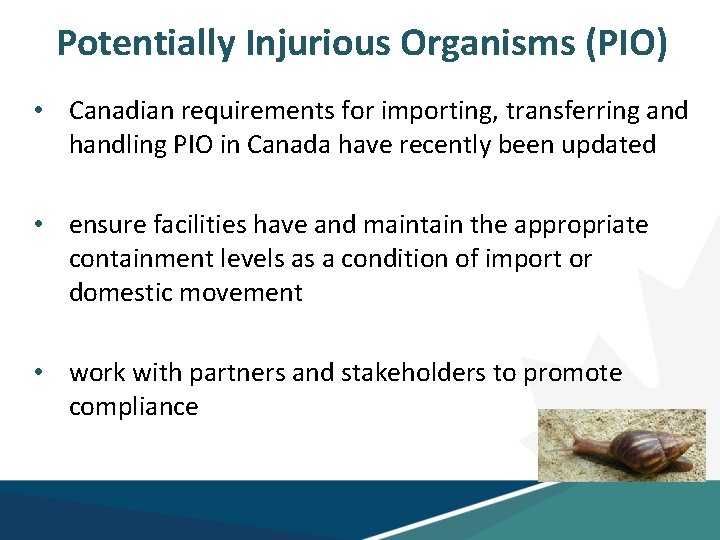
Potentially Injurious Organisms (PIO) • Canadian requirements for importing, transferring and handling PIO in Canada have recently been updated • ensure facilities have and maintain the appropriate containment levels as a condition of import or domestic movement • work with partners and stakeholders to promote compliance
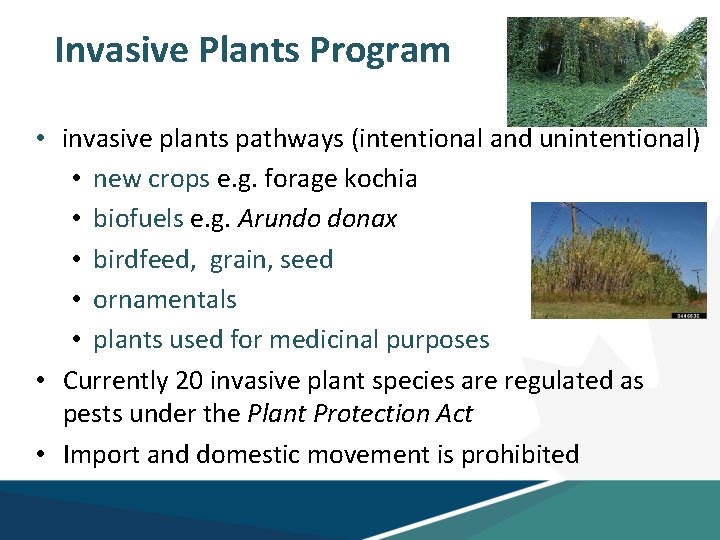
Invasive Plants Program • invasive plants pathways (intentional and unintentional) • new crops e. g. forage kochia • biofuels e. g. Arundo donax • birdfeed, grain, seed • ornamentals • plants used for medicinal purposes • Currently 20 invasive plant species are regulated as pests under the Plant Protection Act • Import and domestic movement is prohibited
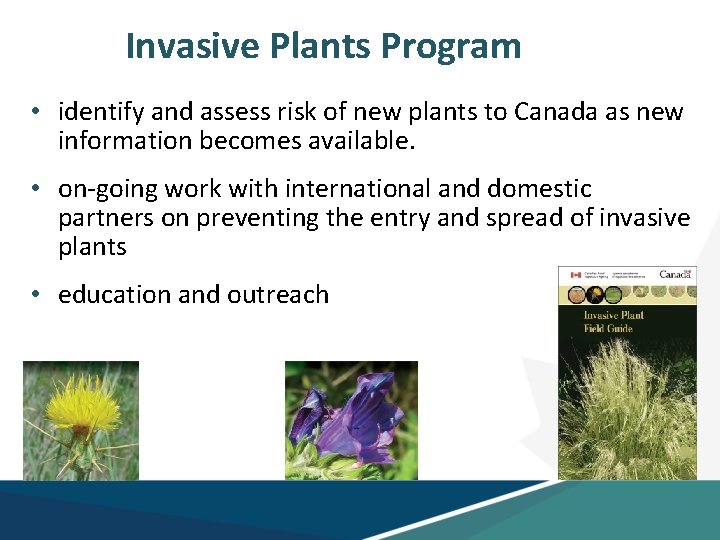
Invasive Plants Program • identify and assess risk of new plants to Canada as new information becomes available. • on-going work with international and domestic partners on preventing the entry and spread of invasive plants • education and outreach
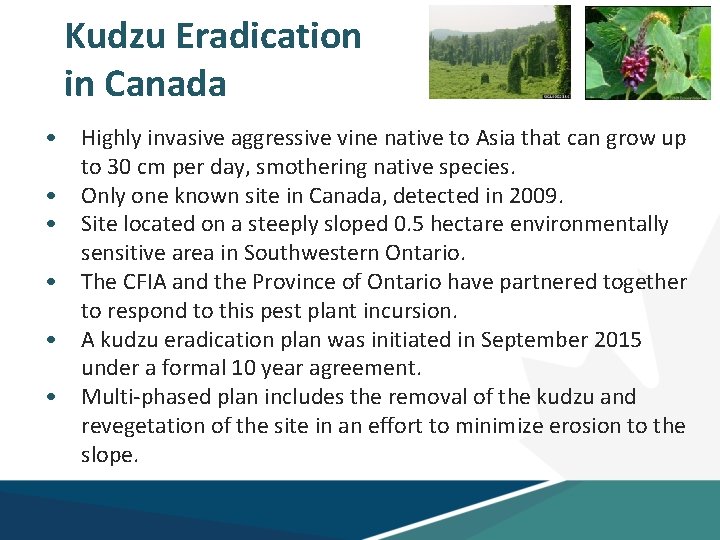
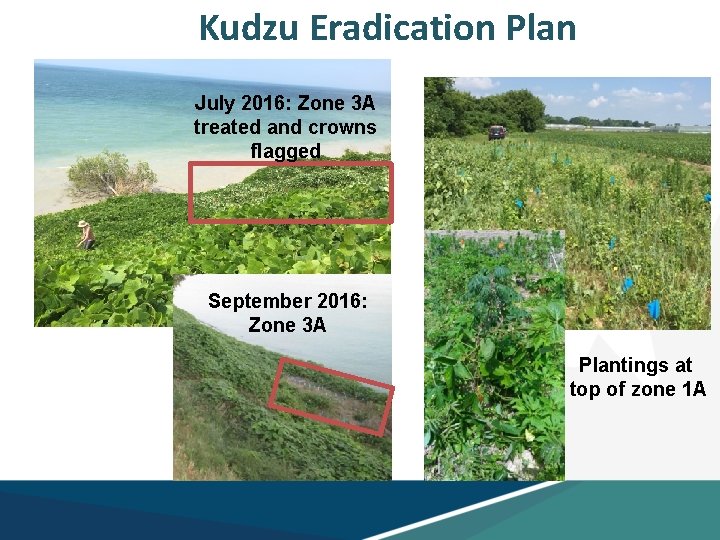
Kudzu Eradication in Canada • Highly invasive aggressive vine native to Asia that can grow up to 30 cm per day, smothering native species. • Only one known site in Canada, detected in 2009. • Site located on a steeply sloped 0. 5 hectare environmentally sensitive area in Southwestern Ontario. • The CFIA and the Province of Ontario have partnered together to respond to this pest plant incursion. • A kudzu eradication plan was initiated in September 2015 under a formal 10 year agreement. • Multi-phased plan includes the removal of the kudzu and revegetation of the site in an effort to minimize erosion to the slope.
Kudzu Eradication Plan July 2016: Zone 3 A treated and crowns flagged September 2016: Zone 3 A Plantings at top of zone 1 A
Working Together • better understand challenges and opportunities for risk identification and mitigation • minimize risk while maintaining trade flow, where feasible Shared risk and shared responsibility
Thank You. Comments, Questions, Discussion? For more information, please contact: CFIA-IAS_ACIA-EEE@inspection. gc. ca and sign up for the Invasive Species Listserv visit CFIA’s website at: www. inspection. gc. ca