
Plant Organs Roots Stems I Roots A Fxs


- Slides: 34
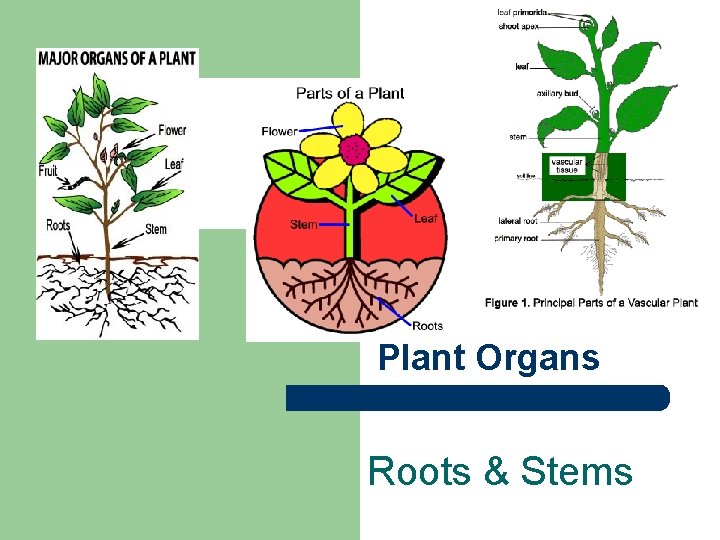
Plant Organs Roots & Stems
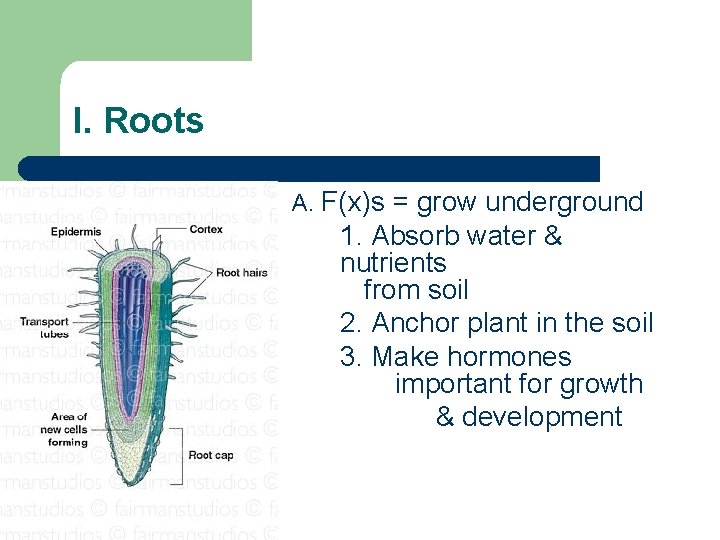
I. Roots A. F(x)s = grow underground 1. Absorb water & nutrients from soil 2. Anchor plant in the soil 3. Make hormones important for growth & development
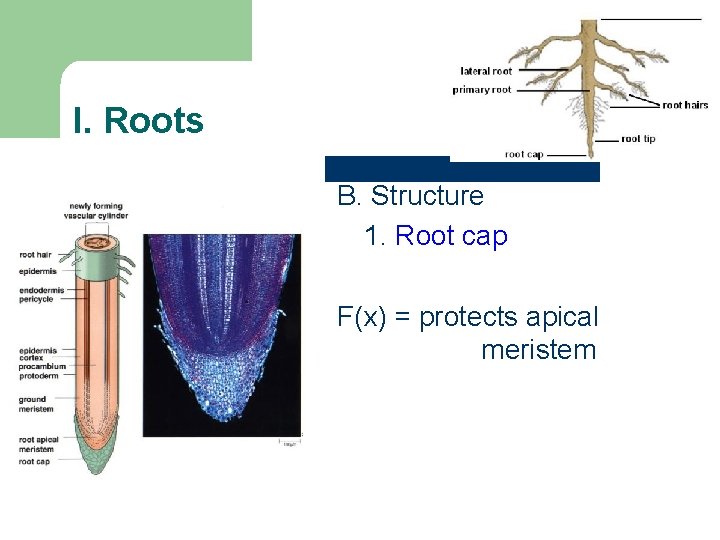
I. Roots B. Structure 1. Root cap F(x) = protects apical meristem
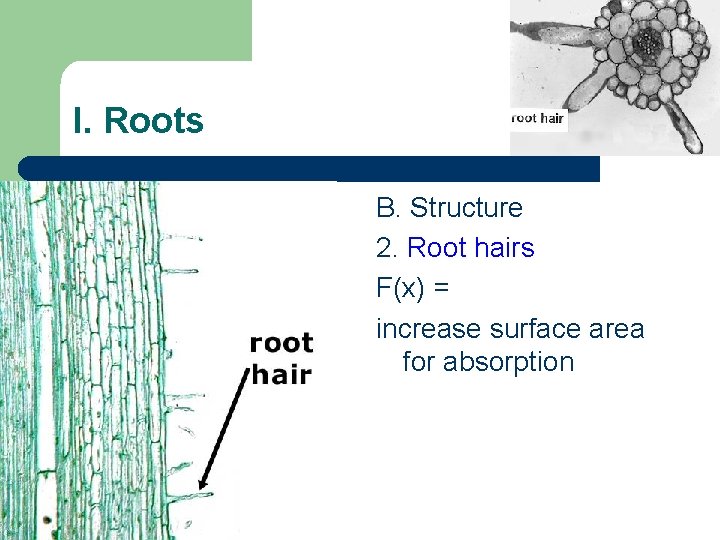
I. Roots B. Structure 2. Root hairs F(x) = increase surface area for absorption
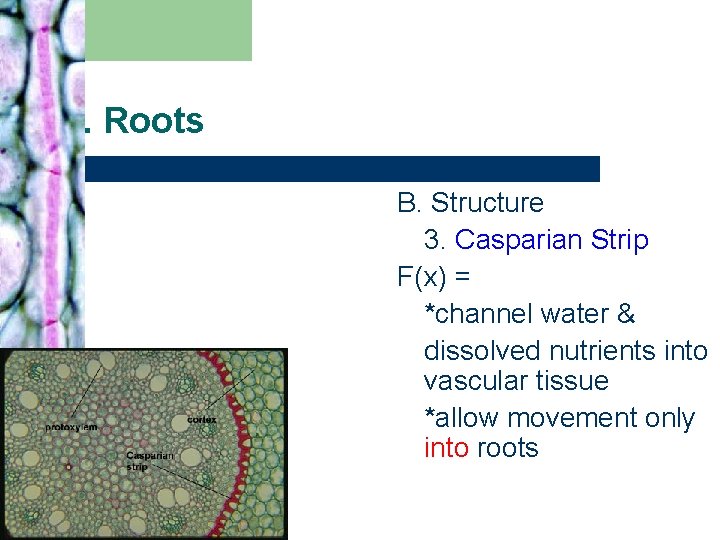
I. Roots B. Structure 3. Casparian Strip F(x) = *channel water & dissolved nutrients into vascular tissue *allow movement only into roots
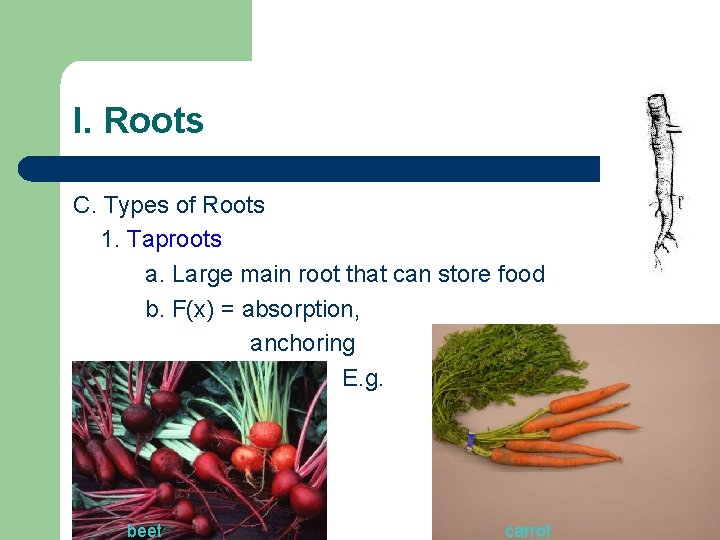
I. Roots C. Types of Roots 1. Taproots a. Large main root that can store food b. F(x) = absorption, anchoring E. g. beet carrot
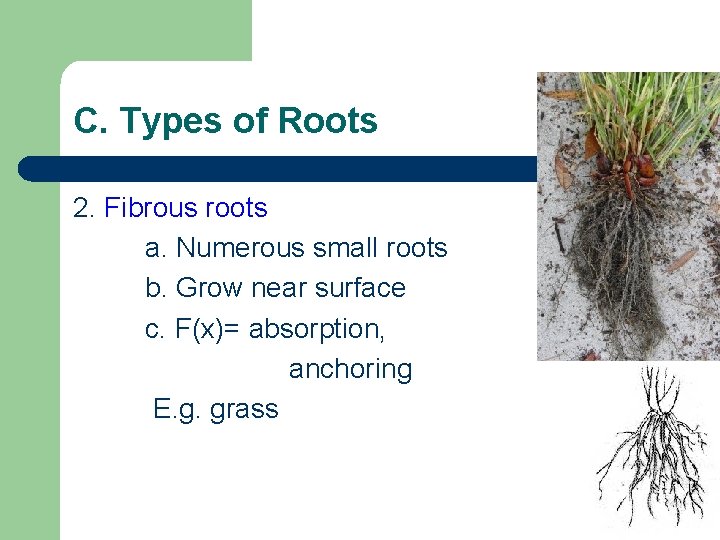
C. Types of Roots 2. Fibrous roots a. Numerous small roots b. Grow near surface c. F(x)= absorption, anchoring E. g. grass
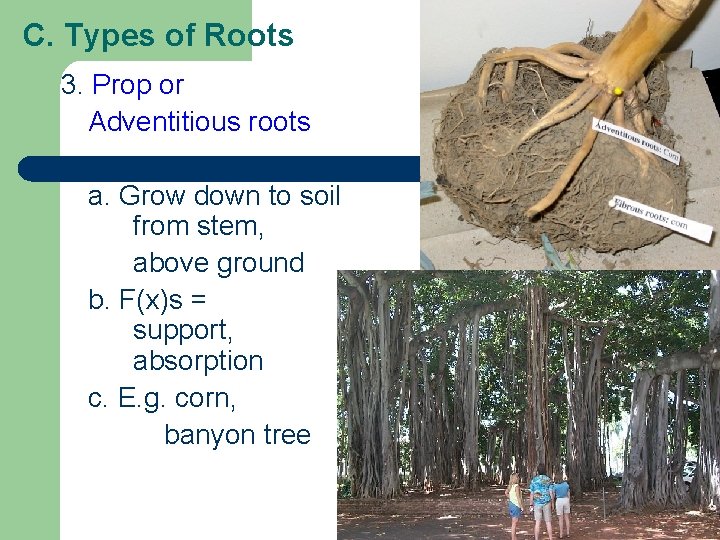
C. Types of Roots 3. Prop or Adventitious roots a. Grow down to soil from stem, above ground b. F(x)s = support, absorption c. E. g. corn, banyon tree
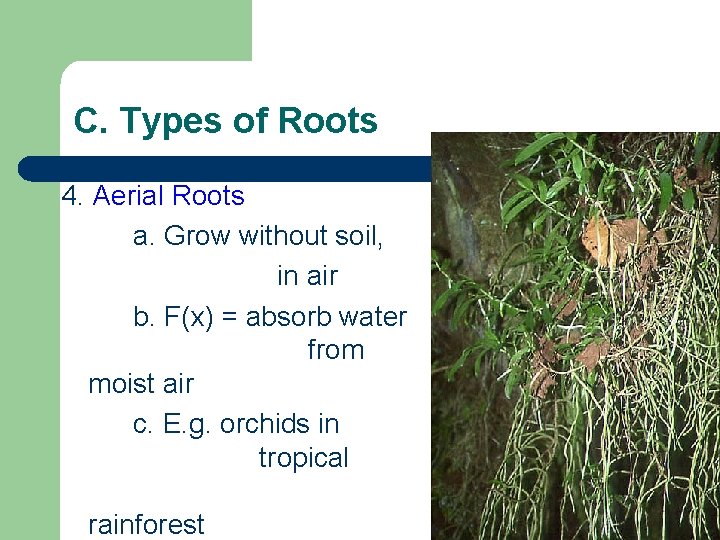
C. Types of Roots 4. Aerial Roots a. Grow without soil, in air b. F(x) = absorb water from moist air c. E. g. orchids in tropical rainforest
II. Stems A. F(x)s 1. Hold leaves up to sunlight 2. Transport water & nutrients from roots to leaves 3. Food storage in some plants
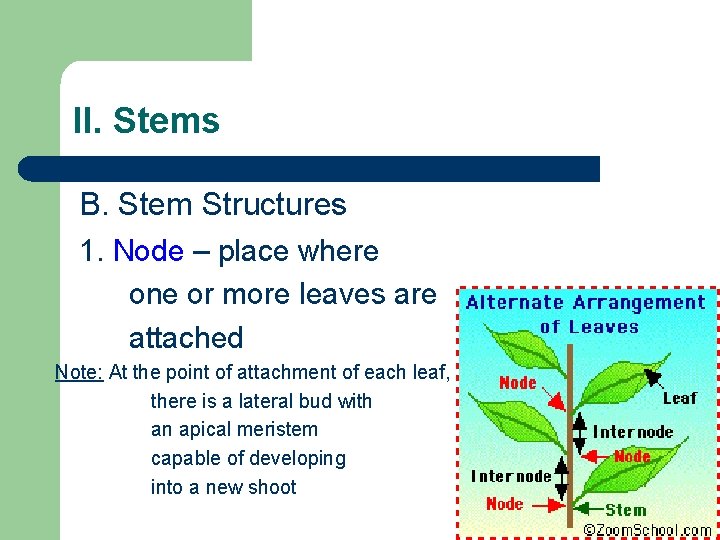
II. Stems B. Stem Structures 1. Node – place where one or more leaves are attached Note: At the point of attachment of each leaf, there is a lateral bud with an apical meristem capable of developing into a new shoot
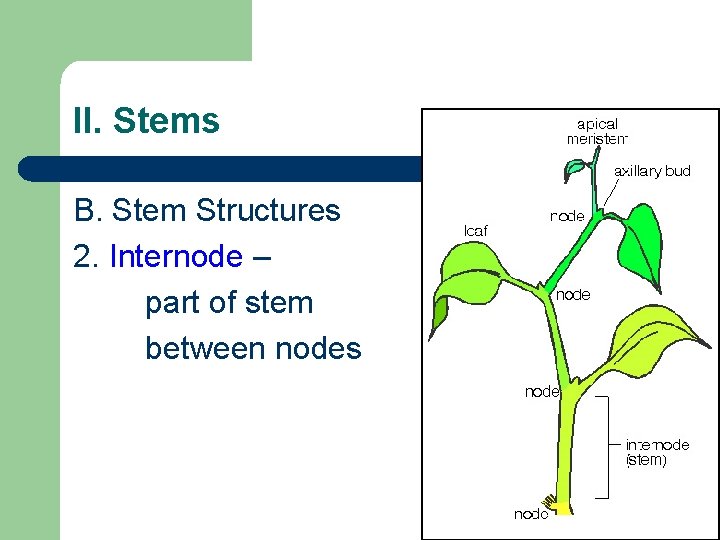
II. Stems B. Stem Structures 2. Internode – part of stem between nodes
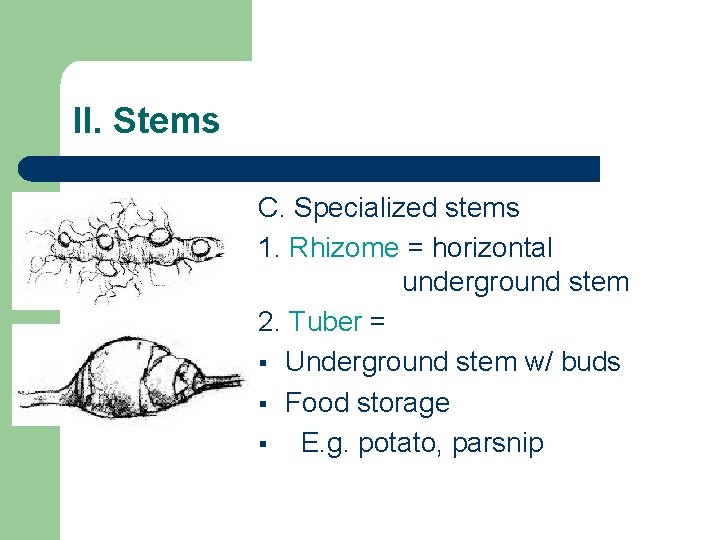
II. Stems C. Specialized stems 1. Rhizome = horizontal underground stem 2. Tuber = § Underground stem w/ buds § Food storage § E. g. potato, parsnip
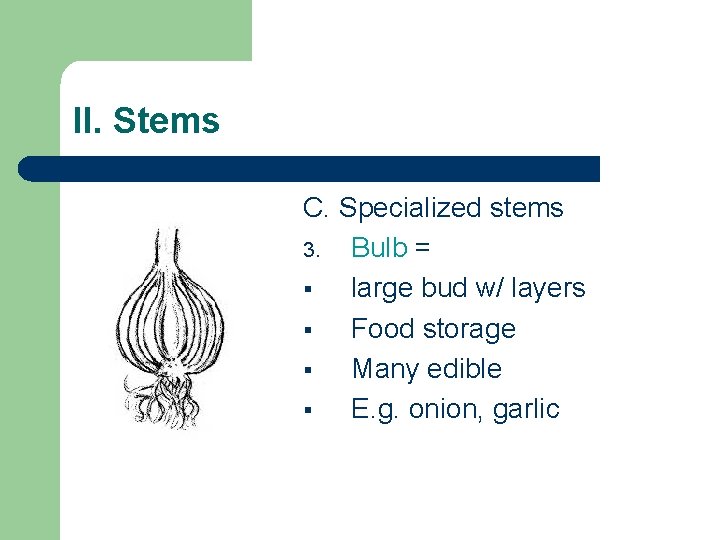
II. Stems C. Specialized stems 3. Bulb = § large bud w/ layers § Food storage § Many edible § E. g. onion, garlic
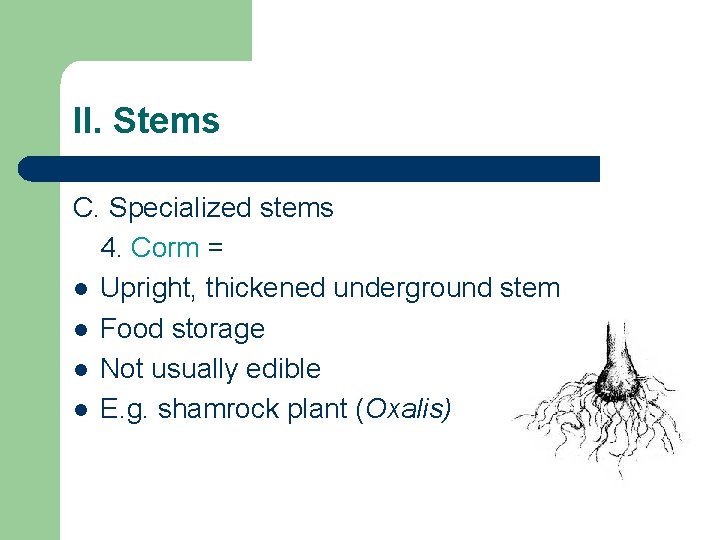
II. Stems C. Specialized stems 4. Corm = l Upright, thickened underground stem l Food storage l Not usually edible l E. g. shamrock plant (Oxalis)
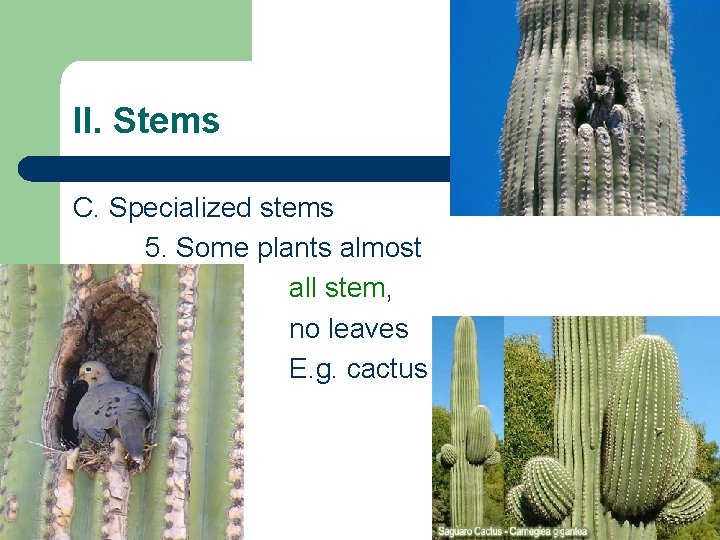
II. Stems C. Specialized stems 5. Some plants almost all stem, no leaves E. g. cactus
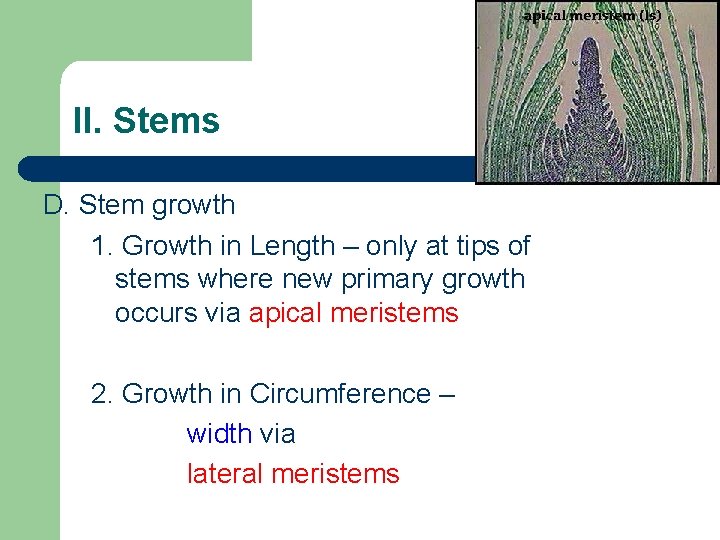
II. Stems D. Stem growth 1. Growth in Length – only at tips of stems where new primary growth occurs via apical meristems 2. Growth in Circumference – width via lateral meristems
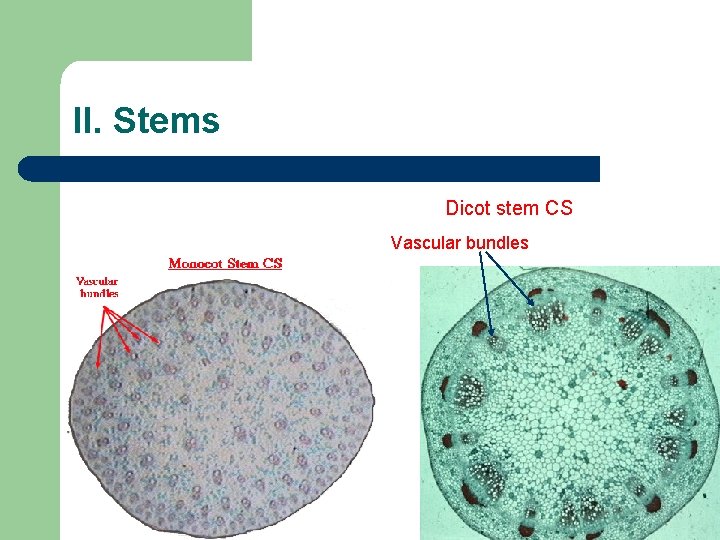
II. Stems E. Primary Growth in Stems 1. Vascular tissue arranged in vascular bundles 2. Dicots – bundles in a ring around outside edge 3. Monocots – bundles scattered throughout stem
II. Stems Dicot stem CS Vascular bundles
II. Stems E. Primary Growth in Stems 4. Pith – center of the stem 5. Cortex – ground tissue btwn. Vascular Bundles & epidermis Vascular bundle dicot monocot
II. Stems F. Secondary Growth in Stems ¿Which get wider year after year, monocots or dicots? DICOTS! **Most monocots have no secondary growth. 1. ↑stem width in dicots due to cell ÷ in vascular cambium
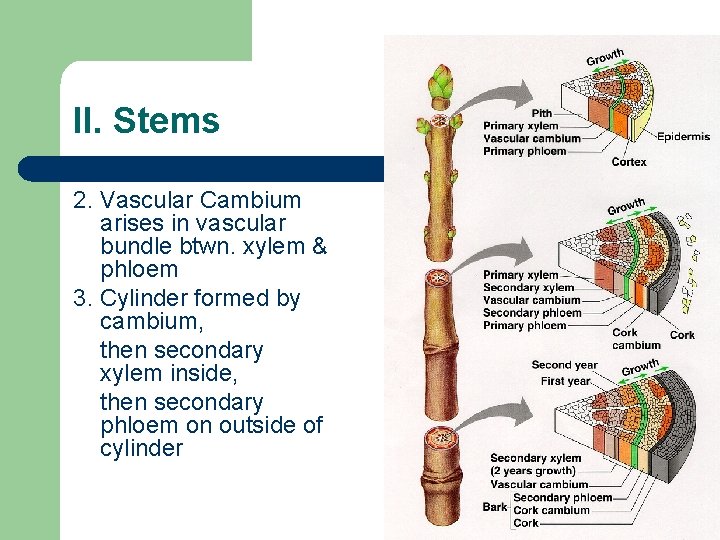
II. Stems 2. Vascular Cambium arises in vascular bundle btwn. xylem & phloem 3. Cylinder formed by cambium, then secondary xylem inside, then secondary phloem on outside of cylinder
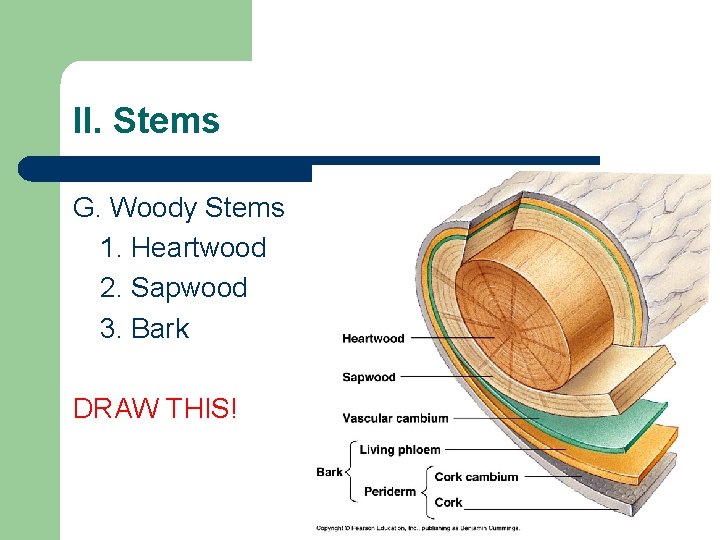
II. Stems G. Woody Stems 1. Heartwood 2. Sapwood 3. Bark DRAW THIS!
II. Stems G. Woody Stems 1. Heartwood v Dark color v Center of tree trunk v Dead xylem , no longer transports water v F(x) = support
II. Stems G. Woody Stems 2. Sapwood v Lighter in color v Nearer to outside of tree trunk v F(x) = transport (live xylem) Note: In a large diameter tree, heartwood gets wider, sapwood stays relatively same width
II. Stems G. Woody Stems 3. Bark v F(x) = protection v Made of cork, cork cambium & phloem
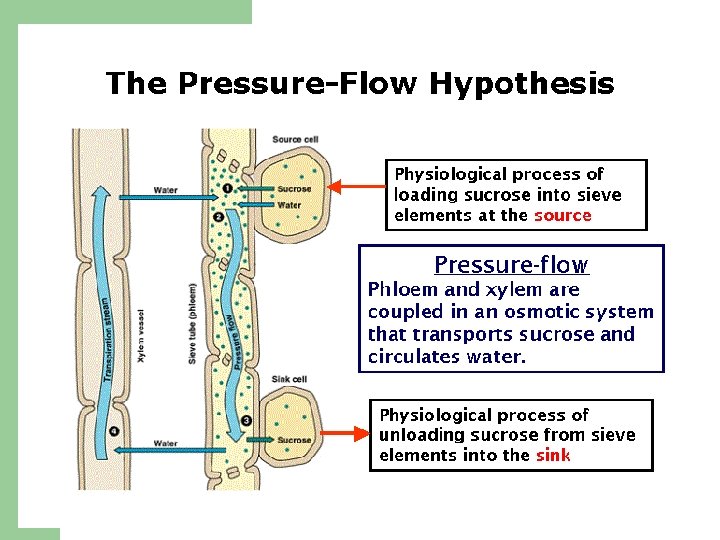
II. Stems H. Stem F(x)s 1. Phloem moves sugars a. Translocation – sugars moved from source (photosynthesis in leaves) to sink (where they are stored) b. Products of Photosynthesis can move in ____? ___ direction ANY
II. Stems H. Stem F(x)s 1. Phloem moves sugars c. Pressure – Flow Hypothesis i. Sugars PUMPED into sieve tubes @ the source ii. Turgor = pressure increase due to water entering sieve tubes by osmosis
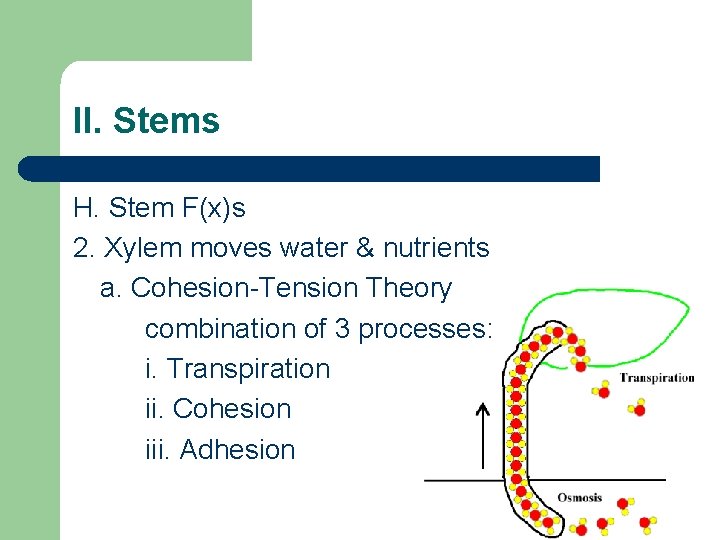
II. Stems H. Stem F(x)s 2. Xylem moves water & nutrients a. Cohesion-Tension Theory combination of 3 processes: i. Transpiration ii. Cohesion iii. Adhesion
Transpiration l l In leaves, release of excess water to atmosphere Creates negative pressure in xylem Replacement water pulled from xylem Water enters roots to replace lost water
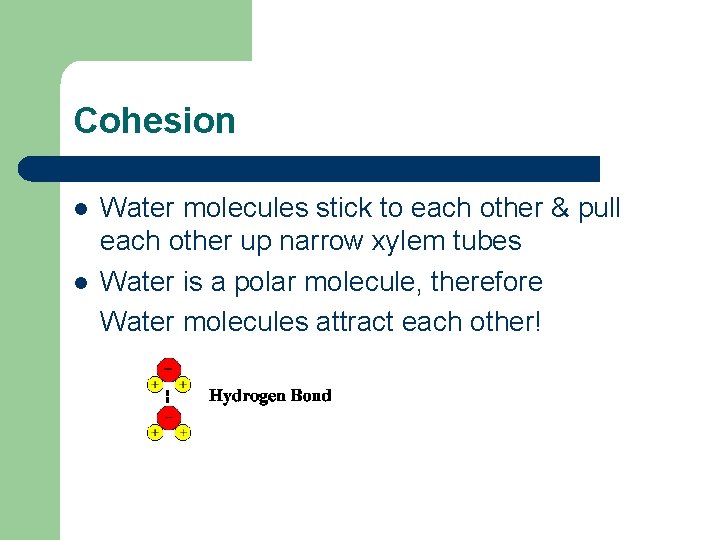
Cohesion l l Water molecules stick to each other & pull each other up narrow xylem tubes Water is a polar molecule, therefore Water molecules attract each other!
Adhesion l Water molecules strongly attracted to xylem wall
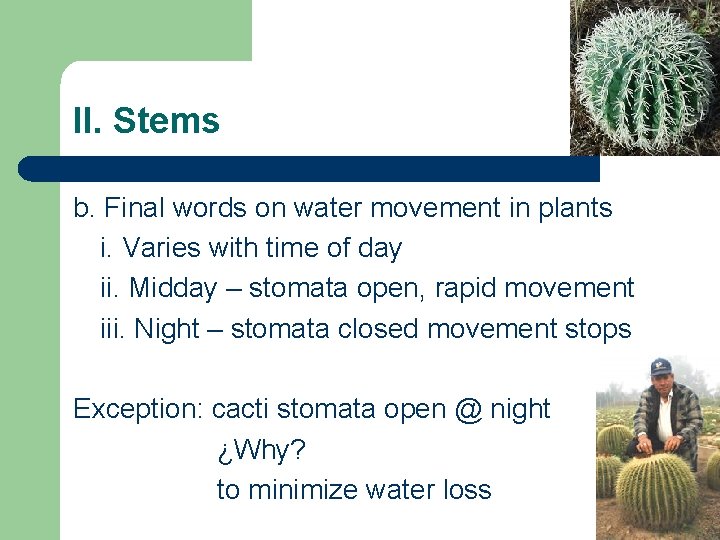
II. Stems b. Final words on water movement in plants i. Varies with time of day ii. Midday – stomata open, rapid movement iii. Night – stomata closed movement stops Exception: cacti stomata open @ night ¿Why? to minimize water loss