
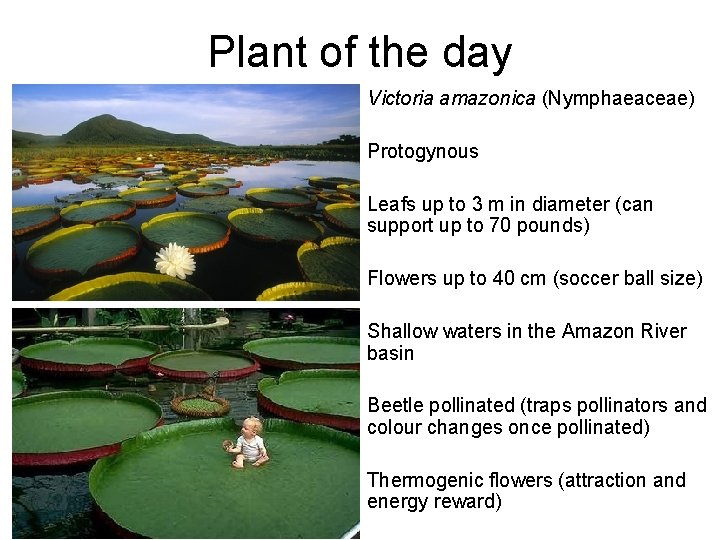
Plant of the day Victoria amazonica Nymphaeaceae Protogynous
- Slides: 43
Plant of the day Victoria amazonica (Nymphaeaceae) Protogynous Leafs up to 3 m in diameter (can support up to 70 pounds) Flowers up to 40 cm (soccer ball size) Shallow waters in the Amazon River basin Beetle pollinated (traps pollinators and colour changes once pollinated) Thermogenic flowers (attraction and energy reward)
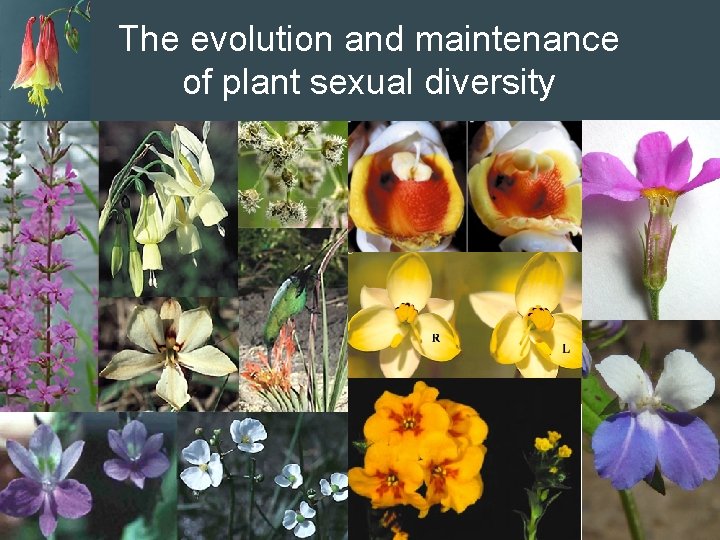
The evolution and maintenance of plant sexual diversity
Why study polymorphic sexual Why is there high sexual diversity systems? in flowering plants? • Immobility (rely on pollen vectors) • Hermaphoditism (self-fertilization) • Modular growth - get bigger by producing repeating organs via apical meristems (clonality and inter flower selfing) • Closed carpel (mate selection e. g. SI) • Life history diversity (mating patterns depend on longevity, plant size etc. )
sexual systems Sexual system: the particular deployment of sexual structures within and among plants and the physiological mechanisms governing mating Sexual interference: conflict in maternal and paternal functions resulting in gamete wastage and reduced fitness -physical interference, pollen clogging stigma, self fertilization etc -may or may not be associated with self-pollination
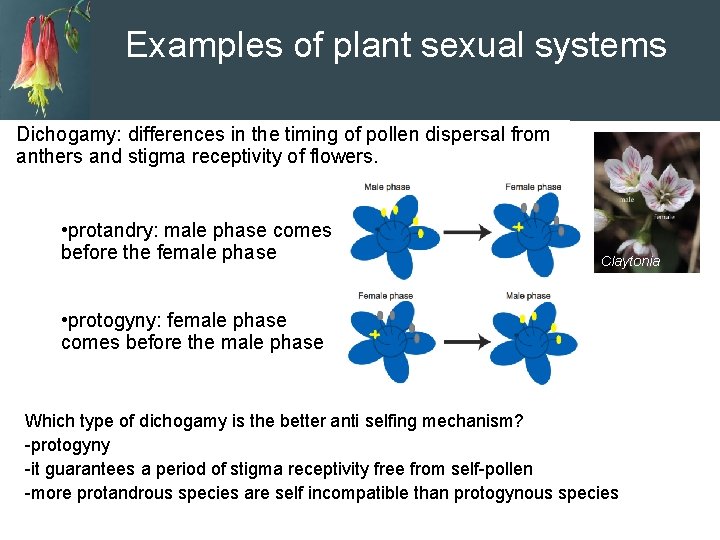
Examples of plant sexual systems Dichogamy: differences in the timing of pollen dispersal from anthers and stigma receptivity of flowers. • protandry: male phase comes before the female phase Claytonia • protogyny: female phase comes before the male phase Which type of dichogamy is the better anti selfing mechanism? -protogyny -it guarantees a period of stigma receptivity free from self-pollen -more protandrous species are self incompatible than protogynous species
Examples of plant sexual systems Many dichogamous species are also self incompatible. Why? -may serve to reduce interference between maternal and paternal functions rather than just preventing selfing and inbreeding depression
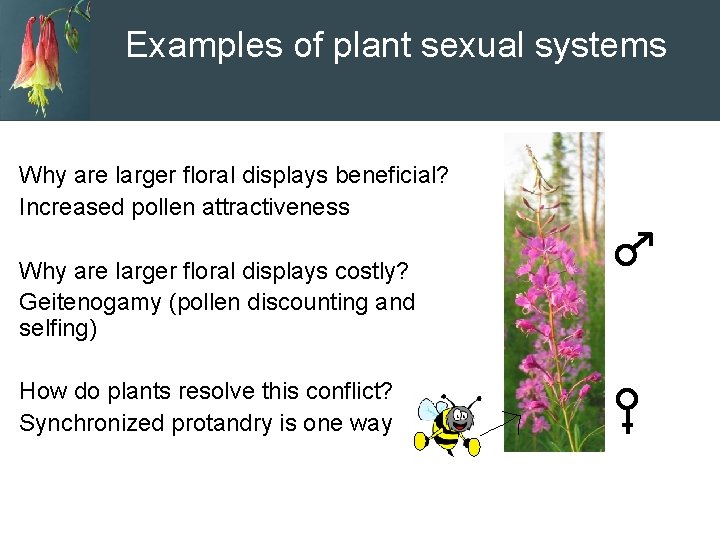
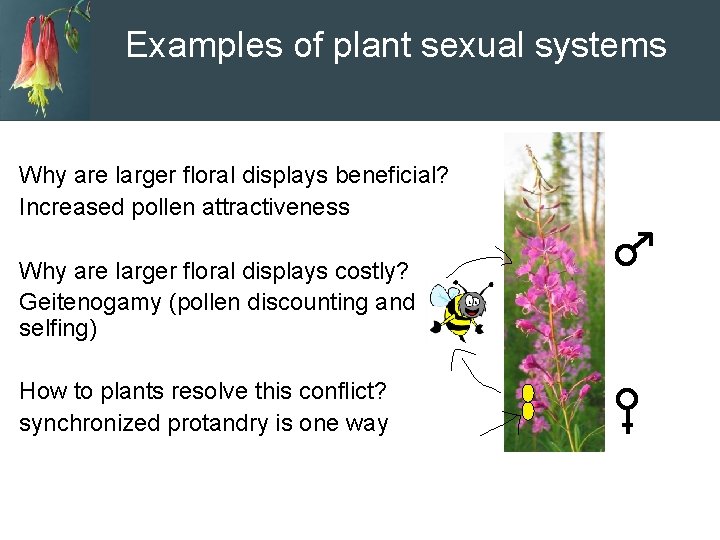
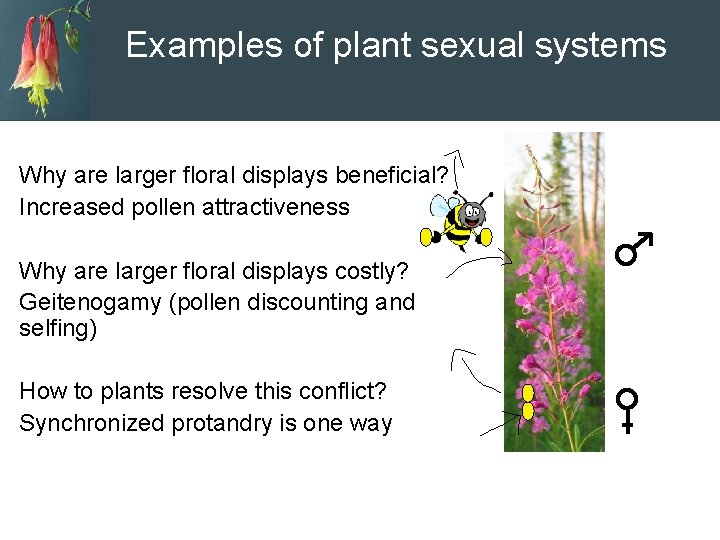
Examples of plant sexual systems Why are larger floral displays beneficial? Increased pollen attractiveness Why are larger floral displays costly? Geitenogamy (pollen discounting and selfing) How do plants resolve this conflict? Synchronized protandry is one way
Examples of plant sexual systems Why are larger floral displays beneficial? Increased pollen attractiveness Why are larger floral displays costly? Geitenogamy (pollen discounting and selfing) How to plants resolve this conflict? synchronized protandry is one way
Examples of plant sexual systems Why are larger floral displays beneficial? Increased pollen attractiveness Why are larger floral displays costly? Geitenogamy (pollen discounting and selfing) How to plants resolve this conflict? Synchronized protandry is one way
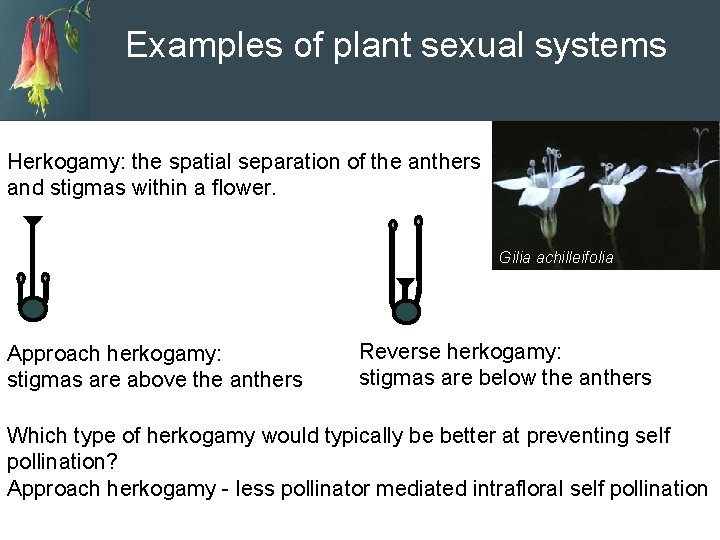
Examples of plant sexual systems Herkogamy: the spatial separation of the anthers and stigmas within a flower. Gilia achilleifolia Approach herkogamy: stigmas are above the anthers Reverse herkogamy: stigmas are below the anthers Which type of herkogamy would typically be better at preventing self pollination? Approach herkogamy - less pollinator mediated intrafloral self pollination
Examples of plant sexual systems Many herkogamous species are also self incompatible. Why? -herkogamy may serve to reduce interference between maternal and paternal functions rather than just preventing selfing and inbreeding depression
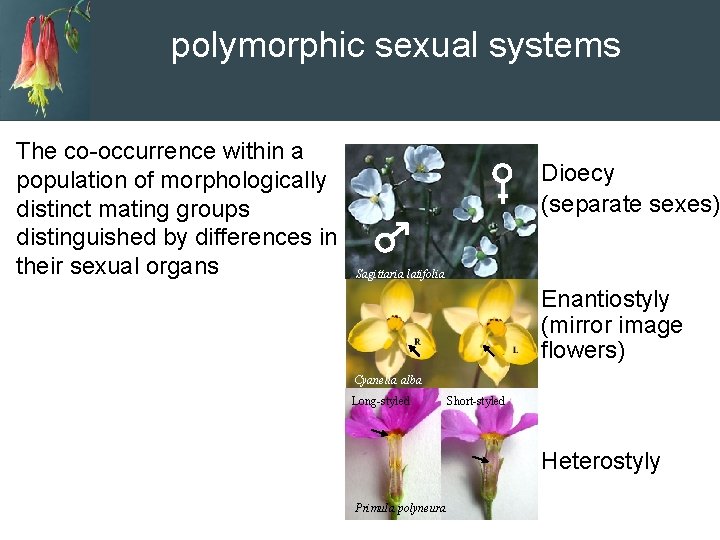
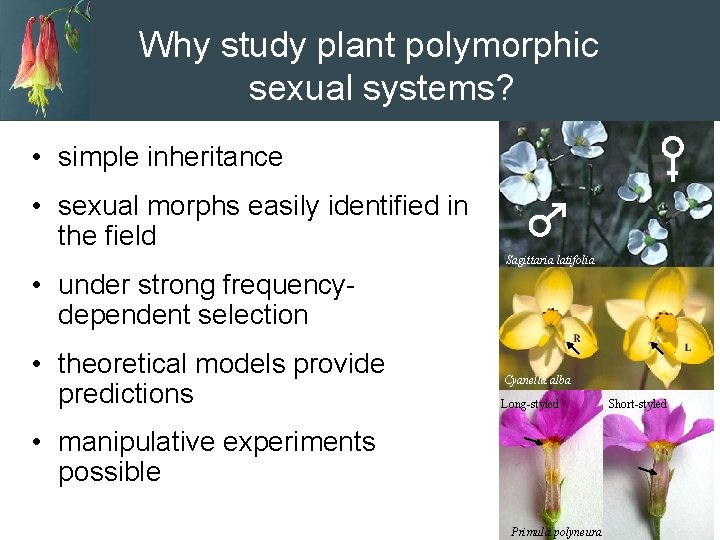
polymorphic sexual systems The co-occurrence within a population of morphologically distinct mating groups distinguished by differences in their sexual organs Dioecy (separate sexes) Sagittaria latifolia Enantiostyly (mirror image flowers) Cyanella alba Long-styled Short-styled Heterostyly Primula polyneura
Why study polymorphic sexual Why study plant polymorphic systems? sexual systems? • simple inheritance • sexual morphs easily identified in the field Sagittaria latifolia • under strong frequencydependent selection • theoretical models provide predictions Cyanella alba Long-styled • manipulative experiments possible Primula polyneura Short-styled
The evolution of separate sexes ~ 1/2 of flowering plant families have species with separate sexes ~6% of species have separate sexes How do separate sexes evolve from cosexuality?
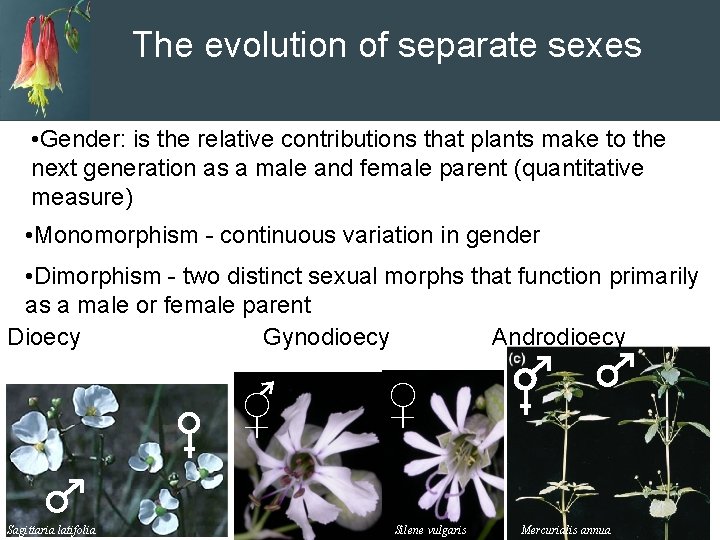
The evolution of separate sexes • Gender: is the relative contributions that plants make to the next generation as a male and female parent (quantitative measure) • Monomorphism - continuous variation in gender • Dimorphism - two distinct sexual morphs that function primarily as a male or female parent Dioecy Gynodioecy Androdioecy ♀ Sagittaria latifolia ♀ Silene vulgaris Mercurialis annua
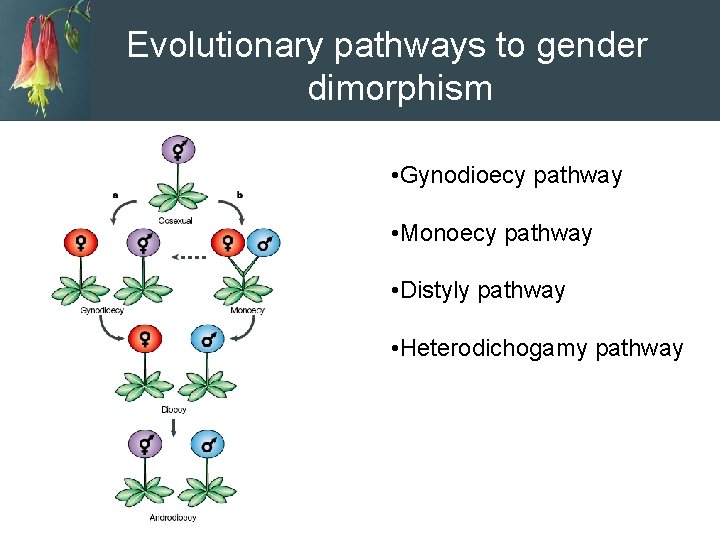
Evolutionary pathways to gender dimorphism • Gynodioecy pathway • Monoecy pathway • Distyly pathway • Heterodichogamy pathway
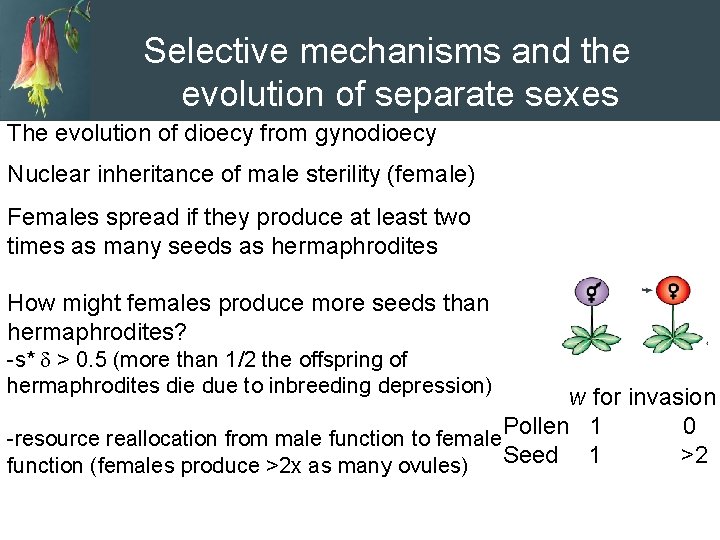
Selective mechanisms and the evolution of separate sexes The evolution of dioecy from gynodioecy Nuclear inheritance of male sterility (female) Females spread if they produce at least two times as many seeds as hermaphrodites How might females produce more seeds than hermaphrodites? -s* > 0. 5 (more than 1/2 the offspring of hermaphrodites die due to inbreeding depression) w for invasion Pollen 1 0 -resource reallocation from male function to female Seed 1 >2 function (females produce >2 x as many ovules)
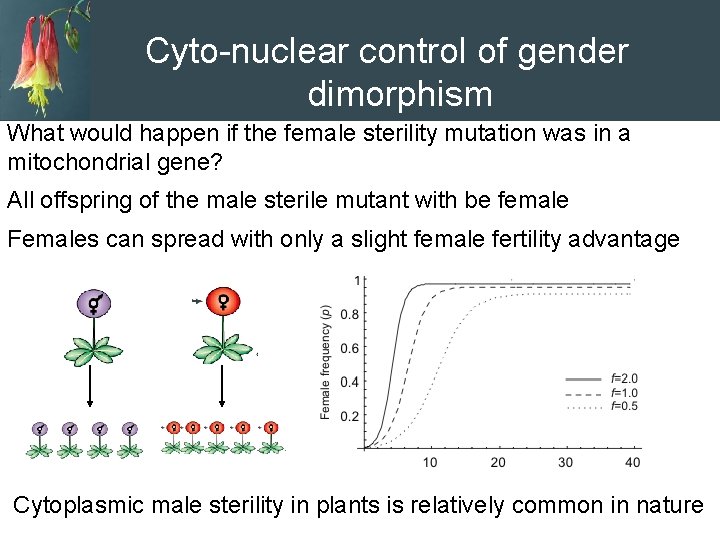
Cyto-nuclear control of gender dimorphism What would happen if the female sterility mutation was in a mitochondrial gene? All offspring of the male sterile mutant with be female Females can spread with only a slight female fertility advantage Cytoplasmic male sterility in plants is relatively common in nature
The next step to dioecy In a gynodioecious population hermaphrodites pass on most of their genes through pollen Selection for enhanced male function in hermaphrodites can lead to separate sexes
Selective mechanisms and the evolution of separate sexes What factors could lead to increased selfing and the evolution of dioecy?
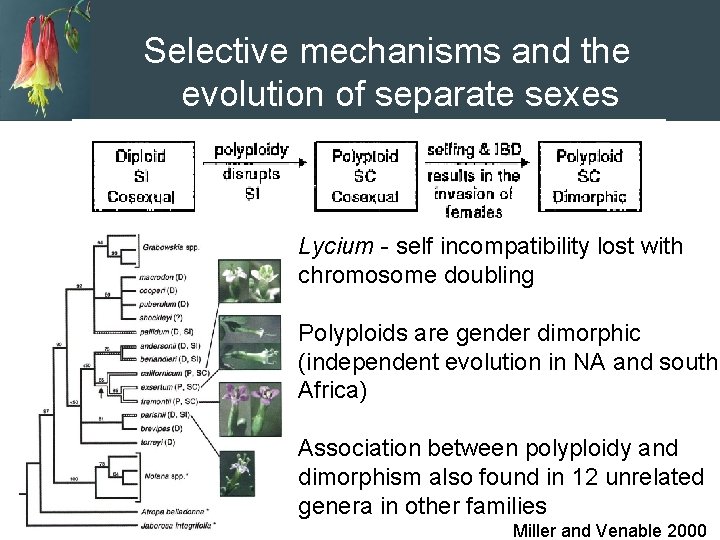
Selective mechanisms and the evolution of separate sexes Lycium - self incompatibility lost with chromosome doubling Polyploids are gender dimorphic (independent evolution in NA and south Africa) Association between polyploidy and dimorphism also found in 12 unrelated genera in other families Miller and Venable 2000
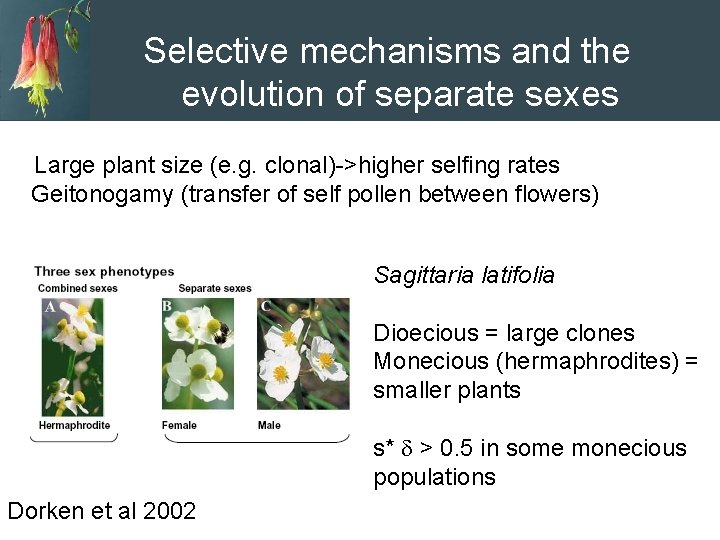
Selective mechanisms and the evolution of separate sexes Large plant size (e. g. clonal)->higher selfing rates Geitonogamy (transfer of self pollen between flowers) Sagittaria latifolia Dioecious = large clones Monecious (hermaphrodites) = smaller plants s* > 0. 5 in some monecious populations Dorken et al 2002
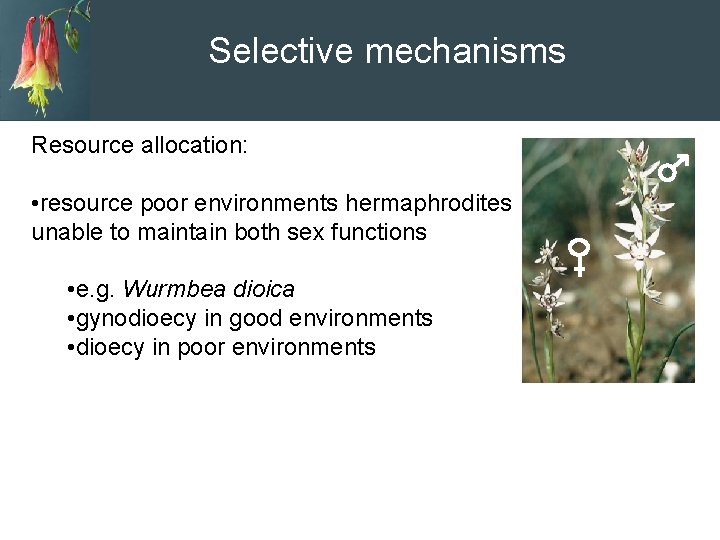
Selective mechanisms Resource allocation: • resource poor environments hermaphrodites unable to maintain both sex functions • e. g. Wurmbea dioica • gynodioecy in good environments • dioecy in poor environments
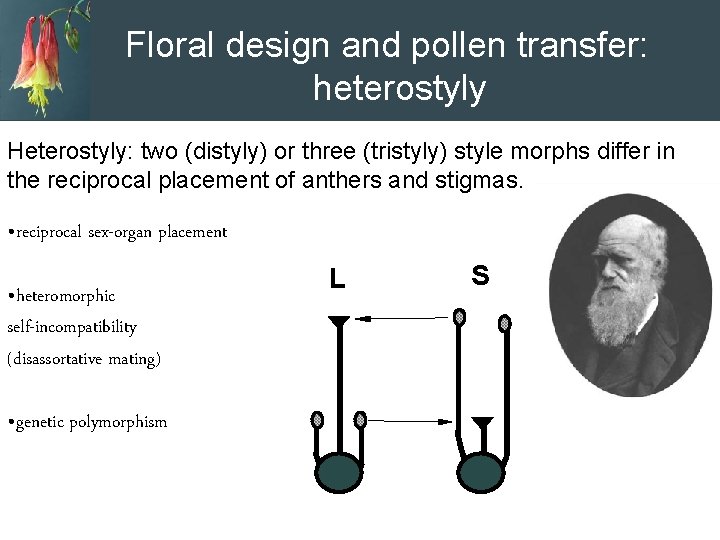
Floral design and pollen transfer: heterostyly Heterostyly: two (distyly) or three (tristyly) style morphs differ in the reciprocal placement of anthers and stigmas. • reciprocal sex-organ placement • heteromorphic self-incompatibility (disassortative mating) • genetic polymorphism L S
Floral design and pollen transfer: heterostyly How does heterostyly evolve?
Floral design and pollen transfer
Floral design and pollen transfer: heterostyly How is heterostyly maintained?
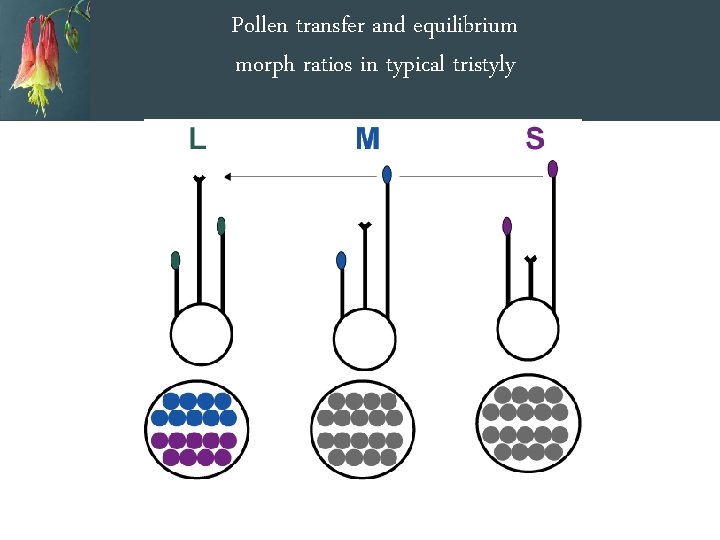
Pollen transfer and equilibrium morph ratios in typical tristyly
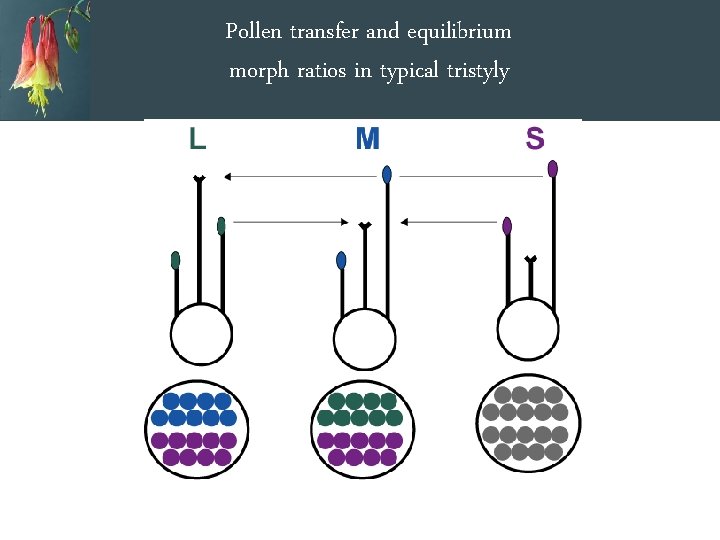
Pollen transfer and equilibrium morph ratios in typical tristyly
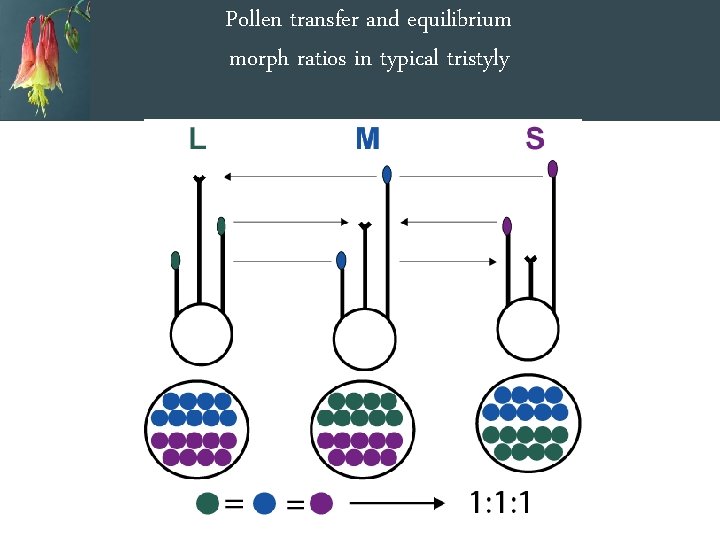
Pollen transfer and equilibrium morph ratios in typical tristyly
Pollen transfer and equilibrium morph ratios in typical tristyly
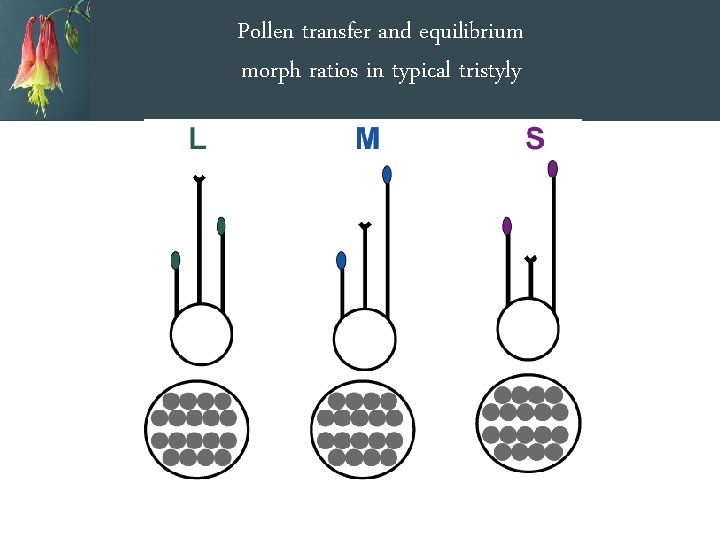
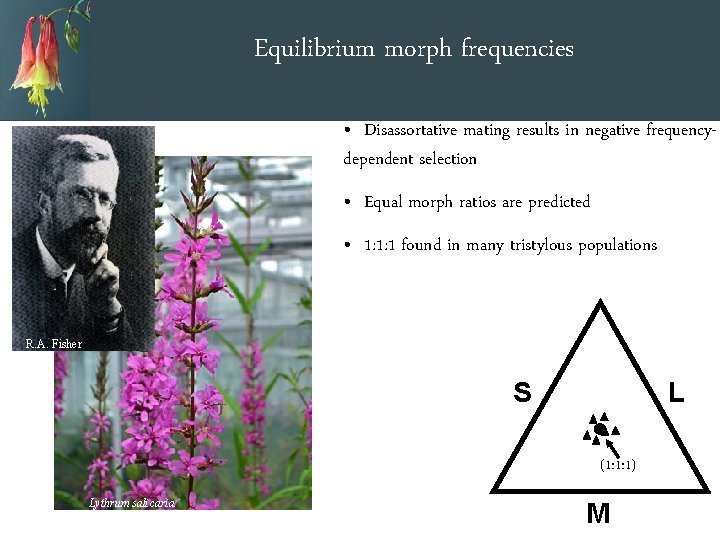
Equilibrium morph frequencies • Disassortative mating results in negative frequencydependent selection • Equal morph ratios are predicted • 1: 1: 1 found in many tristylous populations R. A. Fisher S L (1: 1: 1) Lythrum salicaria M
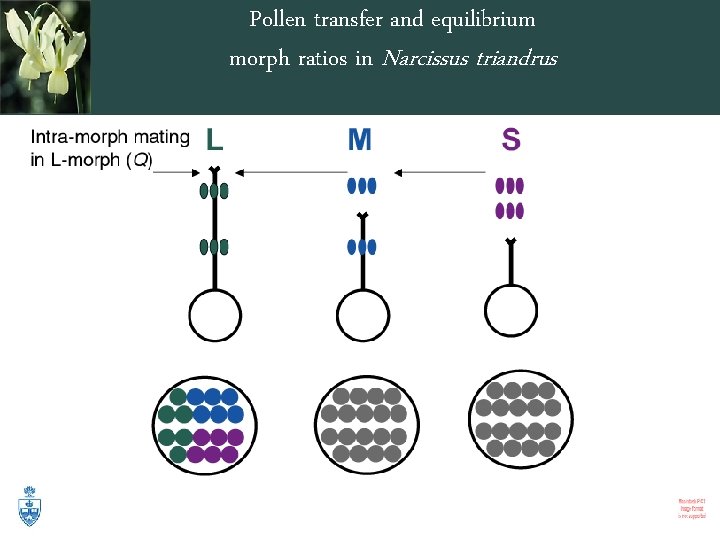
Pollen transfer and equilibrium morph ratios in Narcissus triandrus
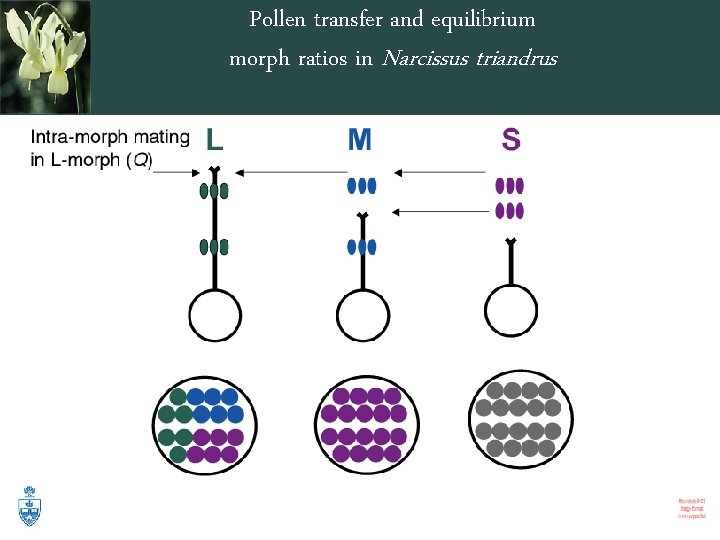
Pollen transfer and equilibrium morph ratios in Narcissus triandrus
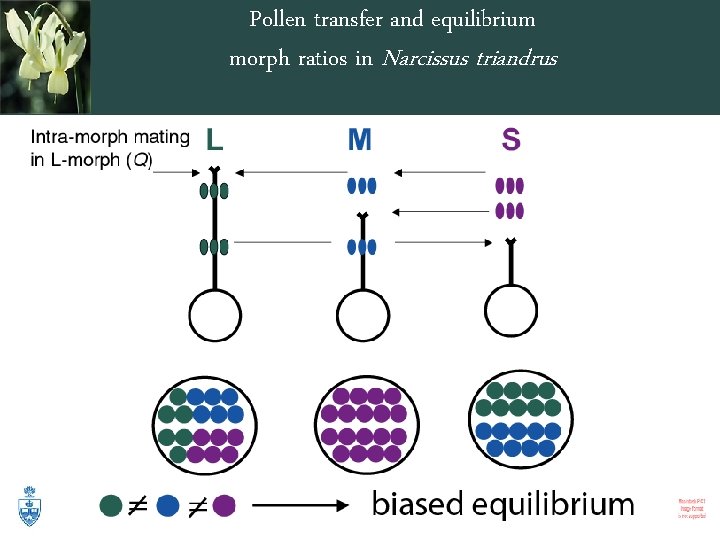
Pollen transfer and equilibrium morph ratios in Narcissus triandrus
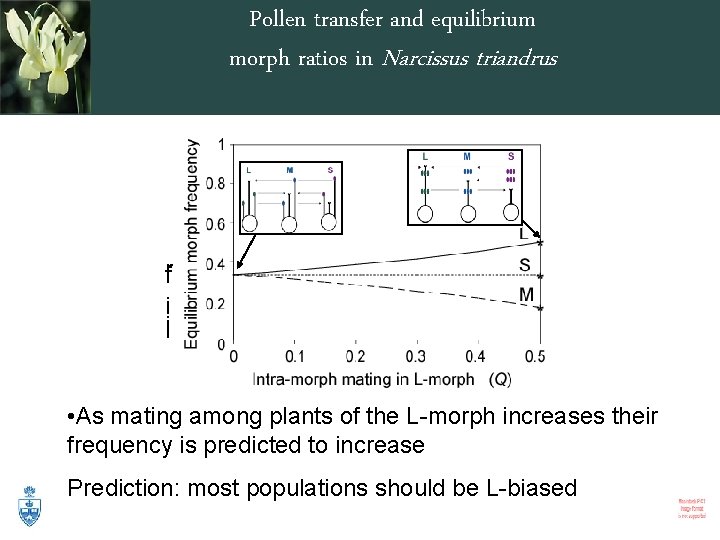
Pollen transfer and equilibrium morph ratios in Narcissus triandrus rf i il • As mating among plants of the L-morph increases their frequency is predicted to increase Prediction: most populations should be L-biased
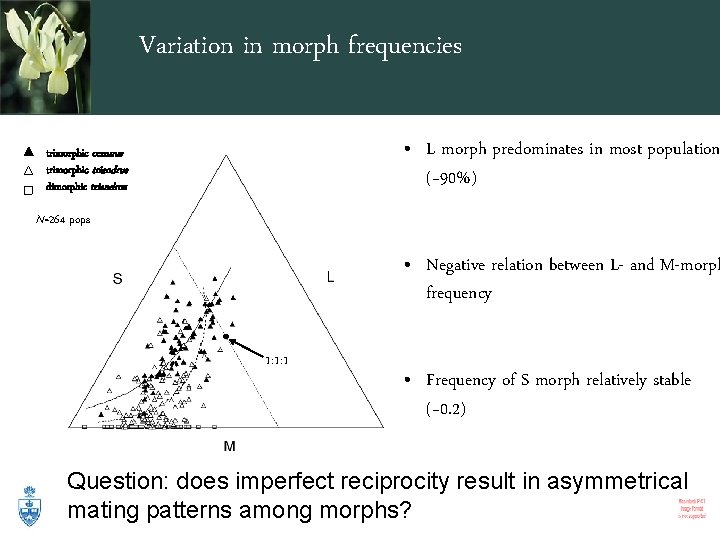
Variation in morph frequencies • L morph predominates in most population (~90%) trimorphic cernuus trimorphic triandrus dimorphic triandrus N=264 pops • Negative relation between L- and M-morph frequency 1: 1: 1 • Frequency of S morph relatively stable (~0. 2) Question: does imperfect reciprocity result in asymmetrical mating patterns among morphs?
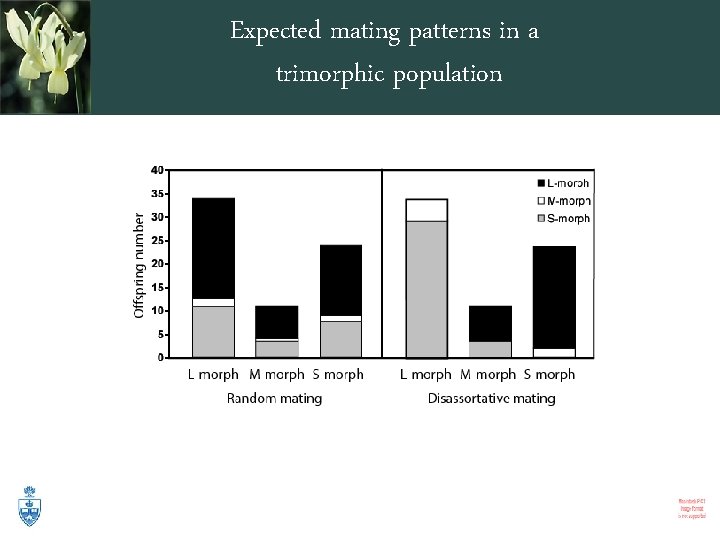
Expected mating patterns in a trimorphic population
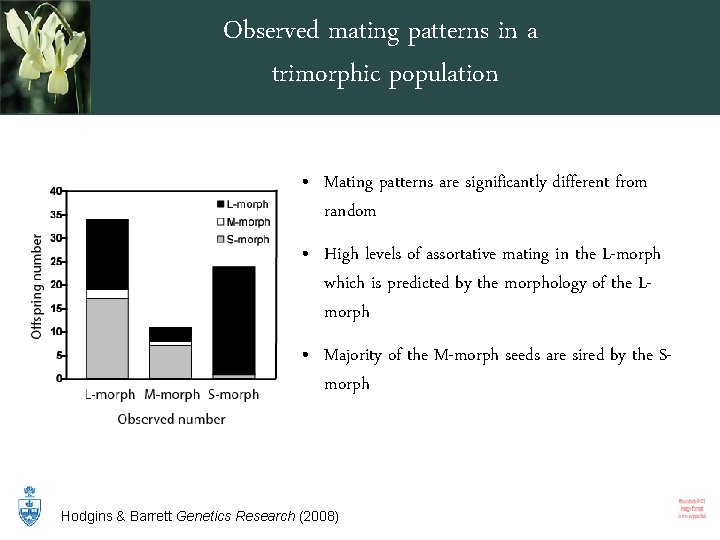
Observed mating patterns in a trimorphic population • Mating patterns are significantly different from random • High levels of assortative mating in the L-morph which is predicted by the morphology of the Lmorph • Majority of the M-morph seeds are sired by the Smorph Hodgins & Barrett Genetics Research (2008)
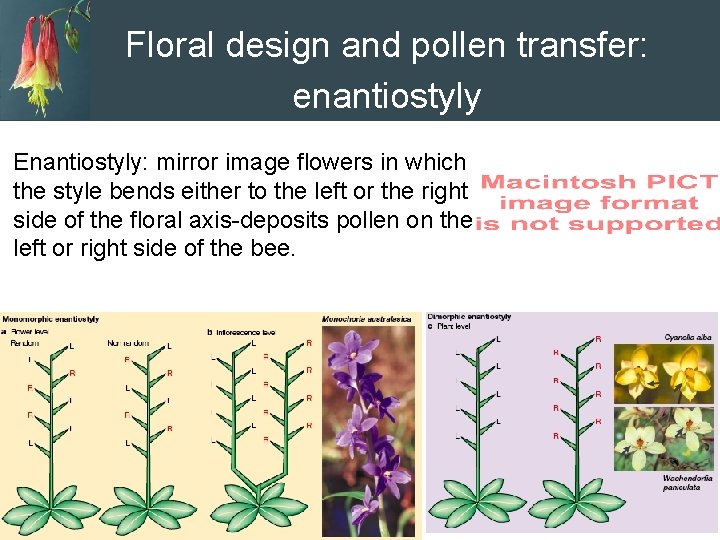
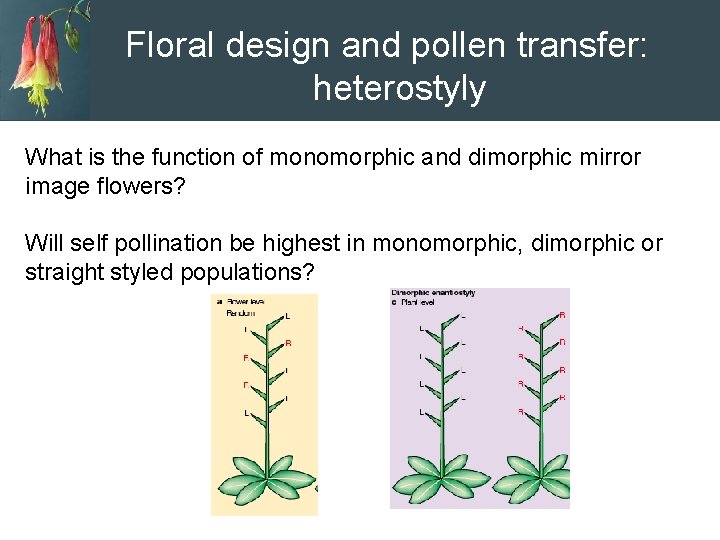
Floral design and pollen transfer: enantiostyly Enantiostyly: mirror image flowers in which the style bends either to the left or the right side of the floral axis-deposits pollen on the left or right side of the bee.
Floral design and pollen transfer: heterostyly What is the function of monomorphic and dimorphic mirror image flowers? Will self pollination be highest in monomorphic, dimorphic or straight styled populations?
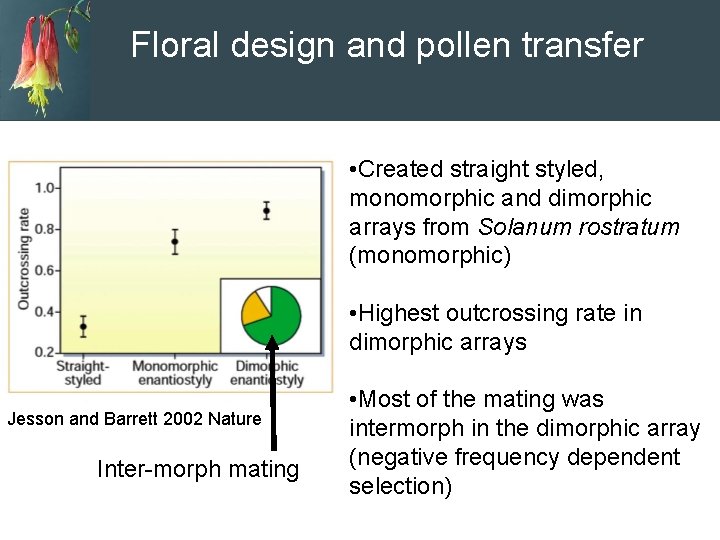
Floral design and pollen transfer • Created straight styled, monomorphic and dimorphic arrays from Solanum rostratum (monomorphic) • Highest outcrossing rate in dimorphic arrays Jesson and Barrett 2002 Nature Inter-morph mating • Most of the mating was intermorph in the dimorphic array (negative frequency dependent selection)
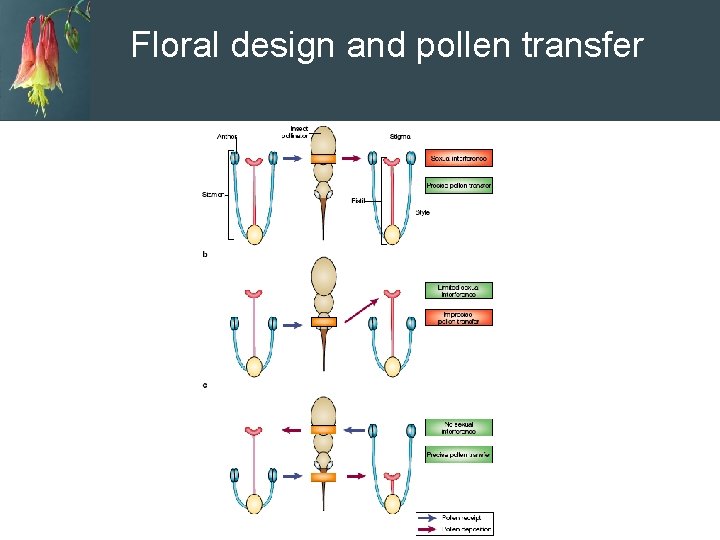
Floral design and pollen transfer • Herkogamy reduces self pollination (and other forms of sexual interference) • Separation reduces precision of cross pollination (lower male and female fitness-pollen wastage and pollen limitation) • Reciprocal herkogamy improves pollen transfer efficiency • Polymorphisms is generally maintained by disassortative mating at equal frequency