
Plant growing structures Nursery structures and growing environments


- Slides: 24
Plant growing structures
Nursery structures and growing environments. Consider following things while growing nursery structures: � Climate � soil � Topography � available water source � type of plant material � and production method when selecting a nursery structure or growing environment.
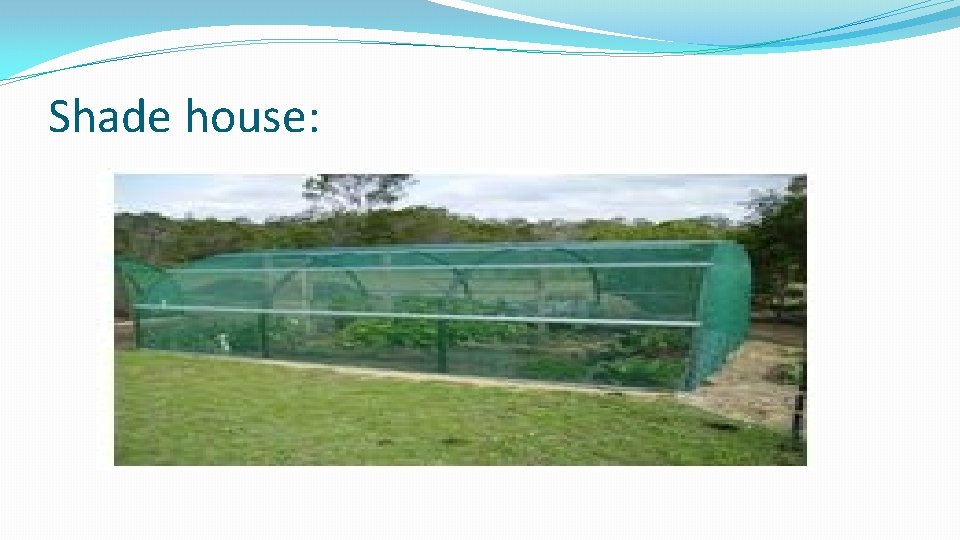
Shade Houses: �Shade houses in nurseries in tropical and sub-tropical regions offer many advantages like, �raising of seedling in bags directly. �protecting the grafts from hot summer months. �effective irrigation through upside down overhead micro sprinklers. �The shade house made with shade nets ( 50% or 75%) for regulation of shade are particularly very useful in arid regions where the humidity is very low during summer months.
Shade house:
Shade houses: Advantages. 1) Constructed of wood, PVC or galvanized steel. 2) No artificial heat source, heated by solar radiation. 3) Used for hardening off plants and hot weather holding. 4) Protects plants from adverse weather conditions. 5) Cover with white plastic during the winter to reduce overwintering injury to woody ornamentals as well as reduce temperature fluctuations during the overwintering period.
Conti… 6) A variety of plant material can be grown in a shade house structure. 7) Provides good air circulation. 8) Provides filtered light when covered by shade cloth. 9) Inexpensive growing structures. Disadvantages. 1) Some plants cannot be grown year round. 2) No heat source other than the sun.
Maintenance of Shade houses A. B. C. D. Need painting or replacing over time. Plastic covering will need to be replaced on a regular basis. Replacement of gravel and weed block. Debris removal.
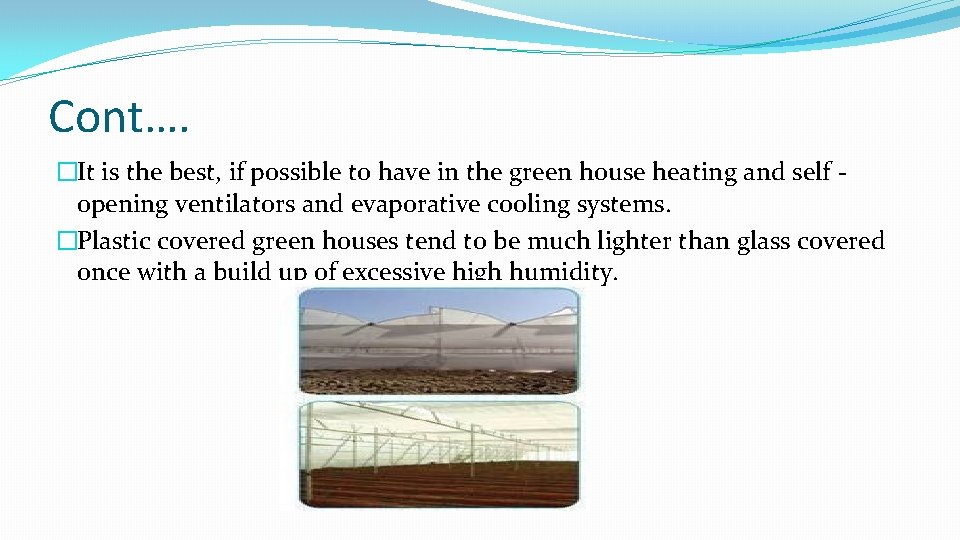
Green Houses /Poly Houses: �Grafting or budding of several fruit species under poly house or low cost green houses with natural ventilation will enhance the percentage graft / bud take besides faster growth of grafts due to favorable micro climatic conditions of poly house. �In green house construction a wood or metal frame work is built to which wood or metal sack bars are fixed to support panes of glass work. �in all poly house/greenhouse means of providing air movement and air exchange is necessary to aid in controlling temperature and humidity.
Cont…. �It is the best, if possible to have in the green house heating and self opening ventilators and evaporative cooling systems. �Plastic covered green houses tend to be much lighter than glass covered once with a build up of excessive high humidity.
Hotbeds: � The hotbeds is often used for same purpose as a green house but in a smaller scale. �Amateur operations and seedling can be started and leafy cuttings root easily in the cold seasons in such structures. �Heat is provided artificially below the propagating medium by electric heating cables, pot water, steam pipes or hot air blows. � As in the green house, in the hot beds attention must be paid for shading and ventilation as well as temperature and humidity control.
Hot beds:
Hotbeds. Advantages: 1) Constructed of wood or galvanized steel, glass and/or plastic. 2) Solar heated, electric cables, steam or heated by natural materials such as hay, manure. 3) Used for starting plants earlier than in a cold frame. 4) Inexpensive growing structure. Disadvantages: 1) Can be expensive to heat. 2) Hay or manure needs to be replaced when the temperature in the hotbed drops below 50 degrees.
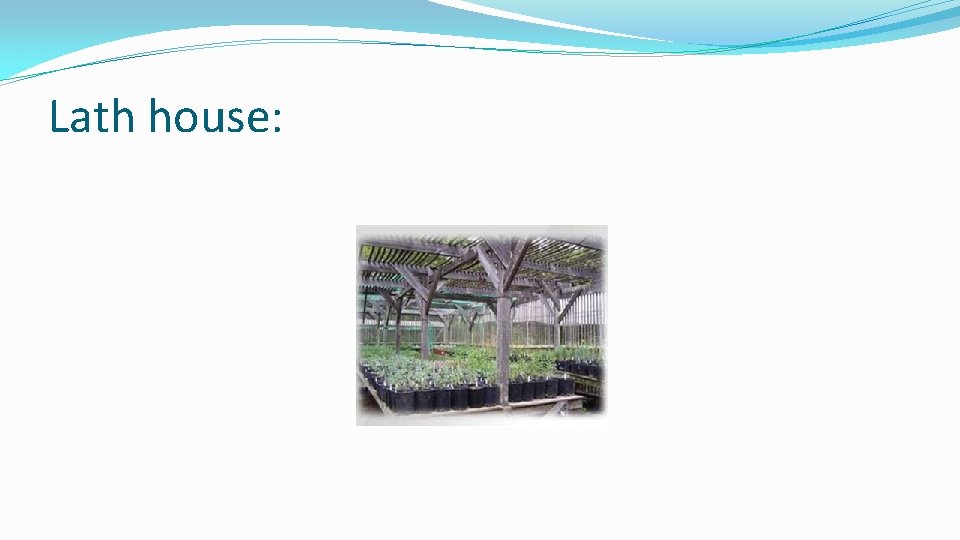
Lath Houses: �These structures are very useful in providing protection from the sun for container grown nursery stocks in areas of high summer temperatures and high light intensity. �Well-established plants also require lath house protecting including shade-loving plants. �Lath house construction varies widely depending on the material used. �Aluminum pre-fabricated lath house are available but may be more costly than wood structures. �Shade is provided by appropriate structures and use of shade nets of different densities allows various intensities of light in the lath house.
Lath house:
Net house: �Net houses are widely used as propagation structures in tropical areas, where artificial heating is not required and artificial cooling is expensive. �In these areas, net houses may be constructed with roofs covered with glass or plastic film and its sides are covered with wire net. �It provides necessary ventilation and maintains an ideal temperature for germination of seeds and subsequent growth of the seedlings. �The roof of net house may be covered with gunny cloth or even with live plant creeper to cut off the solar radiant energy and to keep the house cool. �Net house can be constructed as per the need of the propagator and therefore its size varies with the requirements of the nurserymen.
Miscellaneous Propagating Structures: �Mist Beds: These are valuable propagating units both in the green house and out doors and are useful mainly in rooting of leafy cuttings. �Mist Chambers: This is structure used to propagate soft wood cutting, difficult to root plants and shrubs. Here the principle is to spray the cutting with a minimum quantity of water. � This is achieved by providing the cutting a series of intermittent spraying rather than a continuous spray.
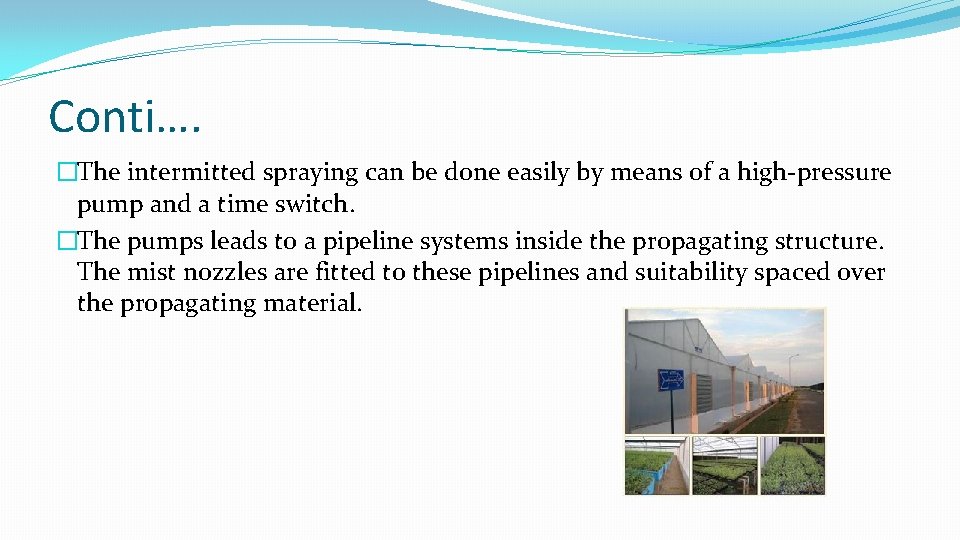
Conti…. �The intermitted spraying can be done easily by means of a high-pressure pump and a time switch. �The pumps leads to a pipeline systems inside the propagating structure. The mist nozzles are fitted to these pipelines and suitability spaced over the propagating material.
Nursery Bed: �These are raised beds or boxes made of bricks and morter, provided with drainage holes at a bottom. �The dimension of the boxes are 60 cm high, 120 cm broad and length as required preferably not exceeding 10 m roof structures for planting on both sides and forming ridges at the center are constructed on the top of the nursery beds. �These structures may be made permanent with angle iron or maybe made of wood. �bamboos mats, palm leaf mats are placed over these structures to protected the seedling from hot sun and heavy rains.
Fluorescent Light Boxes: �Young plants of many species grow satisfactory under artificial light from fluorescent lamp units. �Although adequate growth of many plant species may be obtained under fluorescent lamps but not up to the mark compared to good green house conditions. �Propagating Cases: Even in green house, humidity condition are often not sufficiently high for rooting. �The use of enclosed frames or cases covered with glass or plastic materials may be necessary for successful rooting. �In using such structures, care is necessary to avoid the build up of disease organism due to high humidity.
Plastic Mulch: �Mulch is a material used for covering the soil in order to prevent weed growth avoids direct evaporation of the water from the soil and to increase soil temperature. �mulching seedbeds with opaque black plastic film prevents weed growth completely and because of higher soil temperature and better conservation of soil moisture, brings about early germination and faster seedling growth.
Mini-Green Houses: �The plants need carbon dioxide for making food through photosynthesis. �The green house helps in providing additional carbon dioxide to the plants to enhance their rate of photosynthesis. �This can be achieved by enclosing the plants in a box like structure made out of bamboo and colorless transparent plastic, with a lid at the top. �The lid is closed after sun set, so that carbon dioxide produce due to respiration accumulate in the box.
Cont… �After sun rise the plant start photosynthesis and since there is higher carbon dioxide content around the plant, the rate of carbon assimilation is higher. �After a few hours the lid is opened to prevent over-heating alternatively. �A plot or beds of plant can be provided with plastic films skirting supports by bamboo stakes, about 12 cm. high. �Since CO 2 is heavier than air it tends to settle around the plants.
Light Chamber: �Several plants to go into winter dormancy when the day length shorts. �Additional light from tube lights, given after sun-set, creates long day conditions that prevent the plants from going into winter dormancy. �Light given at the end of the day. Also encourage growth of green leaves; they grow tall without developing lateral branches. �On the other hand, if they are exposed to fluorescent light from tubelights laid on the grounds, they developed side branches and show a bushy habits.
High-Humidity Chambers: �This technique resolves the common problems of graft or cutting dying due to desiccation when planted in the soil for rooting, by ensuring a humid atmosphere around the cuttings, thus wood preventing excessive evaporation. �The cutting/grafts are planted on a sand beds, enclosed on all the sides by a dome made of GI wire and covered with a transparent, colourless plastic film. �The sand is watered to field capacity, and plastic film traps evaporation inside the chamber creating a highly humid atmosphere. �The dome must be shaded, since direct sunlight will heat up the internal atmosphere of the dome, killing the plants.