
PLANT DESIGN PROJECT II Design of Plant for




















- Slides: 57
PLANT DESIGN PROJECT II Design of Plant for the Production of Maleic Anhydride GROUP 16 SITI AISHAH BINTI MOHAMAD ZAMBERI RAJA NORAKMAL BIN RAJA BAKHTIAR AFFENDY NURUL SYAZWANI BINTI ABDUL JABAR SYED OSAMA BUKHARI WADDAA GASIM MOHAMED SAMUEL DHUKPUOU MAKHOI SUPERVISOR : Dr. Yeong Yin Fong 12190 12176 12170 13490 14128 11748
OUTLINES § § § Problem Statement Project Objectives Literature Review Conceptual Design Process Flow Sheet Control Strategy & P&ID Safety, HAZOP and Plant Layout Waste Treatment Economic Evaluation Conclusion Recommendations
PROBLEM STATEMENT • To produce 30, 000 metric tones of Maleic Anhydride (MAN) per year • Feed stock – mixed butane
OBJECTIVES • To meet the potential increasing demands of Maleic Anhydride (MAN) • To design a Maleic Anhydride plant as per specified: § Best process route § Perform process and mechanical design § Discuss safety and environmental issue § Perform economic evaluation
LITERATURE REVIEW
USAGES
USAGES
MARKET STUDY
MARKET STUDY
SITE FEASIBILTY STUDY Factors affecting the choice of location: § Source of raw material § Land price § Communication and infrastructure § Utilities supplies § Labor availability § Government incentive
SITE FEASIBILTY STUDY
PROCESS DESIGN
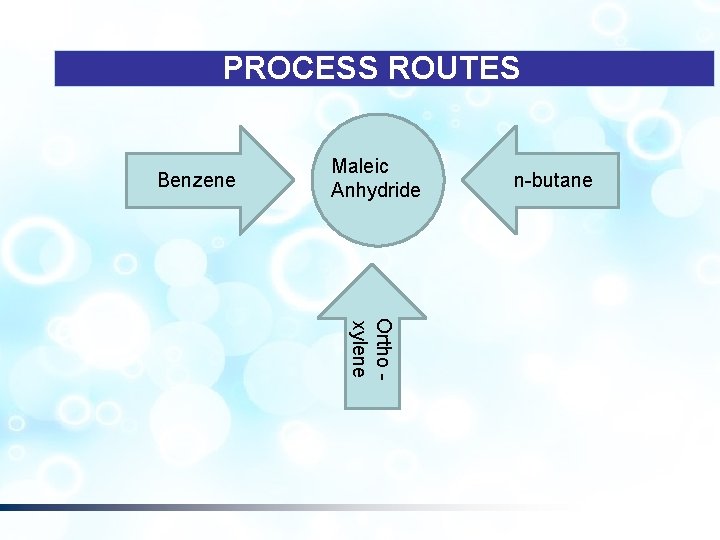
PROCESS ROUTES Benzene Maleic Anhydride n-butane Ortho xylene
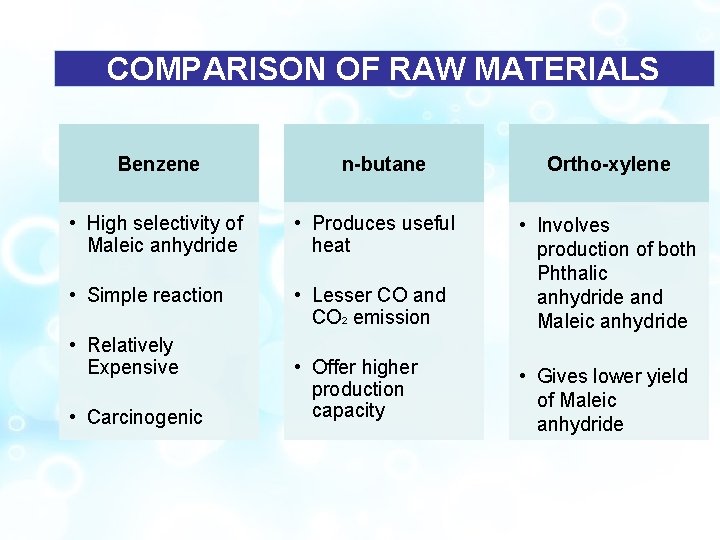
COMPARISON OF RAW MATERIALS Benzene n-butane • High selectivity of Maleic anhydride • Produces useful heat • Simple reaction • Lesser CO and CO 2 emission • Relatively Expensive • Carcinogenic • Offer higher production capacity Ortho-xylene • Involves production of both Phthalic anhydride and Maleic anhydride • Gives lower yield of Maleic anhydride
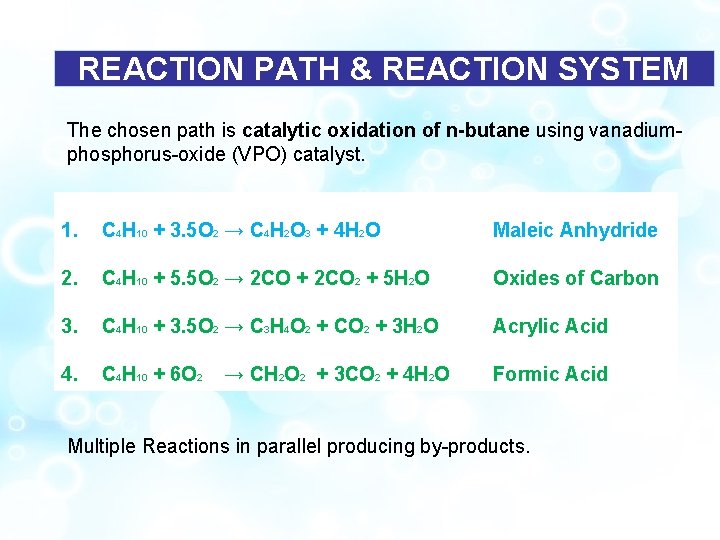
REACTION PATH & REACTION SYSTEM The chosen path is catalytic oxidation of n-butane using vanadiumphosphorus-oxide (VPO) catalyst. 1. C 4 H 10 + 3. 5 O 2 → C 4 H 2 O 3 + 4 H 2 O Maleic Anhydride 2. C 4 H 10 + 5. 5 O 2 → 2 CO + 2 CO 2 + 5 H 2 O Oxides of Carbon 3. C 4 H 10 + 3. 5 O 2 → C 3 H 4 O 2 + CO 2 + 3 H 2 O Acrylic Acid 4. C 4 H 10 + 6 O 2 Formic Acid → CH 2 O 2 + 3 CO 2 + 4 H 2 O Multiple Reactions in parallel producing by-products.
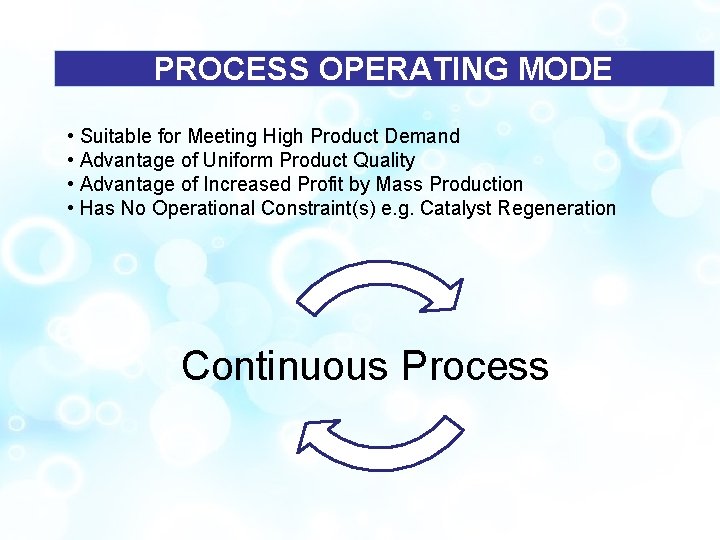
PROCESS OPERATING MODE • Suitable for Meeting High Product Demand • Advantage of Uniform Product Quality • Advantage of Increased Profit by Mass Production • Has No Operational Constraint(s) e. g. Catalyst Regeneration Continuous Process
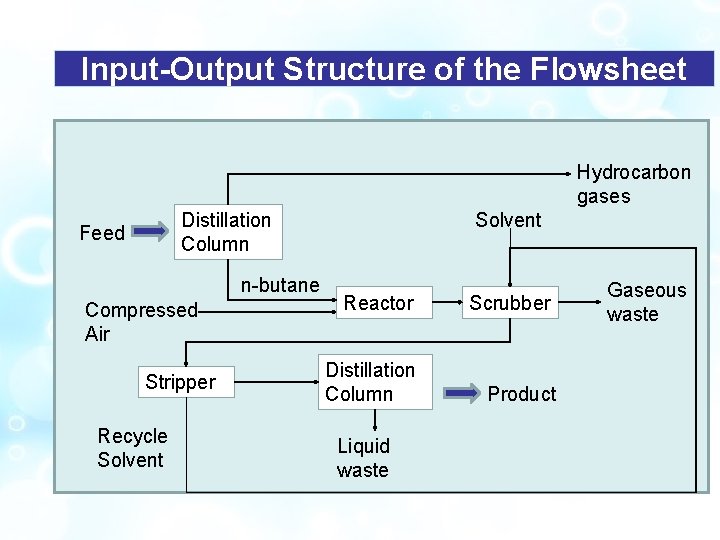
Input-Output Structure of the Flowsheet Hydrocarbon gases Distillation Column Feed n-butane Compressed Air Stripper Recycle Solvent Reactor Distillation Column Liquid waste Scrubber Product Gaseous waste
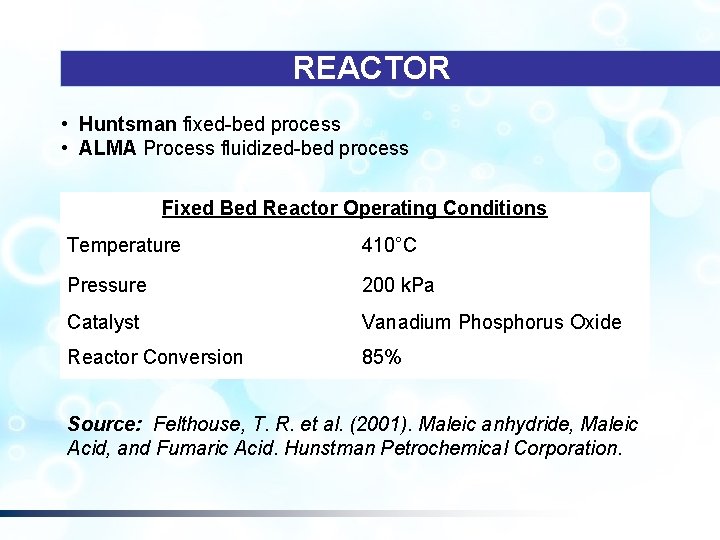
REACTOR • Huntsman fixed-bed process • ALMA Process fluidized-bed process Fixed Bed Reactor Operating Conditions Temperature 410°C Pressure 200 k. Pa Catalyst Vanadium Phosphorus Oxide Reactor Conversion 85% Source: Felthouse, T. R. et al. (2001). Maleic anhydride, Maleic Acid, and Fumaric Acid. Hunstman Petrochemical Corporation.
SEPARATORS & SEQUENCING
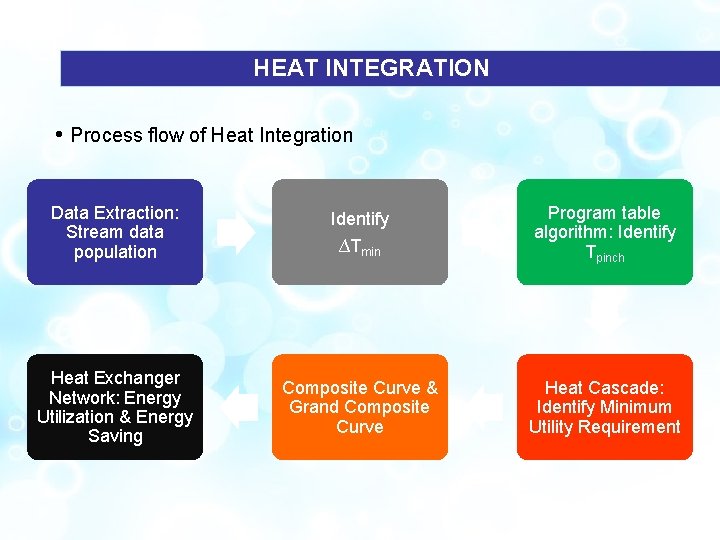
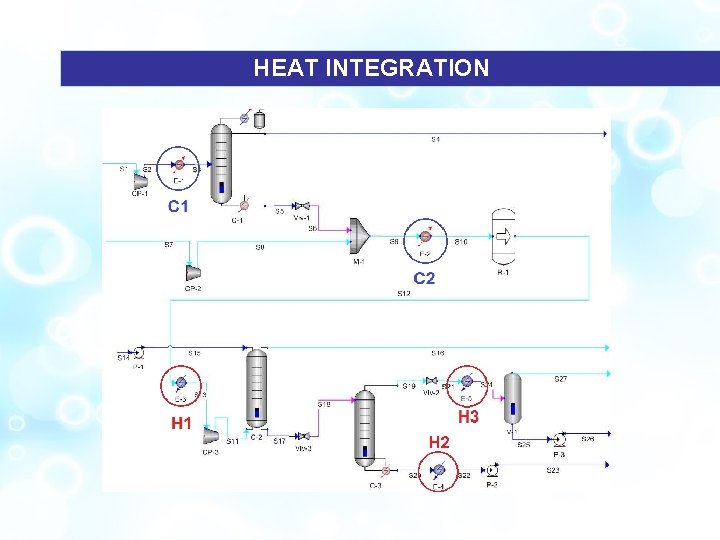
INTEGRATION HEAT INTEGRATION • Process flow of Heat Integration Data Extraction: Stream data population Heat Exchanger Network: Energy Utilization & Energy Saving ∆Tmin Program table algorithm: Identify Tpinch Composite Curve & Grand Composite Curve Heat Cascade: Identify Minimum Utility Requirement Identify
INTEGRATION HEAT INTEGRATION
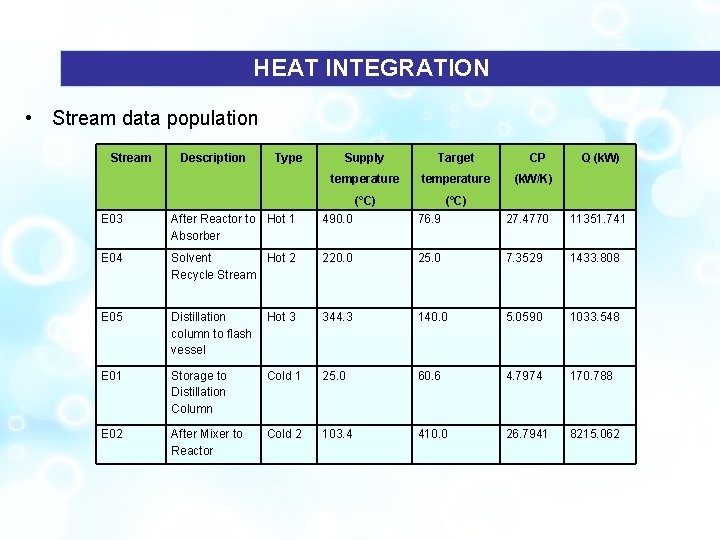
HEAT INTEGRATION • Stream data population Stream Description Type Supply Target temperature (°C) CP Q (k. W) (k. W/K) E 03 After Reactor to Hot 1 Absorber 490. 0 76. 9 27. 4770 11351. 741 E 04 Solvent Hot 2 Recycle Stream 220. 0 25. 0 7. 3529 1433. 808 E 05 Distillation Hot 3 column to flash vessel 344. 3 140. 0 5. 0590 1033. 548 E 01 Storage to Distillation Column Cold 1 25. 0 60. 6 4. 7974 170. 788 E 02 After Mixer to Reactor Cold 2 103. 4 410. 0 26. 7941 8215. 062
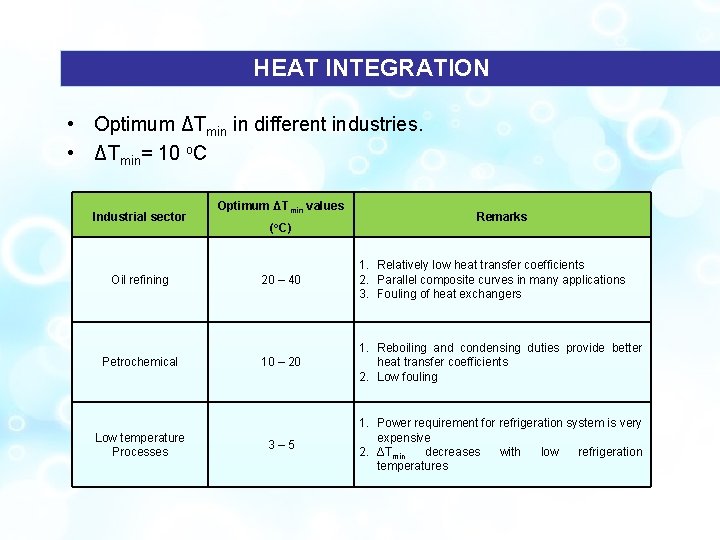
INTEGRATION HEAT INTEGRATION • Optimum ΔTmin in different industries. • ΔTmin= 10 o. C Industrial sector Oil refining Petrochemical Low temperature Processes Optimum ΔTmin values (o. C) Remarks 20 – 40 1. Relatively low heat transfer coefficients 2. Parallel composite curves in many applications 3. Fouling of heat exchangers 10 – 20 1. Reboiling and condensing duties provide better heat transfer coefficients 2. Low fouling 3 – 5 1. Power requirement for refrigeration system is very expensive 2. ΔTmin decreases with low refrigeration temperatures
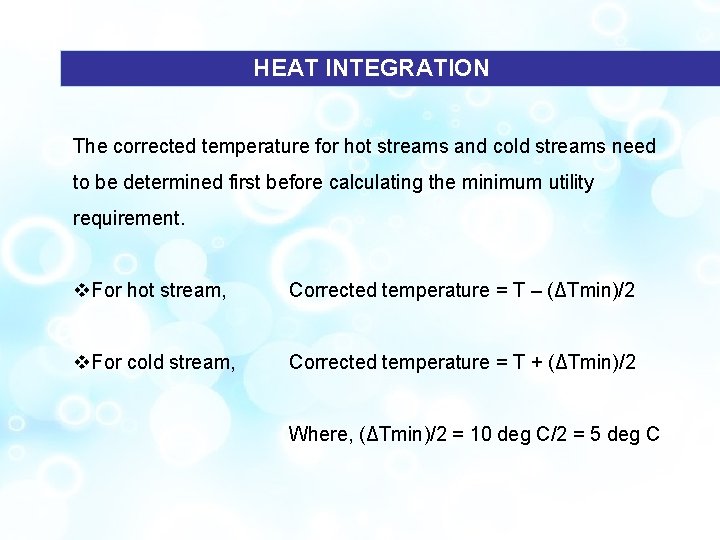
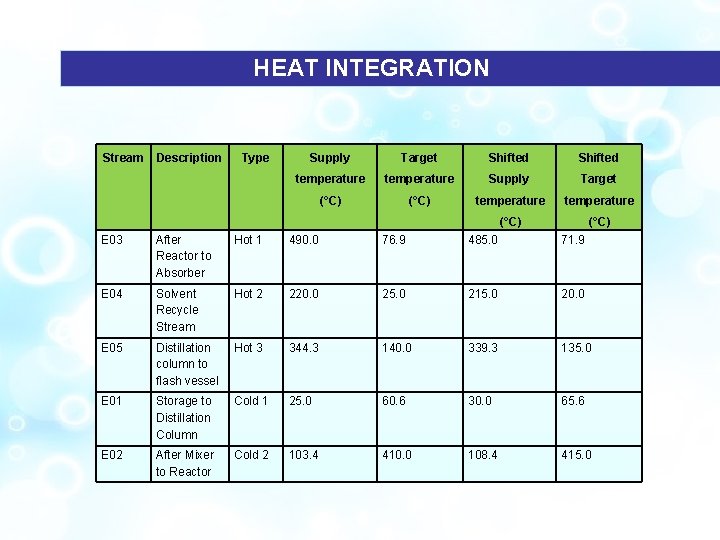
INTEGRATION HEAT INTEGRATION The corrected temperature for hot streams and cold streams need to be determined first before calculating the minimum utility requirement. v. For hot stream, Corrected temperature = T – (ΔTmin)/2 v. For cold stream, Corrected temperature = T + (ΔTmin)/2 Where, (ΔTmin)/2 = 10 deg C/2 = 5 deg C
INTEGRATION HEAT INTEGRATION Stream Description Type Supply Target Shifted temperature Supply Target (°C) temperature (°C) E 03 After Reactor to Absorber Hot 1 490. 0 76. 9 485. 0 71. 9 E 04 Solvent Recycle Stream Hot 2 220. 0 25. 0 215. 0 20. 0 E 05 Distillation column to flash vessel Hot 3 344. 3 140. 0 339. 3 135. 0 E 01 Storage to Distillation Column Cold 1 25. 0 60. 6 30. 0 65. 6 E 02 After Mixer to Reactor Cold 2 103. 4 410. 0 108. 4 415. 0
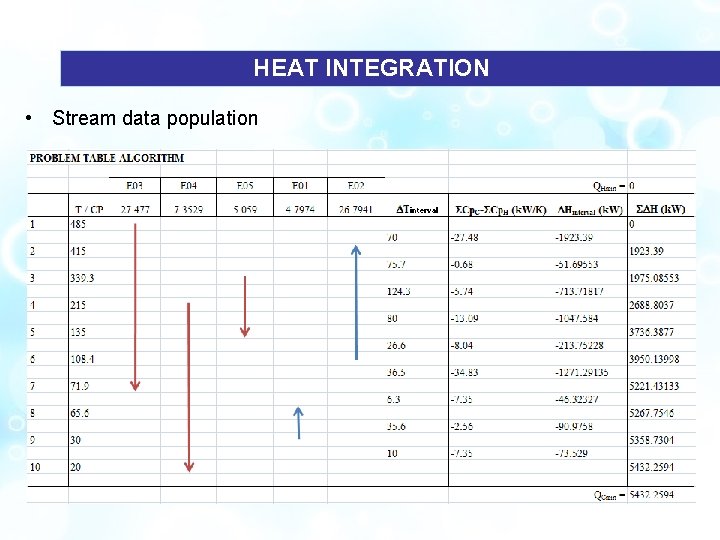
INTEGRATION HEAT INTEGRATION • Stream data population
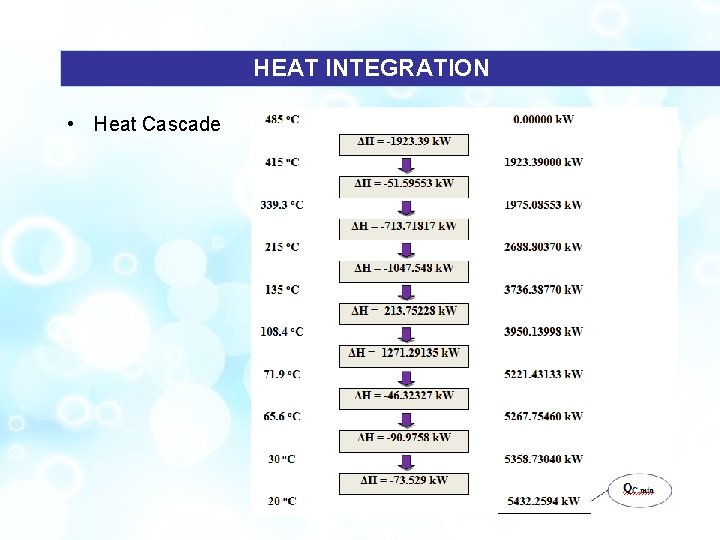
INTEGRATION HEAT INTEGRATION • Heat Cascade
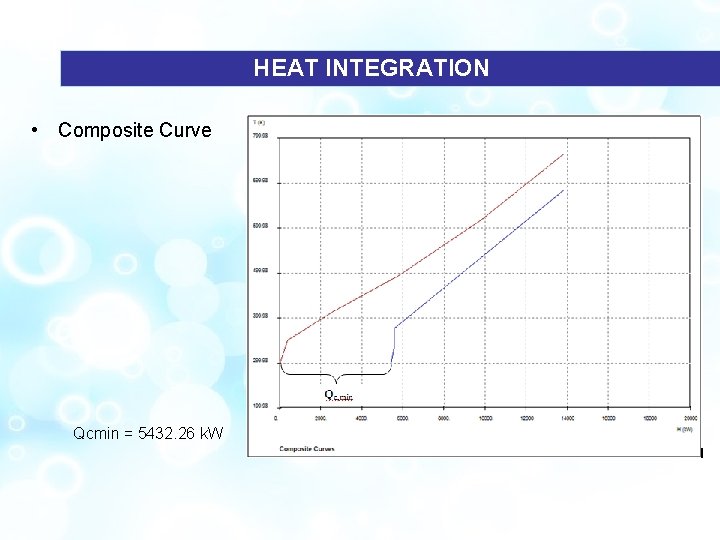
INTEGRATION HEAT INTEGRATION • Composite Curve Qcmin = 5432. 26 k. W
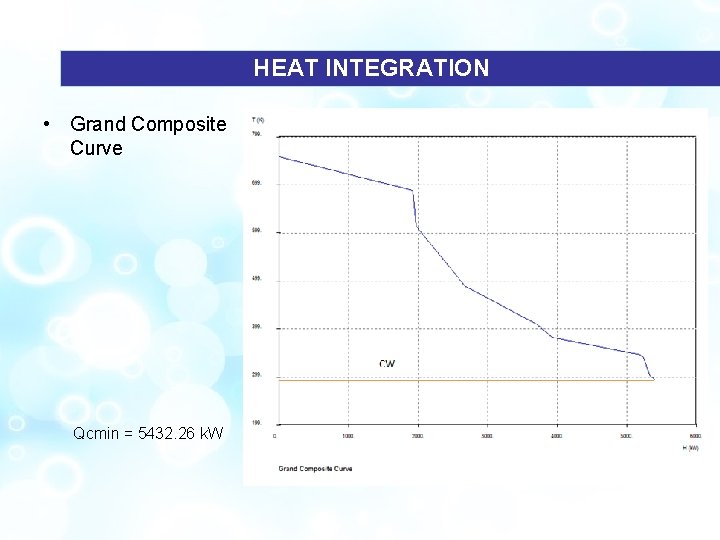
INTEGRATION HEAT INTEGRATION • Grand Composite Curve Qcmin = 5432. 26 k. W CW
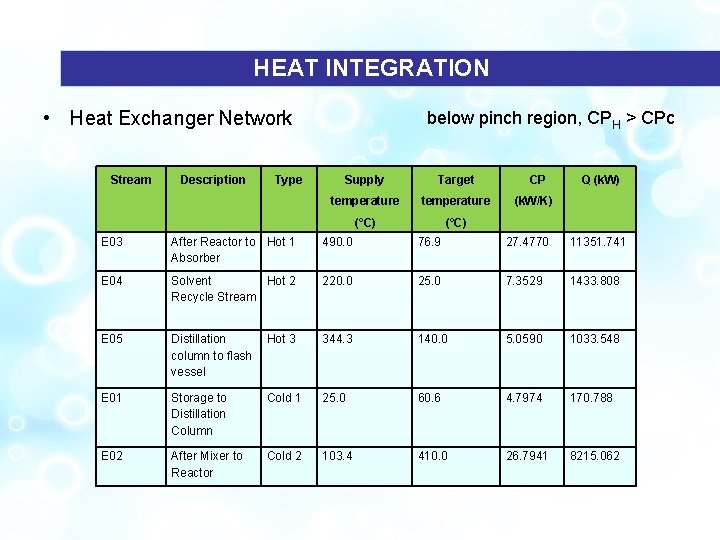
INTEGRATION HEAT INTEGRATION • Heat Exchanger Network Stream Description Type below pinch region, CPH > CPc Supply Target temperature (°C) CP Q (k. W) (k. W/K) E 03 After Reactor to Hot 1 Absorber 490. 0 76. 9 27. 4770 11351. 741 E 04 Solvent Hot 2 Recycle Stream 220. 0 25. 0 7. 3529 1433. 808 E 05 Distillation Hot 3 column to flash vessel 344. 3 140. 0 5. 0590 1033. 548 E 01 Storage to Distillation Column Cold 1 25. 0 60. 6 4. 7974 170. 788 E 02 After Mixer to Reactor Cold 2 103. 4 410. 0 26. 7941 8215. 062
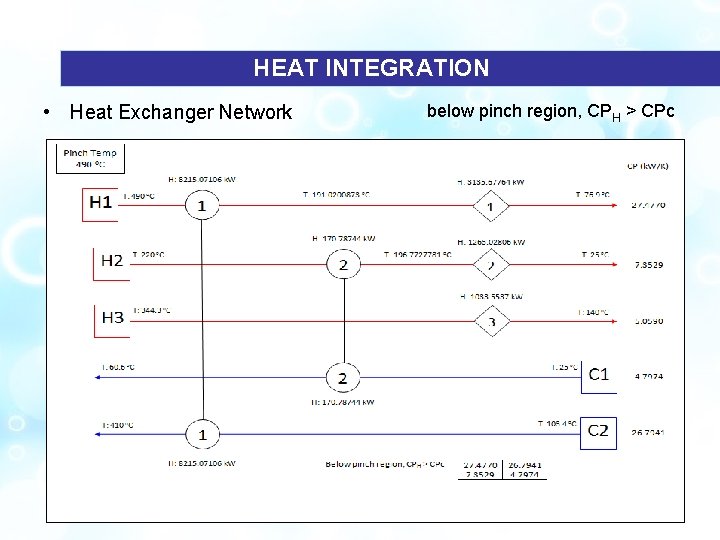
INTEGRATION HEAT INTEGRATION • Heat Exchanger Network below pinch region, CPH > CPc
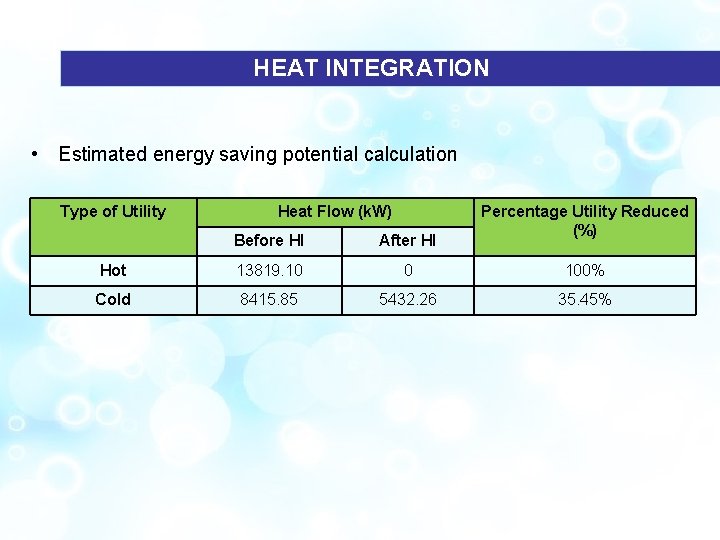
INTEGRATION HEAT INTEGRATION • Estimated energy saving potential calculation Type of Utility Heat Flow (k. W) Percentage Utility Reduced (%) Before HI After HI Hot 13819. 10 0 100% Cold 8415. 85 5432. 26 35. 45%
PROCESS FLOWSHEET
PROCESS FLOW DIAGRAM
CONTROL STRATEGY AND P&ID
For the proposed MAN production plants, the vital objectives for designing control system are: 1. To have a safe operation plants and avoids explosion. Therefore, to maintain desired temperature and pressure in the reactor and columns are vital. 2. To control the production rates 30, 000 metric ton per year. 3. To maintain the product purity above 99 %. 4. To avoid excess usage of cooling and heating utility. The control systems include: 1. Reactor control system 2. Separation units control system 3. Heat exchanger control system
SAFETY AND LOSS PREVENTION
HAZARD MINIMIZATION § Objective to reduce potential hazard and provide a safer working environment § Approaches § Administrative control § Save storage § Reduce inventory § Fire fighting procedure § Properating procedure § Transport and handling
HAZOP ANALYSIS
PLANT LAYOUT
PLANT LAYOUT
WASTE TREATMENT
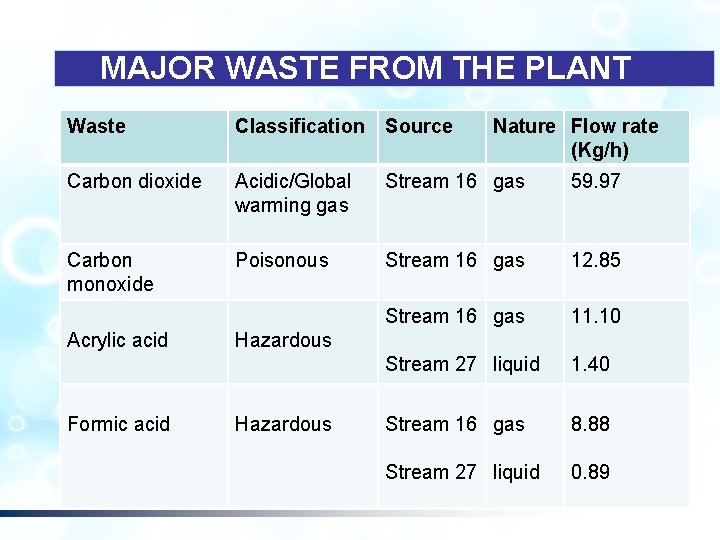
MAJOR WASTE FROM THE PLANT Waste Classification Source Carbon dioxide Acidic/Global warming gas Stream 16 gas 59. 97 Carbon monoxide Poisonous Stream 16 gas 12. 85 11. 10 Hazardous Stream 16 gas Stream 27 liquid Stream 16 gas 8. 88 Stream 27 liquid 0. 89 Acrylic acid Formic acid Hazardous Nature Flow rate (Kg/h) 1. 40
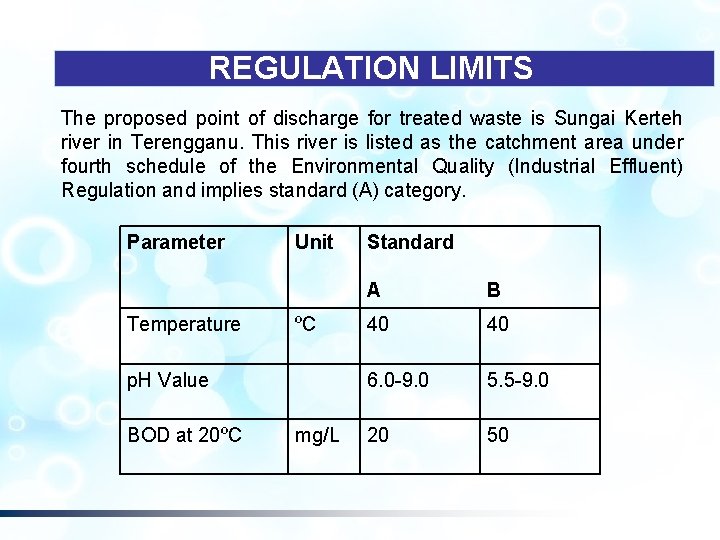
REGULATION LIMITS The proposed point of discharge for treated waste is Sungai Kerteh river in Terengganu. This river is listed as the catchment area under fourth schedule of the Environmental Quality (Industrial Effluent) Regulation and implies standard (A) category. Parameter Temperature Unit ºC p. H Value BOD at 20ºC mg/L Standard A B 40 6. 0 -9. 0 5. 5 -9. 0 20 50
ECONOMIC EVALUATION
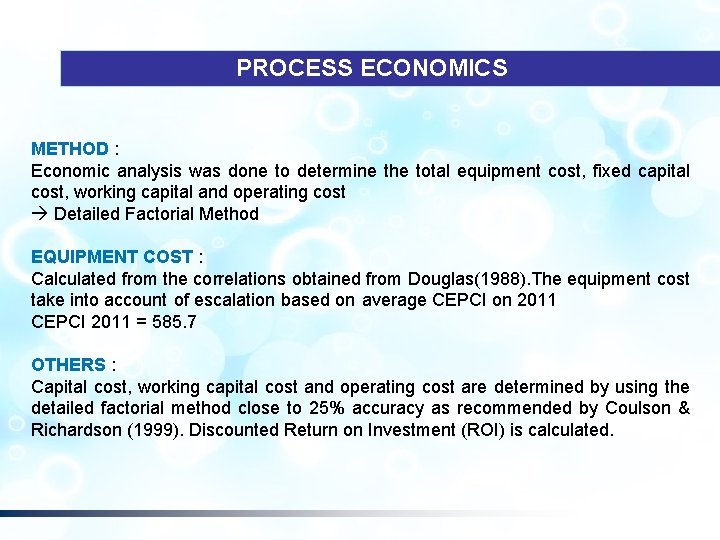
PROCESS ECONOMICS METHOD : Economic analysis was done to determine the total equipment cost, fixed capital cost, working capital and operating cost Detailed Factorial Method EQUIPMENT COST : Calculated from the correlations obtained from Douglas(1988). The equipment cost take into account of escalation based on average CEPCI on 2011 CEPCI 2011 = 585. 7 OTHERS : Capital cost, working capital cost and operating cost are determined by using the detailed factorial method close to 25% accuracy as recommended by Coulson & Richardson (1999). Discounted Return on Investment (ROI) is calculated.
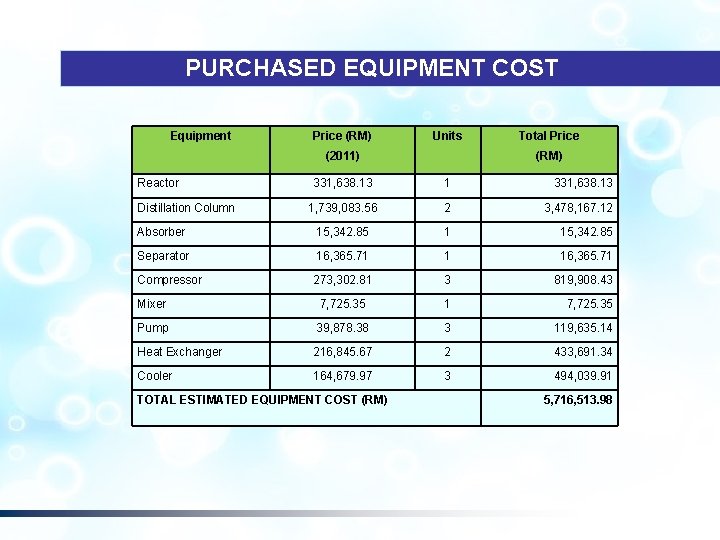
PURCHASED EQUIPMENT COST Equipment Price (RM) Units (2011) Reactor Total Price (RM) 331, 638. 13 1, 739, 083. 56 2 3, 478, 167. 12 Absorber 15, 342. 85 1 15, 342. 85 Separator 16, 365. 71 1 16, 365. 71 Compressor 273, 302. 81 3 819, 908. 43 Mixer 7, 725. 35 1 7, 725. 35 Pump 39, 878. 38 3 119, 635. 14 Heat Exchanger 216, 845. 67 2 433, 691. 34 Cooler 164, 679. 97 3 494, 039. 91 Distillation Column TOTAL ESTIMATED EQUIPMENT COST (RM) 5, 716, 513. 98
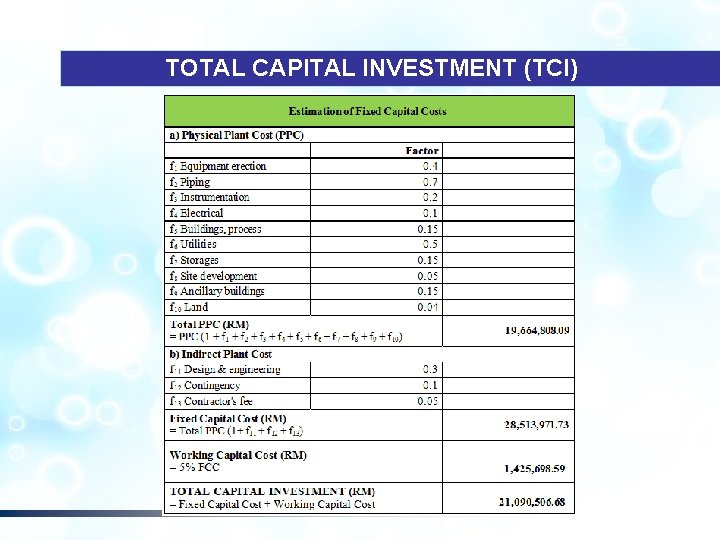
TOTAL CAPITAL INVESTMENT (TCI)
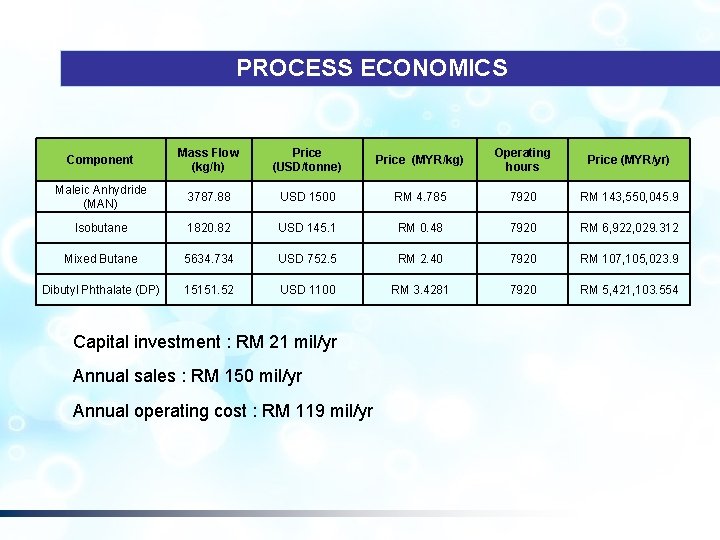
PROCESS ECONOMICS Component Mass Flow (kg/h) Price (USD/tonne) Price (MYR/kg) Operating hours Price (MYR/yr) Maleic Anhydride (MAN) 3787. 88 USD 1500 RM 4. 785 7920 RM 143, 550, 045. 9 Isobutane 1820. 82 USD 145. 1 RM 0. 48 7920 RM 6, 922, 029. 312 Mixed Butane 5634. 734 USD 752. 5 RM 2. 40 7920 RM 107, 105, 023. 9 Dibutyl Phthalate (DP) 15151. 52 USD 1100 RM 3. 4281 7920 RM 5, 421, 103. 554 Capital investment : RM 21 mil/yr Annual sales : RM 150 mil/yr Annual operating cost : RM 119 mil/yr
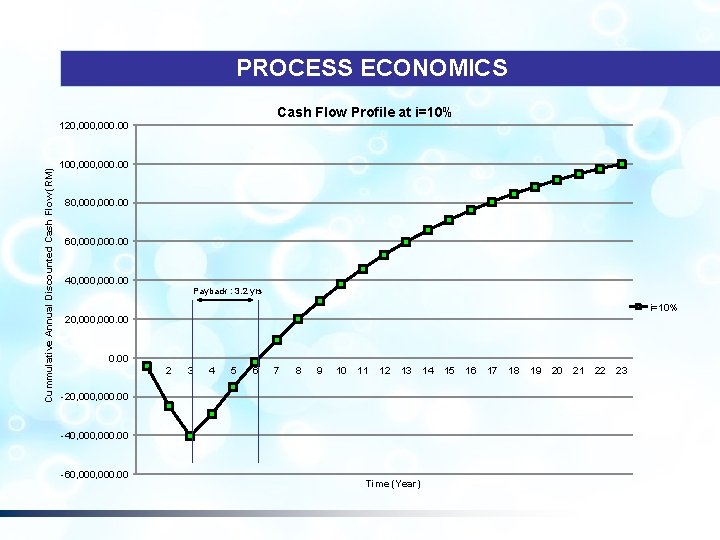
PROCESS ECONOMICS Cash Flow Profile at i=10% Cummulative Annual Discounted Cash Flow (RM) 120, 000. 00 100, 000. 00 80, 000. 00 60, 000. 00 40, 000. 00 Payback : 3. 2 yrs i=10% 20, 000. 00 1 2 3 4 5 6 7 8 9 10 11 12 13 -20, 000. 00 -40, 000. 00 -60, 000. 00 Time (Year) 14 15 16 17 18 19 20 21 22 23
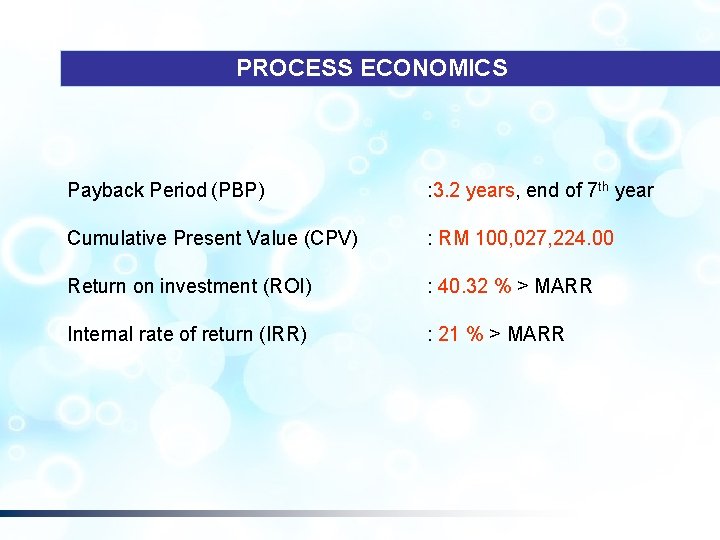
PROCESS ECONOMICS Payback Period (PBP) : 3. 2 years, end of 7 th year Cumulative Present Value (CPV) : RM 100, 027, 224. 00 Return on investment (ROI) : 40. 32 % > MARR Internal rate of return (IRR) : 21 % > MARR
CONCLUSION
CONCLUSION • It has been proven conceptually that the setting up of an MAN plant in Malaysia is feasible and crucial in order to meet the high demand of MAN worldwide. • From the feasibility research carried out, Telok Kalong, Kertih is identified to be the best location for an MAN production plant. • HAZOP and safety consideration i. e plant layout has been adhered to based on PTS • The plant also consists of systematic plant wide control for safety and economics purposes • Waste treatment designed meets the Department of Environment, Malaysia (DOE) environmental standard and regulations
CONCLUSION • It has been proven conceptually that the setting up of an MAN plant in Malaysia is feasible and crucial in order to meet the high demand of MAN worlwide. • From the feasibility research carried out, Telok Kalong, Kertih is identified to be the best location for an MAN production plant. • HAZOP and safety consideration i. e plant layout has been adhered to based on PTS • The plant also consists of systematic plant wide control for safety and economics purposes • Waste treatment designed meets the Department of Environment, Malaysia (DOE) environmental standard and regulations
RECOMMENDATION
RECOMMENDATION • Optimize system to reduce heating and cooling requirements • Thorough research on the transportation route of raw material and product to ensure smooth timing in production • Economic Evaluation to be done using a more accurate and up to date method and price • Emphasize on pollution i. e noise pollution for employee’s and public safety and health
THANK YOU