
Plant Cell Why do plant cells look like
- Slides: 11
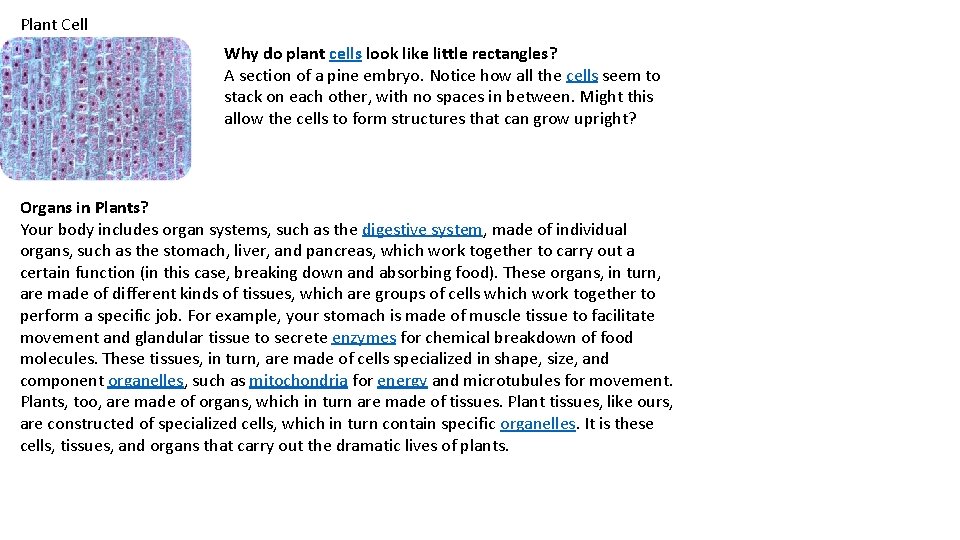
Plant Cell Why do plant cells look like little rectangles? A section of a pine embryo. Notice how all the cells seem to stack on each other, with no spaces in between. Might this allow the cells to form structures that can grow upright? Organs in Plants? Your body includes organ systems, such as the digestive system, made of individual organs, such as the stomach, liver, and pancreas, which work together to carry out a certain function (in this case, breaking down and absorbing food). These organs, in turn, are made of different kinds of tissues, which are groups of cells which work together to perform a specific job. For example, your stomach is made of muscle tissue to facilitate movement and glandular tissue to secrete enzymes for chemical breakdown of food molecules. These tissues, in turn, are made of cells specialized in shape, size, and component organelles, such as mitochondria for energy and microtubules for movement. Plants, too, are made of organs, which in turn are made of tissues. Plant tissues, like ours, are constructed of specialized cells, which in turn contain specific organelles. It is these cells, tissues, and organs that carry out the dramatic lives of plants.
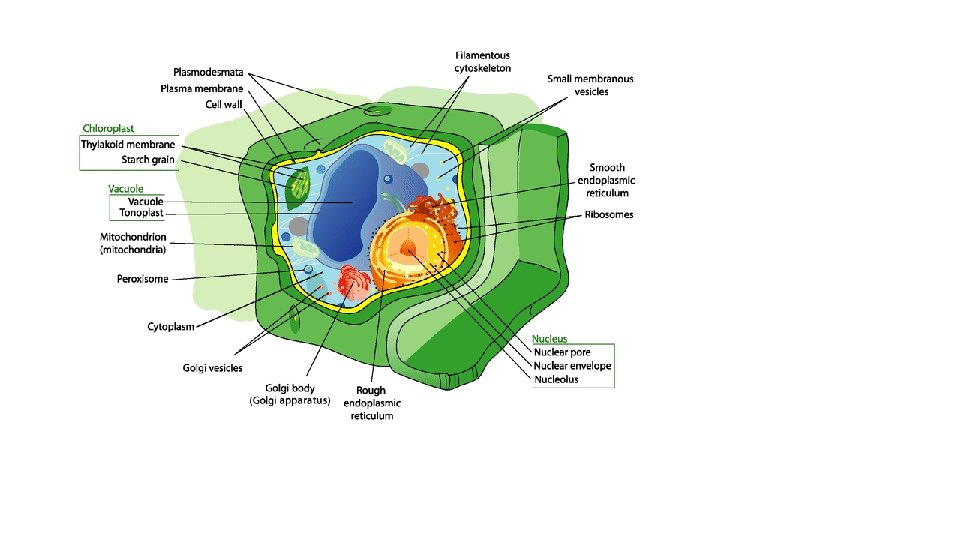
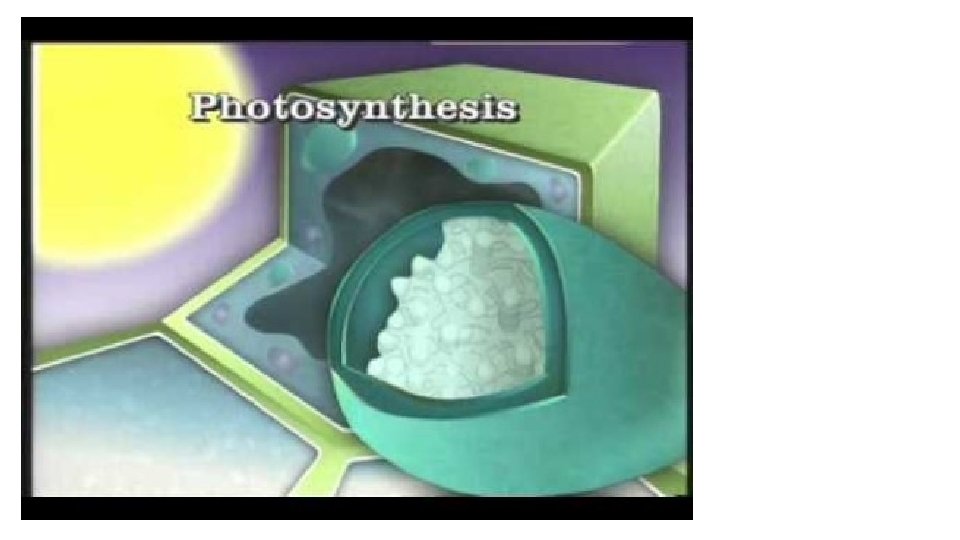
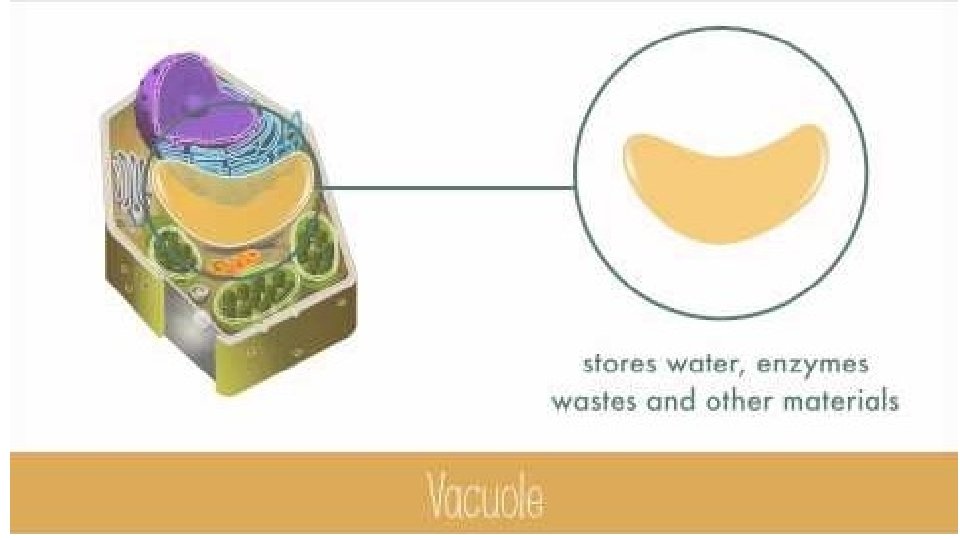
Plant Cell Structures found in plant cells but not animal cells include a large central vacuole, cell wall, and plastids such as chloroplasts. • The large central vacuole is surrounded by its own membrane and contains water and dissolved substances. Its primary role is to maintain pressure against the inside of the cell wall, giving the cell shape and helping to support the plant. • The cell wall is located outside the cell membrane. It consists mainly of cellulose and may also contain lignin, which makes it more rigid. The cell wall shapes, supports, and protects the cell. It prevents the cell from absorbing too much water and bursting. It also keeps large, damaging molecules out of the cell. • Plastids are membrane-bound organelles with their own DNA. Examples are chloroplasts and chromoplasts. Chloroplasts contain the green pigment chlorophyll and carry out photosynthesis. Chromoplasts make and store other pigments. They give flower petals their bright colors.
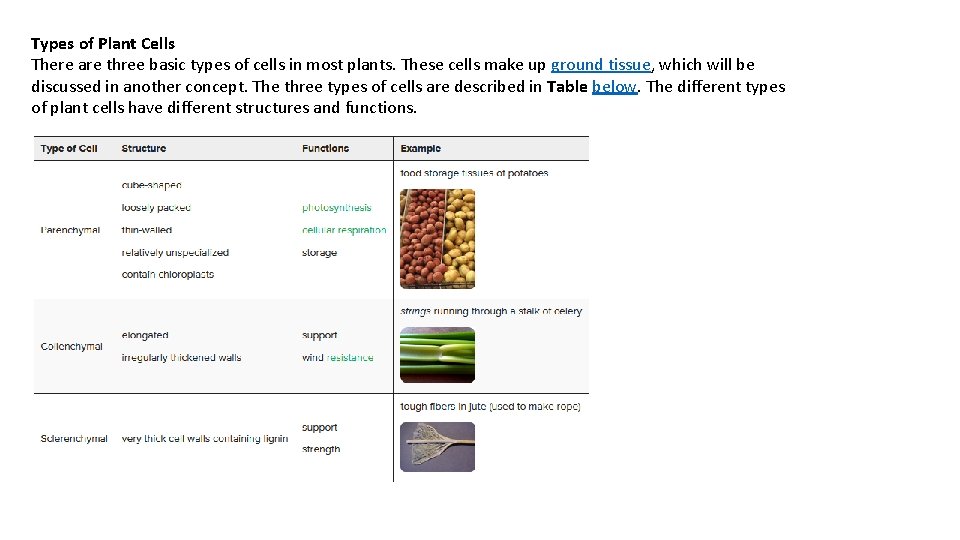
Types of Plant Cells There are three basic types of cells in most plants. These cells make up ground tissue, which will be discussed in another concept. The three types of cells are described in Table below. The different types of plant cells have different structures and functions.
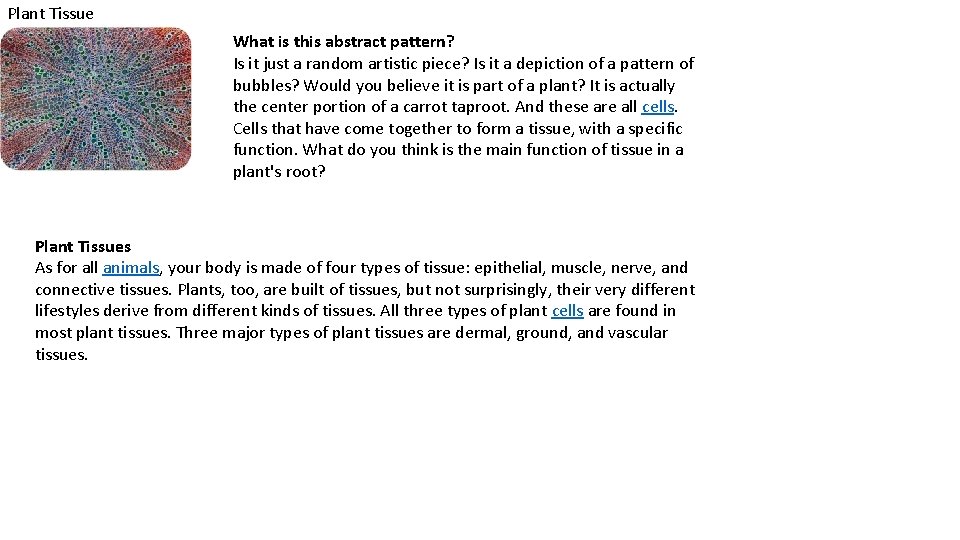
Plant Tissue What is this abstract pattern? Is it just a random artistic piece? Is it a depiction of a pattern of bubbles? Would you believe it is part of a plant? It is actually the center portion of a carrot taproot. And these are all cells. Cells that have come together to form a tissue, with a specific function. What do you think is the main function of tissue in a plant's root? Plant Tissues As for all animals, your body is made of four types of tissue: epithelial, muscle, nerve, and connective tissues. Plants, too, are built of tissues, but not surprisingly, their very different lifestyles derive from different kinds of tissues. All three types of plant cells are found in most plant tissues. Three major types of plant tissues are dermal, ground, and vascular tissues.
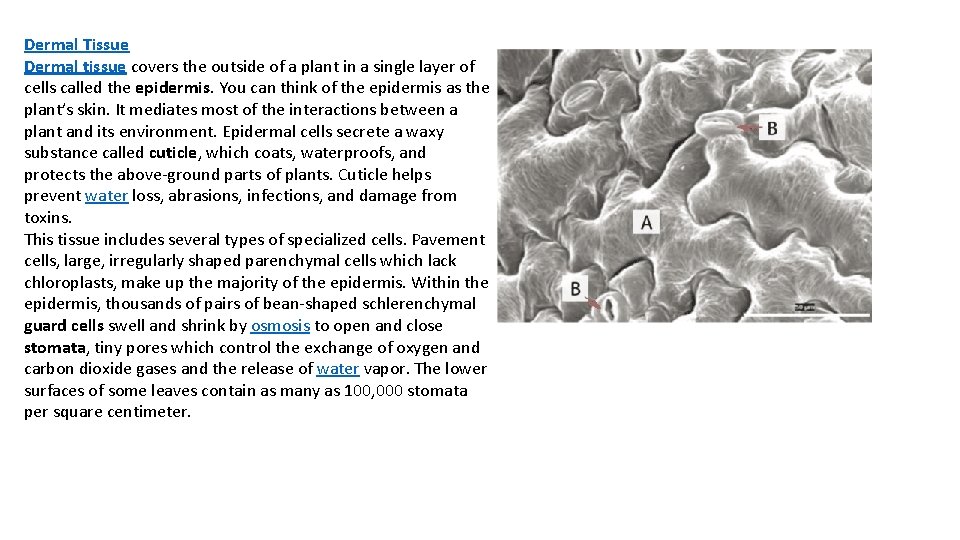
Dermal Tissue Dermal tissue covers the outside of a plant in a single layer of cells called the epidermis. You can think of the epidermis as the plant’s skin. It mediates most of the interactions between a plant and its environment. Epidermal cells secrete a waxy substance called cuticle, which coats, waterproofs, and protects the above-ground parts of plants. Cuticle helps prevent water loss, abrasions, infections, and damage from toxins. This tissue includes several types of specialized cells. Pavement cells, large, irregularly shaped parenchymal cells which lack chloroplasts, make up the majority of the epidermis. Within the epidermis, thousands of pairs of bean-shaped schlerenchymal guard cells swell and shrink by osmosis to open and close stomata, tiny pores which control the exchange of oxygen and carbon dioxide gases and the release of water vapor. The lower surfaces of some leaves contain as many as 100, 000 stomata per square centimeter.
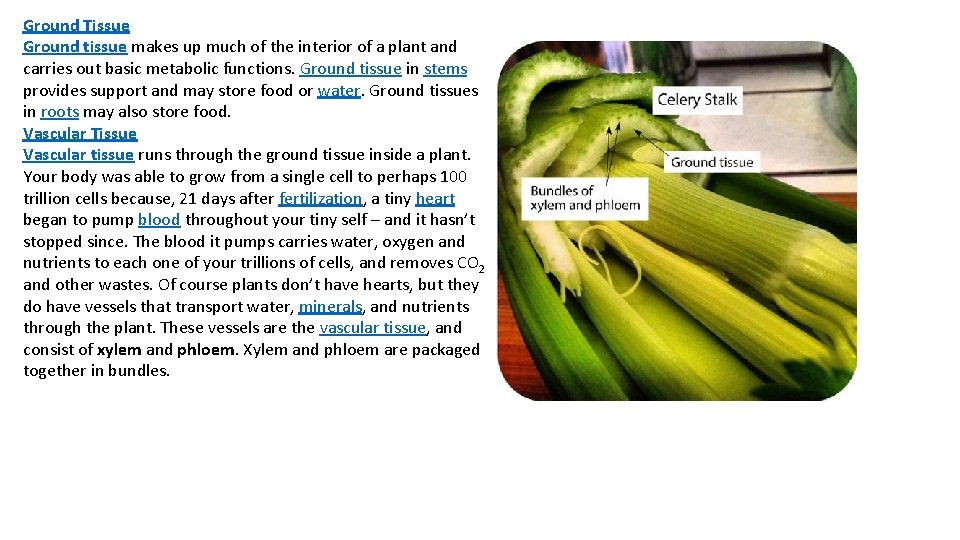
Ground Tissue Ground tissue makes up much of the interior of a plant and carries out basic metabolic functions. Ground tissue in stems provides support and may store food or water. Ground tissues in roots may also store food. Vascular Tissue Vascular tissue runs through the ground tissue inside a plant. Your body was able to grow from a single cell to perhaps 100 trillion cells because, 21 days after fertilization, a tiny heart began to pump blood throughout your tiny self – and it hasn’t stopped since. The blood it pumps carries water, oxygen and nutrients to each one of your trillions of cells, and removes CO 2 and other wastes. Of course plants don’t have hearts, but they do have vessels that transport water, minerals, and nutrients through the plant. These vessels are the vascular tissue, and consist of xylem and phloem. Xylem and phloem are packaged together in bundles.
1. Compare dermal, ground, and vascular tissues of plants. 2. What is cuticle? What is its role? 3. What are guard cells and stomata?