
Plant Assets Intangibles Chapter 9 1 Copyright 2012
Plant Assets & Intangibles Chapter 9 1 Copyright © 2012 Pearson Education, Inc. Publishing as Prentice Hall.
Learning Objectives Measure the cost of a plant asset Account for depreciation Record the disposal of an asset by sale or trade Account for natural resources Account for intangible assets Describe ethical issues related to plant assets 2 Copyright © 2012 Pearson Education, Inc. Publishing as Prentice Hall.
Characteristics of Plant Assets Plant assets are relatively expensive Challenge determining the full cost Last several years and allocated to those years Can be sold or traded in 3 Copyright © 2012 Pearson Education, Inc. Publishing as Prentice Hall.
Plant Assets Classification Real or tangible assets Natural resources Intangible assets 4 Copyright © 2012 Pearson Education, Inc. Publishing as Prentice Hall.

Plant Assets and Their Related Expenses Plant Assets Natural Resources Intangible Assets Depreciation Depletion Amortization 5 Copyright © 2012 Pearson Education, Inc. Publishing as Prentice Hall.
1 Measure the cost of a plant asset 6 Copyright © 2012 Pearson Education, Inc. Publishing as Prentice Hall.
The Cost Principle Rule for measuring the asset’s cost Cost of an asset = Sum of all costs incurred to bring the asset to its intended purpose, less any discounts 7 Copyright © 2012 Pearson Education, Inc. Publishing as Prentice Hall.
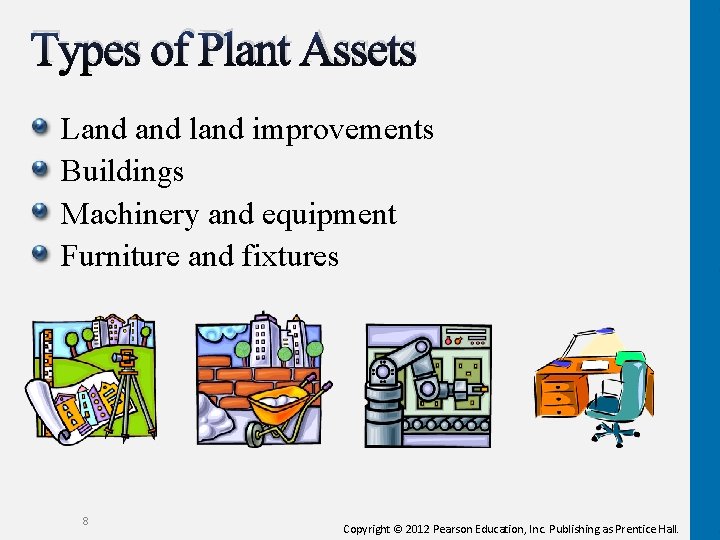
Types of Plant Assets Land land improvements Buildings Machinery and equipment Furniture and fixtures 8 Copyright © 2012 Pearson Education, Inc. Publishing as Prentice Hall.
Land NOT depreciated Costs included in land: Purchase price Brokerage fees Survey and legal fees Property taxes in arrears Title transfer Costs of clearing and removing unwanted buildings 9 Copyright © 2012 Pearson Education, Inc. Publishing as Prentice Hall.
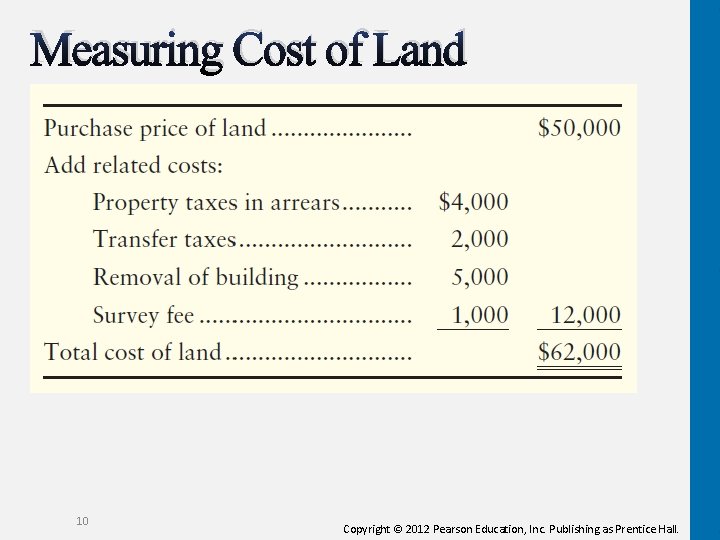
Measuring Cost of Land 10 Copyright © 2012 Pearson Education, Inc. Publishing as Prentice Hall.
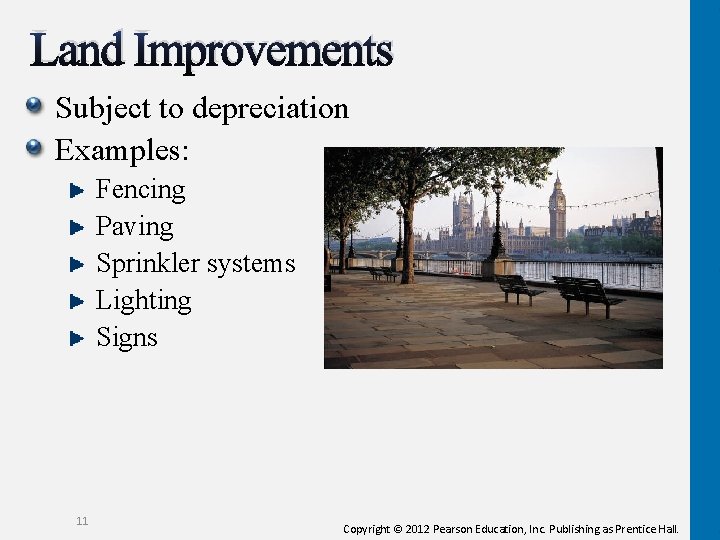
Land Improvements Subject to depreciation Examples: Fencing Paving Sprinkler systems Lighting Signs 11 Copyright © 2012 Pearson Education, Inc. Publishing as Prentice Hall.
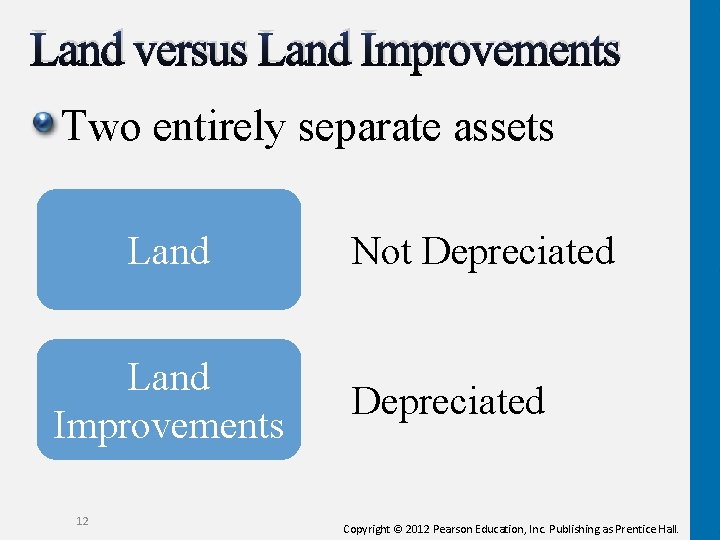
Land versus Land Improvements Two entirely separate assets Land Improvements 12 Not Depreciated Copyright © 2012 Pearson Education, Inc. Publishing as Prentice Hall.
Buildings Building Constructed Architectural fees Building permits Contractor charges Payments for material, labor, and overhead Capitalized interest cost, if self-constructed 13 Building Purchased Purchase price Costs to renovate the building for use Copyright © 2012 Pearson Education, Inc. Publishing as Prentice Hall.
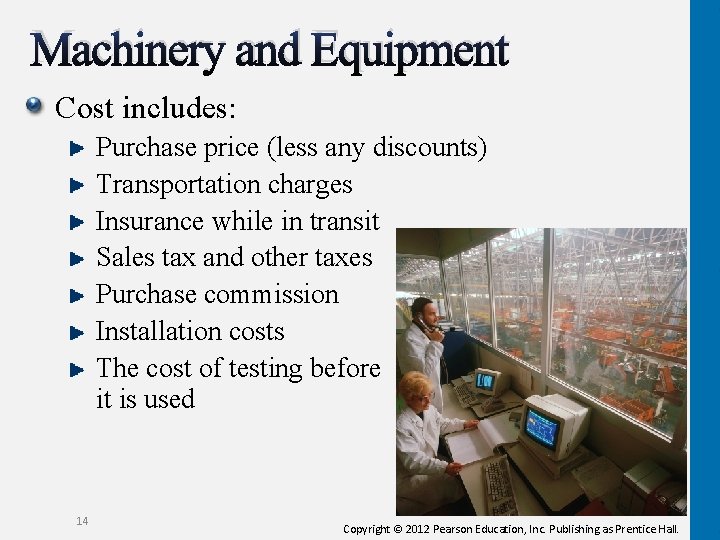
Machinery and Equipment Cost includes: Purchase price (less any discounts) Transportation charges Insurance while in transit Sales tax and other taxes Purchase commission Installation costs The cost of testing before it is used 14 Copyright © 2012 Pearson Education, Inc. Publishing as Prentice Hall.
Furniture and Fixtures Purchase price (less any discounts) Shipping charges Costs to assemble 15 Copyright © 2012 Pearson Education, Inc. Publishing as Prentice Hall.
Lump Sum Purchase (Basket) Purchase a group of plant assets for a single price Assign cost to individual assets based on relative sales values 16 Copyright © 2012 Pearson Education, Inc. Publishing as Prentice Hall.
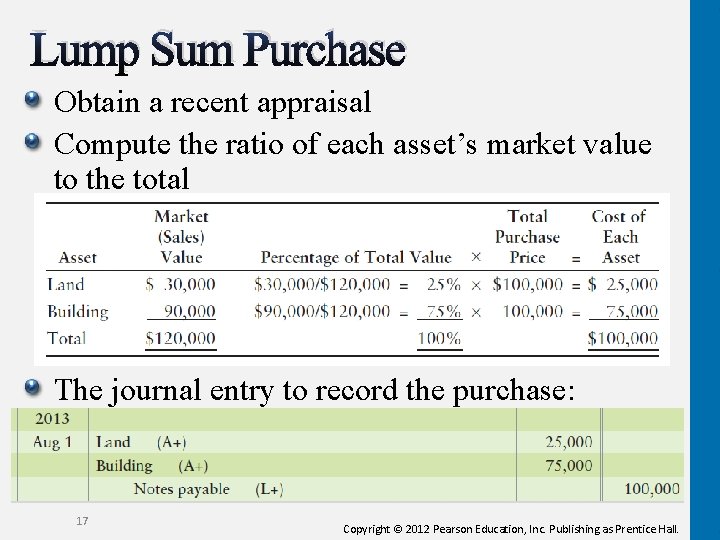
Lump Sum Purchase Obtain a recent appraisal Compute the ratio of each asset’s market value to the total The journal entry to record the purchase: 17 Copyright © 2012 Pearson Education, Inc. Publishing as Prentice Hall.
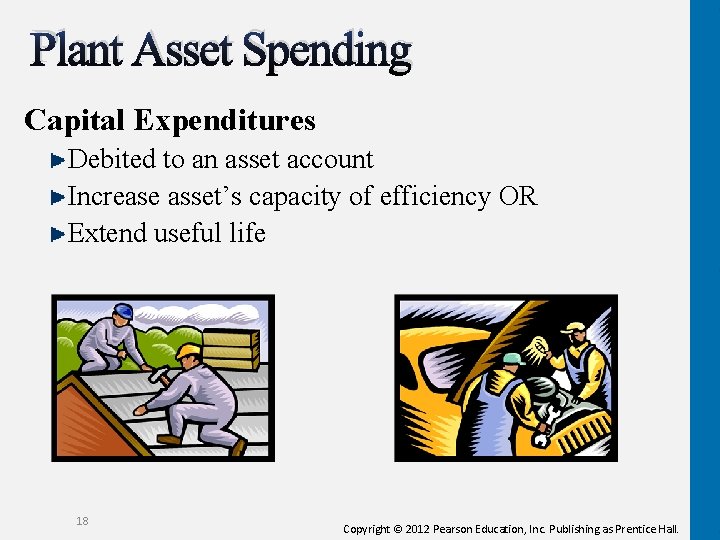
Plant Asset Spending Capital Expenditures Debited to an asset account Increase asset’s capacity of efficiency OR Extend useful life 18 Copyright © 2012 Pearson Education, Inc. Publishing as Prentice Hall.
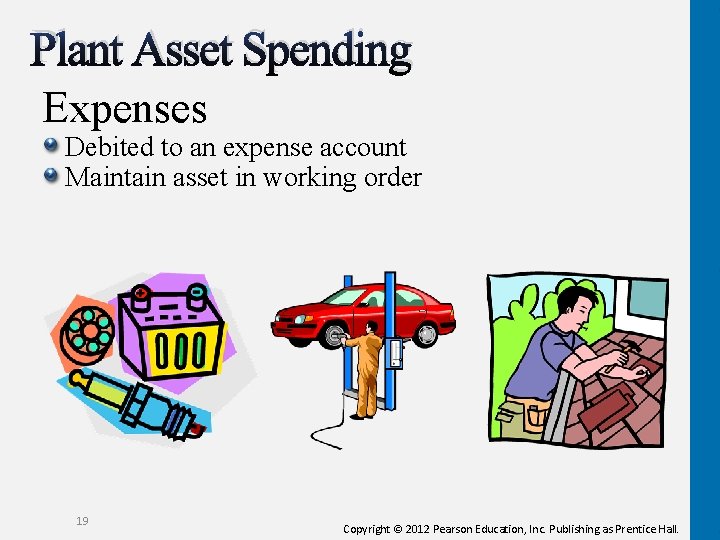
Plant Asset Spending Expenses Debited to an expense account Maintain asset in working order 19 Copyright © 2012 Pearson Education, Inc. Publishing as Prentice Hall.
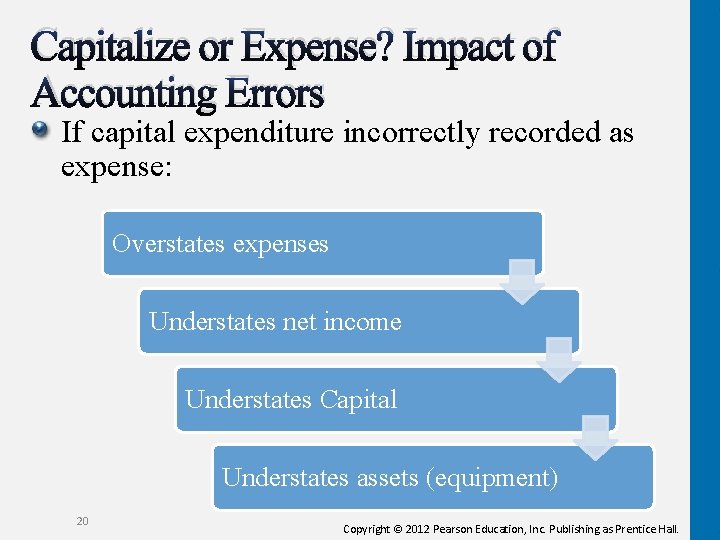
Capitalize or Expense? Impact of Accounting Errors If capital expenditure incorrectly recorded as expense: Overstates expenses Understates net income Understates Capital Understates assets (equipment) 20 Copyright © 2012 Pearson Education, Inc. Publishing as Prentice Hall.
This chapter lists the costs included for the acquisition of land. First is the purchase price, which is obviously included in the cost of the land. The reasons for including the other costs are not so obvious. For example, removing a building looks more like an expense. 1. State why the costs listed in the chapter are included as part of the cost of the land. 21 Copyright © 2012 Pearson Education, Inc. Publishing as Prentice Hall.
(Continued) 2. After the land is ready for use, will these costs be capitalized or expensed? 22 Copyright © 2012 Pearson Education, Inc. Publishing as Prentice Hall.
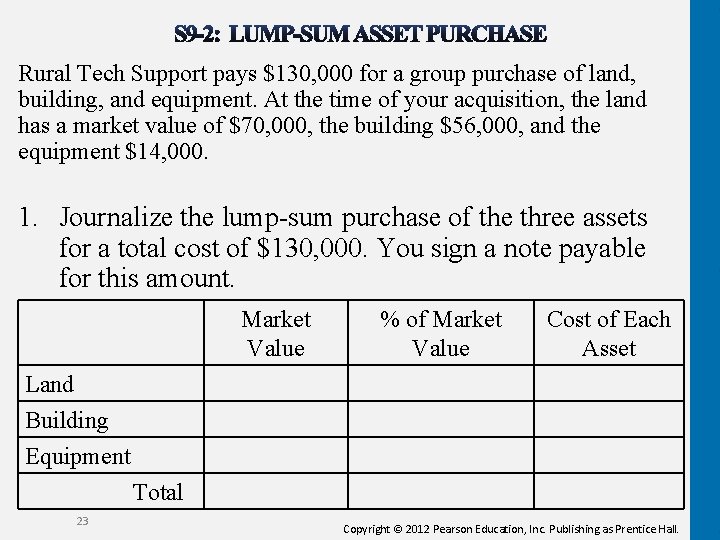
Rural Tech Support pays $130, 000 for a group purchase of land, building, and equipment. At the time of your acquisition, the land has a market value of $70, 000, the building $56, 000, and the equipment $14, 000. 1. Journalize the lump-sum purchase of the three assets for a total cost of $130, 000. You sign a note payable for this amount. Market Value % of Market Value Cost of Each Asset Land Building Equipment Total 23 Copyright © 2012 Pearson Education, Inc. Publishing as Prentice Hall.
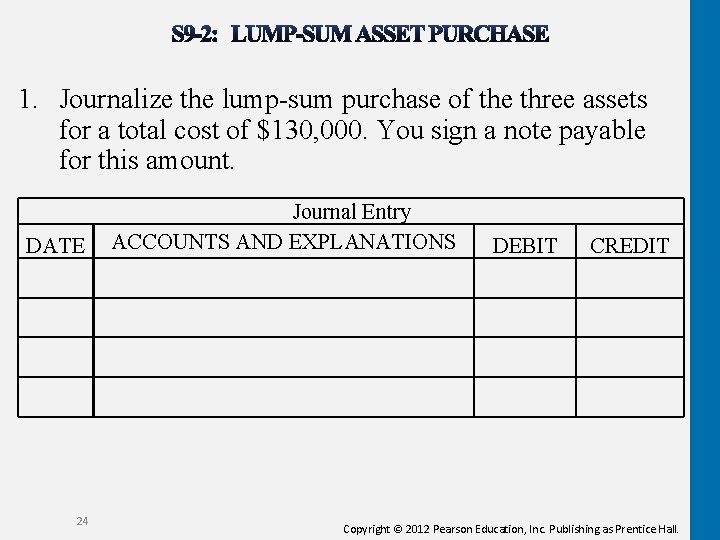
1. Journalize the lump-sum purchase of the three assets for a total cost of $130, 000. You sign a note payable for this amount. DATE 24 Journal Entry ACCOUNTS AND EXPLANATIONS DEBIT CREDIT Copyright © 2012 Pearson Education, Inc. Publishing as Prentice Hall.
2 Account for depreciation 25 Copyright © 2012 Pearson Education, Inc. Publishing as Prentice Hall.
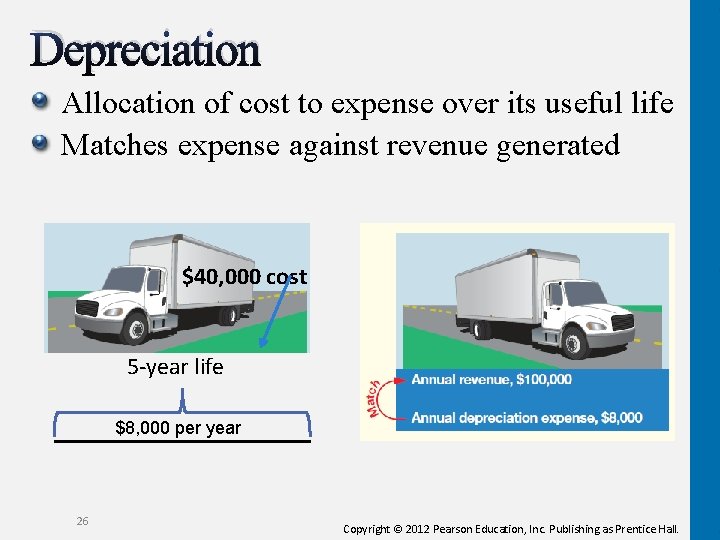
Depreciation Allocation of cost to expense over its useful life Matches expense against revenue generated $40, 000 cost 5 -year life $8, 000 per year 26 Copyright © 2012 Pearson Education, Inc. Publishing as Prentice Hall.
Causes of Depreciation Wear and tear from use Physical factors Obsolescence 27 Copyright © 2012 Pearson Education, Inc. Publishing as Prentice Hall.
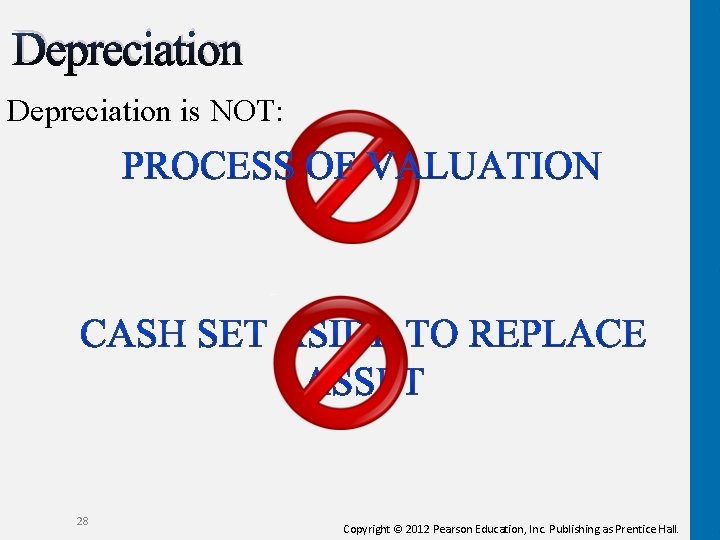
Depreciation is NOT: 28 Copyright © 2012 Pearson Education, Inc. Publishing as Prentice Hall.
Measuring Depreciation Cost–includes all items spent in order for the asset to perform Estimated useful life Estimated residual value Cost minus estimated residual value is called depreciable cost 29 Copyright © 2012 Pearson Education, Inc. Publishing as Prentice Hall.
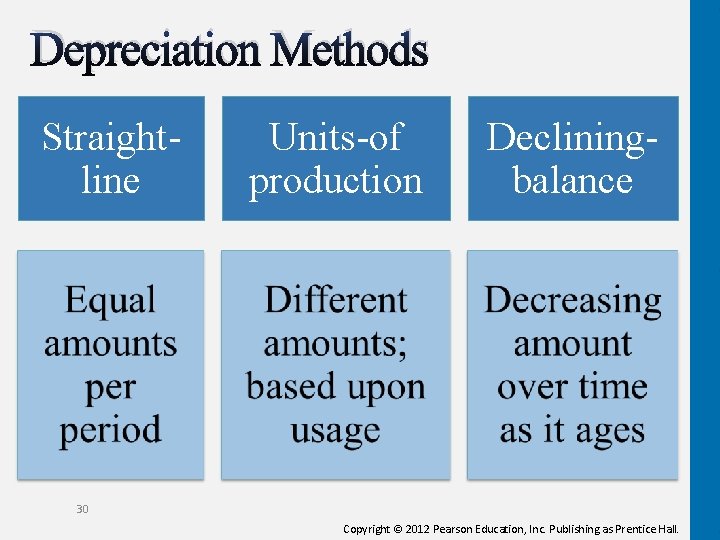
Depreciation Methods Straightline Units-of production Decliningbalance 30 Copyright © 2012 Pearson Education, Inc. Publishing as Prentice Hall.
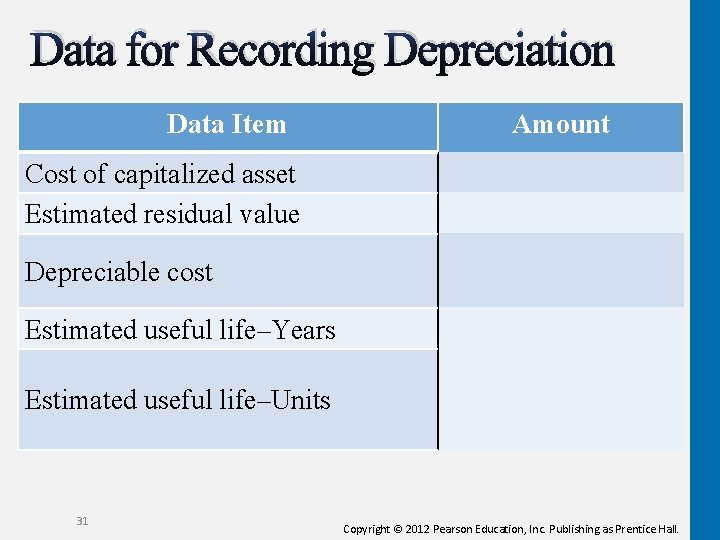
Data for Recording Depreciation Data Item Amount Cost of capitalized asset Estimated residual value Depreciable cost Estimated useful life–Years Estimated useful life–Units 31 Copyright © 2012 Pearson Education, Inc. Publishing as Prentice Hall.
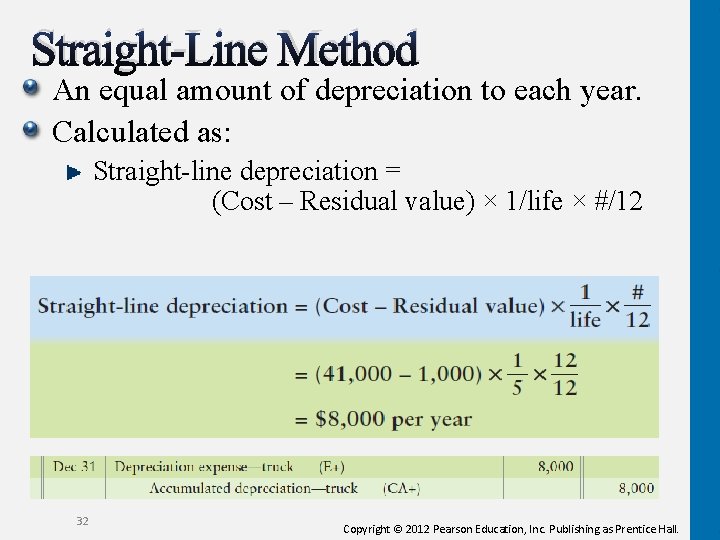
Straight-Line Method An equal amount of depreciation to each year. Calculated as: Straight-line depreciation = (Cost – Residual value) × 1/life × #/12 32 Copyright © 2012 Pearson Education, Inc. Publishing as Prentice Hall.
Net Book Value The carrying value of an asset as it depreciates Calculated as: Cost – Accumulated depreciation As an asset is used Accumulated depreciation increases Net book value decreases 33 Copyright © 2012 Pearson Education, Inc. Publishing as Prentice Hall.
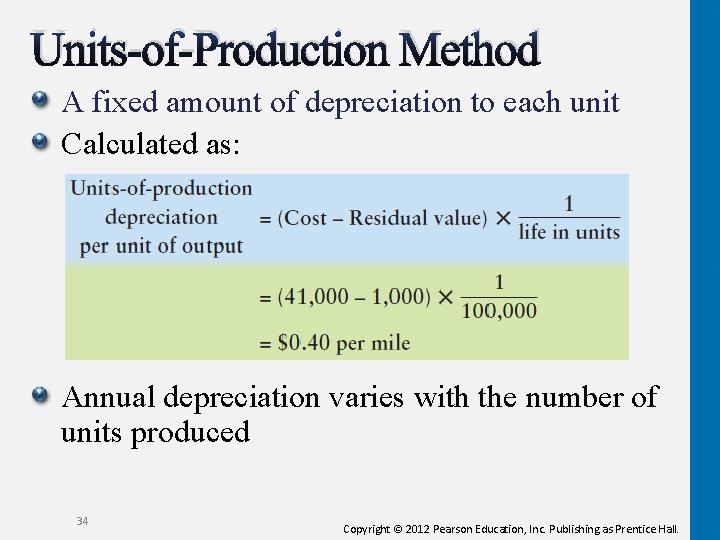
Units-of-Production Method A fixed amount of depreciation to each unit Calculated as: Annual depreciation varies with the number of units produced 34 Copyright © 2012 Pearson Education, Inc. Publishing as Prentice Hall.
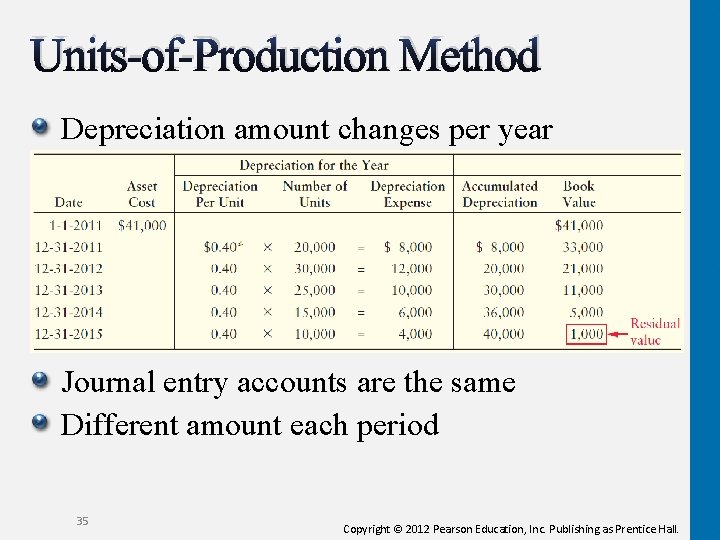
Units-of-Production Method Depreciation amount changes per year Journal entry accounts are the same Different amount each period 35 Copyright © 2012 Pearson Education, Inc. Publishing as Prentice Hall.
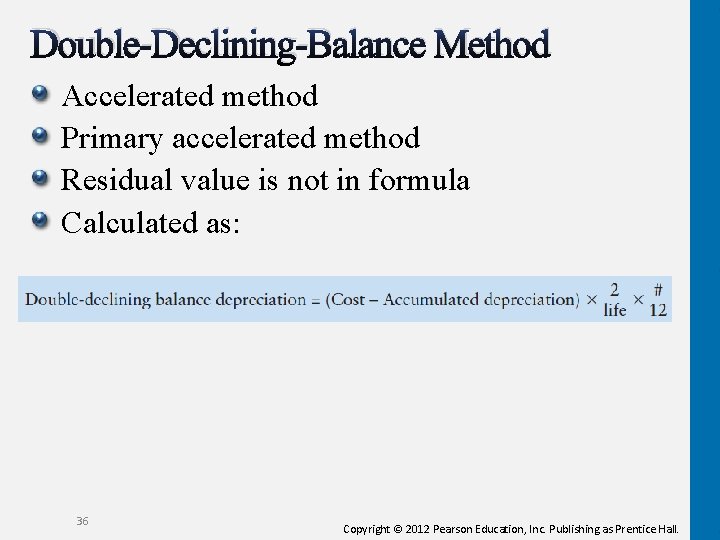
Double-Declining-Balance Method Accelerated method Primary accelerated method Residual value is not in formula Calculated as: 36 Copyright © 2012 Pearson Education, Inc. Publishing as Prentice Hall.
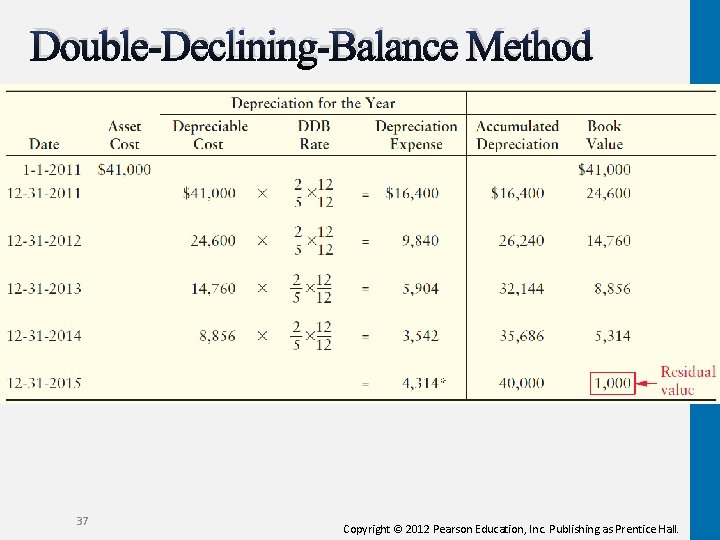
Double-Declining-Balance Method 37 Copyright © 2012 Pearson Education, Inc. Publishing as Prentice Hall.
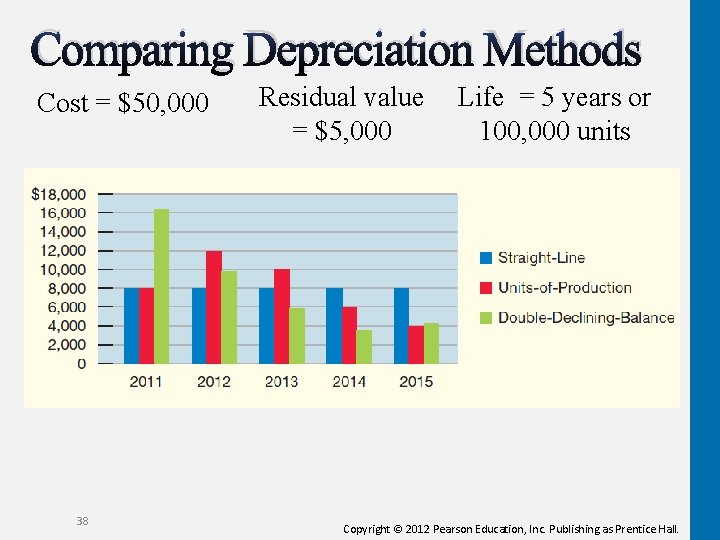
Comparing Depreciation Methods Cost = $50, 000 38 Residual value = $5, 000 Life = 5 years or 100, 000 units Copyright © 2012 Pearson Education, Inc. Publishing as Prentice Hall.
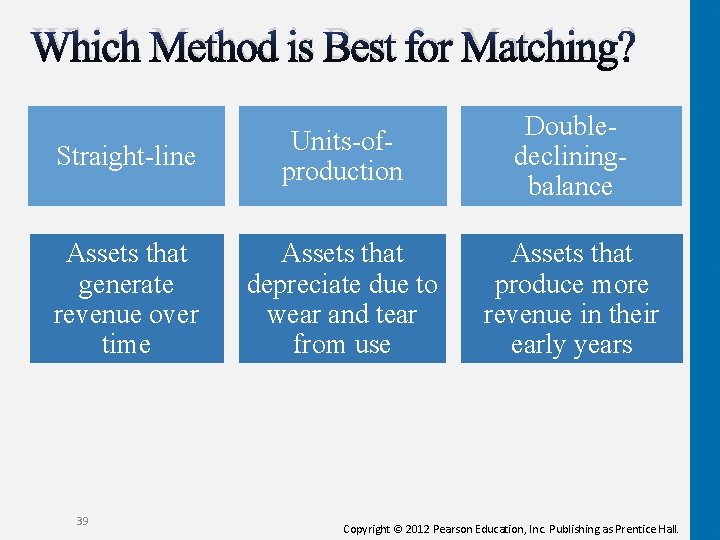
Which Method is Best for Matching? Straight-line Units-ofproduction Doubledecliningbalance Assets that generate revenue over time Assets that depreciate due to wear and tear from use Assets that produce more revenue in their early years 39 Copyright © 2012 Pearson Education, Inc. Publishing as Prentice Hall.
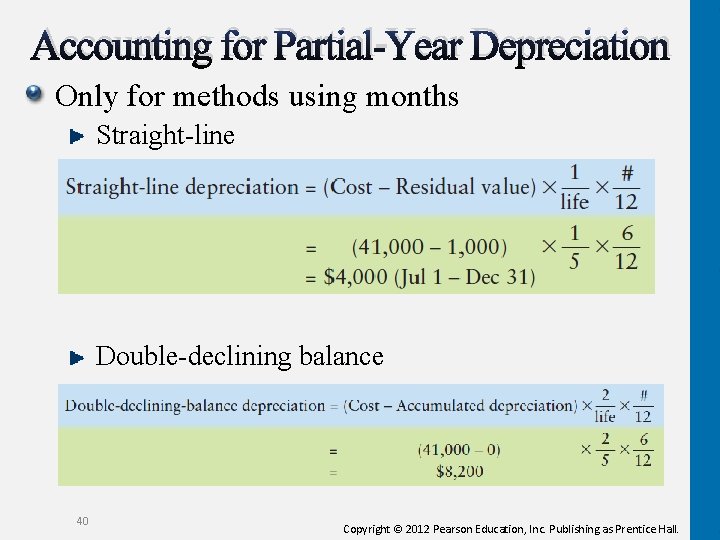
Accounting for Partial-Year Depreciation Only for methods using months Straight-line Double-declining balance 40 Copyright © 2012 Pearson Education, Inc. Publishing as Prentice Hall.
Issues in Accounting for Plant Assets Changes in useful life or residual value Considered a change in estimate Must report on the reason and effect of the change Asset book value is depreciated over the remaining life 41 Copyright © 2012 Pearson Education, Inc. Publishing as Prentice Hall.
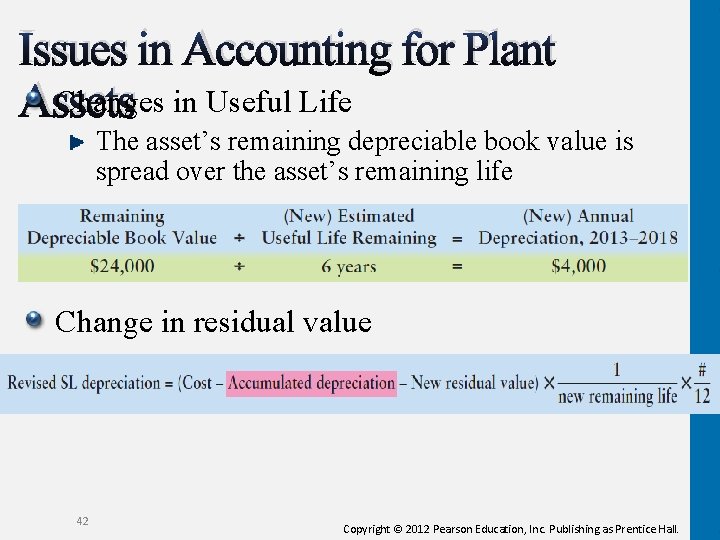
Issues in Accounting for Plant Changes in Useful Life Assets The asset’s remaining depreciable book value is spread over the asset’s remaining life Change in residual value 42 Copyright © 2012 Pearson Education, Inc. Publishing as Prentice Hall.
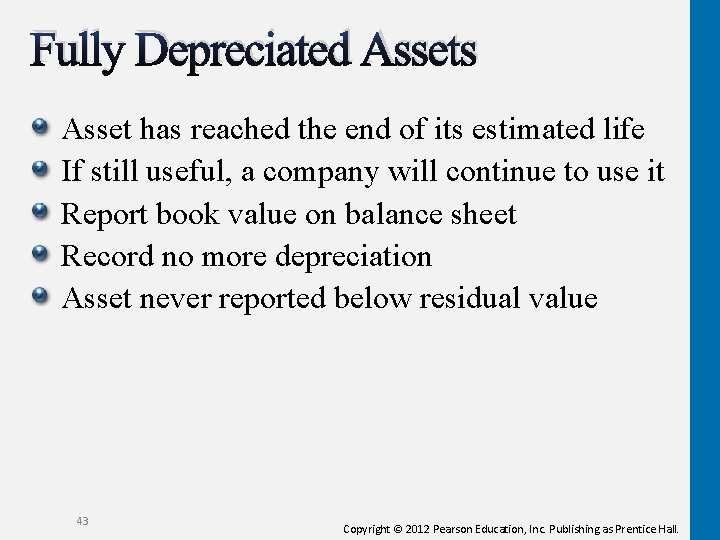
Fully Depreciated Assets Asset has reached the end of its estimated life If still useful, a company will continue to use it Report book value on balance sheet Record no more depreciation Asset never reported below residual value 43 Copyright © 2012 Pearson Education, Inc. Publishing as Prentice Hall.
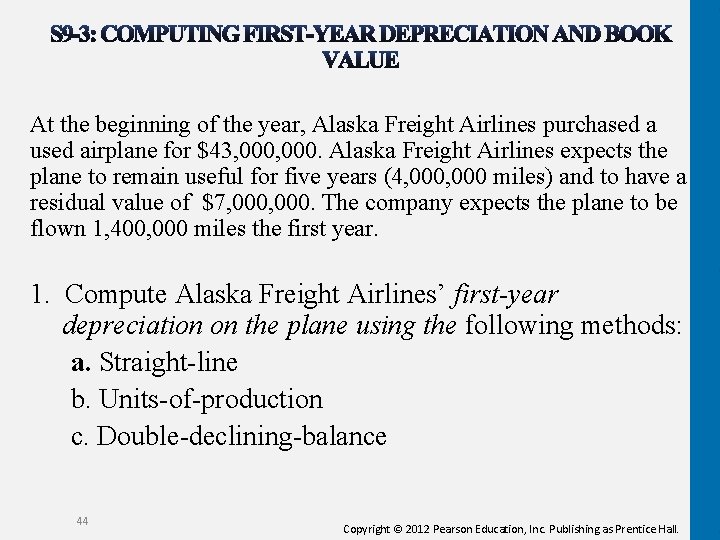
At the beginning of the year, Alaska Freight Airlines purchased a used airplane for $43, 000. Alaska Freight Airlines expects the plane to remain useful for five years (4, 000 miles) and to have a residual value of $7, 000. The company expects the plane to be flown 1, 400, 000 miles the first year. 1. Compute Alaska Freight Airlines’ first-year depreciation on the plane using the following methods: a. Straight-line b. Units-of-production c. Double-declining-balance 44 Copyright © 2012 Pearson Education, Inc. Publishing as Prentice Hall.
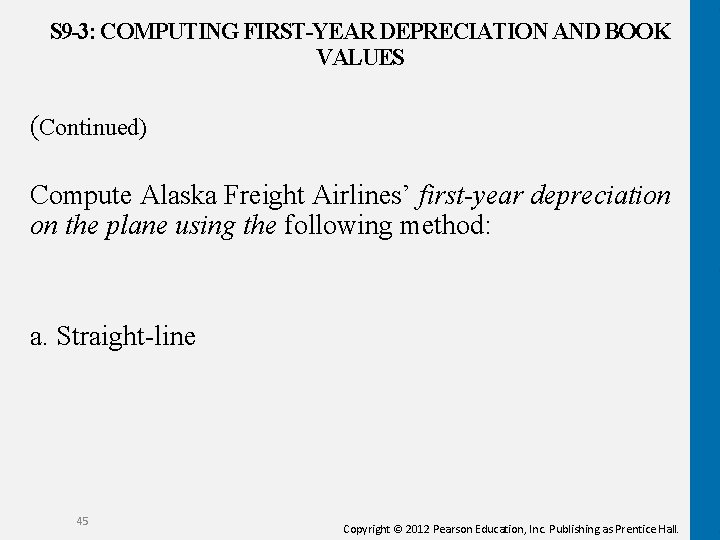
S 9 -3: COMPUTING FIRST-YEAR DEPRECIATION AND BOOK VALUES (Continued) Compute Alaska Freight Airlines’ first-year depreciation on the plane using the following method: a. Straight-line 45 Copyright © 2012 Pearson Education, Inc. Publishing as Prentice Hall.
S 9 -3: COMPUTING FIRST-YEAR DEPRECIATION AND BOOK VALUE (Continued) Compute Alaska Freight Airlines’ first-year depreciation on the plane using the following method: b. Units-of-production 46 Copyright © 2012 Pearson Education, Inc. Publishing as Prentice Hall.
S 9 -3: COMPUTING FIRST-YEAR DEPRECIATION AND BOOK VALUE (Continued) Compute Alaska Freight Airlines’ first-year depreciation on the plane using the following method: c. Double-declining-balance 47 Copyright © 2012 Pearson Education, Inc. Publishing as Prentice Hall.
3 Record the disposal of an asset by sale or trade 48 Copyright © 2012 Pearson Education, Inc. Publishing as Prentice Hall.
Disposing of a Plant Asset wears out or becomes obsolete. Company can: Sell the asset for cash Scrap the asset for no cash Trade the asset for another asset 49 Copyright © 2012 Pearson Education, Inc. Publishing as Prentice Hall.
Accounting for Disposal of Plant Asset Update depreciation Remove old asset from books Record the value of any cash paid or received Determine difference between total debits and total credits 50 Copyright © 2012 Pearson Education, Inc. Publishing as Prentice Hall.
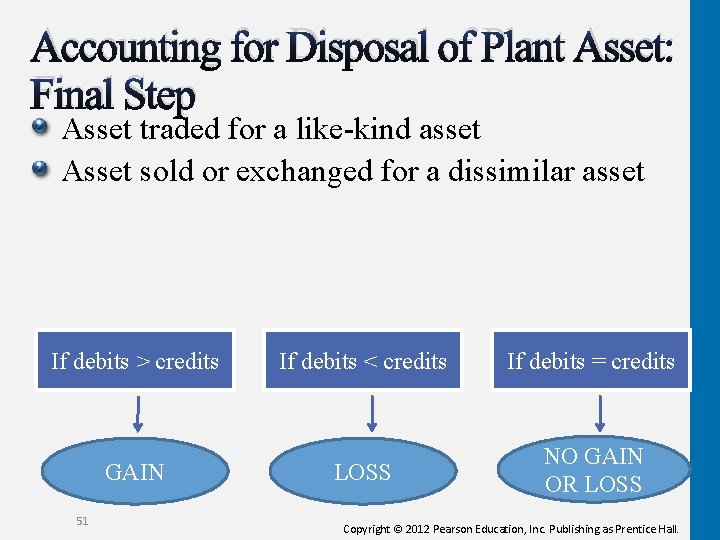
Accounting for Disposal of Plant Asset: Final Step Asset traded for a like-kind asset Asset sold or exchanged for a dissimilar asset If debits > credits GAIN 51 If debits < credits If debits = credits LOSS NO GAIN OR LOSS Copyright © 2012 Pearson Education, Inc. Publishing as Prentice Hall.
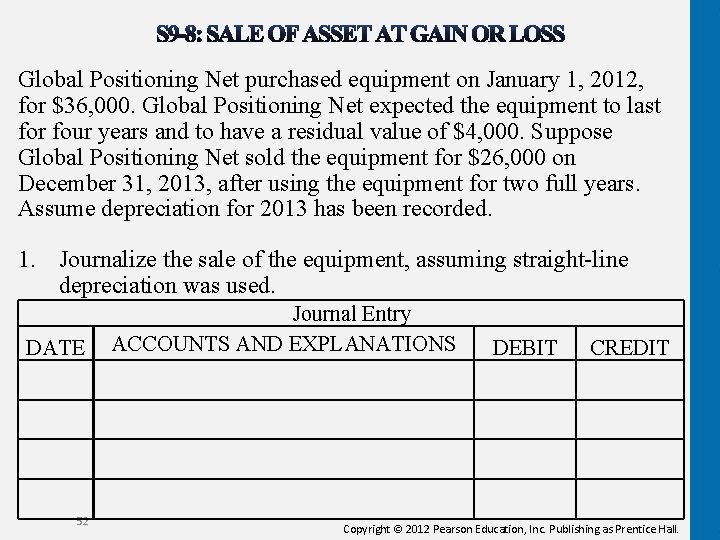
Global Positioning Net purchased equipment on January 1, 2012, for $36, 000. Global Positioning Net expected the equipment to last for four years and to have a residual value of $4, 000. Suppose Global Positioning Net sold the equipment for $26, 000 on December 31, 2013, after using the equipment for two full years. Assume depreciation for 2013 has been recorded. 1. Journalize the sale of the equipment, assuming straight-line depreciation was used. DATE 52 Journal Entry ACCOUNTS AND EXPLANATIONS DEBIT CREDIT Copyright © 2012 Pearson Education, Inc. Publishing as Prentice Hall.
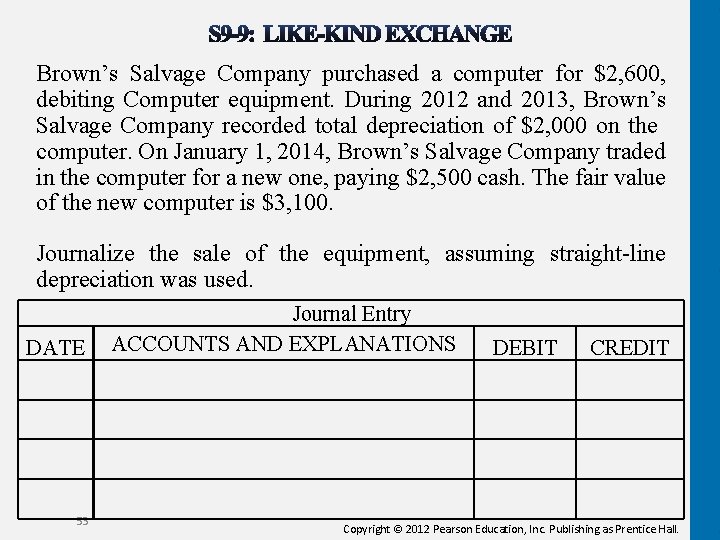
Brown’s Salvage Company purchased a computer for $2, 600, debiting Computer equipment. During 2012 and 2013, Brown’s Salvage Company recorded total depreciation of $2, 000 on the computer. On January 1, 2014, Brown’s Salvage Company traded in the computer for a new one, paying $2, 500 cash. The fair value of the new computer is $3, 100. Journalize the sale of the equipment, assuming straight-line depreciation was used. DATE 53 Journal Entry ACCOUNTS AND EXPLANATIONS DEBIT CREDIT Copyright © 2012 Pearson Education, Inc. Publishing as Prentice Hall.
4 Account for natural resources 54 Copyright © 2012 Pearson Education, Inc. Publishing as Prentice Hall.
Natural Resources Plant assets coming from the earth Expensed through depletion Depletion expense–the portion of the cost used up Computed by the units-of-production method 55 Copyright © 2012 Pearson Education, Inc. Publishing as Prentice Hall.
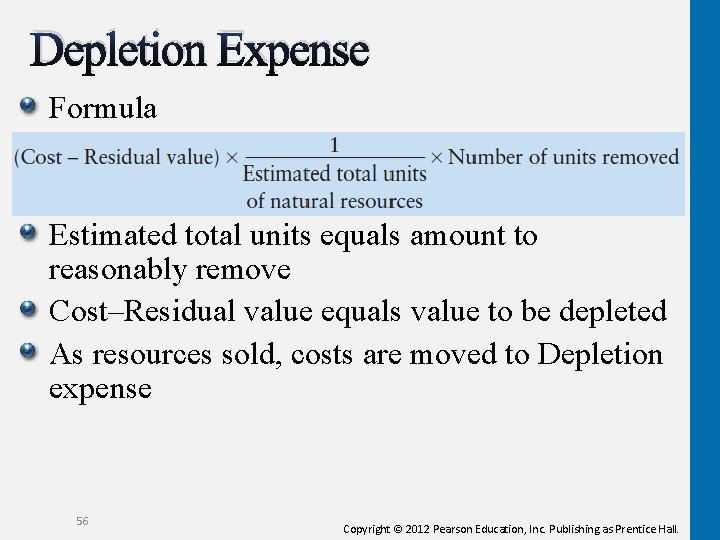
Depletion Expense Formula Estimated total units equals amount to reasonably remove Cost–Residual value equals value to be depleted As resources sold, costs are moved to Depletion expense 56 Copyright © 2012 Pearson Education, Inc. Publishing as Prentice Hall.
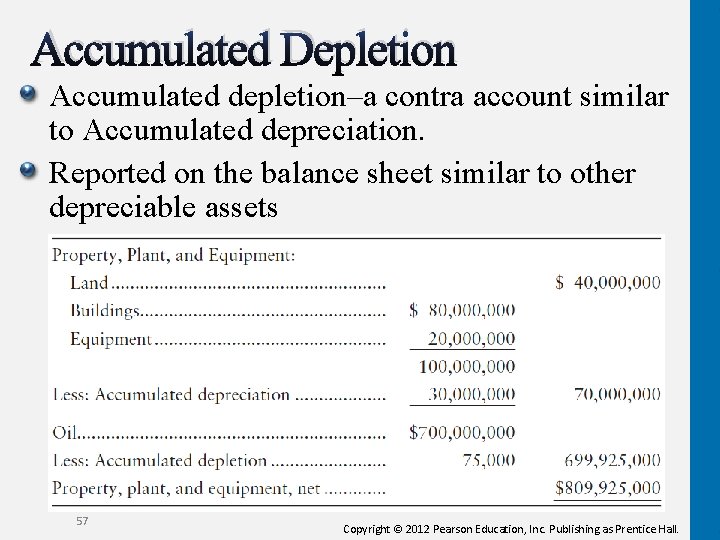
Accumulated Depletion Accumulated depletion–a contra account similar to Accumulated depreciation. Reported on the balance sheet similar to other depreciable assets 57 Copyright © 2012 Pearson Education, Inc. Publishing as Prentice Hall.
Tex. Am Petroleum holds huge reserves of oil and gas assets. Assume that at the end of 2012, Tex. Am Petroleum’s cost of oil and gas reserves totaled $72, 000, representing 8, 000, 000 barrels of oil and gas. 1. Which depreciation method does Tex. Am Petroleum use to compute depletion? 58 Copyright © 2012 Pearson Education, Inc. Publishing as Prentice Hall.
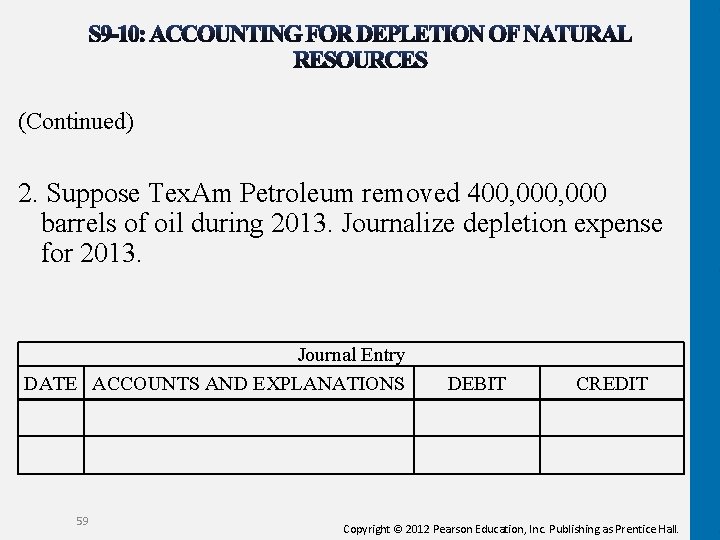
(Continued) 2. Suppose Tex. Am Petroleum removed 400, 000 barrels of oil during 2013. Journalize depletion expense for 2013. Journal Entry DATE ACCOUNTS AND EXPLANATIONS 59 DEBIT CREDIT Copyright © 2012 Pearson Education, Inc. Publishing as Prentice Hall.
5 Account for intangible assets 60 Copyright © 2012 Pearson Education, Inc. Publishing as Prentice Hall.
Intangible Assets Non-current assets with no physical form Provide exclusive rights or privileges Expensed through amortization using the straight-line method R 61 C Copyright © 2012 Pearson Education, Inc. Publishing as Prentice Hall.
Types of Intangibles Patent 62 Copyright Trademarks brand names Copyright © 2012 Pearson Education, Inc. Publishing as Prentice Hall.
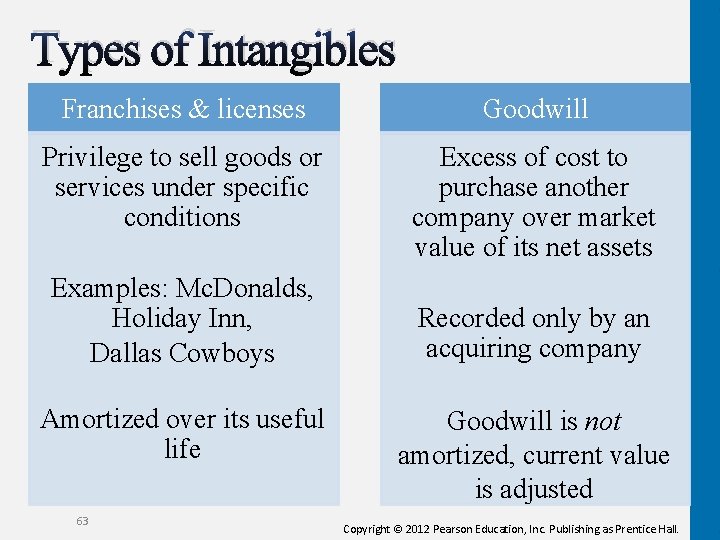
Types of Intangibles Franchises & licenses Goodwill Privilege to sell goods or services under specific conditions Excess of cost to purchase another company over market value of its net assets Examples: Mc. Donalds, Holiday Inn, Dallas Cowboys Amortized over its useful life 63 Recorded only by an acquiring company Goodwill is not amortized, current value is adjusted Copyright © 2012 Pearson Education, Inc. Publishing as Prentice Hall.
Research and Development (R&D) Costs Important to several industries Not an intangible 64 Copyright © 2012 Pearson Education, Inc. Publishing as Prentice Hall.
When one media company buys another, goodwill is often the most costly asset. TMC Advertising paid $170, 000 to acquire Seacoast Report, a weekly advertising paper. At the time of the acquisition, Seacoast Report’s balance sheet reported total assets of $130, 000 and liabilities of $70, 000. The fair market value of Seacoast Report’s assets was $100, 000. 1. How much goodwill did TMC Advertising purchase as part of the acquisition of Seacoast Report? 65 Copyright © 2012 Pearson Education, Inc. Publishing as Prentice Hall.
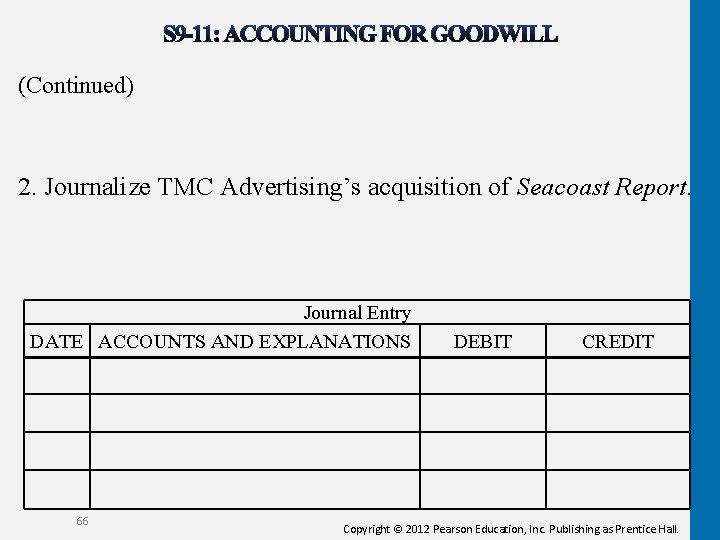
(Continued) 2. Journalize TMC Advertising’s acquisition of Seacoast Report. Journal Entry DATE ACCOUNTS AND EXPLANATIONS 66 DEBIT CREDIT Copyright © 2012 Pearson Education, Inc. Publishing as Prentice Hall.
6 Describe ethical issues related to plant assets 67 Copyright © 2012 Pearson Education, Inc. Publishing as Prentice Hall.
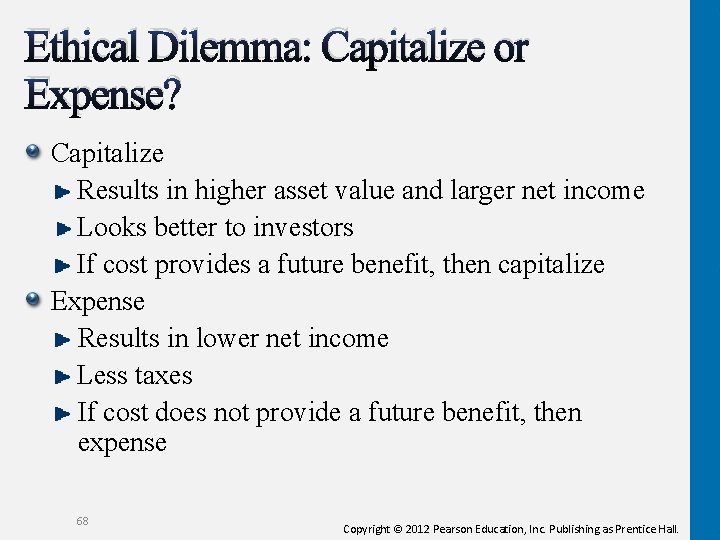
Ethical Dilemma: Capitalize or Expense? Capitalize Results in higher asset value and larger net income Looks better to investors If cost provides a future benefit, then capitalize Expense Results in lower net income Less taxes If cost does not provide a future benefit, then expense 68 Copyright © 2012 Pearson Education, Inc. Publishing as Prentice Hall.

69 Copyright © 2012 Pearson Education, Inc. Publishing as Prentice Hall.
Copyright All rights reserved. No part of this publication may be reproduced, stored in a retrieval system, or transmitted, in any form or by any means, electronic, mechanical, photocopying, recording, or otherwise, without the prior written permission of the publisher. Printed in the United States of America. 70 Copyright © 2012 Pearson Education, Inc. Publishing as Prentice Hall.
- Slides: 70