
Plant and Animal Cell Organelles Organisms and Environments

- Slides: 8
Plant and Animal Cell Organelles Organisms and Environments 1 Which of the following lists includes cellular structures found in both plant and animal cells? A Chloroplasts, cell wall, cell membrane, cytoplasm B Vacuoles, cell membrane, nucleus, mitochondria C Cell membrane, cytoplasm, nucleus, cell wall D Chloroplasts, vacuoles, cell wall, cytoplasm
Plant and Animal Cell Organelles Organisms and Environments 2 The nucleus is a round, double-walled structure often found in the center of both plant and animal cells. Its function is to. A purify water. B store fat. C generate cytoplasm. D contain genetic material.
Plant and Animal Cell Organelles Organisms and Environments 3 Two unlabeled slides are viewed under a microscope. Slide A has cells with a visible nucleus, mitochondria, a cell membrane, a cell wall, and chloroplasts. Slide B has cells with a visible nucleus, mitochondria, and a cell membrane. How should these slides be labeled? A Slide A – animal cells, Slide B – animal cells B Slide A – animal cells, Slide B – plant cells C Slide A – plant cells, Slide B – animal cells D Slide A – plant cells, Slide B – plant cells
Plant and Animal Cell Organelles Organisms and Environments 4 Which of the following structures can help differentiate between a plant cell and an animal cell? A Mitochondria B Nucleus C Chloroplast D Cell membrane
Plant and Animal Cell Organelles Organisms and Environments 5 Vacuoles are round organelles found in both plant and animal cells. Their primary function is to – A produce food and energy for the cell. B control the activities of the cell. C transport materials between parts of the cell. D store water, waste, and nutrients for the cell.
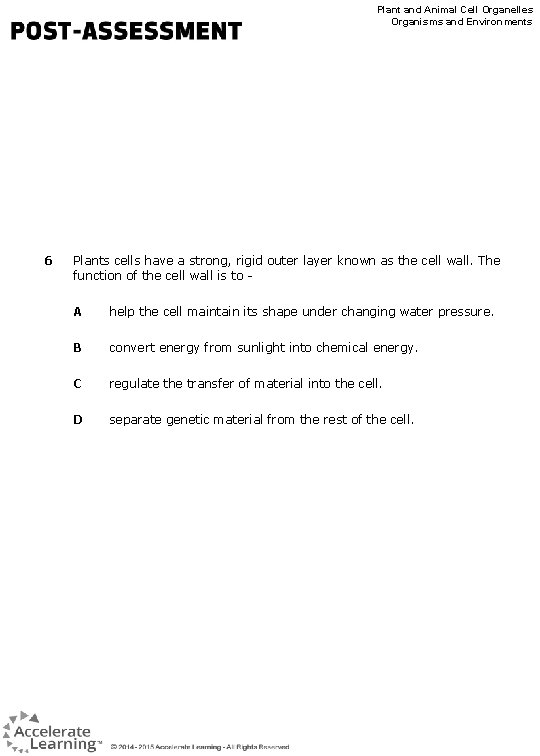
Plant and Animal Cell Organelles Organisms and Environments 6 Plants cells have a strong, rigid outer layer known as the cell wall. The function of the cell wall is to A help the cell maintain its shape under changing water pressure. B convert energy from sunlight into chemical energy. C regulate the transfer of material into the cell. D separate genetic material from the rest of the cell.
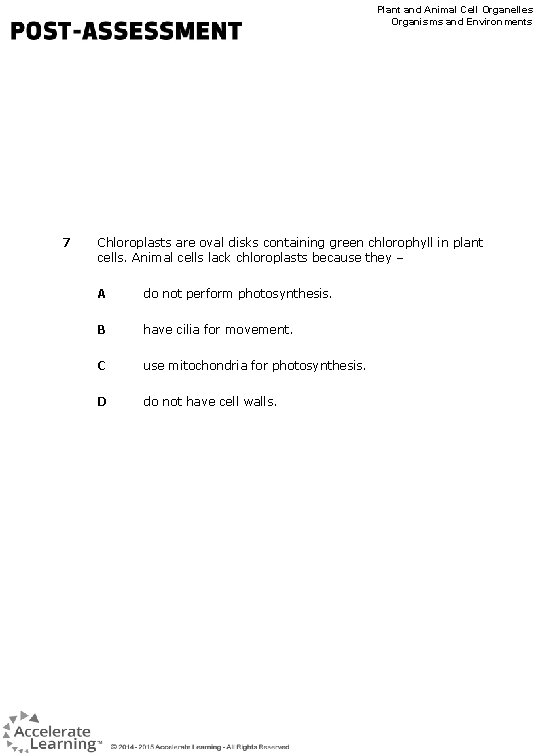
Plant and Animal Cell Organelles Organisms and Environments 7 Chloroplasts are oval disks containing green chlorophyll in plant cells. Animal cells lack chloroplasts because they – A do not perform photosynthesis. B have cilia for movement. C use mitochondria for photosynthesis. D do not have cell walls.
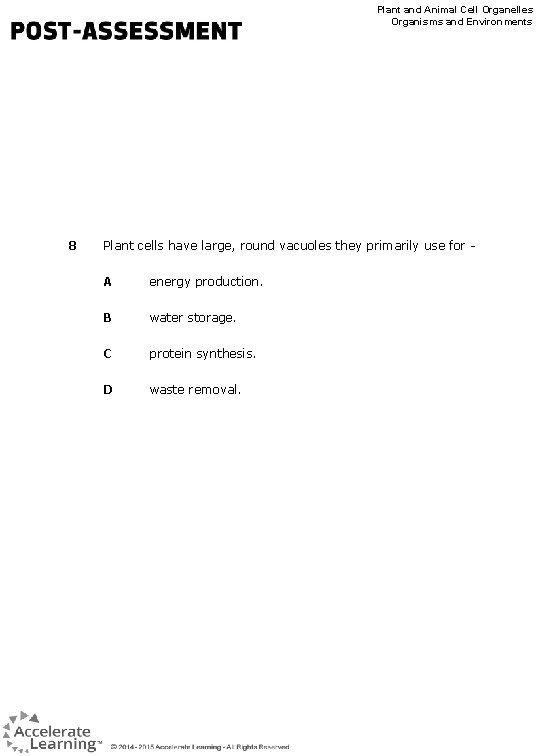
Plant and Animal Cell Organelles Organisms and Environments 8 Plant cells have large, round vacuoles they primarily use for A energy production. B water storage. C protein synthesis. D waste removal.