
Plant Analogy Helps account for moral growth Knowledge

- Slides: 24
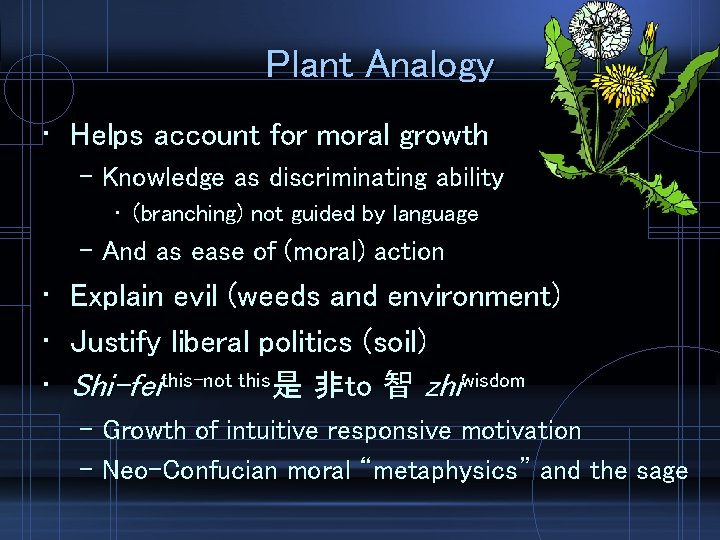
Plant Analogy • Helps account for moral growth – Knowledge as discriminating ability • (branching) not guided by language – And as ease of (moral) action • • • Explain evil (weeds and environment) Justify liberal politics (soil) Shi-feithis-not this是 非to 智 zhiwisdom – Growth of intuitive responsive motivation – Neo-Confucian moral “metaphysics” and the sage
Issues • Strong-weak choice (Conf. detail) – Weak interpretation plausible, strong needed to defend against moral reform • Normative result = Mozi (Utilitarian) – Moral psychology for universal concern • Problem: is moral psychology relevant – Can’t get “ought” from “is” – Mencius’ strategies: unique, health, choose!
Two Principles • Link fact & duty: – "Is-ought": “is” does not imply “ought” • Undermines Mencius’ appeal to nature – "Ought-can: " ought implies can • Is moral reform possible (yes) • Anti-language implications – Avoid 2 roots—foolish man – Good language can inspire but not contribute • Bad language can disrupt and destroy
Questions Coffee Tutorial today w/ questions Back to some Basic concepts (divisions) of philosophy Ethics
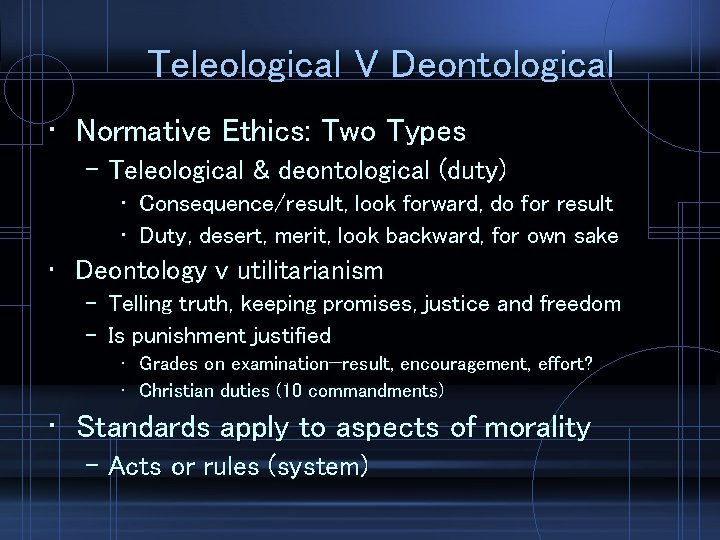
Teleological V Deontological • Normative Ethics: Two Types – Teleological & deontological (duty) • Consequence/result, look forward, do for result • Duty, desert, merit, look backward, for own sake • Deontology v utilitarianism – – Telling truth, keeping promises, justice and freedom Is punishment justified • Grades on examination—result, encouragement, effort? • Christian duties (10 commandments) • Standards apply to aspects of morality – Acts or rules (system)
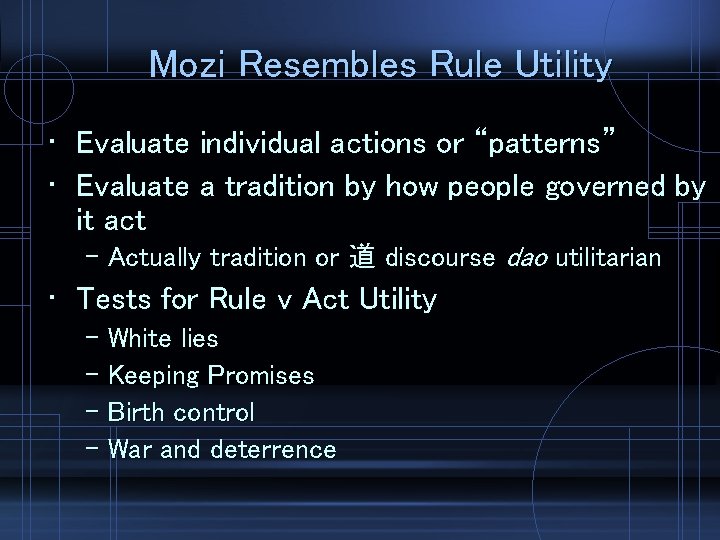
Mozi Resembles Rule Utility • Evaluate individual actions or “patterns” • Evaluate a tradition by how people governed by it act – Actually tradition or 道 discourse dao utilitarian • Tests for Rule v Act Utility – White lies – Keeping Promises – Birth control – War and deterrence
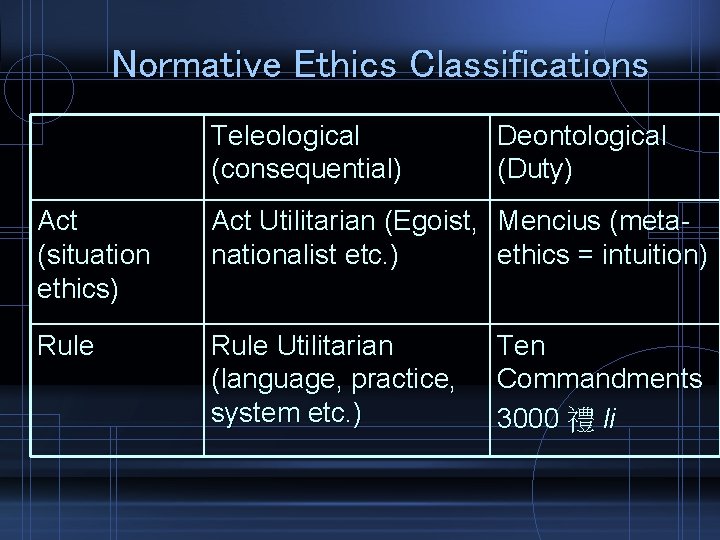
Normative Ethics Classifications Teleological (consequential) Deontological (Duty) Act (situation ethics) Act Utilitarian (Egoist, Mencius (metanationalist etc. ) ethics = intuition) Rule Utilitarian (language, practice, system etc. ) Ten Commandments 3000 禮 li
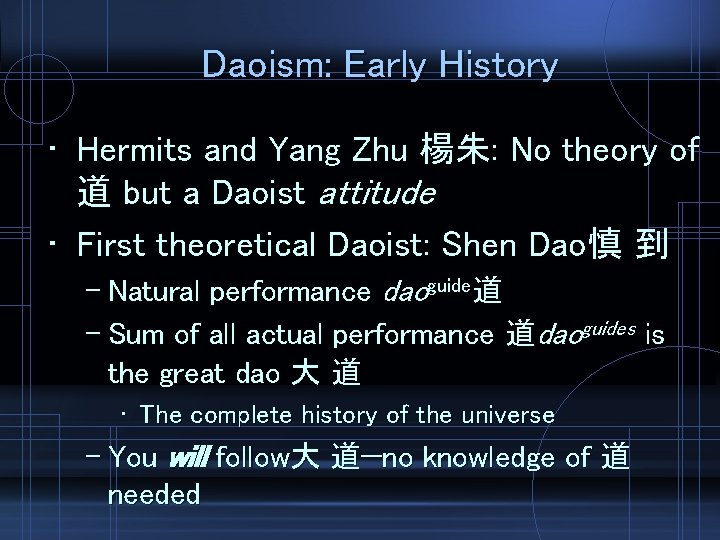
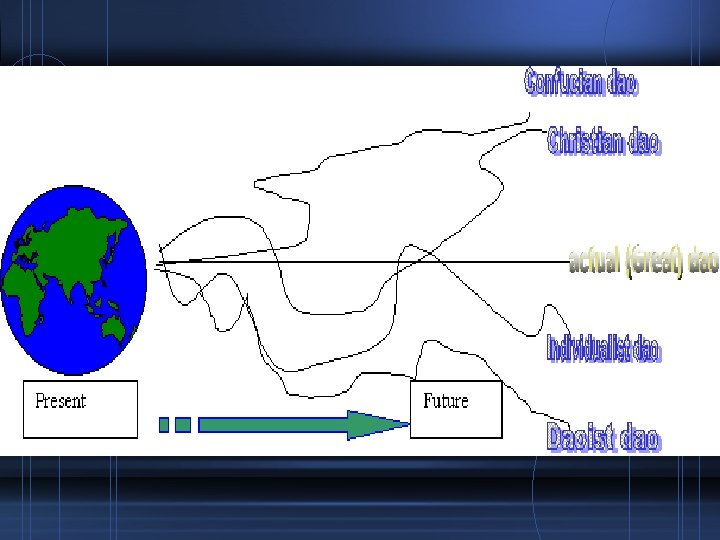
Daoism: Early History • Hermits and Yang Zhu 楊朱: No theory of 道 but a Daoist attitude • First theoretical Daoist: Shen Dao慎 到 – Natural performance daoguide道 – Sum of all actual performance 道daoguides is the great dao 大 道 • The complete history of the universe – You will follow大 道—no knowledge of 道 needed
Three Determinisms • Logical, Scientific, Fatalistic – What will be A = A • Like Parmenides “what is is” • Tautology=true by meaning/grammar – How to be right w/o saying anything • Don’t ___too much; Do what you should do. • Doesn’t entail anything else—free will • Scientific: induction on experience – Things happen by predictable laws (causal) – Generalize: everything predictable in advance
Fatalism • Claim that your decision/will cannot affect the world, outcome, future – Out of human control – Argument (one of the above or theological) • Does fatalism follow? – Not from logical determinism—studypass – From causal? Probably not • Soft determinism says free will does not contradict causal predictability • God’s foreknowledge?
慎 到Shen Dao’s Problems • Draws fatalism conclusion – From logical determinism – There is just one future actual history • The one caused by my (our) actions • Unnatural advice – Knowing & judgment “natural” for humans • Paradox of "abandon knowledge“ – 道 Dao as the object of knowledge • Knowing dao—not needed abandon • Obey it only if you ignore it
Laozi老子 • Textual issues • The Zhuangzi's history – Between Shendao and Zhuangzi • Abandon knowledge w/o relying on fatalism – Argument from freedom from social control – Spontaneity
Analysis of "Knowledge" • Discourse 道 daos: come in opposites – Names 名(opposites) – Distinctions (implied: one per pair) – Desires 欲 • Innovation in seeing desires generated by names/distinctions – 為 weideem: do action
Problem: Same Paradox? • Distinction of natural and conventional desires – Forms of social constraint – Language distorts by gross distinction while there are infinite shades in nature • • • Desire to be natural Act on the desire (forgetting) 無 為 wulack weideem: do a paradox – Wu-wei and yet wu-bu-wei無不為 – no concept guided action
No Constant Dao • 道可道非常道 Any dao that guides is not constant dao-ing • Because based on 名 and – 名可名非常名 Any name that names is not constant name-ing • Negative 道 daoguide by emphasizing opposite virtues – Passive, lower, water, cool, submissive, female – Constant 道 daoguide ? Unspeakable?
Relevance to Mencius • The intuitions that Confucians think are natural are socially cultivated – Burial, filial piety, attitudes to authority – Status, wealth, style • Hong Kong slavery – Innate天 道 is very thin • Eat, sleep, children, farm, small villages
Common Anti-language Problem • 墨 辯 Mohist semantic analysis: – To say “language bad” is bad – Paradox of the liar • This sentence is false • All Sentences are false – Not a paradox – But false • Challenge to Zhuangzi
Puzzle • All language distorts the 道 dao
Zhuangzi: Textual Issues • Relation to Laozi – Probably earlier – No contact or knowledge (mostly later students) – Project a similarity of focus • Construction of desires from language/culture • Relation to School of Names名 家 closer – Friend of 惠 施 Hui Shi • Deals with anti-language paradox better
Pipes of 天tian nature: sky • Human voices and arguing about philosophy is natural – Like birds tweeting and frogs croaking • Gives Yangzhu, Mozi and Mencius what they want – Not worth anything – Want authority over rivals and天tiannature: sky fails • Hint from Shen Dao—no normative content • Pure fact—no ought/value
Priority of Dao over天 • Must presuppose a 道 daoguide • For a Daoist, 道 daoguide the authority, not 天 tiannature: sky – The cosmos doesn't make guiding judgments--all from a 道daoguide – Cannot escape responsibility for our own dao judgments • • Should I follow天 tiannature: sky? No matter what authority
Refutation of Mencius • Should follow our hearts and should follow 天 tiannature: sky (性 xingnature ) – All organs are equally natural • C. f. Mencius' weeds – How do you是shithis: right a favorite? • Rely on the心 xinheart-mind? Begs the question • Take turns or have no ruler?