
Plant Adaptation Adaptation Living things are adapted to




- Slides: 24
Plant Adaptation
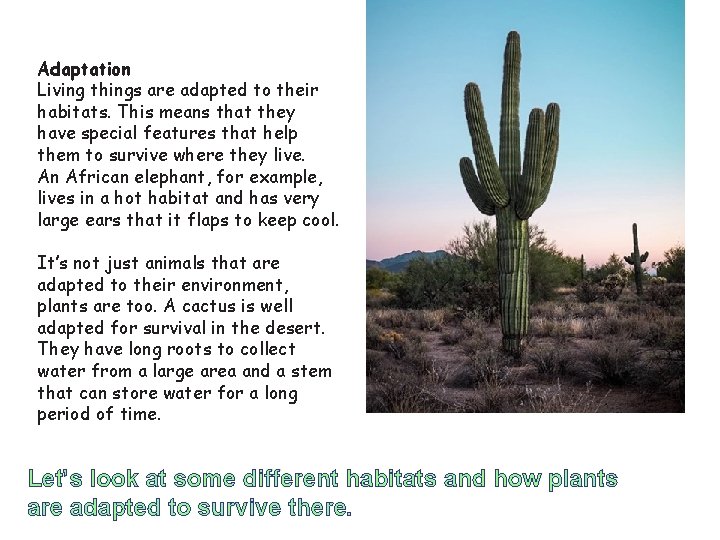
Adaptation Living things are adapted to their habitats. This means that they have special features that help them to survive where they live. An African elephant, for example, lives in a hot habitat and has very large ears that it flaps to keep cool. It’s not just animals that are adapted to their environment, plants are too. A cactus is well adapted for survival in the desert. They have long roots to collect water from a large area and a stem that can store water for a long period of time. Let’s look at some different habitats and how plants are adapted to survive there.
A Tropical Habitat Plants are adapted to cope with : • Lots of water • Little light
support Buttress roots support tall trees so they can reach the light at the top of the tree canopy.
This leaf has a large surface area to capture sunlight in dense, dark rainforest. You can see drip tips and a waxy surface, which help to remove any water which builds up.
Birds nest fern Stags horn fern Wet Tropics support These plants are perched high in the tree canopy to be nearer to the light. The leaves make ‘bowls’ which trap leaf litter to make soil. The plant can then grow its roots into its own bowl.
Wet Tropics Here, leaves are arranged for excess water to be funnelled out through the leaf base.
An Aquatic Habitat Aquatic Waterlily leaves have a large surface area and air spaces in the leaf tissue to help them float.
Aquatic support Mangrove roots act as ropes to support the tree in unstable flooded ground. Other roots grow upwards as ‘snorkels’ or breathing roots.
Deserts Habitats Plants are adapted to cope with: • Lack of water • Strong sunlight • Drying winds
This cactus has leaves which are reduced to spines so less water is lost. The spines also protect the plant from grazing animals. The round shape you see here is the plant stem! It is modified to store lots of water.
Dry/Sub Tropics These fleshy leaves hold reserves of water.
Dry/Sub Tropics support These stone plants are camouflaged! Looking like stones helps them stay safe from predators in the desert. Although they look like stones, the leaves are quite fleshy to store water.
Dry/Sub Tropics Hairy leaves slow down loss of water from the leaves.
Tundra / Alpine Habitats Plants are adapted to cope with : • Lack of water (the ground is often frozen) • Cold • Drying winds
Tundra / Alpine This scrub pine’s leaves are reduced to needles to reduce water loss.
Tundra / Alpine Flat, small, waxy leaves help cut down water loss.
Some plants are adapted to protect themselves from being eaten. Protection from animals These spiny leaves reduce any grazing by animals.
Plants can also protect themselves by having a bad taste. If plants don't have a good taste animals will ignore. The plant in the picture is a peppermint plant.
Protection from animals Some stems have sharp thorns for protection.
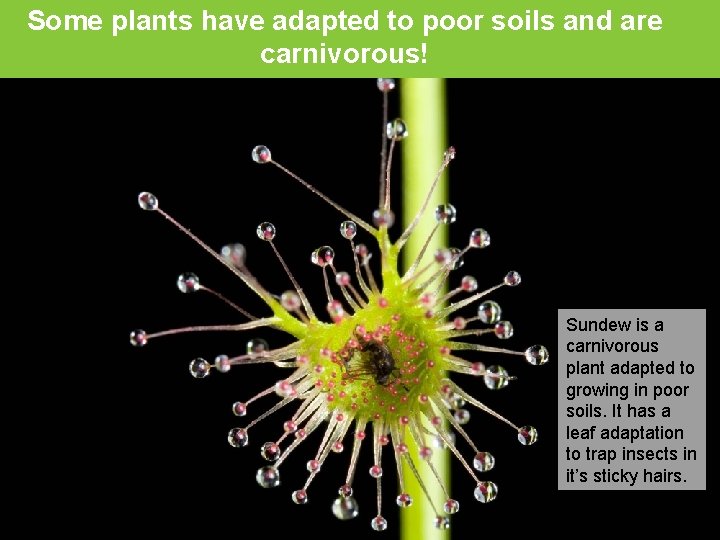
Some plants have adapted to poor soils and are carnivorous! Poor soils support Sundew is a carnivorous plant adapted to growing in poor soils. It has a leaf adaptation to trap insects in it’s sticky hairs.
Wet tropics often have poor soil. Pitcher plants have an adaptation to trap insects as extra food. They are carnivorous plants. The leaf at the top acts as a lid to trap insects inside. Poor soils
This is a Venus fly trap. It lives in poor soil and so has adapted to it’s habitat by becoming carnivorous. The leaves of Venus Flytrap open wide and on them are short hairs. When anything touches these hairs enough to bend them, the two leaves snap shut trapping whatever is inside.
Ivy Challenge Water lily Can you suggest why the plants shown above have special features? Why does ivy climb? Why do water lilies have large, flat leaves? Why do stinging nettles sting? Stinging nettle