
Plans of the Beyond Collider Physics study group
Plans of the Beyond Collider Physics study group Joerg Jaeckel, Mike Lamont, Claude Vallée
Fabiola Gianotti SPC May 2016
PBC - Scientific goal • The main goal of the Study Group is to explore the opportunities offered by the CERN accelerator complex to address some of today’s outstanding questions in particle physics through experiments complementary to highenergy colliders and other initiatives in the world. • These experiments would typically: – enrich and diversify the CERN scientific program, – exploit the unique opportunities offered by CERN’s accelerator complex and scientific infrastructure, – complement the laboratory’s collider programme (LHC, HL-LHC and possible future colliders). – Examples of physics objectives include searches for rare processes and very-weakly interacting particles, measurements of electric dipole moments, etc.
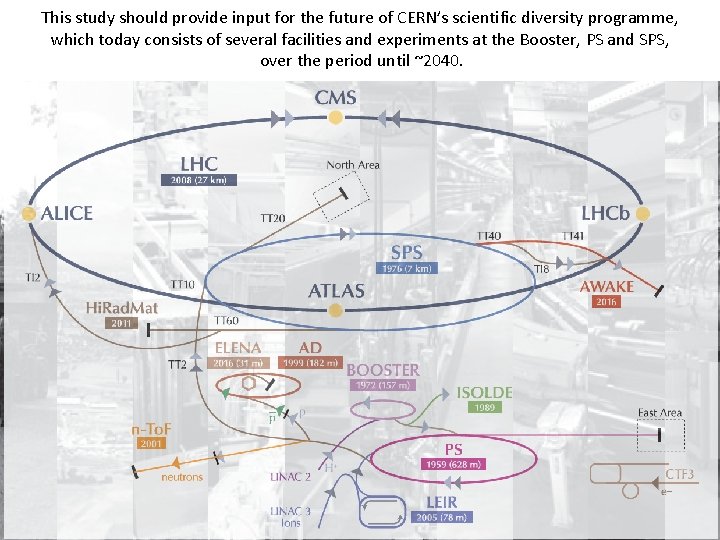
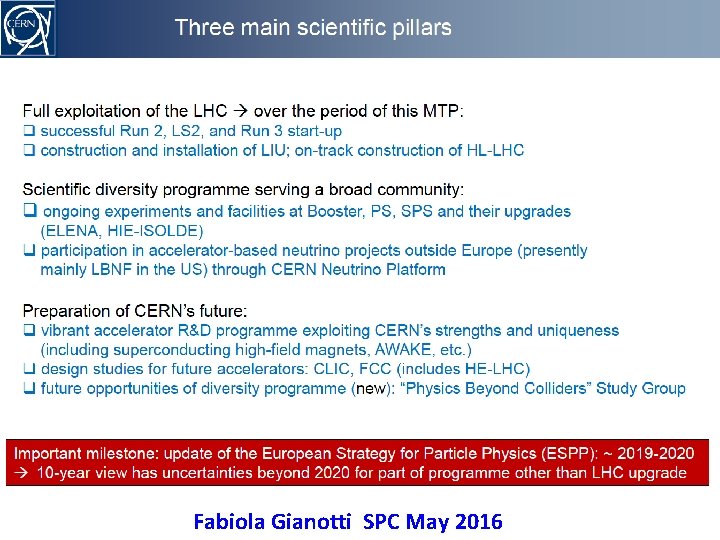
This study should provide input for the future of CERN’s scientific diversity programme, which today consists of several facilities and experiments at the Booster, PS and SPS, over the period until ~2040.
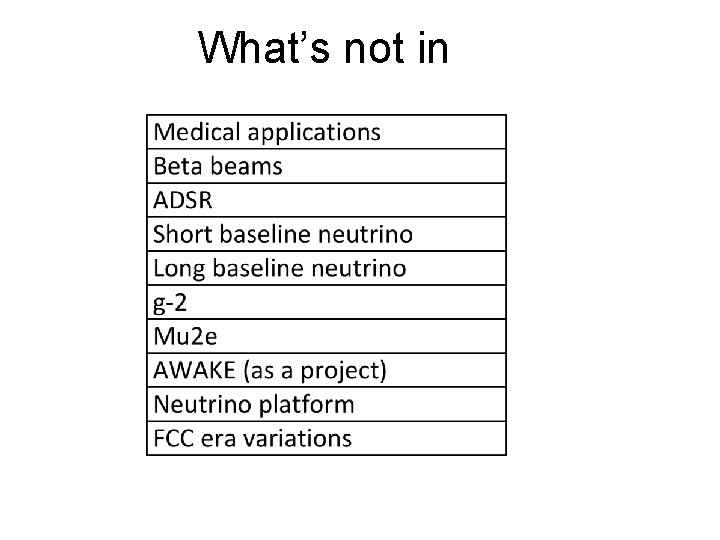
What’s not in
Many thanks to Sergio Cittolin for the artwork
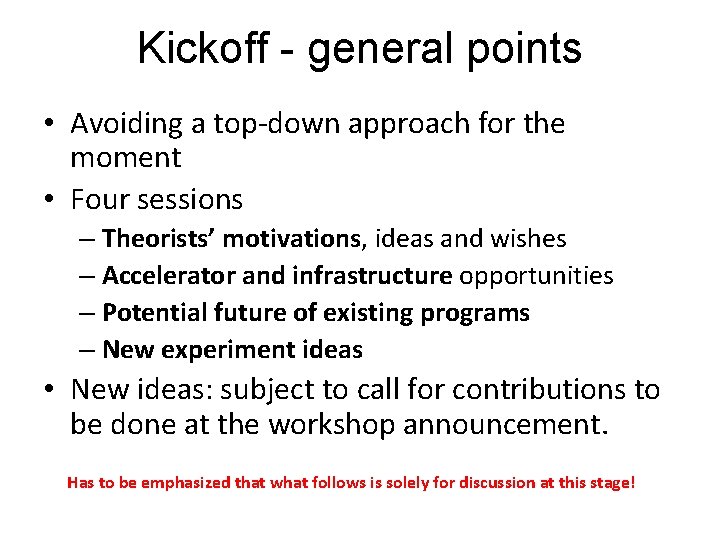
Kickoff - general points • Avoiding a top-down approach for the moment • Four sessions – Theorists’ motivations, ideas and wishes – Accelerator and infrastructure opportunities – Potential future of existing programs – New experiment ideas • New ideas: subject to call for contributions to be done at the workshop announcement. Has to be emphasized that what follows is solely for discussion at this stage!
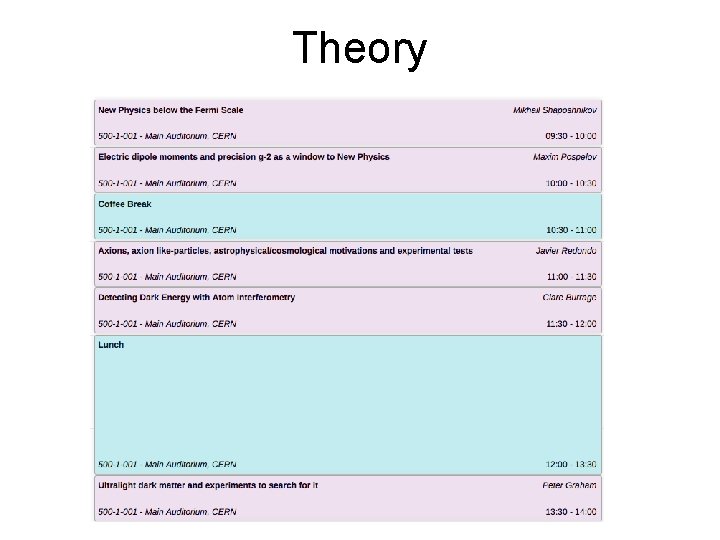
Theory
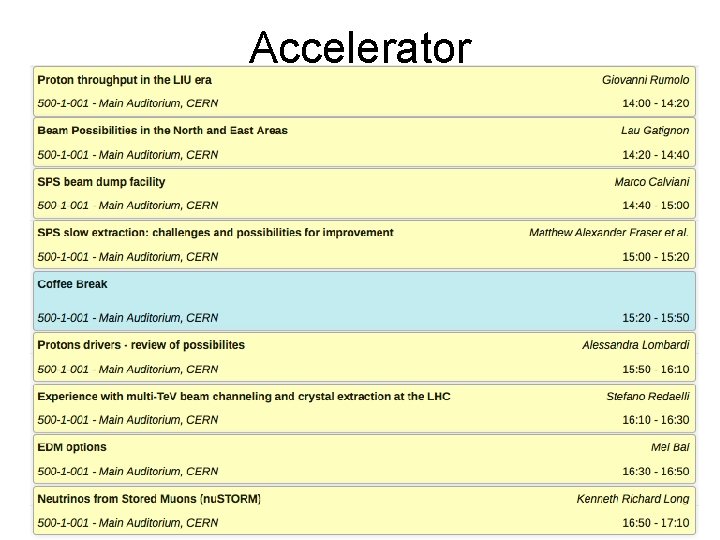
Accelerator
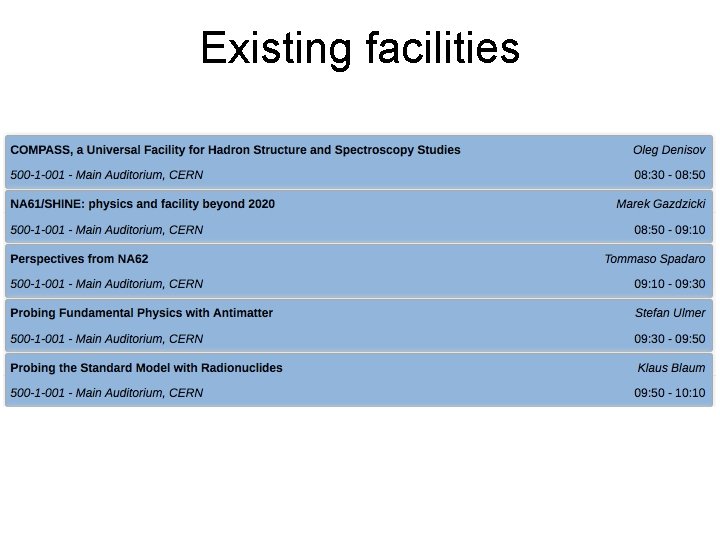
Existing facilities
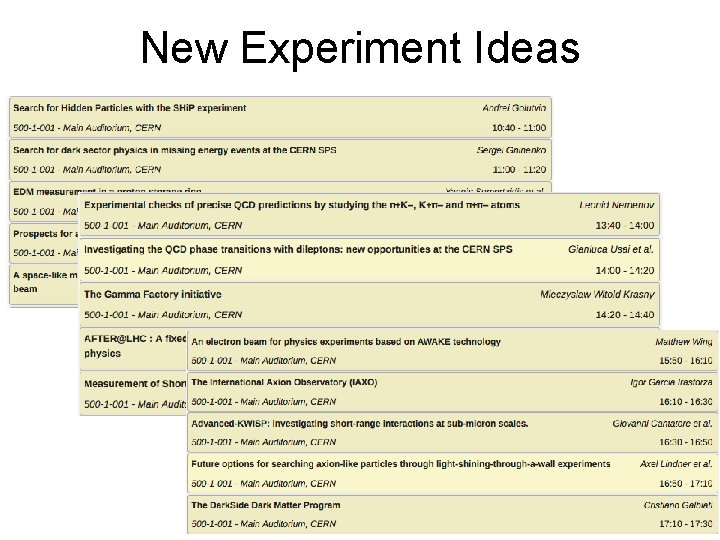
New Experiment Ideas

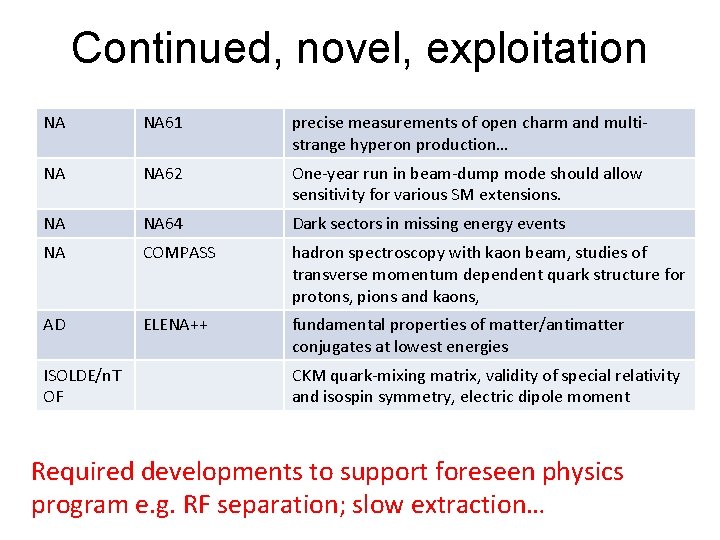
Continued, novel, exploitation NA NA 61 precise measurements of open charm and multistrange hyperon production… NA NA 62 One-year run in beam-dump mode should allow sensitivity for various SM extensions. NA NA 64 Dark sectors in missing energy events NA COMPASS hadron spectroscopy with kaon beam, studies of transverse momentum dependent quark structure for protons, pions and kaons, AD ELENA++ fundamental properties of matter/antimatter conjugates at lowest energies ISOLDE/n. T OF CKM quark-mixing matrix, validity of special relativity and isospin symmetry, electric dipole moment Required developments to support foreseen physics program e. g. RF separation; slow extraction…
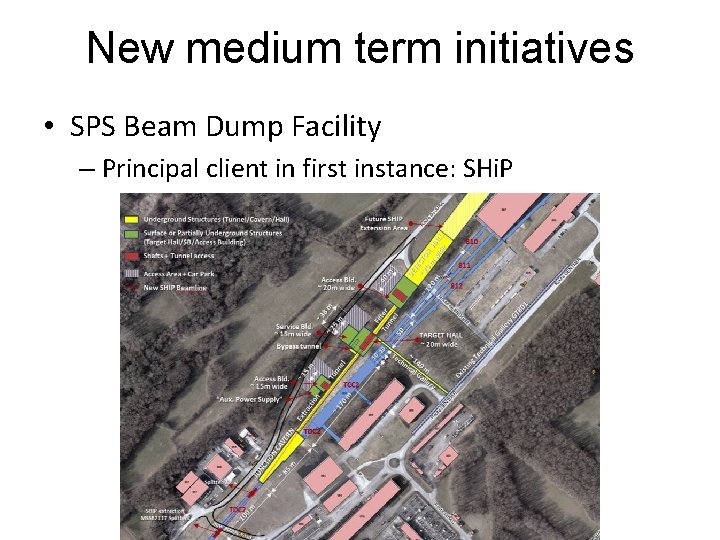
New medium term initiatives • SPS Beam Dump Facility – Principal client in first instance: SHi. P
Smaller scale novel developments • Electric Dipole Moment – Polarized protons, 0. 7 Ge. V storage ring • • Electron beam dump – dark photons… FT via crystal extraction – LHC FT via internal gas jet - LHC Partially stripped ions – LHC - gamma source
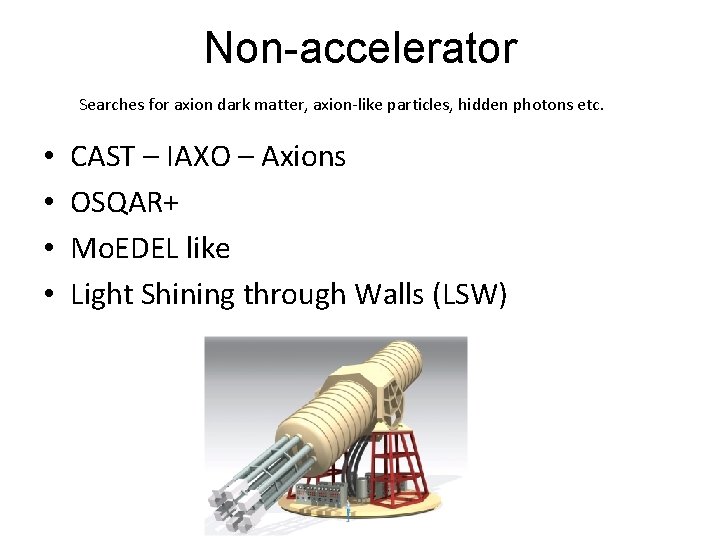
Non-accelerator Searches for axion dark matter, axion-like particles, hidden photons etc. • • CAST – IAXO – Axions OSQAR+ Mo. EDEL like Light Shining through Walls (LSW)
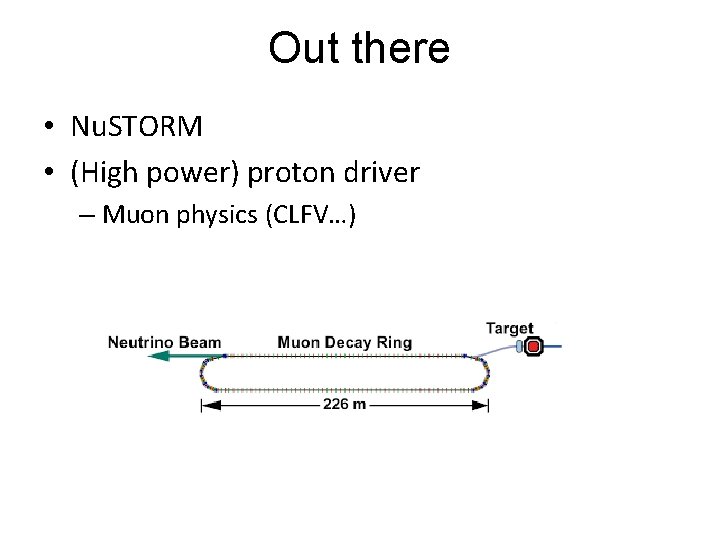
Out there • Nu. STORM • (High power) proton driver – Muon physics (CLFV…)
Deliverables • Deliverables: – Evaluation of possibilities for update of the European Strategy for Particle Physics in ~2019 – Will range from: • • Results of BDF feasibility studies Required R&D going forward Initial CDR for, say, EDM Preliminary evaluations for more long term options
Medium Term Plan 2017 - 2021 • The proposed SHi. P beam-dump experiment at the SPS has been recommended to produce a comprehensive design study over the next three years. • Within the more general context of the “Physics Beyond Colliders” study group, some funding is made available from the accelerator R&D budget line to complete technical feasibility studies of a beam dump facility in the CERN North Area as input to the next ESPP, with the intention that a decision on approval will be taken once the strategy update has been completed.
Conclusions • Physics Beyond Colliders study group to look at CERN’s non-collider options out to 2040 – Report to ESPP in 2019 • Kickoff meeting in September to put options on the table • Will then have to down-select and launch studies of appropriate depth • Some funding in this year’s MTP for the study of the technical feasibility of a beam dump facility at CERN, in the framework of the “Physics Beyond Colliders” Study Group.
- Slides: 21