
Plans for a Transverse Gradient Undulator TGU Experiment
- Slides: 1
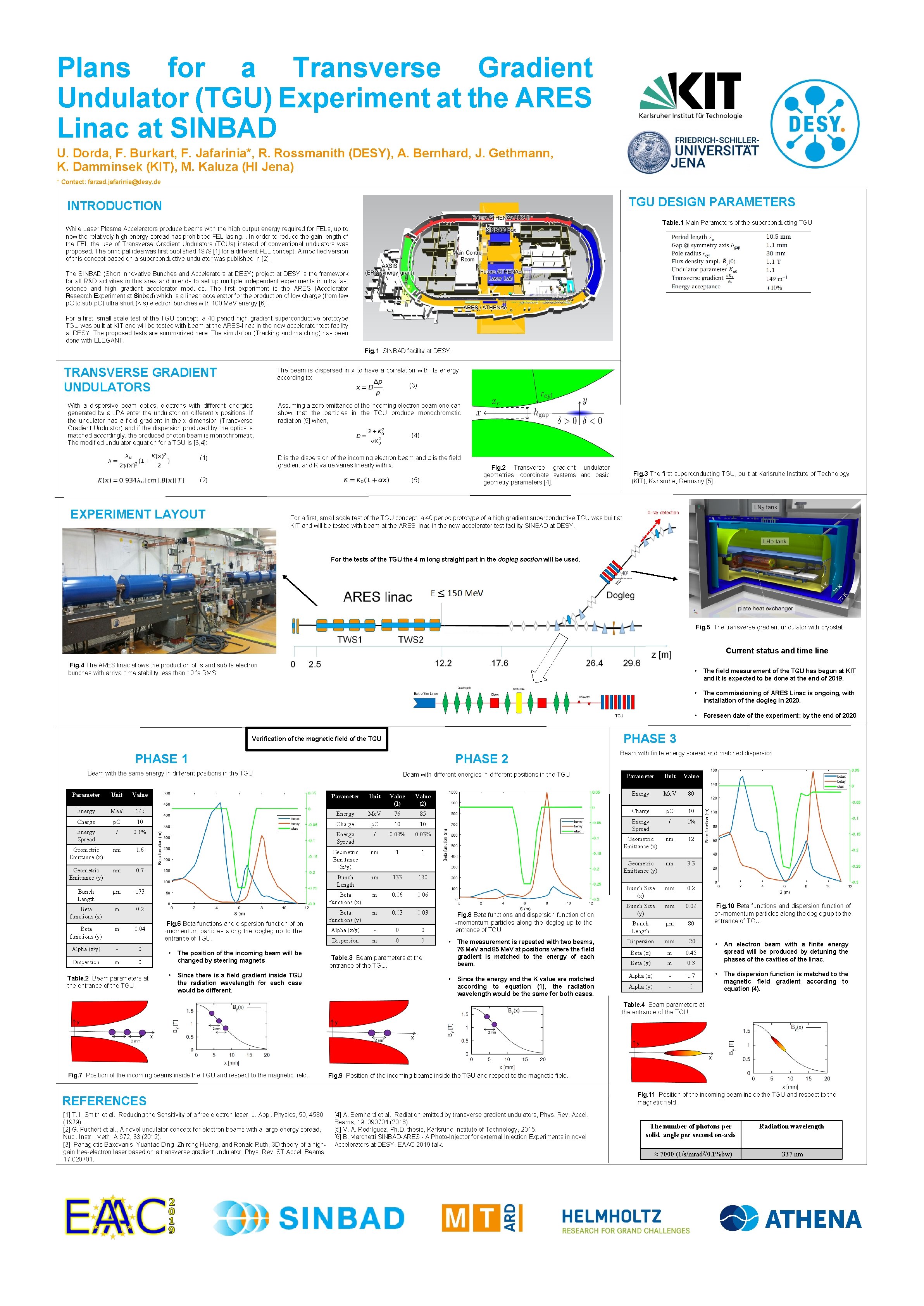
Plans for a Transverse Gradient Undulator (TGU) Experiment at the ARES Linac at SINBAD U. Dorda, F. Burkart, F. Jafarinia*, R. Rossmanith (DESY), A. Bernhard, J. Gethmann, K. Damminsek (KIT), M. Kaluza (HI Jena) * Contact: farzad. jafarinia@desy. de TGU DESIGN PARAMETERS INTRODUCTION Table. 1 Main Parameters of the superconducting TGU While Laser Plasma Accelerators produce beams with the high output energy required for FELs, up to now the relatively high energy spread has prohibited FEL lasing. . In order to reduce the gain length of the FEL the use of Transverse Gradient Undulators (TGUs) instead of conventional undulators was proposed. The principal idea was first published 1979 [1] for a different FEL concept. A modified version of this concept based on a superconductive undulator was published in [2]. The SINBAD (Short Innovative Bunches and Accelerators at DESY) project at DESY is the framework for all R&D activities in this area and intends to set up multiple independent experiments in ultra-fast science and high gradient accelerator modules. The first experiment is the ARES (Accelerator Research Experiment at Sinbad) which is a linear accelerator for the production of low charge (from few p. C to sub-p. C) ultra-short (<fs) electron bunches with 100 Me. V energy [6]. For a first, small scale test of the TGU concept, a 40 period high gradient superconductive prototype TGU was built at KIT and will be tested with beam at the ARES-linac in the new accelerator test facility at DESY. The proposed tests are summarized here. The simulation (Tracking and matching) has been done with ELEGANT. Fig. 1 SINBAD facility at DESY. TRANSVERSE GRADIENT UNDULATORS The beam is dispersed in x to have a correlation with its energy according to: (3) With a dispersive beam optics, electrons with different energies generated by a LPA enter the undulator on different x positions. If the undulator has a field gradient in the x dimension (Transverse Gradient Undulator) and if the dispersion produced by the optics is matched accordingly, the produced photon beam is monochromatic. The modified undulator equation for a TGU is [3, 4]: Assuming a zero emittance of the incoming electron beam one can show that the particles in the TGU produce monochromatic radiation [5] when, (1) D is the dispersion of the incoming electron beam and α is the field gradient and K value varies linearly with x: (2) (4) (5) EXPERIMENT LAYOUT Fig. 2 Transverse gradient undulator geometries, coordinate systems and basic geometry parameters [4]. Fig. 3 The first superconducting TGU, built at Karlsruhe Institute of Technology (KIT), Karlsruhe, Germany [5]. For a first, small scale test of the TGU concept, a 40 period prototype of a high gradient superconductive TGU was built at KIT and will be tested with beam at the ARES linac in the new accelerator test facility SINBAD at DESY. X-ray detection For the tests of the TGU the 4 m long straight part in the dogleg section will be used. Fig. 5 The transverse gradient undulator with cryostat. Current status and time line Fig. 4 The ARES linac allows the production of fs and sub-fs electron bunches with arrival time stability less than 10 fs RMS. • The field measurement of the TGU has begun at KIT and it is expected to be done at the end of 2019. • The commissioning of ARES Linac is ongoing, with installation of the dogleg in 2020. • Foreseen date of the experiment: by the end of 2020 PHASE 3 Verification of the magnetic field of the TGU PHASE 2 PHASE 1 Beam with the same energy in different positions in the TGU Beam with different energies in different positions in the TGU Beam with finite energy spread and matched dispersion Parameter Unit Value (1) Value (2) Energy Me. V 80 Energy Me. V 123 Energy Me. V 76 85 Charge p. C 10 10 / 1% Energy Spread / 0. 03% Energy Spread nm 12 Geometric Emittance (x) nm nm 1 1 3. 3 nm µm Bunch Length µm 173 Bunch Length Geometric Emittance (y) nm Geometric Emittance (y) Geometric Emittance (x/y) Geometric Emittance (x) m 0. 06 mm 0. 2 Beta functions (x) Bunch Size (x) Beta functions (y) m 0. 03 Bunch Size (y) mm 0. 02 Beta functions (y) m 0. 04 Alpha (x/y) - 0 0 Bunch Length µm 80 Dispersion m 0 0 Dispersion mm -20 Alpha (x/y) - Beta (x) m 0. 45 Beta (y) m 0. 3 Alpha (x) - 1. 7 Alpha (y) - 0 Dispersion m 1. 6 0. 7 0 Fig. 6 Beta functions and dispersion function of on -momentum particles along the dogleg up to the entrance of TGU. • 0 Table. 2 Beam parameters at the entrance of the TGU. • The position of the incoming beam will be changed by steering magnets. 133 0. 06 0. 03 130 Fig. 8 Beta functions and dispersion function of on -momentum particles along the dogleg up to the entrance of TGU. • Table. 3 Beam parameters at the entrance of the TGU. Since there is a field gradient inside TGU the radiation wavelength for each case would be different. • The measurement is repeated with two beams, 76 Me. V and 85 Me. V at positions where the field gradient is matched to the energy of each beam. Since the energy and the K value are matched according to equation (1), the radiation wavelength would be the same for both cases. Fig. 10 Beta functions and dispersion function of on-momentum particles along the dogleg up to the entrance of TGU. • An electron beam with a finite energy spread will be produced by detuning the phases of the cavities of the linac. • The dispersion function is matched to the magnetic field gradient according to equation (4). Table. 4 Beam parameters at the entrance of the TGU. Fig. 7 Position of the incoming beams inside the TGU and respect to the magnetic field. Fig. 9 Position of the incoming beams inside the TGU and respect to the magnetic field. Fig. 11 Position of the incoming beam inside the TGU and respect to the magnetic field. REFERENCES [1] T. I. Smith et al. , Reducing the Sensitivity of a free electron laser, J. Appl. Physics, 50, 4580 (1979). [2] G. Fuchert et al. , A novel undulator concept for electron beams with a large energy spread, Nucl. Instr. . Meth. A 672, 33 (2012). [3] Panagiotis Baxevanis, Yuantao Ding, Zhirong Huang, and Ronald Ruth, 3 D theory of a highgain free-electron laser based on a transverse gradient undulator , Phys. Rev. ST Accel. Beams 17 020701. [4] A. Bernhard et al. , Radiation emitted by transverse gradient undulators, Phys. Rev. Accel. Beams, 19, 090704 (2016). [5] V. A. Rodríguez, Ph. D. thesis, Karlsruhe Institute of Technology, 2015. [6] B. Marchetti SINBAD-ARES - A Photo-Injector for external Injection Experiments in novel Accelerators at DESY. EAAC 2019 talk. The number of photons per solid angle per second on-axis ≈ 7000 (1/s/mrad 2/0. 1%bw) Radiation wavelength 337 nm