
Planning your research types of data Stats Club
Planning your research & types of data Stats Club 1: Nov 2016 Marnie Brennan
How this works…. • 2 sessions a month, the same session is run twice • 1. 5 hrs maximum – 20 -30 min introduction – 30 min plus practical time • Fridays • Alternates between 9 -10: 30 am, and 9: 30 -11 am • Bite-sized topics • Informal
We are not statisticians! • We know a few things about a few things…. . • We can cover the basics, and signpost – If it is complicated, get advice BEFORE you start your study • Low level – build on this • More than one way to skin a stat! – Every day is a school day!
References • Petrie and Sabin - Medical Statistics at a Glance – Really good for beginners • Petrie and Watson - Statistics for Veterinary and Animal Science – This is the standard textbook for undergrads, is very useful • Thrusfield – Veterinary Epidemiology – Good for general concepts • Kirkwood and Sterne – Essential Medical Statistics – Can have out of the ordinary stuff • Dohoo, Martin and Stryhn – Veterinary Epidemiologic Research – This is hard core!
References recommended by others • “Experimental Design for the Life Sciences” by Graeme Ruxton • “Statistics explained, an introductory guide for life scientists” by Steve Mc. Killup • “Modern statistics for the life sciences” by Alan Grafen and Rosie Hails • “Experimental design and data analysis for biologists” by Gerry P. Quinn and Michael J. Keough

Statistical packages we know! • University software we commonly use: – Minitab – SPSS (PASW) – Genstat • Vet School software: – Simca • There are people in the vet school who use: – R http: //www. r-project. org/ (Free software) – Stata – MLwi. N http: //bristol. ac. uk/cmm/software/mlwin/ (Free software to academics)
References for today • Petrie and Sabin - Medical Statistics at a Glance: Chapter 1 • Petrie and Watson - Statistics for Veterinary and Animal Science: Chapter 1 • ‘Experimental design for Science and Engineering’ resource on the Workspace page
Planning your research • It all begins with an aim…. – Hypothesis driven versus exploratory studies – Determines what data you collect • And therefore how you analyse it – Don’t underestimate the power of descriptive statistics! – Seems simple, but remember to do it!
Planning your research • Logistics – The 5 P’s • Prior Preparation Prevents Poor Performance! Statistics cannot fix a badly designed experiment Poorly collected data = Poor conclusions
Planning your research • Logistics – Factor in timing for planning and training • When are you starting your data collection? – Make sure you know what type of data you will have BEFORE you start to collect anything – Make sure you know what ANALYSIS you will do with it before you collect it » This will assist you in optimising the best way to RECORD it for analysis • When might you need help? – Factor in statistics training into your planning – Organise help at the beginning (no surprises!) » It is easy to identify ‘rushed jobs’ » The usefulness of your research will be poorer if you don’t
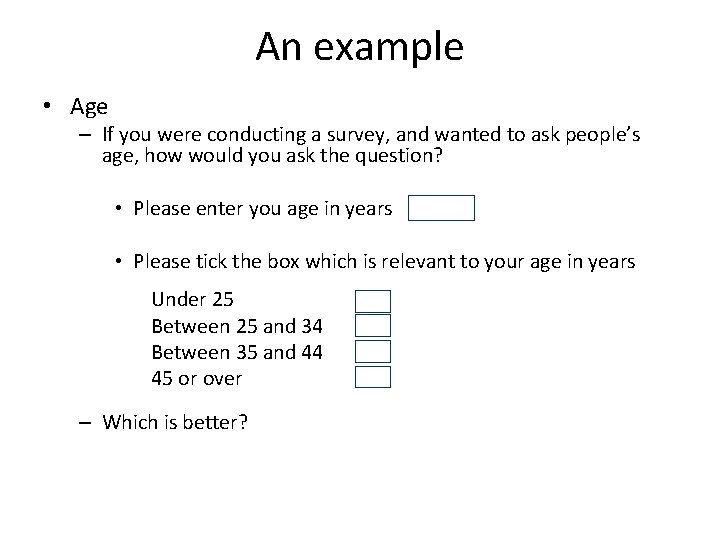
An example • Age – If you were conducting a survey, and wanted to ask people’s age, how would you ask the question? • Please enter you age in years • Please tick the box which is relevant to your age in years Under 25 Between 25 and 34 Between 35 and 44 45 or over – Which is better?
Types of data • Two main types of data: – Numerical • Data has a numerical value – e. g. weight, height, number of visits to the vet in a 12 month period – Categorical • Data can only be classified into a distinct number of categories – e. g. sex (2 categories), neuter status (4 categories), disease status (mild, moderate, severe – 3 categories)
Types of data • Numerical – Can subdivide into 2 categories • Discrete data – Concerns whole numbers e. g. number of visits to the vet in the past 12 months – Often counts of events • Continuous data – Does not have to be whole numbers e. g. weight in grams (53. 5 gms) or kilograms (1. 2 kg)
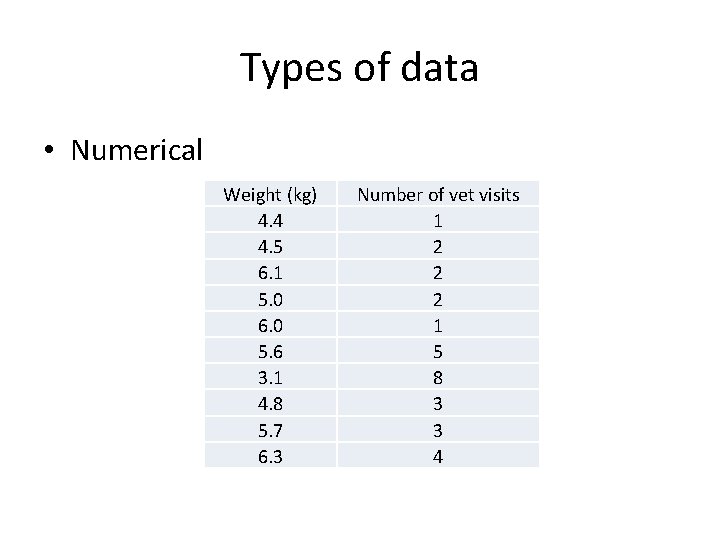
Types of data • Numerical Weight (kg) 4. 4 4. 5 6. 1 5. 0 6. 0 5. 6 3. 1 4. 8 5. 7 6. 3 Number of vet visits 1 2 2 2 1 5 8 3 3 4
Types of data • Categorical – Can subdivide into 2 different categories • Ordinal – The categories have an order to them e. g. 3 categories of disease – mild, moderate or severe • Nominal – Categories, but not ordered e. g. neuter status (Male Entire, Male Neuter, Female Entire, Female Neuter)
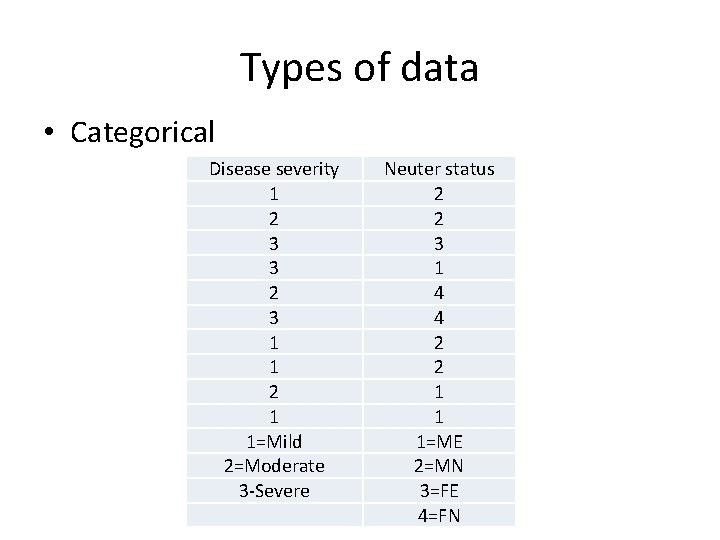
Types of data • Categorical Disease severity 1 2 3 3 2 3 1 1 2 1 1=Mild 2=Moderate 3 -Severe Neuter status 2 2 3 1 4 4 2 2 1 1 1=ME 2=MN 3=FE 4=FN
Your turn! Think about your own research – what data do you have/will you have?
Exercises • Work in pairs – what types of data do you think are involved in the following scenarios?
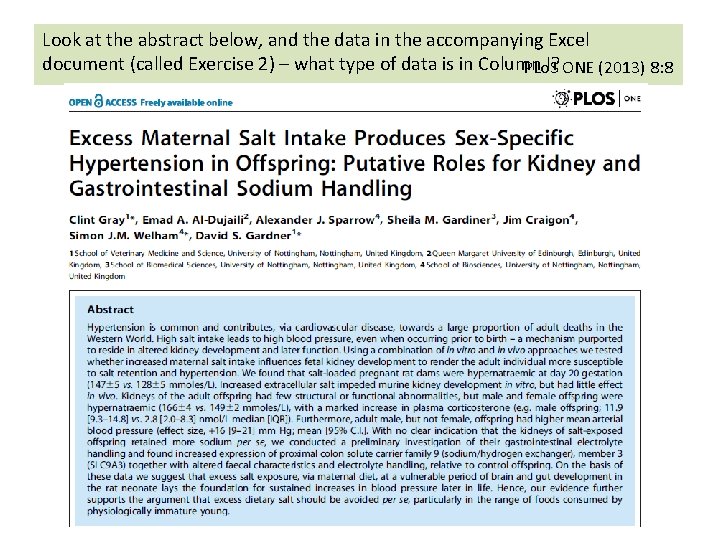
Look at the abstract below, and the data in the accompanying Excel document (called Exercise 2) – what type of data is in Column I? ONE (2013) 8: 8 PLo. S
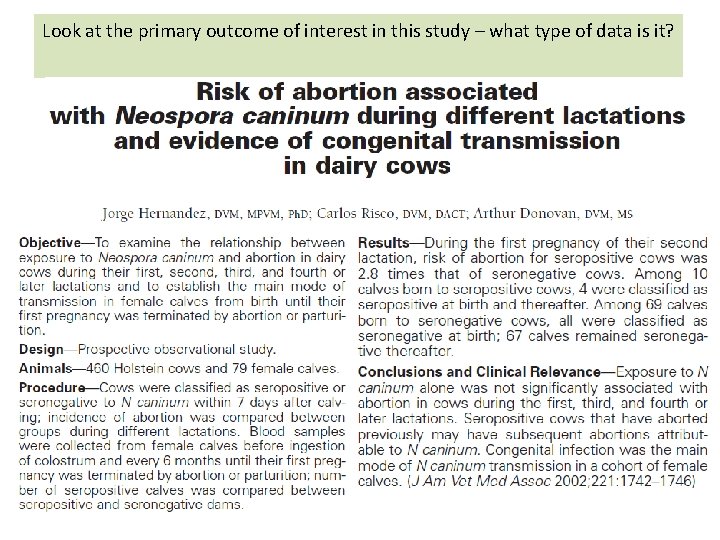
Look at the primary outcome of interest in this study – what type of data is it?
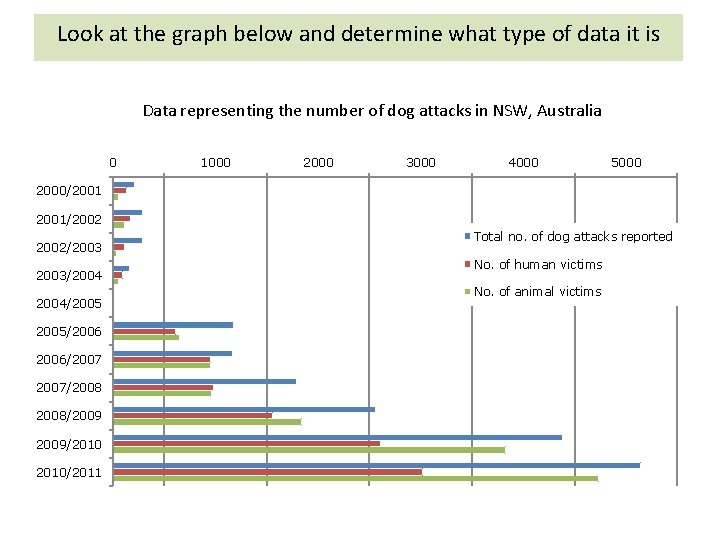
Look at the graph below and determine what type of data it is Data representing the number of dog attacks in NSW, Australia 0 1000 2000 3000 4000 5000 2000/2001/2002/2003/2004/2005/2006/2007/2008/2009/2010/2011 Total no. of dog attacks reported No. of human victims No. of animal victims
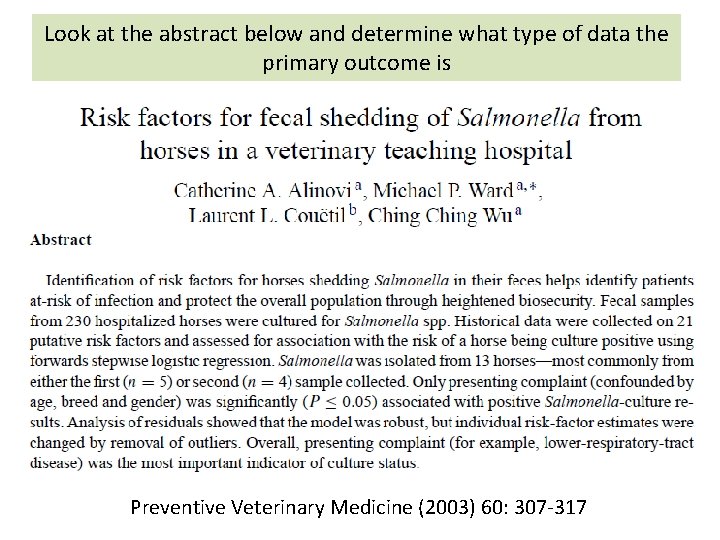
Look at the abstract below and determine what type of data the primary outcome is Preventive Veterinary Medicine (2003) 60: 307 -317
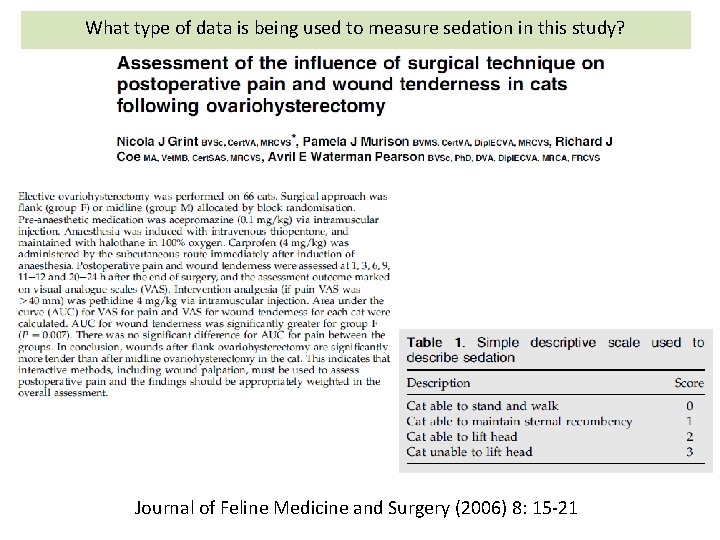
What type of data is being used to measure sedation in this study? Journal of Feline Medicine and Surgery (2006) 8: 15 -21
Type of study design • The type of data you will get is also dependent on the type of study design that is used – Important to be familiar with these! • • Cross-sectional studies Case-control studies Cohort studies Randomised controlled trials – E. g. Cross-sectional survey or questionnaire – likely to have categorical data – Suggested textbooks
Next month • Data entry and preparation for analysis
- Slides: 25