
PLANNING What Is Planning Planning Managerial function that
- Slides: 54
PLANNING
What Is Planning? Planning Managerial function that involves: Defining the organization’s goals Establishing an overall strategy for achieving those goals Developing a comprehensive set of plans to integrate and coordinate organizational work Types of planning Informal: not written down, short-term focus; specific to an organizational unit Formal: written, specific, and long-term focus, involves shared goals for the organization
Purposes of Planning Provides direction Reduces uncertainty Minimizes waste and redundancy Sets the standards for controlling
Planning and Performance The Relationship Between Planning and Performance Formal planning is associated with: Higher profits and returns on assets Other positive financial results The quality of planning and implementation affects performance more than the extent of planning The external environment can reduce the impact of planning on performance
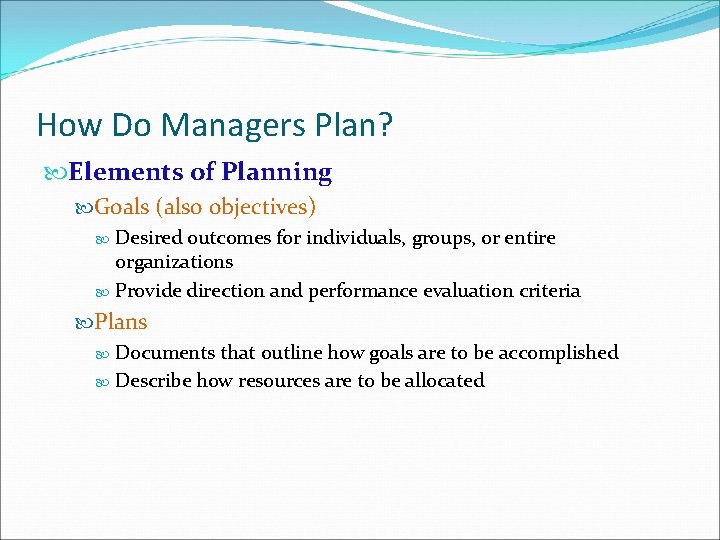
How Do Managers Plan? Elements of Planning Goals (also objectives) Desired outcomes for individuals, groups, or entire organizations Provide direction and performance evaluation criteria Plans Documents that outline how goals are to be accomplished Describe how resources are to be allocated
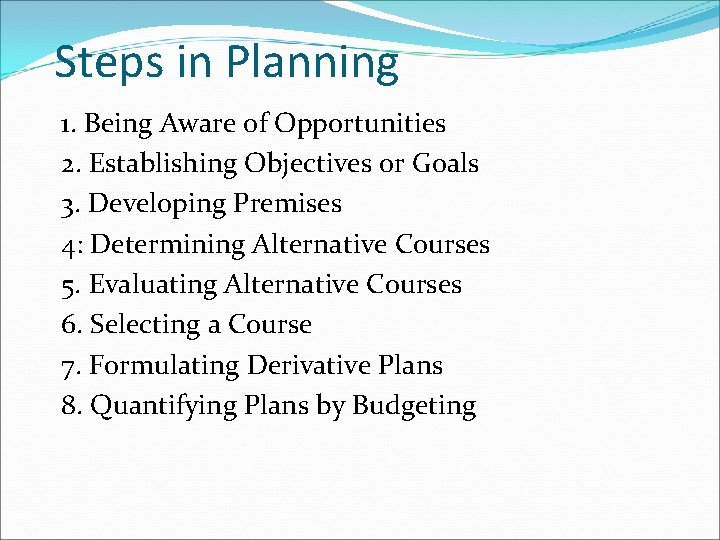
Steps in Planning 1. Being Aware of Opportunities 2. Establishing Objectives or Goals 3. Developing Premises 4: Determining Alternative Courses 5. Evaluating Alternative Courses 6. Selecting a Course 7. Formulating Derivative Plans 8. Quantifying Plans by Budgeting
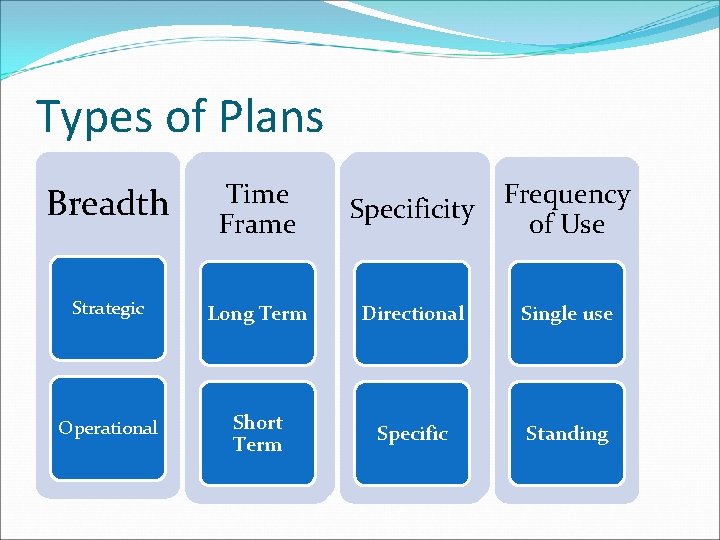
Types of Plans Breadth Time Frame Specificity Frequency of Use Strategic Long Term Directional Single use Operational Short Term Specific Standing
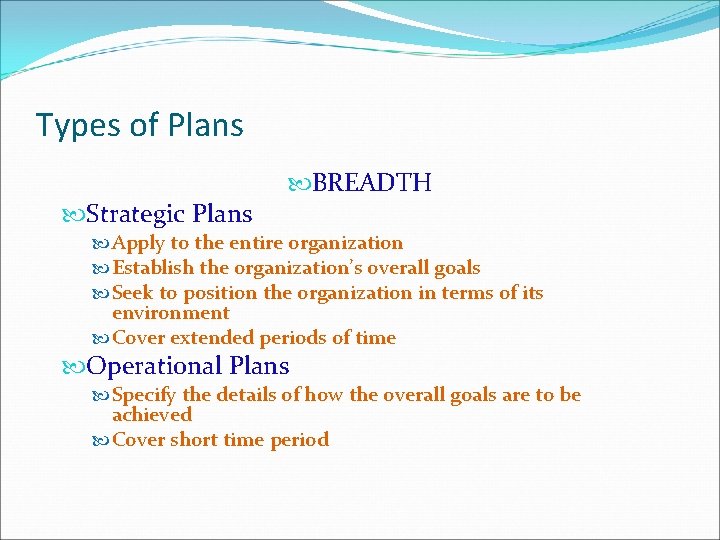
Types of Plans Strategic Plans BREADTH Apply to the entire organization Establish the organization’s overall goals Seek to position the organization in terms of its environment Cover extended periods of time Operational Plans Specify the details of how the overall goals are to be achieved Cover short time period
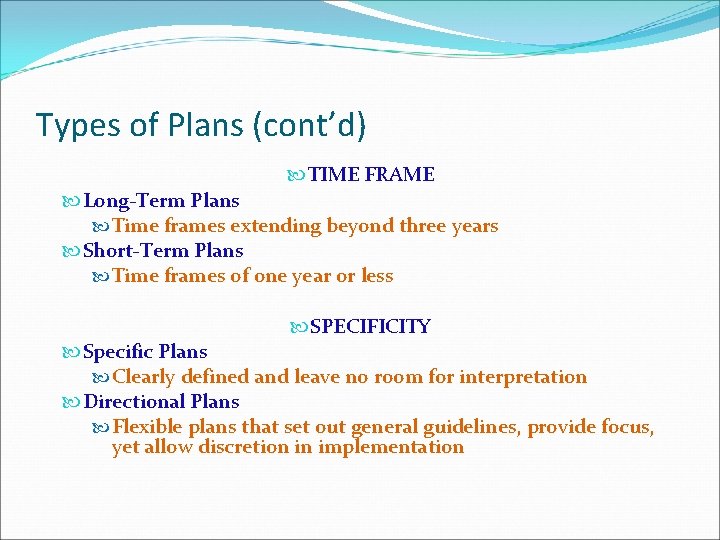
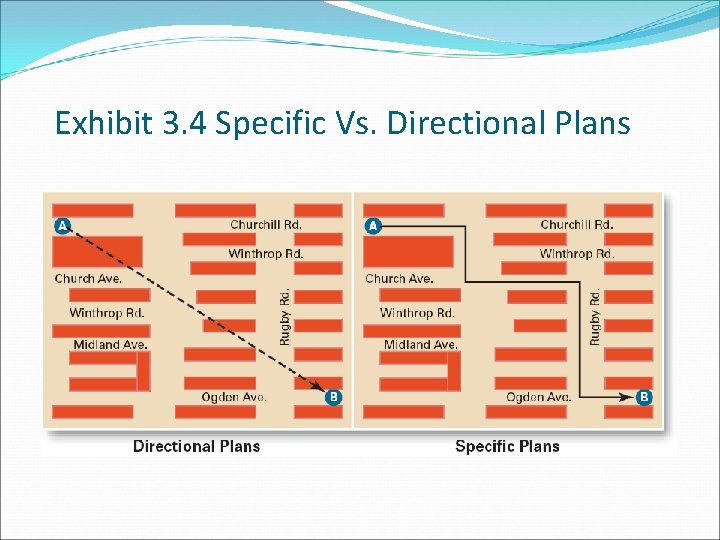
Types of Plans (cont’d) TIME FRAME Long-Term Plans Time frames extending beyond three years Short-Term Plans Time frames of one year or less SPECIFICITY Specific Plans Clearly defined and leave no room for interpretation Directional Plans Flexible plans that set out general guidelines, provide focus, yet allow discretion in implementation
Exhibit 3. 4 Specific Vs. Directional Plans
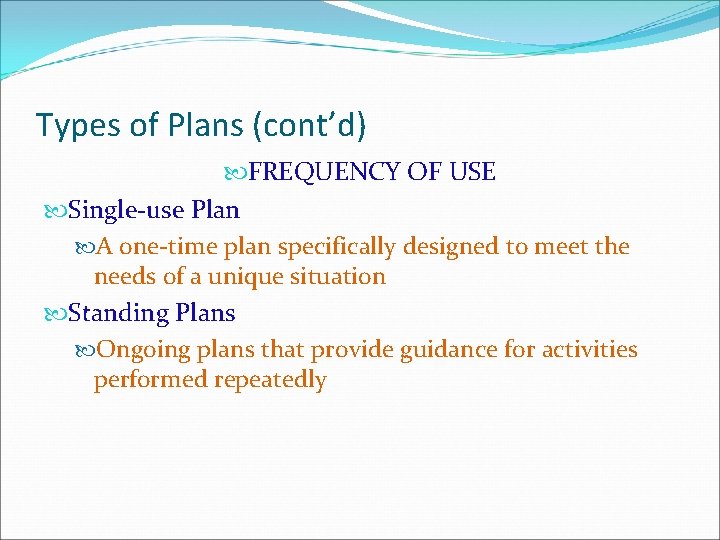
Types of Plans (cont’d) FREQUENCY OF USE Single-use Plan A one-time plan specifically designed to meet the needs of a unique situation Standing Plans Ongoing plans that provide guidance for activities performed repeatedly
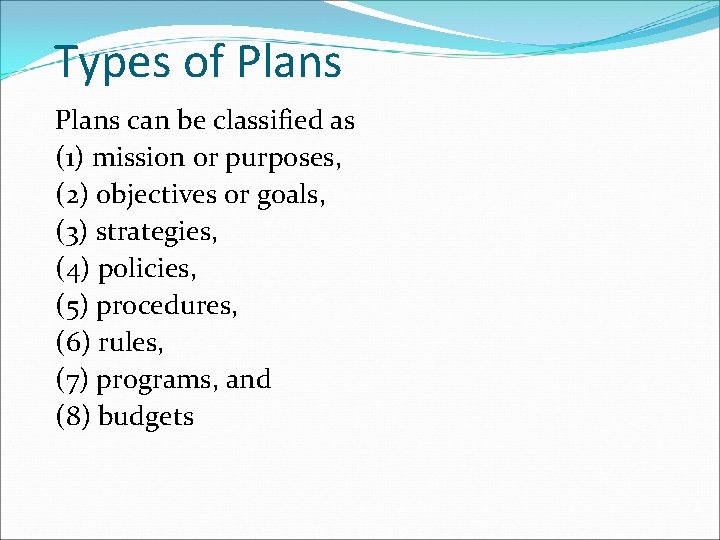
Types of Plans can be classified as (1) mission or purposes, (2) objectives or goals, (3) strategies, (4) policies, (5) procedures, (6) rules, (7) programs, and (8) budgets
Types of Plans The mission, or purpose, identifies the basic purpose or function or tasks of an enterprise or agency or any part of it Objectives, or goals, are the ends toward which activity is aimed Strategy is the determination of the basic long‑term objectives of an enterprise and the adoption of courses of action and allocation of resources necessary to achieve these goals Policies are general statements or understandings that guide or channel thinking in decision making Procedures are plans that establish a required method of handling future activities
Types of Plans – cont. Rules spell out specific required actions or nonactions, allowing no discretion Programs are a complex of goals, policies, procedures, rules, task assignments, steps to be taken, resources to be employed, and other elements necessary to carry out a given course of action A budget is a statement of expected results expressed in numerical terms
Developing Plans Contingency Factors in Planning Degree of environmental uncertainty Stable environment: specific plans Dynamic environment: specific but flexible plans Length of future commitments Current plans affecting future commitments must be sufficiently long-term to meet the commitments
Approaches to Establishing Goals Traditional Goal Setting Broad goals are set at the top of the organization Goals are then broken into subgoals for each organizational level Goals are intended to direct, guide, and constrain from above
Approaches to Establishing Goals (cont’d) Management By Objectives (MBO) Specific performance goals are jointly determined by employees and managers Progress toward accomplishing goals is periodically reviewed Rewards are allocated on the basis of progress toward the goals Key elements of MBO: Goal specificity, participative decision making, an explicit performance/evaluation period, feedback
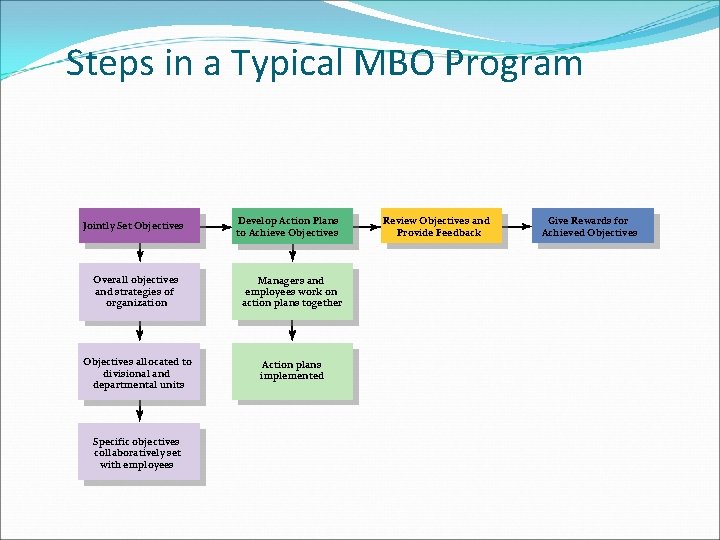
Steps in a Typical MBO Program Jointly Set Objectives Develop Action Plans to Achieve Objectives Overall objectives and strategies of organization Managers and employees work on action plans together Objectives allocated to divisional and departmental units Action plans implemented Specific objectives collaboratively set with employees Review Objectives and Provide Feedback Give Rewards for Achieved Objectives
Does MBO Work? Reason for MBO Success Top management commitment and involvement Potential Problems with MBO Programs Not as effective in dynamic environments that require constant resetting of goals Overemphasis on individual accomplishment may create problems with teamwork
Benefits of Management by Objectives Clear goals: Motivate Improve managing through resultsoriented planning Clarify organizational roles, structures and the delegation of authority Encourage personal commitment to their own and organizational goals. Facilitate effective controlling, measuring results, and leading to corrective actions
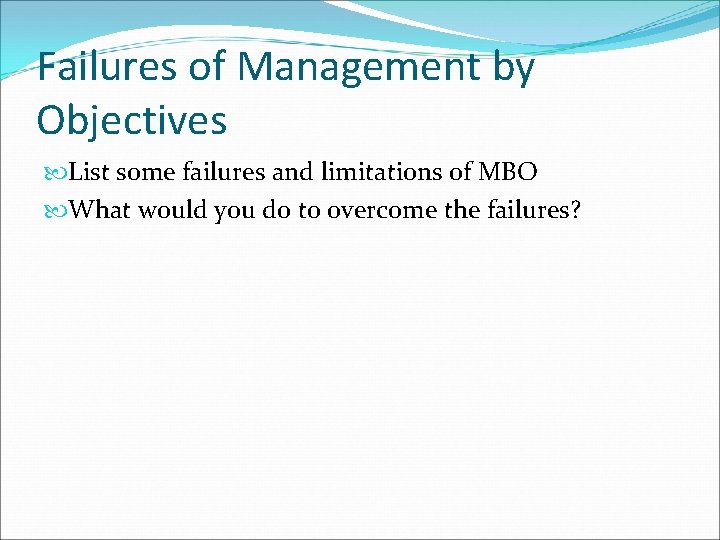
Failures of Management by Objectives List some failures and limitations of MBO What would you do to overcome the failures?
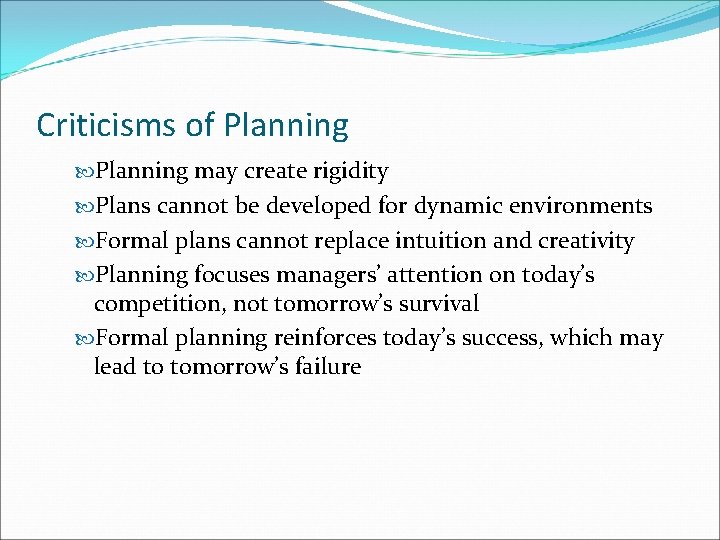
Criticisms of Planning may create rigidity Plans cannot be developed for dynamic environments Formal plans cannot replace intuition and creativity Planning focuses managers’ attention on today’s competition, not tomorrow’s survival Formal planning reinforces today’s success, which may lead to tomorrow’s failure
Organizational Strategy Strategic Management The set of managerial decisions and actions that determines the long-run performance of an organization
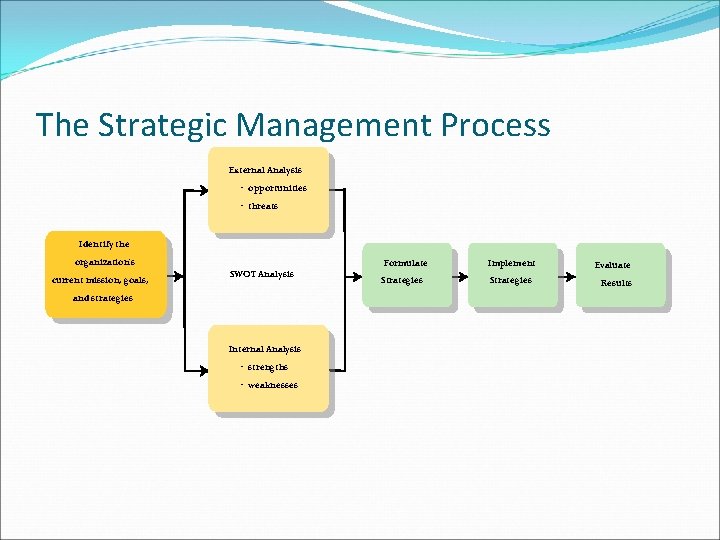
The Strategic Management Process External Analysis • opportunities • threats Identify the organization's current mission, goals, SWOT Analysis and strategies Internal Analysis • strengths • weaknesses Formulate Implement Strategies Evaluate Results
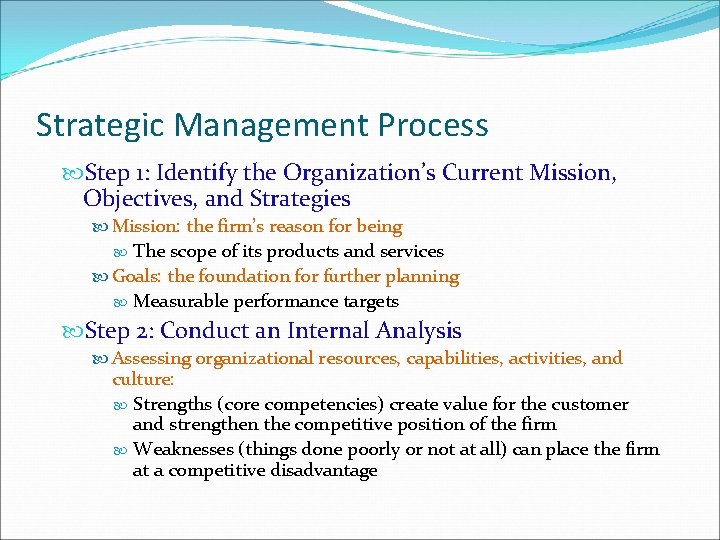
Strategic Management Process Step 1: Identify the Organization’s Current Mission, Objectives, and Strategies Mission: the firm’s reason for being The scope of its products and services Goals: the foundation for further planning Measurable performance targets Step 2: Conduct an Internal Analysis Assessing organizational resources, capabilities, activities, and culture: Strengths (core competencies) create value for the customer and strengthen the competitive position of the firm Weaknesses (things done poorly or not at all) can place the firm at a competitive disadvantage
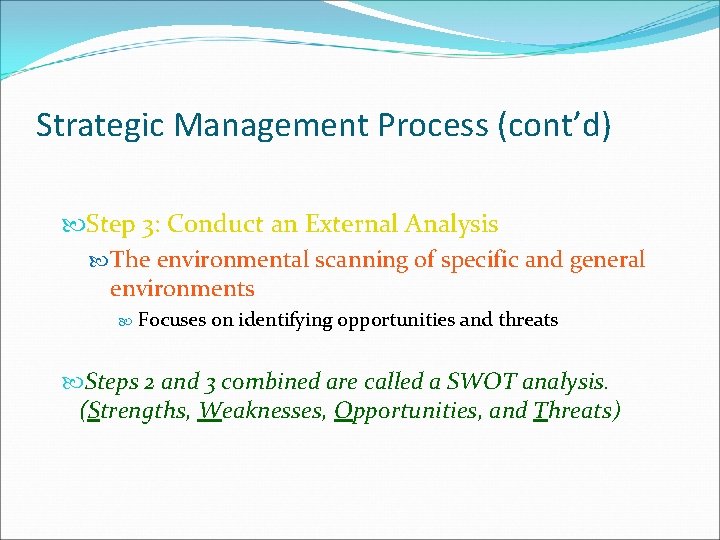
Strategic Management Process (cont’d) Step 3: Conduct an External Analysis The environmental scanning of specific and general environments Focuses on identifying opportunities and threats Steps 2 and 3 combined are called a SWOT analysis. (Strengths, Weaknesses, Opportunities, and Threats)
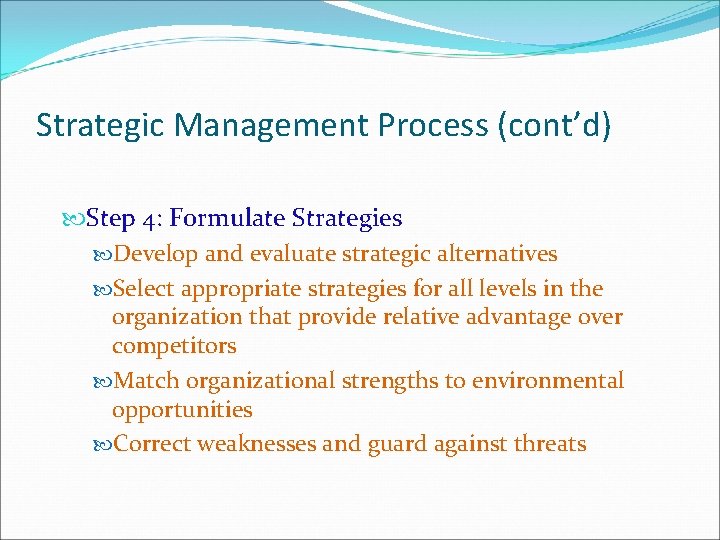
Strategic Management Process (cont’d) Step 4: Formulate Strategies Develop and evaluate strategic alternatives Select appropriate strategies for all levels in the organization that provide relative advantage over competitors Match organizational strengths to environmental opportunities Correct weaknesses and guard against threats
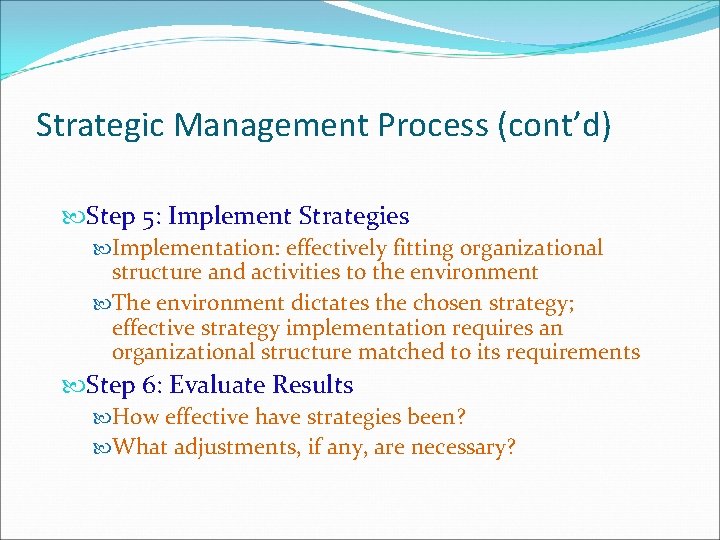
Strategic Management Process (cont’d) Step 5: Implement Strategies Implementation: effectively fitting organizational structure and activities to the environment The environment dictates the chosen strategy; effective strategy implementation requires an organizational structure matched to its requirements Step 6: Evaluate Results How effective have strategies been? What adjustments, if any, are necessary?
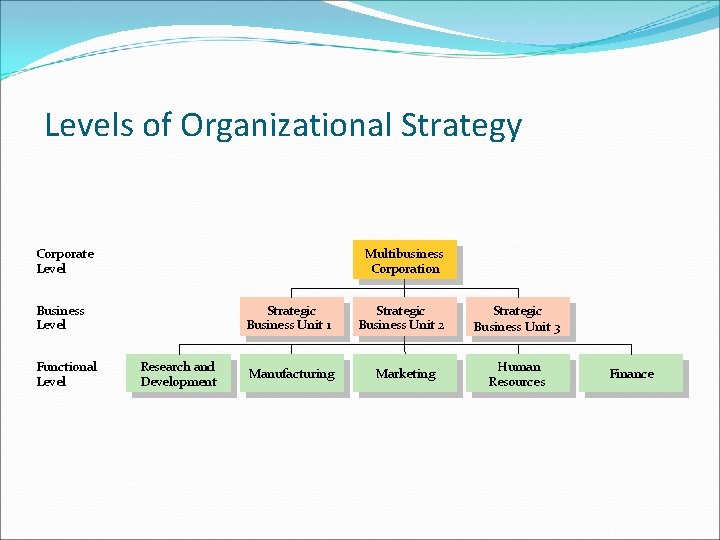
Levels of Organizational Strategy Corporate Level Multibusiness Corporation Business Level Functional Level Strategic Business Unit 1 Research and Development Manufacturing Strategic Business Unit 2 Marketing Strategic Business Unit 3 Human Resources Finance
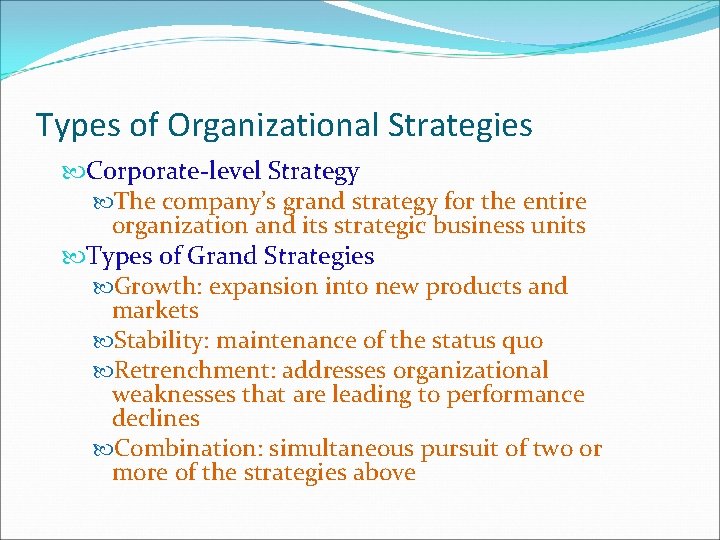
Types of Organizational Strategies Corporate-level Strategy The company’s grand strategy for the entire organization and its strategic business units Types of Grand Strategies Growth: expansion into new products and markets Stability: maintenance of the status quo Retrenchment: addresses organizational weaknesses that are leading to performance declines Combination: simultaneous pursuit of two or more of the strategies above
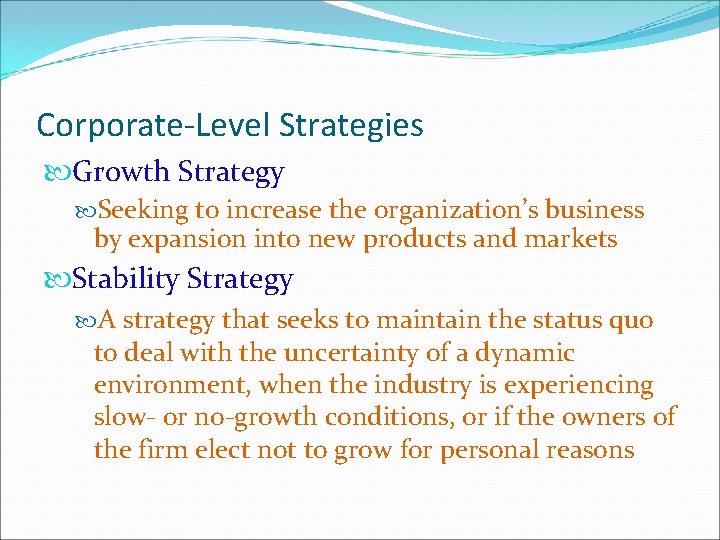
Corporate-Level Strategies Growth Strategy Seeking to increase the organization’s business by expansion into new products and markets Stability Strategy A strategy that seeks to maintain the status quo to deal with the uncertainty of a dynamic environment, when the industry is experiencing slow- or no-growth conditions, or if the owners of the firm elect not to grow for personal reasons
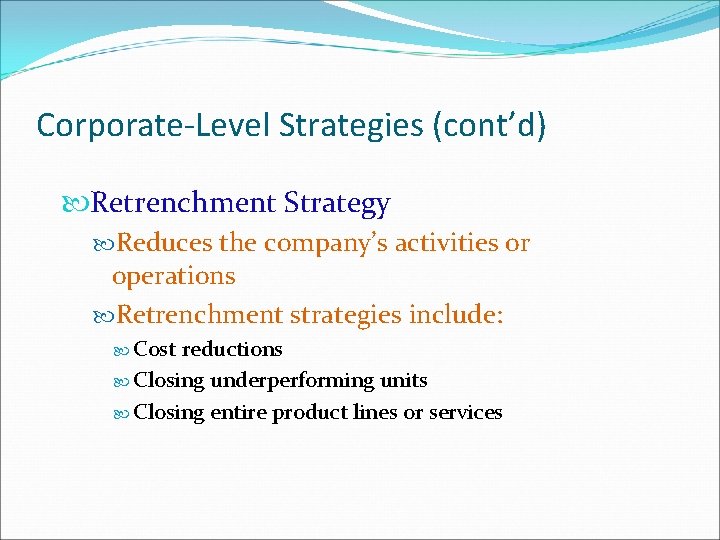
Corporate-Level Strategies (cont’d) Retrenchment Strategy Reduces the company’s activities or operations Retrenchment strategies include: Cost reductions Closing underperforming units Closing entire product lines or services
Corporate-Level Strategies (cont’d) Combination Strategy Simultaneous pursuit by the organization of two or more of growth, stability, and retrenchment strategies
Business-Level Strategy A strategy that seeks to determine how an organization should compete in each unit within the organization to create a competitive advantage Competitive advantage An organization’s distinctive competitive edge that is sourced and sustained in its core competencies
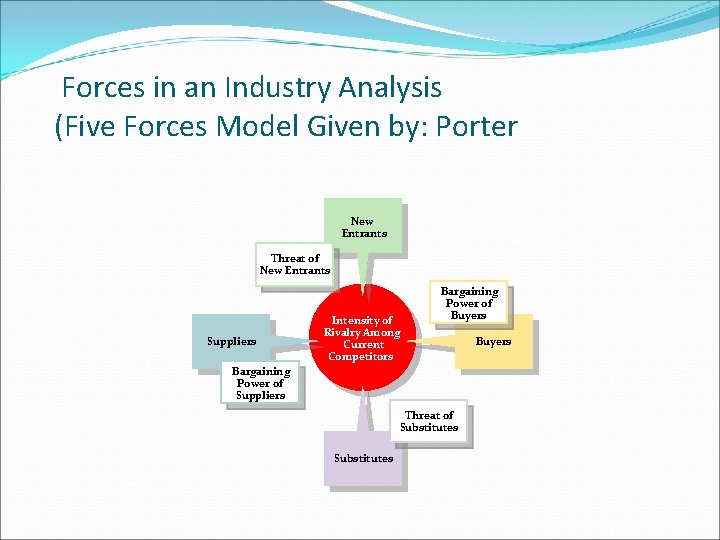
Forces in an Industry Analysis (Five Forces Model Given by: Porter New Entrants Threat of New Entrants Suppliers Intensity of Rivalry Among Current Competitors Bargaining Power of Buyers Bargaining Power of Suppliers Threat of Substitutes Buyers
Five Competitive Forces Threat of New Entrants The ease or difficulty with which new competitors can enter an industry Threat of Substitutes The extent to which switching costs and brand loyalty affect the likelihood of customers adopting substitute products and services Bargaining Power of Buyers The degree to which buyers have the market strength to hold away over and influence competitors in an industry
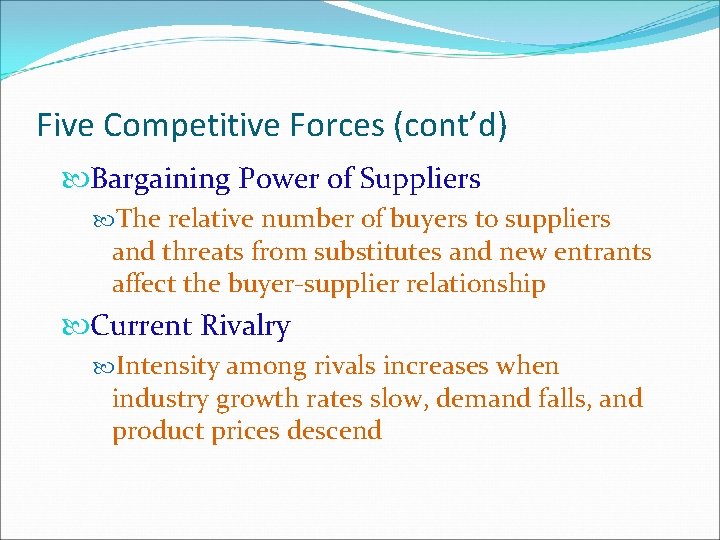
Five Competitive Forces (cont’d) Bargaining Power of Suppliers The relative number of buyers to suppliers and threats from substitutes and new entrants affect the buyer-supplier relationship Current Rivalry Intensity among rivals increases when industry growth rates slow, demand falls, and product prices descend
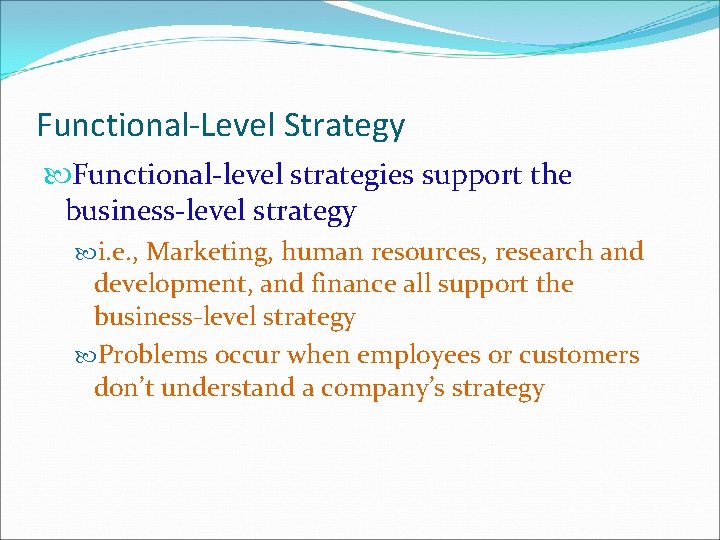
Functional-Level Strategy Functional-level strategies support the business-level strategy i. e. , Marketing, human resources, research and development, and finance all support the business-level strategy Problems occur when employees or customers don’t understand a company’s strategy
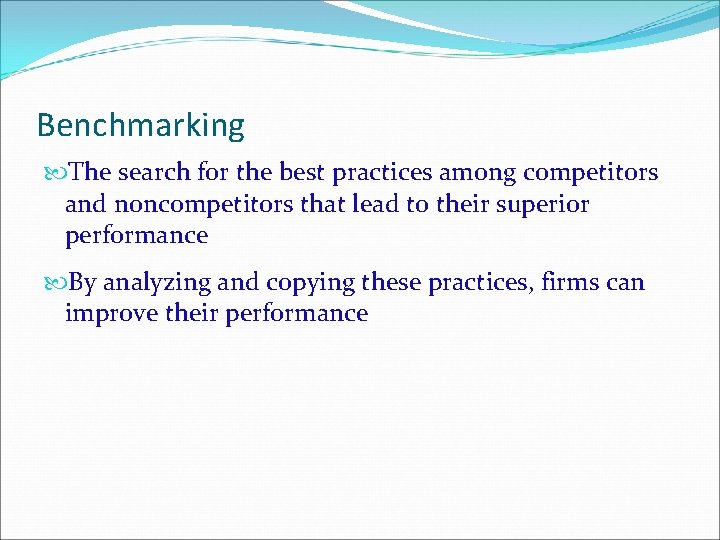
Benchmarking The search for the best practices among competitors and noncompetitors that lead to their superior performance By analyzing and copying these practices, firms can improve their performance
Decision Making Decision making is defined as the selection of a course of action from among alternatives
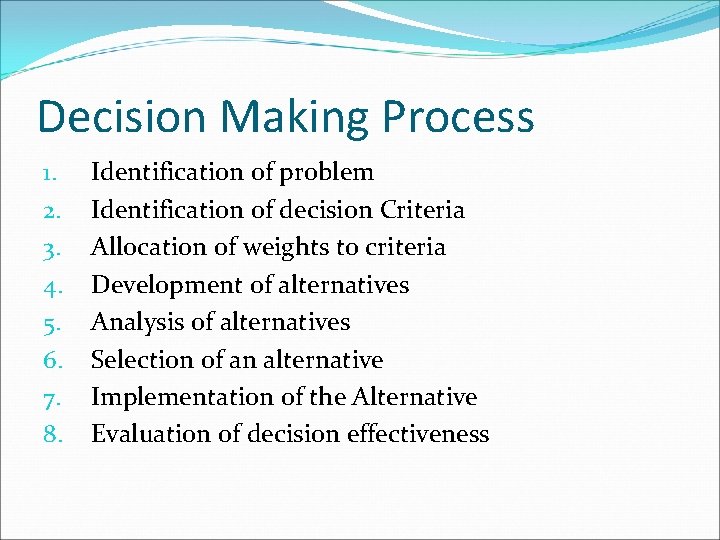
Decision Making Process 1. 2. 3. 4. 5. 6. 7. 8. Identification of problem Identification of decision Criteria Allocation of weights to criteria Development of alternatives Analysis of alternatives Selection of an alternative Implementation of the Alternative Evaluation of decision effectiveness
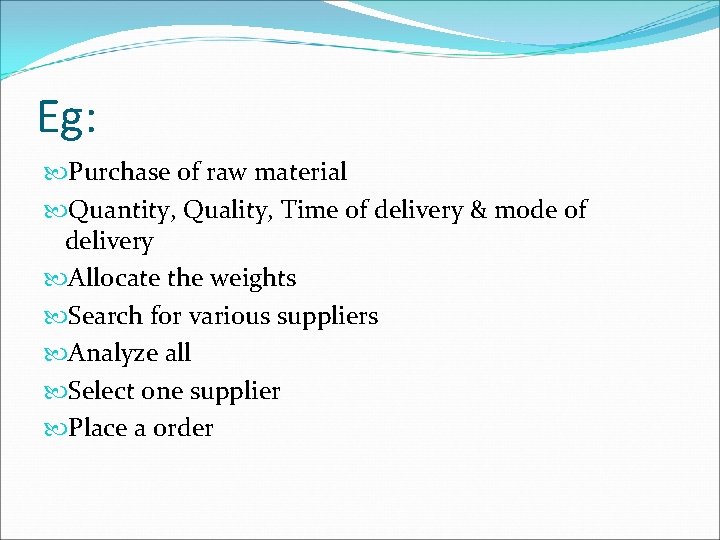
Eg: Purchase of raw material Quantity, Quality, Time of delivery & mode of delivery Allocate the weights Search for various suppliers Analyze all Select one supplier Place a order
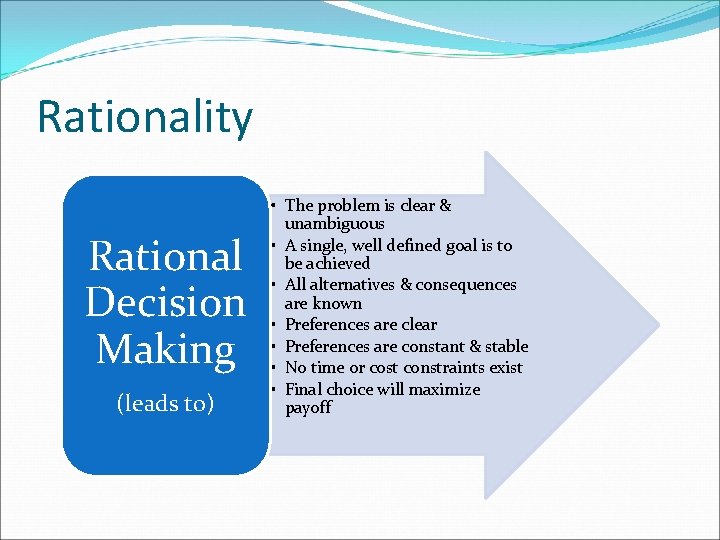
Rationality Rational Decision Making (leads to) • The problem is clear & unambiguous • A single, well defined goal is to be achieved • All alternatives & consequences are known • Preferences are clear • Preferences are constant & stable • No time or cost constraints exist • Final choice will maximize payoff
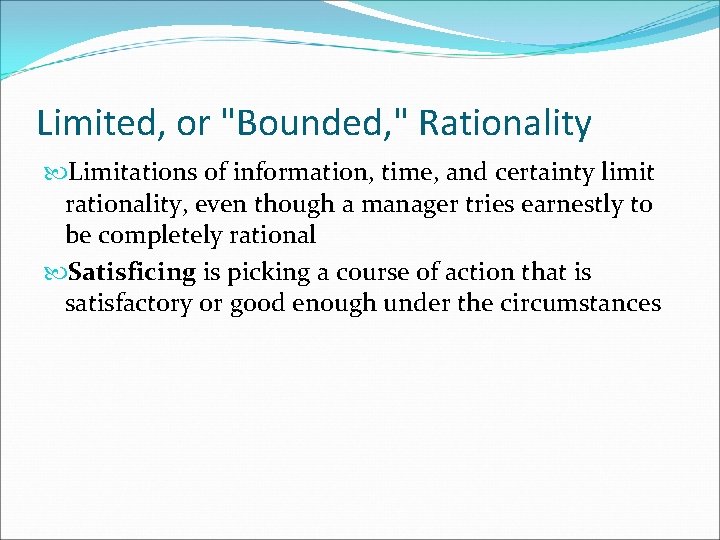
Limited, or "Bounded, " Rationality Limitations of information, time, and certainty limit rationality, even though a manager tries earnestly to be completely rational Satisficing is picking a course of action that is satisfactory or good enough under the circumstances
Programmed And Nonprogrammed Decisions Structured problems &Programmed decisions: Programmed decisions are used for structured or routine work Unstructured Problems & Nonprogrammed decisions: Nonprogrammed decisions are used for unstructured, novel, and ill-defined situations of a nonrecurring nature
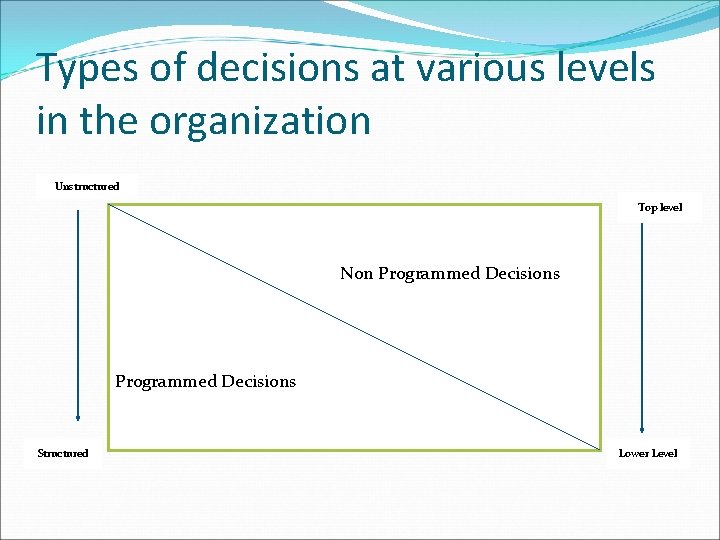
Types of decisions at various levels in the organization Unstructured Top level Non Programmed Decisions Structured Lower Level
Simon’s model of decision making Contribution of Herbert Simon The decision making process can be broken into series of three sequential steps: 1. Intelligent activity 2. Design activity 3. Choice activity
Intelligent activity refers to the initial phase of searching the environment for conditions calling for decisions. Design activity refers to the phase of inventing, developing, and analyzing possible course of action to take place. Choice activity refers to the final phase of actual choice selecting a particular course of action from those available.
Creativity and Innovation Creativity refers to the ability and power to develop new ideas Conditions necessary for Creativity: Expertise, Creative thinking skills, Internal Motivation, Environmental need, Tension & Encouragement from others Innovation means the use of new ideas
Forecasting It is the process of estimating the relevant events of future, based on the analysis of their past and present behaviour Acc to Neter & Wasserman: Business forecasting refers to the statistical analysis of the past & current movement in the given time series so as to obtain clues about the future pattern of those movements
Features of forecasting It relates to future events Defines the probability of happening of future events Analysing the past & present relevant events Use of some statistical tools & techniques
Planning & Forecasting Planning is more comprehensive and forecasting involves the estimation of future events & provides parameters to planning
Importance of Forecasting Promotion of organisation Key to planning Coordination & control Success in organisation
Premising Premises are the assumptions on which plans are formulated A major source of premising is forecasting