
Planning the Climate Change Response through National Systems

- Slides: 16
Planning the Climate Change Response through National Systems : Climate Change Action Plans and Climate Change Financing Framework in Cambodia 03 DECEMBER 2013
Current status of Climate Finance in Cambodia On average, 105 MUSD per year of climate-relevant expenditures according to the latest CPEIR update (2009 -12), with 22% domestically funded and 78% external External resources mobilized in the past three years: over 80 MUSD per year (main donors: CIF/SPCR, US, Japan, EU, Sweden, GEF, LDCF, Adaptation Fund) Cambodia Climate Change Strategic Plan 2014 -23 (approved in November 2013) 9 priority ministries + Ministry of Environment currently developing their Climate Change Action Plans Guidelines for integration of climate change in local government’s plans and budgets also under development
Climate Change Financing Framework (CCFF) Objectives üReview existing modalities, current and future sources of financing, and produce recommendations on how climate change finance should be channeled for the implementation of the CCCSP (including sub-national and national levels) üPresent a coherent, realistic and prioritized action plan üProvide an estimated costing of the Climate Change response (at least for the next 5 years), taking into account financing scenarios üProvide initial estimates of the benefits of the proposed response ü Identify next steps and required capacity development support to implement the framework
Climate Change Financing Framework (2) Process to date üLed by a sub-group of the inter-ministerial Climate Change Technical Team: MEF (coordinator), Mo. Environment, Mo. Planning, NCDD-S (decentralization body), Council for the Development of Cambodia (in charge of aid and investment coordination) üInitial methodology developed in July 2013 and updated as required, based on experience üExercise launched in July 2013, includes detailed work on action plans in 9 priority ministries + Ministry of Environment üFirst draft of the action plans and the national CCFF expected by end December 2013 ü Approval in first quarter 2014
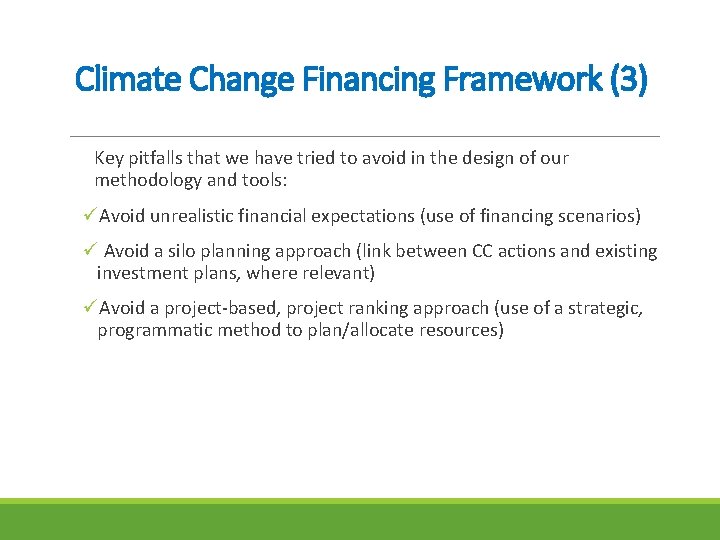
Climate Change Financing Framework (3) Key pitfalls that we have tried to avoid in the design of our methodology and tools: üAvoid unrealistic financial expectations (use of financing scenarios) ü Avoid a silo planning approach (link between CC actions and existing investment plans, where relevant) üAvoid a project-based, project ranking approach (use of a strategic, programmatic method to plan/allocate resources)
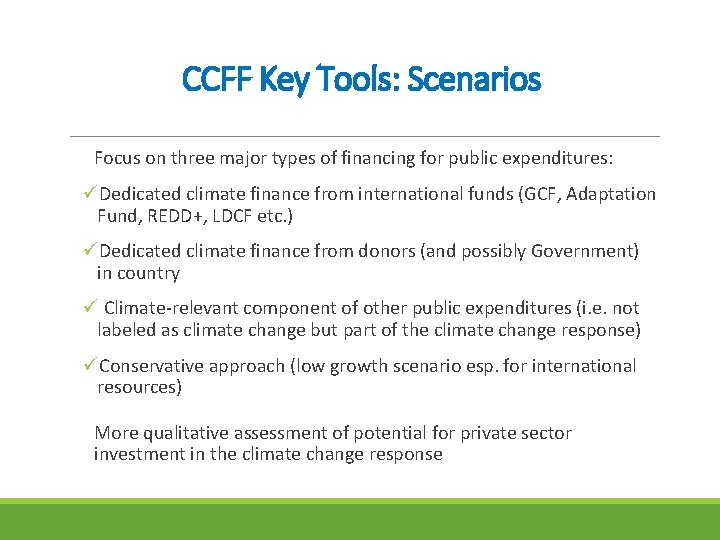
CCFF Key Tools: Scenarios Focus on three major types of financing for public expenditures: üDedicated climate finance from international funds (GCF, Adaptation Fund, REDD+, LDCF etc. ) üDedicated climate finance from donors (and possibly Government) in country ü Climate-relevant component of other public expenditures (i. e. not labeled as climate change but part of the climate change response) üConservative approach (low growth scenario esp. for international resources) More qualitative assessment of potential for private sector investment in the climate change response
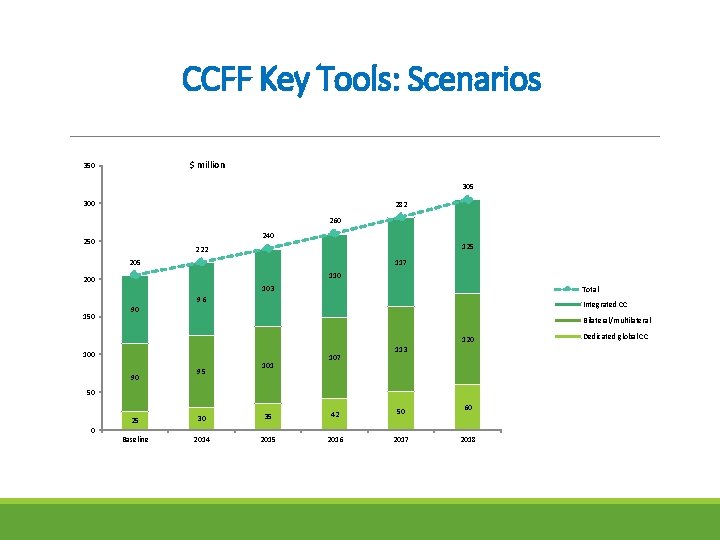
CCFF Key Tools: Scenarios $ million 350 305 300 282 260 240 250 125 222 117 205 110 200 103 Total 96 150 Integrated CC 90 Bilateral/multilateral 120 100 90 95 101 107 113 50 0 30 35 42 50 60 25 Baseline 2014 2015 2016 2017 2018 Dedicated global CC
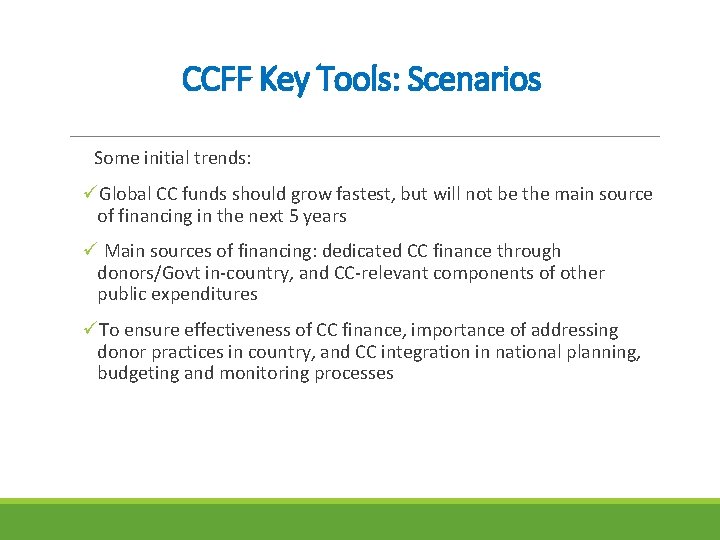
CCFF Key Tools: Scenarios Some initial trends: üGlobal CC funds should grow fastest, but will not be the main source of financing in the next 5 years ü Main sources of financing: dedicated CC finance through donors/Govt in-country, and CC-relevant components of other public expenditures üTo ensure effectiveness of CC finance, importance of addressing donor practices in country, and CC integration in national planning, budgeting and monitoring processes
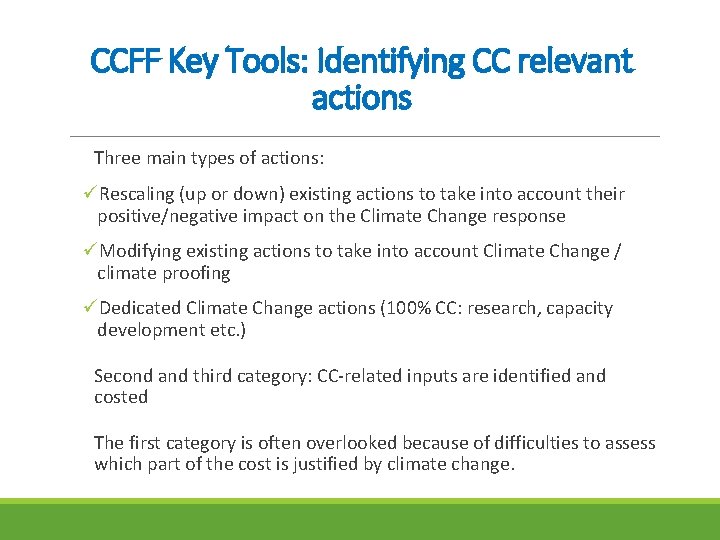
CCFF Key Tools: Identifying CC relevant actions Three main types of actions: üRescaling (up or down) existing actions to take into account their positive/negative impact on the Climate Change response üModifying existing actions to take into account Climate Change / climate proofing üDedicated Climate Change actions (100% CC: research, capacity development etc. ) Second and third category: CC-related inputs are identified and costed The first category is often overlooked because of difficulties to assess which part of the cost is justified by climate change.
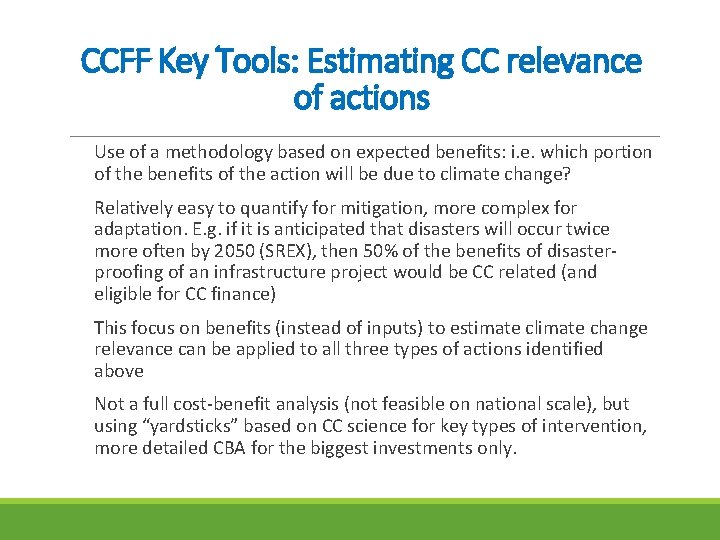
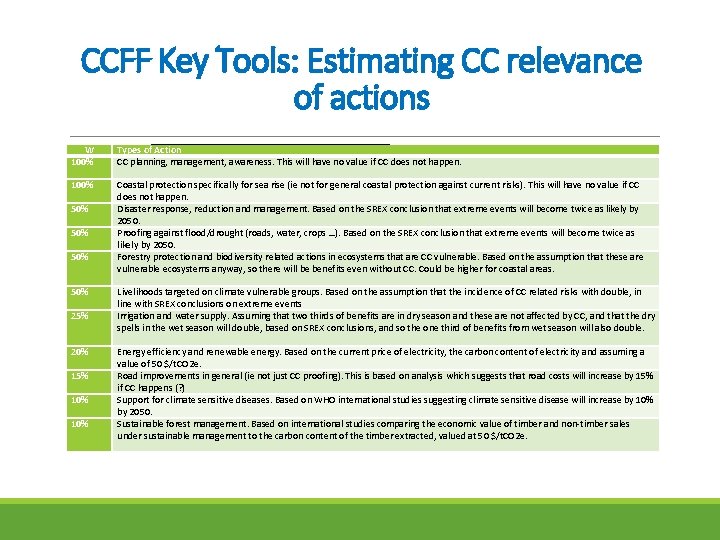
CCFF Key Tools: Estimating CC relevance of actions Use of a methodology based on expected benefits: i. e. which portion of the benefits of the action will be due to climate change? Relatively easy to quantify for mitigation, more complex for adaptation. E. g. if it is anticipated that disasters will occur twice more often by 2050 (SREX), then 50% of the benefits of disasterproofing of an infrastructure project would be CC related (and eligible for CC finance) This focus on benefits (instead of inputs) to estimate climate change relevance can be applied to all three types of actions identified above Not a full cost-benefit analysis (not feasible on national scale), but using “yardsticks” based on CC science for key types of intervention, more detailed CBA for the biggest investments only.
CCFF Key Tools: Estimating CC relevance of actions W 100% Types of Action CC planning, management, awareness. This will have no value if CC does not happen. 100% Coastal protection specifically for sea rise (ie not for general coastal protection against current risks). This will have no value if CC does not happen. Disaster response, reduction and management. Based on the SREX conclusion that extreme events will become twice as likely by 2050. Proofing against flood/drought (roads, water, crops …). Based on the SREX conclusion that extreme events will become twice as likely by 2050. Forestry protection and biodiversity related actions in ecosystems that are CC vulnerable. Based on the assumption that these are vulnerable ecosystems anyway, so there will be benefits even without CC. Could be higher for coastal areas. 50% 50% 25% 20% 15% 10% Livelihoods targeted on climate vulnerable groups. Based on the assumption that the incidence of CC related risks with double, in line with SREX conclusions on extreme events Irrigation and water supply. Assuming that two thirds of benefits are in dry season and these are not affected by CC, and that the dry spells in the wet season will double, based on SREX conclusions, and so the one third of benefits from wet season will also double. Energy efficiency and renewable energy. Based on the current price of electricity, the carbon content of electricity and assuming a value of 50 $/t. CO 2 e. Road improvements in general (ie not just CC proofing). This is based on analysis which suggests that road costs will increase by 15% if CC happens (? ) Support for climate sensitive diseases. Based on WHO international studies suggesting climate sensitive disease will increase by 10% by 2050. Sustainable forest management. Based on international studies comparing the economic value of timber and non-timber sales under sustainable management to the carbon content of the timber extracted, valued at 50 $/t. CO 2 e.
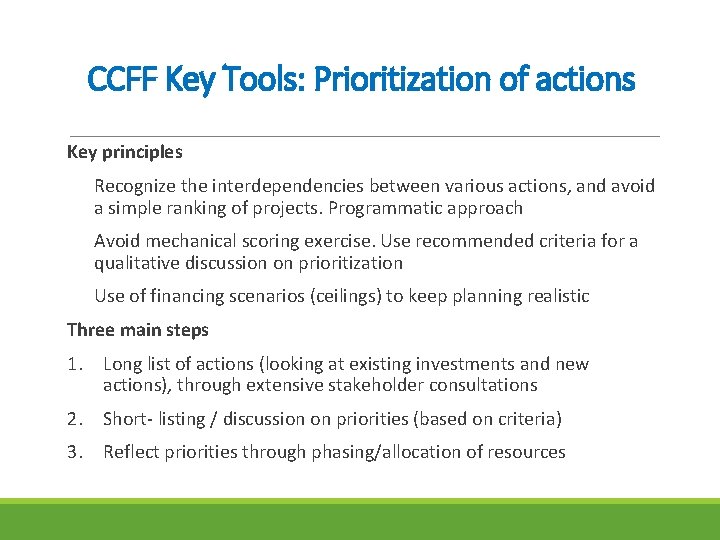
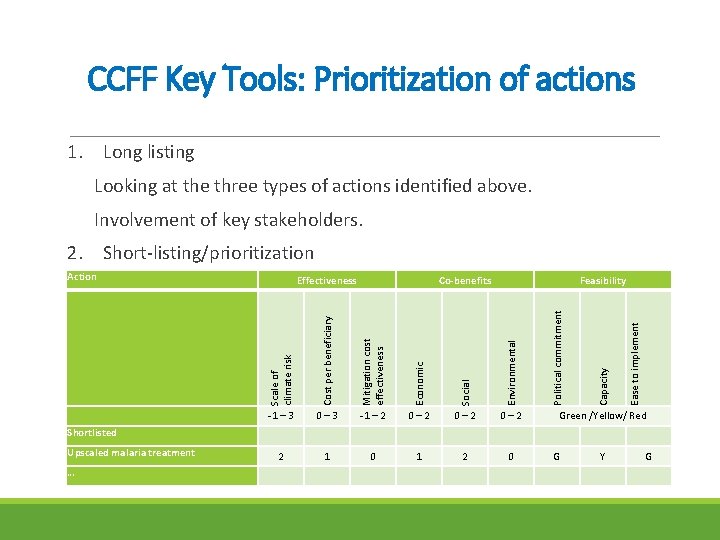
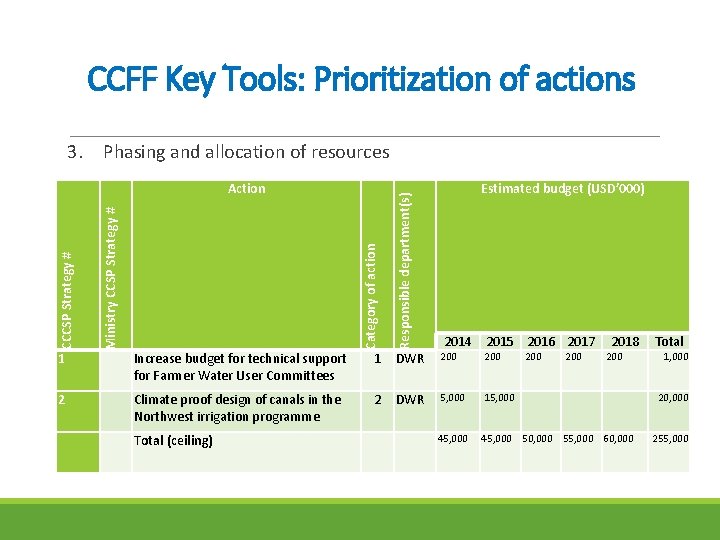
CCFF Key Tools: Prioritization of actions Key principles Recognize the interdependencies between various actions, and avoid a simple ranking of projects. Programmatic approach Avoid mechanical scoring exercise. Use recommended criteria for a qualitative discussion on prioritization Use of financing scenarios (ceilings) to keep planning realistic Three main steps 1. Long list of actions (looking at existing investments and new actions), through extensive stakeholder consultations 2. Short- listing / discussion on priorities (based on criteria) 3. Reflect priorities through phasing/allocation of resources
CCFF Key Tools: Prioritization of actions 1. Long listing Looking at the three types of actions identified above. Involvement of key stakeholders. 2. Short-listing/prioritization Social Environmental 0– 3 -1 – 2 0– 2 2 1 0 1 2 0 Ease to implement Economic -1 – 3 Capacity Mitigation cost effectiveness Feasibility Cost per beneficiary Co-benefits Scale of climate risk Effectiveness Political commitment Action Green /Yellow/ Red Shortlisted Upscaled malaria treatment … G Y G
CCFF Key Tools: Prioritization of actions 2 Increase budget for technical support for Farmer Water User Committees Climate proof design of canals in the Northwest irrigation programme Total (ceiling) Category of action 1 Ministry CCSP Strategy # CCCSP Strategy # Action 1 2 Responsible department(s) 3. Phasing and allocation of resources Estimated budget (USD’ 000) 2014 2015 2016 2017 2018 DWR 200 DWR 5, 000 15, 000 45, 000 50, 000 55, 000 60, 000 200 200 Total 1, 000 20, 000 255, 000
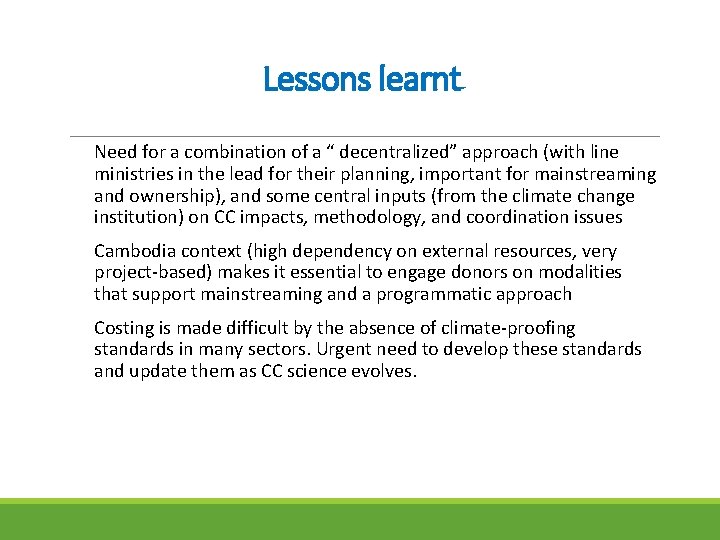
Lessons learnt Need for a combination of a “ decentralized” approach (with line ministries in the lead for their planning, important for mainstreaming and ownership), and some central inputs (from the climate change institution) on CC impacts, methodology, and coordination issues Cambodia context (high dependency on external resources, very project-based) makes it essential to engage donors on modalities that support mainstreaming and a programmatic approach Costing is made difficult by the absence of climate-proofing standards in many sectors. Urgent need to develop these standards and update them as CC science evolves.
Thank you