
PLANNING SYSTEM INSTALLATION IB Computer Science HL TOPICS
PLANNING & SYSTEM INSTALLATION IB Computer Science
HL TOPICS 1 -7, D 1 -4 1: System design 2: Computer Organisation 3: Networks 4: Computational thinking 5: Abstract data structures 6: Resource management 7: Control D: OOP

1: System design HL ONLY 5 OVERVIEW 2: Computer Organisation Thinking recursively 5. 1. 1 Identify a situation that requires the use of recursive thinking 5. 1. 2 Identify recursive thinking in a specified problem solution 5. 1. 3 Trace a recursive algorithm to express a solution to a problem Abstract data structures 5. 1. 4 Describe the characteristics of a two-dimensional array 5. 1. 5 Construct algorithms using two-dimensional arrays 5. 1. 6 Describe the characteristics and applications of a stack 5. 1. 7 Construct algorithms using the access methods of a stack 5. 1. 8 Describe the characteristics and applications of a queue 5. 1. 9 Construct algorithms using the access methods of a queue 5. 1. 10 Explain the use of arrays as static stacks and queues 3: Networks 4: Computational thinking 5: Abstract data structures Linked lists 5. 1. 11 Describe the features and characteristics of a dynamic data structure 5. 1. 12 Describe how linked lists operate logically 5. 1. 13 Sketch linked lists (single, double and circular) Trees 6: Resource management 5. 1. 14 Describe how trees operate logically (both binary and non-binary) 5. 1. 15 Define the terms: parent, left-child, right-child, subtree, root and leaf 5. 1. 16 State the result of inorder, postorder and preorder tree traversal 5. 1. 17 Sketch binary trees 7: Control Applications 5. 1. 18 Define the term dynamic data structure 5. 1. 19 Compare the use of static and dynamic data structures 5. 1. 20 Suggest a suitable structure for a given situation D: OOP
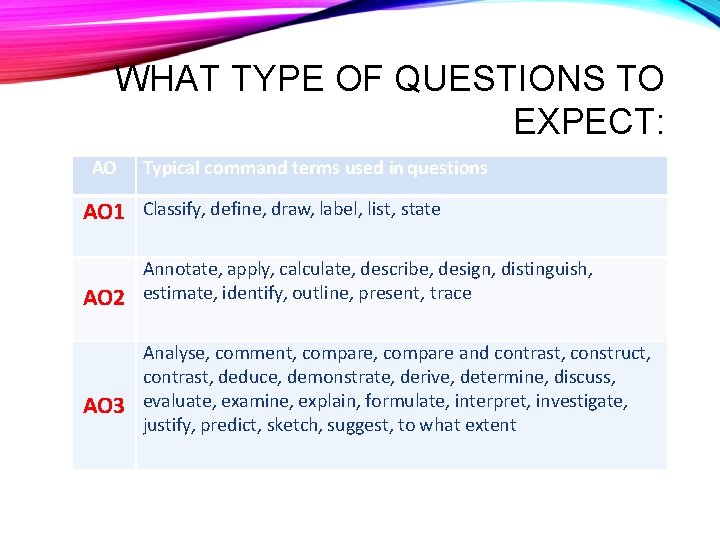
WHAT TYPE OF QUESTIONS TO EXPECT: AO Typical command terms used in questions AO 1 Classify, define, draw, label, list, state AO 2 AO 3 Annotate, apply, calculate, describe, design, distinguish, estimate, identify, outline, present, trace Analyse, comment, compare and contrast, construct, contrast, deduce, demonstrate, derive, determine, discuss, evaluate, examine, explain, formulate, interpret, investigate, justify, predict, sketch, suggest, to what extent
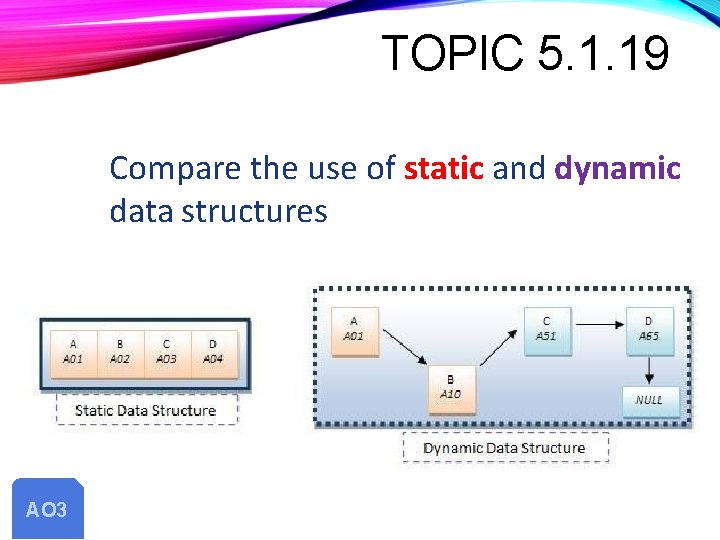
TOPIC 5. 1. 19 Compare the use of static and dynamic data structures AO 3
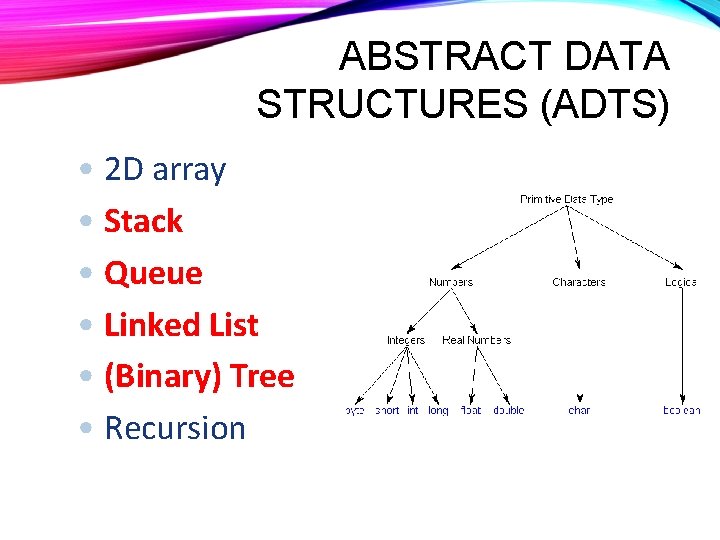
ABSTRACT DATA STRUCTURES (ADTS) • 2 D array • Stack • Queue • Linked List • (Binary) Tree • Recursion
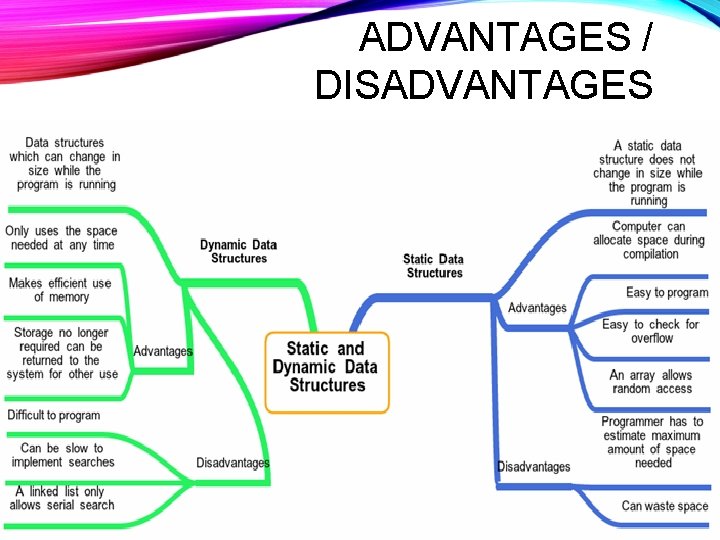
ADVANTAGES / DISADVANTAGES
- Slides: 7