
PLANNING SOLUTIONS FOR 2020 BEYOND DISCLAIMER The information
PLANNING SOLUTIONS FOR 2020 & BEYOND
DISCLAIMER The information contained herein is for informational purposes only and is not an offer or a solicitation related to the sale of any securities. Such an offer or solicitation can be made only through an Offering Memorandum, which is always the controlling document and supersedes the information contained herein. The analysis contained herein does not constitute an investment recommendation or take into account the particular investment objectives, investment strategies, financial situation and needs of any specific recipient. We recommend that you obtain financial and/or tax advice as to the implications of investing in the manner described. Certain services and products are subject to legal restrictions and cannot be offered worldwide on an unrestricted basis and/or may not be eligible for sale to all investors. All information and opinions expressed in this document were obtained from sources believed to be reliable and in good faith, but no representation or warranty, express or implied, is made as to its accuracy or completeness. All information and opinions as well as any prices indicated are current only as of the date of this report and are subject to change without notice. Opinions expressed herein may differ or be contrary to those expressed by other business areas or divisions of Cantor Fitzgerald, L. P. (“Cantor Fitzgerald”) or its affiliates as a result of using different assumptions and/or criteria. The contents of this document have not been and will not be approved by any securities or investment authority in the United States or elsewhere. Cantor Fitzgerald and its affiliates disclaim any and all liability for any loss that may arise from use of the information contained herein. References herein to past returns of any market sector are not an indication of future performance. Cantor Fitzgerald and its affiliates specifically prohibit the redistribution or reproduction of this material in whole or in part without the prior written permission of Cantor Fitzgerald accepts no liability whatsoever for the actions of third parties in this respect. This document is not intended for public use or distribution. Cantor Fitzgerald and its affiliates do not provide tax, legal, or accounting advice. This material and any accompanying communications have been prepared for informational purposes only, and do not constitute, are not intended to provide and should not be relied on as an investment recommendation or tax, legal, accounting, financial or other advice by Cantor Fitzgerald or its affiliates. You should consult your own tax, legal, and accounting, financial or other professionals before engaging in any transaction.
AGENDA 1 INTRODUCTION 2 THE QUALIFIED OPPORTUNITY ZONE PROGRAM 3 FINAL REGULATIONS, SECTION 1231 & K-1 GAINS 4 COMPARING 1031 TAX DEFERRED EXCHANGES & OPPORTUNITY ZONES 5 PLANNING IDEAS & EDUCATIONAL RESOURCES 2 2 3
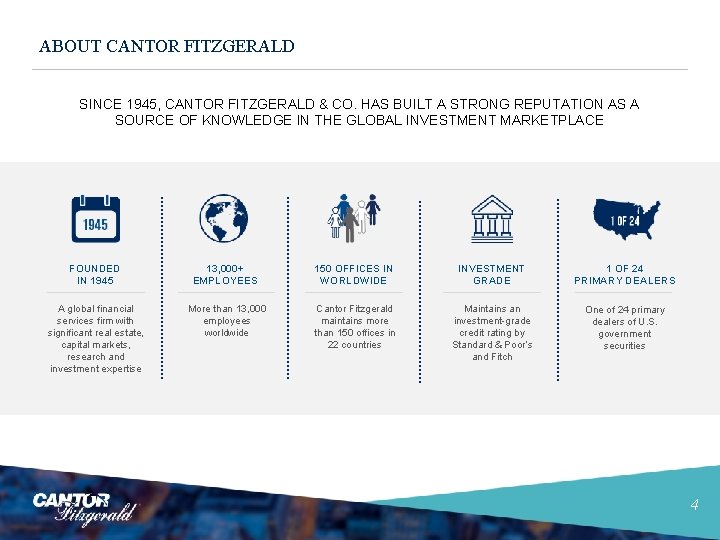
ABOUT CANTOR FITZGERALD SINCE 1945, CANTOR FITZGERALD & CO. HAS BUILT A STRONG REPUTATION AS A SOURCE OF KNOWLEDGE IN THE GLOBAL INVESTMENT MARKETPLACE FOUNDED IN 1945 A global financial services firm with significant real estate, capital markets, research and investment expertise 13, 000+ EMPLOYEES More than 13, 000 employees worldwide 150 OFFICES IN WORLDWIDE INVESTMENT GRADE 1 OF 24 PRIMARY DEALERS Cantor Fitzgerald maintains more than 150 offices in 22 countries Maintains an investment-grade credit rating by Standard & Poor’s and Fitch One of 24 primary dealers of U. S. government securities 4
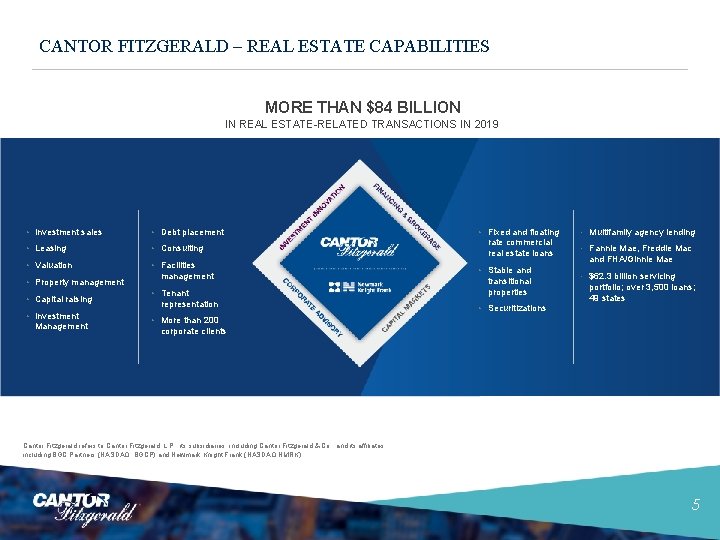
CANTOR FITZGERALD – REAL ESTATE CAPABILITIES MORE THAN $84 BILLION IN REAL ESTATE-RELATED TRANSACTIONS IN 2019 • Investment sales • Debt placement • Leasing • Consulting • Valuation • Facilities management • Property management • Capital raising • Investment Management • Tenant representation • Fixed and floating rate commercial real estate loans • Stable and transitional properties • Multifamily agency lending • Fannie Mae, Freddie Mac and FHA/Ginnie Mae • $62. 3 billion servicing portfolio; over 3, 500 loans; 49 states • Securitizations • More than 200 corporate clients Cantor Fitzgerald refers to Cantor Fitzgerald, L. P. , its subsidiaries, including Cantor Fitzgerald & Co. , and its affiliates including BGC Partners (NASDAQ: BGCP) and Newmark Knight Frank (NASDAQ: NMRK). 5
OVERVIEW THE QUALIFIED OPPORTUNITY ZONE PROGRAM INSTITUTIONAL USE ONLY – NOT FOR FURTHER DISTRIBUTION
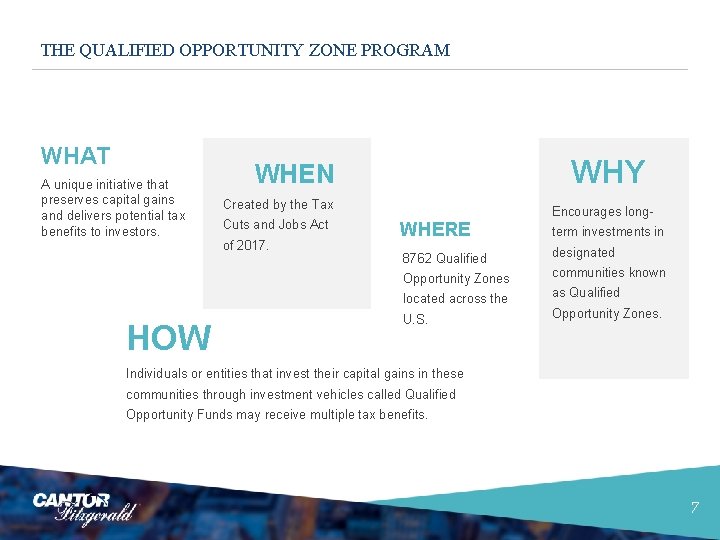
THE QUALIFIED OPPORTUNITY ZONE PROGRAM WHAT A unique initiative that preserves capital gains and delivers potential tax benefits to investors. WHY WHEN Created by the Tax Cuts and Jobs Act of 2017. Encourages long- WHERE term investments in 8762 Qualified designated Opportunity Zones located across the HOW U. S. communities known as Qualified Opportunity Zones. Individuals or entities that invest their capital gains in these communities through investment vehicles called Qualified Opportunity Funds may receive multiple tax benefits. 7
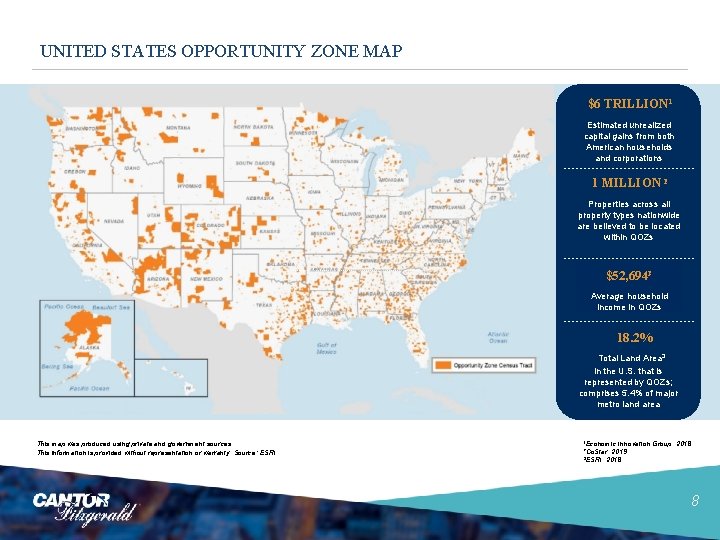
UNITED STATES OPPORTUNITY ZONE MAP $6 TRILLION 1 Estimated unrealized capital gains from both American households and corporations 1 MILLION 2 Properties across all property types nationwide are believed to be located within QOZs $52, 6943 Average household income in QOZs 18. 2% Total Land Area 3 in the U. S. that is represented by QOZs; comprises 5. 4% of major metro land area This map was produced using private and government sources. This information is provided without representation or warranty. Source: ESRI. 1 Economic Innovation Group, 2018 2019 3 ESRI, 2018 2 Co. Star, 8
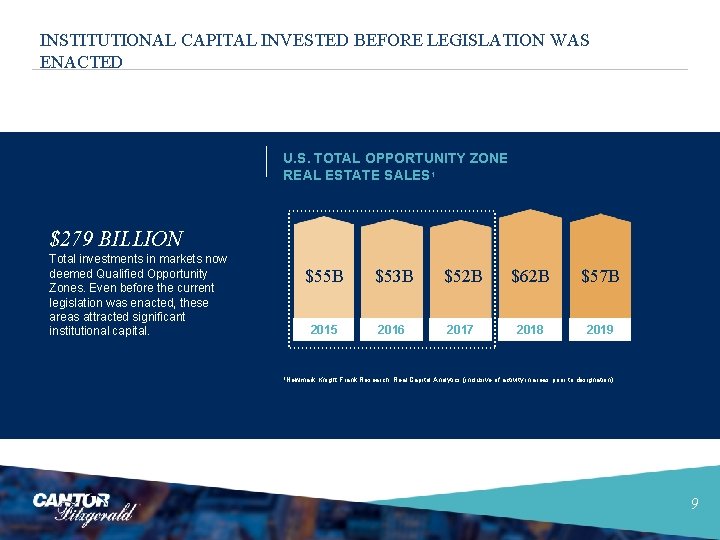
INSTITUTIONAL CAPITAL INVESTED BEFORE LEGISLATION WAS ENACTED U. S. TOTAL OPPORTUNITY ZONE REAL ESTATE SALES 1 $279 BILLION Total investments in markets now deemed Qualified Opportunity Zones. Even before the current legislation was enacted, these areas attracted significant institutional capital. $55 B $53 B $52 B $62 B $57 B 2015 2016 2017 2018 2019 1 Newmark Knight Frank Research, Real Capital Analytics (inclusive of activity in areas prior to designation). 9
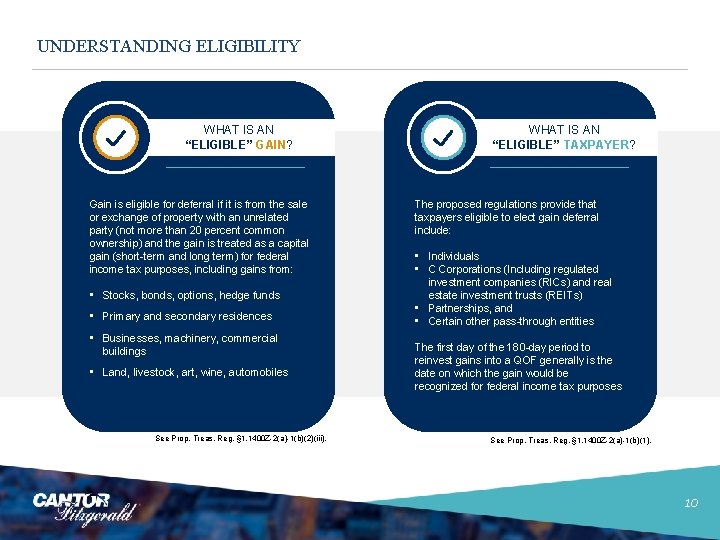
UNDERSTANDING ELIGIBILITY 2 WHAT IS AN “ELIGIBLE” GAIN? Gain is eligible for deferral if it is from the sale or exchange of property with an unrelated party (not more than 20 percent common ownership) and the gain is treated as a capital gain (short-term and long term) for federal income tax purposes, including gains from: • Stocks, bonds, options, hedge funds • Primary and secondary residences • Businesses, machinery, commercial buildings • Land, livestock, art, wine, automobiles See Prop. Treas. Reg. § 1. 1400 Z-2(a)-1(b)(2)(iii). WHAT IS AN “ELIGIBLE” TAXPAYER? The proposed regulations provide that taxpayers eligible to elect gain deferral include: • Individuals • C Corporations (Including regulated investment companies (RICs) and real estate investment trusts (REITs) • Partnerships, and • Certain other pass-through entities The first day of the 180 -day period to reinvest gains into a QOF generally is the date on which the gain would be recognized for federal income tax purposes See Prop. Treas. Reg. § 1. 1400 Z-2(a)-1(b)(1). 10
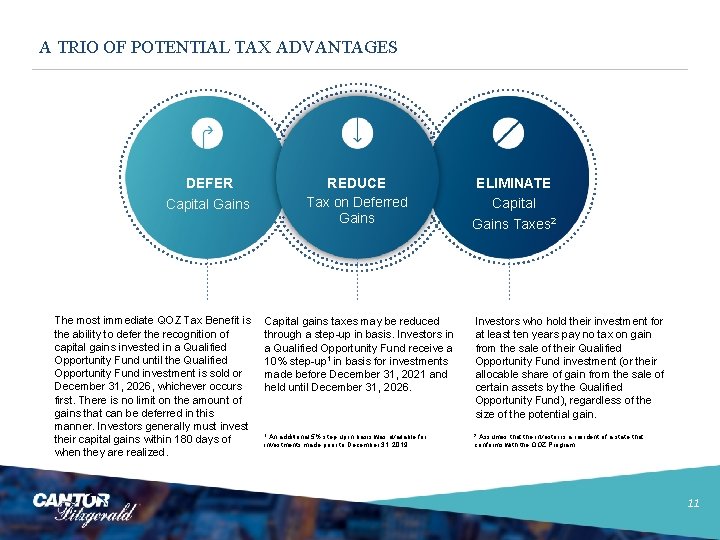
A TRIO OF POTENTIAL TAX ADVANTAGES DEFER Capital Gains The most immediate QOZ Tax Benefit is the ability to defer the recognition of capital gains invested in a Qualified Opportunity Fund until the Qualified Opportunity Fund investment is sold or December 31, 2026, whichever occurs first. There is no limit on the amount of gains that can be deferred in this manner. Investors generally must invest their capital gains within 180 days of when they are realized. REDUCE Tax on Deferred Gains ELIMINATE Capital Gains Taxes 2 Capital gains taxes may be reduced through a step-up in basis. Investors in a Qualified Opportunity Fund receive a 10% step-up 1 in basis for investments made before December 31, 2021 and held until December 31, 2026. Investors who hold their investment for at least ten years pay no tax on gain from the sale of their Qualified Opportunity Fund investment (or their allocable share of gain from the sale of certain assets by the Qualified Opportunity Fund), regardless of the size of the potential gain. 1 An additional 5% step-up in basis was available for 2 Assumes that the investor is a resident of a state that investments made prior to December 31, 2019. conforms with the QOZ Program. 11
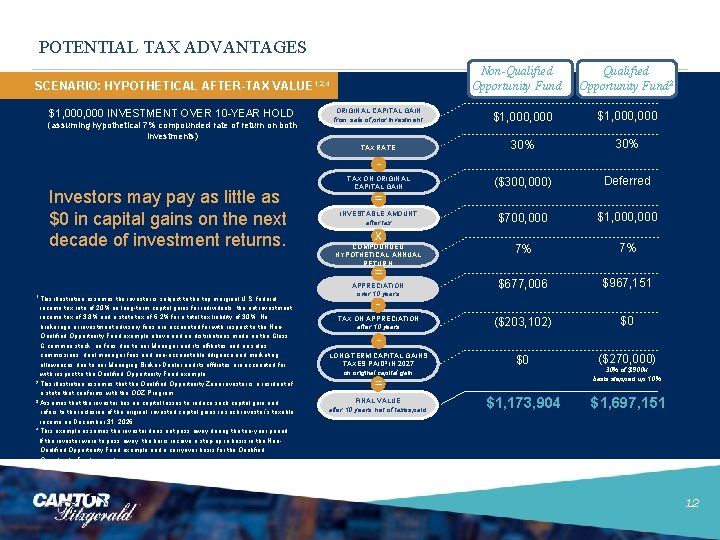
POTENTIAL TAX ADVANTAGES SCENARIO: HYPOTHETICAL AFTER-TAX VALUE $1, 000 INVESTMENT OVER 10 -YEAR HOLD (assuming hypothetical 7% compounded rate of return on both investments) Non-Qualified Opportunity Fund 1, 2, 4 Qualified Opportunity Fund 2 ORIGINAL CAPITAL GAIN from sale of prior investment $1, 000, 000 TAX RATE 30% TAX ON ORIGINAL CAPITAL GAIN ($300, 000) Deferred INVESTABLE AMOUNT after tax $700, 000 $1, 000 7% 7% $677, 006 $967, 151 TAX ON APPRECIATION after 10 years ($203, 102) $0 LONG-TERM CAPITAL GAINS TAXES PAID 3 IN 2027 on original capital gain $0 ($270, 000) FINAL VALUE after 10 years, net of taxes paid $1, 173, 904 - Investors may pay as little as $0 in capital gains on the next decade of investment returns. = X COMPOUNDED HYPOTHETICAL ANNUAL RETURN = 1 This illustration assumes the investor is subject to the top marginal U. S. federal income tax rate of 20% on long-term capital gains for individuals, the net investment income tax of 3. 8% and a state tax of 6. 2% for a total tax liability of 30%. No brokerage or investment advisory fees are accounted for with respect to the Non. Qualified Opportunity Fund example above and no distributions made on the Class C common stock, no fees due to our Manager and its affiliates and no sales commissions, deal manager fees and non-accountable diligence and marketing allowances due to our Managing Broker-Dealer and its affiliates are accounted for with respect to the Qualified Opportunity Fund example. 2 This illustration assumes that the Qualified Opportunity Zone investor is a resident of a state that conforms with the QOZ Program. 3 Assumes that the investor has no capital losses to reduce such capital gain and refers to the inclusion of the original, invested capital gains in such investor’s taxable income on December 31, 2026. 4 This example assumes the investor does not pass away during the ten-year period. If the investor were to pass away, the heirs receive a step-up in basis in the Non Qualified Opportunity Fund example and a carryover basis for the Qualified Opportunity Fund example. APPRECIATION over 10 years - - = 30% of $900 k, basis stepped up 10% $1, 697, 151 12
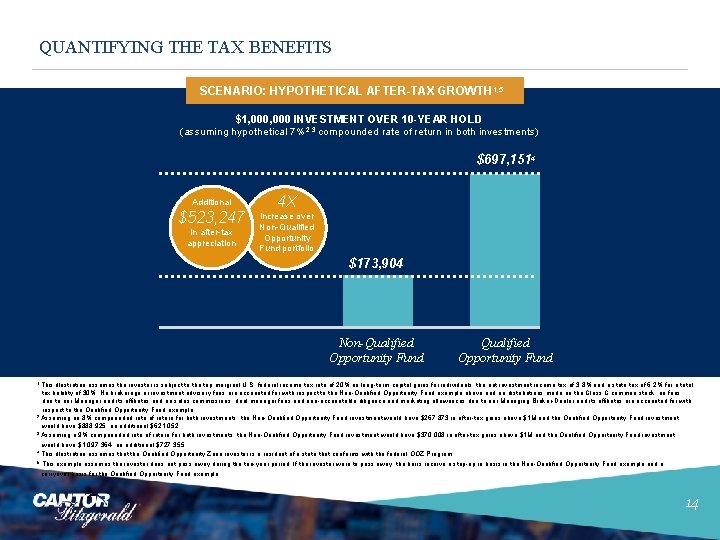
QUANTIFYING THE TAX BENEFITS SCENARIO: HYPOTHETICAL AFTER-TAX GROWTH 1, 5 $1, 000 INVESTMENT OVER 10 -YEAR HOLD (assuming hypothetical 7% 2, 3 compounded rate of return in both investments) $697, 1514 Additional $523, 247 in after-tax appreciation 4 X increase over Non-Qualified Opportunity Fund portfolio $173, 904 Non-Qualified Opportunity Fund 1 This illustration assumes the investor is subject to the top marginal U. S. federal income tax rate of 20% on long-term capital gains for individuals, the net investment income tax of 3. 8% and a state tax of 6. 2% for a total tax liability of 30%. No brokerage or investment advisory fees are accounted for with respect to the Non-Qualified Opportunity Fund example above and no distributions made on the Class C common stock, no fees due to our Manager and its affiliates and no sales commissions, deal manager fees and non-accountable diligence and marketing allowances due to our Managing Broker-Dealer and its affiliates are accounted for with respect to the Qualified Opportunity Fund example. 2 Assuming an 8% compounded rate of return for both investments, the Non-Qualified Opportunity Fund investment would have $267, 873 in after-tax gains above $1 M and the Qualified Opportunity Fund investment would have $888, 925, an additional $621, 052. 3 Assuming a 9% compounded rate of return for both investments, the Non-Qualified Opportunity Fund investment would have $370, 008 in after-tax gains above $1 M and the Qualified Opportunity Fund investment would have $1, 097, 364, an additional $727, 355. 4 This illustration assumes that the Qualified Opportunity Zone investor is a resident of a state that conforms with the federal QOZ Program. 5 This example assumes the investor does not pass away during the ten-year period. If the investor were to pass away, the heirs receive a step-up in basis in the Non-Qualified Opportunity Fund example and a carryover basis for the Qualified Opportunity Fund example. 14
OPPORTUNITY ZONES FINAL REGULATIONS AND IRS NOTICE 2020 -39 INSTITUTIONAL USE ONLY – NOT FOR FURTHER DISTRIBUTION
FINAL REGULATIONS: OVERVIEW The Treasury Department published the final set of Opportunity Zone regulations on December 19, 2019. These regulations build upon two prior sets, released in October 2018 and April 2019, respectively. Even after two rounds of regulatory guidance from the government, there were fundamental questions about aspects of the program. The eagerly anticipated final regulations provide clarity around a host of issues that were of critical importance to both potential investors in the program and businesses interested in taking advantage of the incentives provided for operating in QOZs. The final regulations also provide several new rules and expansions of previously provided safe harbors that appear to be favorable in terms of investment, development, and operation of projects in QOZs. Final Regulations: Qualified Opportunity Zone Program (https: //www. irs. gov/pub/irs-drop/td-9889. pdf) FAQ: Final Regulations on Opportunity Zones (https: //home. treasury. gov/news/press-releases/sm 864) 17
COVID RELIEF - IRS NOTICE 2020 -39 On June 4, 2020, the IRS issued Notice 2020 -39 providing additional relief for taxpayers affected by the COVID-19 pandemic. Among other subjects, the Notice extends the deadline for completing an investment in a Qualified Opportunity Fund (“QOF”) to December 31, 2020 for any investor who’s 180 -day investment period would have ended on or after April 1, 2020 and before December 31, 2020. Any type of gain, short or long-term, realized on October 4, 2019 originally had a 180 day investment deadline of April 1, 2020. IRS Notice 2020 -39 extends the deadline for completing an investment in a QOF to December 31, 2020 for any investor who’s 180 -day investment period would have ended on or after April 1, 2020 and before December 31, 2020. Thus, any gain realized on or after October 4, 2019 is still eligible to complete an investment in a QOF at least until December 31, 2020. 18
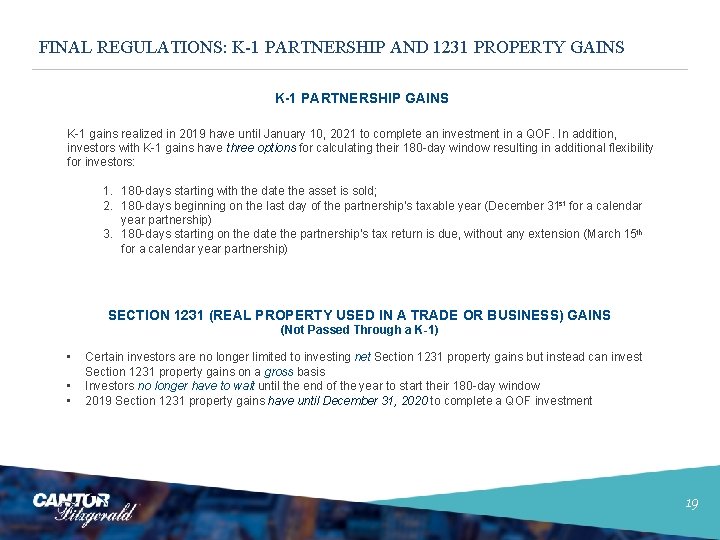
FINAL REGULATIONS: K-1 PARTNERSHIP AND 1231 PROPERTY GAINS K-1 PARTNERSHIP GAINS K-1 gains realized in 2019 have until January 10, 2021 to complete an investment in a QOF. In addition, investors with K-1 gains have three options for calculating their 180 -day window resulting in additional flexibility for investors: 1. 180 -days starting with the date the asset is sold; 2. 180 -days beginning on the last day of the partnership’s taxable year (December 31 st for a calendar year partnership) 3. 180 -days starting on the date the partnership’s tax return is due, without any extension (March 15 th for a calendar year partnership) SECTION 1231 (REAL PROPERTY USED IN A TRADE OR BUSINESS) GAINS (Not Passed Through a K-1) • • • Certain investors are no longer limited to investing net Section 1231 property gains but instead can invest Section 1231 property gains on a gross basis Investors no longer have to wait until the end of the year to start their 180 -day window 2019 Section 1231 property gains have until December 31, 2020 to complete a QOF investment 19
1031 EXCHANGES COMPARING OPPORTUNITY ZONES AND 1031 s
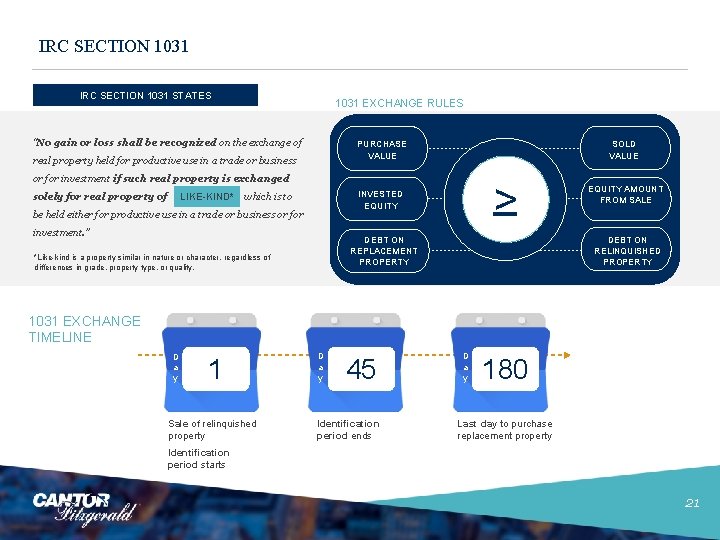
IRC SECTION 1031 STATES 1031 EXCHANGE RULES “No gain or loss shall be recognized on the exchange of PURCHASE VALUE real property held for productive use in a trade or business SOLD VALUE 7 _ > or for investment if such real property is exchanged solely for real property of LIKE-KIND* INVESTED EQUITY which is to be held either for productive use in a trade or business or for investment. ” DEBT ON REPLACEMENT PROPERTY *Like-kind is a property similar in nature or character, regardless of differences in grade, property type, or quality. EQUITY AMOUNT FROM SALE DEBT ON RELINQUISHED PROPERTY 1031 EXCHANGE TIMELINE D a y 1 Sale of relinquished property D a y 45 Identification period ends D a y 180 Last day to purchase replacement property Identification period starts 21
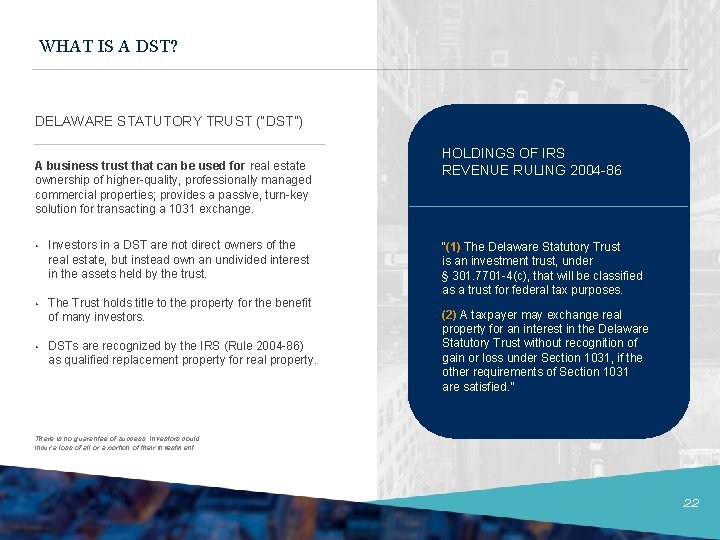
WHAT IS A DST? DELAWARE STATUTORY TRUST (“DST”) A business trust that can be used for real estate ownership of higher-quality, professionally managed commercial properties; provides a passive, turn-key solution for transacting a 1031 exchange. • Investors in a DST are not direct owners of the real estate, but instead own an undivided interest in the assets held by the trust. • The Trust holds title to the property for the benefit of many investors. • DSTs are recognized by the IRS (Rule 2004 -86) as qualified replacement property for real property. HOLDINGS OF IRS REVENUE RULING 2004 -86 “(1) The Delaware Statutory Trust is an investment trust, under § 301. 7701 -4(c), that will be classified as a trust for federal tax purposes. (2) A taxpayer may exchange real property for an interest in the Delaware Statutory Trust without recognition of gain or loss under Section 1031, if the other requirements of Section 1031 are satisfied. ” There is no guarantee of success. Investors could incur a loss of all or a portion of their investment. 22
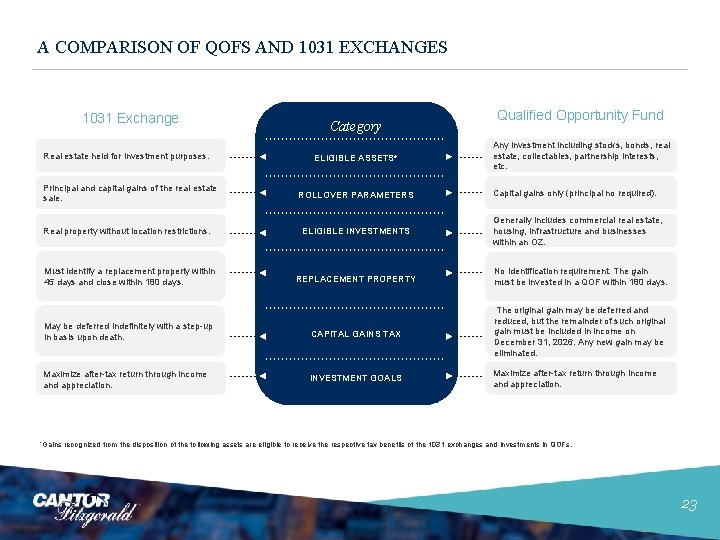
A COMPARISON OF QOFS AND 1031 EXCHANGES 1031 Exchange Real estate held for investment purposes. Principal and capital gains of the real estate sale. Real property without location restrictions. Must identify a replacement property within 45 days and close within 180 days. Category ELIGIBLE ASSETS* ROLLOVER PARAMETERS ELIGIBLE INVESTMENTS Qualified Opportunity Fund Any investment including stocks, bonds, real estate, collectables, partnership interests, etc. Capital gains only (principal no required). Generally includes commercial real estate, housing, infrastructure and businesses within an OZ. REPLACEMENT PROPERTY No identification requirement. The gain must be invested in a QOF within 180 days. May be deferred indefinitely with a step-up in basis upon death. CAPITAL GAINS TAX The original gain may be deferred and reduced, but the remainder of such original gain must be included in income on December 31, 2026. Any new gain may be eliminated. Maximize after-tax return through income and appreciation. INVESTMENT GOALS Maximize after-tax return through income and appreciation. *Gains recognized from the disposition of the following assets are eligible to receive the respective tax benefits of the 1031 exchanges and investments in QOFs. 23

PLANNING IDEAS EDUCATIONAL RESOURCES
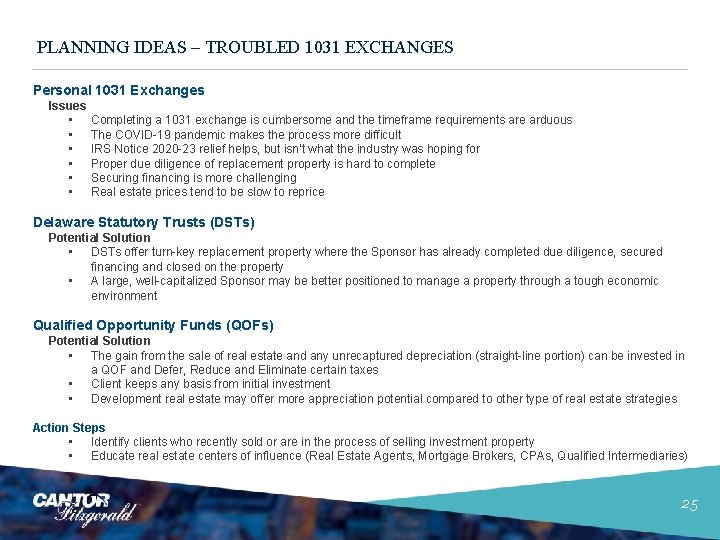
PLANNING IDEAS – TROUBLED 1031 EXCHANGES Personal 1031 Exchanges Issues • • • Completing a 1031 exchange is cumbersome and the timeframe requirements are arduous The COVID-19 pandemic makes the process more difficult IRS Notice 2020 -23 relief helps, but isn’t what the industry was hoping for Proper due diligence of replacement property is hard to complete Securing financing is more challenging Real estate prices tend to be slow to reprice Delaware Statutory Trusts (DSTs) Potential Solution • DSTs offer turn-key replacement property where the Sponsor has already completed due diligence, secured financing and closed on the property • A large, well-capitalized Sponsor may be better positioned to manage a property through a tough economic environment Qualified Opportunity Funds (QOFs) Potential Solution • The gain from the sale of real estate and any unrecaptured depreciation (straight-line portion) can be invested in a QOF and Defer, Reduce and Eliminate certain taxes • Client keeps any basis from initial investment • Development real estate may offer more appreciation potential compared to other type of real estate strategies Action Steps • Identify clients who recently sold or are in the process of selling investment property • Educate real estate centers of influence (Real Estate Agents, Mortgage Brokers, CPAs, Qualified Intermediaries) 25
RIA AND BROKER DEALER INQUIRIES: Cantor Fitzgerald & Co. Q&A Andy Raney 303 -941 -2639 Andrew. Raney@Cantor. com www. Cantor. com INSTITUTIONAL USE ONLY – NOT FOR FURTHER DISTRIBUTION
- Slides: 24