
Planning Search vs planning STRIPS operators Partialorder planning
- Slides: 25
Planning • Search vs. planning • STRIPS operators • Partial-order planning 1
What we have so far • Can TELL KB about new percepts about the world • KB maintains model of the current world state • Can ASK KB about any fact that can be inferred from KB How can we use these components to build a planning agent, i. e. , an agent that constructs plans that can achieve its goals, and that then executes these plans? 2
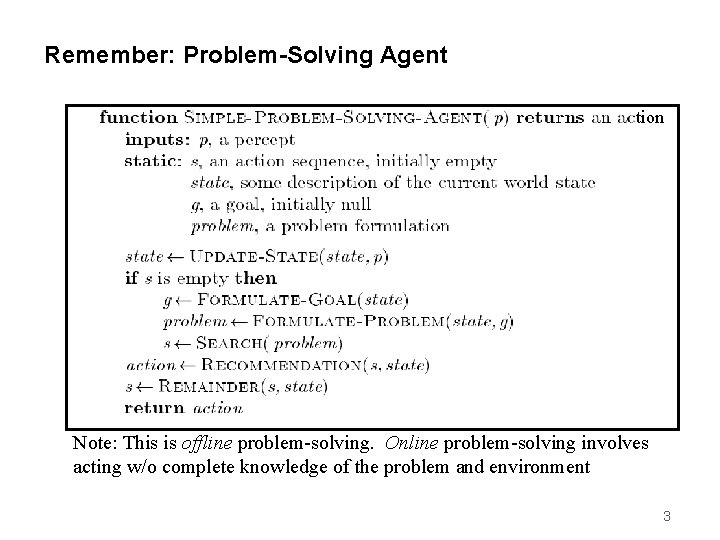
Remember: Problem-Solving Agent tion Note: This is offline problem-solving. Online problem-solving involves acting w/o complete knowledge of the problem and environment 3
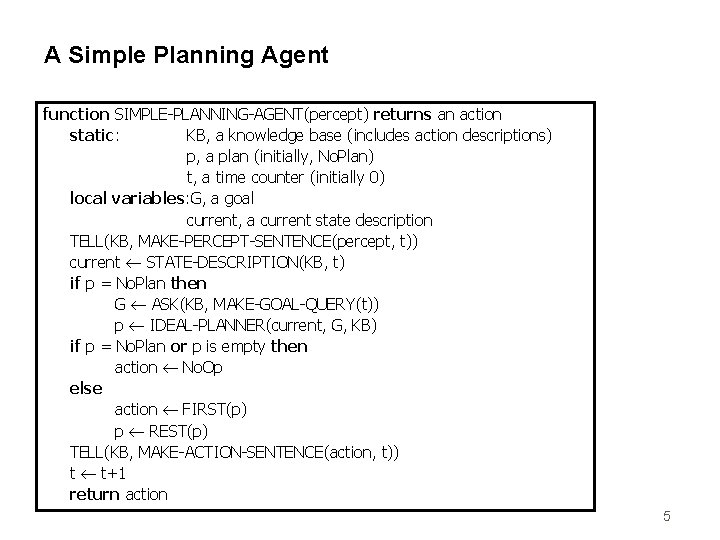
Simple planning agent • Use percepts to build model of current world state • IDEAL-PLANNER: Given a goal, algorithm generates plan of action • STATE-DESCRIPTION: given percept, return initial state description in format required by planner • MAKE-GOAL-QUERY: used to ask KB what next goal should be 4
A Simple Planning Agent function SIMPLE-PLANNING-AGENT(percept) returns an action static: KB, a knowledge base (includes action descriptions) p, a plan (initially, No. Plan) t, a time counter (initially 0) local variables: G, a goal current, a current state description TELL(KB, MAKE-PERCEPT-SENTENCE(percept, t)) current STATE-DESCRIPTION(KB, t) if p = No. Plan then G ASK(KB, MAKE-GOAL-QUERY(t)) p IDEAL-PLANNER(current, G, KB) if p = No. Plan or p is empty then action No. Op else action FIRST(p) p REST(p) TELL(KB, MAKE-ACTION-SENTENCE(action, t)) t t+1 return action 5
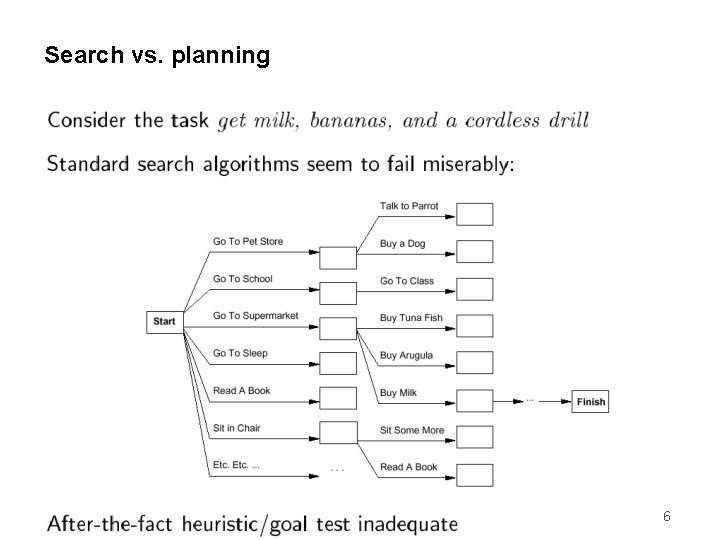
Search vs. planning 6
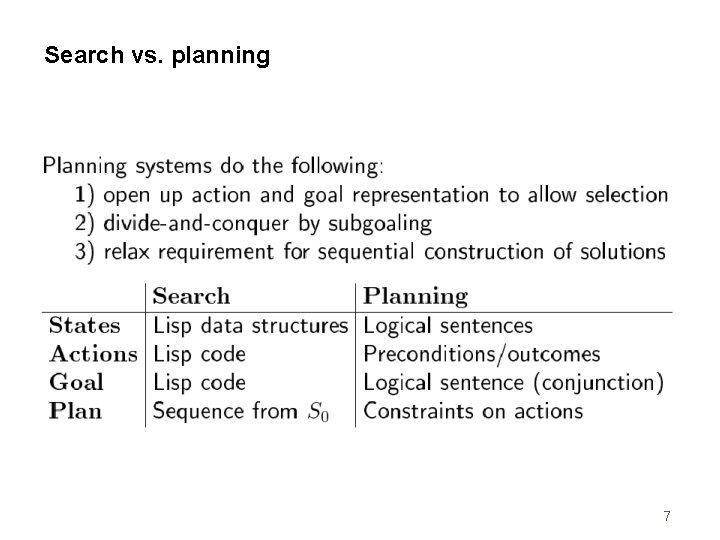
Search vs. planning 7
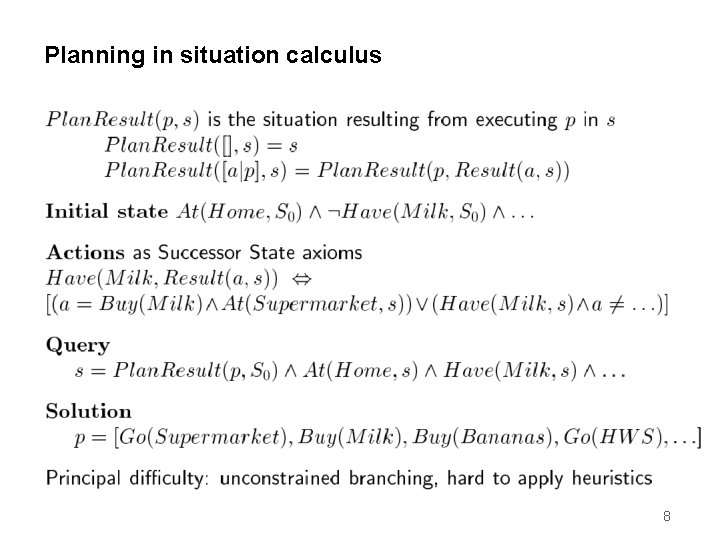
Planning in situation calculus 8
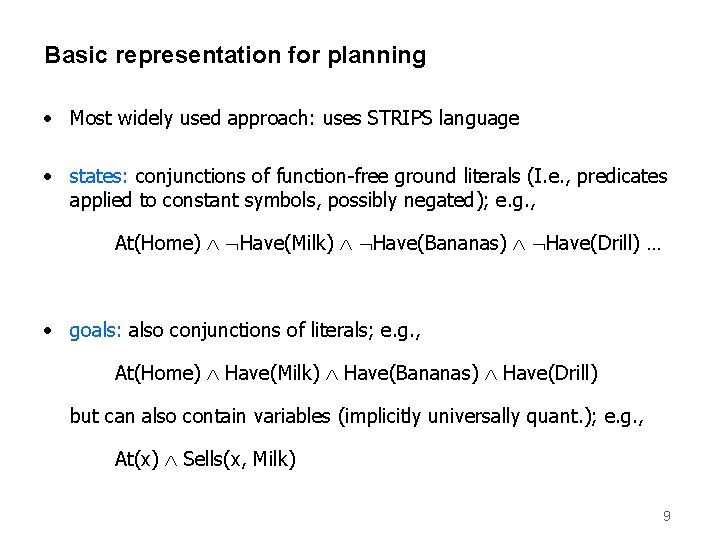
Basic representation for planning • Most widely used approach: uses STRIPS language • states: conjunctions of function-free ground literals (I. e. , predicates applied to constant symbols, possibly negated); e. g. , At(Home) Have(Milk) Have(Bananas) Have(Drill) … • goals: also conjunctions of literals; e. g. , At(Home) Have(Milk) Have(Bananas) Have(Drill) but can also contain variables (implicitly universally quant. ); e. g. , At(x) Sells(x, Milk) 9
Planner vs. theorem prover • Planner: ask for sequence of actions that makes goal true if executed • Theorem prover: ask whether query sentence is true given KB 10
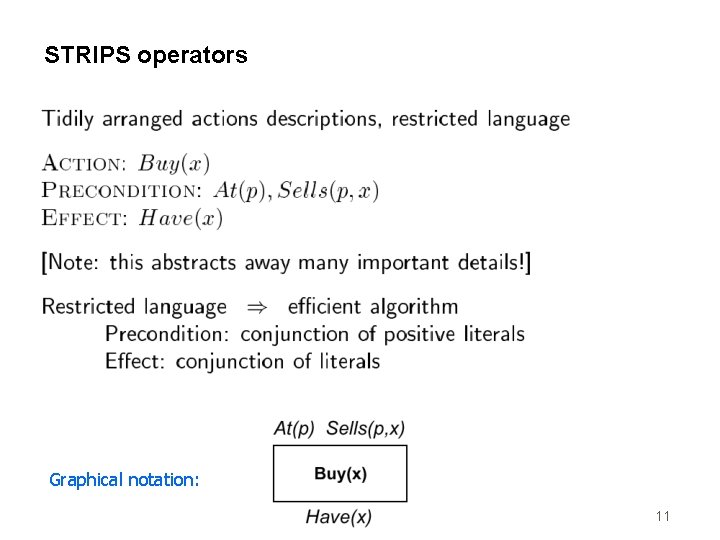
STRIPS operators Graphical notation: 11
Types of planners • Situation space planner: search through possible situations • Progression planner: start with initial state, apply operators until goal is reached Problem: high branching factor! • Regression planner: start from goal state and apply operators until start state reached Why desirable? usually many more operators are applicable to initial state than to goal state. Difficulty: when want to achieve a conjunction of goals Initial STRIPS algorithm: situation-space regression planner 12
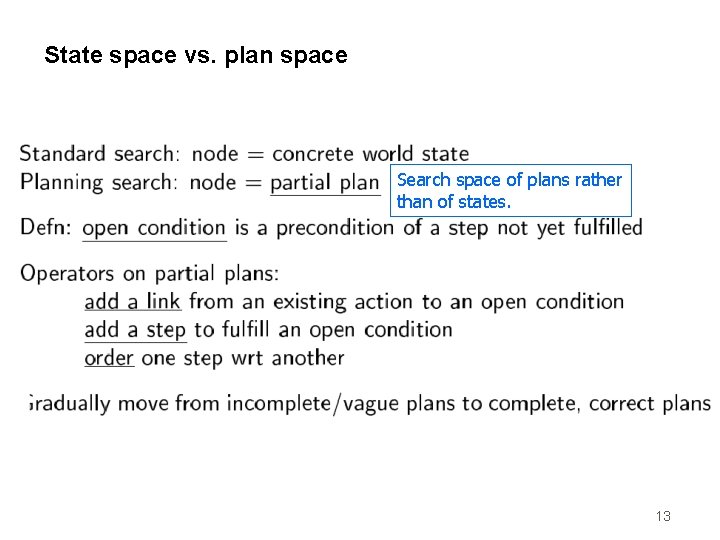
State space vs. plan space Search space of plans rather than of states. 13
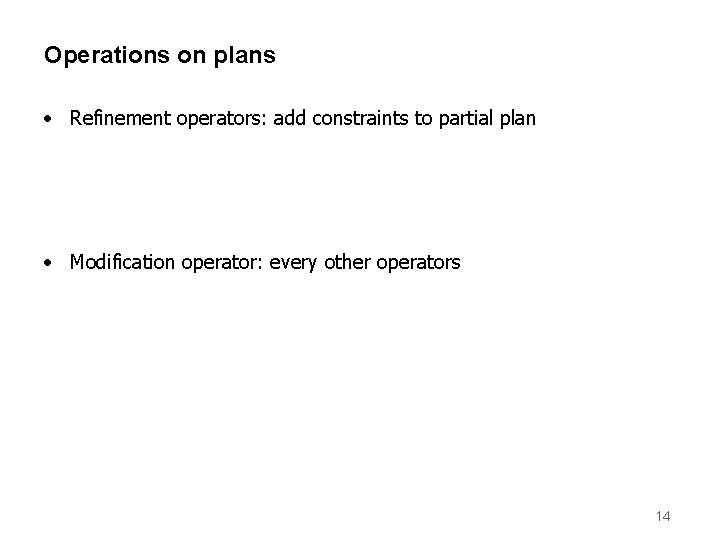
Operations on plans • Refinement operators: add constraints to partial plan • Modification operator: every other operators 14
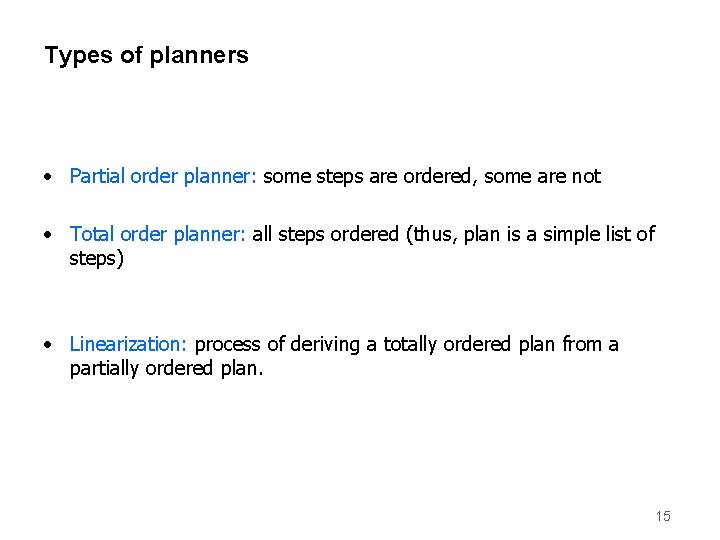
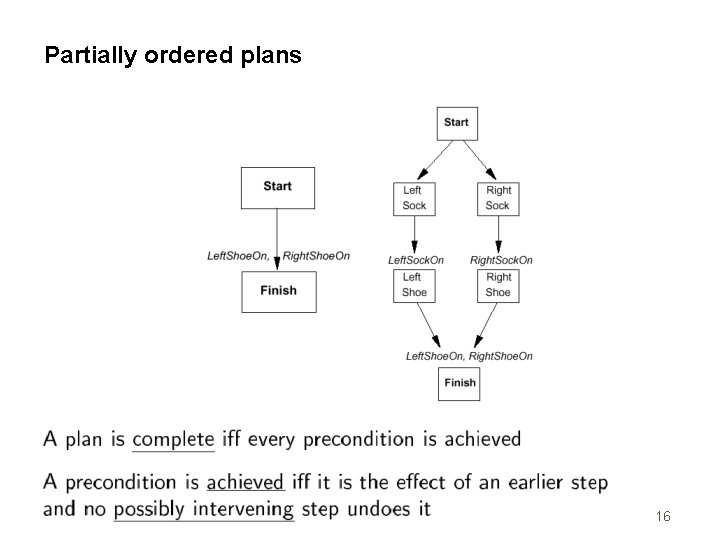
Types of planners • Partial order planner: some steps are ordered, some are not • Total order planner: all steps ordered (thus, plan is a simple list of steps) • Linearization: process of deriving a totally ordered plan from a partially ordered plan. 15
Partially ordered plans 16
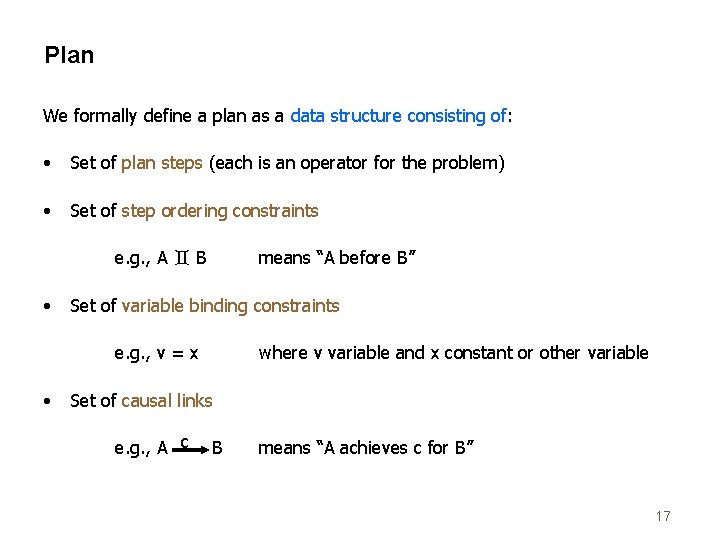
Plan We formally define a plan as a data structure consisting of: • Set of plan steps (each is an operator for the problem) • Set of step ordering constraints e. g. , A B • means “A before B” Set of variable binding constraints e. g. , v = x • where v variable and x constant or other variable Set of causal links e. g. , A c B means “A achieves c for B” 17
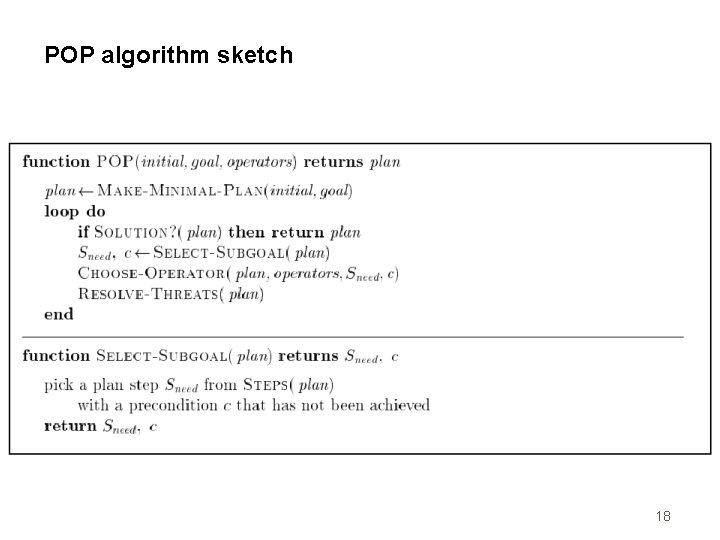
POP algorithm sketch 18
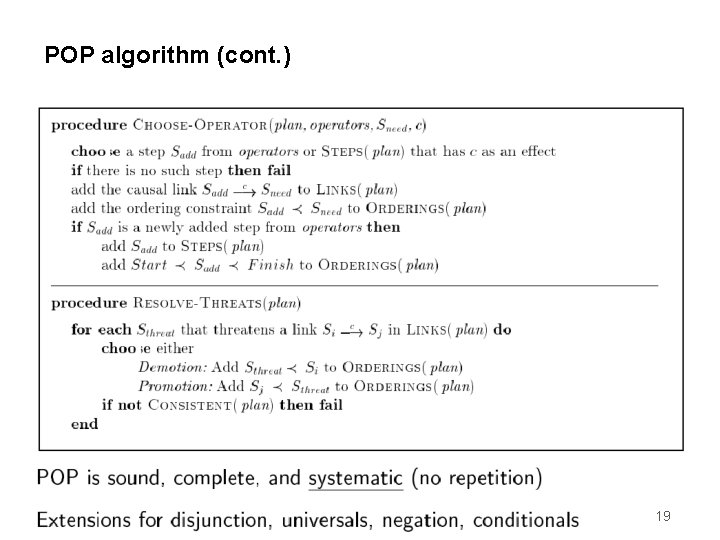
POP algorithm (cont. ) 19
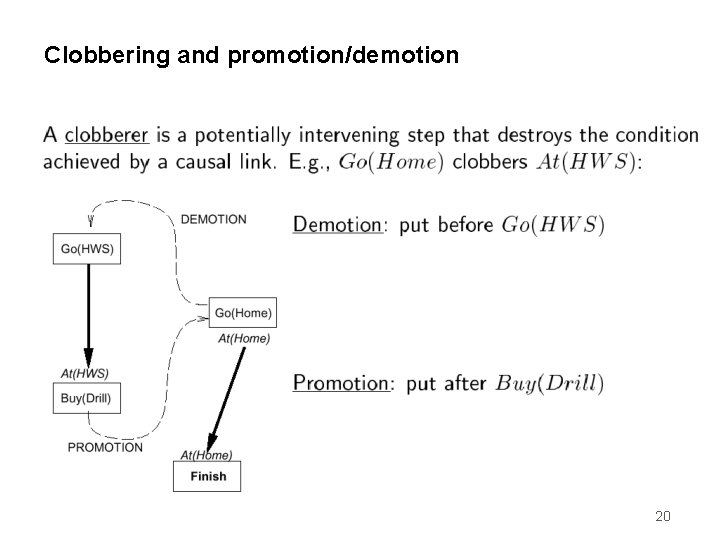
Clobbering and promotion/demotion 20
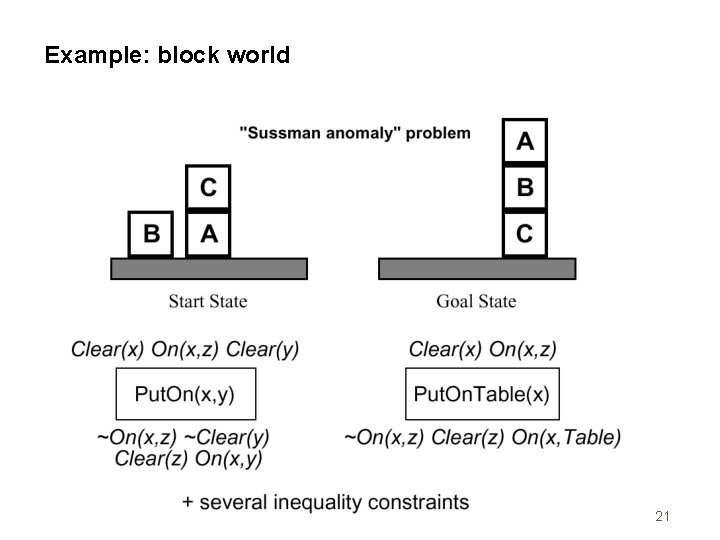
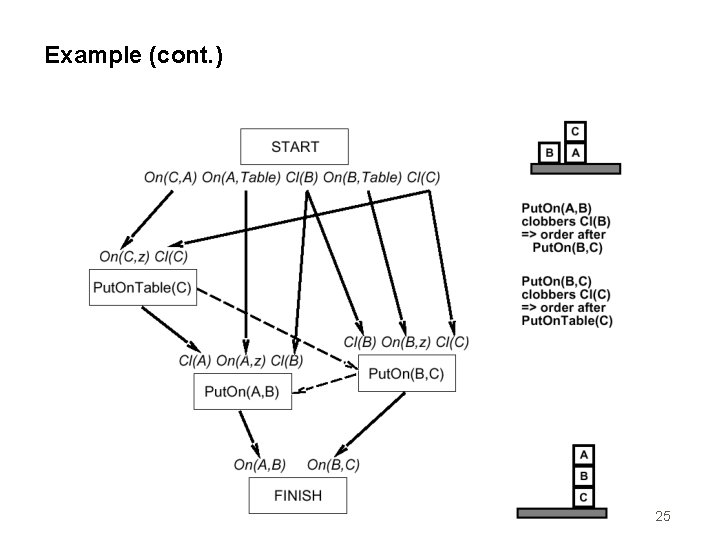
Example: block world 21
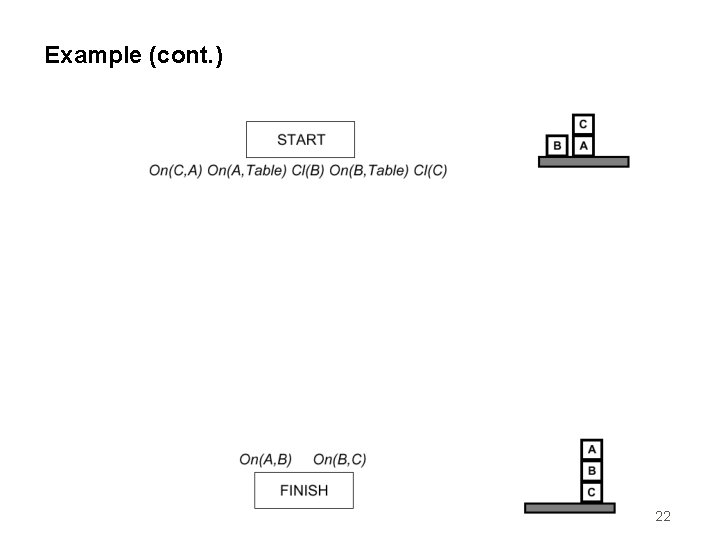
Example (cont. ) 22
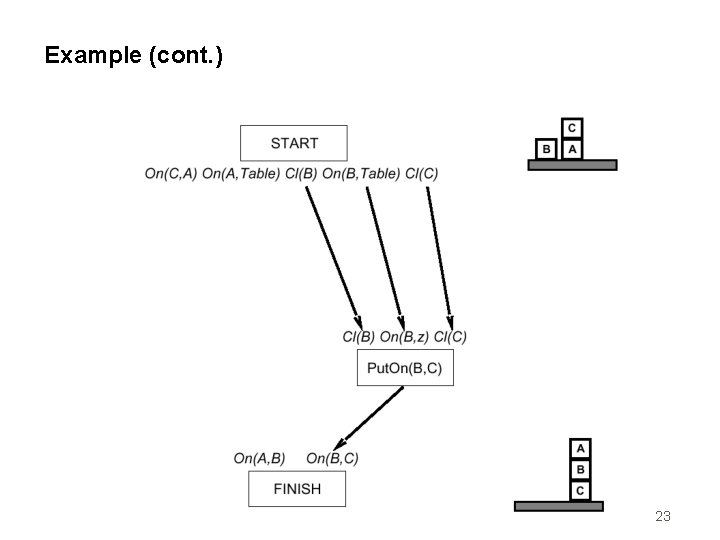
Example (cont. ) 23
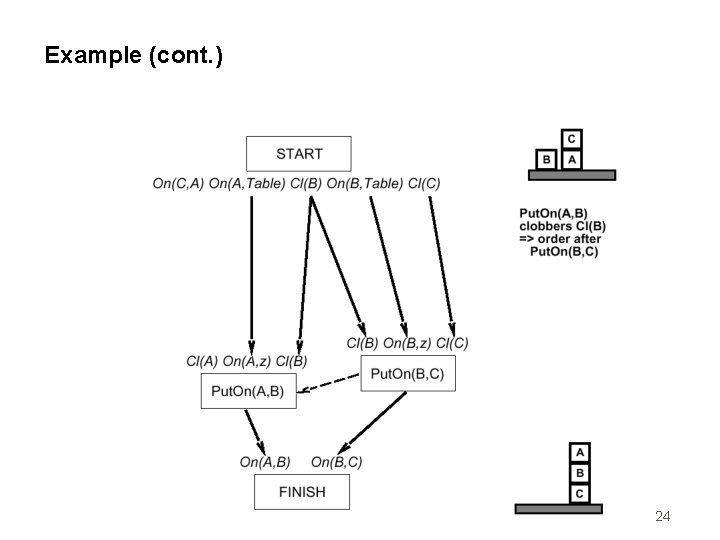
Example (cont. ) 24
Example (cont. ) 25