
Planning Scheduling Assessment Based on Doc Palmers Planning

Planning / Scheduling Assessment Based on Doc Palmer’s Planning and Scheduling 6 Principles
Relationship Between Master Data and Planning & Scheduling • Having up-to-date and accurate master data enables planners and schedulers to create accurate and efficient plans and schedules. The benefits of this are: • Being able to carry out maintenance plans in an organized, sustainable manner • Saving time by informing and mitigating confusion • Saving on costs associated with unexpected downtime and equipment failure 2
Definition of planning and scheduling • Maintenance Planning: • Planning (also called forethought) is the process of thinking about and organizing the activities required to achieve a desired goal. • Planning involves the creation and maintenance of a plan. As such, planning is a fundamental property of intelligent behavior. This thought process is essential to the creation and refinement of a plan, or integration of it with other plans; that is, it combines forecasting of developments with the preparation of scenarios of how to react to them. • An important, albeit often ignored aspect of planning, is the relationship it holds with forecasting. Forecasting can be described as predicting what the future will look like, whereas planning predicts what the future should look like. The counterpart to planning is spontaneous order. http: //en. wikipedia. org/wiki/Planning 3
Definition of planning and scheduling • Maintenance Scheduling: • A schedule or timetable is a basic time management tool consisting of a list of times at which possible tasks, events, or actions are intended to take place, or a sequence of events in the chronological order in which such things are intended to take place. The process of creating a schedule - deciding how to order these tasks and how to commit resources between the variety of possible tasks - is called scheduling, and a person responsible for making a particular schedule may be called a scheduler. Making and following schedules is a fundamental human activity, and learning to do these things effectively is one of the most basic life skills. There a wide variety of situations in which schedules are necessary, or at least useful. • Schedules are useful for both short periods, such as a daily or weekly schedule, and for long term planning with respect to periods of several months or years. They are often made using a calendar, where the person making the schedule can note the dates and times at which various events are planned to occur. Schedules that do not set forth specific times for events to occur may instead list an expected order in which events either can or must take place. http: //en. wikipedia. org/wiki/Scheduling 4
Minimum Requirements to perform basic Planning and Scheduling • Functional location hierarchy complete and accurate • Equipment installed in the hierarchy: – Assessed for criticality – and labeled (S, 1, 2, 3, 4) – At a minimum all equipment will have make, model, serial number attributes populated – Criticality drives the requirement for further levels of detail (E. G. BOMs) – Only critical equipment <4 are likely to have a BOM, Task List(s), Maintenance Plan • (Note the word “likely” OEM vs. Non OEM equipment and spares management will further dictate the requirement) • The level of detail for the “Maintenance Build” is fully dependent on CRITICALITY!!! 5
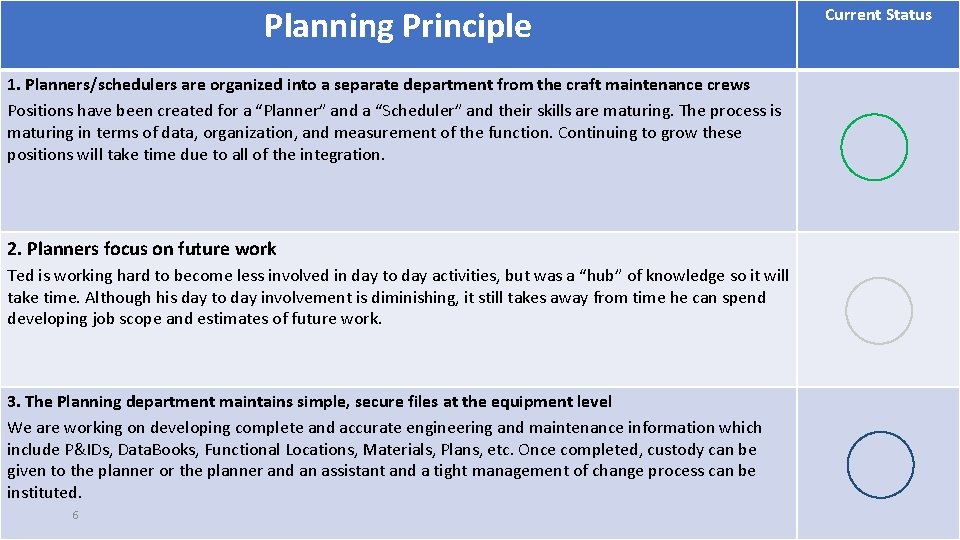
Planning Principle 1. Planners/schedulers are organized into a separate department from the craft maintenance crews Positions have been created for a “Planner” and a “Scheduler” and their skills are maturing. The process is maturing in terms of data, organization, and measurement of the function. Continuing to grow these positions will take time due to all of the integration. 2. Planners focus on future work Ted is working hard to become less involved in day to day activities, but was a “hub” of knowledge so it will take time. Although his day to day involvement is diminishing, it still takes away from time he can spend developing job scope and estimates of future work. 3. The Planning department maintains simple, secure files at the equipment level We are working on developing complete and accurate engineering and maintenance information which include P&IDs, Data. Books, Functional Locations, Materials, Plans, etc. Once completed, custody can be given to the planner or the planner and an assistant and a tight management of change process can be instituted. 6 Current Status
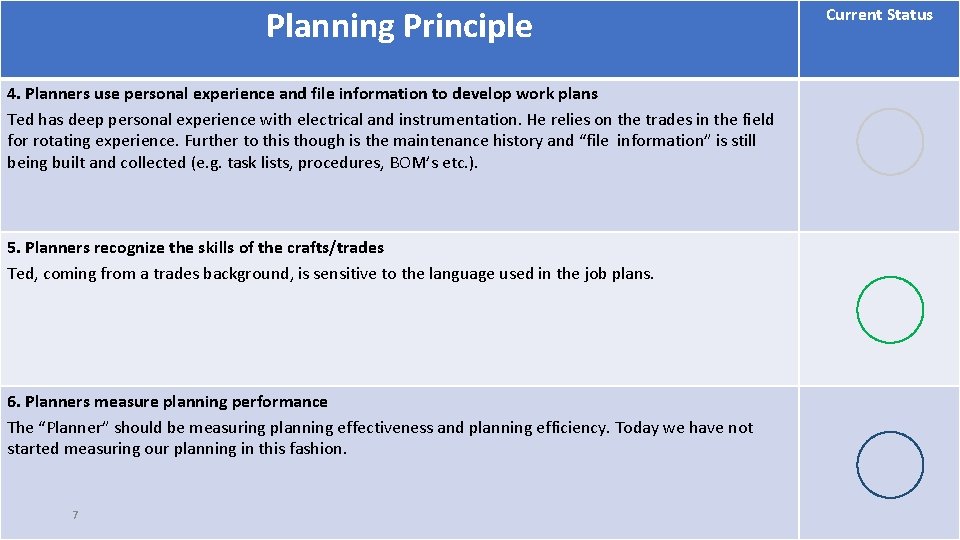
Planning Principle 4. Planners use personal experience and file information to develop work plans Ted has deep personal experience with electrical and instrumentation. He relies on the trades in the field for rotating experience. Further to this though is the maintenance history and “file information” is still being built and collected (e. g. task lists, procedures, BOM’s etc. ). 5. Planners recognize the skills of the crafts/trades Ted, coming from a trades background, is sensitive to the language used in the job plans. 6. Planners measure planning performance The “Planner” should be measuring planning effectiveness and planning efficiency. Today we have not started measuring our planning in this fashion. 7 Current Status
Overall readiness for planning 1. Positions have been created for a “Planner” and a “Scheduler” and their skills are maturing. The process is maturing in terms of data, organization, and measurement of the function. Continuing to grow these positions will take time due to all of the integration. 2. Ted is working hard to become less involved in day to day activities, but was a “hub” of knowledge so will take time. Although his day to day involvement is diminishing, it still takes away from time he can spend developing job scope and estimates of future work. 3. We are working on developing complete and accurate engineering information and maintenance data and information which include P&IDs, Data. Books, Functional Locations, Materials, Plans, etc. Once completed, custody can be given to the planner or the planner and an assistant and a tight management of change process can be instituted. 4. Ted has deep electrical and instrumentation personal experience, he relies on the trades in the field for rotating experience. Further to this though is the maintenance history and “file information” is still being built and collected (e. g task lists, procedures, BOM’s etc). 5. 6. The “Planner” should be measuring planning effectiveness and planning efficiency. Today we have not started measuring our planning in this fashion. 8
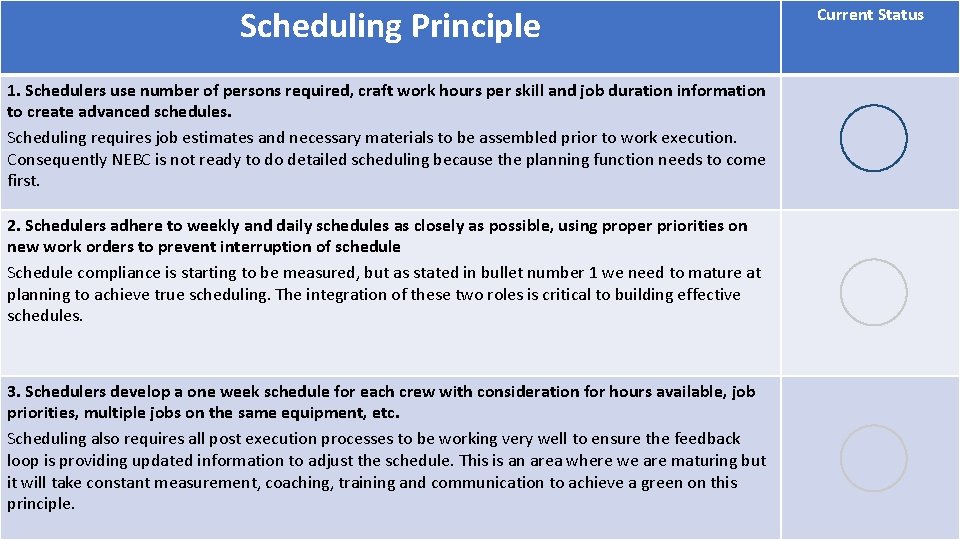
Scheduling Principle 1. Schedulers use number of persons required, craft work hours per skill and job duration information to create advanced schedules. Scheduling requires job estimates and necessary materials to be assembled prior to work execution. Consequently NEBC is not ready to do detailed scheduling because the planning function needs to come first. 2. Schedulers adhere to weekly and daily schedules as closely as possible, using proper priorities on new work orders to prevent interruption of schedule Schedule compliance is starting to be measured, but as stated in bullet number 1 we need to mature at planning to achieve true scheduling. The integration of these two roles is critical to building effective schedules. 3. Schedulers develop a one week schedule for each crew with consideration for hours available, job priorities, multiple jobs on the same equipment, etc. Scheduling also requires all post execution processes to be working very well to ensure the feedback loop is providing updated information to adjust the schedule. This is an area where we are maturing but it will take constant measurement, coaching, training and communication to achieve a green on this principle. 9 Current Status
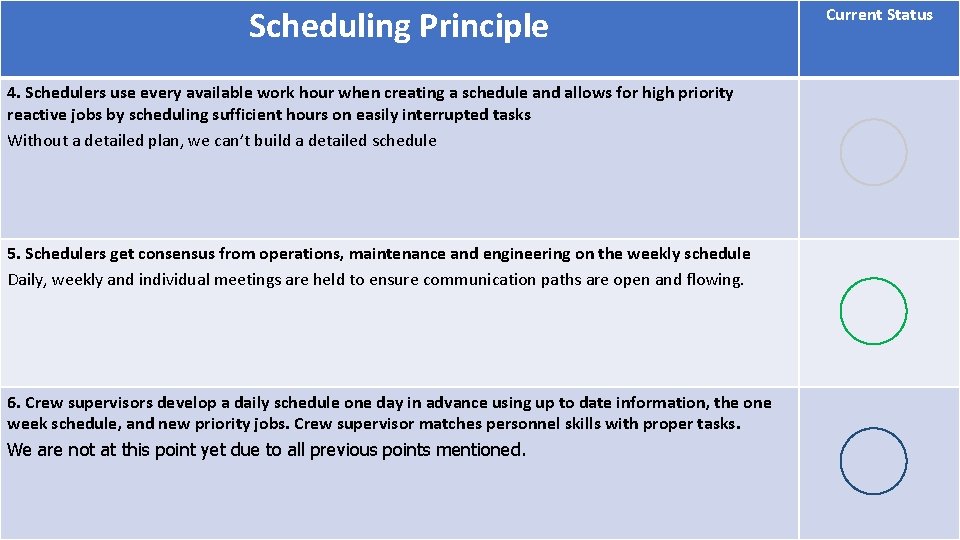
Scheduling Principle 4. Schedulers use every available work hour when creating a schedule and allows for high priority reactive jobs by scheduling sufficient hours on easily interrupted tasks Without a detailed plan, we can’t build a detailed schedule 5. Schedulers get consensus from operations, maintenance and engineering on the weekly schedule Daily, weekly and individual meetings are held to ensure communication paths are open and flowing. 6. Crew supervisors develop a daily schedule one day in advance using up to date information, the one week schedule, and new priority jobs. Crew supervisor matches personnel skills with proper tasks. We are not at this point yet due to all previous points mentioned. 10 Current Status
Overall readiness for scheduling status 1. Scheduling requires job estimates and necessary materials to be assembled prior to work execution consequently NEBC is not ready to do detailed scheduling because the planning function needs to come first. 2. Schedule compliance is starting to be measured, but as stated in bullet number 1 we need to mature at planning to achieve true scheduling. The integration of these two roles is critical to building effective schedules. 3. Scheduling also requires all post execution processes to be working very well to ensure the feedback loop is providing updated information to adjust the schedule. This is an area where we are maturing but will take constant measurement, coaching, training and communication to achieve a green on this principle. 4. Without a detailed plan, we can’t build a detailed schedule 5. Daily, weekly and individual meetings are held to ensure communication paths are open and flowing. 6. We are not at this point yet due all previous points mentioned. 11
- Slides: 11