
Planning rice breeding programs for impact Experimental design
Planning rice breeding programs for impact Experimental design
Learning objectives 1. Review the features of modern experimental designs that allow separation of the effects of genotype and environment 2. Understand the application of randomized completeblock designs (RCBDs), alpha-lattices, and augmented designs IRRI: Planning breeding Programs for Impact
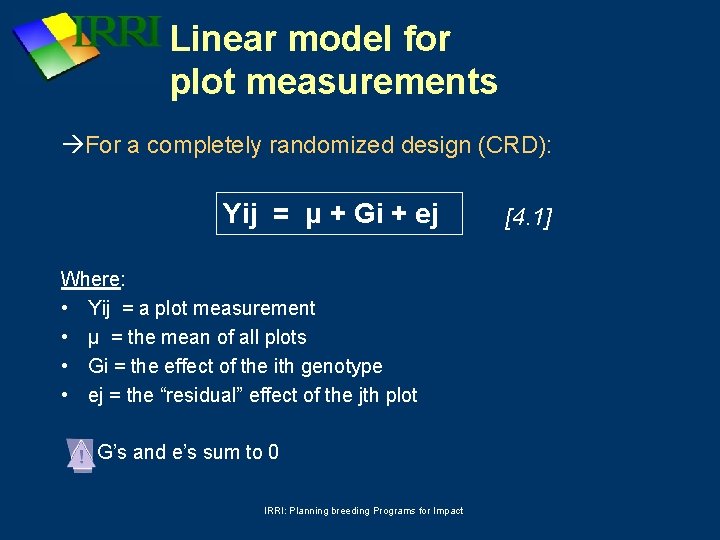
Linear model for plot measurements For a completely randomized design (CRD): Yij = μ + Gi + ej Where: • Yij = a plot measurement • μ = the mean of all plots • Gi = the effect of the ith genotype • ej = the “residual” effect of the jth plot G’s and e’s sum to 0 IRRI: Planning breeding Programs for Impact [4. 1]
The function of experimental design Modern experimental designs reduce the effect of field heterogeneity (e’s) on estimates of genotypic value IRRI: Planning breeding Programs for Impact
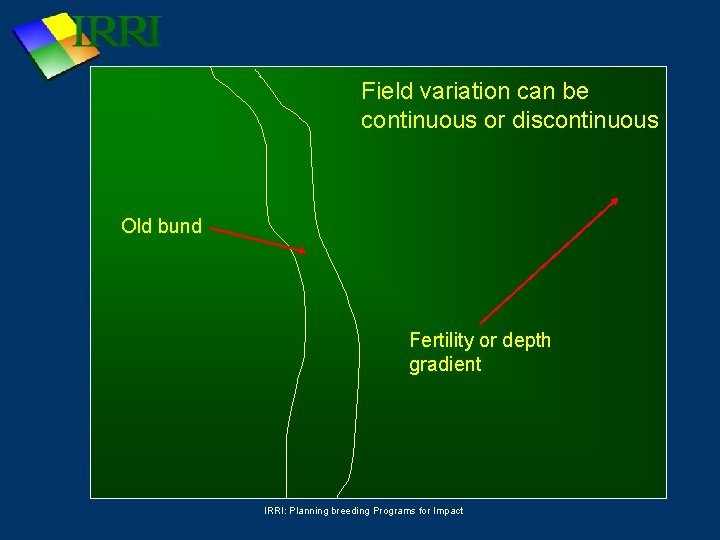
Field variation can be continuous or discontinuous Old bund Fertility or depth gradient IRRI: Planning breeding Programs for Impact
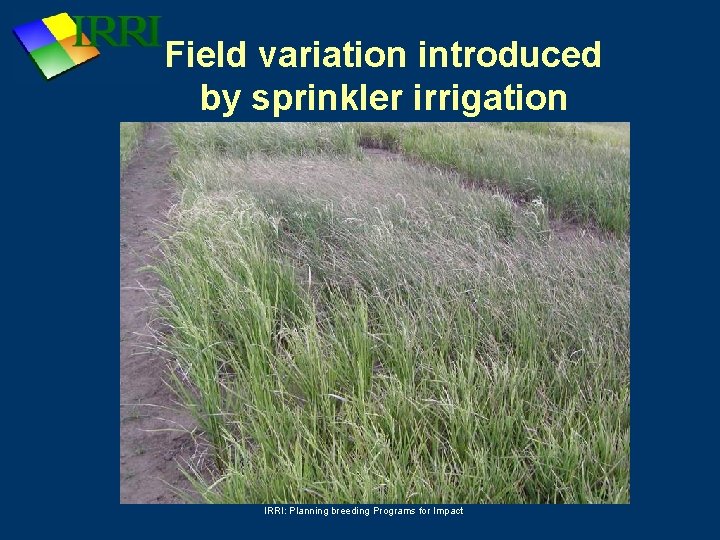
Field variation introduced by sprinkler irrigation IRRI: Planning breeding Programs for Impact
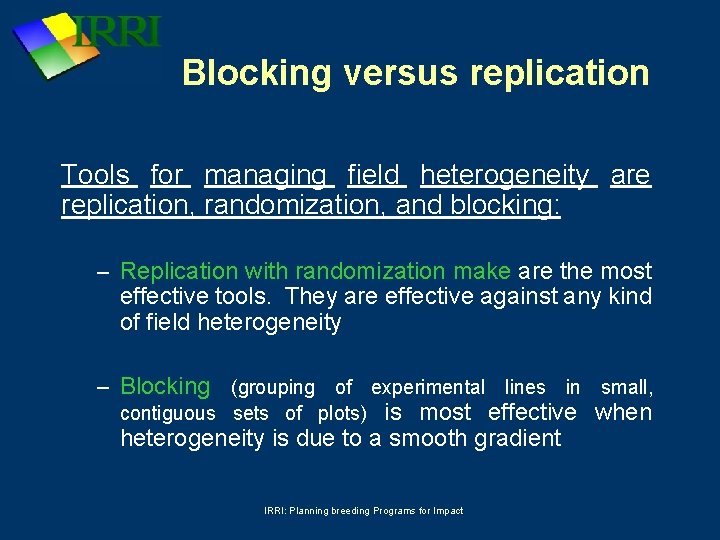
Blocking versus replication Tools for managing field heterogeneity are replication, randomization, and blocking: – Replication with randomization make are the most effective tools. They are effective against any kind of field heterogeneity – Blocking (grouping of experimental lines in small, is most effective when heterogeneity is due to a smooth gradient contiguous sets of plots) IRRI: Planning breeding Programs for Impact
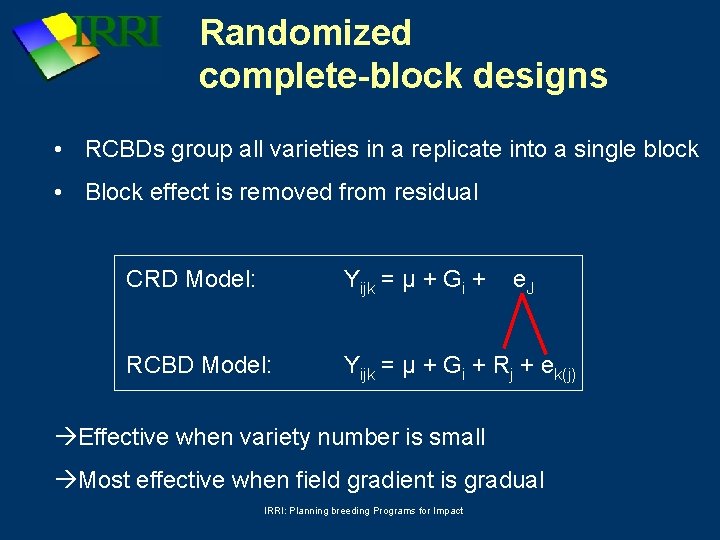
Randomized complete-block designs • RCBDs group all varieties in a replicate into a single block • Block effect is removed from residual CRD Model: Yijk = μ + Gi + e. J RCBD Model: Yijk = μ + Gi + Rj + ek(j) Effective when variety number is small Most effective when field gradient is gradual IRRI: Planning breeding Programs for Impact
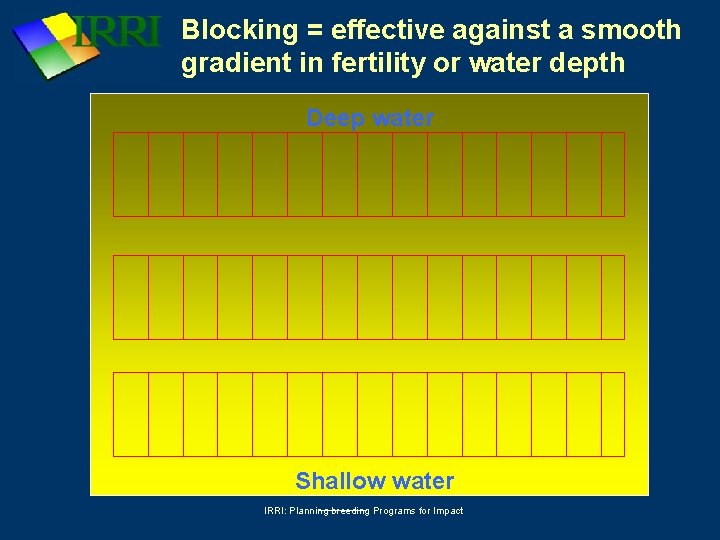
Blocking = effective against a smooth gradient in fertility or water depth Deep water Shallow water IRRI: Planning breeding Programs for Impact
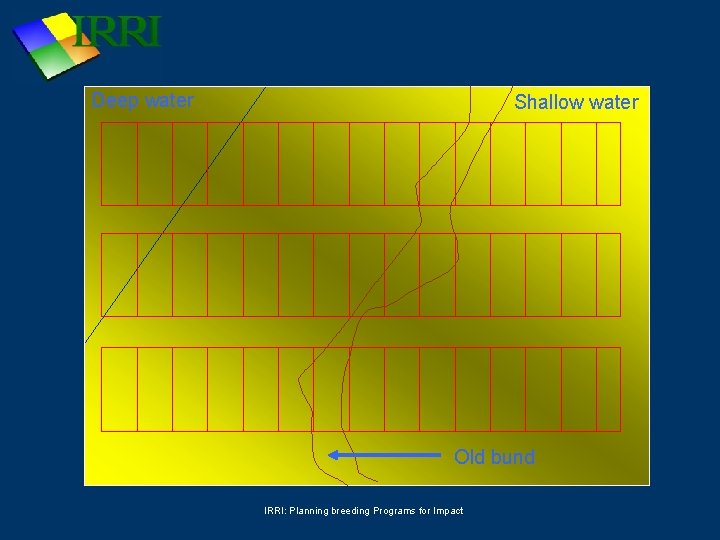
Deep water Shallow water Old bund IRRI: Planning breeding Programs for Impact
Incomplete-block designs • Break up large “complete” blocks into smaller blocks with a fraction of the treatments • Useful when heterogeneity is great within blocks • Often used when number of test varieties large • Work well when field gradient is smooth IRRI: Planning breeding Programs for Impact
Can anyone briefly summarize when to use blocking and when to use replication? IRRI: Planning breeding Programs for Impact
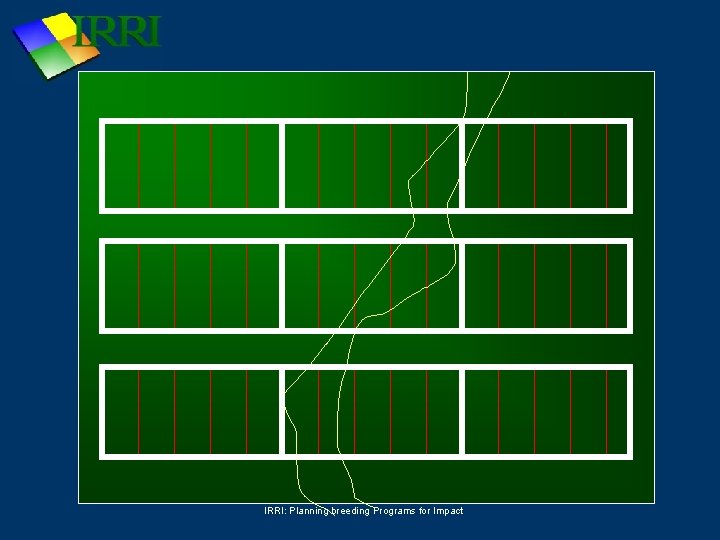
Alpha-lattices • Flexible incomplete block designs that accommodate any even number of entries, any number of replicates For example, a 42 -entry trial could be divided into 6 blocks of 7 lines per rep. • Randomization equalizes frequency of pair wise comparisons within incomplete-blocks • Analysis removes incomplete-block effects • Usually provides a small increase in precision IRRI: Planning breeding Programs for Impact
IRRI: Planning breeding Programs for Impact
Augmented designs • Flexible incomplete block designs that accommodate any even number of entries in a single replicate • Experimental lines replicated once • Checks occur in each block • Checks used to estimate block effects • Checks provide error term • Effective, BUT much of the field is taken up with checks IRRI: Planning breeding Programs for Impact
Effectiveness of incomplete block designs in controlling error • Lattices can also be analysed as RCBDs • Effect of alpha lattice analysis on precision can be evaluated by comparing SEM values from lattice and RCBD analysis IRRI: Planning breeding Programs for Impact
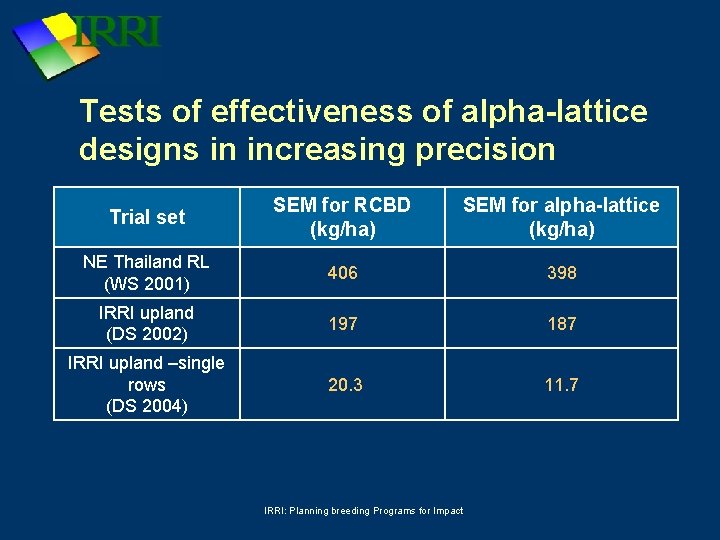
Tests of effectiveness of alpha-lattice designs in increasing precision Trial set SEM for RCBD (kg/ha) SEM for alpha-lattice (kg/ha) NE Thailand RL (WS 2001) 406 398 IRRI upland (DS 2002) 197 187 IRRI upland –single rows (DS 2004) 20. 3 11. 7 IRRI: Planning breeding Programs for Impact
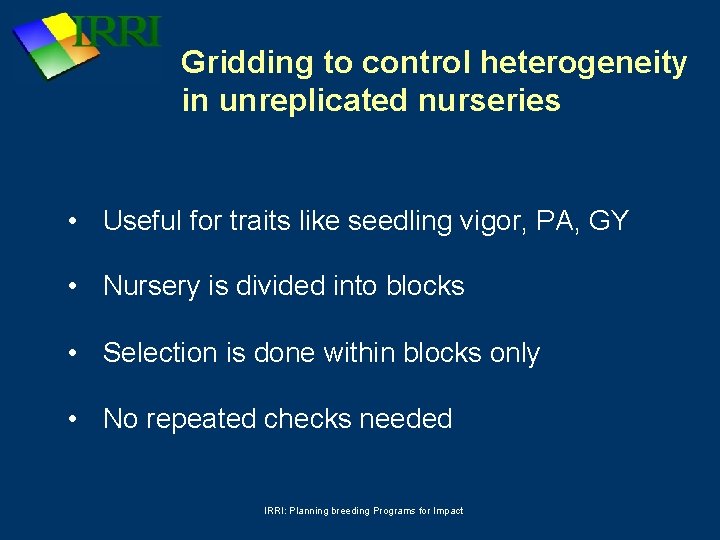
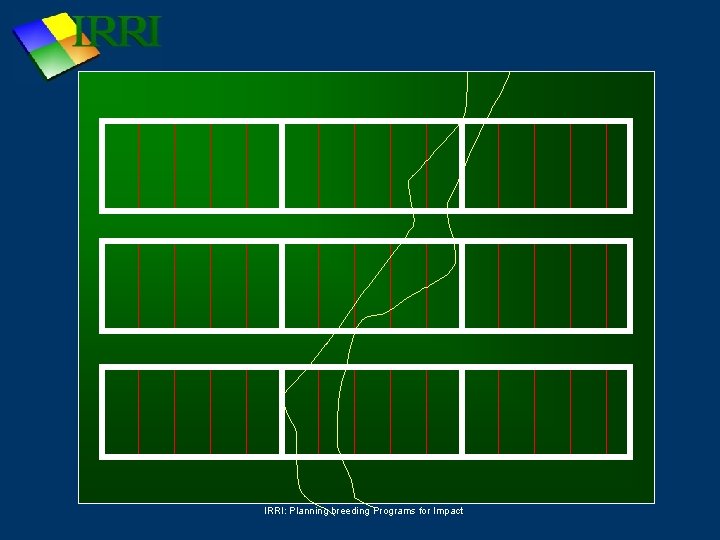
Gridding to control heterogeneity in unreplicated nurseries • Useful for traits like seedling vigor, PA, GY • Nursery is divided into blocks • Selection is done within blocks only • No repeated checks needed IRRI: Planning breeding Programs for Impact
IRRI: Planning breeding Programs for Impact
When should you use: • alpha-lattices? • augmented designs? • gridding? IRRI: Planning breeding Programs for Impact
Conclusion • Replication reduces influence of e’s • Blocking removes part of e’s due to gradient • Alpha-lattices reduce effect of “smooth” within-replicate variation Benefits positive but small • Augmented designs reduce effect of “smooth” withinfield variation, but need many repeated checks • Gridding reduces effect of “smooth” within-field variation, without repeated checks IRRI: Planning breeding Programs for Impact
- Slides: 21