
Planning prepared by Omima mostafa Out lines Introduction
Planning prepared by Omima mostafa
Out lines Introduction Definition Features of planning Importance of planning Principles of planning Types of planning Characteristics of good plans Steps of planning Limitation of planning

Introduction Planning is the primary function of management. it precedes other functions. Planning is the basic requirement and important input of management process. planning provides the framework within which coordinating, motivating and controlling can be undertaken. .
Definition �Planning is determining the long-and short-term objectives (ends) of the organization or unit and the actions (means) that must be taken to achieve these objectives. �Deciding in advance what to do; who is to do it; and how, when, and where it is to be done.
Scope of planning �Planning is primary function �Planning is goal- oriented �Planning is future oriented �Planning is an intellectual process �Planning is a pervasive �Planning is continuous �Planning aims at efficiency
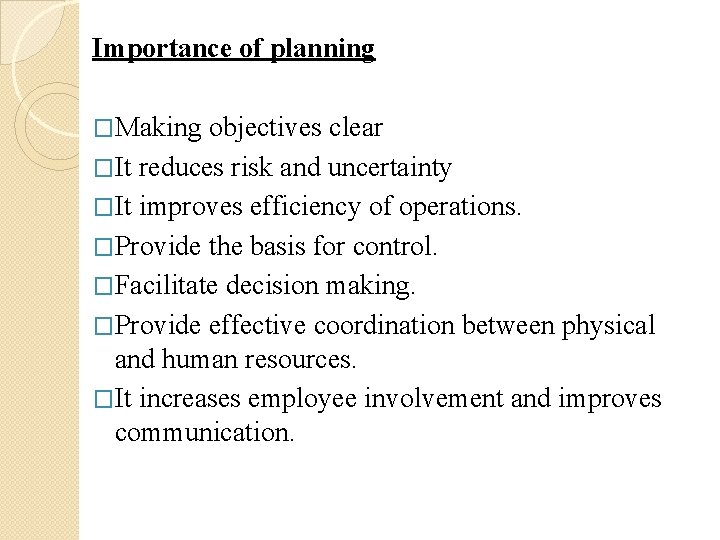
Importance of planning �Making objectives clear �It reduces risk and uncertainty �It improves efficiency of operations. �Provide the basis for control. �Facilitate decision making. �Provide effective coordination between physical and human resources. �It increases employee involvement and improves communication.
Principles of planning: �Principles of contribution of objectives �Principle of pervasiveness of planning �Principle of limiting factors �Principle of flexibility
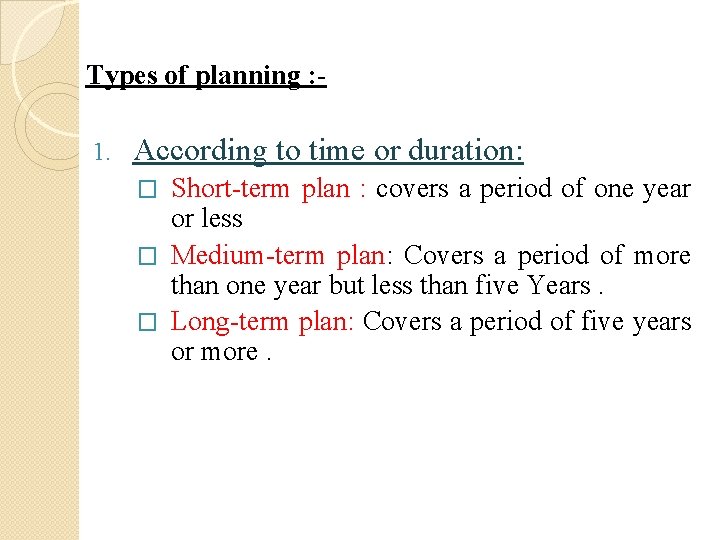
Types of planning : 1. According to time or duration: Short-term plan : covers a period of one year or less � Medium-term plan: Covers a period of more than one year but less than five Years. � Long-term plan: Covers a period of five years or more. �
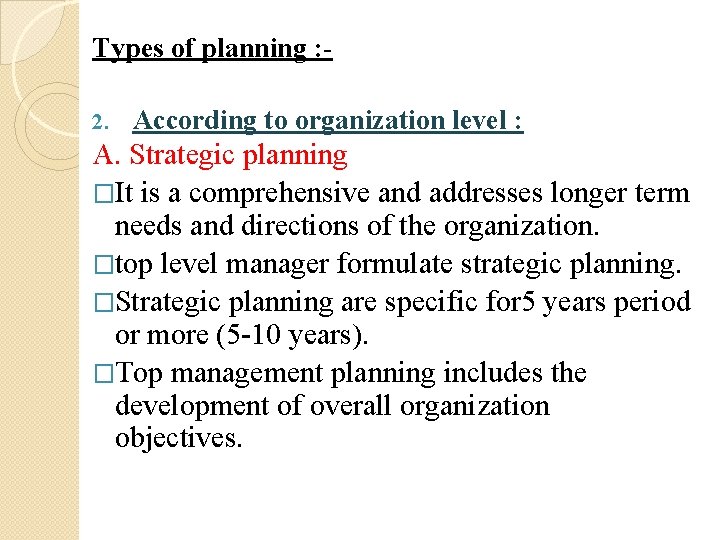
Types of planning : 2. According to organization level : A. Strategic planning �It is a comprehensive and addresses longer term needs and directions of the organization. �top level manager formulate strategic planning. �Strategic planning are specific for 5 years period or more (5 -10 years). �Top management planning includes the development of overall organization objectives.
B. Tactical/Operational Planning: �Is a limited scope addresses activities to implement strategic plans. �Tactical/operational planning is medium range planning that emphasizes the current operations of various parts of the organization (one to three years). �Middle level manager is responsible for translating strategies into shorter term measurable tactical objectives. �Example of tactical plane s includes annual budget.
Functional planning: �Is accomplished by first line managers. �Operational planning is short-range (less than a year) planning that is designed to develop specific action steps that support the strategic and tactical plans. �Example include production planning, marketing planning, financial planning and manpower planning.
According to specificity: A. Standing use plans: �are those that are used on a continuous basis to achieve consistently repeated objectives. Standing plans take the form of: �Policies: is a standing plan that communicates broad guidelines for decisions and action. �Procedures: a standing plan that outlines a series of related actions that must be taken to accomplish a particular task. �Rules: is a standing plan that designates specific requires action.
B. Single use plans: �are those that are used once to achieve unique objectives or objectives that are seldom repeated. They are communicated through: �Programs: is a single use plan designed to carry out a special project within an organization. �Budget: is a single use financial plan that covers a specified length of time. �Schedule: is a single-use plan that commits resources (such as worker, hours) to a given activity.
Characteristics of a good plan: 1) It should be made based on clear defined objectives 2) It must be flexible; it is essential to meet emergencies or changing situations 3) It must be in precision 4) It must be logical, clear, simple and balanced.
Steps in planning: �Define and describe objectives: Objective must be SMART(S : specific , M : measurable, A : Achievable , R : Realistic, T : Time bound) �Determination of planning premises: planning premises are the assumption about the futures. �Discover alternative courses of action �Evaluation of alternatives and final choice. �Formulating of derivative plans(develop detailed plan for its implementation) �Communicating the plan �Reviewing the planning process(continuous evaluation and follow up of plans)
Limitation of planning: �Planning premises may not be fully reliable �Availability of time is limiting factor for planning (planning is time consuming) �Cost involved in planning is also limiting factor �Mental attitude of management: some managers psychologically opposed to planning and have a natural resistance to change. �Procedural and policies rigidities also hinder planning.

Thank you�
- Slides: 17