
Planning Policy Context for Planning Authorities on Communications


- Slides: 13
Planning Policy Context for Planning Authorities on Communications
Focus of this presentation 1996 Telecommunications Guidelines National Planning Framework Circulars & Guidance Development Plans Development Management Role of Members
2018 National Planning Framework National Policy Objective 24: …high speed digital infrastructure is critical to realising employment opportunities and facilitating innovation…for rural Ireland, broadband is essential enabling infrastructure that affords rural communities the same opportunities in the digital economy as urban areas… National Strategic Outcome 3: …policies to drive the development and diversification of our rural towns and villages, re-purposing them to meet with the challenges of the future…
Issued by the Minister (HLGH) July 1996 Support Ireland’s position at top of OECD for quality of communications Provide technical information and planning guidance to: Ensure environmental impacts are minimised Enable consistency for planning of communications infrastructure 1996 Telecommunications Guidelines
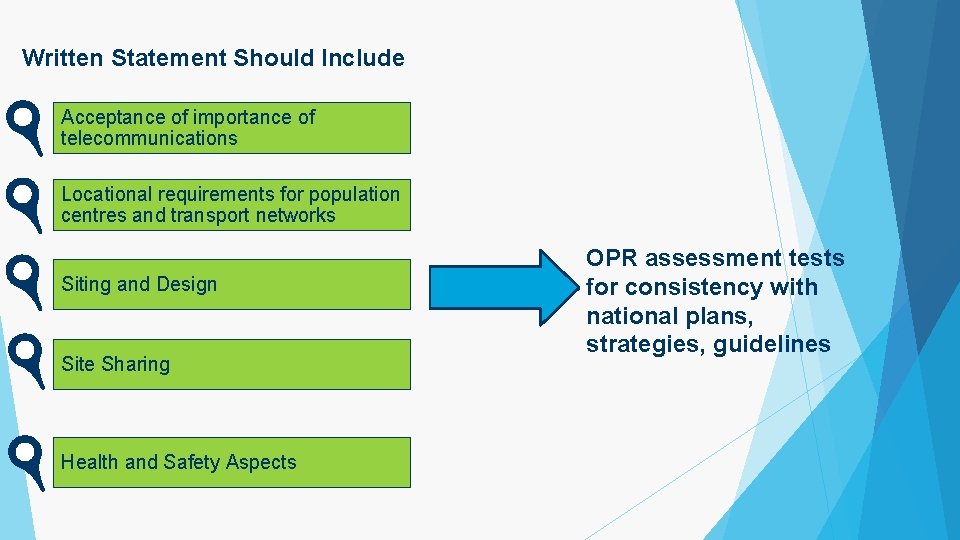
Written Statement Should Include Acceptance of importance of telecommunications Locational requirements for population centres and transport networks Siting and Design Site Sharing Health and Safety Aspects OPR assessment tests for consistency with national plans, strategies, guidelines
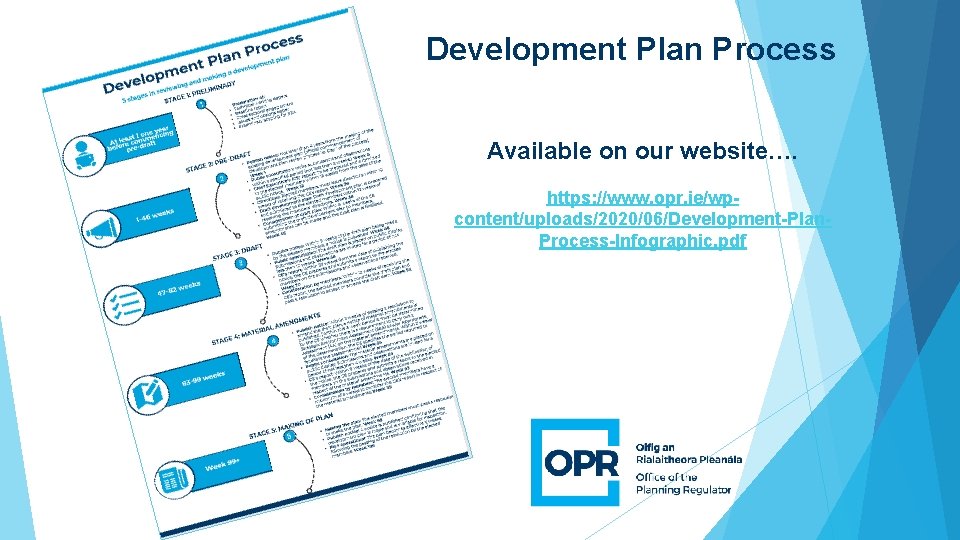
Development Plan Process Available on our website…. https: //www. opr. ie/wpcontent/uploads/2020/06/Development-Plan. Process-Infographic. pdf
1996 Guidelines: Development Management Design & Siting • Usually determined by engineering and technological parameters Visual Impact • Rural areas: masts can be located in forestry – carefully located in scenic areas to avoid prominence in key views • Urban areas: Locate masts on existing utility sites, use tall buildings, appropriate designs • Access roads & poles: avoid scarring pristine areas & follow contours with timber poles using underground ducting only if possible • Sharing facilities: reduces visual impacts
1996 Guidelines: Development Management Health & Safety Aspects • Telecommunications sector subject to regulatory requirements non-ionising radiation emissions. • Planning Authorities should not include monitoring conditions Obsolete Structures • PA’s may consider securities (bonds) to restore sites that become obsolete Temporary Planning Permissions • Avoid except in specific circumstances
Telecommunications Guidelines Updates 2012 q Purpose: enable National Broadband Plan & update 1996 Guidelines q Issued as Section 28 Guidelines specifying: q Roll-out of next-generation broadband will increase importance of telecommunications infrastructure q Temporary planning permissions are no longer appropriate q Bonds for obsolete site restoration are no longer warranted q Avoid rigid separation distances for telecommunications infrastructure q Waivers in respect of development contribution schemes treatment of broadband infrastructure
Telecommunications: Exempted Development q Section 4 Planning & Development Act: Development exempted from pp requirements subject to certain exclusions: q Where proposed development is located in sensitive areas where there is a requirement for Appropriate Assessment (NATURA 2000 sites – Special Protection Areas/ Special Areas of Conservation) (Section 4(4) of Act refers); and q Where proposed development would endanger public safety by reason of a traffic hazard or obstruction of road users (Article 9(1)(iii) of Regulations refers). q Class 31 of Schedule 2 of P&D Regulations 2001 (as amended) specifies the range of telecommunications works by statutory undertakers authorised to provide telecommunications services that are exempted development subject to the above. q Circular Letter PL 11/2020 reiterates these re NBP roll-out q Co-ordinated approach in dissemination of relevant information and implementing these provisions in tandem with roll-out of National Broadband Plan will be important
Telecommunications: Section 254 Licences Section 254 of P&D Act establishes a licencing process for the provision of appliances, cables etc placed on/over public roads (S 254(1)(e) & (ee)) Placement under public roads not covered by S 254 but by obtaining consent from roads authority under S 13(10) of the Roads Act 1993 Development carried out pursuant to a licence under Section 254 is exempted development under the provisions of S 254(7). S 254 licence applications deemed to have been consented if a decision is not made within 4 months of the day of application subject to: Network operators informing the planning authority/roads authority before works are carried out on public roads.
Role of Members Ensure your development plan supports communications infrastructure roll-out Avoid measures that would impede roll-out e. g. rigid separation distances, onerous conditions re monitoring or bonds for reinstatement Exclude telecommunications infrastructure from development contribution schemes Ensure your authorities are working with all relevant stakeholders (DECC/DRCD/DHLGH/Com. Reg) in ensuring smooth roll-out of National Broadband Plan Encourage a co-ordinated approach working with relevant Departments and local authorities.
Thank you