
Planning NUR 4606 Nursing Management Planning l Two
- Slides: 19
Planning NUR 4606
Nursing Management: Planning l Two major types of Planning – Strategic Planning – Tactical Planning (operational)
Benefits of Planning l l l Goal oriented Through reasoning process, managers minimize risks and maximize opportunities Top down process Eliminates guess work Self explanatory If plan for emergencies, can handle them is a calm, efficient manner
Benefits Continued l l l Employees know what is expected of them and can be evaluated effectively Interactive planning creates a feeling of ownership Cost Effective
Scopes of Planning for Nurse Managers l l Top Level- DON-organizational activities broad in scope, phrased in general terms; Strategic Planning! Middle Level- Nurse Supervisor/Case Mgr. Formulation of policies, rules/regulations, methods, procedures for personnel and practice
Scope of Planning for Nurse Managers Continued l l Lower level managers- Head Nurse/Charge Nurse/Team Leader-schedules daily and weekly plan for administration of direct patient care; Day to day operations at the unit level With health care today, nurse leaders are being asked to make decisions that benefit both the patient and the health care agency
Decision Making l l l The process of selecting one course of action from a list of alternatives. Pervades all of the basic management functions—planning, organizing, directing, and controlling. According to Lee Iacocca, ” If I had to sum up in 1 word the qualities that make a good manager, I’d say that it all comes down to decisions. ”
Variables That Affect Nursing Decisions l l Complexity-how complex is the decision? Multiple criteria involved in a decision Consider intangibles Risk and Uncertainty-there are varying degrees of uncertainty in all our lives; Will the nurses at St Vincent strike? How will that strike impact nursing in Little Rock? In Arkansas?
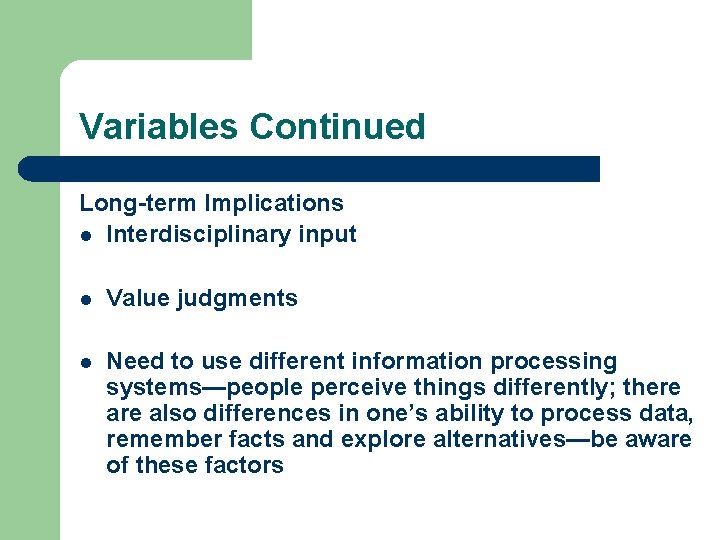
Variables Continued Long-term Implications l Interdisciplinary input l Value judgments l Need to use different information processing systems—people perceive things differently; there also differences in one’s ability to process data, remember facts and explore alternatives—be aware of these factors
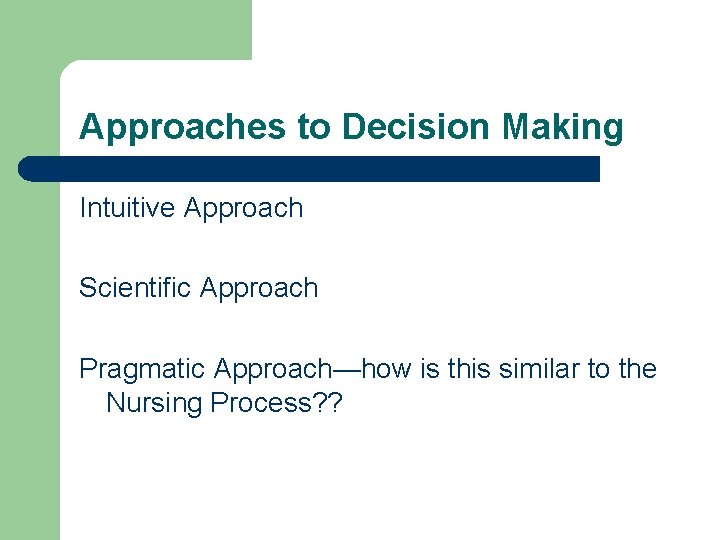
Approaches to Decision Making Intuitive Approach Scientific Approach Pragmatic Approach—how is this similar to the Nursing Process? ?
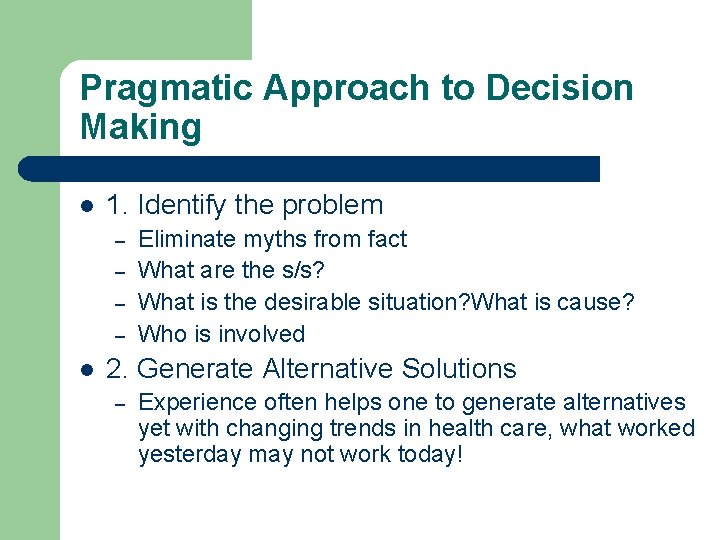
Pragmatic Approach to Decision Making l 1. Identify the problem – – l Eliminate myths from fact What are the s/s? What is the desirable situation? What is cause? Who is involved 2. Generate Alternative Solutions – Experience often helps one to generate alternatives yet with changing trends in health care, what worked yesterday may not work today!
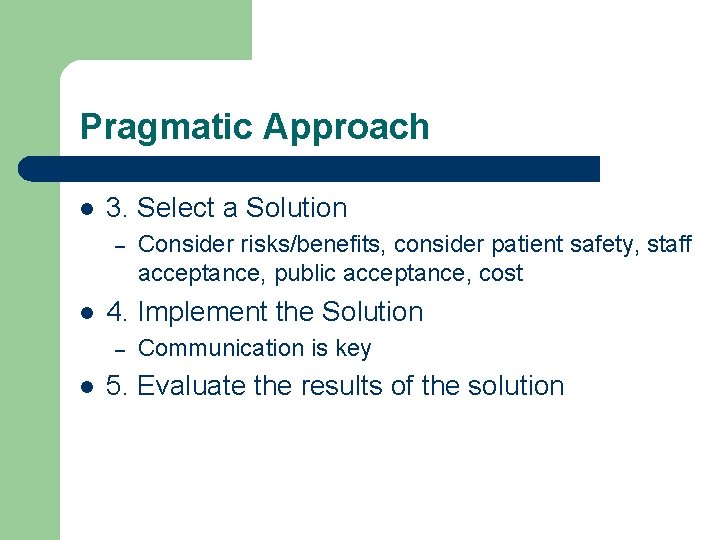
Pragmatic Approach l 3. Select a Solution – l 4. Implement the Solution – l Consider risks/benefits, consider patient safety, staff acceptance, public acceptance, cost Communication is key 5. Evaluate the results of the solution
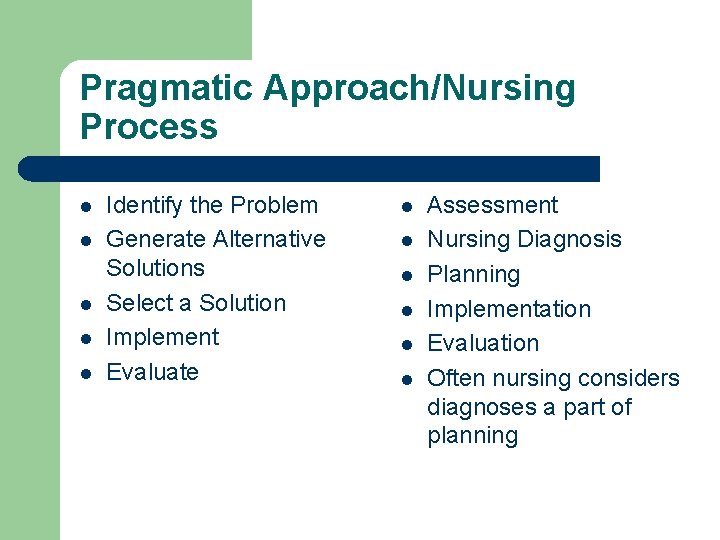
Pragmatic Approach/Nursing Process l l l Identify the Problem Generate Alternative Solutions Select a Solution Implement Evaluate l l l Assessment Nursing Diagnosis Planning Implementation Evaluation Often nursing considers diagnoses a part of planning
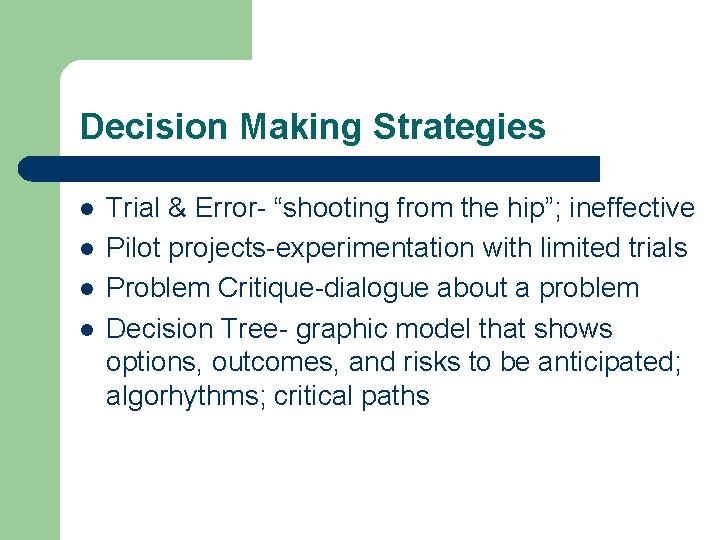
Decision Making Strategies l l Trial & Error- “shooting from the hip”; ineffective Pilot projects-experimentation with limited trials Problem Critique-dialogue about a problem Decision Tree- graphic model that shows options, outcomes, and risks to be anticipated; algorhythms; critical paths
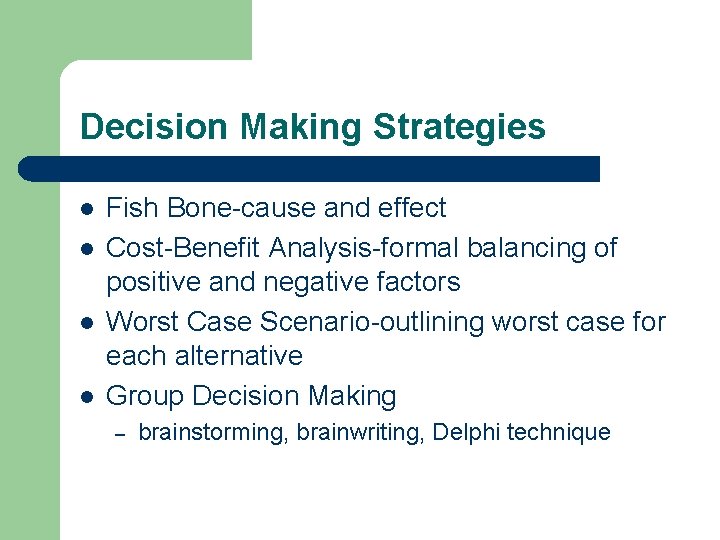
Decision Making Strategies l l Fish Bone-cause and effect Cost-Benefit Analysis-formal balancing of positive and negative factors Worst Case Scenario-outlining worst case for each alternative Group Decision Making – brainstorming, brainwriting, Delphi technique
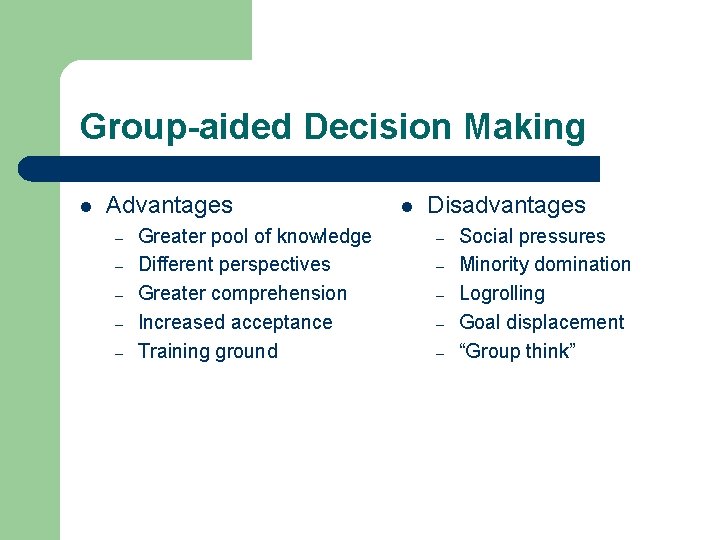
Group-aided Decision Making l Advantages – – – Greater pool of knowledge Different perspectives Greater comprehension Increased acceptance Training ground l Disadvantages – – – Social pressures Minority domination Logrolling Goal displacement “Group think”
Financial Management l A series of activities designed to allocate resources and plan for the efficient operation of an organization l 4 phases: – – Budgeting Recording Reporting Evaluating
Budget l l l A projected plan for income and expenses Functions both as a planning instrument and evaluation tool Types of Budgets (p. 277) – – Operating budget Long-range budget Program budget Capital budget
Budget l Types (p. 277) – – – l l Product-line budgets Cash budget Special purpose budget The primary budgets r/t directly to the delivery of nursing services are the capital budget and the operating budget Nursing is primarily concerned with direct, indirect, and supply costs