
Planning Interdisciplinary Instruction in American Literature and History
- Slides: 24
Planning Interdisciplinary Instruction in American Literature and History Linda Johns ELMT 7130 Spring 2008
Rationale v Grew out of a specific need at the school where I was an intern v Currently under development by committee for implementation in the 2008 -2009 school year v Second semester revolves around a research topic so the media specialist will ultimately be involved on some level v Designed for use by the entire 11 th grade Language Arts and History faculty as a “tip of the iceberg” introduction to media services
Overview Subject: Resources for research paper topics and coordinating hands-on projects related to Georgia Performance Standards for high school American History and Literature Audience: Teachers of 11 th grade American Literature and History
Overview Purpose: To support the collaborative effort of the Social Studies and Language Arts Departments to integrate the Reading Across the Curriculum standards through semester-long interdisciplinary student projects in 11 th grade American Literature and History classes
Background üThe Georgia Performance Standards (2006) state, “Focusing on a study of American literature, the student …develops an understanding of the ways the period of a work of literature affects its structure and how the chronology of a work of literature affects its meaning. ” üThese standards further state, “[I]n order to achieve mastery each grade level has a particular writing focus. Expository writing is the focus for 11 th grade; by the end of 11 th grade, the student will demonstrate developing competency of specified strategies in expository writing” (Georgia Board of Education, 2006).
Background üFurthermore, all disciplines are held accountable to the Reading Across the Curriculum standards which include the mandate that a student “relates messages and themes from one subject area to those in another area” (Georgia Board of Education, 2006). üBy working collaboratively, 11 th grade teachers of history and literature can effectively and efficiently meet these standards. üBy implementing this project, teachers integrate multimedia and experiential education with traditional classroom instruction, expanding students’ research skills, course knowledge, and kinetic learning.
The Committee’s Task • Coordinate major historic concepts and events with selected works of literature • Create a list of 600+ individual, unique topics for use by 11 th grade students studying the history and literature of the Civil War through the early 21 st century. • Literature teachers: Create a plan for students to produce a research paper on the chosen literature/history topic • History teachers: Create a plan for students to produce a three-dimensional, hands-on project on the same literature/history topic for display in the school • Meet appropriate Georgia Performance Standards
Georgia Performance Standards SSUSRC 1 & ELAALRC 1 The student reads a minimum of 25 grade-level appropriate books or book equivalents (approximately 1, 000 words) per year from a variety of subject disciplines. The student reads both informational and fictional texts in a variety of genres and modes of discourse, including technical texts related to various subject areas. ELAALRL 3 The student deepens understanding of literary works by relating them to their contemporary context or historical background…. The student… a. Relates a literary work to the seminal ideas of the time in which it is set or the time of its composition. b. Relates a literary work to the characteristics of the literary time period that it represents.
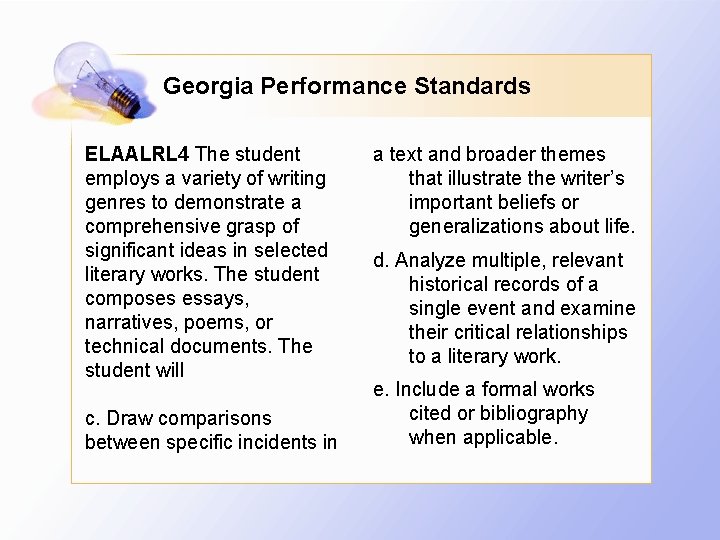
Georgia Performance Standards ELAALRL 4 The student employs a variety of writing genres to demonstrate a comprehensive grasp of significant ideas in selected literary works. The student composes essays, narratives, poems, or technical documents. The student will c. Draw comparisons between specific incidents in a text and broader themes that illustrate the writer’s important beliefs or generalizations about life. d. Analyze multiple, relevant historical records of a single event and examine their critical relationships to a literary work. e. Include a formal works cited or bibliography when applicable.
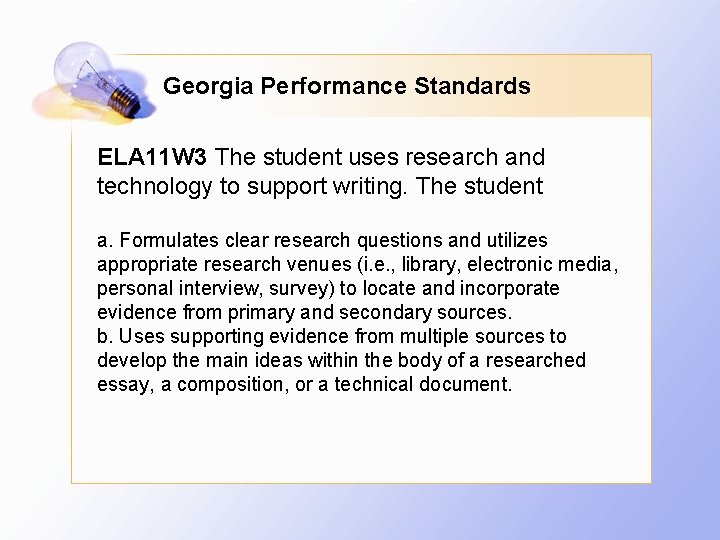
Georgia Performance Standards ELA 11 W 3 The student uses research and technology to support writing. The student a. Formulates clear research questions and utilizes appropriate research venues (i. e. , library, electronic media, personal interview, survey) to locate and incorporate evidence from primary and secondary sources. b. Uses supporting evidence from multiple sources to develop the main ideas within the body of a researched essay, a composition, or a technical document.
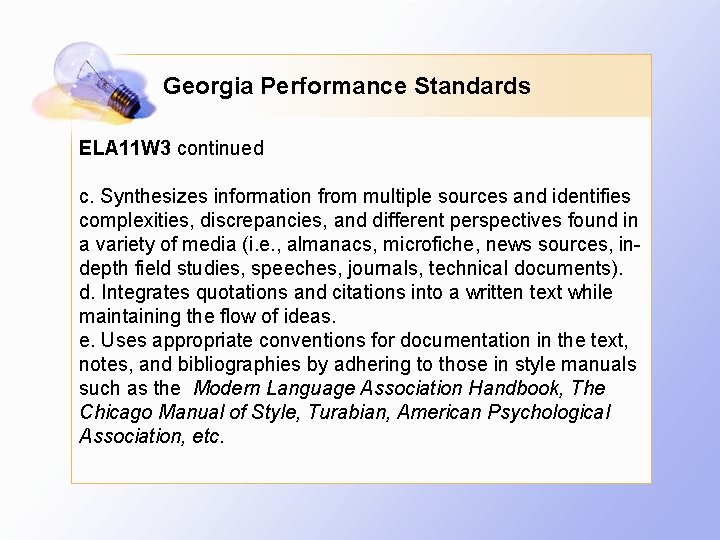
Georgia Performance Standards ELA 11 W 3 continued c. Synthesizes information from multiple sources and identifies complexities, discrepancies, and different perspectives found in a variety of media (i. e. , almanacs, microfiche, news sources, indepth field studies, speeches, journals, technical documents). d. Integrates quotations and citations into a written text while maintaining the flow of ideas. e. Uses appropriate conventions for documentation in the text, notes, and bibliographies by adhering to those in style manuals such as the Modern Language Association Handbook, The Chicago Manual of Style, Turabian, American Psychological Association, etc.
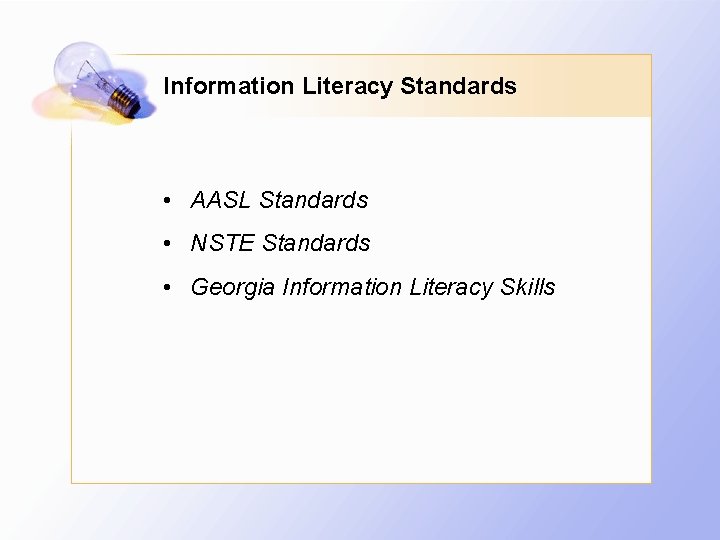
Information Literacy Standards • AASL Standards • NSTE Standards • Georgia Information Literacy Skills
Instructional Objectives • To provide a limited number of highly productive resources with broad coverage • To encourage the use of technology by including several non-print sources • To provide multimedia and experiential learning opportunities • To identify resources for the hands-on component of the project
Personal Objectives ☺ To create opportunities for future information literacy instruction ☺ To reinforce my role as a collaborative partner in curriculum planning ☺ To make myself known as a valuable resource at a new school
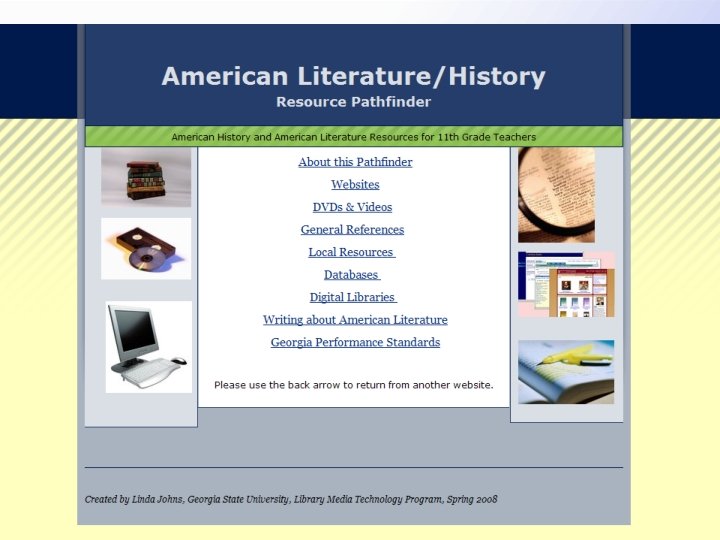
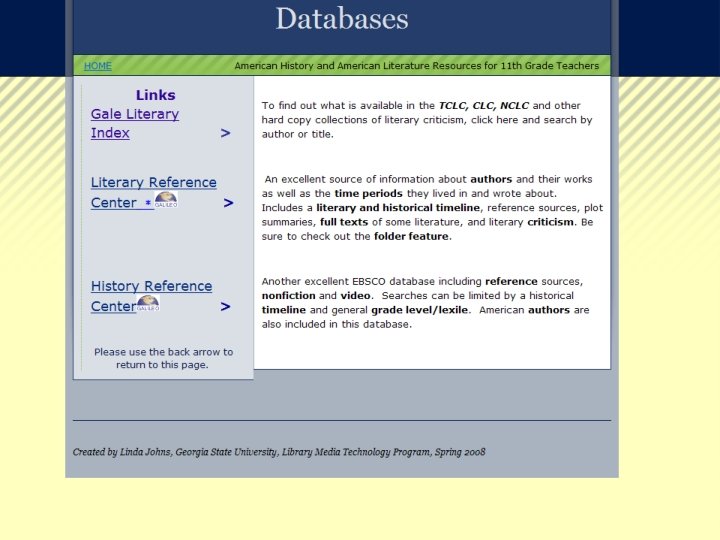
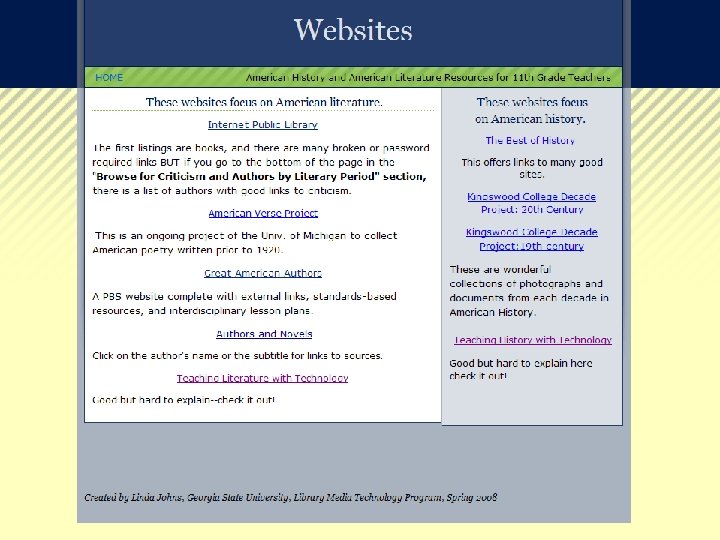
The Pathfinder http: //lindjohns. googlepages. com/pathfinder
Sample Information Problems and Solutions How do we find out about movies that are historically significant or based on literature?
Sample Information Problems and Solutions How do we find ideas for the hands-on project?
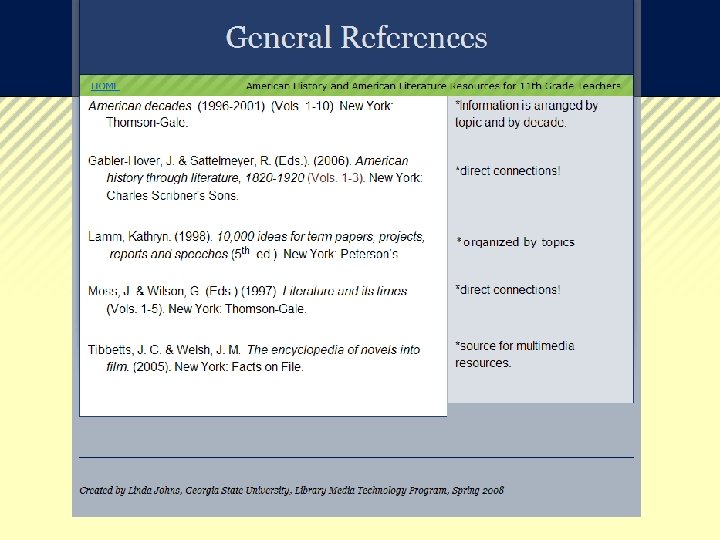
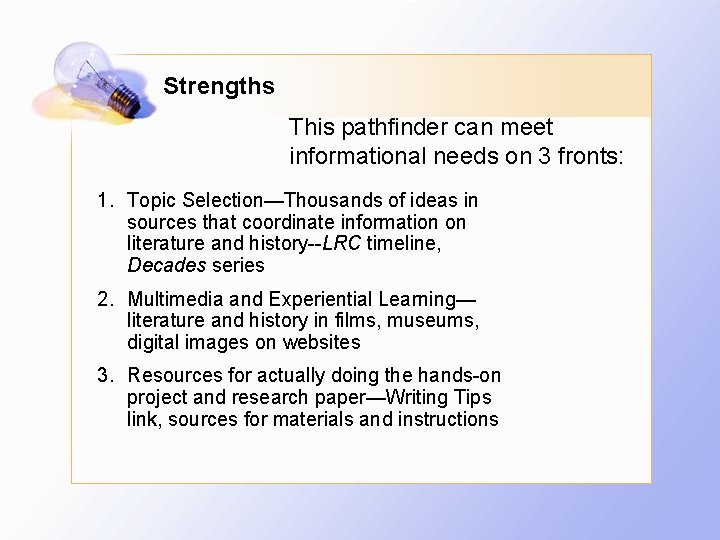
Strengths This pathfinder can meet informational needs on 3 fronts: 1. Topic Selection—Thousands of ideas in sources that coordinate information on literature and history--LRC timeline, Decades series 2. Multimedia and Experiential Learning— literature and history in films, museums, digital images on websites 3. Resources for actually doing the hands-on project and research paper—Writing Tips link, sources for materials and instructions
Weaknesses • “An inch deep and a mile wide” • Google Page Creator limitations • Not actively involved with the committee
Bibliography American decades. (1996 -2001). (Vols. 1 -10). New York: Thomson-Gale. American Association of School Librarians. (2007, November 6). Standards for the 21 st-century learner. Retrieved March 17, 2008, from http: //www. ala. org/ala/aaslproftools/learningstandards/standards. cfm Craver, K. W. Creating cyber libraries. Greenwood Village, CO: Libraries Unlimited, 2002 Gabler-Hover, J. & Sattelmeyer, R. (Eds. ). (2006). American history through literature, 1820 -1920 (Vols. 1 -3). New York: Charles Scribner's Sons. Gale Literary Index. (2008). Retrieved January 23, 2008, from http: //www. galenet. com/servlet/Lit. Index; jsessionid=7 D 86 C 68 B 2789491 B 72 AEC 360013 E 6 B 4 C Georgia Department of Education. (2006). Georgia Sstandard. org. Retrieved March 17, 2008, from http: //www. georgiastandards. org/ History Reference Center. (2008). Retrieved January 23, 2008, from EBSCOhost via GALILEO. Lamm, Kathryn. (1998). 10, 000 ideas for term papers, projects, reports and speeches (5 th ed. ). New York: Peterson’s. Literary Reference Center. (2008). Retrieved January 23, 2008, from EBSCOhost via GALILEO. Moss, J. & Wilson, G. (Eds. ) (1997). Literature and its times (Vols. 1 -5). New York: Thomson-Gale. Tibbetts, J. C. & Welsh, J. M. (2005). The encyclopedia of novels into film. New York: Facts on File.