
Planning for Sustainability of MATR Efforts Maximizing Reimbursement
Planning for Sustainability of MAT/R Efforts: Maximizing Reimbursement and Building a Case for Support Eric Haram, LADC Mary Jean Mork, LCSW Quality Counts October 3, 2018
Objectives Participants will be able to: • Articulate the key principles and foundation for building a business case for MAT services for practices and health systems • Identify the methods of group billing for MAT, as well as other basics of billing MAT services • Plan for next steps in building their program budgets, including resources available to them Disclaimer: • This information does not represent how a payer might respond to a claim • This information does not replace any regulatory information • Always seek information from your own local agency consultants regarding any billing and coding practices

Where are you in your program development? Where are your present barriers/questions/concerns?

Making The Business Case Eric Haram, LADC Principal, Haram Consulting
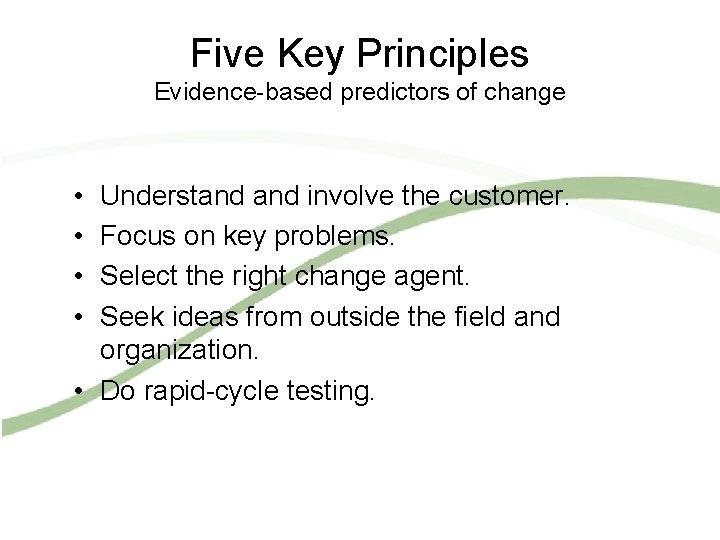
Five Key Principles Evidence-based predictors of change • • Understand involve the customer. Focus on key problems. Select the right change agent. Seek ideas from outside the field and organization. • Do rapid-cycle testing.
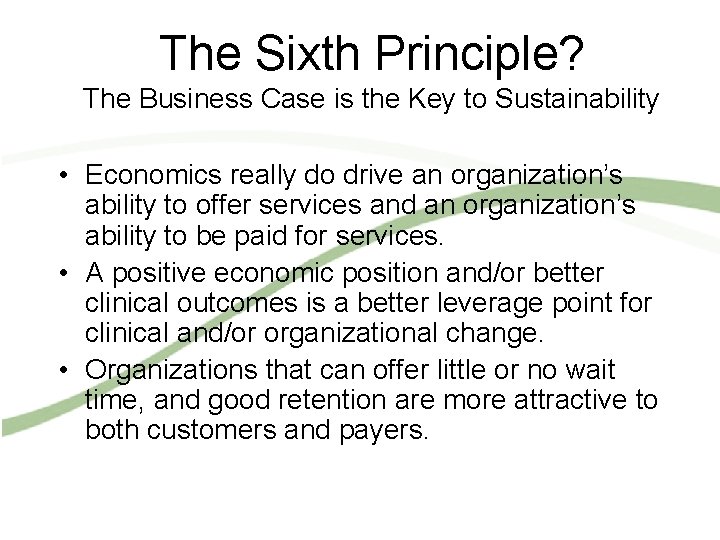
The Sixth Principle? The Business Case is the Key to Sustainability • Economics really do drive an organization’s ability to offer services and an organization’s ability to be paid for services. • A positive economic position and/or better clinical outcomes is a better leverage point for clinical and/or organizational change. • Organizations that can offer little or no wait time, and good retention are more attractive to both customers and payers.
Using Treatment Resources Wisely • Many persons who make important decisions about how substance abuse treatment and mental health care get funded don’t really know what we do all day. • It is OUR JOB to communicate with them, in terms they do understand: business principles like efficiency (such as reduced wait time or reduced no-shows), and improved outcomes are a common language. • Remember, at the same time, we are talking about real people.
Illustrating the Business Case • Increased money by service line – usually due to volume (fee for service or improved payer mix). • Improved efficiency in a program – more people being served for the same money, but not always more revenue (i. e. , capitation) or an improved process that saves a lot of time. • Improved productivity and/or staff retention.
Reimbursement is Complex • Make a simple argument. • Your job is to translate between business interest and clinical interest – they need to be parallel.
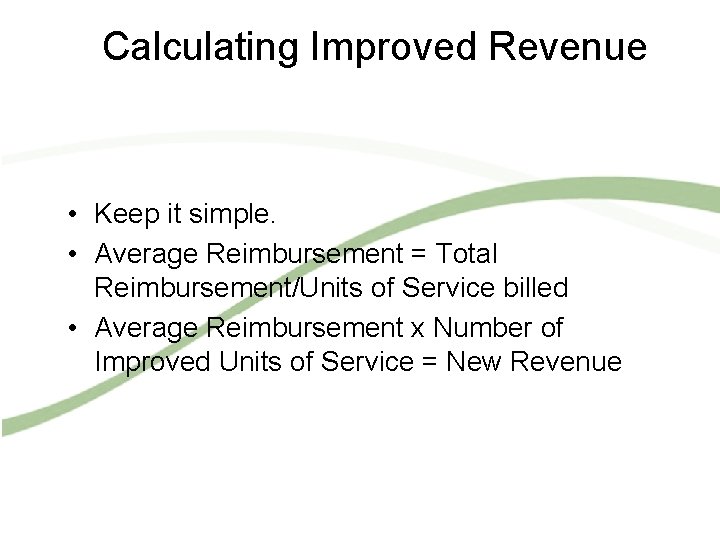
Calculating Improved Revenue • Keep it simple. • Average Reimbursement = Total Reimbursement/Units of Service billed • Average Reimbursement x Number of Improved Units of Service = New Revenue
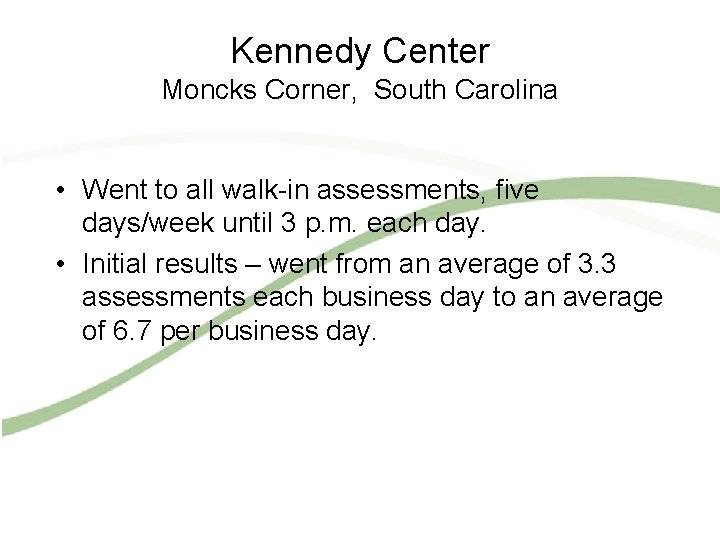
Kennedy Center Moncks Corner, South Carolina • Went to all walk-in assessments, five days/week until 3 p. m. each day. • Initial results – went from an average of 3. 3 assessments each business day to an average of 6. 7 per business day.
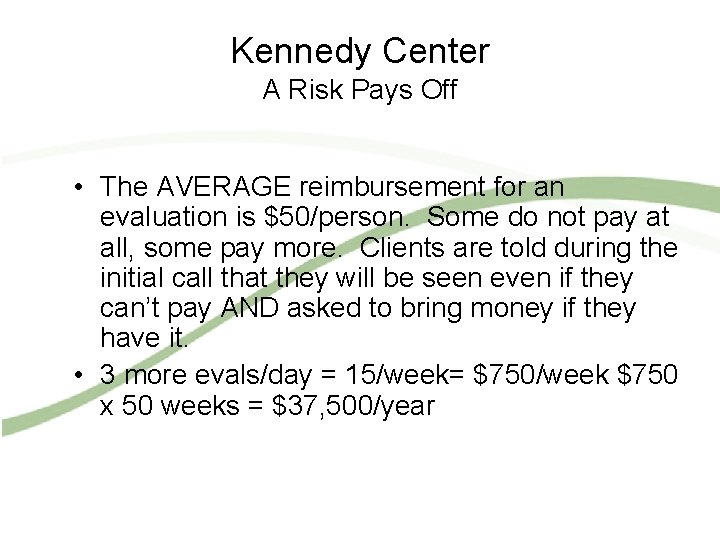
Kennedy Center A Risk Pays Off • The AVERAGE reimbursement for an evaluation is $50/person. Some do not pay at all, some pay more. Clients are told during the initial call that they will be seen even if they can’t pay AND asked to bring money if they have it. • 3 more evals/day = 15/week= $750/week $750 x 50 weeks = $37, 500/year
Adding IOP/MAT Service • OPBH Work Redesign • ARC • 14 -hour MD contract • Unfreeze 20 -hour admin. vacancy for sustaining Damariscotta Expansion Project
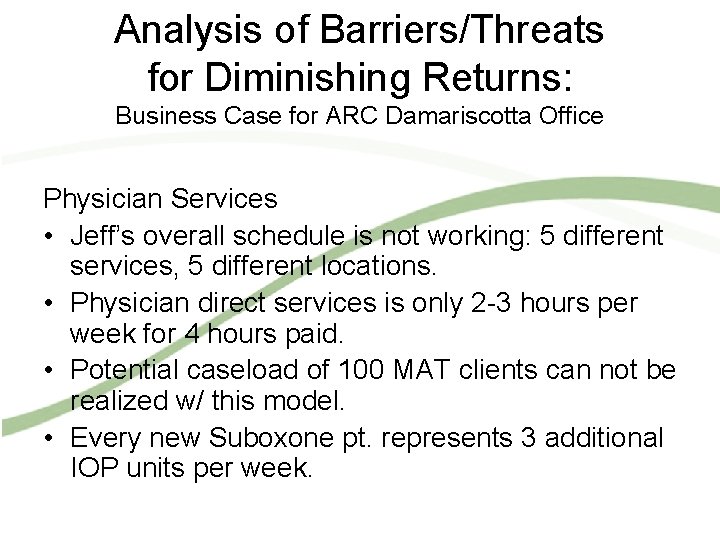
Analysis of Barriers/Threats for Diminishing Returns: Business Case for ARC Damariscotta Office Physician Services • Jeff’s overall schedule is not working: 5 different services, 5 different locations. • Physician direct services is only 2 -3 hours per week for 4 hours paid. • Potential caseload of 100 MAT clients can not be realized w/ this model. • Every new Suboxone pt. represents 3 additional IOP units per week.
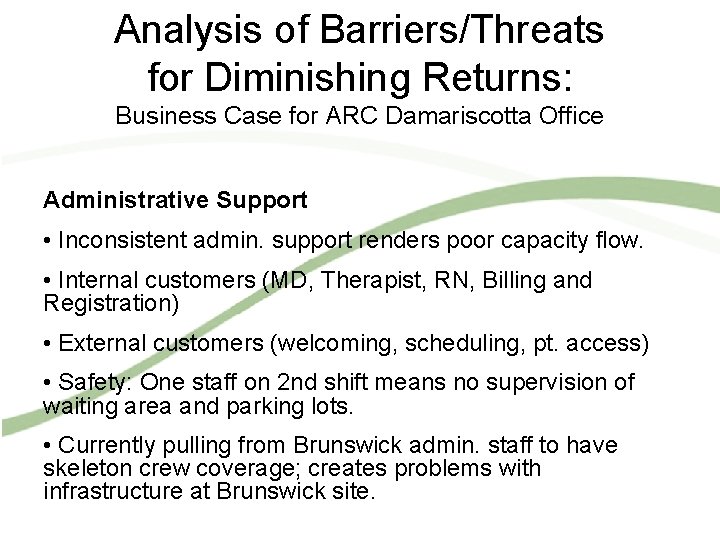
Analysis of Barriers/Threats for Diminishing Returns: Business Case for ARC Damariscotta Office Administrative Support • Inconsistent admin. support renders poor capacity flow. • Internal customers (MD, Therapist, RN, Billing and Registration) • External customers (welcoming, scheduling, pt. access) • Safety: One staff on 2 nd shift means no supervision of waiting area and parking lots. • Currently pulling from Brunswick admin. staff to have skeleton crew coverage; creates problems with infrastructure at Brunswick site.
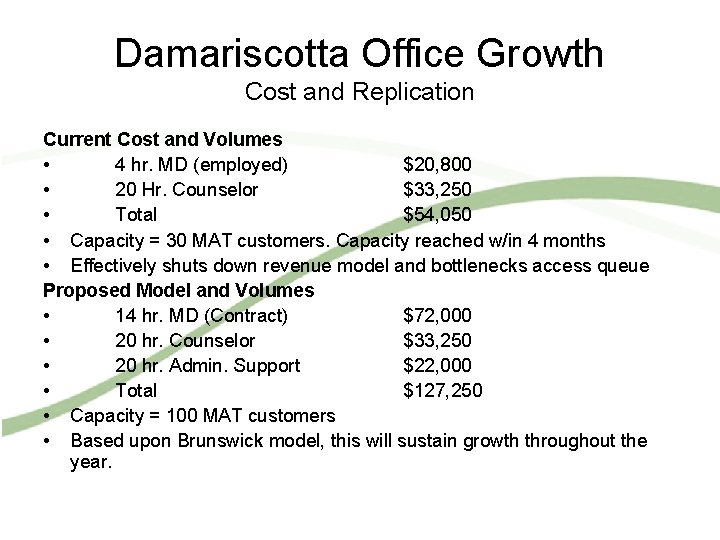
Damariscotta Office Growth Cost and Replication Current Cost and Volumes • 4 hr. MD (employed) $20, 800 • 20 Hr. Counselor $33, 250 • Total $54, 050 • Capacity = 30 MAT customers. Capacity reached w/in 4 months • Effectively shuts down revenue model and bottlenecks access queue Proposed Model and Volumes • 14 hr. MD (Contract) $72, 000 • 20 hr. Counselor $33, 250 • 20 hr. Admin. Support $22, 000 • Total $127, 250 • Capacity = 100 MAT customers • Based upon Brunswick model, this will sustain growth throughout the year.
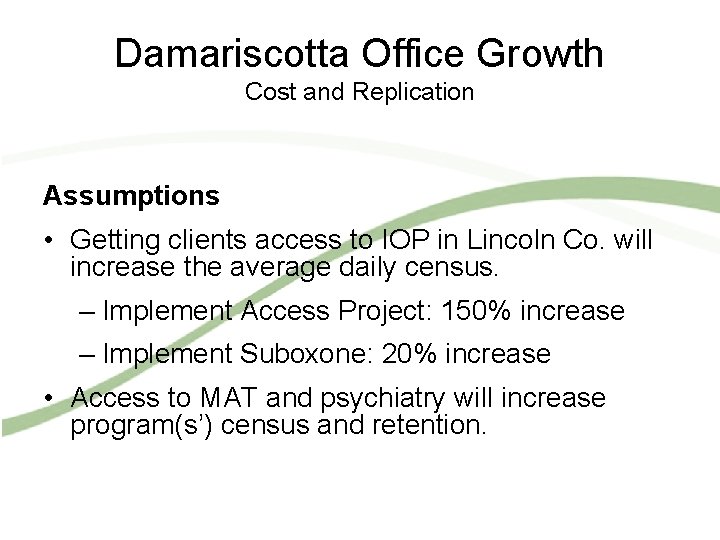
Damariscotta Office Growth Cost and Replication Assumptions • Getting clients access to IOP in Lincoln Co. will increase the average daily census. – Implement Access Project: 150% increase – Implement Suboxone: 20% increase • Access to MAT and psychiatry will increase program(s’) census and retention.
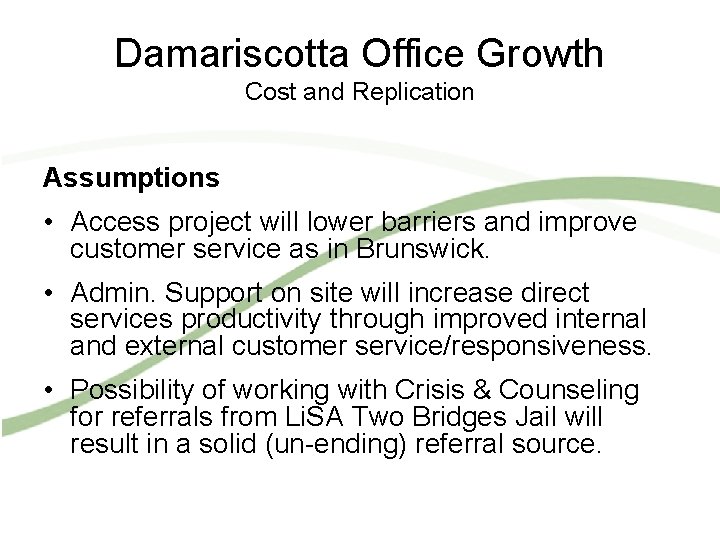
Damariscotta Office Growth Cost and Replication Assumptions • Access project will lower barriers and improve customer service as in Brunswick. • Admin. Support on site will increase direct services productivity through improved internal and external customer service/responsiveness. • Possibility of working with Crisis & Counseling for referrals from Li. SA Two Bridges Jail will result in a solid (un-ending) referral source.
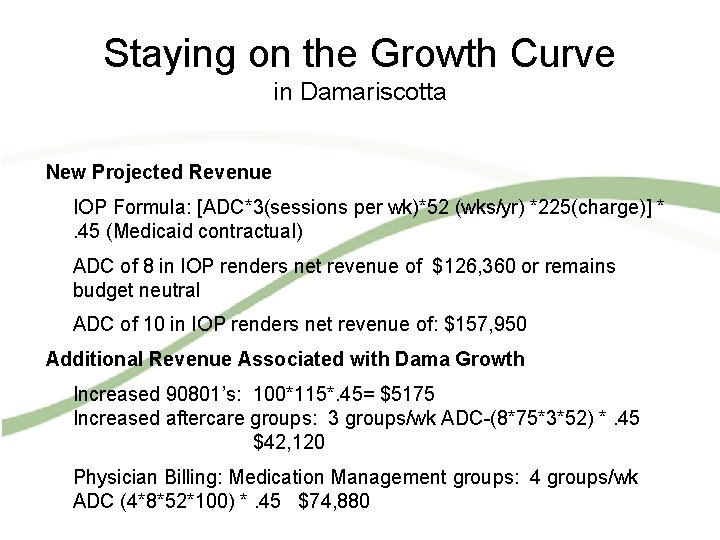
Staying on the Growth Curve in Damariscotta New Projected Revenue IOP Formula: [ADC*3(sessions per wk)*52 (wks/yr) *225(charge)] * . 45 (Medicaid contractual) ADC of 8 in IOP renders net revenue of $126, 360 or remains budget neutral ADC of 10 in IOP renders net revenue of: $157, 950 Additional Revenue Associated with Dama Growth Increased 90801’s: 100*115*. 45= $5175 Increased aftercare groups: 3 groups/wk ADC-(8*75*3*52) *. 45 $42, 120 Physician Billing: Medication Management groups: 4 groups/wk ADC (4*8*52*100) *. 45 $74, 880
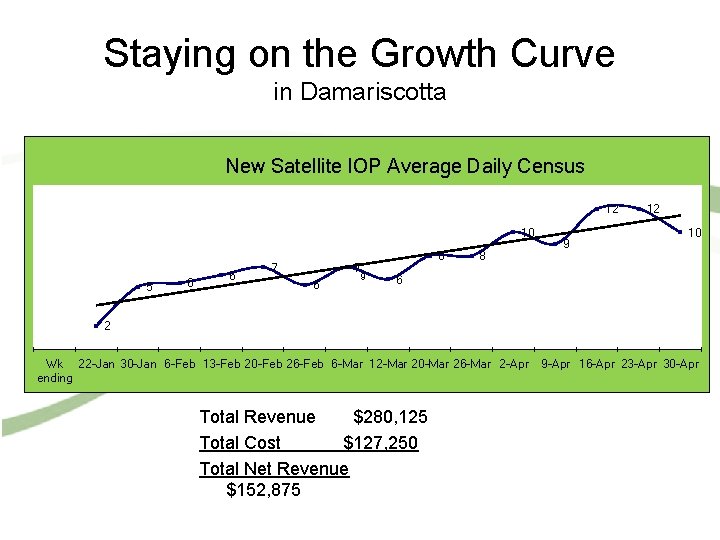
Staying on the Growth Curve in Damariscotta New Satellite IOP Average Daily Census 12 10 5 6 6 7 7 6 g 8 8 9 12 10 6 2 Wk 22 -Jan 30 -Jan 6 -Feb 13 -Feb 20 -Feb 26 -Feb 6 -Mar 12 -Mar 20 -Mar 26 -Mar 2 -Apr ending Total Revenue $280, 125 Total Cost $127, 250 Total Net Revenue $152, 875 9 -Apr 16 -Apr 23 -Apr 30 -Apr
Key Business Case Ideas • Improved performance can lead to an improved bottom line and/or improved stewardship. • Staff retention and morale seem to improve in organizations where staff are excited and involved. • Business principles are a good communication tool and provide us a way to advocate for our work and therefore, our clients.
Assignment #1 • What challenges will you have as you try to illustrate the business case? • How might you change the membership of your change team to meet these challenges?
An Example – Improving Show Rates • Maximum Group size = 12, and the no-show rate is 50% • Average reimbursement/person = $20. 00 So, if 6 people show up, then the agency recoups 6 x $20. 00 = $120. 00/group. What happens if one more person comes to each group and you run 10 groups/week?
YOUR Data • How will you make the business case for your change? • Average reimbursement = total reimbursement/units of svc billed
Walk-through Instructions • September 2018 – Me. HAF Opioid MAT Expansion Project • Instructions: During October, please do a walk-through of your current MAT service line for the patient described below. As part of our November coaching call we’ll report out on what we learned and discuss how this might shape your service line in the future
Patient- Walk Through Case • Childless adult, 35 years old • Discloses that he/she has OUD and is seeking some kind of help • He/she is a daily user of opioids, but not via injection • No chronic pain and no co-morbidities • Has funding of some kind. Insurance, not Medicaid
How does this person get him/herself admitted to the MAT service line? • • What are the steps? Who does each of those steps? What is the time frame? Where are the billing opportunities?
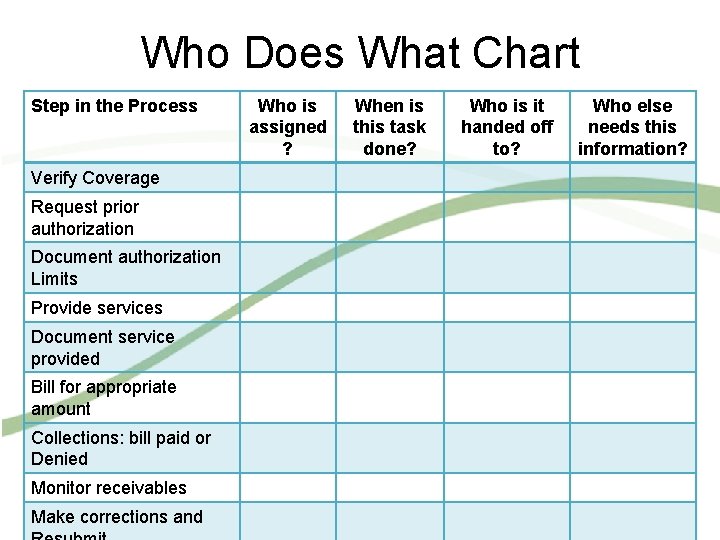
Who Does What Chart Step in the Process Verify Coverage Request prior authorization Document authorization Limits Provide services Document service provided Bill for appropriate amount Collections: bill paid or Denied Monitor receivables Make corrections and Who is assigned ? When is this task done? Who is it handed off to? Who else needs this information?
Resources/Additional Background • How to Perform a Walk-through • Billing Guide (see pages 5 and 14) • How to Flowchart
Maximizing Reimbursement for MAT/R: tools for success Mary Jean Mork, LCSW
Official Disclaimer • Consultant makes no warranty regarding the manner in which any payer, governmental or private, will accept or deny any claim for reimbursement relating to integrated mental health services. • In publishing or otherwise disseminating any Work Product this author makes no representation or warranty regarding the manner in which any payor, governmental or private, will accept or deny any claim for reimbursement relating to integrated mental health services; that the provided is not intended to replace the information contained in the ICD-9 -CM and CPT-4 manuals or specific coding, reporting, or reimbursement information that may be disseminated by third-party or government payers; and that providers should seek advice for their own consultants with respect to submission of particular claims or categories of claims for reimbursement by payors.
Typical billing scenario • • • Medical billing for physician Medical billing for labs Behavioral health billing for assessments Behavioral health billing for groups Other? What is your present arrangement for billing?
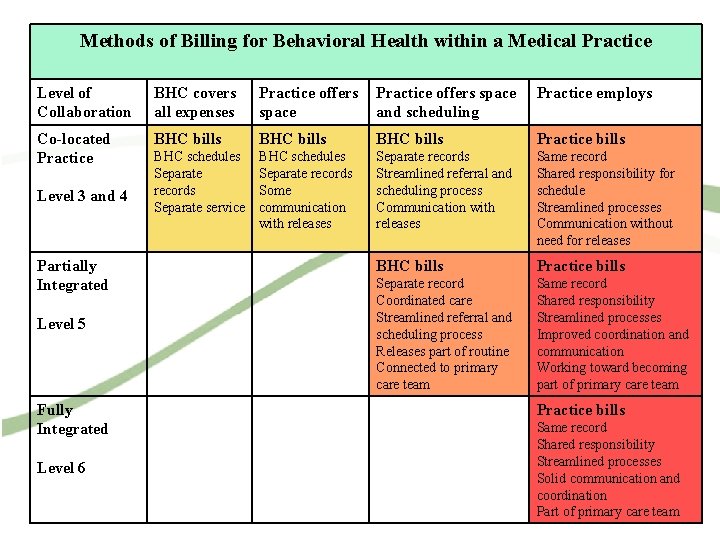
Methods of Billing for Behavioral Health within a Medical Practice Level of Collaboration BHC covers all expenses Practice offers space and scheduling Practice employs Co-located Practice BHC bills Practice bills BHC schedules Separate records Separate service BHC schedules Separate records Some communication with releases Separate records Streamlined referral and scheduling process Communication with releases Same record Shared responsibility for schedule Streamlined processes Communication without need for releases BHC bills Practice bills Separate record Coordinated care Streamlined referral and scheduling process Releases part of routine Connected to primary care team Same record Shared responsibility Streamlined processes Improved coordination and communication Working toward becoming part of primary care team Level 3 and 4 Partially Integrated Level 5 Fully Integrated Level 6 Practice bills Same record Shared responsibility Streamlined processes Solid communication and coordination Part of primary care team
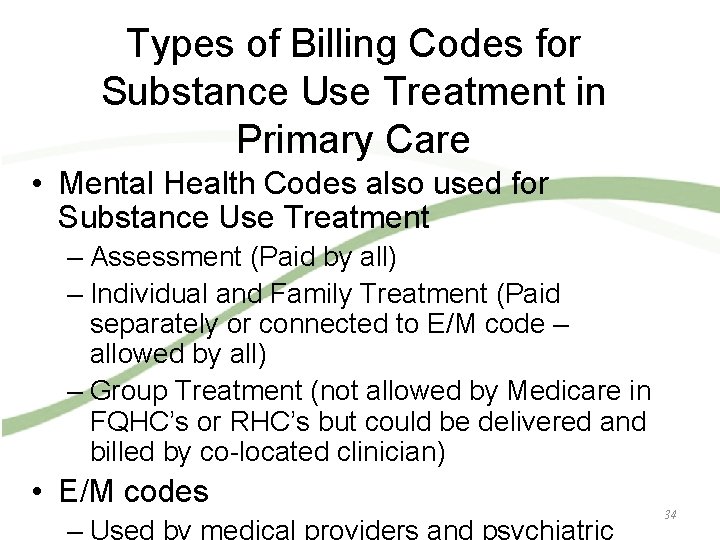
Types of Billing Codes for Substance Use Treatment in Primary Care • Mental Health Codes also used for Substance Use Treatment – Assessment (Paid by all) – Individual and Family Treatment (Paid separately or connected to E/M code – allowed by all) – Group Treatment (not allowed by Medicare in FQHC’s or RHC’s but could be delivered and billed by co-located clinician) • E/M codes 34
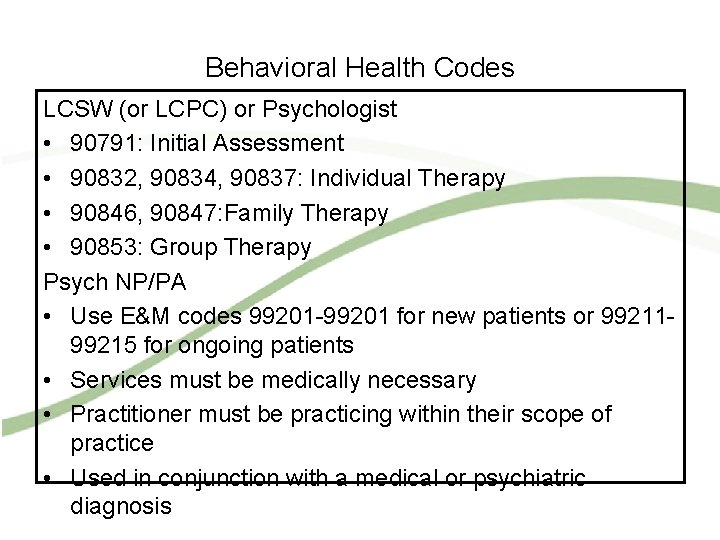
Behavioral Health Codes LCSW (or LCPC) or Psychologist • 90791: Initial Assessment • 90832, 90834, 90837: Individual Therapy • 90846, 90847: Family Therapy • 90853: Group Therapy Psych NP/PA • Use E&M codes 99201 -99201 for new patients or 9921199215 for ongoing patients • Services must be medically necessary • Practitioner must be practicing within their scope of practice • Used in conjunction with a medical or psychiatric diagnosis
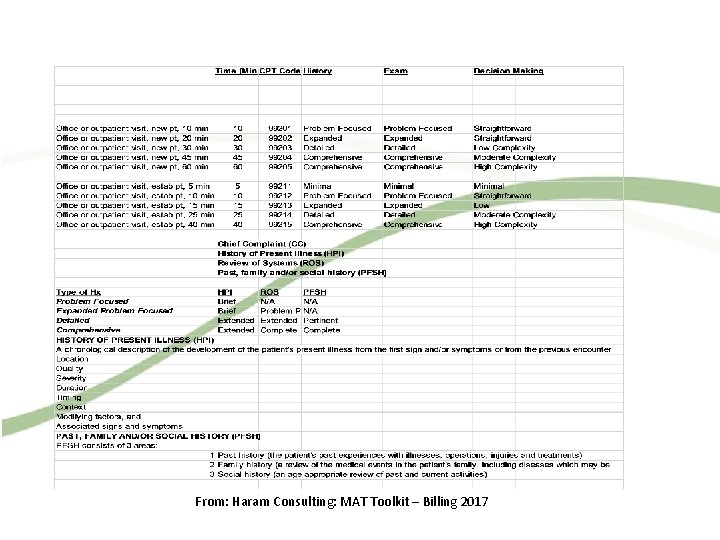
From: Haram Consulting: MAT Toolkit – Billing 2017
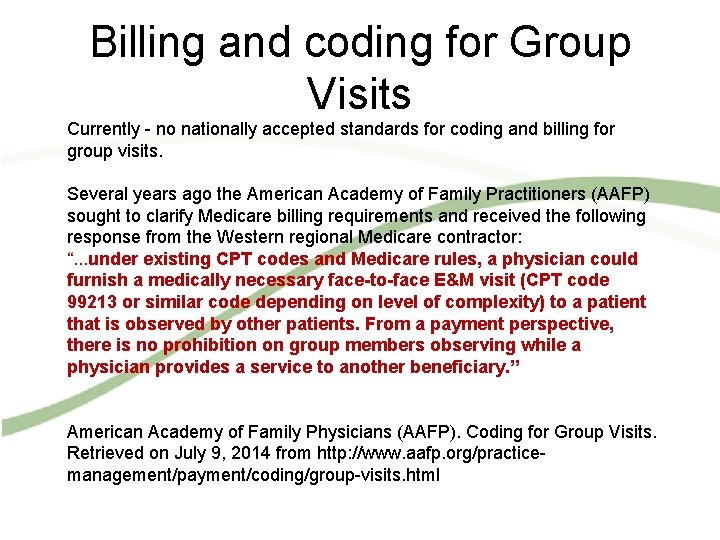
Billing and coding for Group Visits Currently - no nationally accepted standards for coding and billing for group visits. Several years ago the American Academy of Family Practitioners (AAFP) sought to clarify Medicare billing requirements and received the following response from the Western regional Medicare contractor: “. . . under existing CPT codes and Medicare rules, a physician could furnish a medically necessary face-to-face E&M visit (CPT code 99213 or similar code depending on level of complexity) to a patient that is observed by other patients. From a payment perspective, there is no prohibition on group members observing while a physician provides a service to another beneficiary. ” American Academy of Family Physicians (AAFP). Coding for Group Visits. Retrieved on July 9, 2014 from http: //www. aafp. org/practicemanagement/payment/coding/group-visits. html
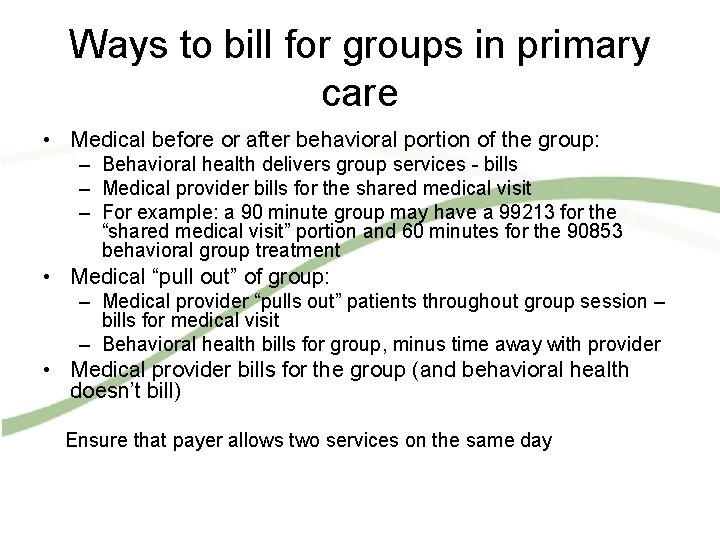
Ways to bill for groups in primary care • Medical before or after behavioral portion of the group: – Behavioral health delivers group services - bills – Medical provider bills for the shared medical visit – For example: a 90 minute group may have a 99213 for the “shared medical visit” portion and 60 minutes for the 90853 behavioral group treatment • Medical “pull out” of group: – Medical provider “pulls out” patients throughout group session – bills for medical visit – Behavioral health bills for group, minus time away with provider • Medical provider bills for the group (and behavioral health doesn’t bill) Ensure that payer allows two services on the same day
Behavioral Health Group Billing - 90853 • Effective and efficient form of treatment • Requires - Initial Psychiatric Assessment to determine the diagnosis for each group member • Treatment Plan required and includes group as method of treatment • Each Group Treatment note includes: • General statement about the group session and • Paragraph specific to that patient’s involvement/progress in that session. • All other Progress Note expectations apply
Billing for Groups • FQHC’s and RHC’s - – Medicare does not allow - but some practices are delivering services and not billing Medicare – Maine. Care does appear to reimburse for group services • Provider based practices (non-FQHC or RHC). – Medicare and Maine. Care both allow – Medicare requires LCSW or Psychologist for any billing
Keep in mind… • Document clearly – individual services provided to each patient as well as the services provided to the group as a whole • Emphasize the medical management component • Use medical E/M code 99213 (rarely 99214) • If more than one clinician billing (i. e. , a physician and psychologist) differentiate services provided to avoid duplicate billing • Patient education is not directly reimbursed under current system, except in specific cases such as diabetes self management education (DSME) by a certified diabetes educator (CDE) References: Putting Group Visits into Practice in the Patient Centered Medical Home. Stephanie Eisenstat MD, Karen Carlson MD and Kathleen Ulman Ph. D. Massachusetts General Hospital 2014 Putting Group Visits into Practice: A Practical Overview to Preparation, Implementation and Maintenance of Group Visits at Massachusetts General Hospital. 2012, Eisenstat, Lipps Siegel, Carson and Ulman. 2012.
What to do for the uninsured? OHH • Opioid Health Homes are an option • OHH factors to consider: – Need to have a mix of Maine. Care and uninsured – May be able to partner with pharmacy or other parts of the team (e. g. peer recovery) – OHH will pay for medication for uninsured – Financially viable for Maine. Care patients in induction phase due to need for multiple medical visits vs. those in maintenance phase? – DHHS is in process of gathering information about present OHH regulations and barriers to implementation
One additional barrier: Interpreting 42 CFR part 2 in relation to MAT/R services in the primary care setting
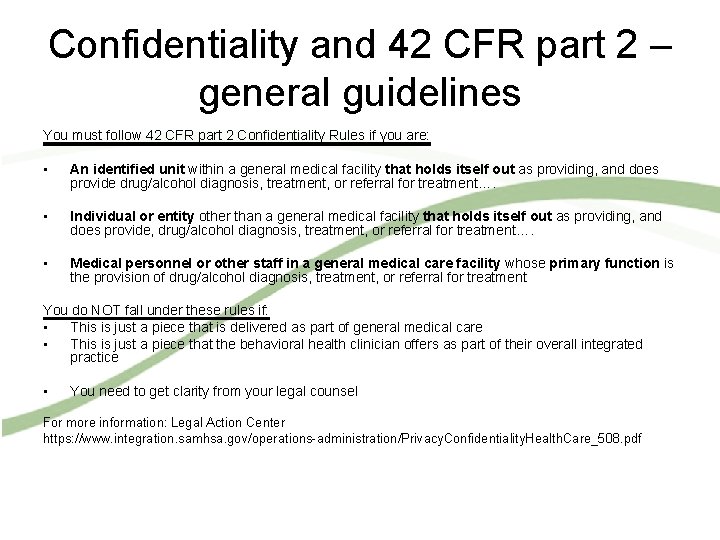
Confidentiality and 42 CFR part 2 – general guidelines You must follow 42 CFR part 2 Confidentiality Rules if you are: • An identified unit within a general medical facility that holds itself out as providing, and does provide drug/alcohol diagnosis, treatment, or referral for treatment…. • Individual or entity other than a general medical facility that holds itself out as providing, and does provide, drug/alcohol diagnosis, treatment, or referral for treatment…. • Medical personnel or other staff in a general medical care facility whose primary function is the provision of drug/alcohol diagnosis, treatment, or referral for treatment You do NOT fall under these rules if: • This is just a piece that is delivered as part of general medical care • This is just a piece that the behavioral health clinician offers as part of their overall integrated practice • You need to get clarity from your legal counsel For more information: Legal Action Center https: //www. integration. samhsa. gov/operations-administration/Privacy. Confidentiality. Health. Care_508. pdf
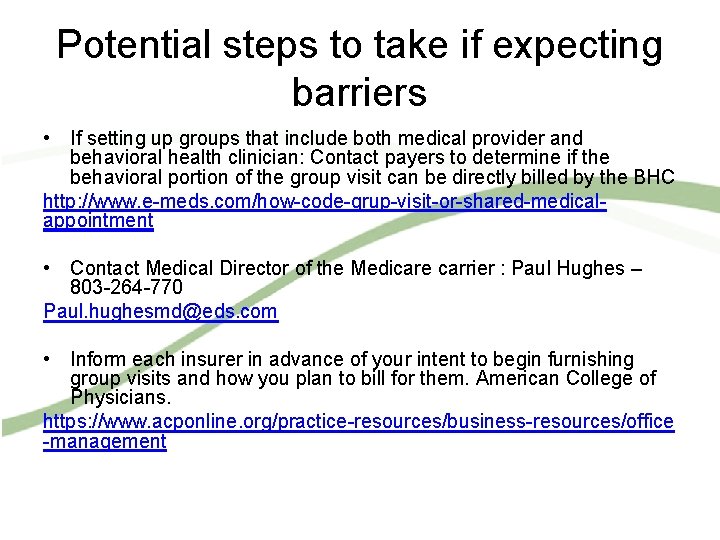
Potential steps to take if expecting barriers • If setting up groups that include both medical provider and behavioral health clinician: Contact payers to determine if the behavioral portion of the group visit can be directly billed by the BHC http: //www. e-meds. com/how-code-grup-visit-or-shared-medicalappointment • Contact Medical Director of the Medicare carrier : Paul Hughes – 803 -264 -770 Paul. hughesmd@eds. com • Inform each insurer in advance of your intent to begin furnishing group visits and how you plan to bill for them. American College of Physicians. https: //www. acponline. org/practice-resources/business-resources/office -management
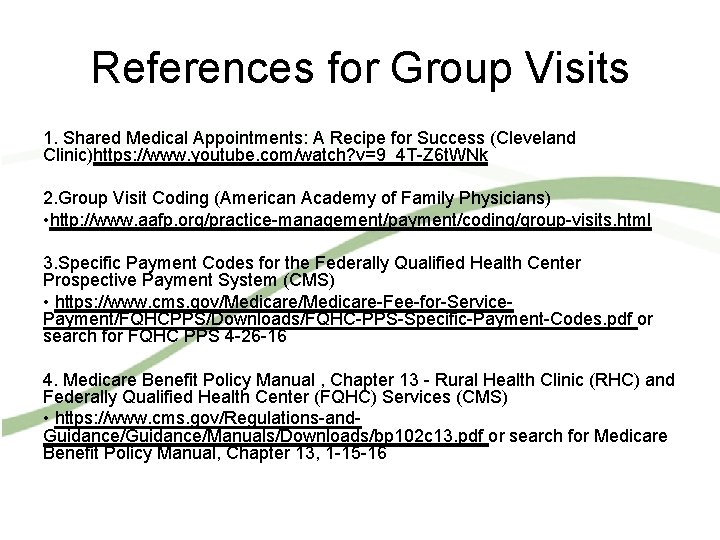
References for Group Visits 1. Shared Medical Appointments: A Recipe for Success (Cleveland Clinic)https: //www. youtube. com/watch? v=9_4 T-Z 6 t. WNk 2. Group Visit Coding (American Academy of Family Physicians) • http: //www. aafp. org/practice-management/payment/coding/group-visits. html 3. Specific Payment Codes for the Federally Qualified Health Center Prospective Payment System (CMS) • https: //www. cms. gov/Medicare-Fee-for-Service. Payment/FQHCPPS/Downloads/FQHC-PPS-Specific-Payment-Codes. pdf or search for FQHC PPS 4 -26 -16 4. Medicare Benefit Policy Manual , Chapter 13 - Rural Health Clinic (RHC) and Federally Qualified Health Center (FQHC) Services (CMS) • https: //www. cms. gov/Regulations-and. Guidance/Manuals/Downloads/bp 102 c 13. pdf or search for Medicare Benefit Policy Manual, Chapter 13, 1 -15 -16
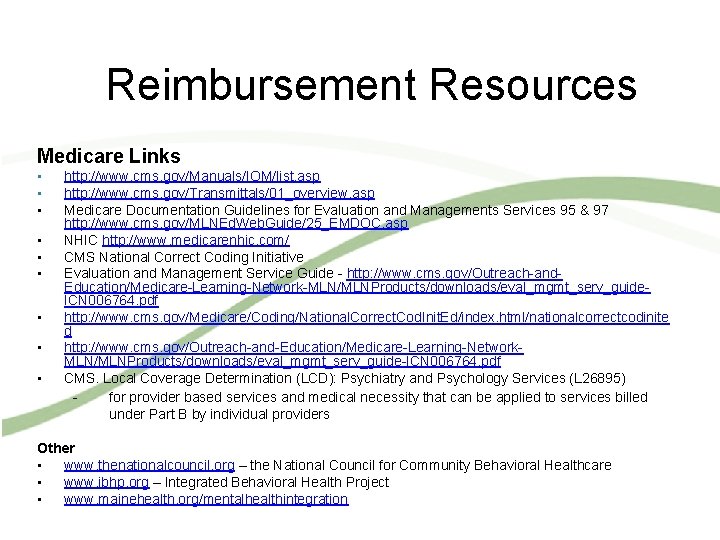
Reimbursement Resources Medicare Links • • • http: //www. cms. gov/Manuals/IOM/list. asp http: //www. cms. gov/Transmittals/01_overview. asp Medicare Documentation Guidelines for Evaluation and Managements Services 95 & 97 http: //www. cms. gov/MLNEd. Web. Guide/25_EMDOC. asp NHIC http: //www. medicarenhic. com/ CMS National Correct Coding Initiative Evaluation and Management Service Guide - http: //www. cms. gov/Outreach-and. Education/Medicare-Learning-Network-MLN/MLNProducts/downloads/eval_mgmt_serv_guide. ICN 006764. pdf http: //www. cms. gov/Medicare/Coding/National. Correct. Cod. Init. Ed/index. html/nationalcorrectcodinite d http: //www. cms. gov/Outreach-and-Education/Medicare-Learning-Network. MLN/MLNProducts/downloads/eval_mgmt_serv_guide-ICN 006764. pdf CMS. Local Coverage Determination (LCD): Psychiatry and Psychology Services (L 26895) for provider based services and medical necessity that can be applied to services billed under Part B by individual providers Other • www. thenationalcouncil. org – the National Council for Community Behavioral Healthcare • www. ibhp. org – Integrated Behavioral Health Project • www. mainehealth. org/mentalhealthintegration
Contacts • Eric Haram, LADC eharam@gmail. com • Mary Jean Mork, LCSW morkm@mmc. org
- Slides: 48