
Planning for Security Chapter 5 Information Security Quality
- Slides: 70
Planning for Security Chapter 5
Information Security Quality security programs begin & end with policy. Primarily management problem, not technical one.
Information Security Policies Form basis for all IS security planning Direct how issues should be addressed Don’t specify properation of equipment or software Should never contradict law Obligates personnel to function in manner that adds to security of info Least expensive control to execute Most difficult to implement properly Standup in court if challenged Be properly administered through dissemination and documented acceptance
Policy Plan or course of action Convey instructions Organizational laws Dictate acceptable and unacceptable behavior Define What is right What is wrong The appeal process What are the penalties for violating policy Written to support the mission, vision and strategic plan of org
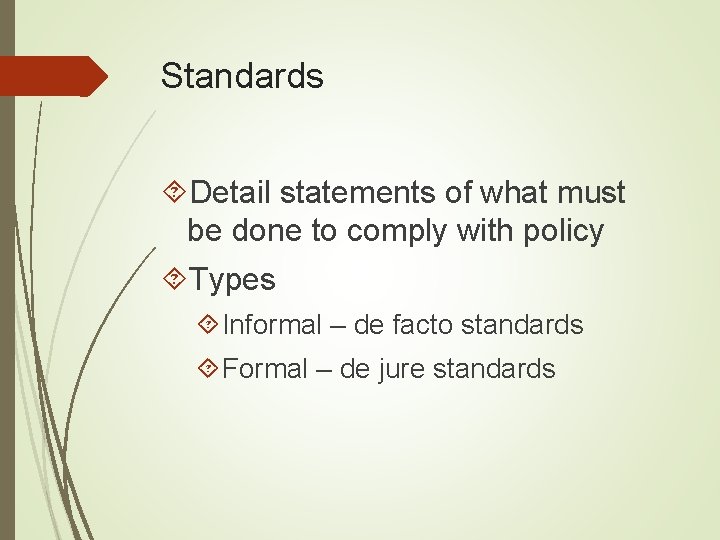
Standards Detail statements of what must be done to comply with policy Types Informal – de facto standards Formal – de jure standards
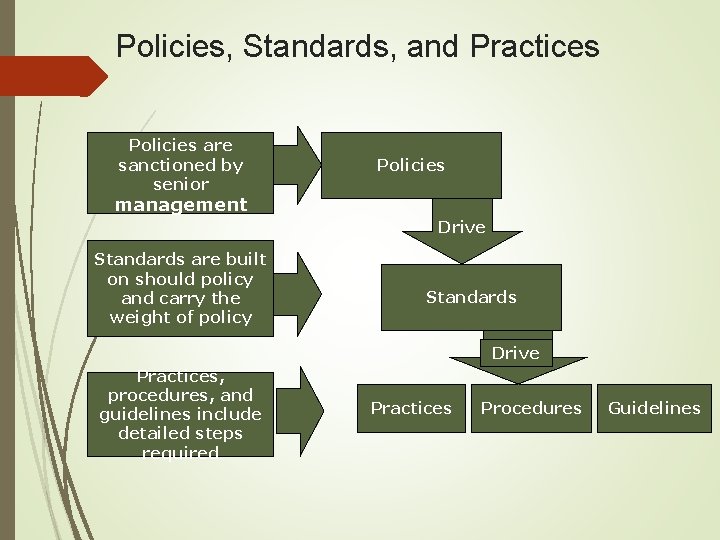
Policies, Standards, and Practices Policies are sanctioned by senior Policies management Drive Standards are built on should policy and carry the weight of policy Standards Drive Practices, procedures, and guidelines include detailed steps required Practices Procedures Guidelines
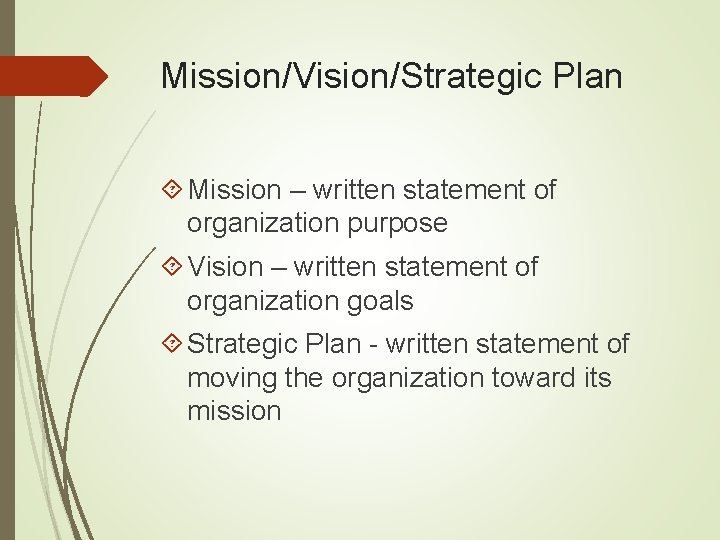
Mission/Vision/Strategic Plan Mission – written statement of organization purpose Vision – written statement of organization goals Strategic Plan - written statement of moving the organization toward its mission
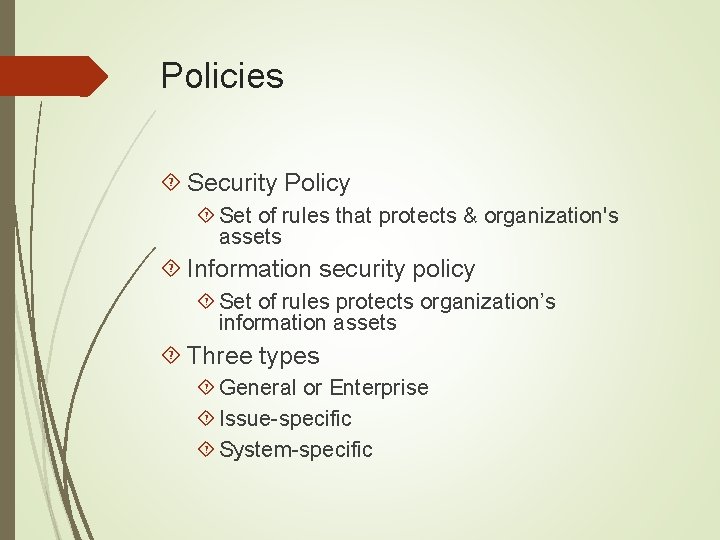
Policies Security Policy Set of rules that protects & organization's assets Information security policy Set of rules protects organization’s information assets Three types General or Enterprise Issue-specific System-specific
EISP Enterprise Information Security Policy Executive level document General Information Security Document 2 -10 pages in length Shapes the philosophy of security in IT Contains requirements to be met Assigns responsibilities Addresses legal compliance
ISSP Issue-Specific Security Policy Addresses specific areas of technology Requires frequent updates Contains statement on organization’s position on specific issue
3 Approaches to ISSP Independent document tailored to a specific issue Scattered approach Departmentalized Single comprehensive document covering all issues Centralized management and control Tend to over generalize the issue Skip vulnerabilities
3 Approaches to ISSP Modular plan Unified policy creation and administration Maintain each specific issue’s requirements Provide balance
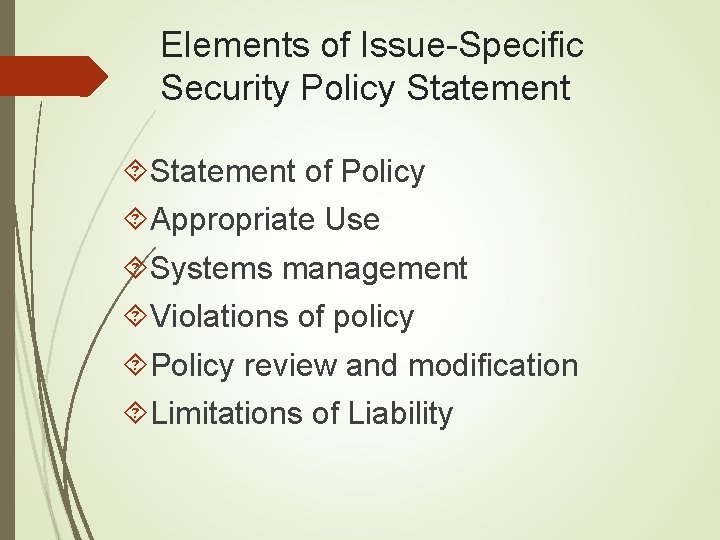
Elements of Issue-Specific Security Policy Statement of Policy Appropriate Use Systems management Violations of policy Policy review and modification Limitations of Liability
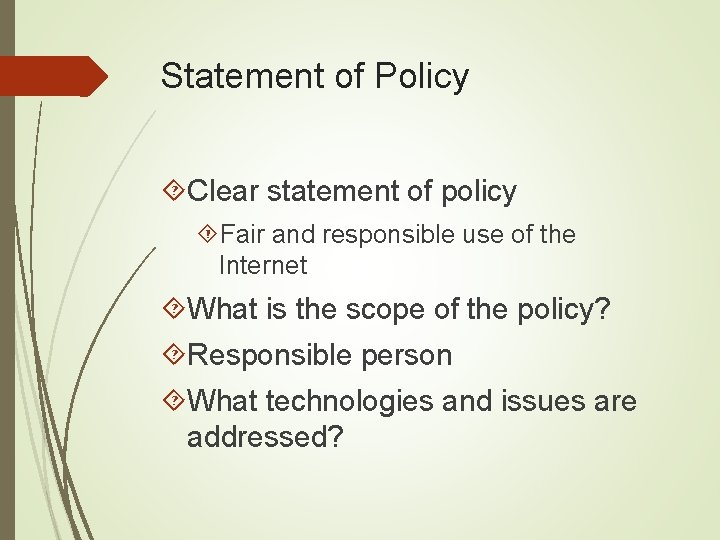
Statement of Policy Clear statement of policy Fair and responsible use of the Internet What is the scope of the policy? Responsible person What technologies and issues are addressed?
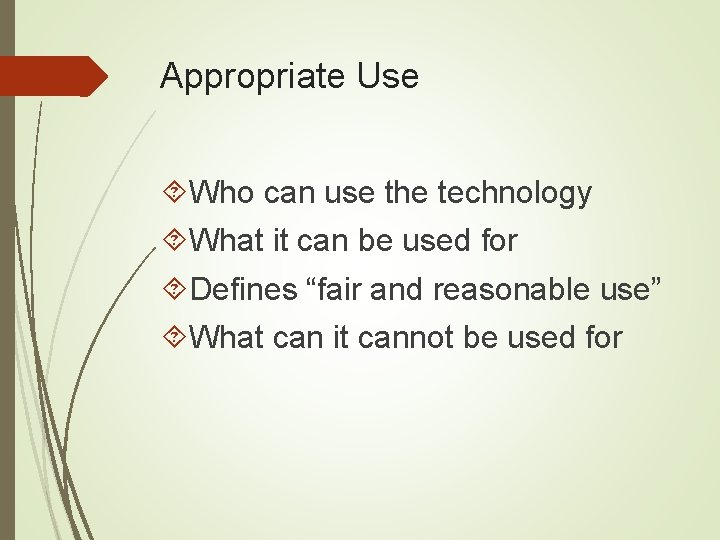
Appropriate Use Who can use the technology What it can be used for Defines “fair and reasonable use” What can it cannot be used for
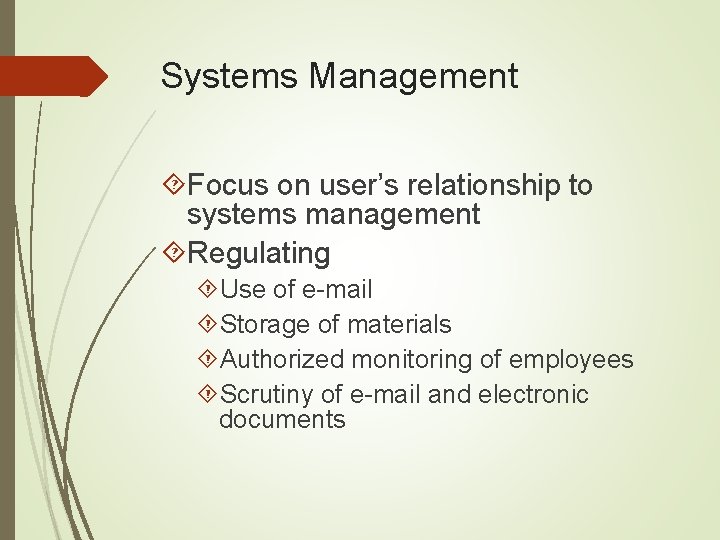
Systems Management Focus on user’s relationship to systems management Regulating Use of e-mail Storage of materials Authorized monitoring of employees Scrutiny of e-mail and electronic documents
Violations of Policy Give guidance on penalties and repercussions of violating policy Specifics on penalties How to report violations
Policy Review and Modification Procedures and a timetable for periodic review Specific methodology for modification
Limitations of Liability Set of disclaimers If employee violates policy or law, the company will not protect them Company is not liable for actions of employees
Sys. SP System-Specific Policy Frequently codified as standards & procedures Used when configuring or maintaining system Example Access Control Lists (ACLs) Configuration rules
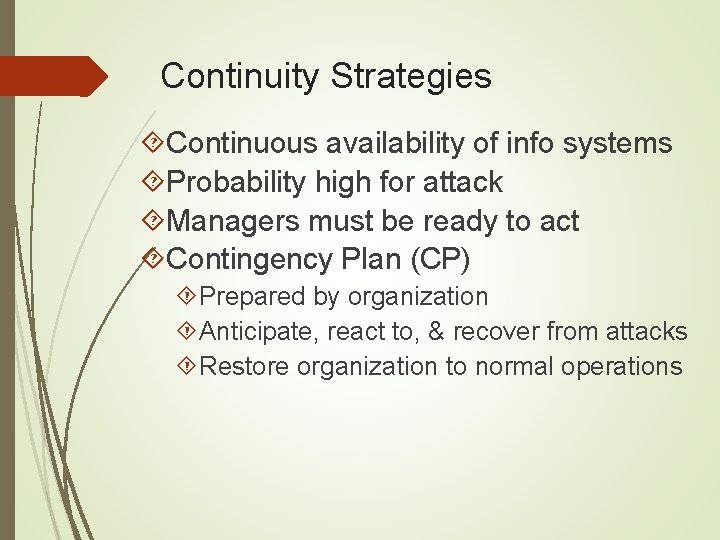
Continuity Strategies Continuous availability of info systems Probability high for attack Managers must be ready to act Contingency Plan (CP) Prepared by organization Anticipate, react to, & recover from attacks Restore organization to normal operations
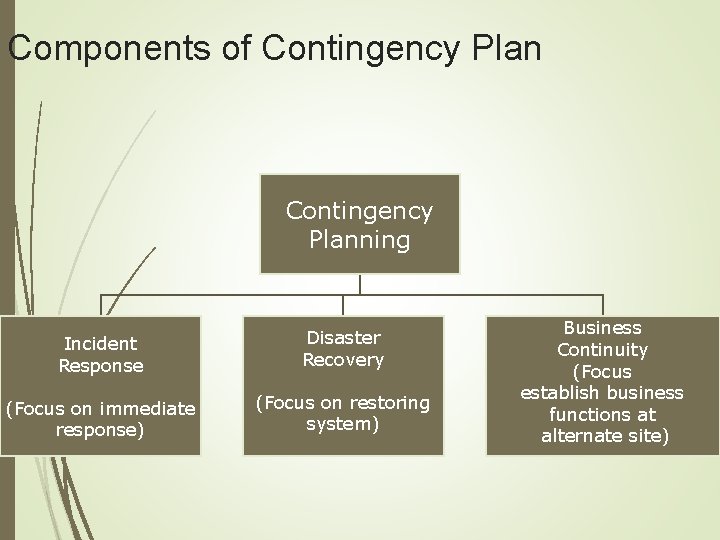
Components of Contingency Planning Incident Response Disaster Recovery (Focus on immediate response) (Focus on restoring system) Business Continuity (Focus establish business functions at alternate site)
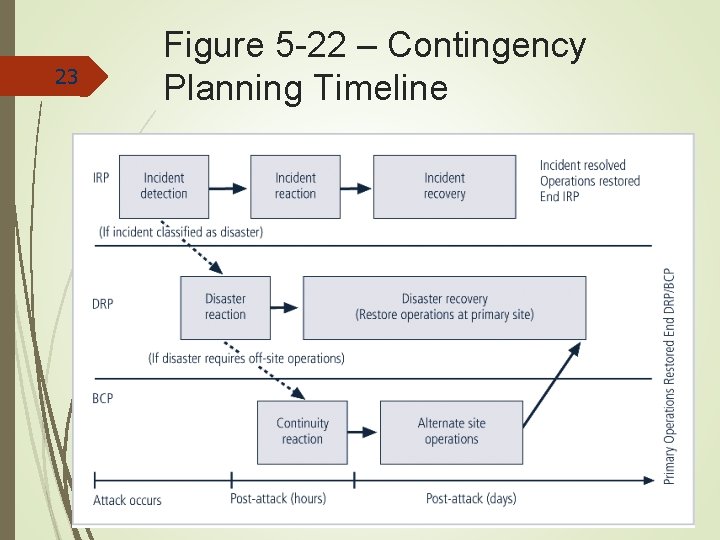
23 Figure 5 -22 – Contingency Planning Timeline
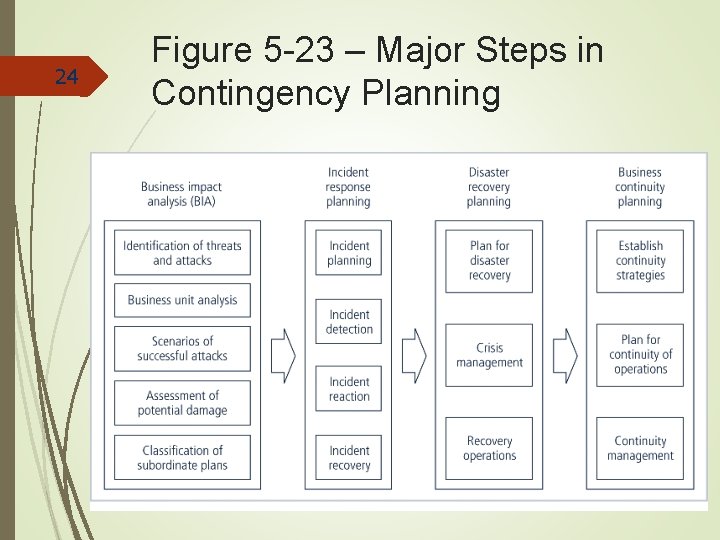
24 Figure 5 -23 – Major Steps in Contingency Planning
Incident Response Planning Activities to be performed when an incident has been identified What is an incident? If action threatens information & completed Characteristics Directed against information assets Realistic change of success Threaten the confidentiality, integrity, or availability of info
Incident Response Set of activities taken to plan for, detect, and correct the impact Incident planning Requires understanding BIA scenarios Develop series of predefined responses Enables org to react quickly
Incident Response Incident detection Mechanisms – intrusion detection systems, virus detection, system administrators, end users
Incident Detection Possible indicators Presence of unfamiliar files Execution of unknown programs or processes Unusual consumption of computing resources Unusual system crashes
Incident Detection Probable indicators Activities at unexpected times Presence of new accounts Reported attacks Notification form IDS
Incident Detection Definite indicators Use of dormant accounts Changes to logs Presence of hacker tools Notification by partner or peer Notification by hackers
Incident Detection Predefined Situation Loss of availability Loss of integrity Loss of confidentiality Violation of policy Violation of law
Incident Reaction Actions outlined in the IRP Guide the organization Stop the incident Mitigate the impact Provide information recovery Notify key personnel Document incident
Incident Containment Strategies Sever affected communication circuits Disable accounts Reconfigure firewall Disable process or service Take down email Stop all computers and network devices Isolate affected channels, processes, services, or computers
Incident Recovery Get everyone moving and focused Assess Damage Recovery Identify and resolve vulnerabilities Address safeguards Evaluate monitoring capabilities Restore data from backups Restore process and services Continuously monitor system Restore confidence
Disaster Recovery Plan Provide guidance in the event of a disaster Clear establishment of priorities Clear delegation of roles & responsibilities Alert key personnel Document disaster Mitigate impact Evacuation of physical assets
Crisis Management Disaster recovery personnel must know their responses without any supporting documentation Focus first & foremost -people involved Team responsibilities Support personnel and loved ones Determine impact on normal operations Keep public informed Communicate with major players
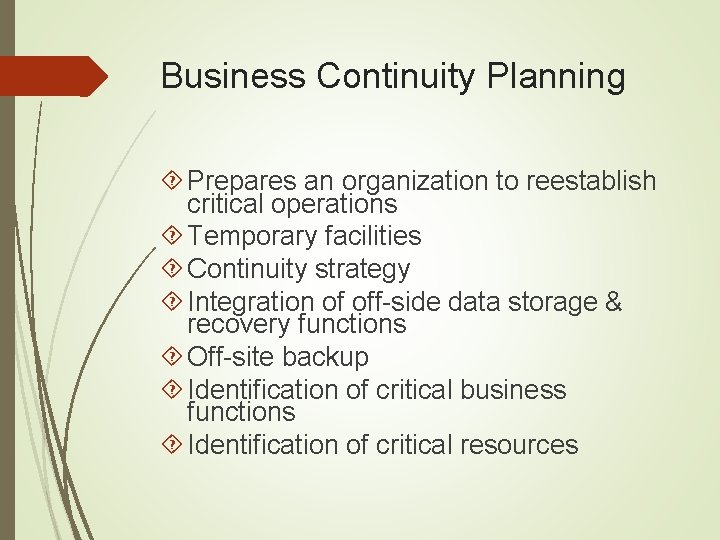
Business Continuity Planning Prepares an organization to reestablish critical operations Temporary facilities Continuity strategy Integration of off-side data storage & recovery functions Off-site backup Identification of critical business functions Identification of critical resources
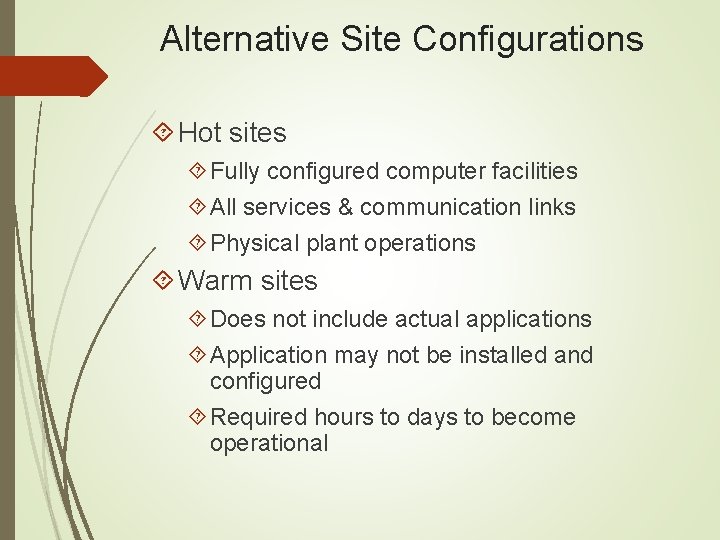
Alternative Site Configurations Hot sites Fully configured computer facilities All services & communication links Physical plant operations Warm sites Does not include actual applications Application may not be installed and configured Required hours to days to become operational
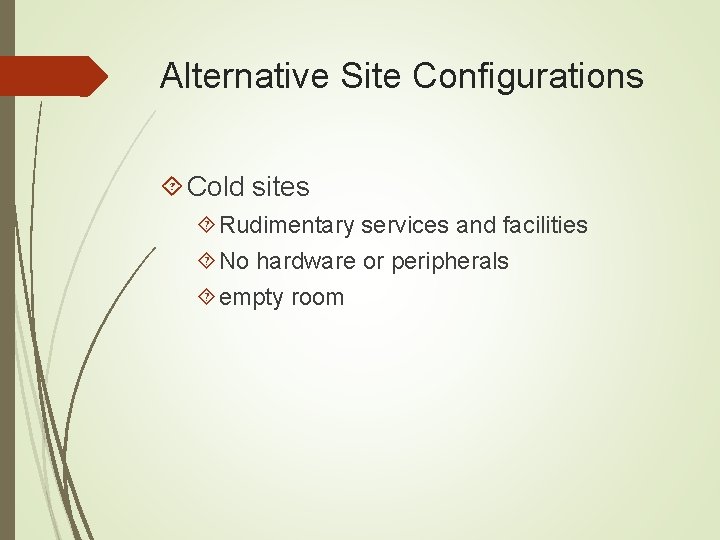
Alternative Site Configurations Cold sites Rudimentary services and facilities No hardware or peripherals empty room
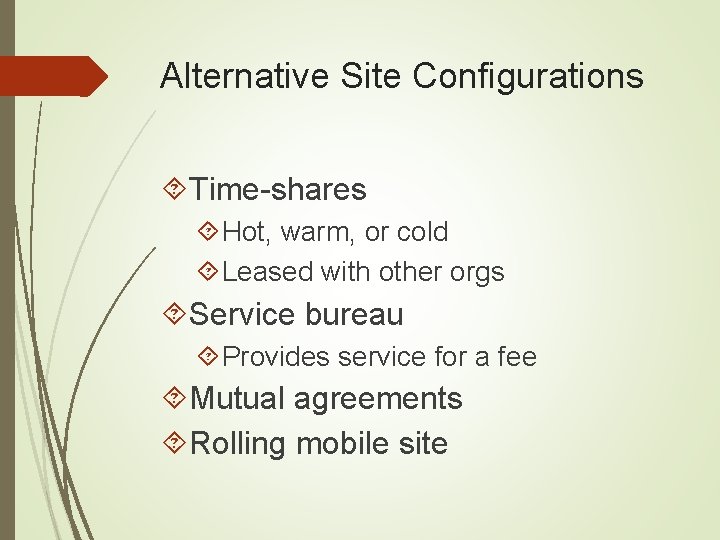
Alternative Site Configurations Time-shares Hot, warm, or cold Leased with other orgs Service bureau Provides service for a fee Mutual agreements Rolling mobile site
Off-Site Disaster Data Storage “off-site” – how far? Electronic vaulting Transfer of large batches of data Receiving server archives data Fee Journaling Transfer of live transactions to off-site Only transactions are transferred Transfer is real time
Off-Site Disaster Data Storage Shadowing Duplicated databases Multiple servers Processes duplicated 3 or more copies simultaneously
ACL Policies Restrict access from anyone & anywhere Can regulate specific user, computer, time, duration, file
ACL Policies What regulated Who can use the system What authorization users can access When authorization users can access Where authorization users can access
ACL Policies Authorization determined by persons identity Can regulated specific computer equipment Regulate access to data Read Write Modify Copy Compare
Rule Policies More specific operation of a system than ACL May or may not deal with user directly Define configuration of firewalls, IDS, and proxy servers
Policy Management Living documents Must be managed Constantly changed and grow Must be properly disseminated Must be properly managed Responsible individual Policy administrator Champion & manager Not necessarily a technically oriented person
Reviews Schedule Retain effectiveness in changing environment Periodically reviewed Should be defined and published Should be reviewed at least annually Procedures and practices Recommendations for change Reality one person drafts
Document Configuration Management Include date of original Includes date of revision Include expiration date
Information Classification Control for the protection of information Important facet of policy Least “for internal use only” Clean desk policy
Information Security Blueprint Risk Assessment Quantitative and qualitative analysis Feasibility studies Cost benefit analysis Good idea of systems vulnerabilities Specify tasks to be accomplished Specify order of performing tasks Serve as plan for IS security needs for years not just today
Information Security Blueprint Basis for design, selection & implementation All security policies Education Training program Technology controls
Security Models ISO (International Organization for Standards) IEC (International Electrotechnical Commission)
Security Models ISO/IEC 17799 Purpose – “give recommendations for information security management for use by those who are responsible for initiating, implementing, or maintaining security in their organization. Provides a common basis Must pay for these
Security Modes NIST Available from Computer Security Resource Center of National Institute for Standards & Technology Publically available at no charge Several publications dealing with various aspects
Security Models IETF Internet Engineering Task Force VISA Internal Focus on system that can and do integrate with VISA Base lining and Best Practices Comparison of your organization security with another
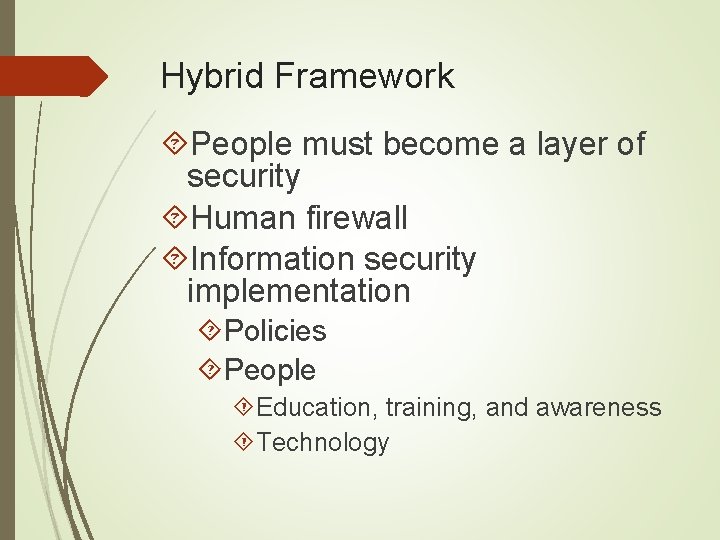
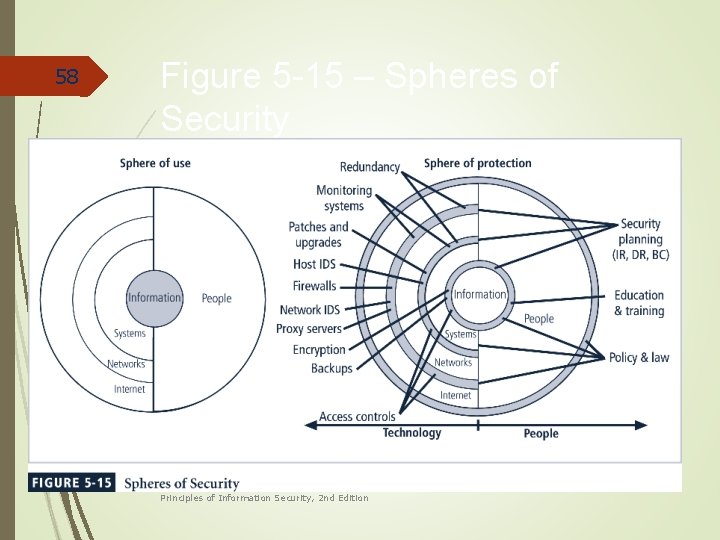
Hybrid Framework People must become a layer of security Human firewall Information security implementation Policies People Education, training, and awareness Technology
58 Figure 5 -15 – Spheres of Security Principles of Information Security, 2 nd Edition
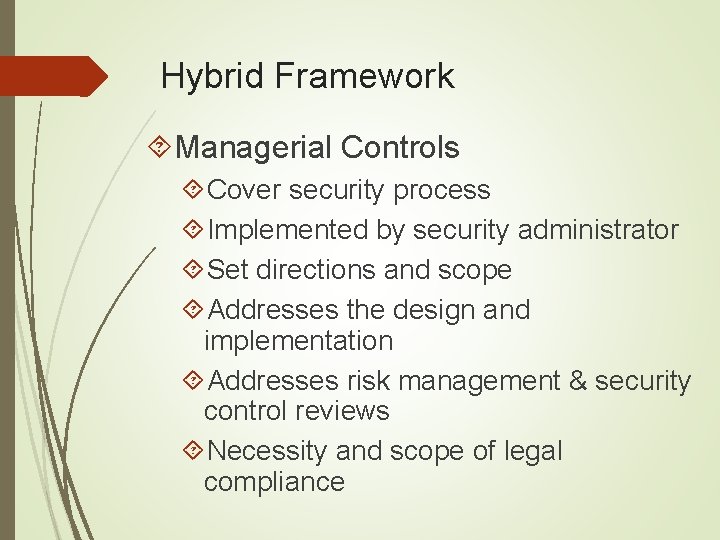
Hybrid Framework Managerial Controls Cover security process Implemented by security administrator Set directions and scope Addresses the design and implementation Addresses risk management & security control reviews Necessity and scope of legal compliance
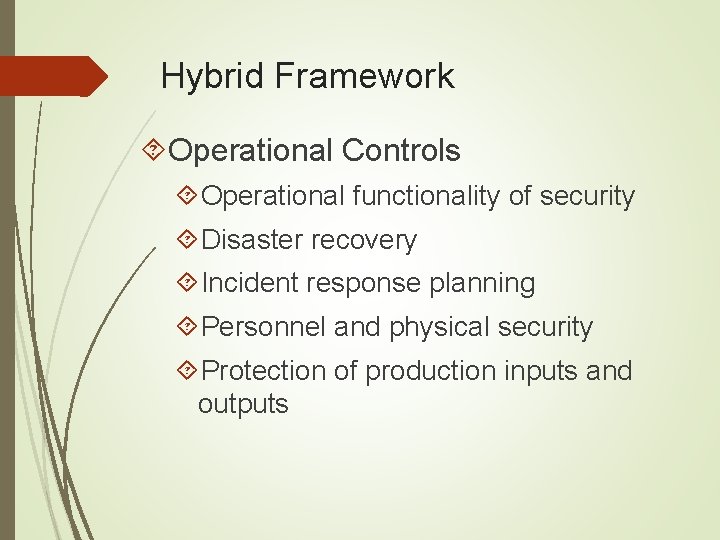
Hybrid Framework Operational Controls Operational functionality of security Disaster recovery Incident response planning Personnel and physical security Protection of production inputs and outputs
Hybrid Framework Operational Controls Development of education, training & awareness Addresses hardware and software system maintenance Integrity of data
Hybrid Framework Technical Controls Addresses the tactical & technical issues Addresses specifics of technology selection & acquisition Addresses identification Addresses authentication Addresses authorization Addresses accountability
Hybrid Framework Technical Controls Addresses development & implementation of audits Covers cryptography Classification of assets and users
Hybrid Framework Security Architecture Components Defenses in Depth One of basic tenants Implementation of security in layers Policy Training Technology Security Perimeter Defines the edge between the outer limit of an organization’s security and the beginning of the outside world
Hybrid Framework Security Architecture Components First level of security – protects all internal systems from outside threats Multiple technologies segregate the protected information Security domains or areas of trust
Key Technology Components SETA Security education, training and awareness Employee errors among top threats Purpose Improve awareness of need to protect Develop skills and knowledge Build in-depth knowledge to design, implement, or operate security programs
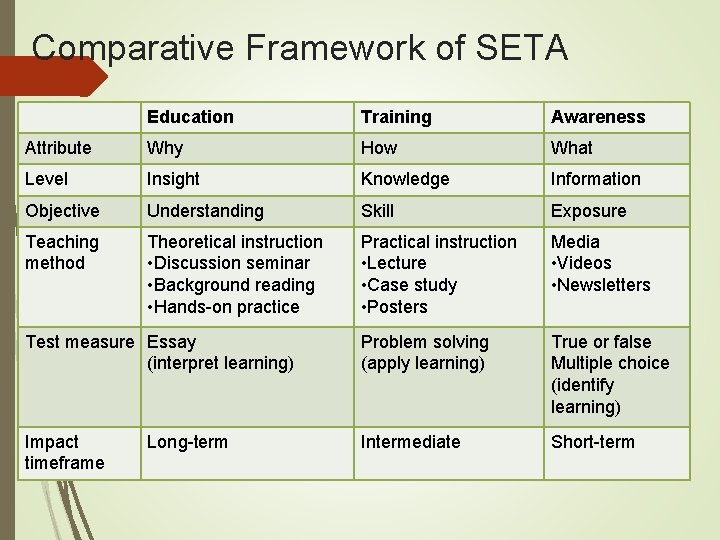
Comparative Framework of SETA Education Training Awareness Attribute Why How What Level Insight Knowledge Information Objective Understanding Skill Exposure Teaching method Theoretical instruction • Discussion seminar • Background reading • Hands-on practice Practical instruction • Lecture • Case study • Posters Media • Videos • Newsletters Test measure Essay (interpret learning) Problem solving (apply learning) True or false Multiple choice (identify learning) Impact timeframe Intermediate Short-term Long-term
Business Impact Analysis (BIA) Investigate & assess impact of various attack First risk assessment – then BIA Prioritized list of threats & critical info Detailed scenarios of potential impact of each attack Answers question “if the attack succeeds, what do you do then? ”
BIA Sections Threat attack identification & prioritization Attack profile – detailed description of activities that occur during an attack Determine the extent of resulting damage Business Unit analysis Analysis & prioritization-business functions Identify & prioritize functions w/in orgs units
BIA Sections Attack success scenario development Series of scenarios showing impact Each treat on prioritized list Alternate outcomes Best, worst, probable cases Potential damage assessment Estimate cost of best, worst, probable What must be done under each Not how much to spend Subordinate Plan Classification Basis for classification as disastrous not disastrous