
PLANNING FOR INSTRUCTION AND GROUPING INSTRUCTIONAL PLANNING Instructional




- Slides: 37
PLANNING FOR INSTRUCTION AND GROUPING
INSTRUCTIONAL PLANNING
Instructional Planning ü is the ability of the teacher to visualize and forecast into the future of what, why and how of the teaching-learning process.
Importance of Instructional Planning • Provides for logical sequencing and pacing lessons • Economizes cost - time and energy • Presents a comprehensive, integrated and meaningful content at an appropriate level • Prepares pupils/students for the day’s activities
Components of Instructional Planning • The teachers’ attitudes, beliefs, orientations and teachers’ social background • The pupils’/students’ age, background, knowledge, motivational level of interest • The learning content which is characterized by the subject matter guidelines
• Material resources which include equipment/tools for teaching • Time frame which is considerable
TYPES OF INSTRUCTIONAL PLANNING
Unit Plan üA unit plan reflects long-range goals and is means of organizing various aspects of the course of the study and serves as a basis for developing a set of related daily teaching plans and educational activities.
Lesson Plan üA lesson plan is a very important tool of a teacher. It is a guide which includes the aims and objectives, subject matter, materials and devices to be used, time frame, anticipated problems and procedures.
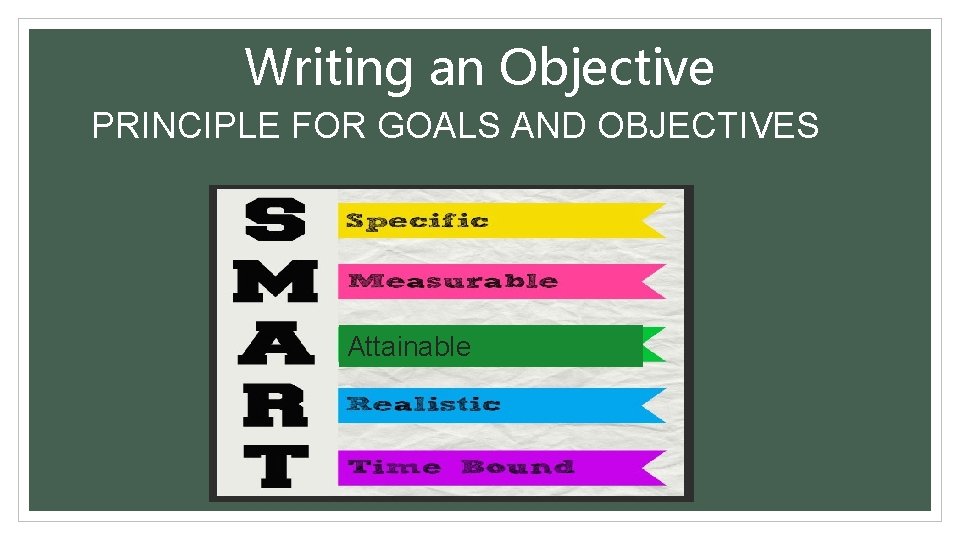
Writing an Objective PRINCIPLE FOR GOALS AND OBJECTIVES Attainable
Assessment • Is the ongoing process of interpreting the evidence of what a student can do.
Purpose of Assessment • To assist in student learning. • To assess and improve student learning • To identify children’s strengths and weaknesses. • To assess the effectiveness of a particular instructional strategy.
TEACHING STRATEGIES
Discussion üIt is students’ exchange and share ideas about the lesson or about the assigned task. When planned properly, it can provide the students activities that will help develop thinking skills and allow them to engage in higher-level thinking.
Demonstration üThis strategy designates the teacher or a designated individual to model the behavior of presentation, analysis and synthesis. It calls for a carefully planned presentation that shows how to perform an act as a procedure.
Role Playing üThis strategy is used when resolving problems or dilemmas and in creating empathy and understanding for another person’s views or behavior. The process enables students to identify with others in a variety of situations, develop empathy, concern for others, and other personal behaviors by having a student enact an incident or situation.
Simulation üProvides students with activities that are designed to provide lifelike problem-solving experiences.
Lecture üIt is a well-prepared oral presentation of a lesson by the teacher. This most widely used exposition strategy when properly organized and planned for. This is a teacher-directed strategy designed to help learners understand relationships in organized bodies of knowledge.
INSTRUCTIONAL GROUPING
Types of Instructional Grouping §Learning Cycle Groups §Cooperative Groups üRequire students with diverse ability and characteristics to work together and learn from one another to accomplish assigned learning goals or tasks. § Group Investigation
§Peer Tutoring Approaches in Peer Tutoring: 1. Team Assisted Individualization üThe team goal is to help one another complete assigned tasks successfully and to improve each student's performance on a quiz measuring skills and content covered in the student's individual assignment.
2. Teams and Games üAfter studying content and skills in learning teams, students are combined into tournament groups based on ability. Individual student's performance in tournaments contributes to individual and learning team scores. Tournament groups are temporary for particular skill or content area.
3. Jigsaw üMaterial to be learned is broken into sections. Each student is to learn a section and then teach it to other team members. Each student is tested and graded individually on entire set of material. Teams are temporary based on material to be learned.
4. . Learning Together üA small group is given one assignment sheet. The group completes and hands in this single assignment. Evaluation is based on how well students work together to complete the assignment sheet and performance on completed sheet. Concept development • Small groups of four to six students are formed. Generally the students in each group have diverse characteristics
• Tasks assigned to groups are complex, e. g. , tasks with more than one answer or way to solve a problem. • Groups engage in learning activities such as reenactment of historical events; dramatizations; instructional games; and development of fictional events, countries or governments, and so forth. • Students plan what to do and assign subtasks, if any, to students based on group plans. • Evaluation frequently includes qualitative as well as quantitative rating of final products. • Teams are temporary.
5. Long-Term Ability üStudents are assigned to groups based on academic ability. Changes in group assignments occur only when a student's academic performance changes.
WHY IS INSTRUCTIONAL GROUPING USED?
§To assure that all students learn §To increase student engagement in learning §To teach students how to work with others §To facilitate social interaction among students §To motivate students §To improve students' self-concepts and attitudes toward self and school §To teach students how to learn in a variety of ways
ACTIONS FOR EFFECTIVENESS
§Teacher pre-planning and preparation §Tasks to be completed §Group size §Group composition §Roles and responsibilities §Advance training of students
§Effective teaching skills Clarity §Monitoring §Reinforcement and feedback §Substantive teacher time §Evaluation §Review of group composition
CAUTIONS REGARDING USE OF INSTRUCTIONAL GROUPS
§Permanence of group §Teacher perceptions and expectations and group assignment §Importance of group placement §Instruction in pull-out groups vs. Regular classroom instruction §Changes in the role of the teacher required by instructional groups
POLICY IMPLICATIONS
§Use of instructional groups §Teacher training
POTD: Pulot of the Day