
Planning for highchallenge high support classrooms Setting up


- Slides: 28
Planning for high-challenge, high support classrooms Setting up EAL/D Learners for Success (English as an Additional Language/Dialect) Colleen Combe, Consultant, Teaching Multilingual Learners (TML) Program NT DET
What do your EAL/D learners need to do if they are to achieve success in their academic learning? 2
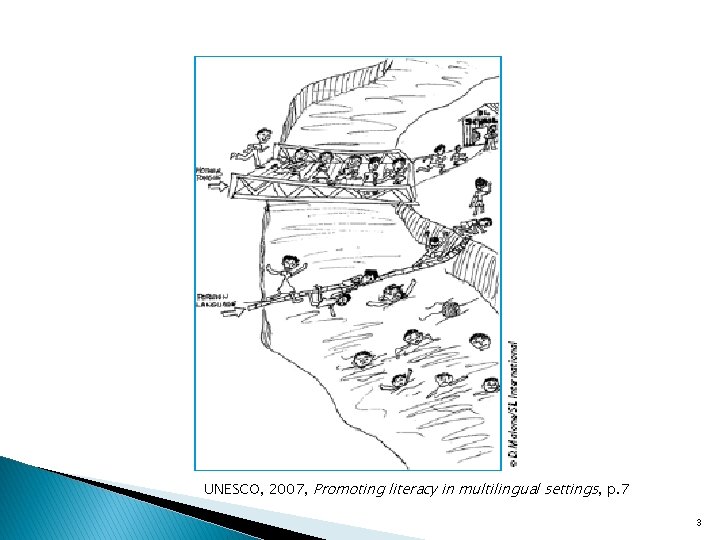
UNESCO, 2007, Promoting literacy in multilingual settings, p. 7 3
How do we support our EAL/D learners? Questions all teachers need to consider 4
1. �What are the basic essential skills, knowledge and understandings that learners need in order for them to progress successfully? 5
Content Think about your teaching area. � What age are your learners? � What are the basic , essential skills , knowledge and understandings that your learners need? � Where do you obtain information about this? 6
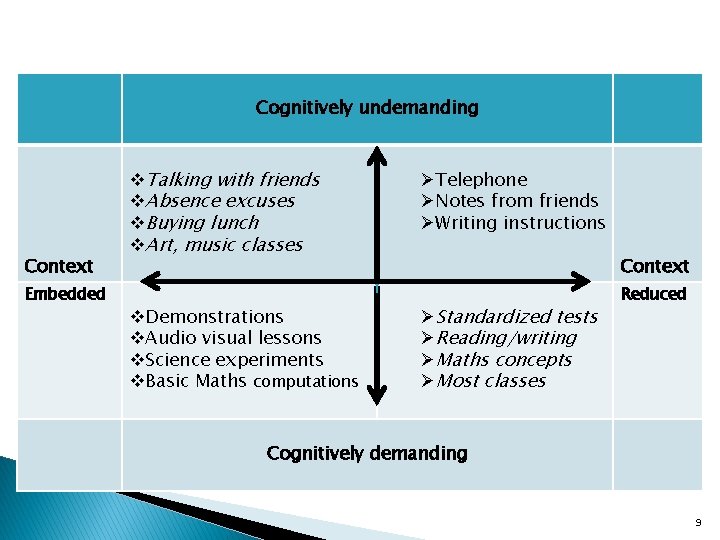
Cummins: BICS �Basic Interpersonal Communication Skills �The language necessary for day to day living including conversations with friends and informal interactions � 2 years 7
Cummins: CALP �Cognitive Academic Language Proficiency �The language necessary to understand discuss content in the classroom �Cognitively demanding –deals with abstract concepts, - has specialised vocabulary - uses more complex language � 5 – 7 years 8
Cognitively undemanding Context Embedded v. Talking with friends v. Absence excuses v. Buying lunch v. Art, music classes v. Demonstrations v. Audio visual lessons v. Science experiments v. Basic Maths computations ØTelephone ØNotes from friends ØWriting instructions Context ØStandardized tests ØReading/writing ØMaths concepts ØMost classes Reduced Cognitively demanding 9
Cummins �‘ We should not assume that non-native speakers who have attained a high degree of fluency and accuracy in everyday spoken English have the corresponding academic language proficiency’ � ‘The non-native speakers who have exited from the ESL program, are still, in most cases, in the process of catching up with their native speaking peers. ’ http: //esl. fis. edu/teachers/support/cummin. htm 10
2. �What English language knowledge, skills and understandings do teachers need to teach in order for learners to engage successfully with the content? 11
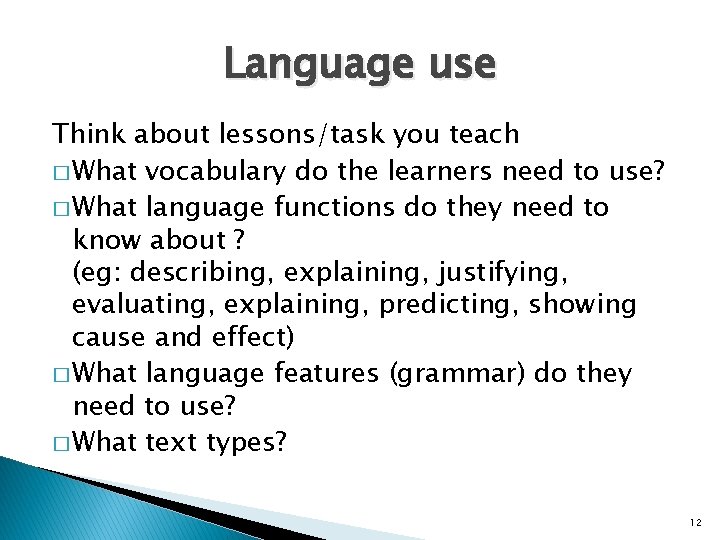
Language use Think about lessons/task you teach � What vocabulary do the learners need to use? � What language functions do they need to know about ? (eg: describing, explaining, justifying, evaluating, explaining, predicting, showing cause and effect) � What language features (grammar) do they need to use? � What text types? 12
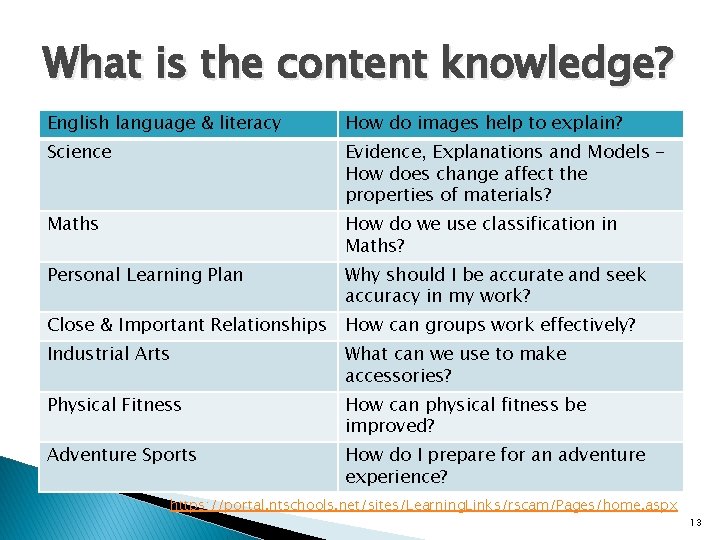
What is the content knowledge? English language & literacy How do images help to explain? Science Evidence, Explanations and Models How does change affect the properties of materials? Maths How do we use classification in Maths? Personal Learning Plan Why should I be accurate and seek accuracy in my work? Close & Important Relationships How can groups work effectively? Industrial Arts What can we use to make accessories? Physical Fitness How can physical fitness be improved? Adventure Sports How do I prepare for an adventure experience? https: //portal. ntschools. net/sites/Learning. Links/rscam/Pages/home. aspx 13
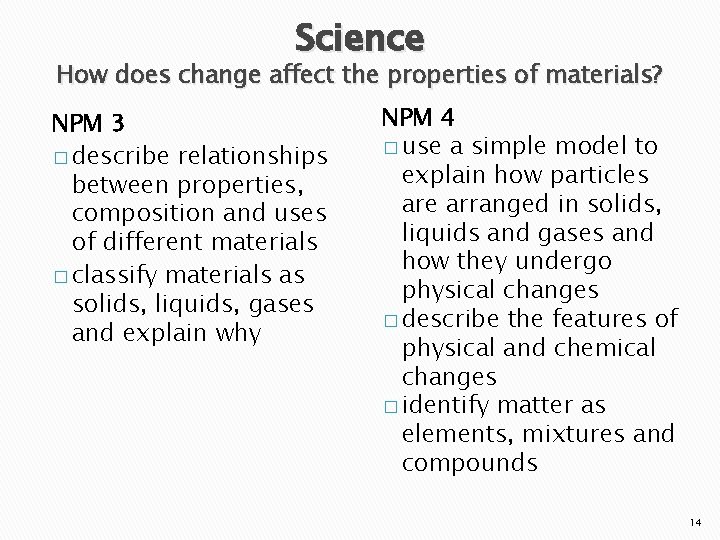
Science How does change affect the properties of materials? NPM 3 � describe relationships between properties, composition and uses of different materials � classify materials as solids, liquids, gases and explain why NPM 4 � use a simple model to explain how particles are arranged in solids, liquids and gases and how they undergo physical changes � describe the features of physical and chemical changes � identify matter as elements, mixtures and compounds 14
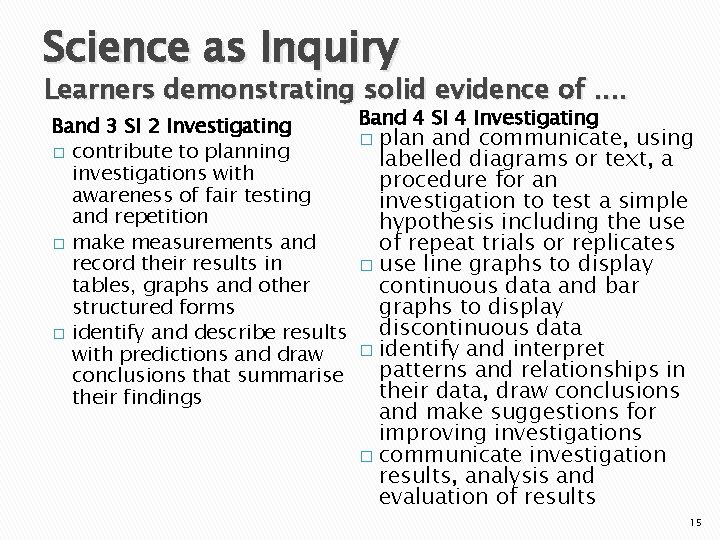
Science as Inquiry Learners demonstrating solid evidence of. . Band 4 SI 4 Investigating Band 3 SI 2 Investigating � plan and communicate, using � contribute to planning labelled diagrams or text, a investigations with procedure for an awareness of fair testing investigation to test a simple and repetition hypothesis including the use � make measurements and of repeat trials or replicates record their results in � use line graphs to display tables, graphs and other continuous data and bar structured forms graphs to display discontinuous data � identify and describe results � identify and interpret with predictions and draw patterns and relationships in conclusions that summarise their data, draw conclusions their findings and make suggestions for improving investigations � communicate investigation results, analysis and evaluation of results 15
3. �What teaching approach/ methodology or model should teachers use so that the learners can successfully engage in the learning? 16
4. �What activities/strategies do teachers need to use in their lesson planning to allow learners to access the content required and build on their language understandings in order to be successful learners and progress? 17
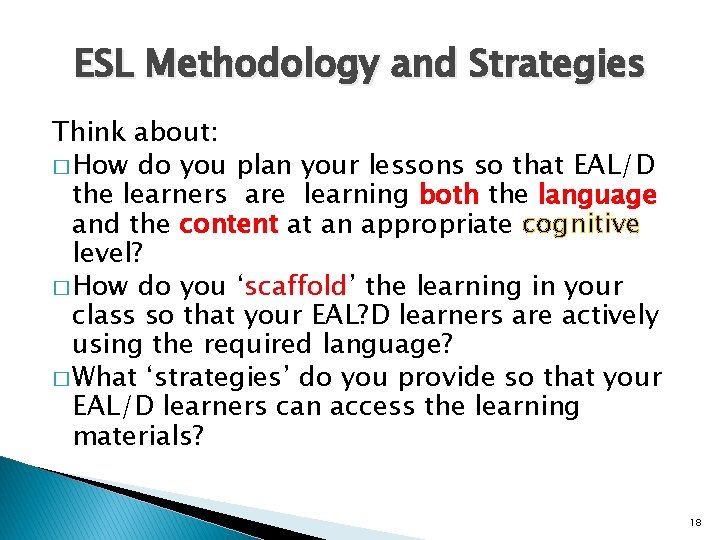
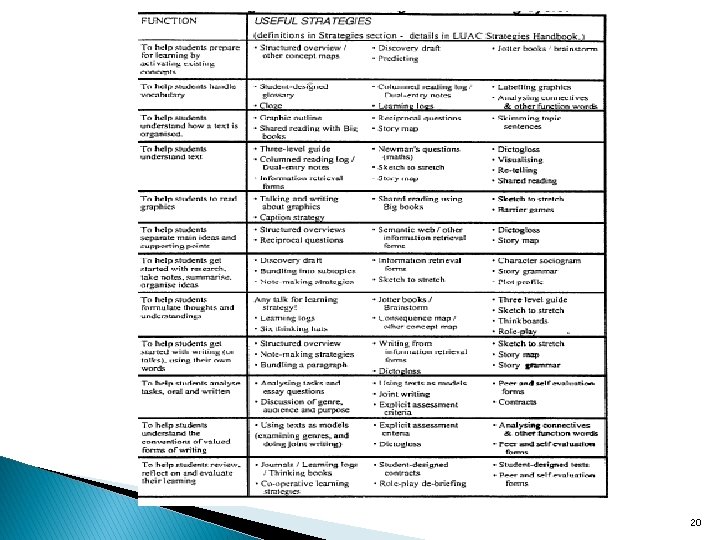
ESL Methodology and Strategies Think about: � How do you plan your lessons so that EAL/D the learners are learning both the language and the content at an appropriate cognitive level? � How do you ‘scaffold’ the learning in your class so that your EAL? D learners are actively using the required language? � What ‘strategies’ do you provide so that your EAL/D learners can access the learning materials? 18
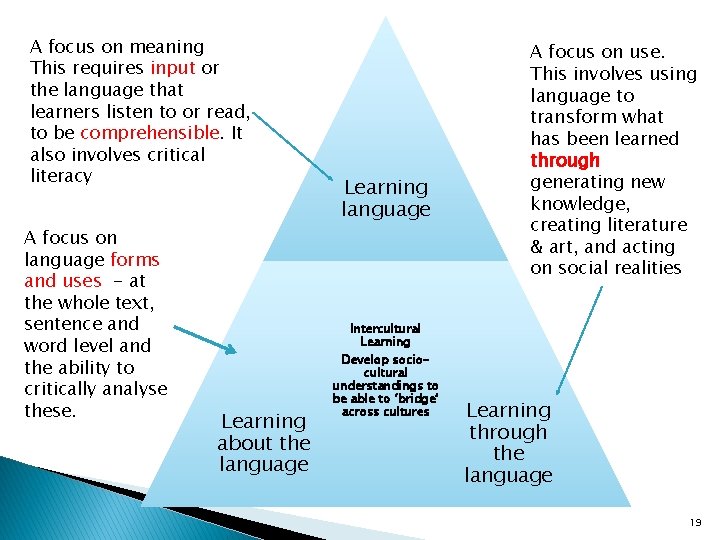
A focus on meaning This requires input or the language that learners listen to or read, to be comprehensible. It also involves critical literacy A focus on language forms and uses - at the whole text, sentence and word level and the ability to critically analyse these. Learning about the language Learning language Intercultural Learning Develop sociocultural understandings to be able to ‘bridge’ across cultures A focus on use. This involves using language to transform what has been learned through generating new knowledge, creating literature & art, and acting on social realities Learning through the language 19
20
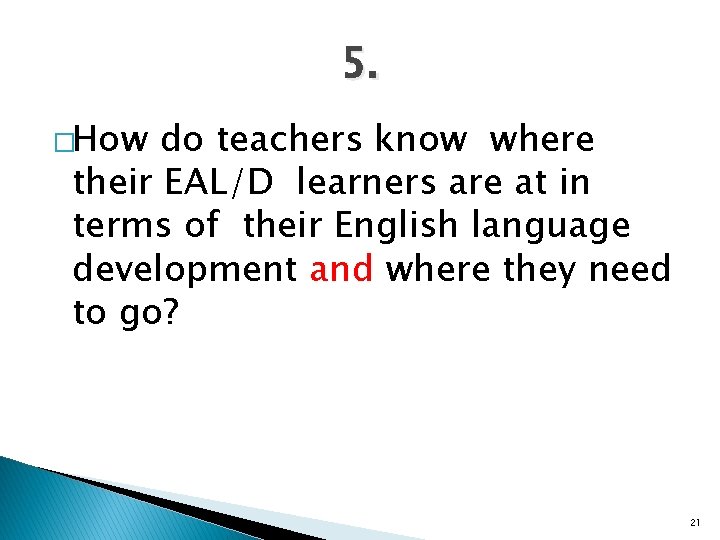
5. �How do teachers know where their EAL/D learners are at in terms of their English language development and where they need to go? 21
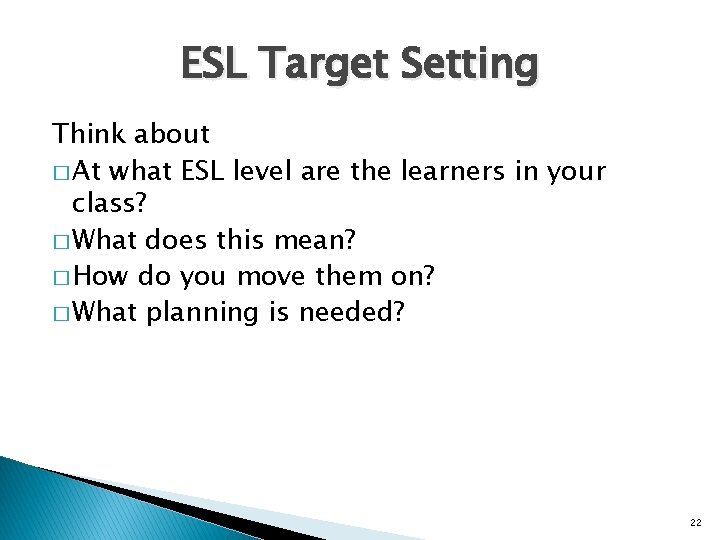
ESL Target Setting Think about � At what ESL level are the learners in your class? � What does this mean? � How do you move them on? � What planning is needed? 22
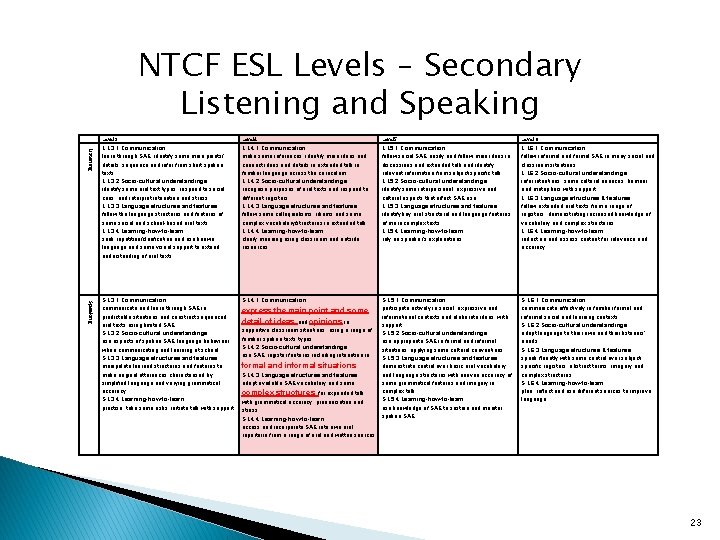
NTCF ESL Levels – Secondary Listening and Speaking Listening Speaking Level 3 Level 4 Level 5 Level 6 L L 3. 1 Communication learn through SAE, identify some main points/ details, sequence and infer from short spoken texts L L 3. 2 Socio-cultural understandings identify some oral text types, respond to social cues, and interpret intonation and stress L L 3. 3 Language structures and features follow the language structures and features of some social and school-based oral texts L L 3. 4 Learning-how-to-learn seek repetition/clarification and use known language and some visual support to extend understanding of oral texts. L L 4. 1 Communication make some inferences, identify main ideas and connect ideas and details in extended talk in familiar language across the curriculum L L 4. 2 Socio-cultural understandings recognise purposes of oral texts and respond to different registers L L 4. 3 Language structures and features follow some colloquialisms, idioms and some complex vocabulary/structures in extended talk L L 4. 4 Learning-how-to-learn clarify meaning using classroom and outside resources. L L 5. 1 Communication follow social SAE easily and follow main ideas in discussions and extended talk and identify relevant information from subject-specific talk L L 5. 2 Socio-cultural understandings identify some interpersonal, expressive and cultural aspects that affect SAE use L L 5. 3 Language structures and features identify key oral structural and language features of more complex texts L L 5. 4 Learning-how-to-learn rely on speaker's explanations. L L 6. 1 Communication follow informal and formal SAE in many social and classroom situations L L 6. 2 Socio-cultural understandings infer intentions, some cultural nuances, humour and metaphors with support L L 6. 3 Language structures & features follow extended oral texts from a range of registers, demonstrating increased knowledge of vocabulary and complex structures L L 6. 4 Learning-how-to-learn reflect on and assess content for relevance and accuracy. S L 3. 1 Communication communicate and learn through SAE in predictable situations and construct sequenced oral texts using limited SAE S L 3. 2 Socio-cultural understandings use aspects of spoken SAE language behaviour when communicating and learning at school S L 3. 3 Language structures and features manipulate learned structures and features to make original utterances, characterised by simplified language and varying grammatical accuracy S L 3. 4 Learning-how-to-learn practise, take some risks, initiate talk with support. S L 4. 1 Communication S L 5. 1 Communication participate actively in social, expressive and informational contexts and elaborate ideas, with support S L 5. 2 Socio-cultural understandings use appropriate SAE in formal and informal situations, applying some cultural conventions S L 5. 3 Language structures and features demonstrate control over basic oral vocabulary and language structures with uneven accuracy of some grammatical features and imagery in complex talk S L 5. 4 Learning-how-to-learn use knowledge of SAE to sustain and monitor spoken SAE. S L 6. 1 Communication communicate effectively in familiar formal and informal social and learning contexts S L 6. 2 Socio-cultural understandings adapt language to their own and their listeners’ needs S L 6. 3 Language structures & features speak fluently with some control over subjectspecific registers, abstract terms, imagery and complex structures S L 6. 4 Learning-how-to-learn plan, reflect and use different sources to improve language. express the main point and some detail of ideas and opinions in supportive classroom situations, using a range of familiar spoken texts types S L 4. 2 Socio-cultural understandings use SAE register features including intonation in formal and informal situations S L 4. 3 Language structures and features adapt available SAE vocabulary and some complex structures for expanded talk with grammatical accuracy, pronunciation and stress S L 4. 4 Learning-how-to-learn access and incorporate SAE into own oral repertoire from a range of oral and written sources. 23
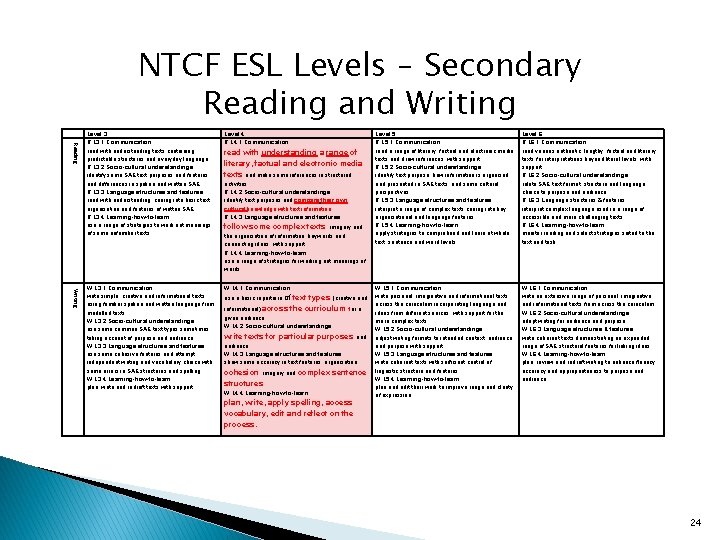
NTCF ESL Levels – Secondary Reading and Writing Reading Writing Level 3 R L 3. 1 Communication read with understanding texts containing predictable structures and everyday language R L 3. 2 Socio-cultural understandings identify some SAE text purposes and features and differences in spoken and written SAE R L 3. 3 Language structures and features read with understanding, cueing into basic text organisation and features of written SAE R L 3. 4 Learning-how-to-learn use a range of strategies to work out meanings of some unfamiliar texts. Level 4 R L 4. 1 Communication W L 3. 1 Communication write simple, creative and informational texts using familiar spoken and written language from modelled texts W L 3. 2 Socio-cultural understandings use some common SAE text types sometimes taking account of purpose and audience W L 3. 3 Language structures and features use some cohesive features and attempt independent writing and vocabulary choice with some errors in SAE structures and spelling W L 3. 4 Learning-how-to-learn plan, write and redraft texts with support. W L 4. 1 Communication read with understanding a range of literary, factual and electronic media texts and make some inferences in structured activities R L 4. 2 Socio-cultural understandings identify text purposes and compare their own cultural knowledge with text information R L 4. 3 Language structures and features follow some complex texts , imagery and the organisation of information, keywords and connecting ideas, with support R L 4. 4 Learning-how-to-learn use a range of strategies for working out meanings of words. of text types (creative and informational) across the curriculum for a use a basic repertoire given audience W L 4. 2 Socio-cultural understandings write texts for particular purposes and audience W L 4. 3 Language structures and features show some accuracy in text features, organisation, cohesion, imagery and complex sentence structures W L 4. 4 Learning-how-to-learn plan, write, apply spelling, access vocabulary, edit and reflect on the process. Level 5 R L 5. 1 Communication read a range of literary, factual and electronic media texts and draw inferences, with support R L 5. 2 Socio-cultural understandings identify text purpose, how information is organised and presented in SAE texts, and some cultural perspectives R L 5. 3 Language structures and features interpret a range of complex texts cueing into key organisational and language features R L 5. 4 Learning-how-to-learn apply strategies to comprehend and learn at whole text, sentence and word levels. Level 6 R L 6. 1 Communication read various authentic, lengthy, factual and literary texts for interpretations beyond literal levels, with support R L 6. 2 Socio-cultural understandings relate SAE text format, structure and language choice to purpose and audience R L 6. 3 Language structures & features interpret complex language used in a range of accessible and more challenging texts R L 6. 4 Learning-how-to-learn monitor reading and select strategies suited to the text and task. W L 5. 1 Communication write personal, imaginative and informational texts across the curriculum incorporating language and ideas from different sources, with support for the more complex texts W L 5. 2 Socio-cultural understandings adjust writing formats to intended context, audience and purpose with support W L 5. 3 Language structures and features write coherent texts with sufficient control of linguistic structure and features W L 5. 4 Learning-how-to-learn plan and edit their work to improve range and clarity of expression. W L 6. 1 Communication write an extensive range of personal, imaginative and informational texts from across the curriculum W L 6. 2 Socio-cultural understandings adapt writing for audience and purpose W L 6. 3 Language structures & features write coherent texts demonstrating an expanded range of SAE structural features for linking ideas W L 6. 4 Learning-how-to-learn plan, review and redraft writing to enhance fluency, accuracy and appropriateness to purpose and audience. 24
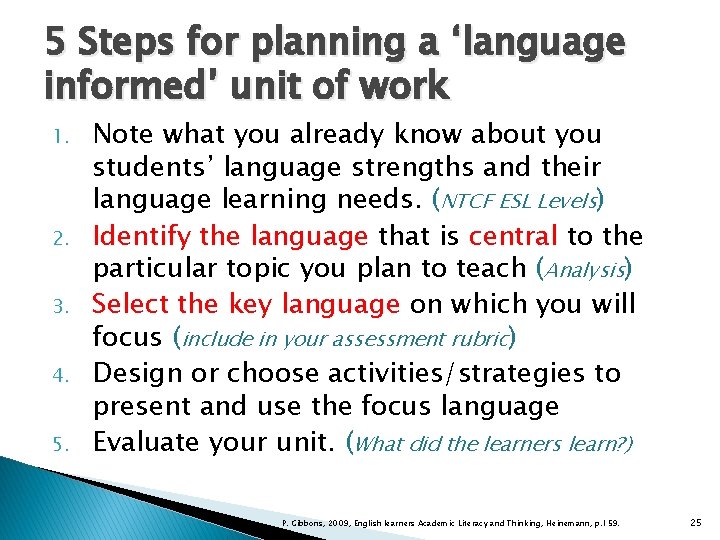
5 Steps for planning a ‘language informed’ unit of work 1. 2. 3. 4. 5. Note what you already know about you students’ language strengths and their language learning needs. (NTCF ESL Levels) Identify the language that is central to the particular topic you plan to teach (Analysis) Select the key language on which you will focus (include in your assessment rubric) Design or choose activities/strategies to present and use the focus language Evaluate your unit. (What did the learners learn? ) P. Gibbons, 2009, English learners Academic Literacy and Thinking, Heinemann, p. 159. 25
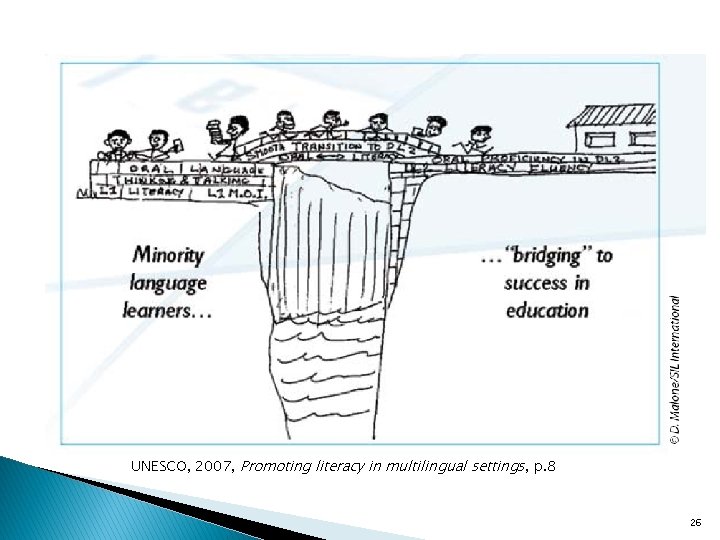
UNESCO, 2007, Promoting literacy in multilingual settings, p. 8 26
Where can I get more information? NALDIC � � � http: //www. naldic. org. uk/docs/resources/documents/06102002 Science. pdf http: //www. naldic. org. uk/docs/resources/documents/ma_eal. pdf LUAC Materials � http: //www. det. act. gov. au/teaching_and_learning/literacy_and_num eracy/language_for_understanding_across_the_curriculum_luac NSW � � http: //www. boardofstudies. nsw. edu. au/syllabus_hsc/pdf_doc/acade mic-english-support-2009 -2012. pdf http: //www. schools. nsw. edu. au/learning/yrk 12 focusareas/esleducat ion/clresources. php 27
Contacts Colleen Combe Consultant TML Program PH: 8999 3746 colleen. combe@nt. gov. au 28